

Saved Bookmarks
This section includes 7 InterviewSolutions, each offering curated multiple-choice questions to sharpen your Current Affairs knowledge and support exam preparation. Choose a topic below to get started.
| 1. |
Assign reasons for the following: (i) Copper(I) ion is not known in aqueous solution. (ii) Actinoids exhibit greater range of oxidation states than lanthanoids. |
|
Answer» SOLUTION :(i) Copper(I) ion does not have a sufficiently negative value of enthalpy of hydrogen. And Cu(I) ion DISPROPORTIONATES in aqueous solution as `2Cu^(+)toCu^(2+)+Cu` (ii) DUE to comparable ENERGIES of 5f, 6d and 7s sub-shells, all the electrons PRESENT in these sub-shells participate in bonding, resulting in large number of oxidation states for actinoids. |
|
| 2. |
Assign reasons for the following: (i) Copper (I) ion is not known in aqueous solution. (ii) Actinoids exhibit greater range of oxidation states than lanthanoids. |
|
Answer» Solution :(i) Because COPPER (I) ion is unstable in aqueous solution and undergoes, disproportionation. (II) Because of very small gap between `5f, 6D and 7s` orbitals in actinoids. |
|
| 3. |
Assign reasons for each of the following: (i) Transition metals generally form coloured compounds. (ii) Manganese exhibits the highest oxidation state of +7 among the 3d-series of transition elements. |
|
Answer» Solution :(i) Transition ELEMENTS generally form coloured compounds on account of d-d TRANSITIONS. Due to partial absorption of VISIBLE light (ii) Mn shows the HIGHEST oxidation state +7. The bonds in such a higher oxidation state are formed by sharing electrons not by the loss of electrons.e.g., Mn shows + 7 oxidation state in `MnO_4^(-)` in which all the bonds are covalent. |
|
| 4. |
Assign reasons for each of the following : (i) Transiti9n metals generally form coloured compounds. (ii) Manganese exhibits the highest oxidation state of+ 7 among the 3d series of transition elements. |
|
Answer» Solution :(i) Transition METALS generally form coloured compounds. Because the energy of excitation of an ELECTRON ind-orbital CORRESPONDS to the visible region. (ii) Manganese exhibits the highest oxidation state of + 7 AMONG the 3d series of transition, elements because all the oxidation states from + 2 to+ 7. Electronic configuration of `M_n`. `[Ar]3d^5S^2M_n^(2+):1S^2,2S^2,2P^6 3P^6 3d^5`. It shows largest no, of oxidation states as it have maximum no. of UNPAIRED electrons. |
|
| 5. |
Assign reasons for each of the following : (i) Manganese exhibits the highest oxidation state of +7 . (ii) UnlikeCr^(3+), Mn^(2+), Fe^93+) and the subseuent M^(3+)ions of 3d series of elements , the 4d an 5d series metals generally do not form stable cationic species. |
|
Answer» Solution :(i) Electronic configuration of `._(25)Mn` is `3d^(5) 4s^(2)` . As all the 7 electrons of 3d and 4s can participate in bonding , it exhibits highest oxidationstate of `+7` (ii) In the 4d and 5D series higher oxidation states are more stable ( because DIFFERENCE of energy between 4d and 5s or 5d and 6s is SMALLER than between 3d and 4s). In the higher oxidation states, bonds formed are mostly covalent .Hence they do not form cationic species. |
|
| 6. |
Assign reasons for the following : (i) The enthalpies of atomisation of transition elements are high. (ii) The transition metals and many of their compounds act as good catalyst.(iii) From element to element the actinoid contraction is greater than the lanthanoid contraction.(iv) The E^(@) value for the Mn^(3+)//Mn^(2+) couple is much more positive than that for Cr^(3+)//Cr^(2+).(v) Scandium (Z = 21) does not exhibit variable oxidation states and yet it is regarded as transition element. |
|
Answer» |
|
| 7. |
Assign reason for the following: The negative value of electron gain enthalpy of fluorine is less than that of chlorine. |
| Answer» Solution :A fluorine ATOM being SMALLEST in SIZE cannot accept electrons easily to change into FLUORIDE ion, because of interelectronic repulsions. Therefore, negative value of electron gain enthalpy (electron affinity) of fluorine is LESS than that of chlorine. | |
| 8. |
Assign reason for the following: Sulphur vapour is paramagnetic. |
| Answer» SOLUTION :SULPHUR is in the diatomic state `(S_2)` in vapour phase. Electronic configuration of S is : `3S^(2) 3p_x^(2) 3p_y^(1) 3p_z^(1)`.There are TWO unpaired electrons in antibonding `pi` orbitals. That is why sulphur in vapour phase is paramagnetic. | |
| 9. |
Assign reason for the following: SF_6 is much less reactive than SF_4. |
| Answer» Solution :`SF_6` is a SYMMETRICAL molecule and HENCE stable. `SF_4` on the other hand, is unstable due to the o PRESENCE of one lone pair of electrons and see-saw geometry. Also all the bond angles in the 6 molecule are not equal. | |
| 10. |
Assign reason for the following: of the noble gas, only xenon is known to form well-established chemical compounds. |
| Answer» SOLUTION :XENON being bigger in SIZE has smaller IONISATION enthalpy. Electrons being comparatively LOOSELY attached to the nucleus participate in bonding with other elements. | |
| 11. |
Assign reason for the following: In solid state, PCl_5 behaves as an ionic species. |
| Answer» SOLUTION :In the solid state, it EXISTS as`[PCl_4]^(+) [PCl_6]^(-)`. That is why it BEHAVES as an ionic SPECIES. | |
| 12. |
Assign reason for the following : (i) Sulphur in vapour state exhibits paramagnetism. (ii) H_(2)O is less acidic than H_(2)Te. (iii) In spite of having same electronegativity, oxygen forms hydrogen bond while chlorine does not. |
| Answer» SOLUTION :DUE to BIGGER SIZE of CL. | |
| 13. |
Assign reason for the following: In solid state, PCI_5 , behaves as an ionic species. |
| Answer» Solution :In the SOLID state, `PCl_3`exists as `[PCl_4]+ [PCl_6]`. That is why it BEHAVES as an IONIC SPECIES. | |
| 14. |
Assign reason for the following : (i) phosphorous doped silicon is a semiconductor. (ii) Schottky defect lowers the density of a solid. |
|
Answer» Solution :(i) It is because its CONDUCTANCE is intermediate between conductor and insulator. (ii) In Schottky defect, both cations and ANIONS are missing which LEADS to LOWERING the density of a solid. |
|
| 15. |
Assign reason for the following Copper (i) ion is not known in aqueous solutions. |
|
Answer» SOLUTION :Assign reason for the FOLLOWING: Copper (I) ion is not known in aqueous solutions. `2Cu^(+) rarr Cu^(2+) + 2 Cu` The GREATER stability of `Cu^(2+)` ion as compared to `Cu^+` is due to the much more negative `Delta_(hydH)` of`Cu^(2+)`than `Cu_((aq))^(+)`which mor than compensates for the SECOND ionization enthalpy of Cu. |
|
| 16. |
Assign reasons for the following : (i) Copper (I) ion is not known in aqueous solution. (ii) Actinoids exhibit greater range of oxidation states than lanthanoids. |
|
Answer» Solution :Assign REASON for the FOLLOWING: Copper (I) ION is not known in aqueous solutions. `2Cu^(+) rarr Cu^(2+) + 2 Cu` The greater stability of `Cu^(2+)` ion as compared to `Cu^+` is due to the much more negative `Delta_(hydH)` of`Cu^(2+)`than `Cu_((aq))^(+)`which mor than compensates for the second IONIZATION enthalpy of Cu. |
|
| 17. |
Assign reason for the following: (a) Noble gases are mostly inert (b) Bismuth is a strong oxidising agent in pentavalent state. |
|
Answer» Solution :(a) It is DUE to stable electronic configuration and high ionisation POTENTIAL of noble gases. (b) Bi(+3) is more stable than Bi(+5) due to INERT pair effect. That is why Bi(+5) gains two electrons to form Bi(+3) and acts as an oxidising agent `Bi^(5+) + 2e^(-) to Bi^(3+)` |
|
| 18. |
Assign reason for the following: Ammonia (NH_3) has greater affinity for protons than phosphine (PH_3). |
| Answer» Solution :Both the molecules have pyramidal shape and both have LONE pair of ELECTRONS on N and P. NITROGEN being smaller in size, ELECTRON DENSITY is more on nitrogen in ammonia than that on P in phosphine. That is why ammonia has greater affinity for protons than phosphine. | |
| 19. |
Assign reason for each of the following statements : (i) The largest number of oxidation states are exhibited by the elements in the middle of the first row transitoin elements. (ii) The atomic radii decrease in size with the increasiing atomic number in the lanthanoid series. |
|
Answer» SOLUTION :(i) The maximum number of oxidation STATES are shown by that element in a TRANSITION series which has maximum number of unpairedelectrons. This is so in the middle of the series. (ii) Refer to PASE ( cause of lanthanoid contraction) |
|
| 20. |
Assign reasns for the following (i)Sulphur vapour is paramagnetic, (ii) Ammonia (NH_(3)) has greater affinity for protons than phosphine (PH_(3)). (iii) The negative value of electron gain enthalphy of fluorine is less than that of chlorne. (iv) SF_(6) is much lessreactive than SF_(4). (v) Of the gases only xenon is know the form well-established chemical compounds |
|
Answer» Solution :(i)In vapour STATE sulphur partly as `S_(2)` molecule which has two unpaired electrons in the antibonding `pi^(**)` orbtitals like ` O_(2)` and hence it exhibits parmagnetism (iii) When `NH_(3) or PH_(3)` accepts a proton, and addtional N-H or P-H bond is formed `H_(3)N:+H^(+)rarrNH_(4)^(+) and H_(3):+H^(+)rarrPH_(4)^(+)` Due to the bigger size of P than, N, thanP-H bond is weaker .As a result `PH_(3)` has less tendency than `NH_(3)` to accept a proton. Therefore,`NH_(3)`, has higher proton affinity than`PH_(3)` (iii) The electron GAIN enthalphy of flurin is less negative than that of chlorine due to that there is strong repulsion of electrons (iv)In `SF_(6)` sex F atom protect the sulphur atom from attack by the reagent to such adn extent tht enven thermodynamicallymsot favourable reaction like hydrolysis do not occur. Nut in `SF_(4)`,is not sterically protected sicne ist is surrounded by only FOUR F atoms, hence `SF_(4)`, undergoes hydrolysis (v) Exepct radon which is radioactive Xe has least IONISATION energy among noble GASSES and hence it is readity forms chemical compounds particularly with oxygen and flurine. |
|
| 21. |
Assign R or S configuration to each of the following compounds. (a) H-underset(CH_(2)OH)underset(|)overset(CHO)overset(|)(C )-OH (b) Br-underset(H)underset(|)overset(Cl)overset(|)(C )-COOH |
|
Answer» SOLUTION :(a) ORDER of PRIORITY is `-Ohgt-CHOgt-CH_(2)Ohgt-H`.  (B) Order of priority is `-Brgt-Clgt-COOHgt-H` 
|
|
| 22. |
Assign Chan-Ingold Prelog priorities to the following sets of substituents: (a) -H,-Br,-CH_(2)CH_(3),-CH_(2)CH_(2)OH (b) -COOH,-COOCH_(3),-CH_(2)OH,-OH (c) -CH,-CH_(2)NH_(2),-CH_(2)NHCH_(3),-NH_(2) (d) -Br,-CH_(2)Br,-Cl,-CH_(3)Cl. |
|
Answer» Solution :(a) `-Brgt-CH_(2)CH_(2)Ohgt-CH_(2)CH_(3)gt-H` (b) `-Ohgt-COOCH_(3)gt-COOHgt-CH_(2)OH` (c) `-NH_(2)gt-CNgt-CH_(2)NH CH_(3)gt-CH_(2NH_(2)` (d) `-Brgt-Clgt-CH_(2)Brgt-CH_(2)Cl` |
|
| 23. |
Assign appropriate reasons for each of the following statements. (i)More metal fluorides are ionic in nature than metal chlorides. (ii) Hydrogen fluoride is a weaker acid than hydrogen chloride in aqueous solution. (iii)In aqueous solution HI is a stronger acid than HCI ? (iv) Addition of Cl_(2) to KI solution gives it a brown colour but excess of Cl_(2) turns it colourless. (v) Perchloric acid is a stronger acid than sulphuric acid. |
|
Answer» (ii)Because of smaller size of `F` as compared to `Cl`, the bond dissociation energy of `H-F` bond is MUCH higher than that of `H-CI` bond.As a result, in aqueous solution, `H-Cl`, the bond can break more easily to form `H^(+)` ion than `H-F` bond.Thus, hydrogen fluoride is a weaker acid than hydrogen chloride in aqueous solution. (iii)Due to smaller size of `Cl` as compared to `l`, bond dissociation energy of `H-Cl` bond is much higher than that of `H-l` bond.As a result, in aqueous solution `H-i` bond breaks more easily to release `H^(+)` ion than `H-Cl` bond.Thus, `Hl` is a stronger acid than `HCl` in aqueous solution. (iv)`Cl_(2)` being a stronger oxidising agent than `l_(2)`, first oxidises `Kl` to give `l_(2)` which imparts brown colour to the solution. `2Kl (aq)+ Cl_(2) (g)to2 KCl (aq) + underset("Brown")(l_(2) (s))` If, however, `Cl_(2)` is passed in excess, the `l_(2)` thus formed gets further oxidized to iodic acid `(HIO_(3))` which is colourless. `5 Cl_(2) + l_(2) + 6 H_(2)Oto10 HCl +2 underset("Colourless")(HIO_(3))` (v)The oxidation state of `Cl` in PERCHLORIC acid is `+7` while that of `S` in sulphuric acid is `+6` `(##RES_INO_CHM_XII_V02_C03_E01_020_A01##)` Due to higher oxidation state and higher electronegativity of `CI, CIO_(3)` part of `HCIO_(4)` pullls the electrons of the `O-H` bond more strongly and hence can break the `O-H` bond more easily to liberate a proton than `SO_(2)` part in `H_(2)SO_(4)`.Thus, perchloric acid is stronger acid than sulphuric acid. |
|
| 24. |
Assign an appropriate reason for the following:More metal fluorides are ionic in nature than metal chlorides. |
| Answer» SOLUTION :Electronegativity difference between metal and fluorine is more than that between metal and chlorine. Therefore metal FLUORIDES are more ionic in NATURE. | |
| 25. |
Assign an appropriate reason for the following:SCI_6 is not known but SF_6 is known. |
| Answer» SOLUTION :CHLORINE atom is much bigger in size than fluorine atom. It is not possible to ACCOMMODATE SIX chlorine atoms around S in `SCI_6` whereas six fluorine atoms can be accommodated around S. | |
| 26. |
Assign alkanamines names to the following: N,N-dimethylcycloheptylamine |
| Answer» SOLUTION :N,N-dimethylcycloheptanamine | |
| 27. |
Assign alkanamines names to the following: N-methylethylamine |
| Answer» SOLUTION :N-methylethanamine | |
| 28. |
Assign a reason for the following:Sulphur hexafluoride is used as a gaseous electrical insulator. |
| Answer» Solution :In `SF_6` MOLECULE there are no UNPAIRED ELECTRONS. HENCE, it acts as a gaseous ELECTRICAL insulator. | |
| 29. |
Assign a reason for the following statements : SF_6 is not easily hydrolysed. |
| Answer» Solution :There are no VACANT d-orbitals in the MOLECULE of `SF_6` to accommodate LONE pairs of water molecules. Hence, it is not hydrolysed. | |
| 30. |
Assign a reason for the following statements : Perchloric acid is a stronger acid than sulphuric acid. |
| Answer» SOLUTION :Greater the electronegativity and higher the oxidation state of the central atom greater is the acid strength. In `HClO_4` .Cl. is more ELECTRONEGATIVE than .S. in `H_2SO_4`. Secondly, CI shows +7 oxidation state whereas .S. is in +6 oxidation state. HENCE, perchloric acid is STRONGER than sulphuric acid | |
| 31. |
Assign a reason for the following statements :Of all the noble gases only xenon is known to form established chemical compounds. |
| Answer» Solution : XE has LARGER size and high polarisability. It has a comparatively MUCH smaller ionisation ENTHALPY. | |
| 32. |
Assign a reason for the following statements : Hydrogen fluoride has a much higher boiling point than hydrogen chloride. |
|
Answer» SOLUTION :HF is associated with intermolecular H-bonding WHEREAS HCL is not. Association of molecules raises the BOILING POINT |
|
| 33. |
Assign a reason for the following statements: Alkylamines are stronger bases than arylamines. (b) How would you convert methylamine into ethylamine? |
|
Answer» Solution :(a) Itis because in ARYLAMINES the `NH_(2)` group is attached directly to benzene ring. It results in the unshared electron pair on nitrogen atom to be in conjugation with the benzen ring and tyhus making it less available for protonation whereas alkyl group are electron releasing group. (b) `underset("Methylamine")(CH_(3)NH_(2))+HNO_(2) to cH_(3)OH OVERSET(PCl_(5))(to) CH_(3)CL overset(KCN)(to) CH_(3)C-=N underset (4[H])overset(Na//C_(2)H_(5)OH)(to) underset("Ethylamine")(CH_(3)CH_(2)NH_(2))` |
|
| 34. |
Assign a reason forthe following statements :Hydrogen fluoride is a weaker acid than hydrogen chloride in aqueous solution. |
| Answer» Solution :It is because HF has higher bond ENERGY than HCL which is due to smaller bond LENGTH. | |
| 35. |
Assign a reason forthe following statements :All the bonds in a molecule of PCl_5 are not equal. |
| Answer» SOLUTION :It is because all the bonds are not in same PLANE. Axial bonds are longer than equatorial bonds due to GREATER REPULSION between the former. | |
| 36. |
Assign a reason forthe following:In Group 15, the bond angle H-M-H decreases in the following order NH_3(107.8^(@)), PH_3(93.6^@),AsH_3(91.8^(@)) |
| Answer» SOLUTION :Due to increase in size of Group 15 elements as BOND length increases the bond pair-bond pair repulsion decreases. Therefore, the angle H-M-H decreases from `NH_3` to `PH_3` to `AsH_3`. | |
| 37. |
Assign a reason for each of the following statements : (i) Ammonia is a stronger base than phosphine. (ii) Sulphur in vapour state exhibits a paramagnetic behaviour. |
|
Answer» Solution :(i) Due to the PRESENCE of lone pair of electrons on the CENTRAL atom both `NH_(3)` and `PH_(3)` are Lewis Bases. When `NH_(3)` or `PH_(3)` accepts a proton, an additional N-H or P-H bond is formed. `H_(3)N : + H^(+) rarrNH_(4)^(+), H_(3)P : + H^(+) rarrPH_(4)^(+)` Due to smaller size of N than P, N-H bondthus formed is much stronger than P-H bond. As a result `NH_(3)` has more tendency than `PH_(3)` to accept a proton. Therefore, `NH_(3)` is stronger base than `PH_(3)`. (ii) In vapour state sulphur partly exists as `S_(2)` molecule which has two UNPAIRED electrons is the artibonding `pi**` ORBITALS like `O_(2)` and hence, exhibits paramagnetism. |
|
| 38. |
Assiertion :When a concerntrated solution deluted bu adding more water, molarity of the solution remains unchanged. ltbtgt Reason : Products of moes of a solute and volume is equal to molarity. |
|
Answer» If both ASSERTION are REASON are correct and reason is correct explanation for assertion. Corret Reason : Correct Reason : Molarity of a solution (M) =Moles of solute/Volume of solution in LITRES |
|
| 39. |
Assign a reason for each of the following: (i) Ammonia is a stronger base than phosphine. (ii) Sulphur in vapour state exhibits a paramagnetic behaviour. |
|
Answer» Solution :(i) Both ammonia and PHOSPHINE have pyramidal STRUCTURE and both have a lone pair of electrons on N and P. Nitrogen being smaller than phosphorus, electron density of the lone pair on N in `NH_3` is more. Therefore, ammonia is a STRONGER base than phosphine. (ii) Sulphur in the VAPOUR phase exists as `S_2`. S has electronic configuration : 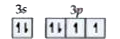 Due to presence of two UNPAIRED electrons in antibonding p* orbitals, it is paramagnetic. |
|
| 40. |
Assign a reason for each of the following statements : (i) Ammonia is a stronger bass than pjhosphine. (ii) Sulpher in vapour state exhibits a paramagnetic behaviour : |
|
Answer» Solution :(i) Both `NH_(3)` and `PH_(3)` have a lone pair of electrons on the central atom. Hence, they act as Lewis bases. When `NH_(3)`or `PH_(3)` accepts a proton to form`NH_(4)^(+)PH_(4)^(+)`, an additional `N-H` or `P-H` bond is formed. `H_(3)N : +H^(-) to NH_(4)^(+)` `H_(3)P : +H^(-) to PH_(4)^(+)` Now, because of the smaller size and the unavailability of d-ORBITALS in N, the lone pair on N is less delocalised than the lone pair present on P. Thus the N-H bond is much stronger than the `P-H` bond. As a result, the ability of `NH_(3)` to accept a proton is much more than that of `PH_(3)`. Therefore, `NH_(3)` is a stronger base than `PH_(3)`. (ii) In vapour state, sulphur exists as `S_(2)` molecule.`S_(2)` molecule, like`O_(2)`, has TWO UNPAIRED electrons in the anti-bonding `n*`orbitals. Hence, like `O_(2)`,it exhibits paramagnetism. |
|
| 41. |
Assiertion : The vapour pressure of a luquid decreses if some non-volatile solute is dissolved in it. Reason : The relative lowering of a solution containing a non-volatile solute is equil to the mole fraction of the solute in the solution. |
|
Answer» If both ASSERTION are REASON are correct and reason is correct explanation for assertion. |
|
| 42. |
Assiertion : The molecular mass of acetic acid was determined by depression in benzene and was found to be different than in water. Reason : Water is polar and benzene in non-polar. |
|
Answer» If both ASSERTION are REASON are CORRECT and reason is correct EXPLANATION for assertion. |
|
| 43. |
Statement -The boiling point of 0.1 M urea solution is less than that if 0.1M KCl solution.Explanation -Elevation of boiling point is directly proportional to the number of species present in the solution. |
|
Answer» If both ASSERTION are REASON are CORRECT and reason is correct EXPLANATION for assertion. |
|
| 44. |
Assiertion : Solubility of gases in liquids increases with increase in pressure. Reason : Dissolution of gas in a liquid is exothermic in nature. |
|
Answer» If both ASSERTION are REASON are correct and reason is correct explanation for assertion. |
|
| 45. |
Assertion : The solubility of a gas in a liquid increases with increase of pressure. Reason : The solubility of a gas in a liquid is directly proportional to the pressure of the gas. |
|
Answer» If both ASSERTION are REASON are CORRECT and reason is correct EXPLANATION for assertion. |
|
| 46. |
Assertion:Molecular mass of KCl calculated on the basis of colligative properties will be lower than the normal molecular mass. Reason : Experimentally determined molar mass of always lower than the true value . |
|
Answer» If both assertion are reason are CORRECT and reason is correct explanation for assertion. |
|
| 47. |
Assiertion : Addition of ethyl alchol lowers the freezing point of water. Reason : Impurities always lower the freezing point of a point of a sovent. |
|
Answer» If both ASSERTION are REASON are CORRECT and reason is correct EXPLANATION for assertion. |
|
| 48. |
Assiertion : If red blood cells were removed form the body and placed in pure water, the pressure inside the cells increases. Reason : The concentration of the salt contant in the cells increases. |
|
Answer» If both assertion are reason are correct and reason is correct explanation for assertion. |
|
| 49. |
Assiertion : An ideal solution obeys Raoult's Law. Reason : In and ideal solution, solute-solute as well as solvent-solvent interations are similar to solute-solvent interations. |
|
Answer» If both ASSERTION are REASON are CORRECT and reason is correct EXPLANATION for assertion. |
|
| 50. |
Assertion: Aquatic species are more comfortable in warm waters than cold waters . Reason: K_H values for both N_2 and O_2 decrease with increase of temperature |
|
Answer» If both assertion are reason are correct and reason is correct explanation for assertion. Correct Assertion : `K_(H)"VALUE of both "N_(2)"and"O_(2)` increase with RISE in temprature. |
|