

Saved Bookmarks
This section includes 7 InterviewSolutions, each offering curated multiple-choice questions to sharpen your Current Affairs knowledge and support exam preparation. Choose a topic below to get started.
| 1. |
Approximate relationship between dissociation constant of water (K) and ionic product of water (K_(w)) is |
|
Answer» `K_(W) = K` `H_(2)O hArr H^(+) + OH^(-)` `K = ([H^(+)][OH^(-)])/([H_(2)O]) = (10^(-4))/(55.6)` `K_(w) = 1 xx 10^(-14)` So, `K_(w) = 55.6 xx K`. |
|
| 2. |
Approximate PH of 0.10 M aqueous H_2S solution having K_1 and K_2 for H_2S at 25^@C are 10^(-7) and 10^(-13) respectively is : |
|
Answer» 4 |
|
| 3. |
Approximate atomic mass of an element is 26.89. if its equivalent mass is 8.9. th exact mass of the element is: |
|
Answer» 29.89 |
|
| 4. |
appropriately matching the information given in the three columns of the following table. Which of the following combination gives correct information. |
| Answer» Answer :A::C | |
| 5. |
appropriately matching the information given in the three columns of the following table. The correct combination that represents diastereomers with their correct properties. |
|
Answer» <P>(I) (i) Q |
|
| 6. |
appropriately matching the information given in the three columns of the following table. The correct combination that represents enantiomers with their correct properties. |
| Answer» Answer :C | |
| 7. |
Appropriate reducing agent for the following conversion is - CH_(2)=CH-CH_(2)-overset(O)overset(||)C-H rarr CH_(3)-CH_(@)-CH_(2)-CH_(2)OH |
|
Answer» `LiAlH_(4)//H_(2)O` |
|
| 8. |
Applying Freundlich adsorptin isotherm, calculate the amount of acetic acid adsorbed by 1 kg of blood charcoal at 25^(@)C from a 5% vinegar solution (mass/volume). Given that if the concentration is expressed in molarity (mol dm^(-3)), x/m is mass of the solute adsorbed per gram of adsorbent, then k=0.160and n=2.32. |
|
Answer» Solution :According to Freundlich adsorption isotherm, `x/m=k C^(1//n)""…(i)` `5%` vingar (acetic acid solution) means 5 G of acetic acid are present in 100 mL of the solution Molar mass of acetic acid `(CH_(3)COOH)=60 g mol^(-1)""therefore 5g` of acetic acid `=5/60` mol `therefore` 1000 mL of the solution will contain acetic acid `=5/60xx1/100xx1000=0.837` mol i.e., CONCENTRATION of the solution `(C ) =0.837 mol L ` Substtutin the values in eqn. (i), we GET `x/m=0.160xx(0.837)^(1//2.32)` `therefore log ""(x)/(m)=log(0.160)+(1)/(2.32)log (0.837)=-0.7959+0.435(-0.0773)=-0.8295=bar1.1750` `therefore x/m=` Antilog `(bar1.1750)=0.1481g (g CHARCOAL)""^(-1)` `therefore` Amount adsorbed by 1 kg (1000 g) of charcoal `=148.1g.` |
|
| 9. |
Applying Aufbau principle, write down the electronic configuration of Sc (Z = 21) and Zn (Z = 30). |
|
Answer» Solution :(1) According to Aufbau principle, the electron first fills the 4s orbital before 3d orbital. (i) `Sc (Z = 21) 1S^(2) 2s^(2) 2p^(6) 3S^(2) 3P^(6) 4s^(2) 3d^(1)` (i) `ZN (Z = 30) 1s^(2) 2s^(2) 2p^(6) 3s^(2) 3p^(6) 4s^(2) 3d^(10)` |
|
| 10. |
Apply VSEPR theory to deduce the structures of XeF_4 and XeF_6 |
|
Answer» Solution : `XeF_4` has square PLANAR structure due to the presence of FOUR bonded pairs of ELECTRONS and two lone pairs of electrons. `XeF_6` has distorted OCTAHEDRAL structure due to the presence of one lone pair of electrons and six bonded pairs of electrons. |
|
| 11. |
Apply Kohlraush's law and determine the limiting molar conductivity of BaCl_(2) |
| Answer» SOLUTION :`wedge_(m)^(0)BaCl_(2)=lambda_(Ba^(2+))^(0)+2lambda_(cl^(-))^(0)` | |
| 12. |
Apply Kohlraush's law and determine the limiting molar conductivity of Al_(2)(SO_(4))_(3) |
| Answer» SOLUTION :`wedge_(m)^(0)Al_(2)(SO_(4))_(3)=2lambda_(AL^(3+))^(0)+3lambda_(SO_(4)^(2-))^(0)` | |
| 13. |
Application of Faraday's laws: An acidic solution of Cu^(2+) salt containing 0.4 g of Cu^(2+) is electroysed until all the copper is deposited. The electrolysis is futher continueed for seven more minutes with the volume of the solution kept at 100mL and the current at 1.0 amp. Calculate the volumes of gases evolved at NTP during the entire electrolysis. Strategy: Since we do not know which Cu^(2+) salt is electrolysed, we can say that (in the first stage of electrolysis)Cu^(2+) is reduced at the cathode to deposit Cu while H_(2)O is oxidized to liberate O_(g) at the anode. In the second stage of electrolysis, only water gets oxidized to librate O_(g) as well as reduced to librate H_(2)g |
|
Answer» Solution :First stage of electrolysis: Anode (oxide): `2H_(2)O(l) rarr O_(2)(g)+4H^(+)(aq.)+4e^(-)` Cathode (red): `Cu^(2+)+2e^(-) rarr Cu` According to Faraday's laws Equivalents of `O_(2)` liberated = Euivalents of `Cu` deposited `= (0.4 g)/(31.8 g eq^(-1))` `{("Equivalent mass of an element"={("Atomic mass of element")/("VALENCY of element")}),(or),("Equivalent mass of metal"),(={("Atomic mass of metal")/("No of"e^(-)s " required to reduce the cation")}):}}` Since `1` equivalent of `O_(2)(g)` is `8 g (1//4 mol)`, the volume occupied by `1` equivalent of `O_(2)(g)` at `NTP` is `5.6 L`. Hence Volume of `O_(2)` (at `NTP`) liberated `= ((0.4)/(31.8)eq.) (5.6 L eq^(-1))` `= 0.07044 L` `= 70.44 mL` Second stage of Electrolysis: Anode (oxide): `2H_(2)O(l) rarr O_(2)(g)+4H^(+)(aq.)+4e^(-)` Cathode (red): `2H_(2)O(l)+2e^(-) rarr H_(2)(g)+2OH^(-)(aq.)` According to Equation (3.34) `(m)/(E = (q)/(F) = (It)/(F)` THUS, EQS. Of `H_(2)(g)` liberated at cathode `=` Eqs. of `O_(2)(g)` liberatedet anode `=` Eqs. of ELECTRICITY passed `= ((1.2A)(7 xx 60 SEC))/(96,500 C eq^(-))` `(504)/(96,500)` Volume of `H_(2)(g)` evolved at `NTP` `= ((504)/(96,500)eq) (11.2 L eq^(-)) = 0.058492` `= 58.49 mL` Note that, `1` eq of `H_(2)` which is `1 g` (`1//2` mol), occupied `11.2 L` at `NTP` . Volume at `O_(2)(g)` evolved at `NTP` `((504)/(96,500)eq) (5.6 L eq^(-1))` ` 0.02924 L` `= 29.24 mL` Thus, during the entire process of electrolysis, Vol. of `H_(2)(g) = 58.49 mL` Vol. of `O_(2)(g) = (70.44 + 29.24)mL` `= 99.68 mL` |
|
| 14. |
(a)Pickles have a long shelf life and do not get spoiled for months, why ? (b)Name an artificial sweetener which is derviative of sucrose. (c )Sodium salts of some acids are very useful as food preservatives. Suggest a few such acids. |
| Answer» Solution :Plenty of salt and cover of oil act as PRESERVATIVES. These do not allow moisture and AIR to enter the MATERIAL and hence BACTERIA cannot thrive on them. Therefore, PICKLES do not get spoiled for months together. | |
| 15. |
(a)Oxide ore-Froth floatation process (b)Sulphide ore-Gravity separation process(c )Gold ore-Leaching method (d)Oxides ore-Magnetic separation |
| Answer» SOLUTION :( C)GOLD ore-Leaching METHOD | |
| 16. |
(A)overset(HgSO_(4))underset("dil." H_(2)SO_(4))(to) (B) underset((2) H^(o+)//Delta)overset((1) NaBH_(4))(to){:(CH_(3)-C-CH_(2)-CH_(3)) , (""||), (""CH-CH_(3)):} Product (B) is : |
|
Answer»

|
|
| 17. |
Aoverset("NaCN")(rarr)Boverset("Na.Ha+HCl")(rarr) 2-methyl 1-propanamine In this reaction A and B are |
|
Answer» n-propyl IODIDE and BUTANE NITRILE |
|
| 18. |
Aoverset(HBr)larr1-" pentene"underset(R_(2)O_(2))overset(HBr)toB A and B are isomers, which of the following statements is true ? |
|
Answer» Both are chain isomers `CH_(3)CH_(2)CH_(2)CHBrCH_(3)` is a opitcal active B is n-pentyl bromide. `CH_(3)CH_(2)CH_(2)CH_(2)CH_(2)Br` is not optical active. |
|
| 19. |
Aoverset(H_2O^(+))toglucose+fructose overset(H_2O^(+))toglucose+galactose overset(H_2O^(+))toglucose+glucose The A,B,C are respectively |
|
Answer» SUCROSE, LACTOSE,MALTOSE |
|
| 20. |
'A'overset(Br_(2)+NaOH)(to)CH_(3)-underset(CH_(3))underset(|)(CH)-CH_(2)-NH_(2) Find out the Reduction Product of 'A' |
|
Answer» ISO BUTYL amine |
|
| 21. |
Anything present in excess in the environment over the perminnible limits causes pollution. |
|
Answer» |
|
| 22. |
Anyl halides are less reactive towards nucleophilic substitution reaction than alkyl halides due to |
|
Answer» the formation of satable carbonimion |
|
| 23. |
HCl gas on passing through ethyl alcohol in presence of anhy. ZnCl_2 gives : |
|
Answer» Ethane |
|
| 24. |
Anydrous ferric chloride is prepared by: |
|
Answer» DISSOLVING ferric HYDROXIDE in dil. HCL |
|
| 25. |
Any series of operations so carried out that at the end, the system is back to its initial state is called |
|
Answer» Boyle's cycle |
|
| 26. |
Give-any two differences between lanthanoids and actinoids. |
Answer» SOLUTION :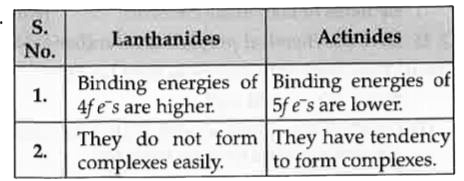
|
|
| 27. |
Any precipitate is formed when |
|
Answer» SOLUTION BECOMES saturated |
|
| 28. |
Any compound fonned by the reaction of a water insoluble fatty acid with a metallic radical or with an organic base may be called as soap. Soaps used for cleaning purpose are sodium or potassium salts of long chain fatty acids, e.g., palmitic, lauric, stearic and oleic acids. Soaps arc generally obtained by the hydrolysis of oils and fats with aqueous alkali. This reaction is called saponification Synthetic detergents are cleansing agents which have all the properties of soaps, but they actually do not contain any soap. A synthetic detergent is the sodium salt of a long chain alkyl hyydrogen sulphate or the sodium salt of a long chain benzene sulphonic acid. |
|
Answer» DETERGENTS have a COMMON GROUP: |
|
| 29. |
Any compound fonned by the reaction of a water insoluble fatty acid with a metallic radical or with an organic base may be called as soap. Soaps used for cleaning purpose are sodium or potassium salts of long chain fatty acids, e.g., palmitic, lauric, stearic and oleic acids. Soaps arc generally obtained by the hydrolysis of oils and fats with aqueous alkali. This reaction is called saponification Synthetic detergents are cleansing agents which have all the properties of soaps, but they actually do not contain any soap. A synthetic detergent is the sodium salt of a long chain alkyl hyydrogen sulphate or the sodium salt of a long chain benzene sulphonic acid. Which one is not a glyceride? |
|
Answer» Soap |
|
| 30. |
Any compound fonned by the reaction of a water insoluble fatty acid with a metallic radical or with an organic base may be called as soap. Soaps used for cleaning purpose are sodium or potassium salts of long chain fatty acids, e.g., palmitic, lauric, stearic and oleic acids. Soaps arc generally obtained by the hydrolysis of oils and fats with aqueous alkali. This reaction is called saponification Synthetic detergents are cleansing agents which have all the properties of soaps, but they actually do not contain any soap. A synthetic detergent is the sodium salt of a long chain alkyl hyydrogen sulphate or the sodium salt of a long chain benzene sulphonic acid. The reaction between alkali and fat is called: |
|
Answer» hydrolysis |
|
| 31. |
Any compound fonned by the reaction of a water insoluble fatty acid with a metallic radical or with an organic base may be called as soap. Soaps used for cleaning purpose are sodium or potassium salts of long chain fatty acids, e.g., palmitic, lauric, stearic and oleic acids. Soaps arc generally obtained by the hydrolysis of oils and fats with aqueous alkali. This reaction is called saponification Synthetic detergents are cleansing agents which have all the properties of soaps, but they actually do not contain any soap. A synthetic detergent is the sodium salt of a long chain alkyl hyydrogen sulphate or the sodium salt of a long chain benzene sulphonic acid. Soaps can be classified as : |
|
Answer» carbohydrates |
|
| 32. |
Any compound fonned by the reaction of a water insoluble fatty acid with a metallic radical or with an organic base may be called as soap. Soaps used for cleaning purpose are sodium or potassium salts of long chain fatty acids, e.g., palmitic, lauric, stearic and oleic acids. Soaps arc generally obtained by the hydrolysis of oils and fats with aqueous alkali. This reaction is called saponification Synthetic detergents are cleansing agents which have all the properties of soaps, but they actually do not contain any soap. A synthetic detergent is the sodium salt of a long chain alkyl hyydrogen sulphate or the sodium salt of a long chain benzene sulphonic acid. Sodium salts of higher fatty acids are known as: |
|
Answer» SOFT SOAPS |
|
| 33. |
Anuradha has two small children who crawl on the floor many a times during the day. Therefore, she instructed her domestic servant Sharda that simple brooming the floor is not enough. After brooming she should sprinkle some phenylene (commercial anme) on the floor and rub the floor with a clean cloth soaked in phenylene simply also called phenyl. After reading the above passage, answer the followig questions: (i) What active chemical constituent does commercial phenylene contain and what are the advantages of its use? (ii) What values are displayed by Anuradha by asking sharda to mop the floor with phenylene? (iii) Give a commerical method of preparation of the active constituent contained in phenylene. |
|
Answer» Solution :(i) the COMMERCIAL phenylene contains phenol as the active constituent. Its M.F. `C_(6)H_(5)OH` and is ALSO called carbolic acid. It is used as a DISINFECTANT because it has a STRONG germicidal action and thus makes the floor germs/bacteria free. (ii) Anuradha displayed values like hygiene annd healthcare. by using phenylene, floor becomes clean and thus prevents the children from illness and diseases. (iii) It is prepared commerically by aerial oxidation of cumene followed by acid hydrolysis of the product thus obtained. |
|
| 34. |
Antiseptics chloroxylenol is |
|
Answer» 4-chloro-3, 5-dimethylphenol 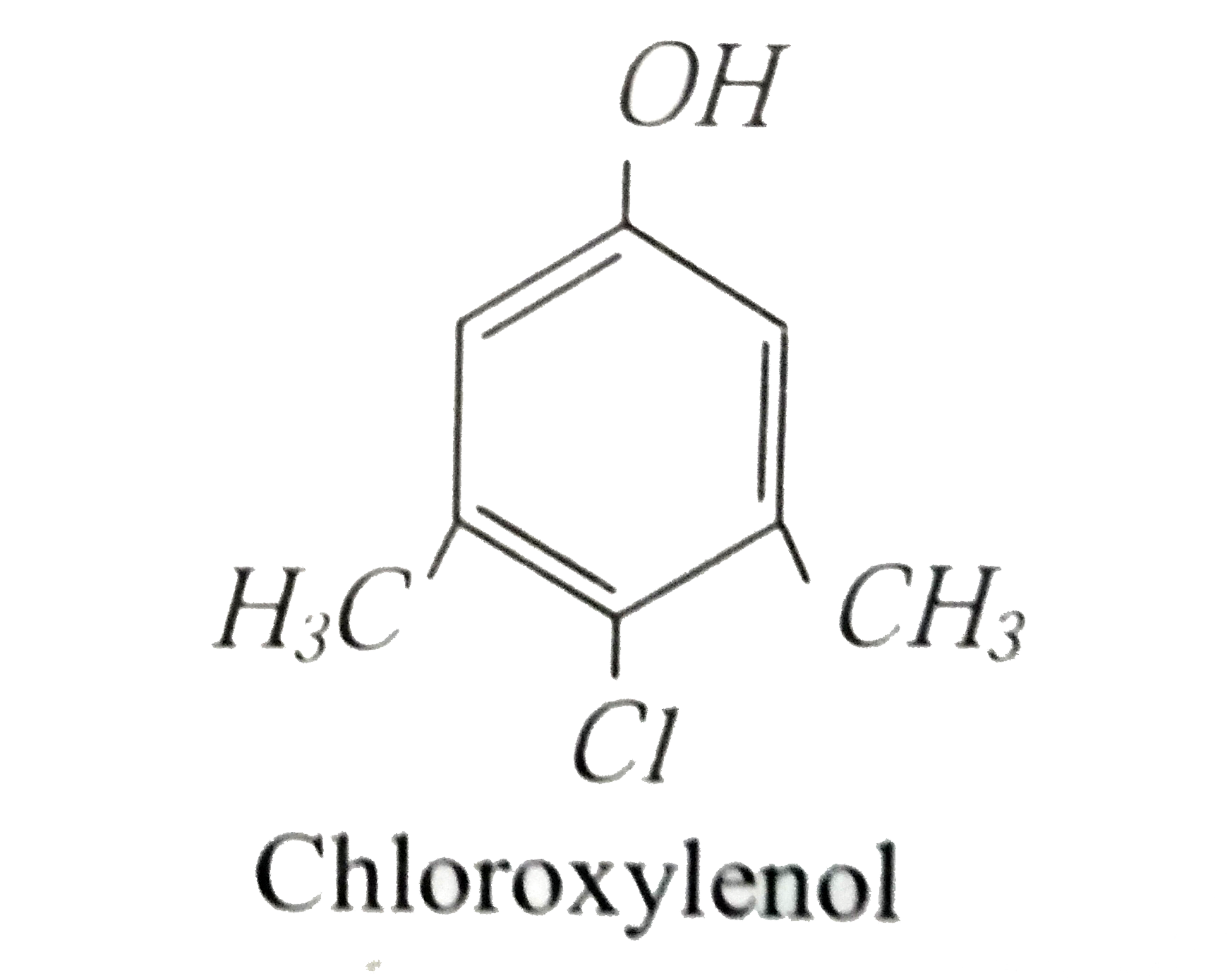
|
|
| 36. |
Antiseptics belong to which class of drug . |
| Answer» SOLUTION :ANTIMICROBIAL DRUG . | |
| 37. |
Antiseptics are the chemicals which either ___________ or ________ the growthof microorganism and are applied as the _______. |
|
Answer» kill, prevent , living TISSUES |
|
| 38. |
Antiseptics and disinfectants either kill or prevent growth of microorganisms, Identify which of the following statements is not true. |
|
Answer» Chlorine and IODINE are used as strong disinfectants |
|
| 39. |
Antiseptics and disinfectants either kill or prevent growth of microorganisms. Identify which of the following statements is not true. |
|
Answer» Dilute SOLUTIONS of BORIC acid and hydrogen peroxide are STRONG antiseptics |
|
| 40. |
Antiseptics and disinfectants either kill or prevent growth of microorganisms. Identify which of the following statements is not true |
|
Answer» Disinfectants harm the LIVING tissues |
|
| 41. |
Antiseptics and disinfectants either kill or prevent growth of microorganisms. Identify which of the following statement is not true. |
|
Answer» dilute SOLUTIONS of boric acid and hydrogen peroxide are strong ANTISEPTICS |
|
| 42. |
Antiseptics and disinfectants either kill or prevent growth of microorganisms. Identify which of the following statements is not true: |
|
Answer» Chlorine and iodine are used as strong disinfectants |
|
| 43. |
Antiseptics and disinfectants either kill or prevent the growth of micro-organisms. Identify which ofthe following statement is not true? |
|
Answer» Dilute solutionsof boric ACID and hydrogen peroxide are strong antiseptics. |
|
| 44. |
Antiseptic, chloroxylenol is |
|
Answer» 4-chloro-3,5-dimethylphenol 
|
|
| 45. |
Antiseptics and disinfectants either kill or prevent growth of micro-organisms. Identify which of the following statements is not true : |
|
Answer» DISINFECTANTS HARM the LIVING tissues. |
|
| 46. |
Antiseptics. |
|
Answer» Solution :(1) Antiseptice are USED for dressing of wounds. (2) They are used to DESTROY fungal growth. (3) They are used to sterilize surgical INSTRUMENTS. (4) They are used as anti-infectives in deodorants, shampoos and surgical soaps. |
|
| 47. |
Antiseptic applied on the tissue is |
|
Answer» Soframicine |
|
| 48. |
Antiseptic chloroxylenol is |
|
Answer» 4 - CHLORO - 3, 5 - dimethylphenol |
|


