

Saved Bookmarks
This section includes 7 InterviewSolutions, each offering curated multiple-choice questions to sharpen your Current Affairs knowledge and support exam preparation. Choose a topic below to get started.
| 1. |
An electrochemical cell is set up as follows Pg(H_(2),1" atm")//0.1M" "HCl ||0.1M" acetic acid "//(H_(2),1" atm")Pt E.M.F. of this cell will not be zero because |
|
Answer» The pH of 0.1 M HCl and 0.1 M acetic ACID is not the same |
|
| 2. |
An electrochemical cell is made of aluminium and tin electrodes with their standard reduction potentials -1.66 V and 0.14 V respectively. Select the anode and the cathode, represent the cell and write the cell reaction. Find the e.m.f.of the cell |
|
Answer» Solution :For `E_(cell)` to be positive, the GIVEN standard reduction potentials show that oxidation will take place on Al-electrode. HENCE, Al will be anode and SN will be CATHODE. The cell will be REPRESENTED as: `Al(s)|Al^(3+)(aq)||Sn^(2+)(aq)|Sn(s)` ltBrgt `E_(cell)^(@)=E_(Sn^(2+),Sn)^(@)-E_(Al^(3+),Al)^(@)=0.14-(-1.66)=1.80V` |
|
| 3. |
An electrochemical cell is made by placing a zinc electrode in 1.0 litre of 0.2 MZnSO_4solution and a copper electrode in 1.0 litre of 0.015 M CuCl_2solution. (a) What is the initial voltage of this cell when it is properly constructed? (b) Calculate the final concentration of Cu^(2+)in this cell if it is allowed to produce an average current of 1 amp for 225 seconds. Given that E_("cell")^@ = 1.1 V. |
| Answer» SOLUTION :(a) 1.07 V (B) 0.014 M | |
| 4. |
An electrochemical cell consists of two metallic electrodes dipping in _________solution(s). |
| Answer» SOLUTION :ELECTROLYTIC | |
| 5. |
An electrochemical cell consists of : |
|
Answer» CADMIUM cell |
|
| 6. |
An electrochemical cell can behave like an electrolytic cell when_____ |
|
Answer» `E_(CELL)=0` |
|
| 7. |
An electrochemicalcell can behavelike an electrolyticcell when |
|
Answer» `E_("cell")=0` |
|
| 8. |
An electrochemical cell can behave like an electrolytic cell when _____. |
|
Answer» `E_(cell)=0` |
|
| 9. |
An electrochemical cell can behave like an electrolytic cell when ………. . |
|
Answer» `E_(cell) lt E_(EXT.)` |
|
| 10. |
An electrochemical cell can behave like an electrolytic cell when …………… |
|
Answer» `E_("cell") =0` |
|
| 11. |
An electric discharge is passed through a containing 50cc of O_(2) and 50cc of H_(2). The volume of the gases formed (i) at room temperature, (ii) at 110^(@)C will be: |
|
Answer» i 25 cc II 50cc 50cc `H_(2)` will COMBINE with 25 cc `O_(2)` to form 50 cc `H_(2)O` `therefore O_(2)` left=25cc At room temperature `H_(2)O` will be in liquid state but at `110^(@)C`, it will be gaseous. Thus, volume of gases at `25^(@)C` and `110^(@)C` will be 25cc and 75cc RESPECTIVELY. |
|
| 12. |
An electric current when passed through dilute sulphuric acid for 2 hours liberated 0.50 g of hydrogen . What weight of copper will be liberated if the same current is passed for one hour through copper sulphate solution ? |
|
Answer» 7.94 G `therefore ` 48,250 Coulbombs `-=15.87 g ` of Cu for 2 hours `therefore ` 1 hours of same current will produce 7.94g of Cu. |
|
| 13. |
An electric current of 'I' amperes was passed through a solution of an electrolyte for 't' seconds depositing 'W' grams of the metal 'M' on the cathode. The equivalent mass 'E' of the metal will be __________. |
|
Answer» `E=(Ixxt)/(Wxx96,500)` |
|
| 14. |
An electric current passed through aqueous solution of the following which one shall decompose ? |
|
Answer» Urea |
|
| 15. |
An electric current of c ampere was passed through a solution of an electrolyte for t second depositing P g of the metal M on the cathode. The equivalent weight E of the metal will be : |
|
Answer» <P>`E=(cxxt)/(Pxx96500)` |
|
| 16. |
An electric current of 1 amp is passed through acidulated water for 160 minutes and 50 seconds. What is the volume of the hydrogen liberated at the anode (as reduced to NTP)? |
|
Answer» 1.12 LITRE `= (1 XX 9650 xx 11.2)/(96500) = 1.12 "litre"` |
|
| 17. |
An electric current is passed through two electrolytic cells connected in series one containing aqueous AgNO_(3) solution while the other containing aqueous H_(2)SO_(4). The volume of oxygen that would be liberated at 25^(@)C and 750 mm pressure from H_(2)SO_(4) if 1 mole of Ag^(+) ions are deposited from AgNO_(3) solution. |
|
Answer» 6.2 L `1" mol Ag" -=1" Eq Ag"-=1" Eq "O_(2)` WEIGHT of `O_(2)` liberated =8 G. `T=298" K", P=(750)/(760) atm` `PV=nRT=(W)/(M)RT` `VO_(2)=(WRT)/(MP)` `=((8G)xx(0.0821" L atm " K^(-1) mol^(-1))xx(298K))/((32" g mol"^(-1))xx(0.987" atm"))=6.2" L"` |
|
| 18. |
An electric current is passed through three cells in series containing respectively solutions of copper sulphate, silver nitrate and potassium iodide. What weights of silver and iodine will be liberated while 1.25 g of copper is being deposited ? |
|
Answer» Solution :`("Wt. of COPPER")/("Wt. of IODINE")=("Eqvt. Wt. copper")/("Eqvt. Wt. of Iodine")` `"or"(1.25)/(x)=(31.7)/(127),""x=(1.25xx127)/(31.7)` Hence, Wt. of Iodine x = 5.0 g of iodine `"Also,"("Wt. of Copper")/("Wt. of Silver")=(1.25)/(y)` `=("Eqvt. wt. of Cu(= 31.7)")/("Eqvt. wt. of Silver( = 108)")` `"Wt. of silver (y) "=(108xx1.25)/(31.7)` = 4.26g |
|
| 19. |
An electric current is passed through silver voltameter connected to a water voltameter. The cathode of the silver voltameter weighted 0.108 g more at the end of the electrolysis. The volume of oxygen evolved at STP is |
|
Answer» `56cm^(3)` |
|
| 20. |
An electric current is passed through silver nitrate soultion using silver electrodes. 10.79 g of silver was found to be deposited on the cathode if the same amount of electricity is passed through copper sulphate solution using copper electrodes, the weight of copper deposited on the cathode is |
|
Answer» 6.4 g |
|
| 21. |
An electric current is passed through following aqueous solutions. Which one shall decompose: |
|
Answer» Urea |
|
| 22. |
An electric current is passed through an aqueous solution of the following . Which one shall decompose ? |
|
Answer» Urea |
|
| 23. |
An electric current is passed through a solution of (i) silver nitrate, (ii) solution of 10 g of copper sulphate (CuSO_(4).5H_(2)O) crystals in 500 mL of water, platinum electrodes being used in each case. After 30 minutes it was found that 1.307 g of silver has been deposited. What was the concentration of copper, expressed as grams of copper per litre in the copper sulphate after electrolysis ? |
| Answer» SOLUTION :4.32 g/litre | |
| 24. |
An electric current is passed through an aqeous solution of the following. Which one shall decompose |
|
Answer» Urea |
|
| 25. |
An electric current is passed through following aqueous solutions . Which one shall decompose |
|
Answer» urea |
|
| 26. |
An electric current is passed through an aqueous solution of a mixture of alanine (isoelectric point 6.0), glutamic acid (3.2) and arginine (10.7) buffered at pH 6. What is the fate of the three acids? |
|
Answer» Glutamic acid migrates to anode at pH 6. Arginine is present as a cation and migrates to the CATHODE. Alanine in a dipolar ion remains UNIFORMLY distributed in solution.  Soit migrates to anode whilearginine arginine exists as cationic specics. 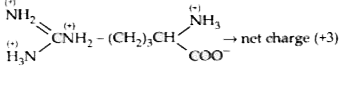 So , it migrates to cathode . Alanine doesnotmigrateto any electrode at its isoelectric point . |
|
| 27. |
An electric current is passed through a silver voltameter connected to a water voltameter. The cathode of the silver voltameter weighed 0.108g more at the end of the electrolysis. The volume of oxygen evolved at STP is: |
|
Answer» `56 CM^(3)` |
|
| 28. |
An electric charge of 5 Faradays is passed throughthree electrolytes AgNO_3, CuSO_4 and FeCl_3 solution. The grams of each metal liberted at cathode will be |
|
Answer» `Ag=10.8g, Cu=12.7g, Fe=1.11g` |
|
| 29. |
An effective atomic number of Co(CO)_(4) is 35 annd hence is less stable. It attains stability by: |
|
Answer» OXIDATION of Co |
|
| 30. |
An carbonyl compounds gives nuclrophilic addition reaction with (1) HCN ""(2) NaSHO_(3) (3) R-MgX""(4) NH_(2) - NH_(2) |
|
Answer» `1,2` |
|
| 31. |
An easy way of obtaining Cl_2 gas in the laboratory is : |
|
Answer» by HEATING NACL and concentrated `H_2SO_4` |
|
| 32. |
An azo dye is fixed on fabrics by the process applicable in |
|
Answer» VAT dyes |
|
| 33. |
An azo dye is |
|
Answer» CONGO red |
|
| 34. |
An azo dye aniline yellow will be formed when benzene diazonium chloride reacts with |
|
Answer» Phenol |
|
| 35. |
An azeotropic solution of two liquids has boiling point lower than either of them when it |
|
Answer» SHOWS negative DEVIATION from RAOULT's LAW |
|
| 36. |
An azeotropic solution of two liquids has a boiling point lower than either of them if it |
|
Answer» shows NEGATIVEDEVIATION from RAOULT's law |
|
| 37. |
An azeotropic solution of two liquids has a boiling point higher than either of the boiling points of the liquids when it |
|
Answer» SHOWS NEGATIVE DEVIATION from Raoult's LAW |
|
| 38. |
An azeotropic mixture of two liquids has boiling point lower than either of them when it |
|
Answer» shows a NEGATIVE devaiation from Raoultas' law |
|
| 39. |
An auueous solution sontaining 4.9 g of solute dessolved in 500 mL of solution shows an osmoticpressure of 2.1 atmosphere at k 27^(@)C. What is the nature of the solute (assciated of dissoviated) if the molar mass of the solute is 57.4 amu ? |
|
Answer» `pi=CRT=(W_(B)xxRxxT)/(M_(B)xxV)or M_(B)=(W_(B)xxRxxT)/(pixxV)` `W_(B)=4.9, R=0.0821"L atm K"^(-1)mol^(-1), T=27+273=300 K` `V=500 mL=0.5 L, pi=2.1 atm.` `M_(B)=((4.9g)XX(0.0821" L atm K"^(-1)mol^(-1))xx(300K))/((2.1"atm")xx(0.5 L))=114.9" g mol"^(-1)`. Step II. Predicting the nature of the solute `"Normal molar mass of the solute "=57.4" g mol"^(-1)` Since the observed molar mass of the solute is more than its normal molar mass, this means that the solute has undergone association in solution. |
|
| 40. |
An automobile antifreezen consists of 38.7% C,9.7% H and remaining oxygen by weight. When 0.93 g of it are vaporised at 200^(@)C and 1 atm pressure 582mL of vapour are formed Find the molecular formula of the antifreeze. |
|
Answer» |
|
| 41. |
An atom with high electronegativity generally has:- |
|
Answer» TENDENCY to FORM +ve ions |
|
| 42. |
An atom with atomic number 20 is most likely to combine chemically with the atom whose atomic number is |
|
Answer» 3 |
|
| 43. |
An atom present at the body centre belongs to only ....................................unit cell. |
|
Answer» 1 |
|
| 44. |
An atom of radium combines with two atoms of chlorine to form RaCl_2 molecule. The radioactivity RaCl_2 |
|
Answer» ONE HALF of the same QUANTITY Ra |
|
| 45. |
An atom of an element has electronic structure 2, 8, 1. Which statement is correct for it? |
|
Answer» The VALENCY of ELEMENT is 7 |
|
| 46. |
An atom of element A has 3 electrons in its valence shell and an atom of B has 6 electrons in its valence shell. The formula of the compound between these two atoms will be : |
|
Answer» `A_(3)B_(6)` B has six electrons in its outermost orbit, its valency = 2. Formula of the compound = `A_(2)B_(3)` 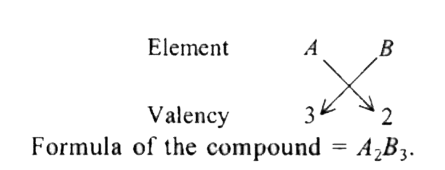
|
|
| 47. |
An atom is assumed to tbe spherical in shape and thus, the size of atom is generally given in terms of radius of the sphere and is called atomic radius. It is usually defined as the distance between the centre of the nucleus and outermost shell where electron are present. The exact measure of atomic radius is not easy due to following reasons: (i) The atom does not have well defined boundary. the probability of finding the electron is never zero even at large distance from the nucleus. (ii) It is not possible to get an isolated atom. the electron density around an atom is affected by the presence of neighbouring atoms, i.e., the size of the atom changes in going from one set of environement to another. (iii) the size of an atom is very small, of the order of about 1.2Å,i.e., 1.2xx10^(-10)m. An estimate of the size of the atom can, however, be made by knowing the distance betweent he atoms in the combined state. the distance between the atoms, i.e., bond length are generally measured by the application of techniques such as X-ray differaction, electron diffraction, infrared spectroscopy, nuclear magnetic resonance spectroscopy, etc. However, bond lengths change with different type of bonding. Three types of radius are commonly used, i.e., (a) Covalent radius "" (b) crystals radius ""(c) Vander waal's radius Which of the following set of ions have the same value of screening constant for the valence electron. calculated fromSlater's rule |
|
Answer» `Li^(+),Na^(+),K^(+)` |
|
| 48. |
An atom having ns^(1) configuration may belongto |
|
Answer» d-block |
|
| 49. |
An atom has four unpaired electrons. The total spin of this atom will be |
|
Answer» 1 |
|