

Saved Bookmarks
This section includes 7 InterviewSolutions, each offering curated multiple-choice questions to sharpen your Current Affairs knowledge and support exam preparation. Choose a topic below to get started.
| 1. |
An aqueous solution of FeSO_(4),Al_(2)(SO_(4))_(3) and chrome alum is heated with excess of Na_(2)O_(2) and filtered. The materials obtained as |
|
Answer» A COLOURLESS FILTRATE and a green residue |
|
| 2. |
An aqueous solution of FeSO_4*Al_2(SO_4) and chrome alum is heated with excess of Na_2O_2 and filtered. The materials obtained are: |
|
Answer» A colourless FILTRATE and a GREEN residue |
|
| 3. |
An aqueous solution of ethyl alcohol : |
|
Answer» Turns BLUE LITMUS RED |
|
| 4. |
An aqueous solution of CuSO_(4) is subjected to electrolysis using inert electrodes.The pH of the solution will |
|
Answer» increase 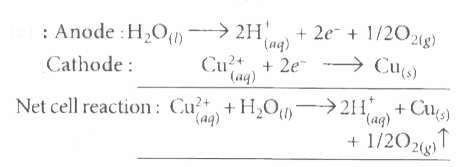 Due to increase in `[H^(+)]`, pH decreases . |
|
| 5. |
An aqueous solution of CuSO_4 and NH_4OH gives a deep blue complex of : |
|
Answer» Cupperammonium Sulphate |
|
| 6. |
An aqueous solution of copper sulphate is electrolysed using platinum electodes in one case and copper electrodes in another case. Will the products of electrolysis be same or different? Give reason. |
|
Answer» Solution :In case of platinum electrodes, the products are Cu on CATHODE and `O_(2)` gas on ANODE. This because out of `Cu^(2+) and OH^(+)` ions (produced from `H_(2)O`), `Cu^(2+)` ions have LOWER discharge potential. Out of `SO_(4)^(2-)` and `OH^(-)` ions, `OH^(-)` ions have lower discharge potential `(OH^(-)toOH+e^(-),CutoCu^(2+)+e^(-))` In case of copper electrodes, product at cathode is the same, viz, Cu but at anode, out of the THREE possible reactions, viz., `OH^(-)toOH+e,SO_(4)^(2-)toSO_(4)+2e^-,CutoCu^(2+)+2e^(-)` Cu is more easiliy oxidized than `OH^(-) and SO_(4)^(2-)` ions. HENCE, anode of Cu dissolves into the solution to form `Cu^(2+)` ions. |
|
| 7. |
An aqueous solution of colourless metal sulphate M gives a white ppt with NH_4 OH. This was soluble in excess of NH_4OH, On passing HQS through this solution a white ppt is formed. The metal Min the sait is . |
|
Answer» Ca |
|
| 8. |
An aqueous solution of CoCl_(3).6NH_(3) is found to be a better conductor of electricity than an aqueous solution of CoCl_(3).4NH_(3) No ammonium ions are detected by addition of H_(2) SO_(4) to the solution of either of these compounds. Can you explain the difference in the conductivities of two solutions |
| Answer» Solution :As no ammonium ions are detected in the SOLUTIONS of these compounds, it indicates that AMMONIA molecules are in the first coordination sphere of the metal ion in both the CASES. The compound `COCI_(3), 6NH_(3)` can therefore be formulated as `[CO(NH_(3))_(6)]Cl_(3)` which may give four ions per mole in solution as indicated by the CONDUCTIVITY of the solution. Since the solution of `CoCl_(3), 4NH_(3)` is less conducting than that of `CoCl_(3).6NH_(3)` it means it give less than four ions per mole in solution. It will be possible only if two of the chlorines are also present in the first coordination sphere and the compound has the formula`(Co(NH_(3))_(4)Cl_(2)]CI`. | |
| 9. |
An aqueous solution of borax is : |
|
Answer» acidic |
|
| 10. |
An aqueous solution of borax is ……………… |
|
Answer» basic |
|
| 11. |
An aqueous solution of aniline of concentration 0.24 M is prepared. What concentration of sodium hydroxide is needed in this solution so that anilinium ion concentration remains at 1xx10^(-8)M ? (K_(a)for C_(6)H_(5)NH_(3)^(+)=2.4xx10^(-5)M) |
| Answer» SOLUTION :`1 XX 10^(-2) M` | |
| 12. |
An aqueous solution of BCl_3 is : |
|
Answer» WEAK acid |
|
| 13. |
An aqueous solution of an electrolyte: |
|
Answer» CONDUCTS electricity WITHOUT any CHEMICAL change |
|
| 14. |
An aqueous solution of an electrolyte |
|
Answer» CONDUCTS electricity without any chemical change |
|
| 15. |
An aqueous solution of an anhydrous white solid A on addition of KCN solution gives a white precipitate B. Addition of excess of KCN to the precipitate dissolves if forming C. |
| Answer» Answer :B | |
| 16. |
An aqueous solution of ammonium carbonate is |
|
Answer» WEAKLY acidic `Cu^(2+) + 2H_(2)O RARR Cu(OH)_(2) + 2H^(+)` |
|
| 17. |
An aqueous solution of ammonium acetate is |
|
Answer» Faintly ACIDIC |
|
| 18. |
An aqueous solution of ammonium acetate is…….. |
|
Answer» FAINTLY acidic |
|
| 19. |
An aqueous solution of aluminium sulphate shows |
|
Answer» A basic nature `UNDERSET("WEAK base")(AL(OH)_(3)) + underset("Strong acid")(H_(2)SO_(4))`. |
|
| 20. |
An aqueous solution of ammonia consists of |
|
Answer» `H^(+)` |
|
| 21. |
An aqueous solution of ammonia acetate is : |
|
Answer» FAINTLY acidic |
|
| 22. |
An aqueous solution of aluminium sulphate would show |
|
Answer» An acetic reaction |
|
| 23. |
An aqueous solution of acetic acid contains: |
|
Answer» `CH_3`COOH and `H^+` |
|
| 24. |
An aqueous solution of a white salt A gives a white precipitate B on treatment with dilute HCl in cold condition. B is soluble in boiling water. An aqeous solution of A gives a yellow precipitate on treatment with a solution of K_(2)CrO_(4). The soda extract of A is acidified with diolute H_(2)SO_(4), boiled to remove CO_(2) and treated with a freshly prepared solution of FeSO_(4). concentratd H_(2)SO_(4) is added to the resulting solution. a brownn ring is formed at the junction of the two layers. Q. On treatment with a KI solution, an aqueous solution of A will give: |
|
Answer» a YELLOW PRECIPITATE, soluble in BOILING water |
|
| 25. |
An aqueous solution of a white salt A gives a white precipitate B on treatment with dilute HCl in cold condition. B is soluble in boiling water. An aqeous solution of A gives a yellow precipitate on treatment with a solution of K_(2)CrO_(4). The soda extract of A is acidified with diolute H_(2)SO_(4), boiled to remove CO_(2) and treated with a freshly prepared solution of FeSO_(4). concentratd H_(2)SO_(4) is added to the resulting solution. a brownn ring is formed at the junction of the two layers. Q. A solution of A, when treated with NH_(3), gives: |
|
Answer» a white precipitate SOLUBLE in an axcess of `NH_(3)` |
|
| 26. |
An aqueous solution of a white salt A gives a white precipitate B on treatment with dilute HCl in cold condition. B is soluble in boiling water. An aqeous solution of A gives a yellow precipitate on treatment with a solution of K_(2)CrO_(4). The soda extract of A is acidified with diolute H_(2)SO_(4), boiled to remove CO_(2) and treated with a freshly prepared solution of FeSO_(4). concentratd H_(2)SO_(4) is added to the resulting solution. a brownn ring is formed at the junction of the two layers. Q. The salt A is: |
| Answer» Answer :B | |
| 27. |
An aqueous solution of a white salt A gives a white precipitate B on treatment with dilute HCI in cold conditions. B is soluble in boiling water. An aqueous solution of A gives a yellow precipitate on treatment with a solution of K_(2)CrO_(4). The soda extract of A is acidified with dilute H_(2)SO_(4) boiled to remove CO_(2) and treated with a freshly prepared solution of FeSO_(4) Concentrated H_(2)SO_(4) is added to the resulting solution (along the walls of the test tube so that the H_(2)SO_(4) forms a separate layer). A brown ring is formed at the junction of the two layers. On treatment with a Kl solution, an aqueous solution of A will give |
|
Answer» a YELLOW precipitate soluble in boiling water |
|
| 28. |
An aqueous solution of a weak monobasic acid containing 0.1 g in 21.7g water freezes at 272.813 K. If the value of K_(f) for water is 1.86 K-kg/mol, what is the molecular mass of the monobasic acid |
|
Answer» 50g/mole |
|
| 29. |
An aqueous solution of a substance 'X' gives a white ppt. on treatment with dil. HCI, which dissolves on heating. When hydrogen sulphide is passed through the hot acidic solution, a black ppt. is obtained. 'X' is: |
|
Answer» `Cu^(2+)` salt |
|
| 30. |
An aqueous solution of a substance gives a white precipitate on treatment with dilute hydrochloric acid, which dissolves on heating. When hydrogen sulphide is passed through the hot acidic solution, a black precipitate is obtained. The substance is a : |
| Answer» Answer :D | |
| 31. |
An aqueous solution of a substance gives a white precipitate on treatment with dilute hydrochloric acid, which dissolves on heating. When hydrogen sulphide is passed through the hot acidic solution, a black precipitate is obtained. The substance is a |
|
Answer» `Hg_(2)^(2+)` SALT |
|
| 32. |
An aqueous solution of a substance gives a white precipitate on treatment with dilute hydrochloric acid when dissolves on heating. When hydrogen, sulphide is passed through the hot acidic solution, a black precipitate is obtained. The substance is a |
|
Answer» `Hg_(2)^(2+)` SALT |
|
| 33. |
An aqueous solution of a substance gives a white precipitate on treatment with dilute hydrochloric acid which dissolves on heating. When hydrogen sulphide is passed through the hot acidic solution, a black precipitate is obtained. The substance is a |
| Answer» Answer :D | |
| 34. |
An aqueous solution of a substance gives a white precipitate on treatment with dilute HCI, which dissolves on heating. When hydrogen sulphide is passed through the hot acidic solution, a black precipitate is obtained. The substance is a: |
|
Answer» `Hg_2^(2+) ` `Pb^(2+) + 2HCl to underset("WHITE ppt")(PbCl_2 darr) overset(H_2S)to underset("Black ppt")(PbS) ` |
|
| 35. |
An aqueous solution of a sodium salt gave no precipitate when treated withh either silver nitrate solution or banium chloride sodium. Which one of the following could be the formula of the sodium salt? |
| Answer» ANSWER :D | |
| 36. |
An aqueous solution of a substance gives a white precipitate on treatment with dilute hydrochloric acid, which dissolves on heating. When hydrogen sulfide is passed through the hot acidic solution, a black precipitate is obtained. The substance is a |
|
Answer» `Hg_(2)^(2+)` salt HENCE,(D) is the correct ANSWER. |
|
| 37. |
An aqueous solution of a sodium salt gave no precipitate when treated with either silver nitrate solution or barium chloride solution. Which one of the following could be the formula of the sodium salt |
|
Answer» NAL |
|
| 38. |
An aqueous solutionof a substance gives a whitepercipitate on treatment with dil ,HCI whichdissolves on heating .When H_(2)S is passedthroughthe hot acidinbg solution a blackprecipitate is obtained .The substances are not : |
|
Answer» `Hg_(2)^(2+)` salt |
|
| 39. |
An aqueous solution of a salt A gives a white crystalline precipitate B with NaCl solutions. The filtrate gave a black ppt. C when H_2 S gas is passed in it. Compound B dissolves in hot water and the solution gives a yellow precipitate D on treatment with Nal and cooling. The compound A does not give any gas with dilute HCI but liberates a reddish brown gas on heating. Identify the compounds A. |
| Answer» Solution :`A : Pb (NO_(3))_(2) , B : PbCl_(2) , C : PbS , D : PbI_2` | |
| 40. |
An aqueous solution of a non-electrolyte solute boils at 100.52^(@)C. The freezing point of the solutiion will be (K_(f) = 1.86 K kg "mol"^(-1), K_(b) = 0.52 K kg"mol"^(-1)) |
|
Answer» `0^(@)C` `i=e.,0.52 = 0.52 xx m` or m=1 `Delta T_(f) =K_(f) xx m = 1.86 xx 1 = 1.86^(@)` `i.e., T_(f) = T_(F)^(@)-Delta T_(f) = 0^(@) C-1.86^(@)C=1.86^(@)C` |
|
| 41. |
An aqueous solution of a mixture of two inorganic salts, when treated with dilute HCl, gave a precipitate (P) and a filtrate (Q). The precipitate P was found to dissolve in hot water. The filtrate (Q) remained unchanged, when treated with H_(2)S in a dilute mineral acid medium. however, it gave a precipitate (R) with H_(2)S in an ammonical medium. the precipitate R gave a coloured solution (S), when treated with H_(2)O_(2) in an aqueous NaOH medium. Q. The precipitate P contains |
|
Answer» `Pb^(2+)` |
|
| 42. |
An aqueous solution of a mixture of two inorganic salts, when treated with dilute HCl, gave a precipitate (P) and a filtrate (Q). The precipitate P was found to dissolve in hot water. The filtrate (Q) remained unchanged, when treated with H_(2)S in a dilute mineral acid medium. however, it gave a precipitate (R) with H_(2)S in an ammonical medium. the precipitate R gave a coloured solution (S), when treated with H_(2)O_(2) in an aqueous NaOH medium. Q. The coloured solution S contains |
|
Answer» `Fe_(2)(SO_(4))_(3)` 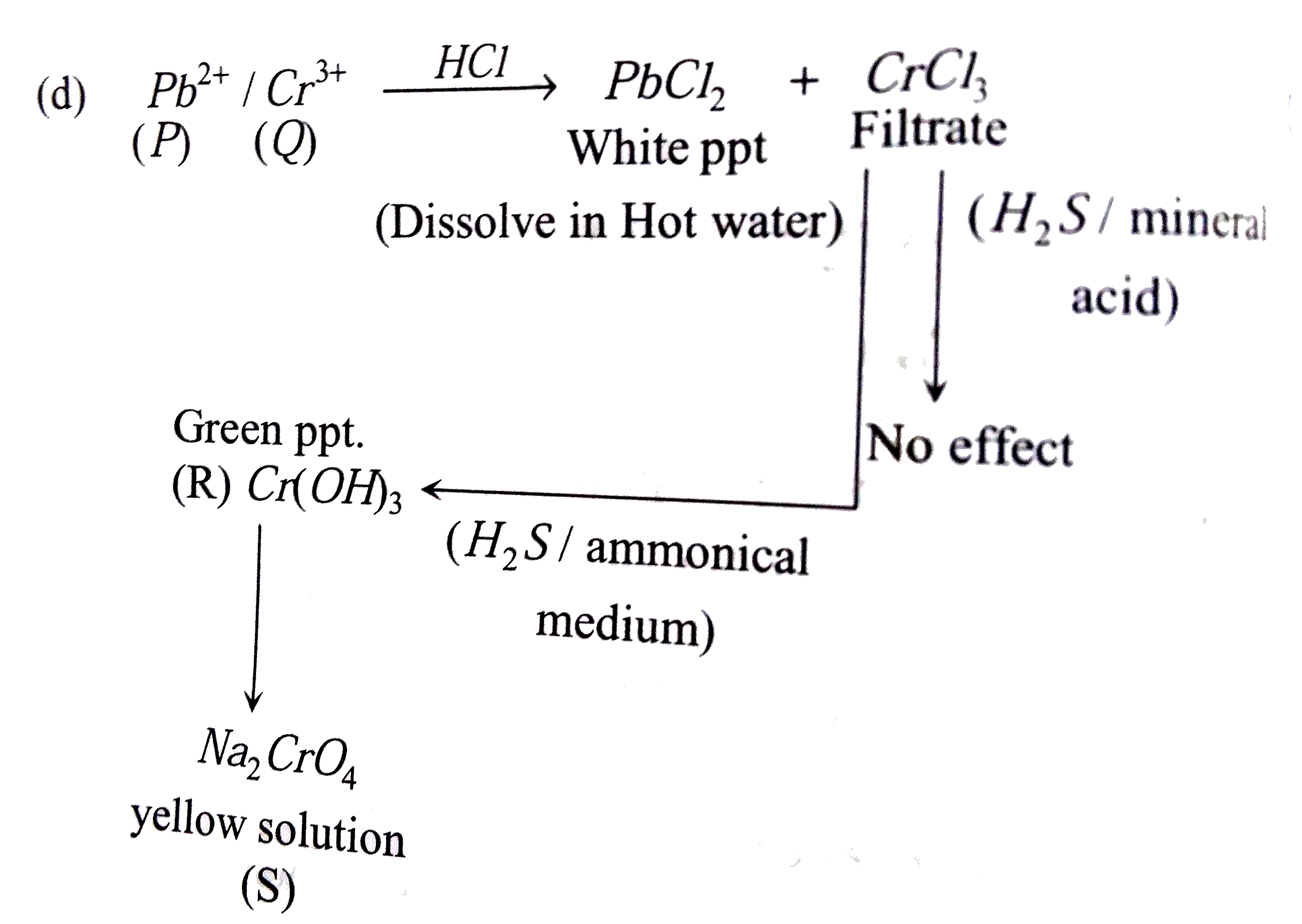
|
|
| 43. |
An aqueous solution of a non-electrolye boils at 100.52^(@)C. The freezing point of the solution will be (K_(b) = 0.52 K kg mol^(-1), K k_(g) = 1.86 K kg mol^(-1) ) |
|
Answer» `0^(@)C ` `Delta T_(b) = 100.52 - 100 `( B.P. of `H_(2)O = 100^(@)C ` ) `= ( 0.52)/( 0.52) =( DeltaT_(f))/(1.86)` `DeltaT_(f)= 1.86 ` ( FREEZING POINT of `H_(2)O = 0^(@) C ) ` Freezing point of solution `= - 1.86^(@) C ` |
|
| 44. |
An aqueous solution of a monoacidic base(B) is neutralised with 50mL of 0.2(M) HCl solution. After neutralisation, 200mg of NaOH is added to the solution The pH of the solution will be [K_b(B)=10^(-5)] |
|
Answer» 6 |
|
| 45. |
An aqueous solution of a mixture of two inorganic salts, when treated with dilute HCl, gave a precipitate (P) and a filtrate (Q).The precipitate P was found to dissolve in hot water. The filtrate (Q)remained unchanged, when treated with H_(2)S in a dilute mineral acid medium. However, it gave a precipitate (R) with H_(2)S in an ammoniaca medium.The precipitate R gave a coloured solution (S), when treated with H_(2)O_(2) in an aqueous NaOH medium. The coloured solution S contains |
|
Answer» `Fe_(2)(SO_(4))_(3)` |
|
| 46. |
An aqueoussolution of amixture of two inorganic salt , when reated with diute HCI ,Gave a precipitate (P) and a filrate (Q) .Theprecipitate Pwasfound todissolve in hot water .The filrate (Q)remained unchanged , whitetracatedwith H_(2)S in a difute mineralacid medium.However itgave a precipitate (R ) with H_(2)Sin an ammoniacalmedium.THeprecipitate R give acolouredsolution (S ) when treated with H_(2)O_(2) to an aq2ueousNaOHmedium The coloured solution S contain |
|
Answer» `Fe_(2)(SO_(4))_(3)` `Pb^(2+) + 2HCI rarr PbCI^(2+) overset(Hot) UNDERSET(water)(to) Solution` The filtrate `(Q)` contains `Cr^(+3)`, since itdoes give any precipitate with `H_(2)S` in acide medium .But givesprecipitate`(R )` with `H_(2)S` in alkline medium So, `R` is `Cr(OH)_(3)` and S is `Na_(2)CrO` `Cr^(+3) overset(Ammonical) underset(H_(2)S)to Cr(OH)_(3) overset(H_(2)O_(3))underset(NaOH)to underset(yellow SOLN)(Na_(2)CrO_(4))` |
|
| 47. |
An aqueous solution of a mixture of two inorganic salts, when treated with dilute HCl, gave a precipitate (P) and a filtrate (Q).The precipitate P was found to dissolve in hot water. The filtrate (Q)remained unchanged, when treated with H_(2)S in a dilute mineral acid medium. However, it gave a precipitate (R) with H_(2)S in an ammoniaca medium.The precipitate R gave a coloured solution (S), when treated with H_(2)O_(2) in an aqueous NaOH medium. The precipitae P contains |
|
Answer» `PB^(2+)` |
|
| 48. |
An aqueoussolution of amixture of two inorganic salt , when reated with diute HCI ,Gave a precipitate (P) and a filrate (Q) .Theprecipitate Pwasfound todissolve in hot water .The filrate (Q)remained unchanged , whitetracatedwith H_(2)S in a difute mineralacid medium.However itgave a precipitate (R ) with H_(2)Sin an ammoniacalmedium.THeprecipitate R give acolouredsolution (S ) when treated with H_(2)O_(2) to an aq2ueousNaOHmedium Thepracipitate Pcontain . |
|
Answer» `PB^(2+)` |
|
| 49. |
An aqueous solution of a metal sulphide is blue colured and on treatment with aqueous NaOH solution forms a blue precipitate (X). The precipitate 'X' is insoluble inexcess of NaOH and on heating it converts intoa black solid (Y). The X and Y respectively are most likely to be |
|
Answer» `CuSO_(4)` and `Cu_(2)O` |
|
| 50. |
An aqueous solution of a mixture of two inorganic saits, when treated with dilute HCl. gave a precipilate (P) and a filtrate (Q). The precipitate P was found to dissolve in hot water. The filtrate (Q) remained unchanged, when treated with H_(2)S in a dilute mineral acid medium. However, it gave a precipitate (R) with H_(2)S in an ammoniacal medium. The precipitate R gave a coloured solution (S), when treated with H_(2)O_(2) in an aqueous NaOH medium. The coloured solution S contains |
|
Answer» `Fe_(2)(SO_(4))_(3)` `CrCl_(3)+H_(2)S+NH_(4)OH rarr underset("GREEN (R)")(Cr(OH)_(3)(s))` `underset("which causes ppt. ion")underset(S^(2-)" ion CONC. increases")([(H_(2)S hArr 2H^(+)+S^(2-)),(NH_(4)OH hArr NH_(4)^(+)+OH),(2H^(+)+ overset()(O)H hArr H_(2)O)])` `Cr(OH)_(3)(s)+underset("OXIDISING AGENT") overset(NaOH+H_(2)O_(2))(rarr)Na_(2)CrO_(4)` Yellow solution (R) |
|