

Saved Bookmarks
This section includes 7 InterviewSolutions, each offering curated multiple-choice questions to sharpen your Current Affairs knowledge and support exam preparation. Choose a topic below to get started.
| 1. |
(A) : Silica is used as acidic flux in metallurgy (R ) : Silica is basic in nature |
|
Answer» A and R are true, R explains A |
|
| 2. |
A siliate used in talcum powder |
|
Answer» Consists of chain which are very long |
|
| 3. |
A sigma-bonded molecule MX_(3) is T-shaped. The number of non-bonding pairs of electrons is- |
|
Answer» 0 |
|
| 4. |
(a) Show the formation of the electrophile in the following reactions : (i) CI_(2)+AICI_(3), (ii) HNO_(3)+H_(2)SO_(4), (iii) Br_(2)+Fe, (iv) H_(2)SO_(4), (v) H_(2)S_(2)O_(7), Fuming sulphuric acid. (b) How do substituent groups on an aromatic rign influence the course of electrophilic aromatic substituion ? Classify them by their effects. |
|
Answer» Solution :(a) (i) `CI_(2)+AICI_(3)toCI^(+)+AICI_(4)^(-)` (ii) `HONO_(2)+HOSO_(3)HtoH_(2)O+NO_(2)^(+)+HSO_(4)^(-)` (iii) `2Fe+3FeBr_(2)to2FeBr_(3)` `FeBr_(3)+Br_(2)toBr^(+)+FeBr_(4)^(-)` (iv) `2H_(2)SO_(4)toH_(3)O^(+)+HSO_(4)^(-)+SO_(3)` (v)`H_(2)S_(2)O_(7)toH^(+)+HSO_(4)^(+)+SO_(3)` (B) The substituents on an aromatic ring affect the electrophilic substitution in two ways : 1. Reactivity : The compound is more reactive than benzene, the groups present are activating. In case, the compound is less reactive than benzene, the groups present are deactivating. 2. Orientation : Whether electrophile (E) enters ortho, para or meta. There are three CLASSES of SUBSTITUENT groups: (i)All activaing groups direct E to ortho or parapositions. (ii) Most deactivating groups direct E to meta-positions. ltbegt (iii) A few deactivating groups, e.g., halogens direct E to ortho or para-positions. |
|
| 5. |
(A): SiF_4is non polar even though fluorine is much more electronegative than silicon (B) : The four bond dipoles cancel one another in SiF_4molecule |
|
Answer» Both (A) and (R) are TRUE and (R) is the correct explanation of (A) |
|
| 6. |
A series of lines in the spectrum of atomic hydrogen lies at 656.46 n, 486.27 nm, 439.17 nm and 410.29 nm. What is the wavelength of the next line in this series? What is the ionisation energy of the atom when it is ini the lower state of transition? |
| Answer» SOLUTION :`lamda_(NEXT)=397.15nm,IE=3.240`EV | |
| 7. |
A semiconductor of Ge can be made p - type by adding |
|
Answer» Trivalent impurity |
|
| 8. |
A semiconductor of Ge can be made p-type by adding |
|
Answer» rtivalent IMPURITY |
|
| 10. |
A sealed container was filled with 1 mol of A_2(g), 1 mol B_2(g) at 800 K and total pressure 1.00 bar. Calculate the amounts of the components in the mixture at equilibrium given that K = 1 for the reaction : A_2(g)+ B_2(g)hArr 2AB(g) |
Answer» Solution :`A_2(g) + B_2(g) hArr 2AB(g)`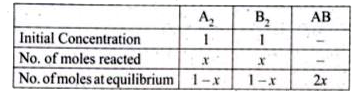 Total no. of moles `= 1-x+ 1 - x + 2x=2` `K_P = ((P_(AB))^2)/((P_(A_2))(P_(B_2))) =(((2x)/2xxP)^2)/((((1-x))/2xxP)(((1-x))/2xxP))` `K_P = (4x^2)/((1-x)^2)` Given that `K_P = (4x^2)/((1-x)^2) = 1` `RARR 4x^2 = (1-x)^2 rArr 4x^2 =1 +x^2 -2x` `3x^2 + 2x -1 = 0` `x = (-2 pmsqrt(4 - 4 xx 3 xx (-1)))/(2(3))` `x = (-2 pmsqrt(4 + 12))/6 = (-2pm sqrt16)/6 = (-2+4)/6,(-2-4)/6 = 2/6, (-6)/6` ` x = 0.33 , -1` (not posoible) `:.[A_2]_(eq) = 1 - x =1 - 0.33 = 0.67` `[B_2]_(eq) = 1- x = 1-0.33 = 0.67` `[AB]_(eq) = 2x = 2 xx 0.33 = 0.66` |
|
| 11. |
A sealed container was filled with 1 mol of A_(2)(g) 1 mol B_(2)(g) at 800 K and total pressure 1.00 bar. Calculate the amounts of the components in the mixture at equilibrium given that K=1 for the reaction A_(2)(g)+B_(2)(g)hArr2AB(g) |
Answer» Solution :`A_(2)(g)+B_(2)(g)hArr2AB(g)`  TOTAL no. of moles `=1-x+1-x+2X=2` `K_(P)=((P_(AB))^(2))/((P_(A_(2)))(P_(B_(2))))=(((2x)/(2)xxP)^(2))/((((1-x))/(2)xxP)((1-x)/(2)xxP))` `K_(P)=(4X^(2))/((1-x)^(2))` Given that `K_(P)=1,(4x^(2))/((1-x)^(2))=1` `rArr4x^(2)=(1-x)^(2)` `rArr4x^(2)=1+x^(2)-2x` `3x^(2)+2x-1=0` `x=(-2pmsqrt(4-(4xx3xx-1)))/(2(3))` `x=(-2pmsqrt(4+12))/(6)` `=(-2pmsqrt(16))/(6)` `=(2)/(6),(-2-4)/(6)` `x=0.33,-1("not POSSIBLE")` `:.[A_(2)]_(eq)=1-x=1-0.33=0.67` `[B_(2)]_(eq)=1-x=1-0.33=0.67` `[AB]_(eq)=2x=2xx0.33=0.66`. |
|
| 12. |
A sea diver at depth of 45m exhales a bubble of air that is 1.0 cm in radius. Assuming the ideal behaviour, find out radius of this bubble as it breaks at the surface of water? |
|
Answer» 1.75 cm `h_1d_1 = h_2d_2` `45 xx 1 = h_2 xx 13.6 = H = 3.3 m`. `:.` Pressure at 45 m depth = `(0.76 + 3.3) = 4.06 m.` `P_1V_1 = P_2V_2` `4.06 xx 4/3 pi (1)^3 = 0.76 xx 4/3 pi (r_(cm))^(3)` `implies r_(cm) root(3)((4.06)/(0.76)) , r_(cm) = 1.75 cm` |
|
| 13. |
A scientist attempts to replace a few carbon atoms in 1.0 g of diamond with boron atoms or nitrogen atoms in separate experiments. Which of the following is correct ? |
|
Answer» The resulting material with B droping will be an N-type semiconductor |
|
| 14. |
(A) Schrodinger wave equation (B) Heisenberg uncertainty principle (C) Millikan oil drop experiment (D) Chadwick.s discovery of neutron Of the scientific milestones listed above, which is the most ancient and most modern respectively ? |
|
Answer» A, D |
|
| 15. |
A saturated solution of sparingly soluble lead chloride on analysis was found to contain 11.84 g/ litre of the salt at room temperature. Calculate the solubility product constantat room temperature. (At. wt . : Pb= 207, Cl = 35.5 ) |
|
Answer» `PbCl_(2) rarr Pb^(2+)+2 CL^(-), K_(sp)=[Pb^(2+)][Cl^(-)]^(2) = (4.259xx10^(-2))(2xx4.259xx10^(-2))^(2) = 3.09xx10^(-4)` |
|
| 16. |
A saturated solution of XCl_(3) has a vapour pressure 17.20 mm Hg at 20^(@)C, while pure water vapour pressure is 17.25 mm Hg. Solubilityproduct (K_(sp)) of XCl_(3) at 20^(@)C is : |
|
Answer» `9.8 xx 10^(-2)` |
|
| 17. |
A saturated solution of o- nitrophenol has a pH equal to 4.53 then its solubility in water is (pK_a=7.23) |
|
Answer» ` 2.085 g//"lit"` ` O- "nitrophenol"_((aq)) hArr O- " nitro phenol " + H^(+) ` ` S(1-ALPHA )"" S alpha "" S alpha ` ` [H^(+) ]=S alpha =sqrt( SKa) ` ` -log [H^(+) ] =(-log S -log Ka)/( 2) ` ` PH =(-log S - log Ka )/( 2) ` ` pH =(- log S +PKA)/( 2) ` ` - log S = 2xx 4.53 -7.23 =1.83` ` rArr S = 1 .48 xx 10 ^(-2)"mol" //"lit" ` ` M. wt = 139 rArr S =2.06 g//lit ` |
|
| 18. |
A saturated solution of iodine in water contain 0.330g I_(2) per litre. More than this I_(2) can be dissolved in KI solution because of the following equilibrium. I_(2(g))+I^(-)hArrI_(3)^(-) A 0.100 M KI solution actually dissolves 12.5 g "iodine per litre", most of which is converted to I_(3)^(-). Assuming that the concentration of I_(2) in all saturated solution is the same, calculate the equilibrium constant for the above reaction. What is the effect of adding water to a clear saturated solution of I_(2) in the KI solution? |
| Answer» SOLUTION :`707 LITRE MOL^(-1)` , | |
| 19. |
A saturated solution of H_2S in water has concetration of approximately 0.10 M. What is the pH of this soluton and equilibrium concentrations of H_2S,HS^(-) andS^(2-)? Hydrogen sulphide is a diprotic acid and its dissociation constants are K_(a_1)=9.1xx10^(-8) ,K_(a_2)=1.3xx10^(-3) "mol L"^(-1) respectively. |
|
Answer» `{:(,H_2S+H_2O hArr, H_3O^(+)+, HS^-),("Initial conc.", 0.10,0,0),("At equilibrium" , 0.10-x, x ,x):}` (x is amount of `H_2S` dissociated ) `K_(a_1)=([H_3O^+][HS^-])/([H_2S])=9.1xx10^(-8)` or `(x xx x)/(0.10-x)=9.1xx10^(-8)` Solving `x=9.5x10^(-5)` `therefore [H_3O^+]=[HS^-]=9.5xx10^(-5) "mol L"^(-1)` `pH=-log [H_3O^+]=-log (9.5xx10^(-5))` `=-log 9.5 +5 =-0.98+5=4.02` `[H_2S]=0.10-9.5xx10^(-5)`=0.10 M To calculate the concentration of `S^(2-)` ion , we are to consider the second dissociation : `{:(,HS^(-)+H_2O hArr, H_3O^(+)+,S^(2-)),("Initial conc.", 9.5xx10^(-5), 9.5xx10^(-5),0),("At equi.",9.5xx10^(-5)-x, 9.5xx10^(-5)+x ,x):}` `K_(a_2)=([H_3O^+][S^(2-)])/([HS^-])` `=((9.5xx10^(-5)+x)xx x)/(9.5xx10^(-5)-x)` Assuming x to be very very small : `9.5xx10^(-5)-x APPROX 9.5 xx10^(-5)` and `9.5xx10^(-5)+x` =`9.5xx10^(-5)` Solving `x=1.3xx10^(-13)` `therefore [S^(2-)]=1.3xx10^(-13)` Thus, `[H_3O^+]=9.5xx10^(-5)` M , `[HS^-]=9.5xx10^(-5)` M, `[S^(2-)]=1.3xx10^(-13)M , [H_2S]`=0.01 M , pH=4.02 |
|
| 20. |
A saturated solution of Ca_3 (PO_4) _2has [Ca^(+2) ]=2xx 10 ^(-8)M and [PO_4^(-3) ] =1.6 xx 10 ^(-5) M , K_(sp)"of "Ca_3(PO_4) _2 is |
|
Answer» `3.2 XX 10^(_13) ` ` K_(Sp)=[Ca^(+2)]^(3)[PO_4^(-3)]^(2) ` ` K_(Sp)=(2XX 10 ^(-8))^(3) (1.6 xx 10^(-5) ) ^(2) ` ` = 8 xx 10^(-24)xx 2.56 xx 10 ^(-10)=2.048 xx 10 ^(-33)` |
|
| 21. |
A saturated solution is prepared at 70^(circ)C containing 32.0g CusO_(4).5H_(2)O per 100 g solution. A 335 g sample of this solution is then cooled to 0^(circ)C so that. CuSO_(4).5H_(2)O crystallises out. If the concentration of a saturated solution at 0^(circ)C is 12.5g CuSO_(4).5H_(2)O per 100.0 g solution, how much of CuSO_(4).5H_(2)O is crystallised? |
|
Answer» |
|
| 22. |
A saturated solution in AgX(K_(sp)=3xx10^(-12))and AgY(K_(sp)=10^(-12)) has conductivity 0.4xx10^(-6)Omega^(-1)cm^(-1). Given: Limiting molar conductivity of Ag^+=60Omega^(-1)cm^2mol^(-1) Limiting molar conductivity of X^(-)=90Omega^(-1)cm^2mol^(-1) The limiting molar conductivity of Y^(-) is (in Omega^(-1)cm^2mol^(-1)): |
|
Answer» 290 |
|
| 23. |
A Saturated polyhalogen compound (A) on heating with zinc gives 2-Butyne. What should be the minimum number of halogen in one molecule of the reactant (A) to give the product. |
|
Answer» |
|
| 24. |
A saturated hydrocarbon has the formula C_(n)H_(12). The value of 'n' in this compound is |
|
Answer» 4 |
|
| 25. |
A Satellite is in an elliptic orbit around the earth with aphelion of 6R and perihelion of 2R |
|
Answer» POSITION isomerism  They are position ISOMERS |
|
| 26. |
A saturated 0.01 M H_(2) S solution is buffered at pH =3 with exactly sufficient Pb(NO_(3))_(2) to not precipitate Pbc. K_(a)of H_(2) S = 10^(-23),K_(sp) of Pbs = 10^(-28) . The concentration of Pb^(+2) in the solution is 10^(-x) . What is x ? |
|
Answer» ` PH =3 rArr [H^(+) ] =10 ^(_3) M` ` 10 ^(-23) =( 10 ^(-6) [S^(-2)])/( 10^(-2) )rArr [S^(-2) ] =10 ^(-19)M` ` PbShArr Pb^(+2)+S^(-2)` ` K_(sp)=[pb^(+2) ][S^(-2) ] rArr 10 ^(-28)=[pb^(+2) ] 10 ^(-19) ` ` [pb^(+2) ] =10 ^(-9) M` |
|
| 27. |
A sample was weighted using two different balances. The results were (i) 3.929 g and (ii) 4.0 g. How would the weight of the sample be reported? |
|
Answer» (a)` 3.929 g` |
|
| 28. |
A sample supposed to be pure CaCO_(3) is used to standardise a solution of HCl. The substance really was a mixture of MgCO_(3) and BaCO_(3), butthe standardisation of HCl was accurate. Find the percentage of BaCO_(3) and MgCO_(3) in mixture. |
|
Answer» |
|
| 29. |
A sample of zinc oxide contains 80.25% zinc. Calculate the equivalent mass of zinc. |
|
Answer» |
|
| 30. |
A sample of water has its hardness due to only CaSO_(4). When this water is passed through on anion exchange resin, SO_(4)^(2-) ions are replaced by OH^(-). A 25.0 mL sample of water so treated requires 21.58 mL of 10^(-3) MH_(2)SO_(4) for its titration. What is the hardness of water expressed in terms of CaCO_(3) in ppm? Assume density of water 1.0g//mL. |
|
Answer» |
|
| 31. |
A sample of water gas contains 42% by volume of carbon monoxide. If the total pressure is 760 mm. the partial pressure of carbon monoxide is |
| Answer» ANSWER :B | |
| 32. |
A sample of water contained 30ppm of MgSO_4 . Its hardness is |
|
Answer» 25ppm |
|
| 33. |
A sample of water contained 30 PPM of MgSO_(4) its hardness is x+20PPM What is 'x' |
|
Answer» Hardness in TERM of `CaCO_3 to 30 XX 100/120 =2 5`ppm |
|
| 34. |
A sample of sucrose is found to contain 72.28 xx 10^21 atoms of carbon. Find the mass of the sample in grams. |
|
Answer» Solution :The MOLECULAR formula of sucrose is `C_12H_22O_11`. From this formula, it is evident that one mole of sucrose CONTAINS 12 gram atoms of carbon. The molecular mass of sucrose is`(12 xx 12.01) + (22 xx 1.008) + (11 xx 16.0) = 342.296` amu. Since, 1 gram atom of carbon contains `6.022 xx 10^(23)`atoms, the number of gram atoms CORRESPONDING to `72.28 xx 10^(21)` atoms `=(72.28 xx 10^(21))/(6.022 xx 10^(23)) = 0.1200` `therefore` The gram moles of sucrose which contain 0.12 gram atoms of carbon `=1/12 xx 0.1200 = 0.0100` `therefore` The mass of 0.0100 moles of sucrose `=0.0100 xx 342.296 = 3.423 g` |
|
| 35. |
A sample of sparingly soluble PbI_(2)(s) containing radioactive I-133 is added to 0.10M KI(aq) and stirred overnight. Observations about this system include which of the following? (P) The radioactivity of the liquid phase increases significantly. (Q) The concentration of the I^(-) ion in solution increases significantly. |
|
Answer» <P>P only |
|
| 36. |
A sample of sour milk was found to be 0.1 M solution of lactic acid CH_(3) CH(OH)CO OH. What is the pH of the sample of milk ? K_(a) for lactic acid at 25^(@)C is 1.37xx10^(-4). |
|
Answer» |
|
| 37. |
A sample of solid KClO_(3) (potassium chlorate) was heated in a test tube to obtain O_(2) according to the reaction 2KClO_(3) rarr 2KCl + 3O_(2) The oxygen gas was collected by downward displacement of water at 295K. The total pressure of the mixture is 772 mm of Hg. The vapour pressure of water is 26.7 mm of Hg at 300K. What is the partial pressure of the oxygen gas ? |
|
Answer» Solution :`2KClO_(3(s)) RARR 2KCl_((s)) + 3O_(2 (g))` `P_("TOTAL")=772mm HG` `P_(H_(2)O) = 26.7 mm Hg` `P_("total") = P_(O_(2)) + P_(H_(2)O)` `:. P_(O_(2)) = P_("total") - P_(H_(2)O)` `P_(1) = 26.7 mm Hg T_(2) = 298K` `T_(1) = 300K, P_(2) = ?, (P_(1))/(T_(1)) = (P_(2))/(T_(2))` `P_(2) = ((P_(1))/(T_(1))) T_(2) = (26.7mm Hg)/(300 CANCEL(K)) xx 295 cancel(K)` `P_(2) = 26.26 mm Hg` `:. P_(O_(2)) = 772-26.26` =745.74 mm Hg |
|
| 38. |
A sample of sodium carbonate contains impurity of sodium sulphate. 1.25 g of this sample are dissolved in water and volume made up to 250 mL. 25 mL of this solution neutralise 20 mL of N/10sulphuric acid. Calculate the percentage of sodium carbonate in the sample. |
|
Answer» |
|
| 39. |
A sample of radioactive element undergoes 90% decomposition in 336 minutes. Its t_(0.5) in minutes is |
|
Answer» (In 2/l In 10) `xx 366` `therefore (t_(0.5))/(t_(0.9))=(ln 2)/(ln 10)` or `t_(0.5) = ("In"//2//"In" 10)xxt_(0.9)` |
|
| 40. |
A sample of pynolusite (MnO_(2)) weights 0.5 gm. To this solutioin 0.594 gm As_(2)O_(3) and a dilute acid are added. After the reaction has stopped As^(+3) is AS_(2)O_(3) is titrated with 45 mlof M/50 KMn_(4) solution. Calculate the percentage of MnO_(2) in pyrolusite. |
|
Answer» `65.25%` For excess of `As_(2)O_(3)`, we have `As_(2)O_(3)+MnO_(4)^(-)rarrMn^(+2)+AsO_(4)^(-3)` Npw `As_(2)O_(3)` getting oxidized to `AsO_(4)^(-3)`, the half reaction is `As_(2)O_(3)+5H_(2)Orarr2As+10H^(+)+4e^(-)` for 1MOL of `As_(2)O_(3)`, No. of `e^(-)s=4`, So, eq. wt of `Al_(2)O_(3)=198//4` M.eq of `As_(2)O_(3)=(0.594)/(198//4)xx1000=12` Me eq of excess of `As_(2)O_(3)` = M.eq of `KMnO_(4)` `=45=((1)/(50)xx5)=4.5` The other half reaction is `MnO_(4)^(-)+5e^(-)+8H^(+)rarrMn^(2)+4H_(2)O` M.eq of `As_(2)O_(3)` used for `MnO_(2)=12-4.5=7.5` `therefore` wt implies `(W)/(87//2)xx1000=7.5impliesW=0.326gm` `%MnO_(2)=(0.326)/(0.5)xx100=65.25%` |
|
| 41. |
A sample of pure PCl_(5) was introduced into an evacuted vessel at 473 K. After equilibrium ws attained , concentration of Pcl_(5) was found to be 0*5 xx 10^(-1)"mol" L^(-1). If value of K_(c)" is "8*3 xx 10^(-3), what are the concentrations of PCl_(3) and Cl_(2) at equilibrium ? |
|
Answer» Solution :` {:(,PCl_(5)(g),HARR,PCl_(3)(g),+,Cl_(2)(g),), ("At eqm.", 0*5 xx 10^(-1)"mol"L^(-1),,x"mol"L^(-1),,x"mol"L^(-1),("suppose")):}` ` :. K_(c) (x^(2))/(0*5 xx 10^(-1)) = 8*3 xx10^(-3) ("Given")` or `x^(2) = (8*3 xx 10^(-3))(0*5 xx 10^(-1)) = 4* 15 xx 10^(-4)` or ` x = sqrt(4*15 xx 10^(-4))= 2*04 xx 10^(-2)"M" = 0 *02 "M"` Hence, `[PCl_(3)]_(eq) = [Cl_(2)]_(eq) = 0*02 " M"` |
|
| 42. |
A sample of pure PCl_5 was introduced into an evacuated vessel at 473 K. After equilibrium was attained, concentration of PCl_5 was found to be 0.5 xx 10^(-1) "mol L"^(-1).If value of K_c is 8.3 xx 10^(-3), what are the concentrations of PCl_3and Cl_2 at equilibrium ? PCl_(5(g)) hArr PCl_(3(g)) +Cl_(2(g)) |
|
Answer» SOLUTION :At equilibrium `PCl_5(0.5xx10^(-1))=0.05 "mol L"^(-1)` Product `[Cl_2]`= Product `[PCl_3]`= x M so, `{:("BALANCE reaction:",PCl_(5(g)) hArr , PCl_(3(g)) + ,Cl_(2(g))),("Equilibrium CONCENTRATION :",0.5xx10^(-1),x ,x):}``K_c=([PCl_3][Cl_2])/([PCl_5])` `therefore 8.3xx10^(-3) =((x)(x))/(0.5xx10^(-1))` `therefore x^2=8.3xx10^(-3)xx0.5xx10^(-1)= 4.15xx10^(-4)` `therefore x=sqrt(4.15xx10^(-4))=2.037xx10^(-2)`=0.02037 M `therefore x approx 0.02 M = [PCl_3]=[Cl_2]` |
|
| 43. |
A sample of pure carbon dioxide, irrespective of its source contains 27.27% carbon and 72.73% oxygen. The data support |
|
Answer» LAW of constant composition |
|
| 44. |
A sample of protein was analysed for metal content and analysis revealed that it contained magnesium and titanium in equal amounts, by mass. If these are the only metallic species present in the protein and it contains 0.008% metal by mass, the minimum possible molar mass of the protein is : [Mg = 24, Ti = 48] |
|
Answer» `1.2 XX 10^(22)` |
|
| 45. |
A sample of pure Ca metal weighing 1.35 grams was quantitatively converted to 1.88 grams of pure Cao. What is the atomic weight of Ca? (O = 16) |
|
Answer» Solution :From the formula of Cao, we know, moles of CA = moles of O `("weight of Ca")/("atomic wt. of Ca")= ("weight of O")/(" atomic wt. of O")` `(1.35)/(at. wt. of Ca.) = ( 1.88 - 1.35)/(16)` Atomic weight of Ca = 40-75. |
|
| 46. |
A sample of potato starch was ground in a ball mill to give a starchlike molecule of lower molecular weight. The product analysed 0.086% phosphorus. If each molecule is assumed to contain one atom of phosphorus, what is the molecular weight of the material? |
|
Answer» |
|
| 47. |
A sample of pond water contains 40mg of organic matter requires 32mg of dissolved oxygen. If pond water contains 100mg of organic matter per two litres, BOD value of the water sample is. |
| Answer» Answer :D | |
| 48. |
A sample of pond water containing 20mg of organic matter requires 16mg of dissolved oxygen. (Pond water contains IOmg of organic matter per 2 litres). It's BOD is |
| Answer» Solution :`O.D = (Wt of O_2)/("Wt. of SAMPLE of water") XX 10^6` | |
| 49. |
A sample of pond water containing 20mg of organic matter requires 16 mg of dissolved oxygen. (Pond water contains 10mg of organic matter per 2 litres). It's BOD is |
| Answer» ANSWER :C | |