Saved Bookmarks
This section includes 7 InterviewSolutions, each offering curated multiple-choice questions to sharpen your Current Affairs knowledge and support exam preparation. Choose a topic below to get started.
| 1. |
A solution containing 1MXSO_4(aq) and 1MYSO_4(aq) is electrolysed. If conc. Of X^(2+) is 10^(-z)M when deposition Y^(2+) and X^(2+) starts simultaneously, calculate the value of Z. Given: (2.303RT)/F=0.06 E_(x^(2+)"|"X)^(@)=-0.12V,E_(Y^(2+)"|"Y)^(@)=-0.24V |
|
Answer» |
|
| 2. |
A solution consists of 0.2 MNH_4 OH and 0.2 MNH_4Cl .If K_b of NH_4 OH is 1. 8 xx 10 ^(-5), the [OH^(-) ] of the resulting solution is |
|
Answer» `0.9 XX 10 ^(-5) M` If ` [S] =[B] rArr pOH = P^(K_b) rArr [OH^(-) ] =K_b` |
|
| 3. |
A soltuion contains mixture of H_(2)SO_(4) and H_(2)C_(2)O_(4), 25mL of N//10 NaOH for neutralization and 23.45 mL fo N//10 KMnO_(4) for oxisation. Calcualte: (i) Normality of H_(2)C_(2) O_(4) and H_(2)SO_(4) (ii) Strength of H_(2)C_(2)O_(4) and H_(2)SO_(4). Assume molecular weight of H_(2)C_(2)O_(4) = 126 |
|
Answer» (II) `H_(2)SO_(4) = 2.362g//"litre"` |
|
| 4. |
Solubility of NaCl in heavy water is |
|
Answer» Both A and R are TRUE and R is the correct EXPLANATION of A |
|
| 5. |
A solid substance AB has a rock salt geometry. What is the coordination number of A and B ? Ho amy atoms oif A and B are presnet in the unit cell ? |
| Answer» SOLUTION :6, 6, : 4,4, | |
| 6. |
A solid substance AB has a rock salt geometry . What is the coordination number of A and B ? How many atoms of A and B are present in the unit cell ? |
| Answer» SOLUTION :6, 6, , 4 ,4 | |
| 7. |
A solid mixture(5.000 g) consisting of lead nitrate and sodium nitrate was heated below 600°C until the weight of the residue was constant. If the loss in weight is 28%, find the amount of lead nitrate and sodium nitrate in the mixture. |
|
Answer» `therefore` The amount of sodium nitrate in the mixture = `5.0 - x` g The corresponding equations are: `2Pb(NO_(3))_(2) to UNDERSET(2 xx 331.22 g)(2PbO) + 4NO_(2) uarr + underset(2 xx 223.2 g)(O_(2)) uarr` `2NaNO_(3) to underset(2.85 g)(2NaNO_(2)0 + underset(2 xx 69 g)(O_(2)) uarr` According to these equations, weight of PBO formed by heating x g of `Pb(NO_(3))_(2)` `=(2 xx 223.2)/(2 xx 331.22) xx x = 0.6739 g` and weight of `NaNO_2` obtained by heating `(5.0 -x) g` of `NaNO_(3)` `=(2 xx 69)/(2 xx 85) xx (5.0-x) = 0.8118(5.0 -x)`g of `NaNO_(3)` `therefore` Total weight of the residue = = 0.6739 x + 0.8118 (5.0 - x) g Since, the mixture loses 28% on heating, the residue obtained on heating 5.0 g of mixture `=(100-28)/100 xx 5.000 = 3.600 g` The amount of `Pb (NO_3)_2` in the mixture = 3.328 g and the amount of `NaNO_3` in the mixture = 5.0 - 3.328 = 1.672 g |
|
| 8. |
A solid is made up of two elements P and Q. Atoms Q are in ccp arrangement while atoms P occupy all the tetrahedral sites. What is the formula of the compound ? |
|
Answer» Then number of tetrahedral sites =2 n `THEREFORE` Number of atoms P=2n `therefore` Ratio P:Q=2n:n =2 :1 , i.e., FORMULA is `P_2Q` |
|
| 9. |
A solid element has specific heat 1 I gm^(-1)k^(-1).If the equivalent weight of the element is 9. Identify the valency and atomic weight of element. |
|
Answer» 2, 6 Valency = `("atomic WEIGHT")/("EQUIVALENT weight")=(26.75)/(9)~=3` |
|
| 10. |
A solid compound XY has NaCl structure. If the radius of the cation is 100 pm, the radius of the anion (Y^-) will be |
|
Answer» 275.1 i.e., `r_+= 0.414xxr_(-)` or `r_(-)=r_+/0.414=100/0.414`=241.5 pm |
|
| 11. |
A solid compound 'X' on heating gives CO_(2)gas and a residue. The residue when mixed with water forms 'Y'. On passing an excess of CO_(2)through 'Y' in water a clear solution 'Z' is obtained. On boiling 'Z' compound 'X' is reformed. The compound 'X' is..... |
|
Answer» `Ca(HCO_(3))_(2)` |
|
| 12. |
A solid compound XY has NaCl structure. If the radius of the cation is 100 pm, the radius of the anion (y^(-))will be |
|
Answer» 275.1 PM `R^(+)//r=0.414 or 100/r=0.414 ,` `r^(-)=(100"pm")/0.414=241.5 " pm"` |
|
| 13. |
A solid compound 'X' on heating gives CO_(2)gas and a residue. The residue mixed with water forms 'Y'. On passing an excess of CO_(2)through Y' in water, a clear solution 'Z' is obtained. On boiling 'Z', compound 'X' is reformed. The compound 'X' is.... |
|
Answer» `Na_(2)CO_(3)` `underset((X))(CaCO_(3)) overset(Delta)to underset(("Residue"))(CaO+CO_(2)UARR),CaO+H_(2)underset((Y))to Ca(OH)_(2)` `Ca(OH)_(2)+CO_(2)+H_(2)O to underset((Z))(Ca(HCO_(3)))` `Ca(HCO_(3))_(2) overset(Delta)to underset((X))(CaCO_(3))+CO_(2)uarr+H_(2)O` |
|
| 14. |
A solid compound contains X, Y and Z atoms in a cubinc lattice with X atoms occupying ht corners. Y atoms in the body centred positions and Z atoms at tjee centres of faces of the unit cell. What is the empricial formula of the comound? |
|
Answer» `XY_(2)Z_(3)` |
|
| 15. |
A solid compound contains X,Y and Z atoms in a cubic lattice with X atoms occupying the corners, Y atoms in the body centred positions and Z atoms at the centres of faces of the unit cell. What is the empirical formula of the compound ? |
|
Answer» `XY_(2)Z_(3)` Atoms of Y per unit cell =1 Atoms of Z per unit cell `=6times1/2=3` `therefore` the formula of the compound is `XYZ_(3)` |
|
| 16. |
A solid acts as an adsorbent because it has |
|
Answer» A definite shape |
|
| 17. |
A solid AB has NaCl structure. If the radius of the cation A is 100 pm, what is the radius of the anion B |
|
Answer» |
|
| 18. |
A solid AB has NaCl structure. If the radius of the cation A is 100 pm, what is the radius of the anion B ? |
|
Answer» |
|
| 19. |
A solid AB has NaCl structure. If the radius of cation A^+ is 170 pm, calculate the maximum possible radius of the anion B^- |
|
Answer» |
|
| 20. |
A solid AB has NaCl structure. If the radius of cation A^(+) is 170 pm, calculate the maximum possibleradius of the anionB^(-) |
|
Answer» |
|
| 21. |
A solid AB has CsCl type structure. The edge length of the unit cell is 404 pm. Calculate the distance of closest approach between A^+ and B^- ions? |
|
Answer» `d=sqrt3/2a=1.732/2xx404` pm =349.9 pm |
|
| 22. |
A solid AB has CsCl typestructure. The edge length of the unit cell is404 pm.Calculate the distance of closest approach between A^(+)and B^(-)ions ? |
|
Answer» `d = sqrt3/ 2 a = 1.732/2 XX 404"pm"= 349.9 ` pm |
|
| 23. |
A solid A^+ B^- has NaCl type close packed structure. If the anion has a radius of 250 pm, what should be the ideal radius of the cation ? Can a cation C^+ having a radius of 180 pm be slipped into the tetrahedral site of the crystal A^+ B^- ? Give reason for your answer. |
|
Answer» It does not lie in the RANGE 0.225-0.414 . HENCE, `C^+` cannot be slipped into the tetrahedralsite. |
|
| 24. |
A solid A^(+)B^(-) has NaCl type close packed structure. If the anion has a radius of 250 pm,what should be the ideal radius of cation ? Can a cationC^(+)having a radius of 180 pm be slipped into the tetrahedral site of the crtstalA^(+) B^(-)?Given reason for your answer . |
|
Answer» It does not ,lie in the RANGE ( 0.225 - 0.414 . Hence`C^(+)`cannot be slipped into the tetrahedral site. |
|
| 25. |
A solid A^+B^- has NaCl type close packed structure .If the anion has a radius of 241.5 pm , what should be the ideal radius of the cation ? Can a cation C^+ having radius of 50 pm be fitted into the tetrahedral hole of the crystal A^+ B^- ? |
|
Answer» Solution :As `A^+ B^-` has NACL structure, `A^+` ions will be present in the octahedral voids. Ideal radius of the cation will be equal to the radius of the octahedral void because in that case. It will touch the anions and the arrangement will be CLOSE packed. Hence, Radius of the octahedral void =`r_(A^+)=0.414 xxr_(B^-)=0.414xx241.5` pm =100.0 pm Radius of the tetrahedral void =`0.225 xxr_(B^-)` =0.225 x 241.5 pm =54.3 pm As the radius of the cation `C^+` (50 pm) is smaller than the size of the tetrahedral void, it can be placed into the tetrahedral void (but not exactly FITTED into it) |
|
| 26. |
A solid A^(+)B^(-) has NaCl close packed structure. The radius of thecation when the radius of the anion is 250 pm is |
|
Answer» 103.5 pm `R^(+)/r^(-)ge0.414` `"Now" r^(-)=250"pm"` `thereforer^(+)=250times0.414=103.5"pm"` |
|
| 27. |
A soldium salt of unknown anion when treated with MgCl_(2) gives white precipitate only on boiling. The anion is: |
|
Answer» `SO_(4)^(2-)` `2NaHCO_(3) + MgCl_(2) rarr underset(("White ppt"))underset(MgCO_(3))underset(darr "heat")(Mg(HCO_(3))_(2))+ 2NaCl` |
|
| 28. |
(A) :Soil becomes infertile due to acid rain (R) :Due to acid rain pH of the soil increases |
|
Answer» Both A and R are true , and R is correct EXPLANATION of A |
|
| 29. |
A sodium street light gives off yellow light that has a wavelength of 600 nm. Then (For energy of a photon take E=(12400eV-"Å")/(lambda("Å")): |
|
Answer» frequency of this LIGHT is `7xx10^(14)s^(-1)` |
|
| 30. |
A sodium salt on treatment with MgCl_(2) gives white precipitate on heating. The anion of the sodium salt is: |
|
Answer» `CO_(3)^(2-)` `NaHCO_(3)+MgCl_(2)rarrunderset("Soluble")(MG(HCO_(3))_(2))+NaCl` `Mg(HCO_(3))_(2)overset(Delta)(rarr)underset("White ppt".)(MgCO_(3))+H_(2)O+Co_(2)` Hence, anion of the SODIUM salt is `HCO_(3)^(Θ)`. |
|
| 31. |
A sodium salt of unknown anion when treated with MgCl_(2) gives white precipitateonly on boiling . The anion is |
|
Answer» `SO_(4)^(2-)` `MgCl_(2) + 2 NaHCO_(3) to NaCl + Mg(HCO_(3))_(2)` `Mg(HCO_(3))_(2) OVERSET(Delta)(to) MgCO_(3) darr + CO_(2) + H_(2)O` |
|
| 32. |
A sodium salt on treatment with MgCI_(2) gives white precipitate only on heating. The anion of sodium salt is |
|
Answer» `HCO_(3)^(-)` |
|
| 33. |
A sodium salt of unknown anion when treated with MgCl_(2)gives white precipitate only on boiling. The anion is .......... |
|
Answer» `SO_(4)^(2-)` |
|
| 34. |
(A) : Sodium metals is stored in kerosene (R): The density of sodium is less than water |
|
Answer» Both A and R are correct and 'R' is the correct EXPLANATION of A |
|
| 35. |
(A) Sodium fusion extract of a compound gives black precipitate with lead acetate. (R) Sulphur containing compounds form Na_(2)S in sodium fusion extract. |
|
Answer» If both ASSERTION and reason are CORRECT and reason is the correct EXPLANATION of the assertion |
|
| 36. |
A sodium fire in the laboratory is extinguished by |
|
Answer» Water |
|
| 37. |
A: SO_(2) molecule has unsymmetrical shape R: The dipole moment of SO_(2) molcule is equal to zero. |
|
Answer» Both (A) and (R) are true and (R) is the correct EXPLANATION of (A) |
|
| 38. |
(A) Soap and detergent are macro-molecular colloids . (R) soap and detergent are molecular of large size. |
|
Answer» IF both (A) and (R) are CORRECT and (r) is the correct EXPLANATION for (a). |
|
| 39. |
A smuggler could not carry gold by depositing iron chemically on the gold surface since |
|
Answer» GOLD is denser |
|
| 40. |
A smaple of pyrolusite weighing 0.5 g is distilled with conc. HCl. The evolved Cl_(2) when passed through a solution of KI liberates sufficient I_(2) to react with 125 mL of N//12.5 hypo (Na_(2)S_(2)O_(3). 5H_(2)O). Calculate the percentage of MnO_(2) in pyrolusite. |
|
Answer» |
|
| 41. |
A small quantity of gaseous NH_(3) and HBr are introduced simultaneously into the opposite ends of an open tube which is one metre long. Calculatethe distance of the white solid NH_(4)Br formed from the end which was used to introduce NH_(3). |
|
Answer» |
|
| 42. |
A small particle of massm moves in such a way that the potential energy U = ar^(2) where a is a constant and r is the distance of the particle from the origin. Assuming Bohr's model of quantization of angular momentum and circular orbits, find the radius of n^(th) allowed orbit. |
|
Answer» `n^2` `=-1/2 (- 1/2 mkr^2) = 1/2 mv^2 , mvr = (NH)/(2PI),` `v^2 = (n^2 h^2)/(4pi^2 m^2 r^2) ,r^4 = (n^2 h^2)/(2pi^2 m^2 k) ` or `r^00 sqrtn` |
|
| 43. |
A small amount of NH_(4)HS is placed in a flask already containing ammonia gas at a certain temperature and 0*50 atm pressure. Ammonium hydrogensulphide decomposes to yield NH_(3) andH_(2)S gass in the flask . When the decomposition reaction reaches equilibrium , the total pressure in the flask rises to 0.84 atm. The equilibrium constant for NH_(4)HS decomposition at this temperature is |
|
Answer» Solution :`{:(,NH_(4)HS (s),HARR,NH_(3) (g),+,H_(2)S (g)), ("Intial",a " moles",,0.5" atm",,), (" At .eqm.",(a-X),,(0.5+p),,p " atm".):}` i.e., if x moles of `NH_(4)HS` decompose , increase in pressure due to `NH_(3)` = increase in pressure due to `H_(2)S` = p atm . Total pressure at equilibrium ` 0.5 + p+ p = 0.5 + 2 p ` atm ` 0.5 + 2 p = 0.84 " atm" or p=0.17` atm ` :. p_(NH_(3)) = 0.5 + 0.17 = 0.67` atm ` p_(H_(2)S) = 0.17 ` atm ` K_(p) =p_(NH_(3)) xx p_(H_(2)S)` ` =0.67 xx 0.17 = 0.1139` |
|
| 44. |
A small amount of CaCO_(3) completely neutralises 525 ml of (N)/(10) HCl and no acid is left at the end after converting all calcium chloride to CaSO_(4). How much plaster paris (CaSO_(4)(1)/(2)H_(2)O) can be obtained |
|
Answer» `1.916g` No. of Meq of HCl = No. of mecq of `CaCl_(2)` = No. of Meq of PLASTER of PARIS So No. of Meq of plaster of paris = 52.5 `52.5=("wt of plaster of paris")/("GEW of plaste of paris")xx1000` `52.5=(X)/(72.5)xx1000impliesx=3.81g` |
|
| 45. |
A single electron system has ionization energy 11180 kJ mol^(-1). Find the number of protons in the nucleus of the system. |
|
Answer» `(11180xx10^(3))/(6.023xx10^(23))=(Z^(2))/(1^(2))xx21.69xx10^(-19)` `Z~~3`. |
|
| 46. |
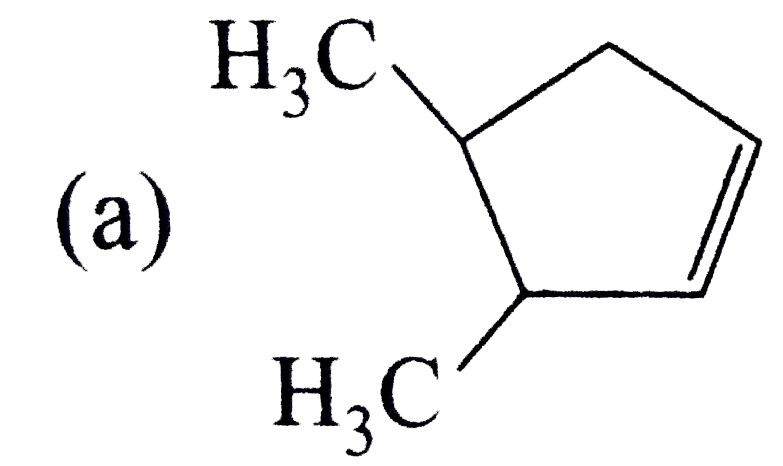
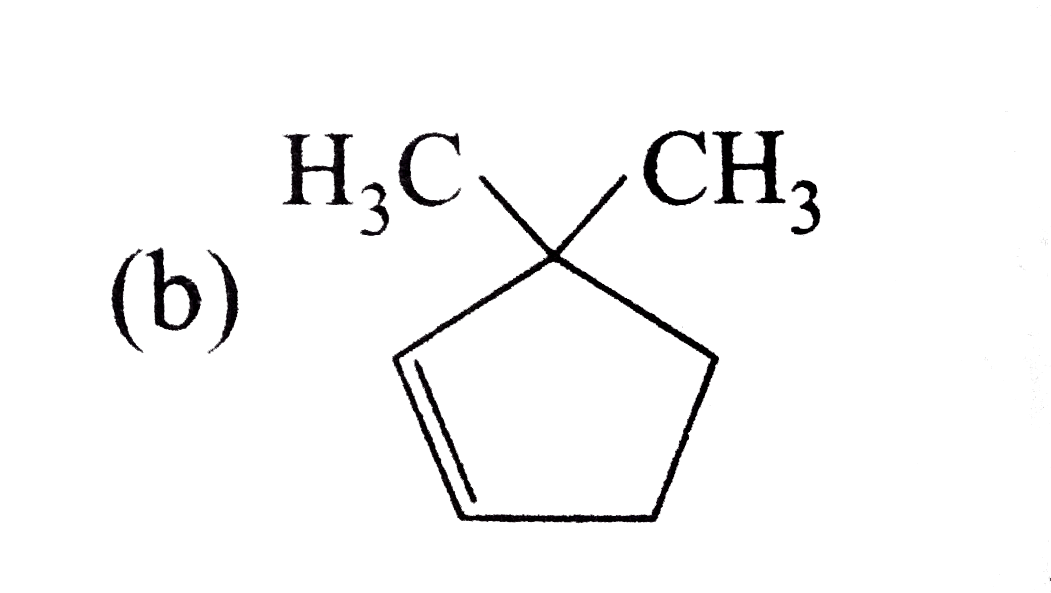
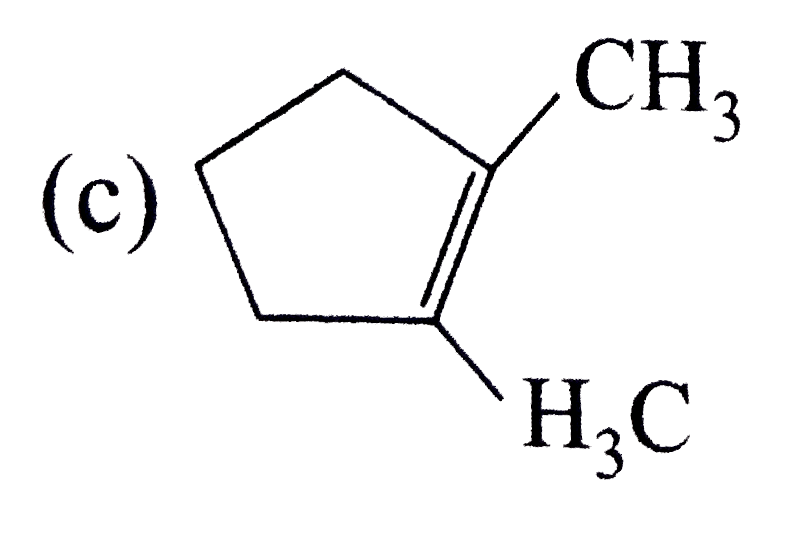
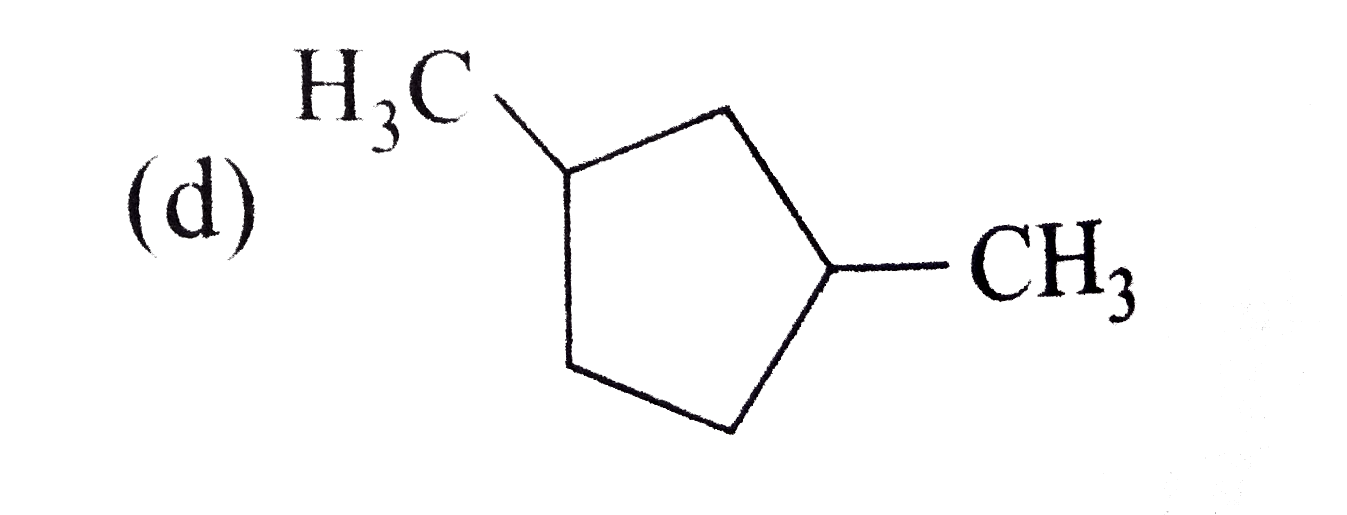
A single compound of the structure is obtained from ozonolysis of twhich of the followiing cyclic compounds ? |
|
Answer»
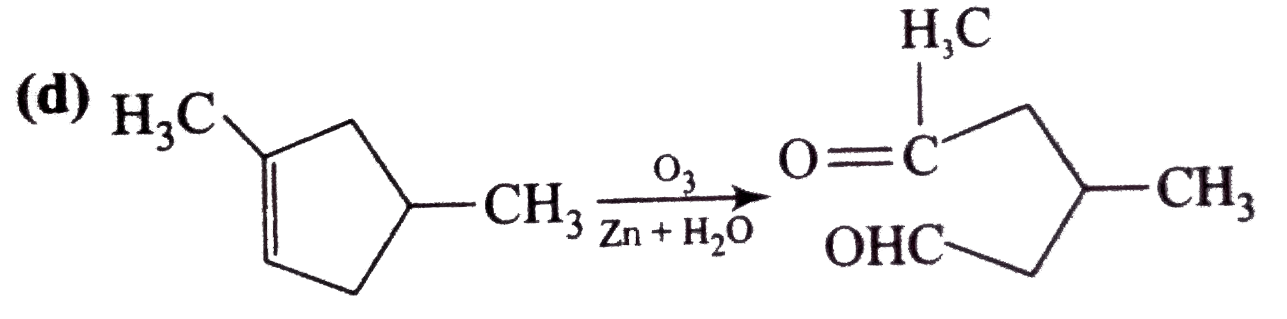
|
|
| 47. |
A simplified application of MO theory to the hypothetical "molecule" OF would give its bond order as |
|
Answer» 2 |
|
| 48. |
A Simple aromatic hydrocarbon A reacts with Cl_2 to give B of molecular formula C_6H_5Cl. B on reaction with ethyl chloride along with sodium metal gives C of formula C_8H_10.C alone reacts with Na metal in the presence of ether to give D C_12 H_10. Identify A,B,C & D. |
|
Answer» Solution : (i) The simple aromatic HYDROCARBON is `C_6H_6` Benzene (A) (ii) Benzene reacts with `Cl_2` to give chlorobenzene. `C_6H_6 + Cl_2 overset(FeCl_2) to underset("benzene")underset("Chloro")(C_6H_5Cl) + HCl_B` (III) Chlorobenzene reacts with ethyl CHLORIDE to FORM ethyl benzene, C as the product. `C_6H_5Cl + 2 Na+ C_2H_5Cl overset("ether")to underset("Ethyl benzene C")(C_6H_5- C_2H_5) + 2NaCl` (iv) Chlorobenzene on reaction Na metal gives Biphenyl compound D as the product. `C_6H_5Cl + 2Na + C_6H_5Clto underset("Biphenyl D")(C_6H_5-C_2H_5) + 2NaCl` 
|
|
| 49. |
A similarity between optical and geometrical isomerism is that |
|
Answer» each forms equal number of isomers for a GIVEN compound |
|