

Saved Bookmarks
This section includes 7 InterviewSolutions, each offering curated multiple-choice questions to sharpen your Current Affairs knowledge and support exam preparation. Choose a topic below to get started.
| 1. |
A solution of 1 litre has 0.6g of non-radioactive Fe^(3+) with mass no. 56. To this solution 0.209g of radioactoveFe^(2+) is added with mass no. 57 and the following reaction occurred. .^(57)Fe^(2+) + .^(56)Fe^(3+) rarr .^(57)Fe^(3+)+ .^(56)Fe^(2+) At the end of one hour it was found that 10^(-5) moles of non-radioactive .^(56)Fe^(2+) mol L^(-1) hr^(-1). Negalecting any charge in volume, calculate the activity of the sample at the end of 1 hr (t_(1//2) for .^(57)Fe^(2+) = 4.62 hr.) |
|
Answer» SOLUTION :`{:(,.^(57)Fe^(2+)+,.^(56)Fe^(3+)to,.^(57)Fe^(3+)+,.^(56)Fe^(2+)),("Before reaction",0.209/57,0.6/56,0,0),("After reaction",[0.209/57-10^(-5)],[0.6/56-10^(-5)],10^(-5),10^(-5)):}` `.^(57)Fe^(2+)` left after reaction `= 3.667xx10^(-3) - 10^(-5)` `= 366.6xx10^(5)` mole or `N_(0) = 366.6xx10^(-5)xx6.023xx10^(23) = 2.208xx10^(21)` Also `t = (2.303)/(lambda) log (N_(0))/(N)` `1 = (2.303xx4.62)/(0.693) log (2.208xx10^(21))/(N)` `N = 1.9xx10^(21)` `:.` Rate of decay `= lambda xx N = (0.693)/(4.62) xx 1.9xx10^(21)` `= 2.85xx10^(20)` DPH |
|
| 2. |
A solution of 0.1M KMnO_4is used for the reaction S_(2)O_(3)^(-2) + 2 MnO_(4)^(-) + H_(2)OrarrMnO_(2) +SO_(4)^(2-)+ OH^(-) . The volume of KMnO_4required to react 0.158gm of Na,s,o, is (MW = 158) |
|
Answer» 13.33 ML `V xx0.1 xx3=(0.158)/(((158)/8))xx1000` `V = 80/3 =26.67 ml` |
|
| 3. |
A solution of 0.01 MCd^(2+)contains 0.01M NH_4OH. What conc. Of NH_4^(+)from NH_4Cl is necessary to prevent precipitation of Cd( OH)_2?K_(sp) " of "(OH)_2 =2.0 xx 10^(-14) ,K_b " of "NH_4 OH = 1.8 xx 10^(-5)if answer is 1.272 xx 10^(-x)mol/litre then x=________? |
|
Answer» ` [OH^(-) ] =1.414 xx 10 ^(-6)rArr K_b =([NH_4^(+) ][OH^(-) ])/( [NH_4OH]) ` ` 1.8 xx 10 ^(-5)=([ NH_4^(+)][1.4 xx 10 ^(-6)])/( 10^(-2))` ` [NH_4^(+) ]=1.2 xx 10 ^(-1) ` |
|
| 4. |
A solution of (+) 2-chloro-2-phenyl ethane in toluene racemises slowly in the presence of small amount of SbCl_(5), due to the formation of……… |
|
Answer» CARBANION |
|
| 5. |
A solution is saturated with respect to SrCO_3 and SrF_2. The [CO_3^(2-)] was found to be1.2 xx 10^(-3)M.The concentration of F^(-)in the solution would be :(K_(sp)of SrCO_3 = 7xx 10^(-10)K_(sp)of SrF_2 =8xx 10^(-10)) |
|
Answer» ` 1.3 XX 10^(-3) M` `rArr [F^(-) ]^(2) =(Ksp_2)/(Ksp_1) xx [CO_3^(2-)]` ` [F^(-)]^(2)=(8xx 10^(-10))/( 7 xx 10 ^(-10)) xx 1.2 xx 10 ^(-3)` ` [F^(-)] =3.7 xx 10 ^(-2)` |
|
| 6. |
A solution is saturated in SrCO_(3), and SrF_(2). The CO_(3)^(2-) was found to be 10^(-3) mol/L. If the concentration of Fin solution is represented as yxx 10^(-2) M then what is the value of 'y'? [Given : K_(sp) (SrCO_(3))= 2.5 xx10^(-10), K_(sp) (SrF_(2))= 10^(-10)] |
|
Answer» ` 1.3 xx 10^(-3) M` `RARR [F^(-) ]^(2) =(Ksp_2)/(Ksp_1) xx [CO_3^(2-)]` ` [F^(-)]^(2)=(8XX 10^(-10))/( 7 xx 10 ^(-10)) xx 1.2 xx 10 ^(-3)` ` [F^(-)] =3.7 xx 10 ^(-2)` |
|
| 7. |
A solution is prepared by mixing 100 ml of 0.1 MNH_(4) OH and 200 ml of 0.2 M NH_(4) Cl . pK_(b) of NH_(4) OH is 4.8 . Then the pH of the solution is |
|
Answer» `9.0` |
|
| 8. |
A solution is prepared by dissolving 46 g of ethyl alcohol in 90 g of water. The mole fraction of ethyl alcohol in this solution is: |
|
Answer» `46/90` No. of moles `(n_(B))` of WATER `=90/18=5` `therefore` Mole FRACTIONI of ethyl alcohol `=n_(A)/(n_(A) + n_(B)) = 1/(1+5) = 1/6` |
|
| 9. |
A solution is prepared by dissolving 18.25 g NaOH in 200 mL of it. Calculate the molarity of the solution. |
|
Answer» `= 2.281 "mol L"^(-1) = 2.281 M`. |
|
| 10. |
A solution is prepared by dissolving 2.0 g of glucose and 4.0 g urea in 100 g of water at 298 K . Calculate the vapour pressure of the solution ,If the vapour pressure of pure water is23.756 torr. (Molecular mass of urea = 60 and glucose= 180g mol^(-1)) |
|
Answer» <P> SOLUTION :(i)`x_A =( n_A)/( n_A+n_B)`` n_A ="No of moles WATER "` `n_B = "No. of MOLESOF glucose " ` `n_A =( 100)/( 18 ) = 5.555` ` n_B =(2)/( 180) = 0.0111` Total moles ` (n_A+n_B) = 5.566` (ii)Urea ` n_A = "No. of moles of water " ` ` n_B=" No. of mole of urea " ` `n_A = 5.555` ` n_B=( 4)/( 60) = 0.0666 " moles of urea "` Total moles ` = 0.555+ 0.066 moles ` `x_B = ( n_A)/( n_A+n_B) ` `= ( 5.555)/( 5.621) = 0.9882` `P_B = P^(@) xx x_B ` `""= 23.756xx 0.9882` ` P_B = 23.42 torr` |
|
| 11. |
A solution is prepared by dissolving 0.63 g of oxalic acid in 100 cm^(3) of water. Find the normality of the solution. |
|
Answer» Solution :Molecular mass of oxalic acid, `(COOH)_(2) . 2H_(2)O = 126` BASICITY of oxalic acid =2 `therefore` EQUIVALENT mass of oxalic acid `=126/2 = 63` Number of gram equivalents of oxalic acid DISSOLVED `=0.63/63 = 0.01` Volume of the solution `=100 cm^(3) = 100/1000 L = 0.1 L` NORMALITY of the solution `=("No. of g eq. of oxalic acid")/("Volume in litres")` `=0.01/0.1 = 0.1 g eq. L^(-1)` |
|
| 12. |
A solution is prepared by adding 4g of a solute A to 36 of water. Calculate the mass percent of the solute. |
|
Answer» |
|
| 13. |
A solution is prepared by adding 5g of a solute 'X' to 45 g of solvent 'Y'. What is the mass percent of the solute 'X' ? |
|
Answer» 0.1 `5/(5+45)xx100`=10% |
|
| 14. |
A solution is prepared by adding 2 g of a substance A to 18 g of water. Calculate the mass percent of the solute. |
|
Answer» `= (2G)/(2 g A + 18 g "of water") xx 100` `= (2g)/(20g) xx 100 = 10%` |
|
| 15. |
A solution is prepared by adding 2 g of a substance A to 18 g of water. Calculate the massper cent of the solute |
| Answer» SOLUTION :Mass PER cent of `A="Mass ofA"/"Mass of solution"xx100=(2g)/("2g of A+18g of WATER")xx100=(2g)/(20g)xx100=10%` | |
| 16. |
A solution is obtained by mixing 300 g of 25% solution and 400 g of 40% solution by mass. Calculate the mass percentage of the resulting solution. |
|
Answer» Solution :300 g of `25%` solution containsd solute = 75 g 400 g of `40%` solution contains solute = 160 g TOTAL MASS of soute `= 160 + 75 = 235g` Total mass of solution `= 300 + 400 = 700 g` `%` of solute in the final solution `= (235)/(700) xx 100 = 33.5%` `%` of water in the final solution `= 100 - 33.5 = 66.5%` |
|
| 17. |
A solution is made by dissolving 49g of H_2SO_4 in 250 mL of water. The molarity of the solution prepared is |
|
Answer» 2 M =`49/98xx1000/250` =2M |
|
| 18. |
A solution is made by dissolving 49 g of H_(2)SO_(4) in 250 mL of water. The molarity of the solution prepared is |
|
Answer» 2 M |
|
| 19. |
A solution is found to contain 0.63 g of nitric acid per 100 ml of the solution . What is the pH of the solution if the acid is completely dissociated ? |
|
Answer» Solution :Concentrationof `HNO_(3)` solution = 0.63 g PER 100 ML (Given) `=6.3 g ` per litre `= (6.3)/(63) ` moles/litre = `10^(-1)M` (`:' ` Mol. Mass of `HNO_(3) = 63`) Now, `HNO_(3)`, completely ionizes as : `HNO_(3)H_(2)O rarrH_(3)O^(+)+NO_(3)^(-)` `:. [H_(3)O^(+)]=[HNO_(3)]=10^(-1)M :. pH = - log [H_(3)O^(+)]= - log 10^(-1)=1` |
|
| 20. |
A solution is containing 2.52g "litre"^(-1) of a reductant, 25mL of this solution required 20 mL of 0.01M KMnO_(4) in acid medium for ocidation. Find the mol. Wt of reducant. Given that each of the two atoms which undergo oxidation per molecule of reducant, suffer an increasein oxidation state by one unit. |
|
Answer» |
|
| 21. |
A solution is formed by mixing 0.2 M NH_(4)Cl and 0.1M NH_(3). The pH of the solution will be close to (pK_(b) of ammonia solution = 4.75). |
|
Answer» `=4.75+ log 2 = 4.75 + 0.3010 ~=5.0` `:. PH = 14 - 5.0 = 9`. |
|
| 22. |
A solution is0.01 M Kland 0. 1 M KCl . If solidAgNO_3is added to the solution, what is the [1^(-) ] when AgClbegins to precipitate[K_(sp) (Agl) =1.5 xx 10^(-16) , K_(sp)(AgCl) =1.8 xx 10^(-10)] |
|
Answer» ` 3.5 xx 10^(-7)` ` [Ag^(+) ] =(1.8 xx 10^(-10))/( 10^(-1) )= 1.8 xx 10^(-9) ` ` [I^(-) ]=(K_(sp) )/( [Ag^(+) ]_(cl^(-) ))=(1.5 xx10^(-16))/( 1.8 xx 10^(-19)) = 8.3 xx 10 ^(-8) M` |
|
| 23. |
A solution has been prepared by dissolved 60 g of methyl alcohol in 120 g of water. What is the mole fraction of methyl alcohol and water ? |
|
Answer» Moles of water `= ("Mass of water")/("Molar mass")=((120g)/("18 g mol"^(-1)))=6.667` mol Mole fraction of `CH_(3)OH=(("1.875 mol"))/(("1.875 mol +6.667 mol"))=(("1.875 mol"))/(("8.542 mol"))=0.220` Mole fraction water `= 1 - 0.220 = 0.780`. |
|
| 24. |
A solution gives yellow colour with orange, methyl red and phenol red. What is the pH of the solution ? |
|
Answer» SOLUTION :Yellow colour with methyl ORANGE MEANS `PH gt 4.5` Yellow colour with methyl redmeans pH ` gt6.2` Yellow colour with phenol red means `pH lt 6.4` . Hence, thesolution has pH between 6.2 to 6.4. |
|
| 25. |
A solution cotaning 0.10 M in Ba(NO_(3))_(2) and 0.10 M in Sr(NO_(3))_(2). If solid Na_(2)CrO_(4) is added to the solution, what is [Ba^(2+)], when SrCrO_(4) beings to precipitate? [K_(sp)(BaCrO_(4)) = 1.2 xx 10^(-10), K_(sp) (SrCrO_(4)) = 3.5 xx 10^(-5)] |
|
Answer» `7.4 XX 10^(-7)` `[CrO_(4)^(2-)] = (3.5 xx 10^(-5))/(0.1)= 3.5 xx 10^(-4)` `K_(sp)(BaCrO_(4)) = [Ba^(2)][CrO_(4)^(2-)]` `[CrO_(4)^(2-)]_("total") = [CrO_(4)^(2-)]` from `SrCrO_(4)` `[Ba^(2+)] = (1.2 xx 10^(-10))/(3.5 xx 10^(-4)) = 3.4 xx 10^(-7)` |
|
| 26. |
A solution contians 0.1 M NaCl, 0.01 M NaBr and 0.001 M Nal.solid AgNO_(3)is gradually added to the solution and its addition K_(sp)AgCl = 10^(-10), K_(sp) AgBr = 10^(-13), K_(sp)AgI = 10^(-17) choose the correct statements |
|
Answer» `AgI` PRECIPITATES first Solution also turn s methly orange red `[H^(+)] gt [H^(-)]` then (B) (C) and (D) are CORRECT. |
|
| 27. |
A solution contains Na_(2)CO_(3) " and " NaHCO_(3), 10 mL of this solution required 2.5 mL of 0.1 M H_(2)SO_(4) for neutralisation using phenolphthalein indicator. Methyl orange is added after first end point, further titration required 2.5 mL of 0.2 M H_(2)SO_(4). The amount of Na_(2)CO_(3) " and " NaHCO_(3) in 1 litre of the solution is : |
|
Answer» 5.3 G and 4.2 g |
|
| 28. |
A solution contains Na_(2)CO_(3) " and " NaHCO_(3). 10 mL of the solution required 2.5 mL of 0.1 MH_(2)SO_(4) forneutralisation using phenolphthalein as indicator. Methyl orange is then added when a further 2.5 mL of 0.2 M H_(2)SO_(4) was required. Calculate the amount of Na_(2)CO_(3) " and" NaHCO_(3) in one litre of the solution. |
|
Answer» SOLUTION :2.5 mL of `0.1 M H_(2)SO_(4)=2.5 mL " of" 0.2 N H_(2)SO_(4)` `=(1)/(2)Na_(2)CO_(3)` present in 10 mL of mixture So, `5 mL " of" 0.2 N H_(2)SO_(4)=Na_(2)CO_(3)` present in 10 mL of mixture `-=5 mL " of" 0.2 N Na_(2)CO_(3)` `-=(0.2xx53)/(1000)xx5=0.053 g` Amount of `Na_(2)CO_(3)=(0.053)/(10)xx1000=5.3 g//L` of mixture Between first and second end POINTS, =2.5 mL of `0.2 M H_(2)SO_(4)` used =2.5 mL of `0.4N H_(2)SO_(4)` used =5 mL of `0.2 N H_(2)SO_(4)` used `-=(1)/(2)Na_(2)CO_(3)+NaHCO_(3)` present in 10 mL of mixture `(5-2.5)mL 0.2 N H_(2)SO_(4)` `-=NaHCO_(3)` present in 10 mL of mixture `-=2.5 mL 0.2 N NaHCO_(3)` `-=(0.2xx84)/(1000)xx2.5=0.042 g` Amount of `NaHCO_(3)=(0.042)(10)xx1000=4.20 g//L` of mixture. |
|
| 29. |
A solution contains Na_(2)CO_(3) " and " NaHCO_(3). 10 mL of the solution required 2.5 mL of 0.1 M H_(2)SO_(4) for neutralisation using phenophthalein as indicator. Methyl orange is then added when a further 2.5 mL of 0.2 M H_(2)SO_(4) was required . Then the amount of Na_(2)CO_(3) " and " NaHCO_(3) in 1 litre of the solution is : |
|
Answer» 5.3 G and 4.2 g |
|
| 30. |
A solution contains mixture of H_(2)SO_(4), H_(2)C_(2)O_420 ml of this solution requires 40 ml of M/10NaOH for neutralization and 20 ml of N/10 KMnO_4 for oxidation. The molarity of H_2C_2O_4, H_2SO_4 are |
|
Answer» ` 0.1, 0.1` No. of milli equivalents of `(H_2SO_4+H_2C_2O_4)` = No. of milli EQUIVALENT of NaOH `20(2M_1+2M_2)=40xx1/10` `40(M_1+M_2)=4` `M_1+M_2=0.1 ""...(1)` No.of milli equivalents of `H_(2)C_(2)O_(4)=` No. of mili equivalents `KMnO_4` `20(2M_2)=20 xx1/10` `M_(2) =1/20 =0.05 M...(2)` `M_1 =0.1 -0.05 =0.05M` |
|
| 31. |
A solution contains equimolar concentration of a weak acid HA and its conjugate base A^(-) , p K_(b) of A^(-) is 9 . The pH of the solution is |
|
Answer» 9 |
|
| 32. |
A solution contains a mixture of isotopes of X^(A)(t_(1//2) = 14 days) and X^(A_(2)) (t_(1//2) = 25 days(. Total acticity is 1 curie at t = 0. The activity reduces by 50% in 20 days. Find: (a) The initial activitites of X^(A_(1)) and X^(A_(2)) (b) The ratio of theirinitial no.of nuclei. |
|
Answer» |
|
| 33. |
A solution contains 410.3 g of H_2SO_4 per litre of the solution at 20°C. If its density is 1.243 g cm^(-3), what will be its molality and molarity ? |
|
Answer» |
|
| 34. |
A solution contains 25% water, 25% ethanol and 50% acetic acid by mass. Calculate the mole fraction of each component. |
|
Answer» SOLUTION :Suppose, we have 100 g of the GIVEN solution. Then, mass of WATER = 25g mass of ethanol = 25 g and mass of acetic acid = 50 g. The molecular MASSES of water, ethanol and acetic acid are 18, 46 and 60 RESPECTIVELY. Therefore, number of moles of water `(n_(1)) = 25/18 = 1.39` number of moles of ethanol `(n_(2)) = 25/46 = 0.54` and number of moles of acetic acid `(n_(3)) = 50/60 = 0.83` Total number of moles in solution = `n_(1) + n_(2) + n_(3) = 1.39 + 0.54 + 0.83 = 2.76` Mole fraction of water = `n_(1)/(n_(1) + n_(2)+ n_(3))` `=1.39/2.76 = 0.503` Mole fraction of ethanol `=n_(2)/(n_(1) + n_(2) + n_(3))` `=0.54/2.76 = 0.196` Mole fraction of acetic acid = `n_(3)/(n_(1) + n_(2) + n_(3)) = 0.83/2.76 = 0.301` |
|
| 35. |
A solution contains 20 g of sodium chloride in 95 cm^(3) solution. The density of solution is 1.25 "g cm"^(-3). What is the mass percent of NaCl ? |
|
Answer» MASS of solution = volume `xx` density `= ("95 cm"^(3))xx("1.25 g cm"^(-3))=118.75`g Mass PERCENT of NaCl `= ("Mass of NaCl")/("Mass of solution")xx100` `=((20g))/((118.75g))xx100=16.84%`. |
|
| 36. |
A solutioncontains 1 milli-curiefo L- phenyol alanine C^(14)(unifromly labellled) in 2.0mL solution. The activity of labelled sample is given as 150 milli-curie/milli-mole. Calculatate: (a) The concentration of sample in the solution inmol/litre. (b) The actitivity of the solution in terms of counting per minute/mL at a countingefficiencyof 80%. |
|
Answer» |
|
| 37. |
A solution contains 1 g mol. Each of p-toluene diazonium chloride and p-nitrophyenl diazonium chloride. To this 1g mol. Of alkaline of phenol is added. Predict the major product. Explain you answer. |
Answer» Solution :This reaction is an example of electrophilic AROMATIC substitution. In alkaline MEDIUM, phenol generates phenoxide ION which is more electron rich than phenol and hence more reactive for electrophilic ATTACK. The electrophile ini this reaction is aryladizonium cation. Stronger the electrophile faster is the reaction. p Nitrophenyldiazonium cation is a stronger electrophile than p-toluene diazonium cation. Therefore, it couples preferntially with phenol. 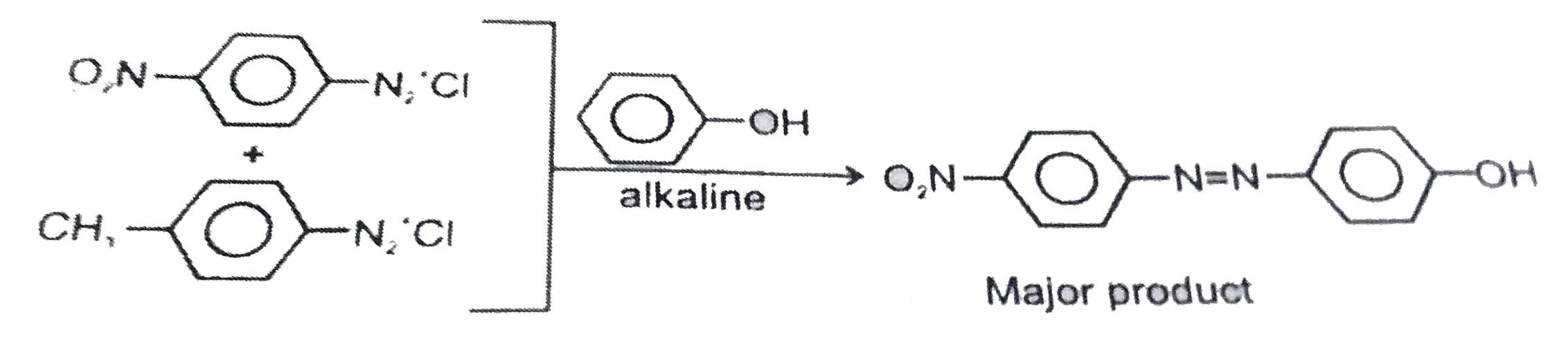
|
|
| 38. |
A solution contains 0.1M H_2S and 0.3M HCI. If K_a and K_(a2) for H_2 S are 1 xx 10^(-7) and 1.3 xx 10^(-13) respectively, calculate concentration of HS^- and S^- in the mixture. |
|
Answer» SOLUTION :First ionisation, step 1 `,H_2 ShArr H^(+) +HS^(-) """ K_a = 1 xx 10^(-7)` Second ionisation, step 2,`HS^(-)hArr H^(+)+s^(2-) "" K_(a_2) = 3 xx 10^(-13)` Presence of HCI supresses the dissociation of `H_2 S` due to common ion effect of `H^(+)`. For step `1,1 xx 10^(-7)= ([H^+][HS^(-)])/( [H_2 S])=(0.3[HS^(-)])/( 0.1)` Cocentrationof `HS^(-) `,`[HS^(-)])= 3.3 xx 10^(-8)mol L^(-1)` or step` 2,1,.3 xx 10^(-13) = ([H^+] [S^(2-)])/([HS^(-)]) = ( 0.3 [S^(2-)])/(3.3 xx 10^(-8))` concentrationof `s^(2-) , [S^(2-)] = 1.43 xx 10^(-20) mol L^(-1)` |
|
| 39. |
A solution contains 0.05M of each of NaCl and Na_(2),CrO_(4),. Solid AgNO_(3), is gradually added to it. Whichof the following facts true (Given: K_(sp)(AgCl) = 1.7xx 106(-10) M^(2) and K_(sp)(Ag_(2),CrO_(4),) = 1.9 xx 10^(-12) M^(3): |
|
Answer» `Cl^(-) ` ions are precipitated first ` [Ag^(+) ]_(CrO_4^(_2) ) = sqrt( (1.9 xx 10^(-12))/(5 xx 10 ^(_2)))=6.1 xx 10 ^(_6) M` ` Cl^(_) `Starts precipitation first ` [Cl^(-)] =(K_(SP))/( [Ag^(+)]_(CrO_4^(_2)))= (1.7 xx 10 ^(-10))/(6.1 xx 10^(_6)) ` ` ""= 2.78 xx 10 ^(_5) M` |
|
| 40. |
A solution containing NH_(4)Cl and NH_(4)OH has [OH]=10^(-6) mol L^(-1), which of the following hydroxides would be precipitated when this solution in added in equal volume to a solution containing 0.1 M of metal ions? |
|
Answer» `Mg(OH)_(2) (K_(SP)=3xx10^(-11))` `:. [OH]=(10^(6))/(2),[M^(+N)]=(0.1)/(2)` `Q_(sp)` ( or `IP`) of metal hydroxides of `M(OH)_(2)` type `=[M^(+n)][OH]^(2)` `=((0.1)/(2))((10^(-6))/(2))^(2)=(1)/(8)xx10^(-13)` `=0.125xx10^(-13)=12.5xx10^(-11)` `:. Q_(sp) lt K_(sp)` of `Mg(OH)_(2) (1.25xx10^(-11)gt3xx10^(-11))` and `Q_(sp)gtK_(sp)` of `Fe(OH)_(2) (1.25xx10^(-11)gt8xx10^(-16))` So both can be precipitated. Since the `K_(sp)` of `Fe(OH)_(2)` is less than `K_(sp)` of `Mg(OH)_(2)`, so `Fe(OH)_(2)` will be precipitated FIRST. Similarly, `Q_(sp)` (or `IP`) of metal hydroxides of `M(OH)` type `=[M^(+1)][OH]=((0.1)/(2))((10^(-6))/(2))=0.25xx10^(-7)` `= Q_(sp)ltK_(sp)` of `AgOH(0.25xx10^(-7)lt5xx10^(-3))` It cannot be precipitated out. Hence `Fe(OH)_(2)` will be precipitated |
|
| 41. |
A solution containing Na_(2)CO_(3) and NaOH requires 300 mL of 0.1 NHCl using phenolphthalein as an indicator. Methyl orange is then added to above titrated solution when a further 25 mL of 0.2 M HCl is required. The amount of NaOH present in the original solution is |
|
Answer» 0.5 G |
|
| 42. |
A solution containing Na_(2)CO_(3) and NaOH requires 300 mL of 0.1 N HCl using phenolphthalein as an indicator. Methyl orange is then added to above titrated solution when a further 25 mL of 0.2 N HCl is required. The amount of NaOH present in the original solution is : |
|
Answer» 0.5 g THUS, 250 mL of 0.1 N HCl is required to neutralise NaOH completely. `N_(1)V_(1)(NaOH)=N_(2)V_(2)(HCl)` `=0.1xx250` =25 `W_(NaOH)=(ENV)/(1000)=(40xx25)/(1000)=1 g` |
|
| 43. |
A solution containing Fe^(2+) ions is titrated with KMnO_(4) solution, Indicator used will be : |
|
Answer» phenolphthalein |
|
| 44. |
A solution containing Cu^(2+) and C_(2)O_(4)^(2-) ions is titrated with 20 " mL of " (M)/(4) KMnO_(4) solution in acidic medium. The resulting solution is treated with excess of KI after neutralisation. The evolved I_(2) is then absorbed is 25 " mL of " (M)/(10) hypo solution. Which of the following statements are correct? |
|
Answer» The difference of the number of m " mol of "`Cu^(2+)` and `C_(2)O_(4)^(2-)` ions in the SOLUTION is 10 m mol Only `C_(2)O_(4)^(2-)` reacts with `MnO_(4)^(2-)` `MnO_(4)^(ɵ)=C_(2)O_(4)^(2-)` `(n=5)(n=2)` `mEq-=mEq` `20xx(M)/(4)xx5-=mEq` `thereforem" Eq of "C_(2)O_(4)^(2-)=25` `mmoles of `C_(2)O_(4)^(2-)=(25)/(2)=12.5` (II). `Cu^(2+)=KI-=I_(2)=S_(2)O_(3)^(2-)` (hypo) `mEq-=mEq-=mEq-=mEq` `(2Cu^(2+)+2I^(ɵ)toCu_(2)I_(2))(2S_(2)O_(3)^(2-)to_S_(4)O_(6)^(2-)+2e^(-))` `(e+Cu^(2+)toCu^(1+))` `m" Eq of "S_(2)O_(3)^(2-)-=25xx(M)/(10)xx1` `=2.5m" Eq of "Cu^(2+)` `m" Eq of "Cu^(2+)=2.5` `mmoles of Cu^(2+)=(2.5)/(1)=2.5` Difference in mmoles of `C_(2)O_(4)^(2-)` and `Cu^(2+)=12.5-2.5=10` EW of `Cu^(2+)=("atomic weight" of Cu^(2+))/(1("n-factor"=1))` Ew of `KI=(M)/("nfactor")=(M)/(1)=M{:(2I^(ɵ)toI_(2)+2e^(-)),(n=(2)/(2)=1):}` |
|
| 45. |
A solution containing a weak acid and its conjugate acts as an acidic buffer. In a buffer the dissociation of the well acid is suppressed by its conjugate base. (K_(1),K_(2), and K_(3), of H_(3)PO_(4), are 10_(-4), 10^(-4), 10^(-13) respectively What is the P^(H) of a solution obtained by mixing 100ml of 0.1 MH(3) PO_(4), and 150ml of 0.IM NaOH |
|
Answer» `8` ` {:( 10 m " MOLES " , 15 m " moles" ,0) , ( - ,10" moles " , 10 "moles " ), (- , 5 " moles " , 10 m " moles ") :} ` ` NaH_2PO_4 + NaOH to Na_2HPO_4 + H_2O ` ` {:( 10 m " moles" , 5 m " moles ",0),( 5, - , 5 m " moles " ),( 5 m " moles" ,- , 5 m " moles") :} ` ` pH =P^(K_(A2)) + log ""(S)/(A)rArr pH = 8` |
|
| 46. |
A solution containing a weak acid and its conjugate acts as an acidic buffer. In a buffer the dissociation of the well acid is suppressed by its conjugate base. (K_(1),K_(2), and K_(3), of H_(3)PO_(4), are 10_(-4), 10^(-4), 10^(-13) respectively Which of the following volume of 0.1 M NaOH added to 100 mlof 0.1MH_(3),PO_(4), does not form a buffer |
|
Answer» 50 ml |
|
| 47. |
A solution containing 8 g of a substance in 100 g of diethyl ether boils at 36.86^(@)C, whereas pure ether boils at 35.60^(@)C. Determine the molecular mass of the solute (For ether K_(b)= 2.02 K kg mol ^(-1)) |
|
Answer» SOLUTION :We have, mass of SOLUTE,` W_(2)=8g` Mass of solvent, `W_(1) = 100 g ` Elevation of boiling point, `Delta T_(b) = 36.86 - 35.60=1.26 ^(@)C` `K_(b)=2.02` Molecular mass of the solute `M _(2) = ( 1000 xx W_(2) xx K _(b))/(Delta T_(b) xx W_(1))= (1000 xx 8 xx 2.02)/(1.26 xx 100) = (161.6)/(1.26)` `= 128.25 g mol ^(-1).` |
|
| 48. |
A solution containing 6 gm of a solute dissolved in 250 ml of water gave an osmotic pressure of 4.5 atmosphere at 27^(@)C. Calculate the boiling point of the solution. The molal elevation constant for water is 0.52 |
|
Answer» |
|
| 49. |
A solution containing 2.68 xx 10^(-3)mol of A^(n+)ions requires 1.61xx10^(-3)mol of MnO_(4)^(-)for the complete oxidation of A^(n+) "to "AO_3^(-)in acidic medium. What is the value of n ? |
|
Answer» `2.68xx10^(-3)xx(5-n)=1.61xx10^(-3)XX5, :. N ~~2` |
|
| 50. |
A solution containing 2.5 g of a non-volatile solute in 100 gm of benzene boiled at a temperature 0.42K higher than at the pure solvent boiled. What is the molecular weight of the solute? The molal elevation constant of benzene is "2.67 K kg mol"^(-1). |
|
Answer» SOLUTION :`K_(b)="2.67 K KG mol"^(-1)` `DeltaT_(b)=0.42K` `W_(1)=100g=(100)/(1000)kg=0.1Kg` `W_(2)=(K_(b))/(DeltaT_(b)).(W_(2))/(W_(1))` `M_(2)=(2.67)/(0.42)XX(2.5)/(0.1)` `M_(2)="158.98 g mol"^(-1)` |
|