

Saved Bookmarks
This section includes InterviewSolutions, each offering curated multiple-choice questions to sharpen your knowledge and support exam preparation. Choose a topic below to get started.
| 18451. |
Question : Define the term natality. |
|
Answer» Solution :Natality : 1. Natality is the rate of production of new individuals in a population PER unit time perunit area. 2. For human population the birth of new individuals is TAKEN into consideration. 3. Population perunit time per unit area is taken as midyear population. `"Natality"=overset("Number of BIRTHS in the YEAR")underset("Mid year population")toxx1000` |
|
| 18452. |
Question : Define the term mutation . Who coined the term ? |
| Answer» SOLUTION :A SUDDEN CHANGE in the genetic material of an ORGANISM is called mutation. The term mutation was introduced by Hugo DE Varies. | |
| 18453. |
Question : Define euheterosis. |
| Answer» Solution :The superiority of the `F_(1)` hybrid in PERFORMANCE over its PARENTS is called HETEROSIS. Euheterosis is the true heterosis which is INHERITED. | |
| 18454. |
Question : Define the term heterogamesis. |
| Answer» Solution :CHROMOSOMAL MECHANISM of sex determination is CALLED HETEROGAMESIS. | |
| 18455. |
Question : Define the term genome. And Who gave the term genome? |
|
Answer» SOLUTION :The GENOME of any organism is the total number of genes present on the HAPLOID set of chromosomes. The term genome was proposed by J. Winkler in 1920 and was used for the first time by Thomas RODERICK in 1986. |
|
| 18456. |
Question : Define Endemism. Name any two regions of accelerated habitat loss in India? |
|
Answer» Solution :The SPECIES CONFINED to a PARTICULAR region and not found any where else , this can be CONSIDERED as Endemism. WESTERN ghats and Srilanka. Himalayas etc are region of accelerated habitat loss in India. |
|
| 18457. |
Question : Define the term Germplasm |
| Answer» SOLUTION :According to Weisnann, germplasm is protoplasm contained INSIDE the GERM cells that is transmitted from GENERATION to generation. | |
| 18458. |
Question : Define the term eutrophication. |
| Answer» Solution :When run-off from LAND containing nutrients reaches water bodies like lakes, it results in dense growth of plant LIFE. This PHENOMENON is CALLED Eutrophication. | |
| 18459. |
Question : Define the term Diplospory . |
|
Answer» Solution :A diploid embryro SAC is formed from MEGASPORE mother cell without a REGULAR meiotic DIVISION. Example: Eupatorium and Aerva. It is a type of apomixis. |
|
| 18460. |
Question : Define endemism. |
| Answer» Solution :ENDEMISM: A species or a taxon which is CONFINED to a specific area E..g: NILGIRI Thar | |
| 18461. |
Question : Define the term biopiracy. Explain the issue of Basmati rice patent in this context. |
| Answer» Solution :Biopiracy is the term used to refer the use of bio-resources by multinational companies and other organisation without proper authorisation from the countries and people.concerned without COMPENSATORY payment. Basmati rice are GROWN in INDIA for centuries. An American company got patent rights on Basmati, proclaiming that they produced a new variety. But this new variety was actually produced from Indian farmer.s variety combined with some semi-dwarf VARIETIES. The new patent gives the company the right to prevent other people from SELLING Basmati rice. | |
| 18462. |
Question : Define ectoparasite and endoparasite and give suitable examples. |
|
Answer» Solution :•Parasites that FEED on the external SURFACE of the host organism are called ectoparasites. • The most common examples of this GROUP are the lice on humans and ticks on dogs. • Endoparasites are those that live inside the host body at different sites (liver, kidney, lungs, RED blood cells, etc.). • The human liver fluke (a TREMATODE parasite) is an endoparasite. |
|
| 18463. |
Question : Define the term Agroforestry. Name any two major tree species cultivated in Agroforestry. |
| Answer» Solution :Agroforestry is an integration of trees, CROPS and livestock on the name plot of LAND. The COMMERCIAL Agroforestry trees are casuarina and Eucalyptus. | |
| 18464. |
Question : Define the term Adaptation |
| Answer» SOLUTION :It is the phenotypic or genotypic CHANGES in morphology, physiology and behaviour of ORGANISMS make them SUITED to a particular environment. | |
| 18465. |
Question : Define embryogenesis. |
| Answer» SOLUTION :EMBRYOGENESIS is the DEVELOPMENT of ZYGOTE into an EMBRYO. | |
| 18466. |
Question : Define the patent type - Grant. |
| Answer» Solution :Grant is a signed DOCUMENT, actually the AGREEMENT that GRANTS patent right to the INVENTOR. It is filled at patent office and not published. | |
| 18467. |
Question : Define the nature of uterus. |
| Answer» Solution :The uterus or womb is a hollow, thick-walled, muscular, highly vascular and INVERTED pear shaped structure LYING in the PELVIC cavity between the URINARY bladder and RECTUM. | |
| 18468. |
Question : Name and explain the branches of ecology. |
| Answer» Solution :Ecology is the STUDY of the RECIPROCAL relationship between LIVING organisms and their ENVIRONMENT. | |
| 18469. |
Question : Define the Homologous chromosomes |
| Answer» Solution :CHROMOSOMES which are SIMILAR in morphology and genetic constitution are CALLED homologouschromosomes. | |
| 18470. |
Question : Define ecological pyramids and describe with examples, pyramids of number and biomass. |
|
Answer» SOLUTION :An ecological pyramid maybe defined as a graphicalrepresentation of the number or biomass or status of accumulated energy at different trophic levels in a food chain in an ecosystem . a.Pyramid of numbers : A pyramid of numbers is the GRAPHICAL representation depicting the arrangement of number of individuls of different trophic level in a food chain in an ecosystem . The pyramid of numbers is found in animal communities . The shape of the pyramids may be upringht . e.g. Food chain in a grassland ecosystem or pond ecosystem and INVERTED . e.g. Parasitive food chain . b. Pyramid of biomass : Pyramid of biomass is a graphicalrepresentation of biomass PRESENT per unit area in different trophic levels . e.g. Grassland and forest ecosystem . |
|
| 18471. |
Question : Define the following terms: i) Commensalism ii) Brood parasitism iii) Mutualism. |
|
Answer» SOLUTION :i) Commensalism- It is the INTERACTION between two species where one species is benefited and the other is neither harmed nor benefited. Eg, an orchid growing as an epiphyte on a mongo tree benefits by getting shelter and nutrition but the MANGO tree is not affected. ii) Brood parasitism- The phenomenon in which organism lay its egg in the nest of another organism iii) Mutualisin-It refers to the INTERSPECIFIC interaction in which both the INTERACTING species are benefited. |
|
| 18472. |
Question : Define the following terms and give one example for each: Resource partitioning |
|
Answer» Solution :Resource partitioning : If TWO species compete for the same source, they could avoid COMPETITION by choosing different times for FEEDING. Eg :- Five closely related species of warbles living on the same tree avoid competition and co-exist DUE to behavioural difference in their FORAGING activities. |
|
| 18473. |
Question : Define ecological pyramids and descibe with example the different types: |
|
Answer» Solution :It is the genetic representation of trophic structure and function of a food chain . It is so called due to its superfical to EGYPTIAN pyramid .The pyramid concept of a in ecologo was propsed by Charles Eltion and hence they are also Eltonian pyramids. It is usually largs below and tapering to an apex above . Produces occupy the broad base while animals or consumers occupy successive steps tapering into the apex of the pyramid. There are 4 tyoes of ecological , pyramids ,namely 1 Pyramid of Number : It is graphic representation of numerical relationship between succesive trophic levels in a food chain. Usually it is anupright pyramid and it illustrates decreasing number of individuals at succesive tropics level from the proxlucers in consumers . Number of individuals is maximum in producres compared to consumber e,g : Pond food chain. Pyramid of Biomass: It is graphical reprsentation of biomass is the total dry weight of an organism or all organisms of a trophic level . It is expressed as pounds or kilograms . Usually it is an upright pyramid and illustrates decreasing biomass at successive trophic level from producers at the base to the consumers. Biomass of producers at the base to the consumers e,g .: pomd of chain. Pyramid of Energy : It is graphic representation of available energy at successive trophic levels in a food chain .Energy level is as kilocalorie .It is the typical upright pyramid . It illustrate decreasing energy level at successive trophic levels form producers at the base to the consumers, Energy level is maximum in producers , less in consumers. e.g: Pond of chain . Pyramid of a parasite food chain (INVERTED Pyramid ) : in the case of parasitic food chain the pyramid of number BECOMES inverted e,gA single large tree (T1) feeds and shelter several FRUIT eating birds (T2). They furhter feed and shelter many exti parasities (ticks & fleas ) T3. These un turn ,feed andshelter numcrous hyperparasite (Bacteria and fungi) T4. Thus it indicates the increasing number of individuals at successive trophic level from base to apex resulting in an inverted pyramid with tapering based below and broad apex above. 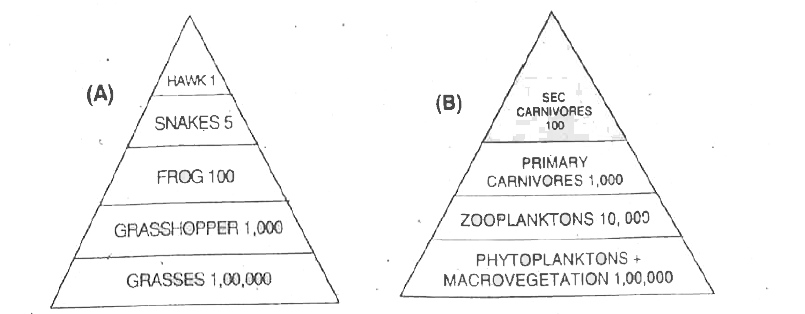 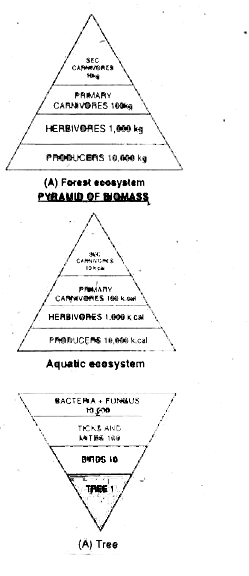
|
|
| 18474. |
Question : Define the following terms and give one example for each: Parasitism |
|
Answer» Solution :PARASITISM : One of the species (parasite) is benefited and the other (host) is HARMED. Eg :- HUMAN liver fluke, malarial parasite, lice on humans, ticks on dogs, marine fish infected with cope pods, parasitic plant cuscuta growing on hedge plants, CUCKOO (Koel) laying eggs in the crow.s nest. |
|
| 18475. |
Question : Define ecological pyramid. Describe pyramid of energy flow with an example. |
|
Answer» Solution :It is the GRAPHICAL representation of trophic structure and function of a food CHAIN Pyramid of energy - It is a graphical representation of available energy at SUCCESSIVE tropic levels in a food chain. Energy level is expressed as KILO calories. It is the typical upright pyramid. It illustrate decreasing energy level at successive tropic level from producers at the BASE to the consumers. Energy level is maximum in producers, less in consumers. Eg:- Pond food chain 
|
|
| 18476. |
Question : Define the following terms and give one example for each: Competitive release |
|
Answer» Solution :Competitive release: Aspecies whose distribution is restricted to a small GEOGRAPHICAL area because of the presence of a COMPETITIVELY superior species, is found to expand its distributional range DRAMATICALLY when the competing species is experimentally removed. Eg :- Larger and competitively superior Balanus on the ROCKY sea coast of Scotland dominates and excludes the smaller barnacle Chathamalus from intertidal zone |
|
| 18477. |
Question : Define ecological niche. Give its types. |
| Answer» Solution :Ecological niche is the specific habitat and FUNCTIONAL role of organism. It is also CALLED "way of LIFE" . Ithas three aspects, Spatial niche, Trophic niche and Hypervolume niche. | |
| 18478. |
Question : Define the following terms and give one example for each : (a) Commensalism (b) Parasitism (c) Camouflage (d) Mutualism (e) Interspecific competition |
|
Answer» Solution :(a) Commensalism : Commensalism is an interspecific interaction between two species where ONE species is benefitted and the other remains unaffected. Example : Orchid and mango tree. (b) Parasitism : It is a relationship between two organisms where the larger ANIMAL is at harm and the smaller animal is benefitted. Example: Malarial parasite and human BEINGS. (c) CAMOUFLAGE : Camouflage is the ability of animals to blend with the surroundings or background. In this way, animals REMAIN unnoticed for protection or aggression. Example: Stick insect. (d) Mutualism : It is relationship between two organisms where both organisms are benefitted. Example : Fungal symbiotic association with algae in lichens. (e) Interspecific Competition : It is an interaction between individuals of two species where both the interacting species are affected. Example : Monarch butterfly and Queen Monarch. |
|
| 18479. |
Question : Define the following terms and give one example for each: Amensalism |
|
Answer» SOLUTION :Amensalism : It is an interaction in which one species is HARMED and the other is unaffected. Eg :- BLACK walnut tree releases chemicals from its roots that HARMS plants around it. |
|
| 18480. |
Question : Define ecological niche. |
| Answer» Solution :NICHE of an organism can be defined as the TOTAL position and function of an INDIVIDUAL in itsenvironment | |
| 18481. |
Question : Define the following terms and give one example for each: Commensalism |
|
Answer» Solution :COMMENSALISM : One SPECIES is benefited and the other is neither harmed nor benefited. Eg-: Orchid, an epiphyte GROWING on a MANGO branch BARNACLES growing on back of whale. Cattle egret and grazing cattle Sea anemone with stinging tentacles and the clown fish. |
|
| 18482. |
Question : Define: Disease |
| Answer» Solution :When FUNCTIONING of ONE or more organs or SYSTEMS of the body is adversely AFFECTED. characterized by VARIOUS signs and symptoms. Any change from normal state causing discomfort or disability is called disease. | |
| 18483. |
Question : Definethe followingtermsand give anexampleeach a.Commensalism b.Parasitism C .Camouflage D.Mutualism e.Interspecific competition . |
|
Answer» Solution :a. commensalismis an intersecific INTERACTION between individualsoftwo SPECIES whereone species in benefitted and other is not affected e.g.Orchid and mangotree. b. PARASITISM is aninterspecificinteraction betweenindividualsof twocies isaffectede.g.Malarial parasite and humanbeings C. Camouflate : it is the ability of teh animalsto blemdwith thesurrounding or backgrougin THISWAY , animalsremain UNNOTICED forprotection oraggression. Exampleis stickinsect. D. Mutualismis aninterspecificinteration betweenindividualsof twoatory way e.g. Pollinationin plantsby animals. e.Interspecificcompetition :it is aninteraction betweenindividuals of archbutterfly and Queenmonarch. |
|
| 18484. |
Question : Define the following terms . (a) Protandry (b) Protogyny |
|
Answer» SOLUTION :(a) Protandary : The stamens mature EARLIER than stigma. E.g. HELIANTHUS (B) Protogyny: The stigma mature earlier than stamens . E.g. ARISTOLOCHIA bracteata |
|
| 18485. |
Question : Define Dobson unit . |
| Answer» Solution :Dobson unit is the unit of measurement of total ozone ONE DU is the number of Molecules of Ozone that would be required to CREATE a layer of pure ozone 0.01 MILLIMETRE at a temperature of `0^@C` and a pressure of 1 atmosphere . | |
| 18486. |
Question : Define Disease. |
| Answer» Solution :Deine can be defined as disorde or malfunction of the mind or body .It INVOLVES morphological,PHYSIOLOGICAL and psychological disturbances which may be due to ENVIRONMENTAL factors or pathogens or genetic anomalies or LIFE style changes. | |
| 18487. |
Question : Define the following terms.a. Genetic engineeringb. Plasmidc. Vectord. Transgenic plant |
|
Answer» Solution : a. Genetic engineering deals with the study of manipulation of genes. Itinvolves the artificial synthesis, MODIFICATION, addition or deletion ofgenetic material to PRODUCE animals or PLANTS with desired quality. b. Plasmid is the extra chromosomal, circular double stranded DNA presentin the bacterial cells. c. Vector is a carrier for transferring the SELECTED DNA into cells. d. The plants produced by incorporating desired genes into their genotypes are called transgenic plants. |
|
| 18488. |
Question : "Differential reproduction" is just another way of saying : |
| Answer» Solution : It states that better adapted individuals reproduce at FASTER rate than less adapted individuals RESULTING changes in gene FREQUENCIES. | |
| 18489. |
Question : Define the following terms. (a) Eutrophication (b) Algal Bloom |
|
Answer» Solution :Eutrophication refers to the NUTRIENT enrichment in WATER bodies leading to lack of oxygen and will end up in the death of aquatic ORGANISMS. Algal Bloom is an excess growth of algae DUE to ABUNDANT excess nutrients imparting distinct color to water. |
|
| 18490. |
Question : Define 'deforestation'. Comment on its effects. |
|
Answer» Solution :1. Deforestation : The permanent removal, decrease or deterioration of FORESTS and woodlands is called deforestation. 2. Effects of deforestation : (1) Deforestation RESULTS in REDUCTION of for est land and extinction of species. (2) It also increases the amount of CARBON dioxide in the atmosphere causing a change in the climate and GLOBAL warming. (3) Soil erosion and loss of biodiversity are the result of def orestation. Soil fertility is also reduced. (4) Fuel wood and timber are shrunken and there is shqrtage for the same. (5) 1 Landslides occur due to deforestation. (6) An overall degradation of environment occurs due to deforestation. |
|
| 18491. |
Question : Explain the following terms with examples:(a) Co-dominance (b) Incomplete dominance. |
|
Answer» Solution :Co-DOMINANCE : It is a phenomena where both the alleles in a HETEROZYGOUS condition express themselves equally. (b) Incomplete dominance : It is a process where the dominant GENE is incompletely dominant over the recessive gene and PRODUCES a phenotype which is intermediate to the PARENTAL type. |
|
| 18492. |
Question : Define decomposition and describe the processes and products of decoposition . |
| Answer» Solution :Decomposition is the process of BREAKING down a substance into its constituent parts . It is a complex , enzymatic that involves step wise degradation of detritus . It involves three steps - fragmentation of detritus , leaching and catabolism involving humification andmineralisation . Humification results in the formation of humus in soil . MINERALISATION results in the RELEASE of inorganic substances `(CO_(2) , H_(2) O)` and NUTRIENTS in the soil . | |
| 18493. |
Question : Define the ecological successions .Mention two types seccession in plants based on the nature of the habitatm What is a pioneer species? |
|
Answer» Solution :2, Hydrogen & LITHOSPHERE . The FIRST COMMUNITY which inhibits the area is known as pioneer SPECIES. |
|
| 18494. |
Question : Define deforestation> |
| Answer» Solution :DEFORESTATION is the DESTRUCTION of FORESTS in order to CLEAR the land and make it AVAILABLE for other uses. | |
| 18495. |
Question : Define the Carrying capacity |
| Answer» Solution :Carrying capacity REFERS to the maximum number of ORGANISMS that a HABITAT can support. | |
| 18496. |
Question : Define decomposition and describe the process and product of decomposition |
| Answer» Solution :DECOMPOSITION is the BREAKDOWN complex organic matter PRESENT in a detritus into inorganic SUBSTANCE LIKE `CO_2`, water and nutrient by decomposers. | |
| 18497. |
Question : Define test cross. |
| Answer» Solution : A SPECIAL type of back cross which is made between an individual with a dominant trait and its RECESSIVE PARENT in order to KNOW whether it is homozygous or heterozygous for the trait is TERMED as a Test cross | |
| 18498. |
Question : Define cross pollination and explain its types. |
|
Answer» SOLUTION :Cross pollination is the transfer of pollens on the stigma of another FLOWER. It is of two types. (i) GEITONOGAMY: When the POLLEN deposites on another flower of same individual plant, it is called geitongamy. It occurs in plants of monoecious plants . (II) Xenogamy: When the pollen deposites on another flower of a different plant of same species. |
|
| 18499. |
Question : Define temperature. How it impacts the life of an organism? |
| Answer» SOLUTION :Temperature or degree of hotness and coldness is an assential and variable FACTOR in any environment. It influences all forms of life by affecting many VITAL activities of organisms like metabolism, behaviour, reproduction, development and even death in the Biosphere | |
| 18500. |
Question : Define terminalization. |
| Answer» Solution :After CROSSING over , chiasma starts to MOVE towards the terminal end of chromatids . This is known as TERMINALIZATION . As a RESULT , COMPLETE separation of homologous chromosomes occurs. | |