

Saved Bookmarks
This section includes InterviewSolutions, each offering curated multiple-choice questions to sharpen your knowledge and support exam preparation. Choose a topic below to get started.
| 42251. |
(a) With the help of a diagram, explainthe principle and working of a moving coil galvanometer. (b) What is the imporance of a magnetic field and how is it produced ? (c) Why is it that while using a moving coil galvanometer as a voltmeter as a voltmeter a high resistance in series is required whereas in an ammeter a shunt is used ? |
|
Answer» Solution :(a) A labelled diagram of a pivoted type moving coil galanometer has been shown in fig. Principle , If a current coil is freely pivoted in a uniform magnetic field, hence on passing current I thorugh it a deflecting torque acts on the coil which is given by `tau = NAIB` where N = total number of turns in the coil, A = area of coil , B = magnetic field. The spring `S_p` attached to the coil provides the counter torque and in equilibrium state balances the deflecting torque. If `phi` be the steady angular deflection then counter torque is `kphi`, where K = torsional constant of the spring. In equilibrium state `NAIB = k phi implies I = k/(NAB) cdot phi` Thus , deflection is directly proportional to the current. (b) In a radial magnetic field the plane of the rotating coil always lies in the direction of magnetic field. Thus, torque on the coil remains constant `(tau = NAIB)` and does not change with angular deflection angle `phi`. Radial magnetic field is produced by making the POLE piece of HORSE shoe magnet concave and by introducing a cylindrical soft iron core in the middle of GALVANOMETER coil. (c) A voltmeter mus draw a very small current so as to given correct voltage measurement. Therefore, a high resistance is connected in series with the galvanometer. An ammeter should have negligible resistance so that its presence does not alter the circuit current. Therefore, a small shunt resistance is connected in parallel to the galvanometer so as to reduce its resistance. 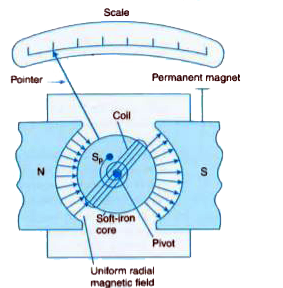
|
|
| 42252. |
For one complete cycle, what is the average power? |
|
Answer» <P> SOLUTION :`P_(AVE) = (i_m^2 R)/(2)` |
|
| 42253. |
Ratio of Hydrogen and Oxygen in Water is |
|
Answer» 2:1 |
|
| 42254. |
The trajectory of a body with two simultaneous, mutually perpendicular oscillations is determined by x=asin(pomegat)""(1) y=bsin(qomegat+phi)""(2) where x and y are the projections of the body displacement on X and Y axes For simplicity, assume pomega=qomega=omega_(0). Then, the equation of trajectory will be y^(2)/b^(2)+x^(2)/a^(2)-(2xy)/(ab)cosphi=sin^(2)phi""(3) which is a general equation of ellipse. But if qomeganepomegaandpneq, then the graph of trajectory on the X-Y plane is either a closed curve, whose loop number is defined by the ratio n = p/q, or an open curve. Note that at the point where the curve reverses along the same trajectory, the velocities along the X-axis and Y-axis become equal to zero simultaneously. The body moving along the curve stops exactly at this moment at a certain point, say P, and then starts moving back, The closed curve for the motion of the body with the above two oscillations (1) and (2) with certain values of p, q and phi is given in the adjacent figure. The value of p/q is |
|
Answer» `1//2` |
|
| 42255. |
A classical atom based on .......... is doomed to collapse. (Thomson's modell Rutherford's model. |
| Answer» SOLUTION :Rutherford.s MODEL | |
| 42256. |
Resistance of wire having radius r is R. If new wire of radius 2r, is made, then the new resistance of wire= ...... |
|
Answer» `(R)/(2)` ` R = (rho l)/(A) = (rho l A)/(A^(2)) = (rho V)/(pi^(2) r^(4))` `THEREFORE R PROP (1)/(r^(4))` `therefore (R_(1))/(R_(2)) = ((r_(1))/(r_(2)) )^(4)` ` (R^(2))/(R)= ((r)/(2r) )^(4)= ((1)/(16))` `thereforeR_(2) = (R)/(16)` |
|
| 42257. |
If we want to observe inside atom.Assume diameter of atom 100 pm That means we can determine region of about 10 pm.For this electron microscope is used. Minimum required energy of electron should be …… |
|
Answer» 1.5 keV Resolving power of microscope is about wavelength of light used .de-Broglie wavelength of particle with mass m and velocity V will be , `lambda=(H)/(p)=(h)/(mv)` Required speed of electron, `v=(h)/(mlambda)=(6.63xx10^(-34))/(9.11xx10^(-11))` `=7.28xx10^(7) (m)/(s)` corresponding kinetic energy, `E=(1)/(2)mv^(2)` `(1)/(2)xx9.11xx10^(31)xx(7.28xx10^(7))^(2)xx(1eV)/(1.6xx10^(-19)J)` |
|
| 42258. |
A transistor connected at common emitter mode contains load resistance of 5 k and an input resistance of 1 kOmega. If the input peak voltage is 5 mV and the current gain is 50, find the voltage gain. |
|
Answer» 250 |
|
| 42259. |
An LCR series circuit with L =0.5H, C=10xx10^(-6) F, R=100 Omegais connected to an A.C. source of frequency of 50 Hz. The impedance of the circuit is ……. |
|
Answer» 1.8765 `Omega` `|Z|=SQRT(R^2+(omegaL-1/(omegaC))^2)` `=sqrt((100)^2+[314xx0.5-1/(314xx10^(-5))]^2)` `|Z|=sqrt(10^4+[157-50000/147]^2)` `THEREFORE |Z|=189.6 Omega` |
|
| 42260. |
Copy and complete the following block diagram . |
|
Answer» <P> SOLUTION :i. Semiconductorii.,p- TYPE iii.n type |
|
| 42261. |
A 100 muF capacitor in series with a 40 Omega resistance is connected to a 110 V, 60 Hz supply. (a) What is the maximum current in the circuit? (b) What is the time lag between the current maximum and the voltage maximum? |
|
Answer» SOLUTION :For a RC CIRCUIT, if `V=V_(0) sin omega t` `I=(V_(0))/(sqrt(R^(2)+(I//omega C)^(2))) sin(omega t+phi)` where `TAN phi=(1)/(omegaCR)` (a) `I_(0)=3.23A` (b) `phi=33.5^(@)` Time lag `=(phi)/(omega)=1.55ms` |
|
| 42263. |
Obtain an expression for deviation suffered by a ray of light when refracted through a small angle prism. |
Answer» Solution : We know that for refraction through a prism `angleA =angler_(1) + angler_(2)` and `angleA + angledelta = anglei + ANGLEE` For a small angled prism `angleA` is small and hence `r_(1)` and `r_(2)` will be evan SMALLER. As `n=(sin i)/(sin r_(1))` and `n= (sin e)/(sin r_(2))` and `angler_(1)` and `angler_(2)` are Hence, the above relations MAY be rewritten as : `i/r_(1) = n` and `e/r_(2)=n` `i/r_(1) =n` and `e/r_(2)=n` `rArr anglei = nangler_(1)` and `anglee = nangler_(2)` `rArr angledelta = (n-1)angleA` or `delta =(n-1) A` |
|
| 42264. |
A train approaching a hill at a speed of 40 km/hour sounds a whistle of frequency 580 Hz when it is at a distance of 1 km from a hill. A wind with a speed of 40 km/hour is blowing in the direction of motion of the train. The frequency of the shistle as heard by an observer on the hill is100y (velocity of sound in air = 1200 km/hour).Find y |
|
Answer» |
|
| 42265. |
Along the straight line joining two consecutive displacement nodes in a pure stationary sound wave at different points |
|
Answer» the S.H.M.s will be in DIFFERENT phases |
|
| 42266. |
At a large distance (r), the electric field due to a dipole varies as |
|
Answer» a) `(L)/(r)` |
|
| 42267. |
A thin metallic spherical shell contains a charge Q on its surface. A point charge q_1 is placed at the centre of the shell and another charge q_2 is placed outside the shell. All the three charges are positive. Then, the force on charge l_1 is |
| Answer» Answer :A | |
| 42268. |
Point charge + 4q,-q and +4q are kept on x-axis at points x=0,x= a and x= 2a respectively : |
|
Answer» Only -Q is STABLE equilibrium |
|
| 42269. |
Suppose N electrons can be placed in either of two configurations. In configuration 1, they are all placed on the circumference of a narrow ring of radius R and are uniformly distributed so that the distance between adjacent electrons is the same everywhere. In configuration 2, N - 1 electrons are uniformly distributed on the ring and one electron is placed in the center of the ring. (a) What is the smallest value of N for which the second configuration is less energetic than the first? (b) For that value of N, consider any one circumference electron-call it e_(0). Howmany other circumference electrons are closer to e_(0) than the central electron is ? |
| Answer» SOLUTION :(a) `12,` (B) `2` | |
| 42270. |
How many cells each marked (6V-12A) should be connected in mixed grouping so that it may be marked (24V-24A) |
|
Answer» 4 |
|
| 42271. |
The wavelength lamda_e of an electron and lamda_p of an photon of same energy E are realised by : |
|
Answer» `lamda_p PROP lamda^2_e` |
|
| 42272. |
The site of action of insulin is |
|
Answer» mitochondria |
|
| 42273. |
A series LCR circuit with R = 20 Omega , L = 1.5 H and C = 35 muFis connected to a variable-frequency 200 V a.c. supply. When the frequency of the supply equals the natural frequency of the circuit, what is the average power transferred to the circuit in one complete cycle ? |
|
Answer» Solution :When FREQUENCY of the supply = natural frequency of circuit `v_(0) = 1/(2pi sqrt(LC)), X_(L) = X_( C)` and resonance takes place so that current `I_(rms) = V_(rms)/R = 200/20 = 10 A` As in resonance condition voltage and current are in same phase condition, (i.e. `PHI = 0^(@)`) hence average power `P_(av) = V_(rms).I_(rms). COS phi = 200 xx 10 cos 0^(@) = 2000 W` or 2kW. |
|
| 42274. |
In amplitude modulation, carrier wave frequencies are ............... than that compared to those in frequency modulation |
| Answer» Answer :A | |
| 42275. |
A disc of mass M = 4 kg, radius R = 1 m is attached with two blocks A and B of masses 1 kg and 2 kg respectively on rim and is resting on a horizontal surface as shown in the figure. Find angular frequency of small oscillation of arrangement: |
|
Answer» `2.2sec^(-1)` Let it ROTATED by a clockwise & released. `Rightarrowtau=20[(cosa)/(2)+(SQRT3)/(2)sina]-10cosa.approx10sqrt3a` ` I=(MR^(2))/(2)+MR^(2)+m_(B)(2Rsin15^(@))^(2)+m_(A)(RSQRT2)^(2)` =`6+8{(1-cos30)/(2)}+2=12-2sqrt3Rightarrow omega=sqrt((C)/(I))=sqrt((10sqrt3)/(12-2sqrt3))Rightarrow omega=sqrt((5sqrt3)/(6-sqrt3))=1.424sec^(-1)` 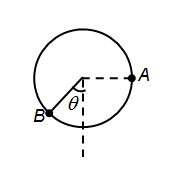
|
|
| 42276. |
The velocity of sound is 340m/s and frequency 340Hz . The time taken to travel distance 68m is |
|
Answer» 0.2sec |
|
| 42277. |
निम्न में से असत्य कथन का चयन कीजिये :-S1: पथ की लम्बाई का समय से भाग करने पर औसत वेग प्राप्त होता है।S2: सामान्यतः, चाल, वेग के परिमाण से अधिक होती है।S3 : दी गई दिशा में गतिमान कण के वेग (अशून्य) की चाल शून्य हो सकती है।S4: औसत वेग का परिमाण, औसत चाल होता है। |
|
Answer» S2 और S3 |
|
| 42278. |
A change of 200mV in base-emitter voltage causes a change of 100muA in the base current. The input resistance of the transistor is |
|
Answer» `1 KOMEGA ` |
|
| 42279. |
Hydrogen atom in its ground state is excited by means of a monochromatic radiation of wavelength 970.6 Å. Different wavelengths are possible in the spectrum. After absorbing the energy of radiation, hydrogen atom goes to the excited state. After 10^(-8) s, the hydrogen atom will come to the ground state by emitting the absorbed energy. The electron of excited hydrogen atom is in which of the following energy states? |
|
Answer» 2 |
|
| 42280. |
Biot-Savart law indicates that the moving electrons (velocity vecv) produce a magnetic field vecB such that |
|
Answer» `vecB` is at right angles to `VECV` |
|
| 42281. |
List-IList-II a) coherent, monochromatic highly unidirectionalye) Malus law b) I= I_(0) cos^(2) thetaf) Polaroid c) selective absorption is exhibited by frontg) spherical wave d) Fresnel diffractionh) LASER |
|
Answer» `A-H, B-E, C-F, D-G` |
|
| 42282. |
When a mass m is attached to the spring of force constant k, then the spring stretches by l. If the mass oscillates with amplitude l, what will be the maximum potential energy stored in the spring ? |
|
Answer» `(kl)/(2)` `:." MG"="kl"` and energy stored in spring `=(1)/(2)kl^(2)=(1)/(2)("mg")/(l)l^(2)=(1)/(2)"mgl"`. When the spring oscillates at maximum displacement then additional POTENTIAL energy stored `=(1)/(2)kl^(2)=(1)/(2)"mgl"`. Thus TOTAL potential energy `=(1)/(2)"mgl"+(1)/(2)"mgl"="mgl"`. Correct choice is (d). |
|
| 42283. |
The dimension of (B^2)/( 2mu_0) , where B is magnetic field and mu_0 is the magnetic permeability of vacuum is |
|
Answer» `M^(1) L^(-1) T^(-2)` `("Force" xx" displacement")/("VOLUME") = (B^2)/( 2mu_0) ""[because "Energy" = "Force" xx "displacement" ]` `therefore [ (B^2) /( 2mu_0) ] = ([F][d])/([V]) ""[because 2mu_(0) " DIMENSIONLESS" ]` `(M^(1) L^(1) T^(-2) xx L^(1) )/( L^(3) )` `= M^(1) L^(-1) T^(-2) ` |
|
| 42284. |
The magnifying power of an astronomical telescope is 8 and the distance between the two lenses is 54 cm. The focal length of eye lens and objective will be respectively. |
| Answer» Answer :4 | |
| 42285. |
Depletion layer in the p-n junction consists of |
|
Answer» ELECTRONS |
|
| 42286. |
The ratio of the intensities at minima to maxima in the interference pattern is 9 : 25. What will be the ratio of the widths of the two slits in the young's double slit experiment ? |
|
Answer» `8:1` |
|
| 42287. |
There will be ...... between two like charge and......between two unlike charges. |
|
Answer» REPULSION, ATTRACTION |
|
| 42288. |
Electric intensity at a place due to a charged conductor is a : |
|
Answer» SCALAR quantity |
|
| 42289. |
What would the grandmother do in the temple on a daily basis? |
|
Answer» Meditation |
|
| 42290. |
Critical angle for certain medium is sin^(-1) (0.6). The polarizing angle of that medium is : |
|
Answer» <P>`ta^(-1) [1.5]` Sin (C ) = 0.6 `MU = (1)/(sinC)=((1)/(0.6))` Polarising angle `i_(p) = tan^(-1) (mu) = tan^(-1) ((1)/(0.6))` `tan^(-1) (1.6667)` |
|
| 42291. |
Three resistors of 4 ohms and 12 ohms are connected in parallel. The combination of above resistors is connected in series to a resistance of 2 ohms and then to a battery of 6 volts. Draw a circuit diagram and calculate. (a) Current in main circuit. Current flowing through each of the resistors in parallel (c ) p.d and the power used by the 2 ohm resistor. |
Answer» Solution :Circuit diagram for the given data is 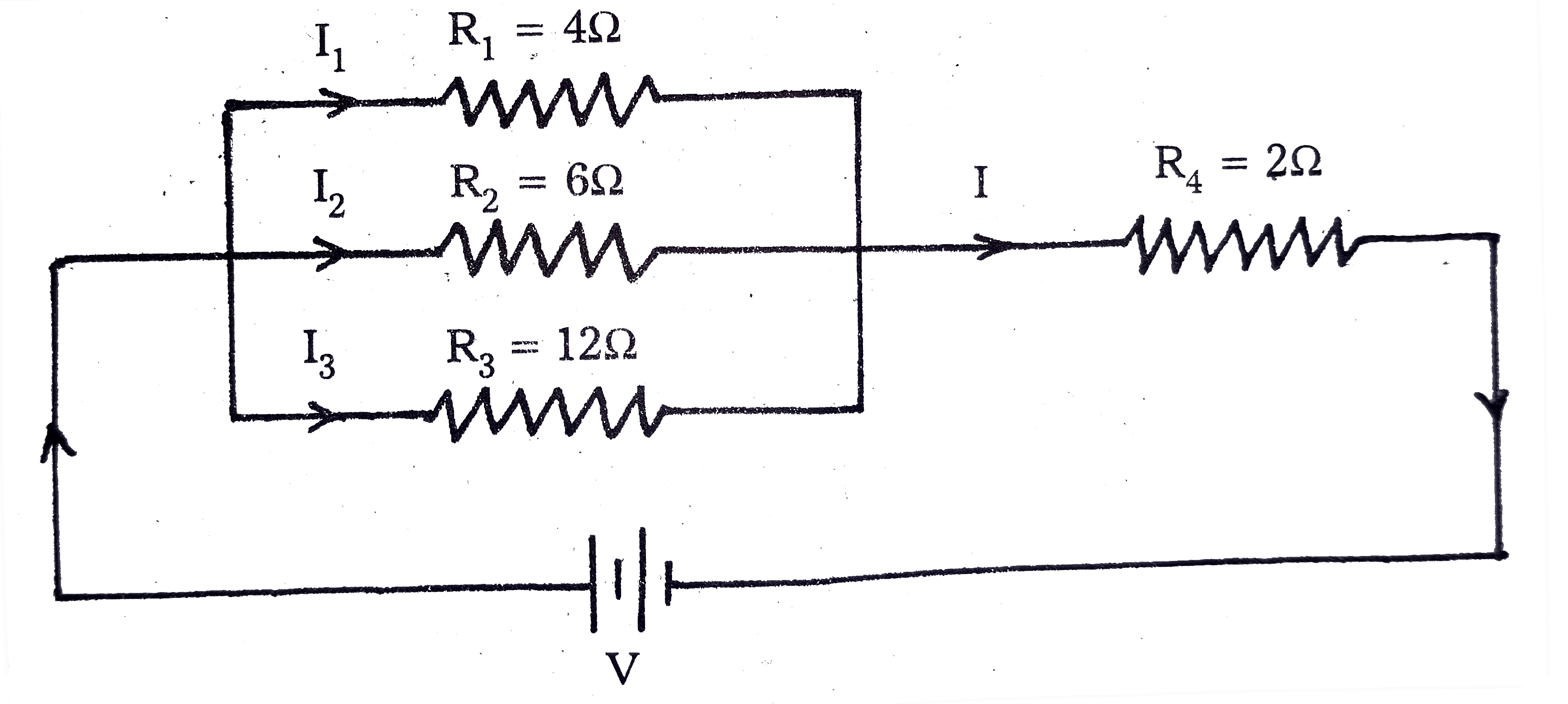 (a) Effecitive resistance when `R_(1), R_(2)` and `R_(3)` are connected in parallel is given by `(1)/(R_(P)) = (1)/(R_(1)) + (1)/(R_(2)) + (1)/(R_(3)) implies (1)/(R_(P)) = (1)/(4) + (1)/(6) + (1)/(12)` `implies (1)/(R_(P)) = (3 + 2 + 1)/(12) = (6)/(12) = (1)/(2)` `:. R_(P) = 2 Omega` Total resistance in the circuit `R = R_(P) + R_(4) = 2 + 2 = 4 Omega` `:.` Current in main circuit `I = (V)/(R) = (6)/(4) = 1.5 A` (b) Current flowing through `R_(1), I_(1) = (ir_(P))/(R_(1)) = (1.5 xx 2)/(4) = 0.74 A` current flowing through `R_(2), I_(2) = (IR_(P))/(R_(2)) = (1.5 xx 2)/(6) = 0.5 A` Current flowing through `R_(3), I_(3) = (IR_(P))/(R_(3)) = (1.5 xx 2)/(12) = 0.25 A` (c ) P.D ACROSS `2 Omega` resistor (i.e., `R_(4)`), `V_(4) = IR_(4) = 1.5 xx 2= 3` volt. POWER used by `2 Omega` resistor, `P = V_(4) I = 3 xx 1.5 = 4.5 W` |
|
| 42292. |
A coil of inductance 0.50 H and resistance 100 ohm is connected to 240 V, 50 Hz a.c. supply. (a) What is the peak current in the coil ? (b) What is the time lag between the peak voltage and the peak current ? |
|
Answer» Solution :Here `L = 0.50 H, R = 100` ohm, `E_(rms) = 240 V, v = 50 Hz` Step I : We know `E_(0) = sqrt(2) E_(rms) = 1.414 XX 240 = 339.4 V` Impedance of LR circuit is `Z_(L) = sqrt(R^(2) + omega^(2)L^(2)) = sqrt(R^(2) + 4PI^(2)v^(2)L^(2))` `= sqrt((100)^(2) + 4 xx (3.14)^(2) xx (50)^(2) xx (0.50)^(2)) = 186.1` ohm Peak current, `I_(0) = (E_(0))/(Z_(L)) = (339.4)/(186.1) = 1.82 A` In LR circuit the phase difference between current and voltage `phi` is given by `tan phi = (0.50 xx2 xx 3.14 xx 50)/(100) = 1.57` `phi = tan^(-1)(1.57) = 57^(@)30. = 57.5^(@)` `= (57.5 xx pi)/(180) = 0.3194 pi` radians Here `E = E_(0) sin omega t , E_(0) = E_(rms) sqrt(2)` `therefore` Time LAG between `E_(0)` and `I_(0)` is given by `t = (phi)/(omega) = (phi)/(2pi v) = (0.3194 pi)/(2pi xx 50)` `= 0.003194 s = 3.194 xx 10^(-3)s`. |
|
| 42293. |
Explain why the bluish colour predominates in a clear sky. |
| Answer» SOLUTION :BLUE COLOR UNDERGOES for more SCATTERING. | |
| 42294. |
An object is placed at a certain distance from a convex lens of focal length 20 cm. Find the distance of the object if the image obtained is. magnified 4 times. |
|
Answer» Solution :f = - 20 cm V =- 4 u ACCORDING to lens formula `(1)/(f) = (1)/(v) + (1)/(u)` `(1)/((-20))=(1)/((-4u))+(1)/(u)` `(1)/((-20))=(1)/(u)[-(1)/(4)+1]` `=(1)/(u)[(3)/(4)]` `u=(3xx20)/(4)=-15cm` |
|
| 42295. |
Which of the following is not a electromagnetic wave ? |
|
Answer» X-rays |
|
| 42296. |
The velocity acquired by a body moving with uniformaccelertion is 30 m s^(-1) in 2s and 60 ms ^(-1) in 4 s, The initial velocity is . |
| Answer» Answer :A | |
| 42297. |
Ice starts forming in a lake water at 0^(@)C when the atmospheric temperature is 10^(@)C. If the time taken for 1 cm of ice to be formed is 7 hour, the time taken for the thickness of the ice to change from 1 cm to 2 cm is : |
|
Answer» 7 h |
|
| 42298. |
Assertion : Two light sources with different frequecies cannot be coherent. Reason : Phase difference between coherent sources remains constant with time. |
|
Answer» If both assertion and REASON are CORRECT and reason is a correct explanation of the assertion. |
|
| 42299. |
The molar heat capacity of an ideal gas (gamma=1.40) varies during a process according to the law C=20.0 + 500/T. Find the work done by a mole of the gas when heated from T_1=200 K to T_2=544 K . |
|
Answer» |
|
| 42300. |
The molar heat capacity of an ideal gas (gamma=1.40) varies during a process according to the law C=20.0 + 500/T. Is the process polytropic ? |
|
Answer» |
|