

Saved Bookmarks
This section includes 7 InterviewSolutions, each offering curated multiple-choice questions to sharpen your Current Affairs knowledge and support exam preparation. Choose a topic below to get started.
| 1. |
A semicircular wire of radiusR= 20 cm rotatesin its own plance about one endwith angular velocity w= 10 rad//s inunifornm magneticfieldB=5 mT perpendicularinto the plane of the wiregtFind the voltage developendbetweentheendsofthe wire |
|
Answer» |
|
| 2. |
On violence |
|
Answer» 2 |
|
| 3. |
Passage III Two small metallic spheres of radii r_(1) and r_(2) carry charges q_(1) and q_(2), respectively such that they have the same polarity. Both the spheres are widely separated from each other and then the two are connected by a metallic wire. Answer the following questions: If V_(1) and V_(2) are the corresponding electric potentials of both the spheres then V_(1)//V_(2) is |
|
Answer» `r_(1)//r_(2)` |
|
| 4. |
Passage III Two small metallic spheres of radii r_(1) and r_(2) carry charges q_(1) and q_(2), respectively such that they have the same polarity. Both the spheres are widely separated from each other and then the two are connected by a metallic wire. Answer the following questions: If sigma_(1) and sigma_(2) are the corresponding surface charge desities of both the spheres then sigma_(1)//sigma_(2) is |
|
Answer» `r_(1)//r_(2)` |
|
| 6. |
Passage III Two small metallic spheres of radii r_(1) and r_(2) carry charges q_(1) and q_(2), respectively such that they have the same polarity. Both the spheres are widely separated from each other and then the two are connected by a metallic wire. Answer the following questions: If E_(1) and E_(2) are the corresponding electric fields on surface of both the spheres then E_(1)//E_(2) is |
|
Answer» `r_(1)//r_(2)` |
|
| 7. |
Four different independent waves are represented by (i) y_(1) = a_(1) sin omega t , (ii) y_(2) = a_(2) sin 2 omega t (iii) y_(3) = a_(3) cos omega t , (iv) y_(4) = a_(4) sin (omega t+(pi)/(3)) With which two waves interference is possible |
|
Answer» In (i) and (III) |
|
| 8. |
(a) Write the conditions under which light sources can be said to be coherent. (b) Why is it necessary to have coherent sources in order to produce an interference pattern ? |
|
Answer» Solution :(a) Following two CONDITIONS are necessary for light sources to be coherent: (i) The sources must emit light of same wavelength (or same frequency). (ii) The originating PHASE difference between light waves emitted by the sources should be either zero or have a constant value. (b) In order to produce an interference PATTERN the light sources must be coherent one so that the interference pattern obtained on the screen is a sustained pattern and positions of bright and dark fringes do not change with TIME. |
|
| 9. |
A bird views a fish at 3 m depth in water. Real depth of fish is ..... (Refraction index of water is 4/3) |
|
Answer» 4 m |
|
| 10. |
If a particle of charge 1μC is projected into a magnetic field vecB = (2hati + yhatj- zhatk) T with a velocity vecV = (4hati+2hatj - 6hatk)ms^(-1), then it passes undeviated. If it is now projected with a velocity vecV = hati + hatj , then find the force experienced by it? |
|
Answer» Solution :Charged particle moves in a MAGNETIC field undeviated when `hatV` is parallel or anti parallel to `hatB` `(V_(k))/(B_(X))=(V_(y))/(B_(y))=(V_(z))/(B_(z))=k,4/2=2/y=(-6)/(-z)` y=1 z=3 `thereforevecB=(2hati+hatj-3hatk)` `vecF=q(vecVxxvecB)` `vecF=10^(-6)abs({:(HATI,hatj,HATK),(1,1,0),(2,1,-3):})` `vecF=10^(-6)[i(-3)-hatj(-3)+hatk(-1)]` `vecF=10^(-6)abs((-3hati+3hatj-hatk))N=sqrt(19)muN` |
|
| 11. |
The intensity of a sound appears to an observer to be periodic. Which of the following can be the cause of it? |
|
Answer» The intensity of the source is PERIODIC |
|
| 12. |
A : When a thin transparent sheet is placed in front of both the slits of Young.s experiment, the fringe width will increase. R : In Young.s experiment the fringe width is inversely proportional to wavelength of the source used. |
|
Answer» Both A and R are true and R is the CORRECT explanation of A |
|
| 13. |
In a perfectly inelastic direct collision maximum transfer of energy takes place if- |
|
Answer» `m_(1) GT gt m_(2)` |
|
| 14. |
A sinusoidal voltage of peak value of 283 V and frequency 50 Hz is applied to a series LCR circuit in which R = 3 Omega , L = 25.48 mH and C = 796 mu F. Find the power dissipated in the circuit, and |
|
Answer» Solution :POWER dissipated in the FORM of heat is , `P= I_(rms) ^(2) R` `= { ( V_(rms))/( |Z|)}^(2) R` `= { ( V_(m))/( sqrt(2)|Z|)}^(2) R` `( :. V_(rms) = ( V_(m))/(sqrt(2)) )` `= ( V_(m) ^(2)R)/( 2 | Z|^(2)) = (( 283)^(2) ( 3))/((2) (5)^(2)) ` `:. P = 4805 W ` ( WATT ) OR `I= I_(rms) = ( V_(rms))/( Z ) = ( V_(m))/( sqrt( 2) Z)= ( 283)/( 1.414 xx 5 )` `P = I^(2) R = ( 40.028)^(2) xx 4800 W ` |
|
| 15. |
A sinusoidal voltage of peak value of 283 V and frequency 50 Hz is applied to a series LCR circuit in which R = 3 Omega , L = 25.48 mH and C = 796 mu F. Find the phasedifference between the voltage across the source the current. |
|
Answer» Solution :PHASE difference `( phi )` between VOLTAGE and current can be FOUND as follows . `tan phi = ( X_(L) - X_(C ))/( R )` `:. tan phi = ( 8-4)/( 3) = ( 4)/(3) `....(1) But from table of natural tangents, `tan ( 53^(@) 8.) = 1.3335 = 1.3333` `:. phi = 53^(@) 8.` Voltage leads aheadof current by an angle `53^(@) 8.` |
|
| 16. |
Which of the following is infra-red wavelength ? |
|
Answer» `10^-4 CM` |
|
| 17. |
A sinusoidal voltage of peak value of 283 V and frequency 50 Hz is applied to a series LCR circuit in which R = 3 Omega , L = 25.48 mH and C = 796 mu F. Find the power factor. |
Answer» Solution : Here, `tan phi = ( 4)/(3) ` [ From EQUATION (1) ] `rArr COS phi = ( 3)/(5) = 0.6 ` OR we have the formula of power factor. `cos phi = ( R )/( | Z |)` `= ( 3)/( 5) = 0.6` |
|
| 18. |
सबसे पहले किसने देखा कि जीवों में अलग-अलग एकक (unit) होते हैं? |
|
Answer» राबर्ट ब्राउन |
|
| 19. |
When point source is kept at 20 cm distance from photcell ,stopping voltage obtained is V_(0) When source distance is changed to 1m, stopping potential will be …….. |
|
Answer» `(V_(0))/(u)` |
|
| 20. |
The focal lengths of the objective and the eye piece of a compound microscope are 1cm and 5cm respectively. An object placed at a distance of 1:1 cm from the objective has its final image formed at (i) infinity (ii) least distance of distinct vision. Find the magnifying power and the distance between the lenses. Least distance of distinct vision is 25 cm. |
|
Answer» |
|
| 21. |
A thin prism of crown glass (mu_r= 1.515,mu_v, = 1.525) and a thin prism of flint glass (mu_r= 1.612, mu_v = 1.632 ) are placed in contact with each other. Their refracting angles are 5.0^@ each and are similarly directed. Calculate the angular dispersion produced by the combination |
| Answer» SOLUTION :`0.15^@` | |
| 22. |
The eye can be regarded as a single refracting surface. The radius of curvature of this surfac is equal to that of cornea (7.8 mm). This surface separates two media of refractive indices 1 an 1.34. Calculate the distance from the refracting surface at which a parallel beam of light wil come to focus. |
|
Answer» 4.0 cm `n_2=1.34` `R_1=7.8 mm=0.78` `R_2=INFTY` For PARALLEL beam, `u~~infty` v=f (IMAGE is obtained at focus) `-1/u+1/v=(n_2-n_1)/(n_1)((1)/(R_1)-(1)/(R_2))` `THEREFORE (-1)/(infty)+1/f=(1.34-1)/(1.34)((1)/(0.78)-(1)/(infty))` `therefore1/f=(0.34)/(1.34)((1)/(0.78))` `therefore f=3.07=3.1` cm |
|
| 23. |
In double slit experiment, the distance between two slits is 0.6 mm and these are illuminated with light of wavelength 4800 A^(0). The angular width of dark fringe on the screen at a distance 120 cm from slits will be |
|
Answer» `8 xx 10^(-4)` RADIAN |
|
| 24. |
STATEMENT -1 : The escape valocity upon Earth's surface is 11.2 km/h. But velocity required for escaping is little less than 11.2 km/h if launched properly. and STATEMENT -2 : Escape velocity is independent of angle of projection. Conservation of mechanical energy uses KE and GPE which are scale quantities. |
|
Answer» STATEMENT 1- True, Statement -2 is True, Statement -2 is a CORRECT EXPLANATION for Statement -11 |
|
| 25. |
For large distance, electric field due to a dipole varies with the distance 'r' as |
|
Answer» a)`E propt 1/r` |
|
| 26. |
Is the formula you employ in (a) valid for calculating radius of the path of a 20 MeV electron beam ? If not , in what way is it modified ? , [ Note : Exercises 20 (b) and (21) b take you to relativistic mechanics which is beyond the scope of this book . They have been inserted here simply to emphasise the point that the formulas you use in part (a) of the exercises are not valid at very high speeds or energies . See answers at the end to know what very high speed or energy means .] |
|
Answer» Solution :Given , E = 20 MeV = ` 20 xx 1.6 xx 10^(-13)`J, `m_(e) = 9.1 xx10^(-31)` kg ` E = 1/2 mv^(2)` ` rArr v = sqrt((2E)/m) = sqrt((2 xx20 xx1.6 xx10^(-13))/(9.1xx10^(-32))) :. v = 2.67 xx10^(9) ` m/s As `upsilon gt C,` the formula USED in (a) `r=(mv)/(eB)`is not valid for calculating the radius of path of `2theta` MeV electron beam because electron with such a high energy has VELOCITY in relatistic domain i.e., comparable with the velocity of light and the mass varies with the increase in velocity but we have TAKEN it as constant. `thereforem=(m_(0))/(sqrt(1-(v^(2))/(c^(2))))rArr " Thus, the modified formula will be r"=(muv)/(eB)[(m_(0))/(sqrt(1-(v^(2))/(c^(2))))](v)/(eB)` |
|
| 27. |
A true balance is one whose pans are of equal masses and arms are of equal lengths. When this happens, the net moment of forces about point of suspension is zero and beam remains horizontal without any weight i.e., for the true balance P_(1)=P_(2) and l_(1)=l_(2) also P_(1)l_(1)=P_(2)l_(2) (mass of beam is neglibigle). A shopkeeper uses a false balance to weigh articles. Both arms and pans of this false balance are different, but beam become horizontal without any weight. (P_(1)neP_(2) and l_(1)nel_(2) but P_(1)l_(1)=P_(2)l_(2)). Q. Choose the correct options(s) |
|
Answer» If MANN of pan `P_(2)` is less than mass of pan `P_(1)` and shopkeeper puts weight W of P_(1), and article on the pan `P_(2)` in this weight GAIN the shopkeeper is W `((l_(2)-l_(1))/(l_(2)))` `Wl_(1)=W_(2)l_(2)impliesW_(2)=(Wl_(1))/(l_(2))` since `(l_(1))/(l_(2))lt1impliesW_(2)ltW` `implies` there will be gain for shopkeeper `DeltaW_(2)=W-W_(2)=W((l_(2)-l_(1))/(l_(2)))` `W_(1)` be the weight of article when article PUT in `P_(1)` `W_(1)l_(1)=Wl_(2)impliesW_(1)=(Wl_(2))/(l_(1))` since `(l_(1))/(l_(2))lt` `impliesW_(1)GTW` `implies` there will be loss for shopkeeper `DeltaW_(1)=W_(1)-W=W((l_(2)-l_(1))/(l_(1)))` Since weight loss is more so net loss `=W((l_(2)l_(1))/(l_(1)))-W((l_(2)-l_(1))/(l_(2)))=W((l_(2)-l_(1))^(2))/(l_(1)l_(2))` |
|
| 28. |
A particle is projected with a velocity v so that its horizontal range is twice the greatest height attained. The horizontal range is : |
|
Answer» `2v^(2)//3G` `sin2theta=sin^(2)theta` `2sintheacostheta=sin^(2)theta` `:.tantheta=2` Range `R=(u^(2).2sinthetacostheta)/g` `=u^(2).2xx(2x)/(sqrt(5)x).x/(sqrt(5)x)xx1/g` `(u^(2).4)/(5g)` 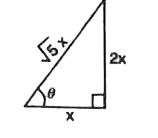
|
|
| 29. |
An electric dipole is placed at the centre of a sphere. The flux passing through the surface of the sphere is.......... |
|
Answer» Infinity `sumq = +Q +(-q)=0` The flux passing through the surface of the sphere according to Gauss.s theorem, `PHI = (sumq)/epsilon_(0) =(+q-q)/epsilon_(0) =0` |
|
| 30. |
A parallel plate capacitor with circular plates of radius 1m has a capacitance of 1 nF. At t=0 , It is connected for charging in series withare resistor R=1 M Q across a 2V battery (fig). Calculate the magnetic field at a point P halfway between the centre and the periphery of the plates. after t=10^(-3) s. (The charge on the capacitor at time tau is q(t) CV [1 =exp (-t//tau) ], where the time constant tau is equal to CR). |
|
Answer» Solution :The time constant of the CR circuit `tau` =CR `=10^(-3) s` , we have `Q(t)=CV[1-"exp"(-t//tau)]` `=2xx10^(-9)[1-"exp"(-t//10^(-3))` The electric field in between the plates at time t is `E=(q(t))/(epsi_(0)A)=(q)/(piepsi_(0)),A=pi (1)^(2) m^(2)=` area of the plates . Consider now a circular LOOP of radius (1/2) m parallel to theplates passing through P. The magnetic field B at all points on the loop is along the loop and of the same value. The flux `phi_(E)`through this loop is The flux `phi_(E)=Exx` area of the loop `=Exxpixx((1)/(2))^(2)=(piE)/(4)=(q)/(4epsi_(0))` The displacement CURRENT `i_(d)=e_(0)(dphi_(E))/(dt)=(1)/(2)(dq)/(dt)=0.5xx10^(-6) "exp" (-1)` at `t=10^(-3)s` . Now , applying Ampere-Maxwell law to the loop, we get `Bxx2pixx((1)/(2))=m_(0) (i_(C)+i_(d))=m_(0)(0+i_(d))=0.5xx10^(-6)m_(0) "exp"(-1)` or `B=0.74 xx 10^(-13)T`. 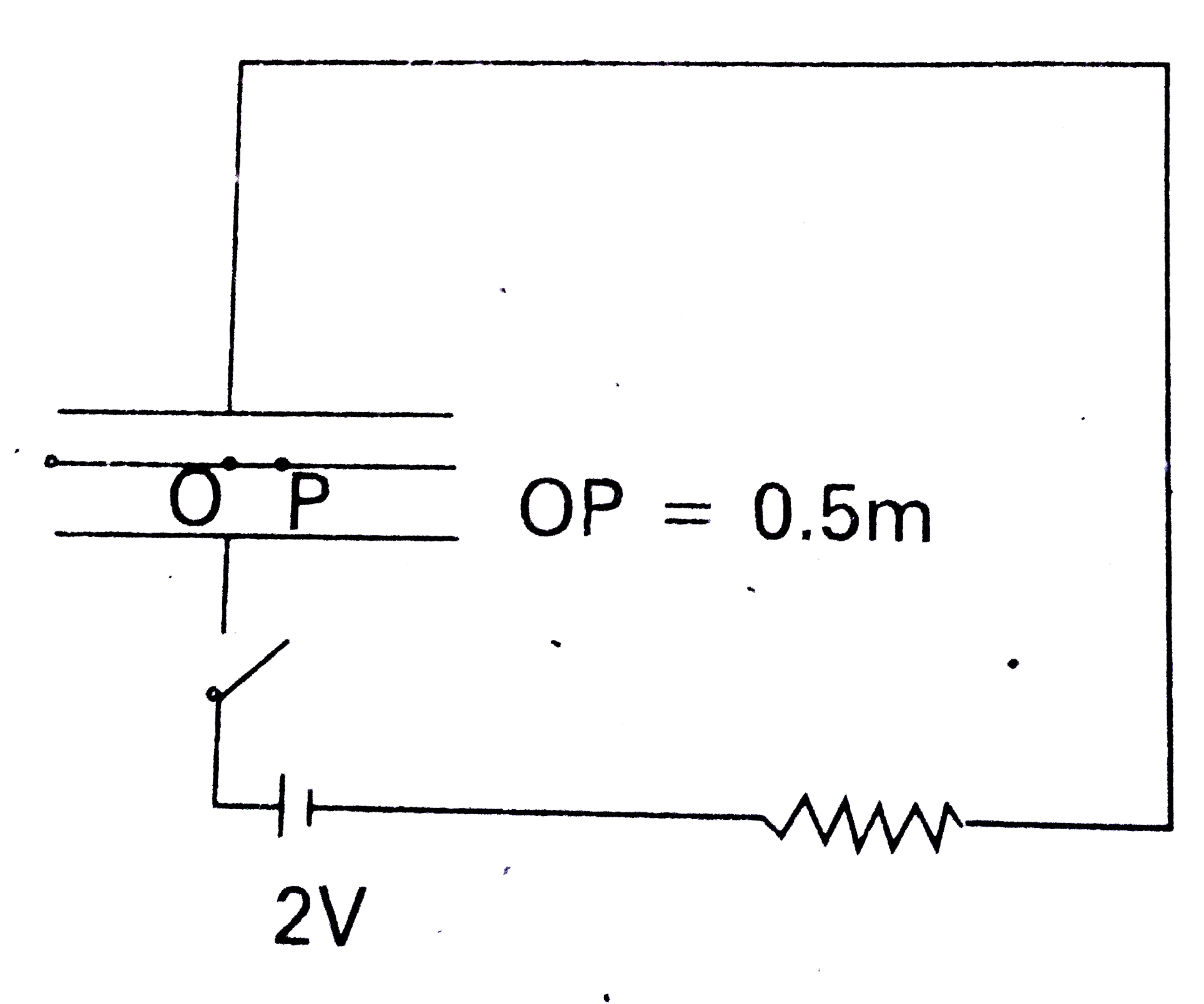
|
|
| 31. |
Define the distance of closest approach. An a particle of kinetic energy K is bombarded on a thin gold foil. The distance of the closest approach is r. What will be the distance of closest approach for an a particle of double the kinetic energy? Or Write two important of Rutherford nuclear model of the atom. |
|
Answer» Solution :Distance of distance of closest approach Finding of distance of closest approach when kinetic energy is doubled. It is the distasnce of charged particle from the centre of the nucleus, at which the whole of the initial kinetic energy of the (far off) charged particle gets converted into the electric potential energh of the system. Distance of closest approach `(r_(c))` is given by ` r_(c)=1/(4 piepsilon_(0)) . (2Ze^(2))/K` K is doubled `:.` r becomes `r/2` [ALTERNATIVELY: If a candidate writes directly `r/2` without mentioning formula, award the mark for this part.] Or Two important limitation of Rutherford NUCLEAR model. 1. According to Rutherford model, electron orbiting around the nucleus, continously radiates energy due to the acceleration, hence the atom will nor remain stable. 2. As electron spirals INWARDS, it angular velocity and frequency CHANGE continuously, therefore it will EMIT a continuous spectrum. |
|
| 32. |
A body travels 50km east , then 120 km north and finally it comes back to the starting point through the shortest distance. Total time of journey is 3 hours. What is the average velocity in km/h , over the entire trip |
|
Answer» 0 |
|
| 33. |
Figure shows a 2.0 V potentiometer used for the determination of internal resistance of a 1.5 V cell. The balance point of the cell in open circuit is 76.8 cm. when a resistor of 9.5 Omega is used in the external circuit of the cell, the balance point shifts to 64.8 cm length of the potentiometer wire. Determine the internal resistance of the cell. |
Answer» SOLUTION : `R=((l_(o)-l_(E))/(l_(C)))R=(76.3-64.8)/(64.8)xx9.5` `r=1.68Omega` |
|
| 34. |
An object having a distance of 21 cm is placed away from the concave mirror of radius of curvature 10 cm.A glass slab of refractive index 1.5 is placed perpendicular to the principle axis. Thickness of the glass plate is 3 cm. Find out the final position of the image. Distance of the nearer end of the glass slab from the mirror is 1 cm. |
|
Answer» |
|
| 35. |
When vecAcdotvecB=-vecAvecB, the two vectors are |
|
Answer» POSITIVE |
|
| 36. |
A small bead of mass m can moves on a smooth circular wire (radiusR) under the action of a force F=(km)/r^(2) directed (r=position of bead from P&K=constant) towards a point P with in the circle at a distance R/2 from the centre what should be the minimum velocity of bead at the point of the wire nearest the centre of force (P) so that bead will complete the circle |
|
Answer» `sqrt((3k)/R` 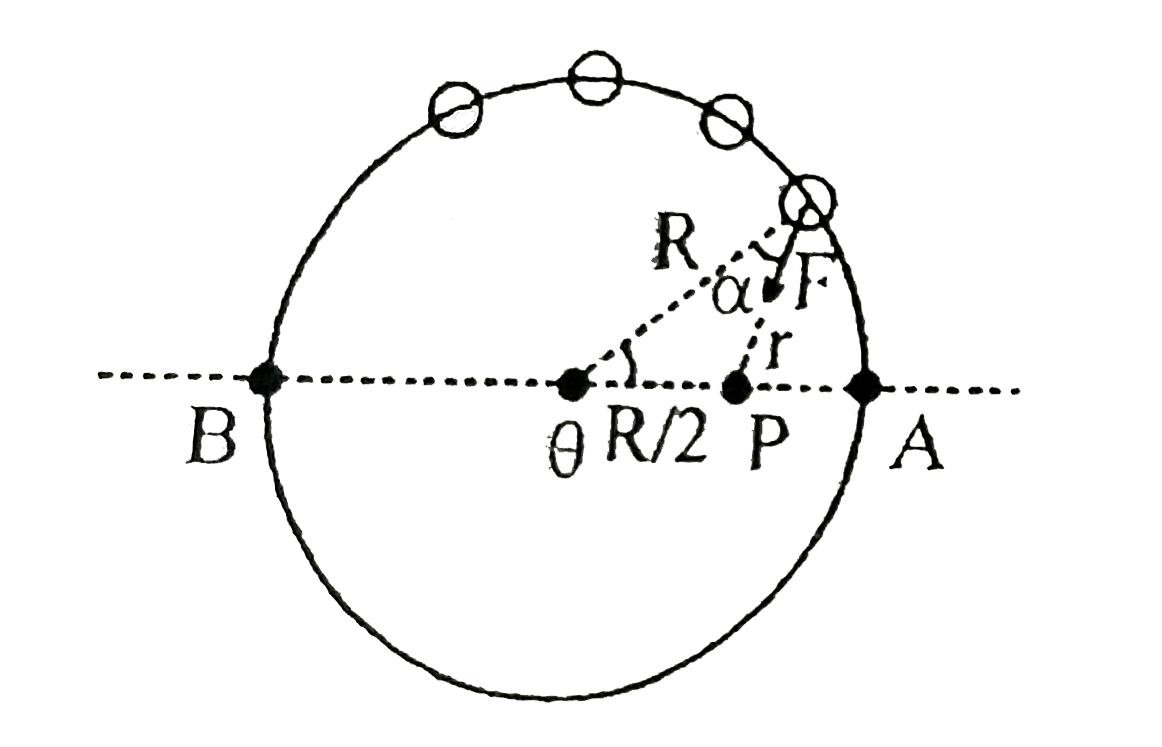 value of A at any angular position 'theta' is given by `f=(km)/r^(2)` here is given by `r=sqrt((Rcostheta-R//2)^(2)+(Rsintheta)^(2))=sqrt(R^(2)+R^(2)//4-R^(2)costheta)=R/2sqrt(5-4costheta)` `Also (2sinalpha)/R=sin 0/r i.e sinalpha =sintheta/sqrt(5-4costheta)` for SMALL angular displacement 'dtheta' work done by this force dw =-frd0cos(9theta-alpha)=-fR sin alpha dtheta `(4kmR)/(R^(2)(5-4costheta)) sintheta/sqrt(5-4costheta)dtheta` work done in moving BEAD from ATOB `Deltaw=-(4km)/R underset(theta)OVERSET(pi)(int) (sin theta d theta)/(5-4costheta)^(3//2)=-(km)/R underset(theta)overset(pi)(int)(4sin theta d theta)/(5-4costheta)^(3//2)` `=(km)/R underset(theta) overset(9)(int) (dt)/t^(3//2)=-(km)/R|t^(-1//2)/-(1//2)|_(1)^(9)` `=+(2km)/R(1/3-1)=-4/3(km)/R` :.Energy provided at point A most be equal to this work done ` :. 1/2mv_(m)^(2)=4/3(km)/R Rightarrow v_(MIN)= sqrt((8k)/(3R))` |
|
| 37. |
Two large metal plates are placed parallel to each other. The inner surface of the plates are charged by +sigma and -sigma("coulomb"//m^2"), the outer surface are neutral. The electric field is in the region between the platesand outside the plates. |
|
Answer» `(2sigma)/epsilon_0,SIGMA/epsilon_0` |
|
| 38. |
A cannon and a targetare 5.10Km apartand located at the same level. How soon will the shell launchedwiththe initial velocity 240m/s reach the targetin the absence of airdrag? |
|
Answer» Solution :Here, `v_(0) = 240 MS^(-1), R = 5.10 km= 5100 m` `g=9.8 ms^(-2), alpha`=? `R=(v_(0)^(2) sin 2alpha)/g` `sin 2alpha =(RG)/v_(0)^(2) rArr alpha = 30^(@)` or `60^(@)` using `=T=(2v_(0)sin alpha)/g` When, `a = 30^(@), T_(1) =(2 xx 240 xx 0.5)/(9.8) = 24.5 s` When, `alpha =60^(@), T_(2) =(2 xx 240 xx 0.867)/9.8 = 42.41` s |
|
| 39. |
In the figure, the pulleyP moves to the rightwitha constant speed u. The downward spee of A isv_(A) andthe speedof Bto therightisv_(B) . Then, |
|
Answer» `v_(A)= v_(B)` ` l_(1) + l_(2) = ( l_(1) -x + ut) + (l_(2) +y ) ` ` orx = ut+ yor (dx)/(dt) = u + (dy)/(dt) ` ` (dx)/(dt) ` = SPEED of B to the right `= v_(B)` ` (dy)/(dt) ` = downwardspeed of A` = v_(A) therefore v_(B) = u+V_(A)` Also `d_(v_(B))/(dt) = (dv_(A))/(dt) = or a_(B) = a_(A)` |
|
| 40. |
A sinusoidal voltage of peak value of 283 V and frequency 50 Hz is applied to a series LCR circuit in which R = 3 Omega , L = 25.48 mH and C = 796 mu F. Find the impedance of the circuit. |
|
Answer» Solution :(i) `X_(L) = omega L` `= 2 pi f L` `= ( 2) ( 3.14) ( 50) ( 25.48 xx 10^(-3))` `= 8 Omega` (ii) `X_(C ) = ( 1)/( omega C )` `= ( 1)/( 2pi f C )` `= ( 1)/( 2 xx 3.14 xx 50 xx 796 xx 10^(-6))` `= 4.00 1 Omega` `= 4 Omega` (iii) Impedance of given SERIES ac circuit. `|Z | = SQRT ( R^(2) + ( X_(L) - X_(C ))^(2))` `= sqrt( (3)^(2) + ( 8-4)^(2)) = 5 Omega` |
|
| 41. |
Who is the writer of the chapter Gillu? |
|
Answer» MAHADEVI Verma |
|
| 42. |
An instantaneousdisplacement of a simple harmonicoscillatoris x=A cos (omegat+pi//4). Its speed will be maximum at time : |
|
Answer» `pi//4omega` For velocity to be MAXIMUM `omega t+pi//4=pi//2""implies""t=(pi)/(4omega)` CORRECT CHOICE is (a). |
|
| 43. |
Column I gives certain situations involving two thin conducting shells connected by a conducting wire via a key K. In all situations, one sphere has net charge +q and other sphere has not net charge. After the key K is pressed, column II gives some resulting effects. Match the figures in Column I with the statement in Column II. |
|
Answer» <P> |
|
| 44. |
A particle of mass m moves in a unidimensional potential field U= kx^(2)//2 (harmonic oscillator). Using the uncertainty principle, evaluate the minimum permitted energy of the particle in that field. |
|
Answer» Solution :We write `P~DeltaP~(ħ)/(Deltax)~(ħ)/(x)` i.E., all FOUR QUANTITIES are of the same ORDER of magnirude. Then `E~~(ħ^(2))/(2 mx^(2))+(1)/(2)kx^(2)((ħ)/(x)-sqrt(mk)x)^(2)+ħsqrt((k)/(m))` Thus we GET an equilibrium situation (`E=` minimum) when `x=x_(0)=sqrt((ħ)/(sqrt(mk)))` and then `E=E_(0)~~ħsqrt((k)/(m))=ħ omega` Quantum mechanics gives `E_(0)=ħ omega//2` |
|
| 45. |
The force vecF experienced by a particle of charge q moving with velocity vecv in a magnetic field vecB is given by vecF = q(vecv xx vecB). Ofthese, name the pairs of vectors which are always at right angles to each other. |
| Answer» Solution :`vecFand vecv` as WELL as `vecF and vecB` are the PAIRS which are ALWAYS at right ANGLES to each other. | |
| 46. |
A point dipole is located at the origin in some orientation. The electric field at the point (10 cm, 10 cm) on the x-y plane is measured to have a magnitude 1.0 xx 10^(-3) V//m. What will be the magnitude of the electric field at the point (20 cm, 20 cm)? |
|
Answer» `5.0 XX 10^(-4) V//m` |
|
| 47. |
A coin slides over a frictionless plane and across an xy coordinate system from the origin to a point with xy coordinates ( 3.0 m , 4.0 m)whilea constant force acts on it. The force has magnitude 2.5 N and is directed at a counter-clockwise angle of 100^(@) from the positive direction of the x axis. How much work is done by the forceon the coin during the displacement ? |
|
Answer» |
|
| 49. |
An electronfalls through a distanceof 1.5 cm in a uniformelectricfield of value 2xx10^(4) N//C. Whenthe directionof electricfield is reversed, a protonfalls throughthe samedistance, Comparethe situation with thatof 'free fall under gravity'. |
Answer» Solution :(a) For electron, REFER to Fig. 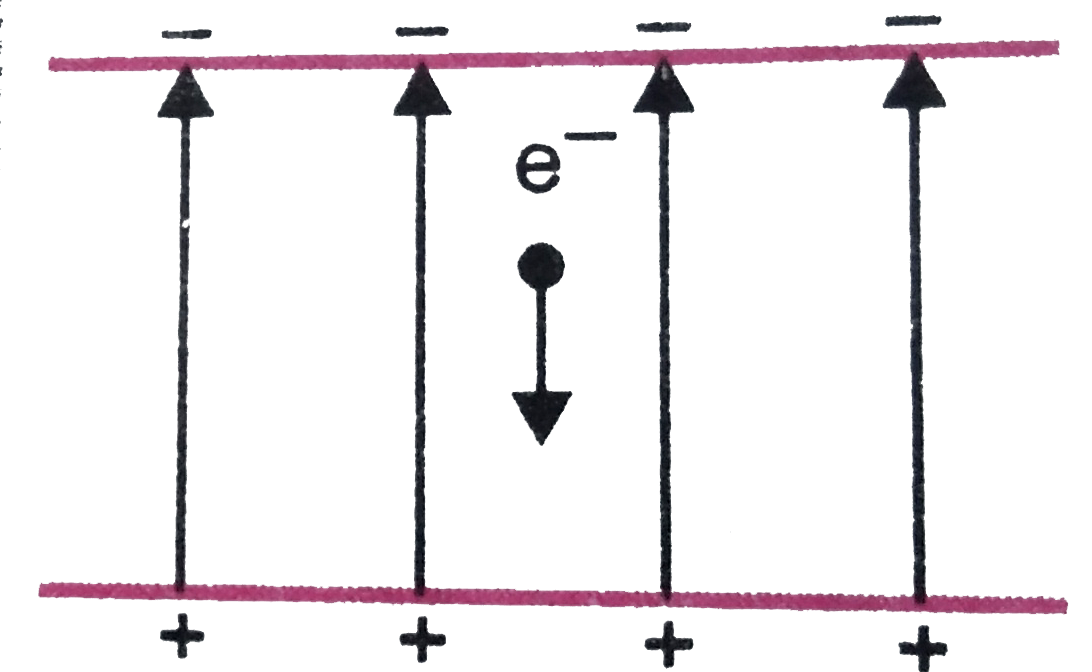 `y_(1) = 1.5 cm = 1.5 xx10^(-2) m, E_(1) = 2xx10^(4) N//C` `q_(0) =1.6xx10^(-19)` coulomb, `m_(1) = 9xx10^(-31) kg`. Acceleratin, `a_(1) = (F_(1))/(m_(1)) = (q_(0) E_(1))/(m_(1)) ` `= (1.6xx10^(-19)xx2xx10^(4))/(9xx10^(-31)) = 3.55xx10^(15) m//s^(2)` From `1 y_(1) = u_(1) t_(1) + (1)/(2) a_(1) t_(1)^(2)` `y_(1) = 0 + (1)/(2) a_(1) t_(1)^(2)` or `t_(1) = sqrt(2 (y_(1))/(a_(1))) = sqrt((2xx1.5xx10^(-2))/(3.55xx10^(15)))= 2.9xx10^(-9) sec.` (b) For proton, Refer to Figurewhenelectricfield is reversed. 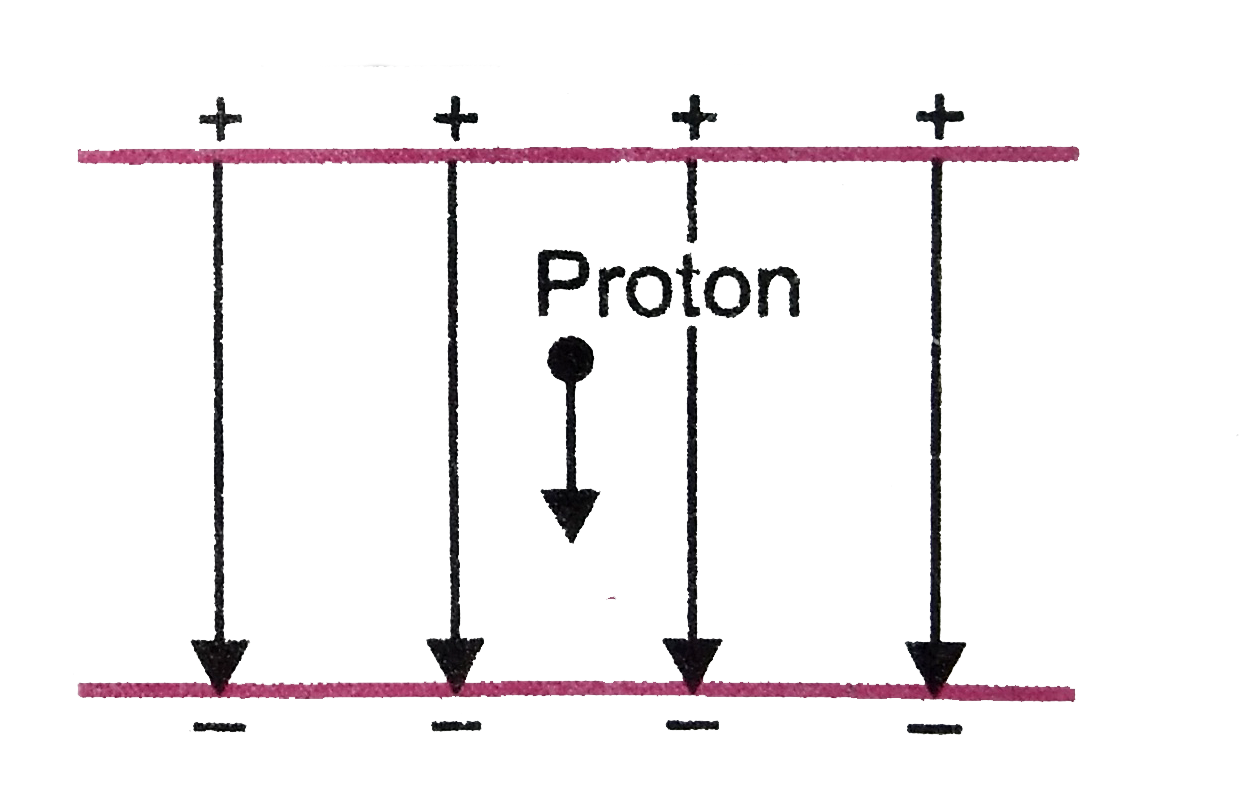 charge `q_(0) = +1.6xx10^(-19) C`, `m_(2) = 1.67xx10^(-27)kg`. `:.` Acceleration, `a_(2) = (F_(2))/(m_(2)) = (q_(0) E_(2))/(m_(2))` `a_(2) = (1.6xx10^(-19)xx2xx10^(4))/(1.67xx10^(-27)) = 1.92xx10^(12) m//s^(2)` Similarly `t_(2) = sqrt((2 y_(2))/(a_(2))) = sqrt((2xx1.5xx10^(-2))/(1.92xx10^(12)))` `=1.25xx10^(-7) s` and `(t_(1))/(t_(2)) = (2.9xx10^(-9))/(1.25xx10^(-7)) = 2.3xx10^(-2)` We observethat acceleration of electron `= 10^(15)m//s^(2)` amd accelerationof proton`= 10^(12) m//s^(2).` The value of 'G' in freefall in only`9.8 m//s^(2) = 10^(1) m//s^(2),` whichis NEGLIGIBLE. Therefore, effectof acc. due to gravitycan be ignored. |
|
| 50. |
Questions number 86-88 are based on the following paragraph : An initialy parallel cylindircal beam travels in a medium of refractive index mu (I) = mu_(0) + mu_(2)I, where mu_(0) and mu(2) are positive constant and I is the intensity of the light beam.The intensity of the bema is decreasing with increasing radius. 86. The initial shape of the wavefront of the beam is: |
|
Answer» PLANAR 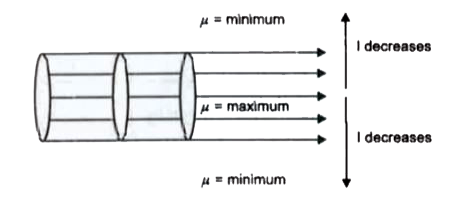
|
|


