

Saved Bookmarks
This section includes 7 InterviewSolutions, each offering curated multiple-choice questions to sharpen your Current Affairs knowledge and support exam preparation. Choose a topic below to get started.
| 1. |
de-Broglie wavelength of an electron wave is 1.227 Å, when the electron is accelerated by a potential difference of _____. |
| Answer» Solution :`100V.` [As `LAMDA=(1.227)/(sqrtV)nm=(12.27)/(SQRT(V))Å`, hence `lamda` is 1.2227 Å only when V=100 VOLTS]. | |
| 2. |
ODBAC is fixed rectangular conductor of negligible resistance (CO is not conneted) and OP is a counductor which rotates clockwise with an angular velocity omega Fig. The entrie system is in a uniform magnetic field B whose direction in along the normal to the surface of the rectangular conductor ABDC. The conductor OP is in electric contact with ABDC. The rotating conductor has a resistance of gamma per unit length. Find the current in the rotating conductor, as it rotates by 180^(@) |
|
Answer» Solution :The SET up is shon in Fig Between time t = 0 `t = (T)/(8) = (pi)/(4 omega)`, the rod OP will make contach with side BD. At any time t: `0 lt t lt (pi)/(4 omega)`, let the length `:.` Magnetic flux through the area ODQ is `phi = B xx area OQD = B xx (1)/(2) QD xx OD = B xx (1)/(2) l tan theta xx l` 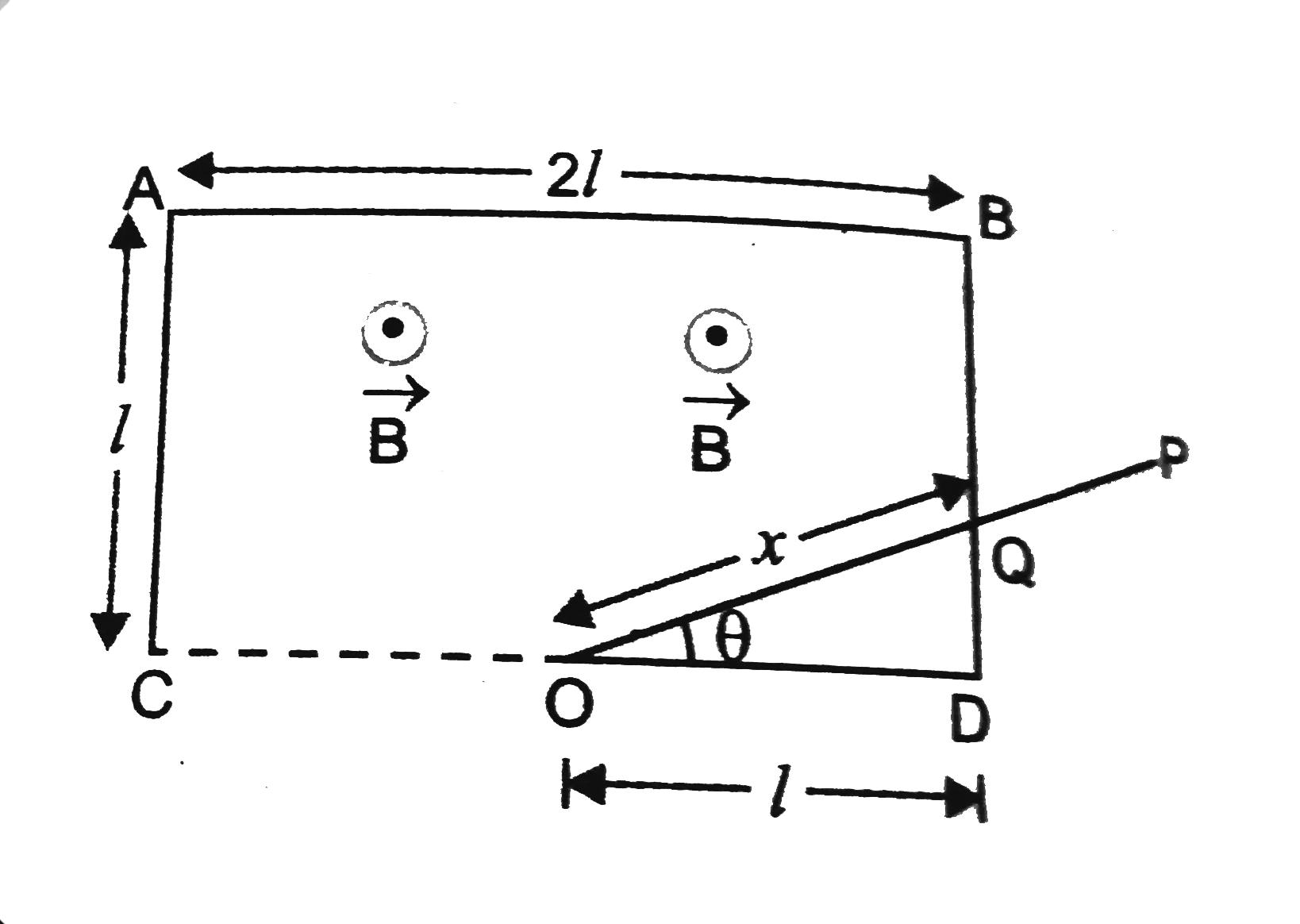 `phi = (1)/(2) B l^(2) tan theta`, where `theta = omega t` Magnetic of EMF generated, `e = (d phi)/(dt) = (1)/(2) B l^(2) omega sec^(2) omega t` If R is resistance of the rod in contact, then induced current `I = (e)/(R )`. Now , `R = lambda x = (lambda l)/(cos omega t):. I = (1)/(2) (B l^(2) omega sec^(2) omega t)/(lambda l //cos omega t) = (B l omega)/(2 lambda cos omega t)` For `t = (T)/(8) = (pi)/(4 omega )` to `t = (3T)/(8) = (3 pi)/(8)`, the rod is contact with the side AB, as shown in Fig. Let the length of the rod in contant, OQ = x. Magnetic flux linked with area ODBQ `phi = B xx `area of TRAPEZIUM ODBQ `= B(l^(2) - (l^(2))/(2 tan theta))`, where `theta = omega t` 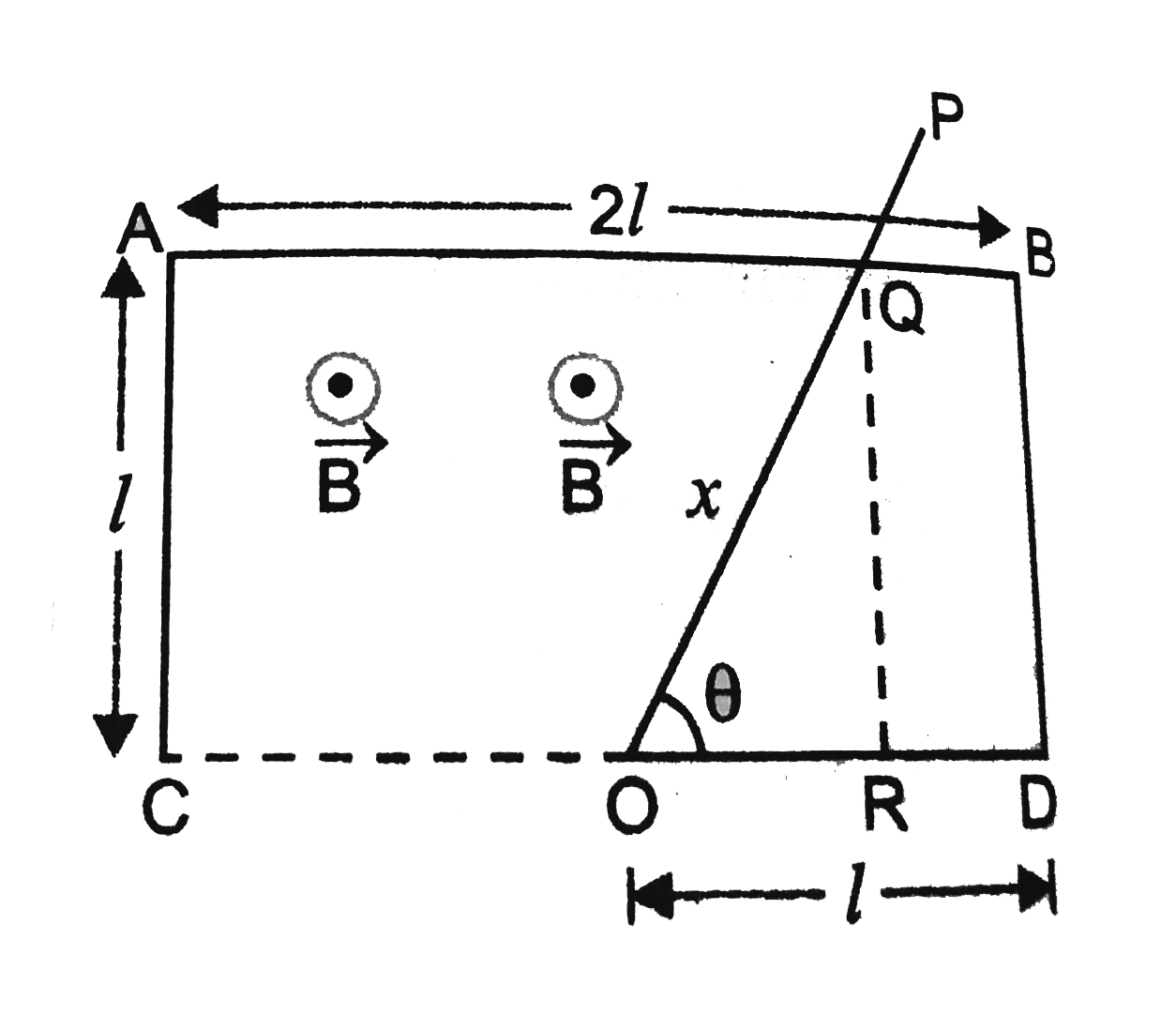 Magnitude of emf generated, `e = (d phi)/(dt) = (1)/(2) B l^(2) omega sec^(2) omega t = (1)/(2) B l^(2) omega (sec^(2) omega t)/(tan^(2) omega t)` Induced current, `I = (e)/(R ) = (e)/(lambda x) = (e sin omega t)/(lambda l) = (1)/(2 lambda) xx (B l omega)/(sin omega t)` For `t = (3T)/(8) = (3 pi)/(4 omega)` to `t = (4 T)/( 8) = (pi)/(omega)`, the rod is in contact with the side AC as shown in Fig. Let the length of the rod in contact OQ = x. Magnetic flux linked with area ODBAQ `phi = B xx` [area of rectangular ABDC - area of `Delta OQC`] 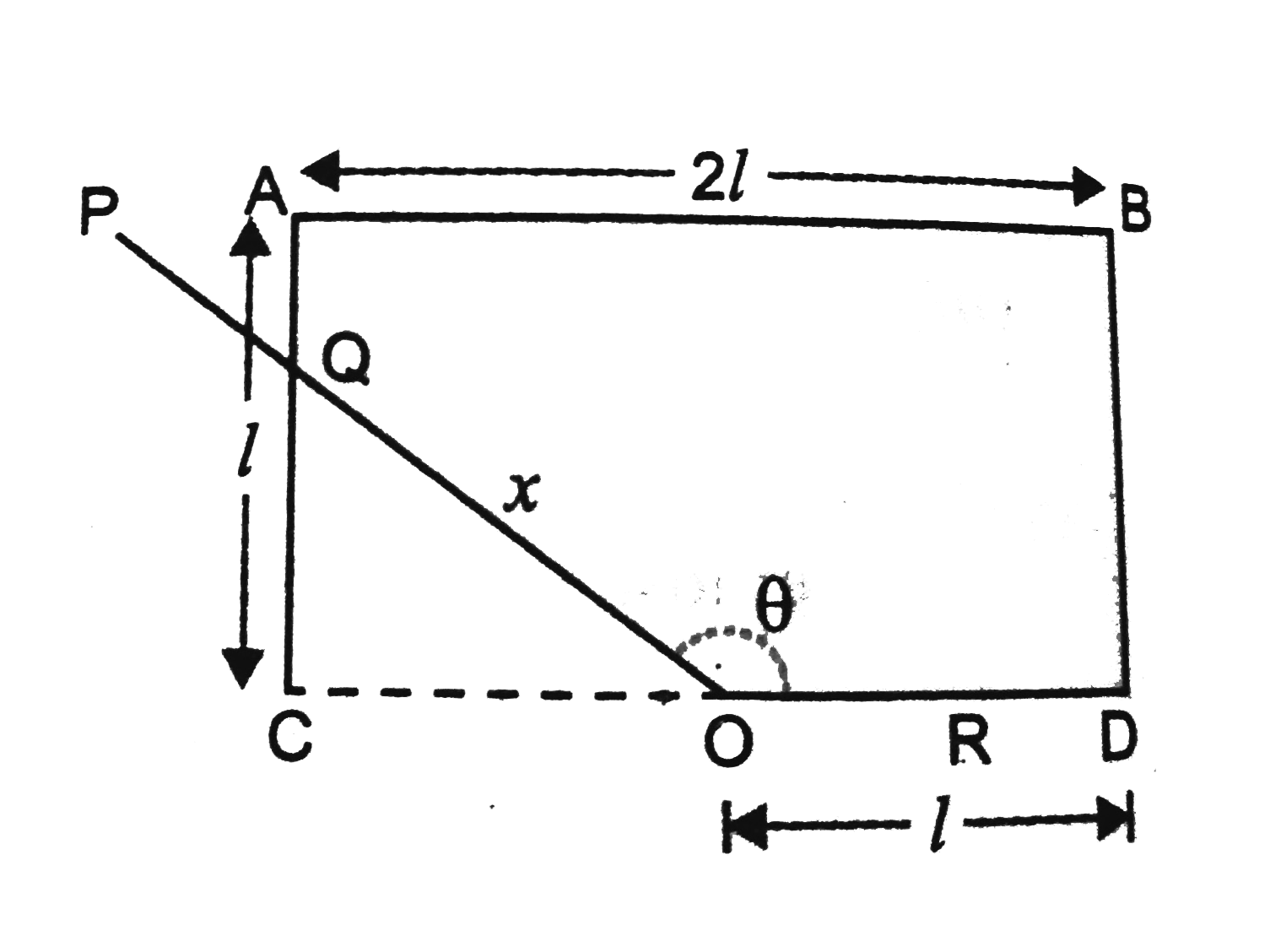 `phi = B [2 l^(2) - (l^(2))/(2 tan omega t)]` Magnitude of induced emf, `e = (d phi)/(dt) = (d)/(dt) B (2 l^(2)- (l^(2))/(2 tan omega t)) = (B omega l^(2) sec^(2) omega t)/(2 tan^(2) omega t)` Induced current, `I = (e)/(R ) = (e)/(lambda x) = (e sin omega t)/(lambda l) = (B l omega)/(2 lambda sin omega t)` |
|
| 3. |
A square (each side of length L) wire loop is kept with a long straight wire carrying current I. The emf induced in the square loop is _____ |
|
Answer» zero |
|
| 4. |
Why do light of a car dim when starter is operated ? |
| Answer» SOLUTION :DUE to large current drawn by starter MOTOR, there is a large POTENTIAL drop in the battery which is equal to iR(R being the internal resistance of the battery). Therefore, the potential difference across the battery reduces momentarity and the BULB becomes dim. | |
| 5. |
Which one of the following was not the feature of Napoleonic Code? |
|
Answer» EQUALITY before the law |
|
| 6. |
Name the experiment which confirms the existence of wave nature of electrons. Derive the expression for de-Broglie wavelength of an electron moving under a potential difference of V volts, (ii) An electron and a proton have the same Kinetic Energy, Which of these particles has the shorter de-Broglie wavelength? |
|
Answer» <P> Solution : Davisson-Germer experiment An electron of charge e, mass m accelerated through a potential difference of v VOLTS, Kinetic energy equals the WORK done (eV) on it by the electric FIELD:K=eV `K=p^(2)/(2m'), p=sqrt((2mk))` (ii) `p=sqrt((2meV))` the de-Broglie wavelength 1 of the ELECTRONS is: `lambda=h/p`. For same `KE, lambda alpha 1/sqrtm` (iii) For same KE, l a........ As mass of proton is greater than that of electron `therefore lambda_(p), lambda_(a)`. |
|
| 7. |
What is the oscillation amplitude of a 4.00kg box oscillating on a spring with spring constant 100N/m if at time t= 1.00s the position is x = 0.129m and the velocity is v= 5.00m/s? At t= 0, what are (a) the position and (b) the velocity? |
| Answer» SOLUTION :(a) 1.01 m, (B) 0.996m, (C ) 0.800m/s | |
| 8. |
Eight wires cut the page perpendicularly at the points shown. Each wire carries current i_0. Odd currents are out of the page and even currents into the page. Find the line intergal ointvec B.vec(dl)along the loop. |
|
Answer» Solution :Acoording to ampere.s circuital law `OINT VEC(B). vec(DL) = mu_0 i ` ENCLOSED `oint vec(B).vec(dl) = mu_0[i_0 - i_0 + i_0 + i_0]` `oint vec(B).vec(dl) = 2mu_0i_0` |
|
| 9. |
An object is placed near two perpendicular plane mirrors as shown in the figure.How many images will be formed? (##MST_AG_JEE_MA_PHY_V02_C33_E01_030_Q01.png" width="80%"> |
|
Answer» 1 |
|
| 10. |
The rms value of potential difference V shown in the figure is |
|
Answer» `V_(0)` |
|
| 11. |
In a deflection magnetometer, the needle is short and the pointer is long because, the |
|
Answer» |
|
| 12. |
Is Coulomb a very big unit of charge? |
| Answer» Solution :YES. The force of repulsion between two ONE coulomb charges placed one METRE apart in air or VACUUM is `9 xx 10^(9)N`, which is enormous. | |
| 13. |
The minimum number of unequal vectors which can give zero resultant is |
|
Answer» 1 |
|
| 14. |
An emf E = 4 cos (1000t) volt is applied to an LR circuit of inductance 3 mH and resistance 4 Omega. What is the amplitude of current in the circuit ? |
|
Answer» `4/sqrt7A` `|Z|=SQRT(R^2+X_L^2)` `=sqrt((4)^2+(3)^2)` `=sqrt25` `|Z|=5Omega` and `E_m`=4V `THEREFORE E_"rms"=E_m/sqrt2=4/1.414`=2.828 V `therefore I_"rms"=E_"rms"/"|Z|"` `=2.828/5` =0.567 `approx` 0.57 `approx 4/7A` |
|
| 15. |
एक स्थलीय भाग जो तीन ओर से समुद्र से घिरा हो |
|
Answer» तट |
|
| 16. |
A student plots a graph between the resistance R and the reciprocal of deflection theta for the give galvanometer. The graph obtained is as shown in figure. From the graph he can calculate the resitance of galvanometer as |
|
Answer» ratio of slope to INTERCEPT |
|
| 17. |
When a glass prism of refracting angle 60^(@) is immersed in a liquid its angle of minimum deviation is 30^(@). The critical angle of glass with respect to the liquid medium is |
|
Answer» `30^(@)` |
|
| 18. |
A 20 gram bullet moving at 300 m/s stops after penetrating 3 cm of bone. Calculate the average force it exerts. |
|
Answer» `2 x 10^4` |
|
| 19. |
The potential difference applied to an X-ray tube is 5 kV and the current through it is3.2 mA. The number of electrons striking the target per second is |
|
Answer» `5 xx 10^16` `n= I/e = (3.2 mA)/(1.6 xx 10^(-19) C) = (3.2 xx 10^(-3 )A)/(1.6 xx 10^(-19) C) = 2 xx 10^16 s^(-1)` |
|
| 20. |
Find the magnitude and direction of the magnetic field due to a small bar magnet of moment 0.03 joule per tesla at a point situated on a line through the centre of the magnet and at an angle of 60^(@) with its axis, the point being at a distance of 0.05m from the centre of the magnet. |
|
Answer» |
|
| 21. |
If each element of set A has one and only one connection in set B then it is |
|
Answer» Relation |
|
| 22. |
A metal rod of length 1m rotates about its one end in a plane at right angles to a horizontal magnetic field of induction 7/22xx10^-4T. If its frequency of rotation is 10 Hz, then what is the magnitude of induced e.m.f.? |
|
Answer» Solution :FLUX `PHI` = B.A Area swept/sec = dA/dt = F.`pir^2` ` therefore E = 7/22xx10^-4xx10xx22/7xx1^2` = imV |
|
| 23. |
A beaker containing water is balanced on the pan of a common balance. A solid of specific gravity 1 and mass 5 g is tied to the arm of the balance and immersed in water contained in the beaker. The scale pan with the beaker. |
|
Answer» GOES down |
|
| 24. |
A = B = C = 4 kg. The table is smooth, the string is light and inextensible. The tension in the string connecting B and C is |
|
Answer» 4 G |
|
| 25. |
A bullet fired vertically up from the ground reaches a point in its path after 3s and 13 s, both times being taken from the instant of firing the bullet. The velocity of projection of the bullet is (g=10 ms^(-2)) |
| Answer» Answer :A | |
| 26. |
Mass remaining constant, the radius of the earth shrinks by 1%. The acceleration due to gravity onthe earth's surface would: |
|
Answer» INCREASE by 2% `THEREFORE (Deltag)/(g) XX 100=2 (DeltaR)/(R )xx100` `=2xx1%=2%` . So the correct choice is (a). |
|
| 27. |
Heat radiations cannot exhibit the following phenomenon. That is |
|
Answer» interference |
|
| 29. |
A system consistsof a him chargedwire ring of radius R and a very uniformly chargedthread orientedalongthe axisof the ring withone of its endscoincidingwiththe centreof the ring. The total charge of the ring isequal to q. The charge of the thread (per unit length) is equal to lambda. Find the interaction force between the ring and the thread. |
|
Answer» Solution :Force "dF" on the wire `=dq barE` `=(QX lambda dx)/(4PI in_(0)(x^(2)+R^(2))^(3//2))` `=(qlambda)/(4pi in_(0)) int_(0)^(OO) (xdx)/((R^(2) +x^(2))^(3//2))` `F=(lambdaq)/(4pi in_(0)R)`. |
|
| 30. |
A polonium nucleus transforms into one of lead. Find the kinetic energy of the alpha-particle and of the recoil nucleus. |
|
Answer» `EPSI=[209.93297-(4.00260+205.97446)]xx931.5=5.5MeV` This energy is equal to the sum of kinetic energies of the alpha-particle and the recoil nucleus : `epsi=K_(alpha)+K_(PH)andK_(alpha)//K_(Ph)=M_(Ph)//M_(alpha)`. |
|
| 31. |
For the following circuit the equivalent capacitance P and Q is |
|
Answer» Solution :ANSWER (4) First THREE capacitors are in parallel and NEXT are short - circuiled . |
|
| 32. |
The plane surface of a plano-convex lens of refracting index 1.5,issilvered. The radius of curvature of curved surface is R. Find the focal length of the mirror thus formed. |
|
Answer» Solution :`1/f_("lens") = (1.5-1)(1/R - 1/infty) implies f_("lens")=2R` `P_("mirror") = 1/(2R) - 1/oo + 1/(2R)= 1/R implies f_("mirror")=-R` (CONCAVE mirror) |
|
| 33. |
They misinterpreted the library as a? |
|
Answer» Park |
|
| 34. |
Many exoplanets have been discovered by the transit method, wherein one monitors a dip in the intensity of the parent star as the exoplanet moves in front of it. The exoplanet has a radius R and the parent star has radius 100R. If I_(0) is the intensity observed on earth due to the parent star, then as the exoplanet transits, |
|
Answer» The MINIMUM observed intensity of the PARENT STAR is `0.9I_(0)` |
|
| 35. |
The count rate fromfrom 100 cm^3 of a radioactive liquid is c. Some of this liquid is now discarded . The count rate of the remaining liquid is found to be c/10 after three Half-lives. Find the volume of the remaining liquid , in cm^3 ? |
|
Answer» Solution :INITIAL count rate (CR) for 1 `cm^3` of LIQUID `=c/100` After 3 half - lives , CR for 1 `cm^3` of liquid `=1/(8)xxc/100` Let the volume of the remaining liquid `=V cm^3` CR of this liquid `=V xxc/(800)=c/10 " or " V = 80` |
|
| 36. |
A bullet of mass 0.005 kg moving with a speed of 200 ms^(-1) enters a heavy wooden block and is stopped after a distance of 50 cm. What is the average force exerted by the block on the bullet? |
|
Answer» `-200` N |
|
| 37. |
The given RC circuit has two switches S_(1) and S_(2) The switch S_(2) is closed till the capacitor C attains its maximum possible charge 90. Then, Sy is opened and S, is closed simultaneously till the capacitor releases half of its total stored charge go for a time interval ty. Finally S is opened and Sa is closed till the capacitor attains a charge (3//4)qo for a time interval t_(2). Find the ratio (t._(1)//t_(2). |
|
Answer» Solution :When the switch `S_(2)` is closed, the capacitor is charged to a potential V. Now the switch `S_(2)` is opened and the switch `S_(1)` is closed The instantaneous charge on the capacitor is `impliesq=q_(0)e^((1)/(RC))` where`q_(0)=CV`Putting`t=t_(1)` for`q=q-(0)//2`,`weobaine^(t_(1)/(R_(1)C))=(1)/(2)` `implies(t_(1)=R_(1)CIn2` Again, the switch `S_(1)` is opened and `S_(2)`is closed. Therefore, the capacitor STARTS charging from charge `q-(0)//2 to (3)/(4)q_(0)` Now, instantaneous charge on the capacitor is `q=q_(0)[1-e^((t)/(R_(1)+(R_(2))C)]]+q_(0)/(2)e^((t)/(R_(1)+R_(2)C))=q_(0)[1-(1)/(2)e^((t)/(R_(1)+R_(2)c)]]` `At,t=t_(2),q^(.)=3q_(0)//4implies3q_(0)/(4)=(q_(0)(1)/(2)e^((t_(2))/((R_(1)+R_(2))C)))` `impliese^(t^(2)/(R_(1)R_(2)C))=(1)/(2)impliest_(2)=(R_(1)+R_(2))CIn2` `therefore` The required ratio of the times =`(t_(1)/(t_(2))(R_(1)CIn2)/((R_(1)+R_(2))CIn2)` or,`(t_(1))/(t_(2))=(R_(1))/((R_(1)+R_(2))` 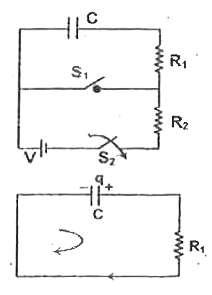
|
|
| 38. |
Range of voltmeter ______ with increase in series resistance. |
|
Answer» decreases |
|
| 39. |
Draw a neat diagram to show dispersion of light in a prism. |
Answer» SOLUTION :The different CONSTITUENT colours obtained on the SCREEN are KNOWN as the SPECTRUM.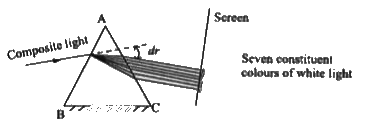
|
|
| 40. |
Choose the wrong statement for zero error and zero correction : |
|
Answer» If the zero of the vernier scale does not coincide with the zero of the main scale then the instrument is said to be having a zero ERROR. |
|
| 41. |
A diode detector is used to detect an amplitude modulated wave of 60% modulation by using a condenser of capacity 250 pico farad in parallel with a load resistance 100 kilo ohm. Find the maximum modulated frequency which could be detected by it. |
|
Answer» 10.62 kHz 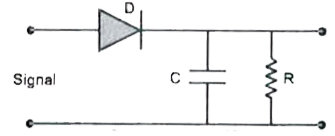 `tau=RC=100xx10^3xx250xx10^(-12)` SEC `2.5 xx10^7xx10^(-12)sec` `=2.5xx10^(-5)` sec The higher FREQUENCY which ca be detected with tolerable distortion is `f=1/(2pim_aRC)-1/(2pixx0.6xx2.5xx10^(-5))Hz` `=(100xx10^4)/(25xx1.2pi)Hz =4/(1.2pi)xx10^4Hz = 10.61 KHz` This condition is OBTAINED by APPLYING the condition that rate of decay of capacitor voltage must be equal or less than the rate of decay modulated SIGNAL voltage for proper detection of modulated signal. |
|
| 42. |
Can a capacitor of suitable capacitance replace a choke coil in an ac circuit? |
| Answer» SOLUTION :Yes. A CAPACITOR can REPLACE a choke coil in an ac circuit because power factor is zero for a capacitor and an INDUCTOR. | |
| 43. |
How could a blue object appear under sodium lamp light ? |
| Answer» SOLUTION :The OBJECT will APPEAR BLACK. | |
| 44. |
Find the probability that a certain radioactive atom would get disintegrated in a time equal to the mean life of the radioactive sample. |
|
Answer» <P> Solution :Since , the Probability P(t) that a particular radioactive ATOM gets DISINTEGRATED in a TIME t (from Eq.) given by`P(t)=1-e^(-lambdat)` `therefore` Here `t= LT t gt =1/lambda"" therefore P(t)=1-1//e` `approx` 1-0.37=0.63 |
|
| 45. |
According to Newtons first law of motion , which of the following statement (s) is/are correct ? |
|
Answer» If the vector SUM of forces acting on a body is ZERO, then and only then the body remains unaccelerated |
|
| 46. |
Tritium is an isotope of hydrogen whose nucleus Triton contains 2 neutrons and 1 proton free neutrons decay into p+overline(e)+overline(v) if one of the neutrons in triton decays, it would transform into a He^(3) nucleus. This does not happen because. |
|
Answer» TRITON ENERGY is less than that of a `He^(3)` nucleus. |
|
| 47. |
For the potentiometer circuit shown in the given figure, points X and Y represent the two terminals of an unknown emf epsi . A student observed that when the jockey is moved from the end A to the end B of the potentiometer wire, the direction of the deflection in the galvanometer remains in the same direction. What may be the two possible faults in the circuit that could result in this observations ? If the galvanometer deflection at the end B is (i) more, (ii) less, than that at the end A which of the two faults," listed above, would be there in the circuit ? Give reasons in support of your answer in each case. |
|
Answer» SOLUTION :TWO possible faults in the circuit can be : 1. Positive terminal of unknown emf source e is not connected to point A, where positive terminal of battery E has been connected. 2. Emf of battery E is less than the unknown emf `epsi` . (i) If on sliding the jockey from the end A to end B galvanometer deflection gradually increasesthen it means that connections of unknown emf `epsi`are wrong because then in accordance with Kirchhoff.s laws potential is gradually increasing from A to B. (ii) If on sliding the jockey from the end A to end B galvanometer deflection decreases butnull point is not obtained then it means that the emf of battery E is less than unknown emf `epsi`and hence deflection is in ONE direction only. |
|
| 48. |
Two identical point particle A and B are placed infront of a concave mirror of focal length 20 cm at distances 10 cm and 30 cm respectively. The particles oscillate perpendicular to the principal axis, such that the displacement equation for both the particles is given by Y_(A)=Y_(B)=0.1 sin (pit) cm. Find the maximum separation between the images of A and B measured perpendicular to the principal axis in mm. |
|
Answer» |
|
| 49. |
Light from an ordinary source (say a sodium lamp) is passed through a polaroid sheet P_(1). The transmitted light is then made to pass through a second polaroid sheet P_(2) which can be rotated so that the angle theta between the two polaroid sheets varies from 0^(@) to 90^(@). Show graphically the variation of intensity of light transmitted by P_(1) and P_(2) as a function of angle theta. Take incident beam intensity I_(0). Why does light from clear blue portion of sky show a rise and fall of intensity when viewed through a polaroid which is rotated ? |
|
Answer» SOLUTION :When incident beam INTENSITY from an ordinary source is `I_(0)`, beam intensity of polarised light from `P_(1)` is `I_(0)//2`.If `theta` is angle between `P_(1)` and `P_(2)`, then according to law of MALUS, intensity of polarised light from `P_(2)` is `I = (I_(0))/(2) COS^(2) theta` When `theta = 0^(@)`,`I = (I_(0))/(2) cos^(2) theta = ((I_(0))/(2))` When `theta = 30^(@)`,`I = (I_(0))/(2) cos^(2) 30^(@) = (3)/(4)((I_(0))/(2))` When `theta = 45^(@)`,`I = (I_(0))/(2) cos^(2) 45^(@) = (1)/(2)((I_(0))/(2))` When `theta = 60^(@)`,`I = (I_(0))/(2) cos^(2) 60^(@) = (1)/(4)((I_(0))/(2))` When `theta = 90^(@)`,`I = (I_(0))/(2) cos^(2)90^(@) = Zero` The variation of `I` with `theta` is plotted in Fig. The blue COLOUR of sky is due to scattering. Light from clear blue portion of sky polarised by scattering. The polaroid through which this light is observed atcs as analyser. The intensity of light viewed through rotating polaroid varies as per law of Malus. 
|
|