Saved Bookmarks
This section includes 7 InterviewSolutions, each offering curated multiple-choice questions to sharpen your Current Affairs knowledge and support exam preparation. Choose a topic below to get started.
| 1. |
If a man wants hit a target, in what direction be point his rifle ? (Higher , lower or in the same direction as the target). |
| Answer» SOLUTION :HIGHER than the target because the bullet surffers a VERTICAL DOWNWARD deflection `y=(1/2)gt^2` | |
| 2. |
An inductance of 0.2 H and resistance 100Omega are connected to an AC 180V-50Hz. The current in the circuit is |
|
Answer» 0.52A |
|
| 3. |
Columns A and B describe some definitions, descriptions and symbolic representations used in current electricity. |
|
Answer» |
|
| 4. |
(a) Unpolarised light of intensity I_(0) passes through two polaroids P_(1) and P_(2) such that pass axis of P_(2) makes an angle theta with the pass axis of P_(1), Plot a graph showing the variation of intensity of light transmitted through P_(2) as the angle theta varies from zero to 180^(@). (b) A third polariod P_(3) is placed between P_(1) and P_(2) with pass axis of P_(3) making an angle beta with that of P_(1). If I_(1), I_(2) and I_(3) represent the intensities of light transmitted by P_(1), P_(2) and P_(3) determine the values of angle theta and betafor which I_(1)=I_(2)=I_(3). |
Answer» Solution :(a) The REQUIRED GRAPH WOULD have the form shown as :  Using `I_(2)=I_(1)cos^(2)theta` (b) `I_(1)=` Light TRANSMITTED by `P_(1)` `I_(3)=` Light transmitted by `P_(3)=I_(1)cos^(2)beta` `I_(2)=` Light transmitted by `P_(2)=I_(3)cos^(2)(theta-beta)` `:.I_(2)=I_(3)` `I_(1)cos^(2)beta.cos^(2)(theta-beta)=I_(1)cos^(2)beta` `theta=beta` Also `I_(1)=I_(2)` `I_(1)=I_(1)cos^(2)theta` or `cos^(2)theta=1` `:.theta=0^(@)` or `pi` Therefore `beta=0^(@)` or `pi` |
|
| 5. |
The quantity ((nh)/(2piq B))^(1/2) , when n is a postive integer, h is Planck'sconstant, qis charge and B is magnetic field, has the dimensions of |
|
Answer» area ` ((nh)/(2piq B))^(1/2) = (("Energy " xx " time")/("Force / velocity "))^(1/2` = displacement ,which is havingthe samedimensions as that of length. |
|
| 6. |
The potential energy of a particle in a conservative field is U = frac{a}{r^3}-frac{b}{r^2} , where a and b are positive constants and r is the distance of particle from the centre of field. For equilibrium, the value of r is |
|
Answer» `FRAC{2A}{b}` |
|
| 7. |
Find the angular velocity of rotation of a hydrogen molecule on the first excited rotational level, if the distance between the centres of its atoms is 0.74 Å. |
|
Answer» The KINETIC energy will accordingly be `K_(rot)=L^(2)/(2J)=(l(l+1)h^(2))/(2J)` where J is the moment of INERTIA. The kinetic energy in the first excited state is `L_(1)=hsqrt2` and the angular velocity is `omega_(1)=L_(1)/J=(2hsqrt2)/(md^(2))` Here d = 0.74 Å is the distance between the centres of the atoms in the molecule, and m = `1.67xx10^(-27)Kg` is the mass of HYDROGEN atom. |
|
| 8. |
एक पिता और उसके पुत्र की आयु का योग 45 वर्ष है। 5 वर्ष पूर्व दोनों की आयु का गुणनफल उस समय पिता की आयु का 4 गुना है । पिता की आयु x वर्ष मानते हुए इन कथनों का समीकरण रूप होगा |
|
Answer» `(x-5)(45-x)=4X` |
|
| 9. |
Two magnets held together in earth's magnetic field when the same polarity together causes 12 vib/min and when opposite poles 4 vib/min. What is the ratio of magnetic moments? |
|
Answer» |
|
| 10. |
A ball is allowed to fall from a height of 10 m. There is 40% loss of energy every time it hits the ground. After second impact with the ground, the ball will rise upto |
|
Answer» 10 m Then`h_1 PROP P.E` `:.H_1=(60)/(100)xx10=6m` Similarly `h_2=(60)/(100)xx6=3.6 m` |
|
| 11. |
A long solenoid of 20 turns/ cm carries a current of 1.0 A. Radiation of wavelength lamda fall on a target placed within the solenoid. It is observed that electrons emitted move in a circle of largest radius 1 cm. Find the value of lamda. Given work function is 1 eV: |
|
Answer» `1000Å` `B= mu_(0)ni` `=4PI xx10^(-7)xx20xx100xx1*0=8pixx10^(-4)T` The speed v of the ejected ELECTRON is GIVEN by `(mv^(2))/(r)=evB or v=(eBr)/(m)` Then `v=4*46xx10^(6)m//s` Now `(hc)/(lambda)=w+(1)/(2)mv^(2)` `=1eV+(1)/(2)xx9xx10^(-31)(4*46xx10^(6))^(2)` `=1*6xx10^(-19)+0*89xx10^(-19)` `rArr E=2*49xx0^(-19)` Now `lambda=(hc)/(E)` `:. lambda=(hc)/(2*49xx10^(-19))` `=(6*62xx10^(-34)xx3xx10^(8))/(2*49xx10^(-19))` or `lambda=7*675xx10^(-7)m=79757Å` |
|
| 12. |
A ball falls from the window of a railway carriage moving horizontally at a constant velocity V. The path Followed by the ball as seen by the person on the ground is |
|
Answer» STRAIGHT line |
|
| 13. |
The wavelength of photon needed to remove a proton from a nucleus which is bound to the nucleus with 1 MeV energy is nearly . |
|
Answer» 1.2 nm `E_(p)ge|E|` `THEREFORE (E_(P))_(MIN)=|E|` `therefore (hc)/(lambda)=|E|` `therefore lambda=(hc)/(|E|)` `=(6.625xx10^(-34)xx3xx10^(8))/(1xx10^(6)xx1.6xx10^(-19))` `=1.242xx10^(-12)m` `=1.242xx10^(-3)xx10^(-9)m` `=1.242xx10^(-3)nm` |
|
| 14. |
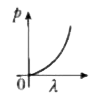
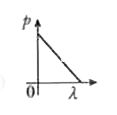
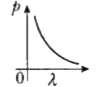
Which of the following graph represent the variation of particle momentum and associated de Broglie wavelength? |
|
Answer»
|
|
| 15. |
How does an unpolarised light get polarised when passed through a polarised ? Two polaroids are set in crossed positions . A third polaroid is placed between the two making an angle theta with the pass axis of the first polaroid . Write the expression for the intensity of light transmitted from the second polaroid . In what orientations will the transmitted intensity be (i) minimum and (ii) maximum ? |
|
Answer» Solution :If an unpolarised light wave is INCIDENT ona polaroid then the light get linearly polarised with the electric vector oscillating along a direction perpendicular to the aligned molecules . If the light from anordinary source (like a sodium lamp) passes through a polaroid sheet `P_(1)`, it is observed that its intensity is reduced by half.Rotating `P_(1)` has no effect on the transmitted beam and transmitted intensity CONSTANT . Let an identical piece of polaroid `P_(2)` be placed before `P_(1)` , the light from the lamp is reduced in intensity on passing through `P_(2)` alone . But rotating `P_(1)` has effect on the light coming from `P_(2)`. In ONE position , the intensity transmitted by `P_(2)` followed by `P_(1)` is nearly zero . When turned by `90^(@)` from this position `P_(1)` transmits nearly the full intensity emerging from `P_(2)` as shown in fig. 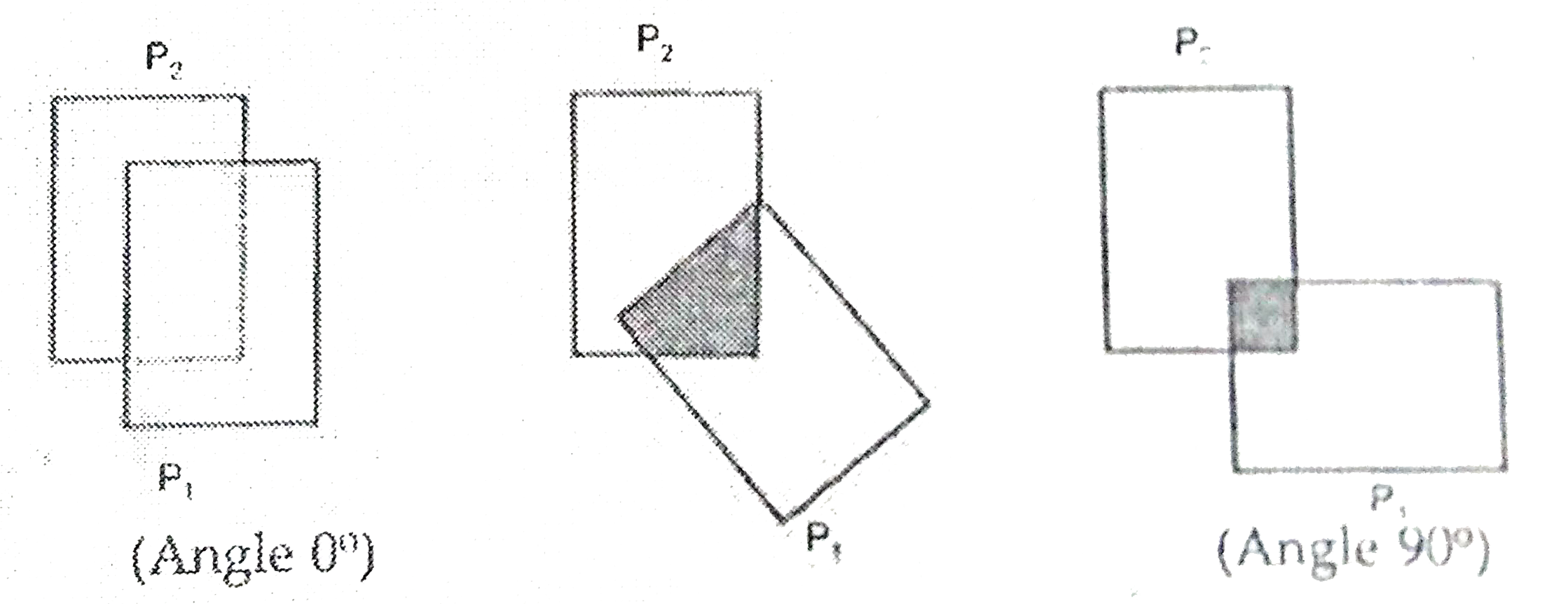 Graph : The graph between intensity of light and the angle between polariser and analyser is shown in the figure . When the polaroid is rotated in the path of plane polarised light , its intensity will vary from maximum (When the VIBRATIONS of the plane polarised light are parallel to the axis of the polaroid ) to minimum (When the direction of vibrations becomes perpendicular to the axis of the crystal). Let `I_(0)` be the intensity of polarised light after passing through first polariser `P_(1) ` . Then intensity of light after passing through second polariser `P_(2)` is GIVEN by `I = I_(0) cos^(2) theta`. 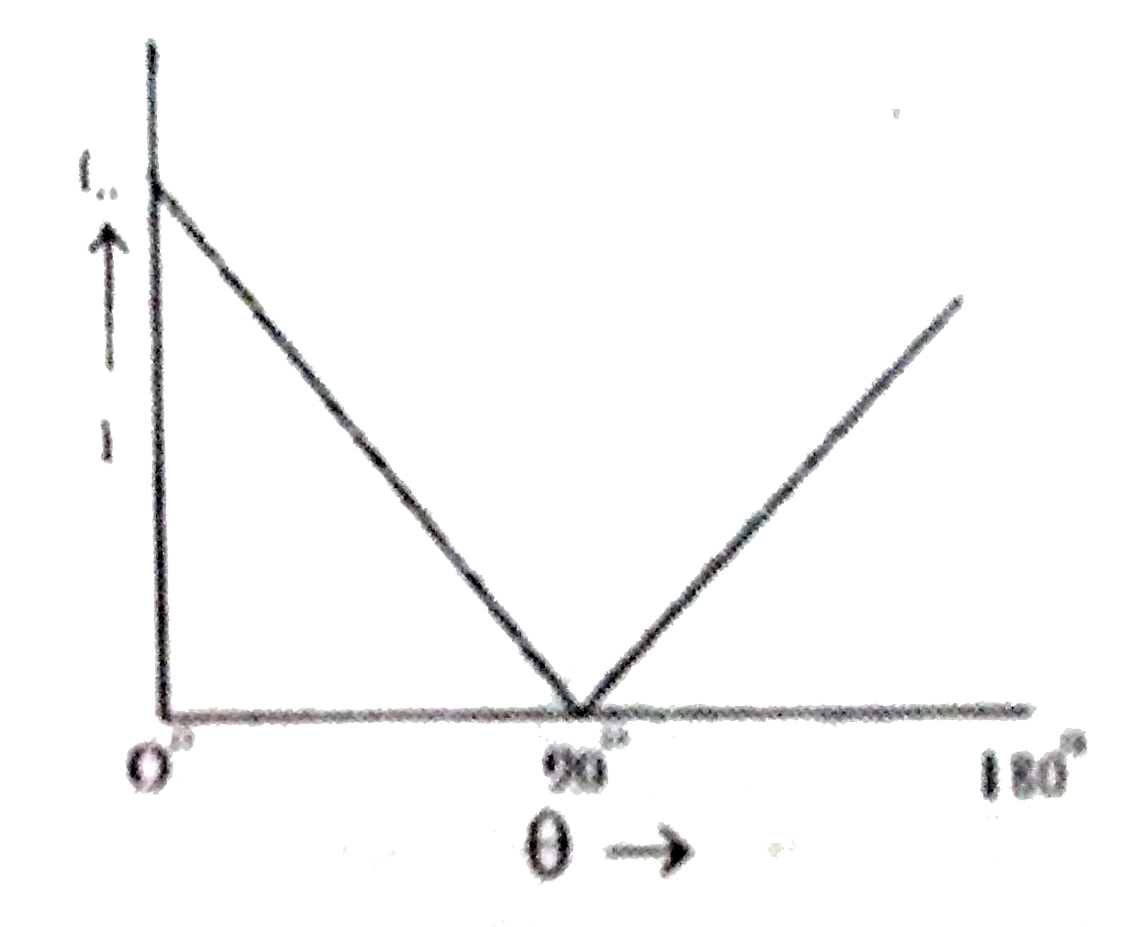
|
|
| 16. |
If E_1 is the electric field strength of a short dipole on its axial line and E_2 that on the equatorial line at the same distance, then |
|
Answer» `E_1 = E_2` |
|
| 17. |
Figure shows a graph of potential energy. Consider the following graph of position and time , which represents the motion of the certain particle in the given potential. What is the total energy of the particle? |
|
Answer» `-5`J |
|
| 18. |
(i) In an isolated system (neither connected to the terminal of a battery nor to any other source of charge e.g each) net charge remains constant. (ii) From two terminal of a battery or from two plates of a capacitor equal and opposite charges enter or leave. Question : Two capacitors of capacity 6muFand 3muFare charged to 100 V and 50 V separatelly and connected as shown. Now all the three swiches S_(1)S_(2) and S_3are closed. Suppose q_(1),q_(2) and q_(3)be the magnitudes of charges flown from switches S_(1) S_(2) and S_(3)after they are closed. Then : |
|
Answer» `q_(1) =q_(3) and q_(2)=0` |
|
| 19. |
(A): Neutrons penetrate matter more readily compared to protons (R) : Neutrons are slightly more massive than protons . |
|
Answer» Both .A. and .R. are true and .R. is the correct explanation of .A. |
|
| 20. |
The figure shows a charge q placed inside a cavity in an uncharged conductor. Now if an external electric field is swiched on |
|
Answer» only INDUCED charge on OUTER SURFACE will redistribute |
|
| 21. |
A very small particle of mass m and charge q is given an initial speed u against uniform electric field E. How much distance will the particle cover before acquiring the same speed again? |
| Answer» SOLUTION :`(m u^2)/(QE)` | |
| 22. |
Photo cells are used in Light meters |
|
Answer» LIGHT meters |
|
| 23. |
In Young.s double slit experiment how many maximas can be obtained on a screen (including the central maximum) on both sides of the central fringe it lambda= 2000A^(0)" and "d= 7000A^(0). |
|
Answer» Solution :For maximum intensity on the screen `d sin THETA = n LAMBDA (" or ") sin theta = (n lambda)/(d)= ((n)(2000))/((7000))= (n)/(3.5)` maximum value of `sin theta =1` `therefore n = -3, -2, -1, 0, 1, 2, 3` `therefore 7` maximas. |
|
| 24. |
A small telescope has an objective lens of focal length 140 cm and eye piece of focal length 5.0 cm. The telescope is used to view a 100 m tall tower 3 km away. The height of the image ' of the tower formed by objective lens is |
|
Answer» `14/3`CM |
|
| 25. |
The same physical quantity is expressed in two different units x_(1) and x_(2). The corresponding numerical values of the quantity are n_(1) and n_(2) respectively. Then |
|
Answer» `n_(1)x_(1)=n_(2)x_(2)` HENCE `(a)` is the choice. |
|
| 26. |
Discuss the various properties of conductors in electrostatic equilibrium . Properties of conductors in electrostatic equilibrium: |
Answer» Solution :(i) The electric field is ZERO everywhere inside the conducator . This is true regardless of whether the conductor ios SOLID or hollow . This is an experimental fact. Suppose the electric field is not zeroinside the metal then there will be a force on the mobile charge carriers due to this electric field . As a result there will be a net motion of the mobile charges which contradicats the conductors being in electrostatic equilibrium. Thus the electric field is zero everywhere inside the conductor . we can also understand this fact by applying an external uniform electric field on the conductor.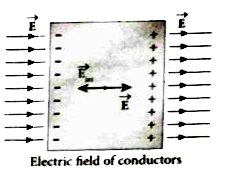 Before applying teh external electric field the free electrons in the conductor are uniformly distributed in the conductor . When an electric field is applied the free electrons accelerate to the left causing the left plate to be negatively charged and the right plate to be positively charged . Due to this realignment of of free electrons there will be an internal electric field created inside the conductor which increases until it nullifies the external electric field . Once the external electric field is nullified the conductor is said to be in electrostatic equilibrium . The time taken by a conductor to reach electrostatic equilibrium is in the order of `10^(-16)` s, which can be taken as almost instantaneous. (ii) There is no net charge inside the conductors . The charges must reside only on the surface of the conductors . We can prove this property USING Gauss law . Consider an arbitarily shaped conductor . A Gaussian surface is drawn inside the conductor such that it is very close to the surface of the conductor . Since the electric field is zero everywhere inside theconductor the net electric flux is also zero over this Gaussian surface . From Gauss.s law this implies that there is no net charge inside the conductor it IMMEDIATELY reaches the surface of the conductor . 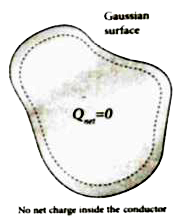 (iii) The electric field outside the conductor is perpendicular to the surface of the conductor and has a magnitude of `(sigma)/(epsilon_(0))` where `sigma` is the surface charge density at that point . If the electric field has components parallel to the surface of the conductor then free electrons on the surface of the conductor would experience acceleration . This means that the conductor is not in equilibrium . Therefore at electrostatic equilibrium the electric field must be perpendicular to the surface of the conductor. We now prove that the electric field has magnitude `(sigma)/(epsilon_(0))` just outside the conductor .s surface . Consider a small cylindrical Gaussian surface . One half of this cylinder is embedded inside the conductor . Since electric field ios normal to the surface of the conductor the crurved part of the cylinder has zero . Hence the bottom flat part of the Gaussian surface has no electric flux . Therefore the top flat surface alone contributes to the electric flux. The electric field is parallel to the AREA vector and the total charge indside the surface is `sigma A`. By applying Gauss .s law `EA = (sigma A)/(epsilon_(0))` In vector form `vecE = (sigma)/(epsilon_(0)) hatn` 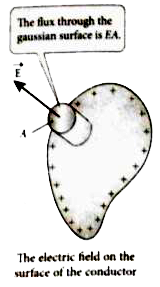 Here `hatn` represents the unit vector outward normal to the surface of the conductor . Suppose `sigma lt 0` then electric field poionts inward perpendicular to the surface. (iv) The electrostatic potential has the same value on the surface and inside of the conductor . We know that the conductor has no parallel electric component on the surface which means that charges can be moved on the suface withouth doing any work . This is possible only if the electrostatic potential is constant at all surface . Since the electric field is zero inside the conductor the potential is the same as the surface of the conductor . Thus at electrostatic equilibrium the conductor is always at equipotential. |
|
| 27. |
If linear momentum of a particle is 2.2xx10^(4) kgms^(-1) then what will be its de-Broglie wavelength ? [h=6.6xx10^(-34)Js] |
|
Answer» `3XX10^(-29)nm` `lambda=(3xx10^(-38))/(10^(-9))=3xx10^(-29)nm` |
|
| 28. |
Explain, with the help of a diagram, how plane polarised light can be produced by scattering of light from the Sun. Two polaroids P_(1) and P_(2) are placed with their pass axes perpendicular to each other. Unpolarised light of intensity I is incident on P_(1). a third polaroid P_(3) is kept between P_(1) and P_(2) such that its pass axis makes an angle of 45^(@) with that of P_(1). calculate the intensity of light transmitted through P_(1),P_(2) and P_(3). |
|
Answer» |
|
| 29. |
When an AC voltage, of variable frequency is applied to series L-C-R circuit, the current in the cirucit is the same at 4kHz. The current in the ciruit is maximum at (x)kHz. Find the value of x |
|
Answer» |
|
| 30. |
Differentiate between electrical resistance and resistivity of a conductor. |
| Answer» Solution :Resistance of a conductor is a measure of the OPPOSITION offered by it for flow of electric current through it. Resistance of a conductor depends UPON its DIMENSIONS and the nature of its material The resistivity of a conductor is the property depending solely on its material and is defined as the resistance offered by a conductor of that material having unit LENGTH and unit cross-section area. | |
| 31. |
In the options given below, let E denote the rest mass energy of a nucleus and n a neutron. The correct option is: |
|
Answer» `E(""_(92)^(236)U) gt E_(""_(53)^(137)I)+E (""_(39)^(97)Y)+2E(n)` |
|
| 32. |
Approximate height of ozone layer above the ground is |
| Answer» Answer :A | |
| 33. |
A resistance R is to be measured using a meter bridge. Student chooses the standard resistance to be 100 Omega. He finds the null point at I_(1) = 2.9 cm He is told to attempt to improve the accuracy Which of the following is a useful way ? |
|
Answer» He should measure `I_(1)` more ACCURATELY. To decrease percentage ERROR in resistance R null point of meter bridge should be near the mid point for that value of S should be changed. For balance of bridge, `(R)/(S) = (l_(1))/(100 - l_(1)) = (2.9)/(100 - 2.9) = (2.9)/(97.1)approx=0.02987` `therefore S= 100 xx 0.02987= 2.987 Omega` `thereforeSapprox 3 Omega` so, option (C ) Is CORRECT . |
|
| 34. |
What is the maximum possible number of spectral lines observed when the hydrogen atom is in its second excited state? |
Answer» SOLUTION :
|
|
| 35. |
20 tuning forks are arranged in series that each fork given 4 beat per second with the previous one. The frequency of the 20th fork is 3 times that of the first what is the frequency of the first tuning fork. |
|
Answer» SOLUTION :Frequencies are arranged in increasing ORDER FREQUENCY of the `P^th` fork is ` n_0=n_1+(p-1)N` `3n_1=n_1+(20-1)xx4 ` `therefore [n=4 ,p=20 ,n_p=3n_1]` `2n_1=19xx4 or n_1=`38hz |
|
| 36. |
A cylindrical conductor is made so that its resistance is independent of temperature. It is done by stacking layers of copper, carbon and nichrome as shown in figure. The length of each copper layer is 1 cm and sum of lengths of consecutive carbon and Nichrome Leyers is also 1 cm. find the length of each Nichrome segment. Given [rho = resistivity, alpha = temperature coefficient of resistivity] rho_(Cu) =1.7xx10^(-8) Omegam^(-1) ,rho_(C)=5xx10^(-5)Omegam^(-1) rho_(Ni) =1xx10^(-6) Omegam^(-1) , alpha_(Cu)=3.9 xx 10^(-3) .^(@)C^(-1) alpha_(C)=-5xx10^(-4) .^(@)C^(-1), alpha_(Ni)=4xx10^(-4) .^(@)C^(-1) Assume no change in dimensions of the segment due to temperature change. |
|
Answer» |
|
| 37. |
The figure shows an RC circuit with a parallel plate capacitor. Before switching on the circuit, plate A of the capacitor has a charge. -Q_(0) while plate B has no net charge. If at t = 0, the switch is closed then after how much time (in seconds) will the net charge on plate A becomes zero? [Given : C = 1 mu F, Q_(0) = 1 mC, epsilon = 1000 V and R = (2 xx 10^(6))/(1n 3) Omega] |
|
Answer» |
|
| 38. |
The work done to from a layer of soap solution of size 10cm xx 10cm will be ( surface tension of soap solution = 3 xx 10^-2 N/m) |
|
Answer» `3 XX 10^-4 `JOULE |
|
| 39. |
(i) Obtain the expression for the torque vec(tau)experiencedby an electric dipole of dipolemoment vec(p) in a uniformelectric field , vec(E ), (ii) What will happenif thefield were notuniform ? |
|
Answer» Solution :(i) Takean electricdipolein an uniformfield `vec(E )`, its dipole makes angle ` theta` with electricfield(as shown)as twoforcesare equaloppositehenceconstitutetorque. Force on charge `-q` at `A = -qE` (opposite of `vec(E )`) Force of `+q` at `B = qE` (along E).  and `tau = qvecE xx AC` (Force `xx` Arm of the force) Now, `AC = AB sin theta = 2a sin theta` (`2a = " legth of dipole"`) So, `tau = qE xx 2asin theta= pEsin theta`(where `vec(p) = q xx 2a`) dipole moment. `rArr tau = vecp xx vecE`DIRECTED by RIGHT hand screw rule, here it is into the copper. (ii) If field is not uniform TEST. `F_("net") = F_(1)+F_(2) = q(E_(1) - E_(2)) = q DeltaE` for `E_(1) gt E_(2)` i.e., object (dipole) with zero CHARGEAND having net dipolemoment will experience a net force if E is non-uniform. |
|
| 40. |
A glass hemisphere (mu=1.5) has a radius of curvature of 16 cm. A small object O is located on its axis halfway between the plane and spherical surface. The distance betweentwo images , when viewed along the axis from the sides of the hemisphere is |
|
Answer» `32/15cm` |
|
| 41. |
Represent the resultant force acting on a charge q_(0) due to point charges q_(1),q_(2),q_(3),q_(4). Assume the position vectors as vecr_(0),vecr_(1),vecr_(2),vecr_(3),vecr_(4) respectively. Give the expression for net force on q_(0) |
Answer» Solution : 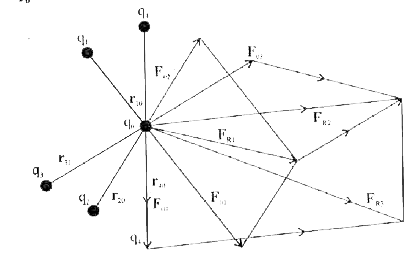 Here `vecF_(R_(1))=vecF_(01)+vecF_(02)` `vecF_(R_(2))=vecF_(R_(1))+vecF_(03)` `vecF_(R_(3))=vecF_(R_(2))+vecF_(04)` `:.vecF_(R_(3))=vecF_(01)+vecF_(02)+vecF_(03)+vecF_(04)` i.e. `vecF_(R_(3))=(1/(4 pi epsilon_(0)))q_(0)(sum_(i=1)^(4)(q_(i))/(r_(0I)^(2)))hatr_(oi)` for n point CHARGES around `q_(0)` `vecF_(0)=(1/(4 pi epsilon_(0)))q_(0)(sum_(i=q)^(n)(q_(i))/(r_(0i)^(2)))hatr_(0i)` The above forces `vecF_(01),vecF_(02),vecF_(03),vecF_(04)` may be represented by the sides of a POLYGON taken in order ane their resultant is represented by the closing side whose direction is taken in a reverse order. |
|
| 42. |
The momentum of a body increases by 20%. What is the percentage increase in its K.E.? |
|
Answer» 60 When momentum BECOMES n times then % change in `K.E. = (n^(2) - 1)xx100 = ((36)/(25) – 1)X100` `=(11)/(25)xx100=44%` HENCE correct choice is (c). |
|
| 43. |
The first overtone of open organ pipe is same as first overtone of closed organ pipe of length 30cm, then length of open pipe will be |
|
Answer» 60cm |
|
| 44. |
A cylinder rolls up an inclined plane, reaches some height, and then rolls down (without slipping throughout these motions). The directions of the frictional force acting on the cylinder are : |
|
Answer» up the incline while ascending and down the incline while descending |
|
| 45. |
State the two Kirchhoff's laws . Explain briefly how these rules are justified . |
|
Answer» |
|
| 46. |
Obtain the binding energy (in MeV) of a nitrogen nucleus (""_7^14 N), given m (""_7^14N) = 14.00307 u . |
|
Answer» Solution :`BE = [{Zm_P + (A -Z)m_N}-M]c^2` BINDING ENERGY of `""_7^14N = [{7 xx 1.007825 + 7 xx 1.008665} - 14.00307] 931( :. 1U = 931 (MeV)/(c^2))` `= 104.61 MeV`. |
|
| 47. |
Statement I: If an electric field is applied to a metallic conductor, the free electrons experience a force but do not accelerate, they only drift at a constant speed. Statement II: The force exerted by the electric field is completely balanced by the Coulomb force between electrons and protons . |
|
Answer» Statement I is true, Statement II is True, Statement II is a correct explanation for Statement I. positive ions of the conductor. Although the electric field accelerates an electron between two collisions, it is decelerated by COLLISION. The NET accleration averages out to zero and the electron acquires a constant average speed. The gain in speed between collisions is LOST in the next collision. |
|
| 48. |
The average energy released in the fission of is U^235 is |
|
Answer» 2 eV |
|
| 49. |
When a positively charged conductor is earth connected |
|
Answer» a) protons flow from the conductor to the EARTH |
|
| 50. |
A source radio signals of 100 MHz and moves towards an observer with a speed to 9Kms^(-1). The apparent change in the frequency of the signals is |
|
Answer» 3KHz |
|