Saved Bookmarks
This section includes 7 InterviewSolutions, each offering curated multiple-choice questions to sharpen your Current Affairs knowledge and support exam preparation. Choose a topic below to get started.
| 1. |
The equation of a progressive wave can be given by y = 15 sin(660pit - 0.02 pix)cm. The frequency of the wave is |
|
Answer» 330 Hz The GENERAL equation of a progressive wave as, `y(x,t) =A sin((2pi)/TT -(2pi)/lambdax)` `THEREFORE (2pi)/T = 660 pi` or `1/T = 330` or `v = 330 Hz` |
|
| 2. |
A magnetic dipole is under the influence of two magnetic fields. The angle between the field directions is 60^@, and one of the fields has a magnitude of 1.2 xx 10^(-2) T. If the dipole comes to stable equilibrium at an angle of 15^@ with this field, what is the magnitude of the other field? |
|
Answer» Solution :As shown in Fig. Let `vecB_1 =1.2xx10^(-2) T ` and `vecB_2` be inclined at an ANGLE `60^@` from `vecB_1` The magnetic dipole n s COMES to stable equilibrium at an angle of `15^@` with the field `vecB_1`. It means that net torque acting on the magnetic dipole MUST be zero i.e., `vectau_1 + vectau_2 = 0 ` or `|vectau_1 | = |vectau_2|` 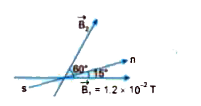 `impliesmB_1 sin 15^@ = mB_2 sin (60^@ - 15^@)` `impliesB_1 sin 15^@ = B_2 sin 45^@` `therefore B_2 = (B_1 sin 15^@)/(sin 45^@) =((1.2 xx 10^(-2))xx0.2588)/(0.7071) =4.39 xx 10^(-3) T ~=4.4 xx 10^(-3) T` |
|
| 3. |
An air bubble is trapped inside a glass cube of edge 30 cm. Looking through the face ABEH, the bubble appears to be at normal distance 12 cm from this face and when seen from the opposite face CDGF, it appears to be at normal distance 8 cm from CDGF. Find refractive index of glass and also the actual position of the bubble. |
|
Answer» Solution :LET the ACTUAL distance of the bubble from the face ABEH is then its actual distance from the face CDGF is 30 - x But `mu=("Actualdistanceof bubblefrom refracting surface ")/("Apparent distance of bubble from refracting surface")` The apparent distance of bubble from refracting surface ABEH `=(x)/(mu) , 12= (x)/(mu ` ..... (1) The apparent distance of bubble from refracting - surface CDGF`=(30-x )/( mu ), 8 = (30 -x)/(mu )` Adding Eqs(1) and (2) ` (x)/(mu ) +(30-x)/(mu )=20` We get`mu =1.5 ` FromEq। (1)`(x)/(mu ) =12 (or) (x)/(1.5 ) = 12 ` so `x=18cm ` This actual position of bubble is at normal distance 18 cm from face ABEH or at a distance 12 cm from face CDGF. |
|
| 4. |
How does magnifying power change with change in length of tube for a given telescope ? |
| Answer» SOLUTION :DECREASES with INCREASE in LENGTH | |
| 5. |
In a common emitter (CE) amplifier having a voltage gain G, the transistor used has tranconductance 0.02 mho and current gain 20, the voltage gain will be: |
|
Answer» ` 5/4 G` or `A_(V)propg_(m)` `:. A_(V_(2))/A_(V_(1))=g_(m_(2))/(g_(m_(1))) or A_(V_(2))/G=0.02/0.03=2/3 or A_(V_(2))=(2G)/3` |
|
| 6. |
a. The wave nature of matteris not noticeable in our daily observations. Justify your answer. |
|
Answer» Solution :a. For a very small dust PARTICLE of radius `10^(-6)m(1mu m)`, density `rho=10^(4)kg//m^(3)` moving with a velocity of 0.01 m/s, its momentum p is `p=mv=(4)/(3)pi r^(3) rhov=(4)/(3)pi xx (10^(-6))^(3)xx10^(4)xx0.01` `p ~~ 4xx10^(-16)"kg m"//s` de Broglie wavelength associatedwith this particleis `lambda=(H)/(p)=(6.625xx10^(-34))/(4xx10^(-16))~~1.6xx10^(-18)m` This value of `lambda` is extremely small COMPARED to the dimension of any PHYSICAL system. |
|
| 7. |
Three identical metal plates with large surface areas are kept parallel to each other as shown in figure. The leftmost plate is given a charge Q. the rightmost a charge - 2Q and the middle one remains neutral. Find the charge appearing on the outer surface of the rightmost plate |
|
Answer» `-(Q)/(2)` |
|
| 8. |
When both the slits are opened, we can see interference pattern. Why? |
| Answer» Solution :Due to th superposition of light waves COMING from the TWO SLITS. CONSTRUCTIVE and destructive interference are taking PLACE. | |
| 9. |
A small object stuck on the surface of a glass sphere (mu = 1.5) is viewed from the diametrically opposite position. Find transverse magnification |
|
Answer» Solution :Refraction will take place at side II of the surface `(mu_2)/(v )- (mu _1)/(u ) = (mu_2 -mu_1)/( R)`  Here `mu_1, = 1.5, mu_2 , = 1 and u=-2R ` `(1)/(v ) - (1.5)/((-2R)) =(1-1.5 )/(-R)` ` (1)/(v)= (0.5 )/(R )-(1.5)/( 2R ) = (-0.5 )/(2R) or v=-4R ` Negative sign INDICATES that the image is formed to the LEFT of refracting surface as shown. Magnification ` m= (mu_1 v)/(mu_2 u )=(1.5 (-4R))/( 1(-2R))` ` therefore m=3` |
|
| 10. |
What do you mean by power of a lens ? Define its unit. |
Answer» Solution : Power of a lens is a measure of the degree of convergence and divergence of light FALLING on it. MATHEMATICALLY, the power (P) of a lens is defined as the tangent of the angle by which it CONVERGES or diverges a light beam falling at UNIT distant from the optical centre C. As shown in Fig. 9.40, `tan delta = h/f` and if h=1, then `tan delta = 1/f`, Thus, power `P = 1/f` The SI unit of power is 1 dioptre (1 D). 1 dioptre is the power of a lens of focal length 1 m. Power of a converging (convex) lens is taken as +ve and that of a diverging (concave) lens as -ve. |
|
| 11. |
On shining light of wavelength 6.2xx10^(-6) m on a metal surface photo-electrons are emitted. The work function of the metal is 0.1 eV. Find the kinetic energy of a photo-electron (in eV) |
|
Answer» 0.1 Energy of the incident photon , `E=hupsilon=(hc)/lambda` `E=((6.6xx10^(-34))(3xx10^8))/(6.2xx10^(-6))`J `=(6.6xx3xx10^(-26))/((6.2xx10^(-6))(1.6xx10^(-19)))` eV=0.2 eV As `E=K+phi_0 , K=E- phi_0`=0.2 eV - 0.1 eV =0.1 eV |
|
| 12. |
The focal length of the objective and the eyepiece of a telescope are 50 cm and 5 cm respectively. If the telescope is focussed for distinct vision on a scale distant 2 m from its objective, then its magnifying power will be : |
|
Answer» `-4` `d=25cm, u_(0)=-200cm` Magnification `M=?` As `(1)/(v_(0))-(1)/(u_(0))=(1)/(f_(0))` `rArr (1)/(v_(0))=(1)/(f_(0))+(1)/(u_(0))=(1)/(50)-(1)/(200)=(4-1)/(200)=(3)/(200) or v_(0)=(200)/(3)CM` Now `v_(e)=d=-25cm` From, `(1)/(v_(e))-(1)/(u_(e))=(1)/(f_(e))` `-(1)/(u_(e))=(1)/(f_(e))-(1)/(v_(e))=(1)/(5)+(1)/(25)=(6)/(25) or,""v_(e)=(-25)/(6)cm` Magnification `M=M_(0)xxM_(e)` `=(v_(0))/(u_(0))xx(v_(e))/(u_(e))=(-200//3)/(200)xx(-25)/(-25//6)=-(1)/(3)xx6=-2` |
|
| 13. |
For point source, the wavefront is |
|
Answer» CYLINDRICAL always |
|
| 14. |
Let the magnetic field on earth be modelled by that of a point magnetic dipole at the centre of earth. The angle of dip at a point on the geographical equator |
|
Answer» is always ZERO. |
|
| 15. |
The driver of a car moving towards a rocket launching with a speed of 6 ms^(-1) observed that the rocket is moving with speed of 10 ms^(-1). The upward speed of the rocket as seen by the stationary observer is nearly |
| Answer» Answer :C | |
| 16. |
Prove that a bar magnet and a solenoid produce similar fields. |
|
Answer» Solution :Bar magnet produce similar field of Solenoid : (1) We know that the current loop acts as a magnetic dipole. According to Ampere's all magnetic phenomena can be explained in terms of circulating currents. (2) Cutting a bar magnet is like a solenoid. We get two similar solenoids with weaker magnetic proeperties. (3) The magnetic field lines REMAIN CONTINUOUS, emerging from one face of solenoid and entering into other face of solenoid. (4) If we were to move a small compass needle in the neighbourhood of a bar magnet and a current carrying solenoid, we would find that the deflections of the needle are similar in both cases as shown in diagrams. 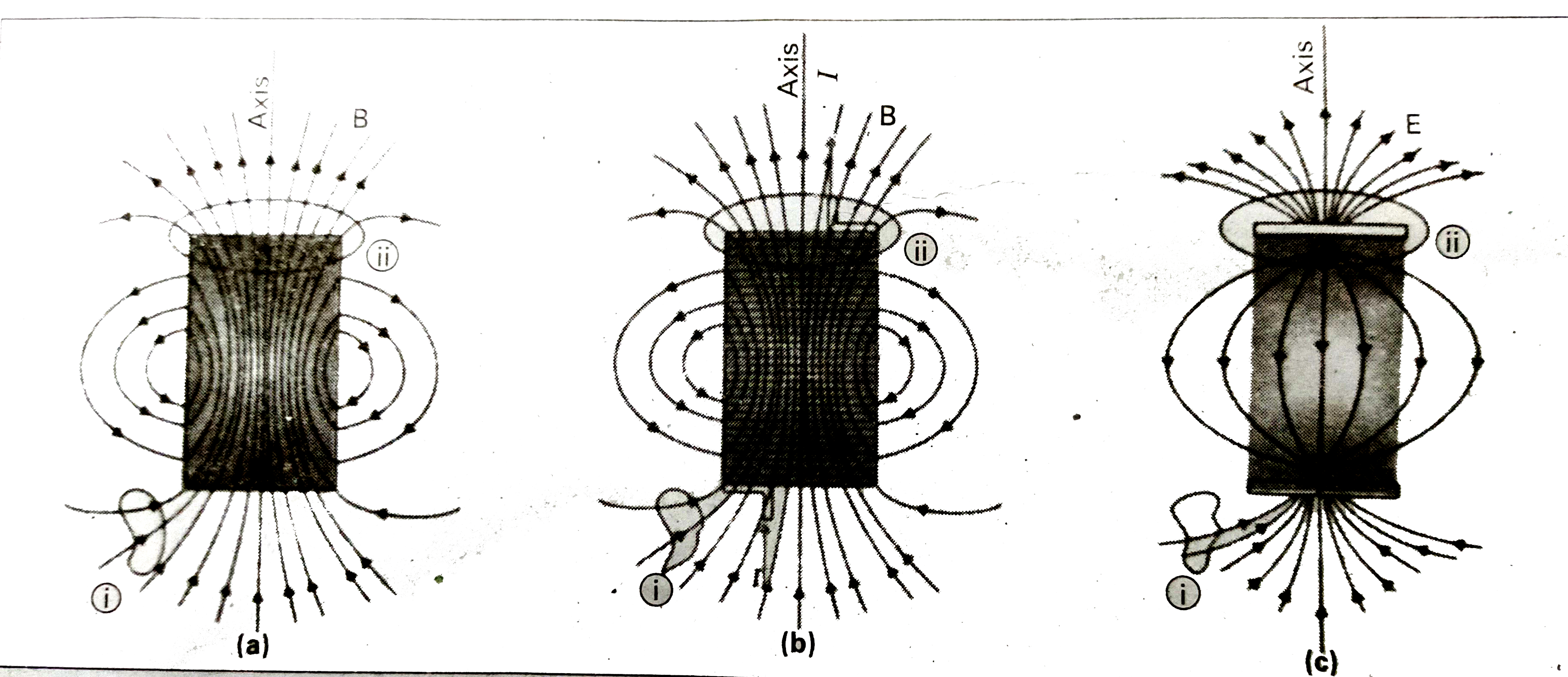 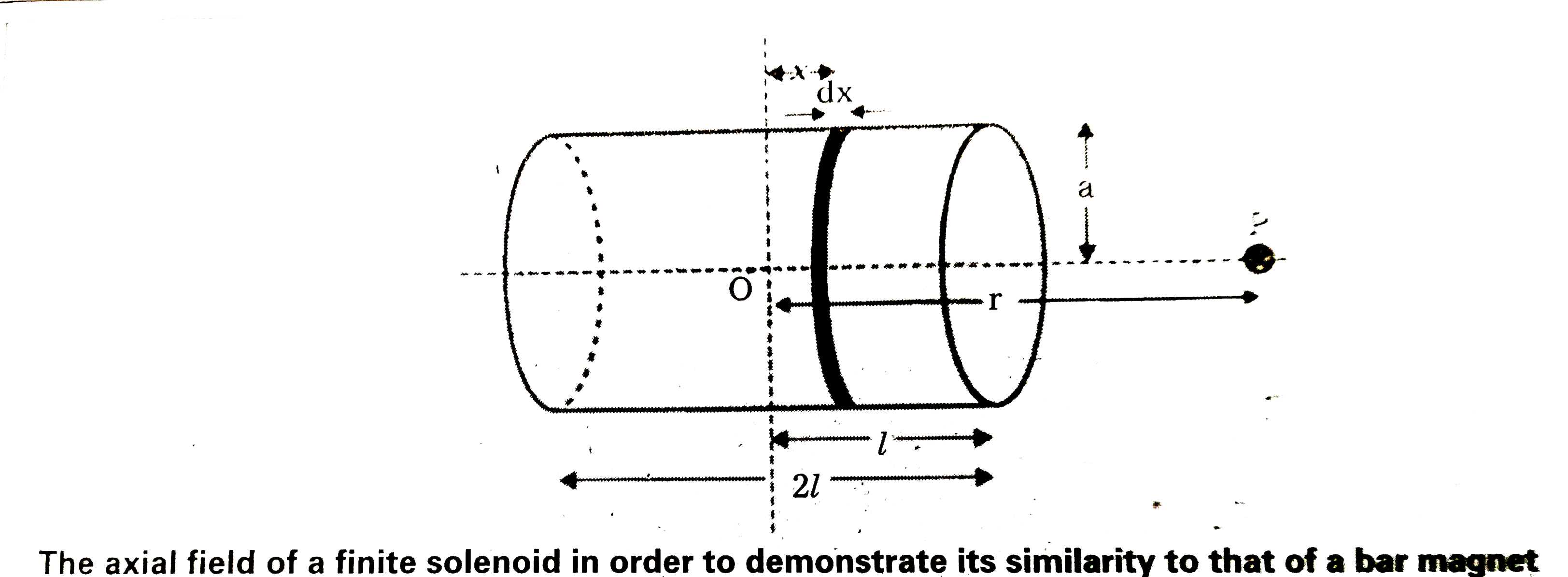 The magnetic field at point P due to bar magnet in the form of solenoid is `B = (mu_(0))/(4pi) (2m)/(r^(3))` (6) The total magnetic field, at a point P due to solenoid is given by `B = (mu_(0)n I)/(2)(a^(2))/(r^(3))(2L) = (mu_(0))/(4pi)(2N(2l)I pi a^(2))/(r^(3))` (7) The MAGNITUDE of the magnetic moment of the solenoid is, `m = n(2l) I (pi a^(2))`. `:. B = (mu_(0))/(4pi) (2m)/(r^(3))` Therefore, magnetic moment of a bar magnet is equal to magnetic moment of an equivalent solenoid that produces the same magnetic field. |
|
| 17. |
(a) A giant refracting telescope at an observatory has an objective lens of focal length 15 m. If an eyepiece of focal length 1.0 cm is used, what is the angular magnification of the telescope? (b) If this telescope is used to view the moon. What is the diameter of the image of the moon formed by the objective lens? The diameter of the moon is 3.48xx10^(6)m abd the radius of lunar orbit is 3.8xx10^(8)m. |
|
Answer» |
|
| 18. |
The length of a conductor is increased two folds. What will happen to the resistivity of the material? |
| Answer» SOLUTION :RESISTIVITY will REMAIN the same. | |
| 19. |
In double slit experiment SS_2 is greater than SS_1 by 0.25lamda. Calculatethe path difference between two interfering beam from S_1 and S_2 forminima and maxima on the point P as shown in figure. |
|
Answer» Solution :PATH DIFFERENCE `(SS_2+S_2P)-(SS_1+S_1P)=(SS_2-SS_1)+(SS_2P-S_1P)` `=(0.25 LAMDA +S_2P-S_1P)` For maxima path difference `=n lamda` , So, `S_2P-S_1P= n lamda-0.25 lamda=(n-0.25) lamda` For minima path difference =`(2n+1) lamda/2` So, `S_2P-S_1P=(2n+0.5)lamda//2` |
|
| 20. |
Why did the boy say he would have no ugly dreams? |
|
Answer» It is because he had a GOOD DAY and happy thoughts |
|
| 21. |
A laser beam and a sound wave from directional sources both enter a liquid at an angle of 60^(@) from the horizontal surface of the liquid. The speed of sound in the liquid is 5 times than that of the speed of the sound in air. For light, the refractive index of the liquid is 1.8. What happens ? |
|
Answer» Both the light and the SOUND REFRACT at an angle of `74^(@)` from the horizontal |
|
| 22. |
In photoelectric phenomenon, the number of photo electrons emitted depends on |
|
Answer» The intensity of incident RADIATION |
|
| 23. |
A thin prism of glass is placed in air and water successively. If ""_(a)mu_(g) = 3/2 and a ""_(a)mu_(w) = 4/3, then the ratio of deviations produced by the prism for a small angle of incidence, when placed in air and water is? |
|
Answer» `9:8` |
|
| 24. |
Obtain an anaalytical solution for the relation of phase between instantaneous current and voltage for an LCR series AC circuit. |
|
Answer» Solution :The voltage equation for L-C-R series circuit is `L(dI)/(dt) + RI + ( q)/( C ) = V` `L (dI)/( dt) + RI + ( q)/( C ) = V_(m) sin omegat `....(1) `I = ( dq)/( dt) :. (dI)/( dt) - ( d^(2)q)/( dt^(2)) ` HENCE from equation (1) `L (d^(2)q)/( dt^(2)) + R(dq)/( dt) + ( q)/( C ) = V_(m) sin omega t ` `:. ( d^(2) q)/( dt^(2)) + ( R )/(l) ( dq)/( dt) + ( q)/( LC ) = ( V_(m))/( L) sin omega t ` ....(2) This is like the equation for a forced, damped oscillator. Let us ASSUME a solution, `q = q_(m) sin ( omega t + theta ) ` ....(3) `:. ( dq)/( dt) = q_(m) omegacos ( omega t + theta ) ` ...(4) and `(d^(2)q)/( dt^(2)) = - q_(m) omega^(2) sin ( omega t + theta ) `.....(5) `:.` Putting VALUE of equation (3), (4) and (5) in equ. (2), `-q_(m)omega^(2) L sin(omega t + theta ) + Rq_(m) omega COS ( omega t + theta ) + ( q_(m))/( C ) sin (omega t + theta ) = V_(m ) sin omega t ` `q_(m) omega [-L omega sin ( omega t + theta ) + R cos ( omega t + theta ) + ( 1)/( omegaC ) sin ( omega t+ theta ) = V_(m) sin omega t] ` `:. q_(m) omega [ R cos ( omega t + theta ) + ( 1)/( omega C ) sin ( omega t + theta ) - omega L sin ( omega t + theta ) = V_(m) sin omega t ]` `:. q_(m) omega [ R cos ( omega t + theta ) + ( X_(C ) - X_(L)) sin ( omega t + theta ) = V_(m) sin oemga t ` [ Putting `(1)/( omega C ) = X_(C )` and `omega L = X_(L)]` Multiplying and dividing by Z, `:. q_(m) omega Z [ ( R )/( Z) cos ( omega t + theta ) - (( X_(C ) - X_(L))/( Z)) sin ( omega t + theta ) = ( V_(m) Z sin omega t )/( Z )]` `:. q_(m)omega Z [ cos phi cos ( omega t + theta ) - sin phi sin ( omega t + theta ) ]= V_(m) sin omega t `.....( 6) where `( R )/( Z ) = cos phi ` and `( X_( C ) - X_(L))/( Z) = sin phi ` `:. (X_(C ) - X_(L))/( R ) = tan phi ` `:. phi = tan^(-1) ((X_(C)-X_(L))/(R )) `....(7) `:. q_(m) omega Z [ cos (omega t + theta ) cos phi + sin ( omega t + theta ) sin phi ]= V_(m) sinomegat ` `:. q_(m) omega Z [ cos ( omega t + theta- phi]=V_(m) sin oemga t ` `[ :. cos alpha cos beta - sin alpha sin beta = cos ( alpha - beta )]` `:. q_(m) omega Z [ cos { omega t + ( [ ( pi )/( 2)) } ] = V_(m) sin omega t ``[ :. ` Takin `theta - phi = - ( pi )/( 2) ]` `:. q_(m) omega Z sin omega t = V _(m) sin omega t `...(8) Comparing with, `V_(m) = q_(m) omega Z` `:. V_(m) = I_(m) Z ``[ :. I_(m) = q_(m) omega ]` Current in circuit, `I = ( dq)/( dt) = ( d)/( dt) [ q_(m) sin (omega t + theta )]` `= q_(m) omega cos ( omega t + theta )` `= I_(m) cos ( omega t + theta ) ``[ :. q_(m) omega = I_(m)]` or `I = I_(m) sin ( omega t + phi ) ` where `theta = phi - ( pi )/(2)` and `I_(m) = ( V_(m))/( Z ) = ( V_(m))/( sqrt( R^(2) + (X_(C ) -X_(L))^(2)))` and `phi = tan^(-1) ( X_(C ) - X_(L))/(R )` Hence, in L-C-R series circuit, current is`I_(m) cos ( omega t + theta ) ` or `I_(m) sin ( omega t + phi ) ` and amplitude `I_(m) = ( V_(m))/( sqrt(R^(2) + ( X_(C )- X_(L))^(2)))` Hence, solution obtained by both techniques are same. |
|
| 25. |
For the ideal RL circuit shown, the resistance is R=10.0Omega, the inductance is L=5.0 H and the battery has voltage xi_("bat") = 12volts. Some time after the switch S in the circuit is closed, the ammeter in the circuit reads 0.40A. If the rate at which energy is being stored by the inductor at this instant is (16)/(x) Watts, what is the value of x? |
|
Answer» 3 |
|
| 26. |
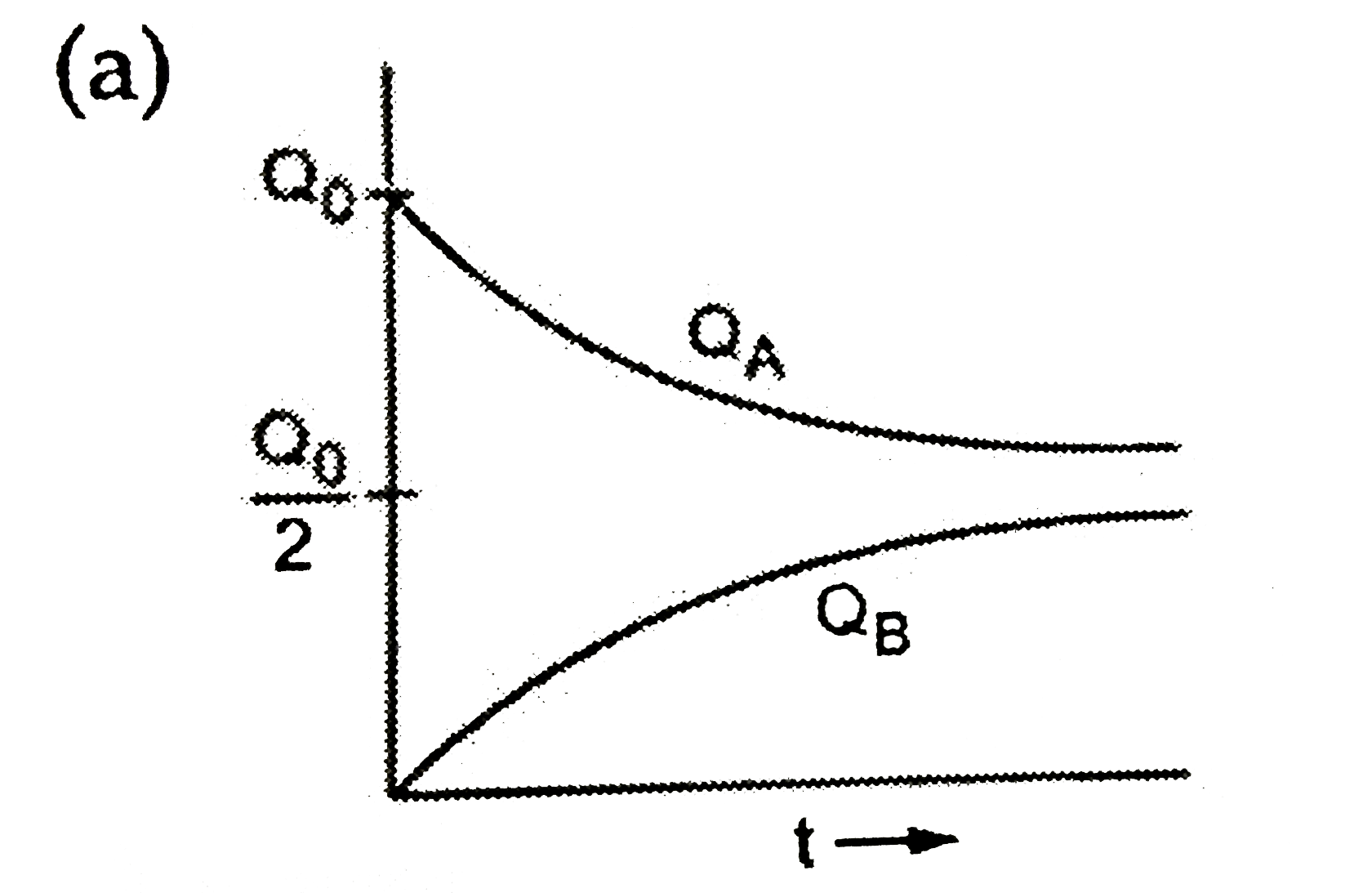
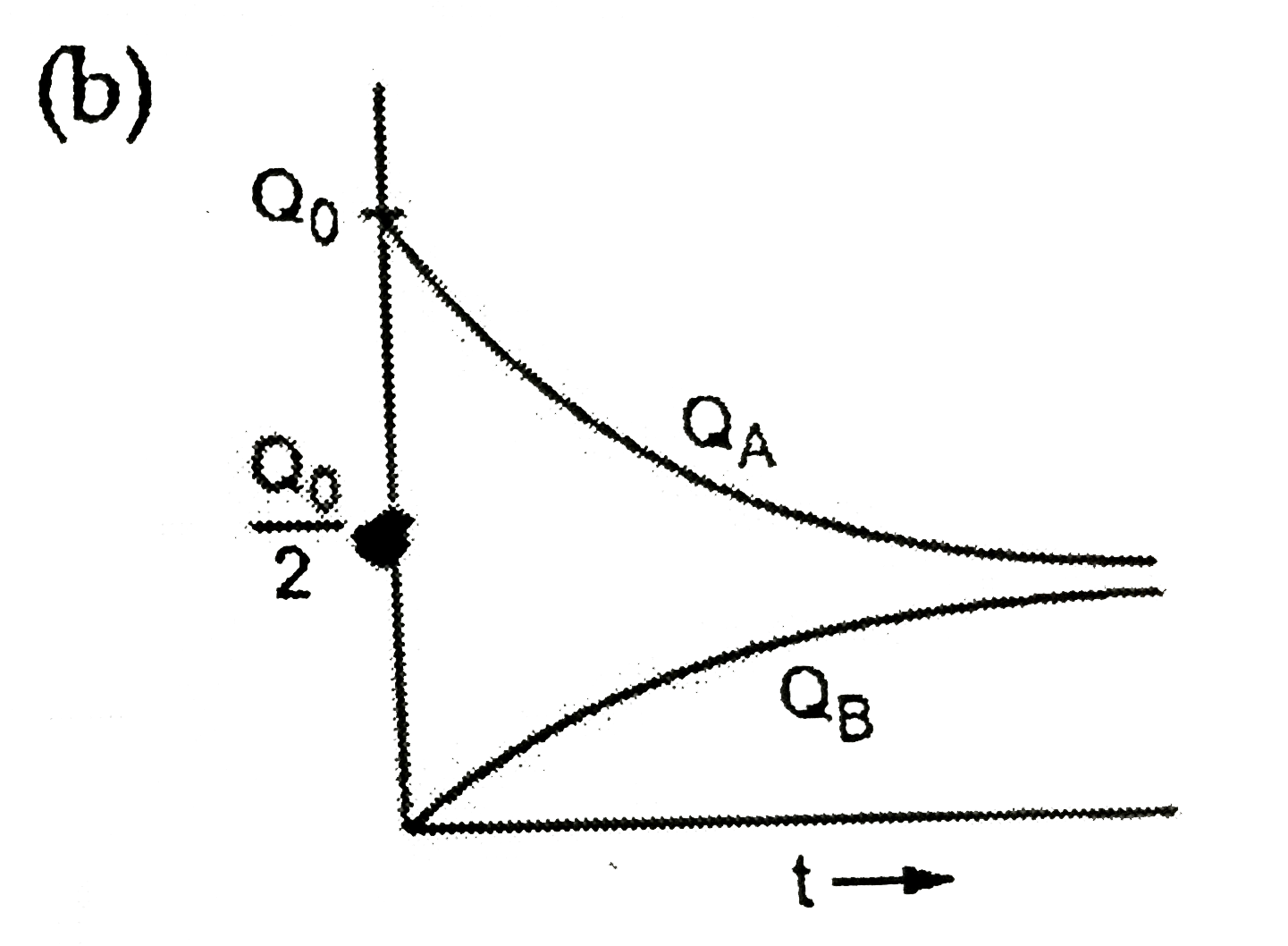
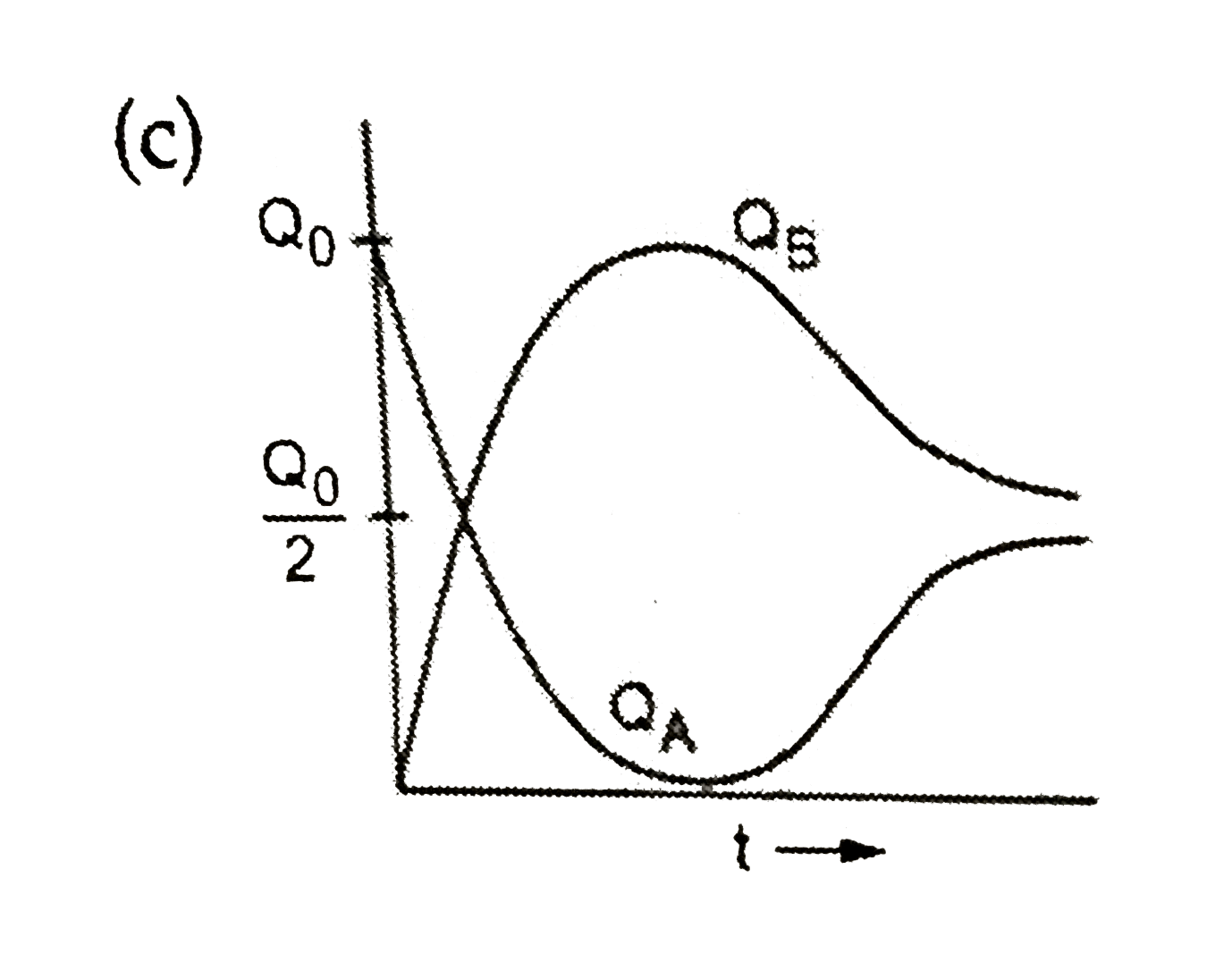
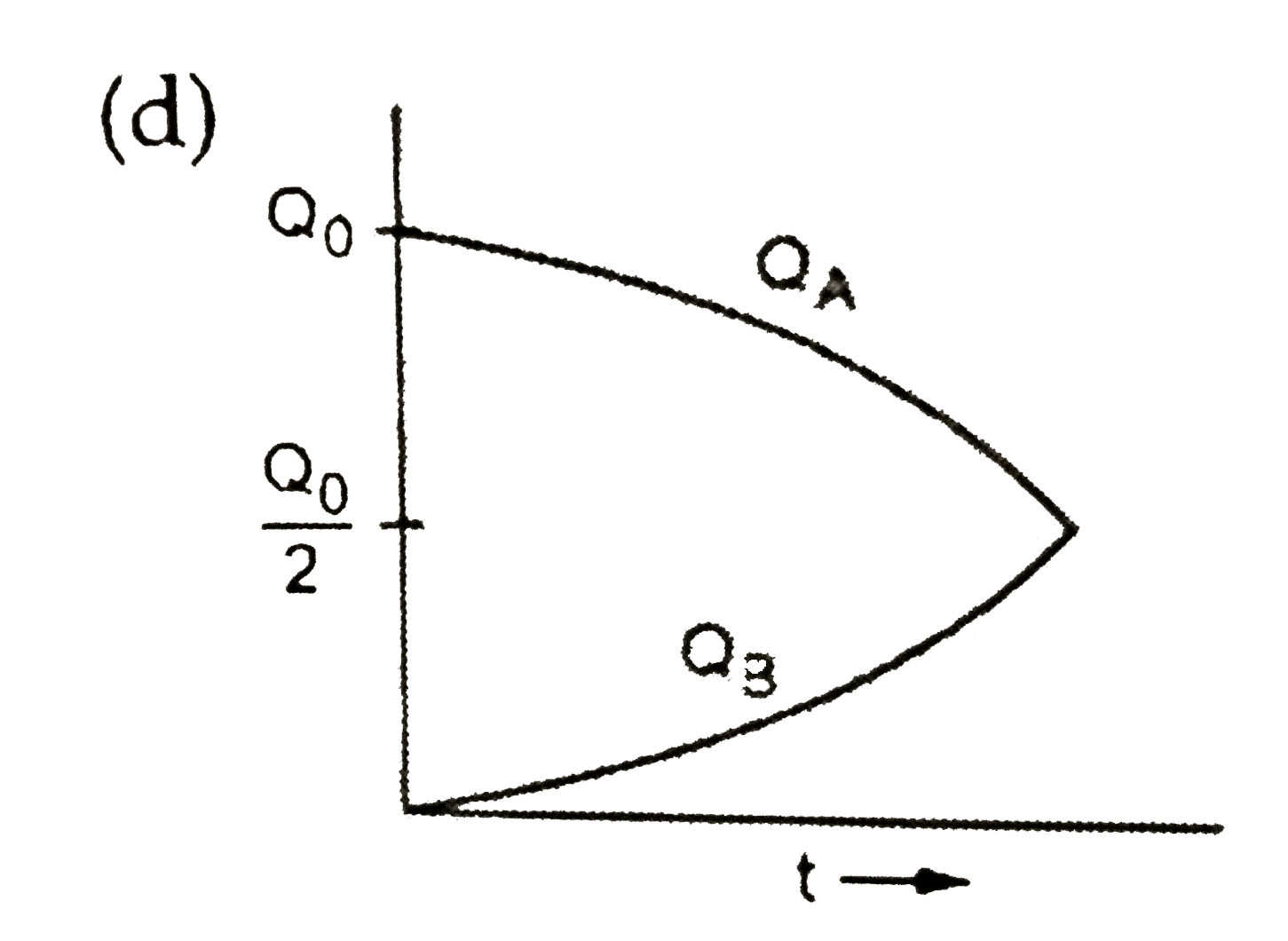
A capacitor A with charge Q_(0) is connected through a resistance to another identical capacitor B, which has no charge. The charges on A and B after time t are Q_(A) and Q_(B) respectively, and they are plotted against time t. Find the correct curves |
|
Answer»
|
|
| 27. |
What is the width of a single slit if the first minimum is observed at an angle 2^@ with a light of wavelength 9680 Å ? |
|
Answer» 0.2 mm |
|
| 28. |
For the wave described in the last problem plot the displacement ( y ) versus (t) graphs for x = 0.2 and 4 cm. What are the shapes of these graphs? In which aspects doesthe oscillatory motion in travelling wave differ from one point to another : amplitude, frequency or phase ? |
|
Answer» Solution :The transverse HARMONIC wave is `y( x,t) = 3.0 [ 36T + 0.018x+(pi)/(4) ]` For x = 0 `y ( 0,t) = 3.0 SIN ( 36t + ( pi)/(4) )` ...(i) Here `w = ( pi)/(T) =36, T =( 2pi)/( 36) =( pi)/(18) sec`. |
|
| 29. |
Which orientation of an electric dipole in a uniform electric field corresponds to stable equilibrium ? |
| Answer» Solution :When dipole has its dipole MOMENT `oversetto p` along the direction of ELECTRIC FIELD `oversetto E.` | |
| 30. |
A hollow copper sphere is placed in front of a point charge Q such that the latter is at a distance r from the centre O of the former. What is the electric field at the centre O, due to the charges induced in the sphere? |
|
Answer» |
|
| 31. |
A ray of light in air is incident at an angle of 45^@ on the surface of separation of a medium. It is refracted in the medium at an angle of 30^@. What is the velocity of light in that medium? |
|
Answer» `1.5 XX 10^8 m//s` |
|
| 32. |
A spherical conductorA of radius r is placed concentrically inside a conducting shell B of radius (R tgt r) . A charge Q is given to A,and then A is joint to B by a metal wire. The charge flowing from A to will be : |
|
Answer» `Q((R)/(R+r))` |
|
| 33. |
A circuit contains an ammeter, a battery of 30 V and a resistance 40.8 ohm all connected in series. If the ammeter has a coil of resistance 480 ohm and a shunt of 20 ohm, the reading in the ammeter will be : |
|
Answer» `1A`  `R.=R+(R_(A)XXS)/(R_(A)+S)` = `40.8+(480xx20)/(480+20)` = `40.8+19.2=60.0Omega` `THEREFORE` Current in the circuit, `I=V/(R.)=30/60=0.5A` `therefore` MEASUREMENT of ammeter is 0.5A. |
|
| 34. |
A copper rod (length =2.0m, radius =3.0 xx 10^(-3)m) hangs down from the ceiling. A 9.0kg object is attached to the lower end of the rod. The rod acts as a ''spring'' and the object oscillates vertically with a small amplitude. Ignoring the rod's mass, find the frequency f of the simple harmonic motion. |
|
Answer» 66Hz |
|
| 35. |
If 2x + 3y = 12 and 3x - 2y = 5 then |
|
Answer» X = 2, y = 3 |
|
| 36. |
When a wheatstone's bridge is said to be balanced ? |
| Answer» SOLUTION :A wheatstone.s BRIDGE is SAID to be BALANCED if no current flows through the galvanometer over then P/Q=R/S. | |
| 37. |
The amplitude of electric and magnetic fields related to each other are : |
|
Answer» `E_(0)=B_(0)` |
|
| 38. |
Charge q is inside a hollow cylinder. If flux associated with its curved surface B is phi, then flux associated with surface A is ...... |
|
Answer» `1/2(q/epsilon_(0)-phi)` `phi_("total") = phi_(A) + phi_(B) + phi_(C)` `q/epsilon_(0) =phi_(A) + phi + phi_(C)` but `phi_(A) = phi_( C)` `therefore q/epsilon_(0) = 2phi_(A) +phi` `therefore phi_(A) =1/2[q/epsilon_(0)-phi]` |
|
| 39. |
A stable nucleus (light with A lt 10) has |
|
Answer» EXACTLY the same number of neutrons and protons |
|
| 40. |
Centre of gravity of a body is the point through which its _____ acts. |
| Answer» SOLUTION :[WEIGHT] | |
| 41. |
A plane e.m. wave of frequency 30 MHz travels in free space along the x - direction. The electric field component of the wave at a particular point of space and time is E=6Vm^(-1) along y - direction. Its magnetic field component B at this point would be |
|
Answer» `2xx10^(-8)T" along z - direction."` |
|
| 42. |
A body is dropped from a height of 100m. At what height the velocity of the body will be equal to one half of the velocity when it hits the ground ? |
|
Answer» SOLUTION :`1/2mV_0^2=1/2mV^2-1/2mV_e^2 V_0^2=(3V_e)^2-V_e^2therefore V_0=SQRT(9V_e^2-V_e^2)=sqrt(8V_e^2)=2sqrt2V_e` |
|
| 43. |
The electric current existing in a discharge tube is 2.0(mu)A.How much charge is tarnsferred across a cross-section of the tube in 5 minutes ? |
|
Answer» SOLUTION :`i=2 mu A` ` t = 5 min. = 5 xx 60 SEC. ` ` Q = it = 2 xx (10^-6) xx 5 xx 60 ` ` = 10 xx 60 xx (10^-6)C ` ` = 6 xx (10^-4)C `. |
|
| 44. |
A litre of ideal gas at 27°C is heated at the constant pressure to 297°C. Then the final volume is approximately : |
|
Answer» 1 ·2 litre `rArrV_(2)=V_(1)((T_(2))/(T_(1)))` `=1(570/300)` `V_(2)=1.9` litre Thus correct CHOICE is (c). |
|
| 45. |
The dimensional formulaof (1)/(2) in_(0) E^(2) is (in_(0) permitivity of free space and E electric field intensity ) |
|
Answer» `ML^(2) T^(-2)` |
|
| 46. |
Assertion (A) : The number of free electrons in a p-type semiconductor silicon is less than the number of electrons in a pure silicon semiconductor at room temperature. Reason (R) : It is due to law of mass action. |
| Answer» Solution :In a p-type SEMICONDUCTOR number of HOLES increases due to the presence of trivalent ACCEPTOR impurity atoms and CONSEQUENTLY the number of electrons falls such that `n_(e).n_(h) = n_(i)^(2)`. | |
| 47. |
Assertion: A bird perches on a high power line and nothing happens to the bird. Reason : Bird's body is a bad conductor of current. |
|
Answer» Both Assertion and REASON are true and Reason is the correct explanation of Assertion |
|
| 48. |
A motor cyclist wants to show a feat by going round on a verticle plane inside a spherical cage of radius 5m. What should be the minimum speed to avoid fall, if g is 9.8 m/s^2 ? |
|
Answer» 5 m/s |
|
| 49. |
Identify the wrong sign convention |
|
Answer» The magnification for virtual image formed by a convex lens is positive |
|