Saved Bookmarks
This section includes 7 InterviewSolutions, each offering curated multiple-choice questions to sharpen your Current Affairs knowledge and support exam preparation. Choose a topic below to get started.
| 1. |
A 5.5 m length of string has a mass of 0.035 kg. If the tension in the string is 77 N, the speed of a wave on the string is : |
|
Answer» `110" ms"^(-1)` |
|
| 2. |
In above question the value of unknown resistance is |
|
Answer» `664Omega` |
|
| 3. |
From the Zener diode circuit shown in figure, the current through the Zener diode is |
|
Answer» 34 mA Zener voltage, `V_(Z )=50V` LOAD current, `I_(L )=(V_(Z ))/(R_(L ))=(50)/(20xx10^(3))` `=2.5XX10^(-3)A` Current through R, `I=(220-50)/(5xx10^(3))=34xx10^(-3)A` Zener current, `I_(Z)=I-I_(L)=34xx10^(-3)-2.5xx10^(-3)=31.5mA` 
|
|
| 4. |
A glass piece is dipped in a liquid of refractie index 4//3, it gets dissappeared in the liquid. The refractive index of the glass piece is |
|
Answer» `3/4` So, refractive index of glass piece MUST be `4/3`. |
|
| 5. |
A beam of electromagnetic radiation intensity 6.4xx10^(-5)W//cm^(2) is comprised of wavelength ,lambda=310 nm.It falls normally on metal (work function 2 eV) of surface are 1 cm^(2).If one in 10^(3) photons ejects an electron ,total number of electrons ejected in 1 s is 10^x [hc=1240 eV-nm ,1 eV=1.6xx10^(-19)J],the value of x is.... |
|
Answer» 14 `=6.4xx10^(-5)xx1` `=6.4xx10^(-5)W` `implies`E=hf `=(hc)/(lambda)` `=(1240)/(310)=4eV gt 2eV` `therefore As E gt phi_(0)`, photoelectrons can be emitted. nE=P `therefore n=(P)/(E )=(6.4xx10^(-5))/(4xx1.6xx10^(-19))` `therefore n=10^(14)` `therefore`No. of electrons EMITTING out at every SECOND `(n)/(10^(3))=(10^(14))/(10^(3))` `10^(X)=10^(11)` `therefore x=11` |
|
| 6. |
The weight of a body on surface of earth is 12.6N. When it is raised to a height half the radius of earth, its weight will be |
|
Answer» `2.8`N At height h, the VALUE of g. is given by g.`=g(R^(2))/((R+h)^(2))` Now `h=R//2` `:. g.=g((R )/(R+(R//2)))^(2)=(4)/(9)g` Weight at height `h=(4)/(9)mg=12.6xx(4)/(9)=5.6`N |
|
| 7. |
"To emit a free electron from a metal surface a minimum amount of energy must be supplied"It is called…………………. |
| Answer» SOLUTION :THRESHOLD ENERGY | |
| 8. |
Formation of covalent bonds in compounds exhibits : |
|
Answer» WAVE NATURE of electron |
|
| 9. |
A straight conductor carrying a current I, is split into a circular loop of radius r as shown in the figure. The fied at the centre O of the circle, in tesla is |
|
Answer» `(prop_(0)I)/(2R)` |
|
| 10. |
In the above problem, if the coil rotates with a constant angular velocity omega, the emf indiuced in it |
|
Answer» (a) is ZERO if the normal to the plane of the COIL makes an angle `theta` with the DIRECTION of `B`, the flux linked with the coil is `phi = Ban COS theta` `= Ban cos (omegat)` `e.m.f. = e = (-dphi)/(dt) = Banomegasin(omegat)` |
|
| 11. |
The power gain for common base amplifier is 800 and the voltage amplification factor is 840.The collector when base current is 1.2mA is |
|
Answer» 24mA |
|
| 12. |
A progressive wave of frequency 500 Hz is travelling with a velocity of 360 m/s.How far apart are two points 60^@ out of phase ? (ii)Does the speed of a plane-progressive wave depend on the amplitude ? (iii)The equation of a progressive wave is represented by Y=A sin^2 (kx-omegat). Find its amplitude and frequency (iv)Which of the following equations represents a wave travelling along positive y-axis?(a)x=5 sin (2y-6t)(b) y=6sin (7x-5t) (c ) y=10 sin (6y) cos (8t) |
|
Answer» Solution :Phase difference `PHI=(2pi//lambda)` x path difference `RARR pi/3 =(2pi)/lambdaDeltax` `rArr Deltax=lambda/6=V/(6f)`=12 cm (ii) No (iii)The given equation can be WRITTEN as Y=(A/2)[1-cos (2kx-`2omegat`)] Amplitude of this wave is (A/2) and frequencyis `(omega//pi)`, where as angular frequencyis `2omega`. (iv)The most general equation of a wave travelling ALONG y-axis will be `x=A sin [(ky - omegat) pm phi)]`comparing this with the given equations we find that the first equation i.e. x=5 sin (2y-6t) represents a wave travelling along positive y-axis . |
|
| 13. |
What is meant by skip distance? |
| Answer» Solution :The shortest DISTANCE between the transmitter and the point of RECEPTION of the sky WAVE ALONG the surface is called as the skip distance. | |
| 14. |
The sensitivity of a potentiometer canbe increasesed by |
|
Answer» decreasing the LENGTH of potentiometer wire |
|
| 15. |
The potential energy of a 1kg particle free to move along x-axis is given by V(x)=((x^(4))/(4)-(x^(2))/(2))J. The total mechanical energy of the particle is 2J. Then, the maximum speed (in m/s) is : |
|
Answer» `3//SQRT(2)` `THEREFORE` At `x=0`, K.E. = Total energy `(1)/(2)mv^(2)=2impliesv=sqrt((2xx2)/(1))=2MS^(-1)` |
|
| 16. |
An equiconvex crown glass lens has a focal length 20 cm for violet rays. Its focal length for red rays is (mu_(v)=1.5 "and" mu_(r)=1.47) |
|
Answer» `20.82` CM For VIOLET rays : `(1)/(20)=(1.5-1)xx(2)/(R)` ...(i) For red rays : `(1)/(f_(r))=(1.47-1)xx(2)/(R)` ...(ii) DIVIDING (i) by (ii), we get `(1)/(f_(r))=((1.5-1)/(1.47-1))=(0.5)/(0.47)` or `f_(r)=(0.5)/(0.47)xx20=21.28` cm |
|
| 17. |
Jambaji's followers were called as? |
|
Answer» Bishnois |
|
| 18. |
A glass prism of angle 60^(@) and mu_(g) = 1.66 is immersed in a liquid of mu_(1) = 1.33. Find the angle of minimum deviation for a parallel beam of light passing through prism. |
|
Answer» `9.4^(@)` When prism is DIPPED in water and `delta_(m)`is MINIMUM DEVIATION, then `.^(w)mu_(g)=(sin((A+deltam)/(2)))/((sinA)/(2))` ` = (1.66)/(1.33)` Solving, we get, `delta_(m) = 17.2^(@)` |
|
| 19. |
If N_1=N_@E^(-lambda t_1), then the number of atoms decayed during time interval from t_1 and t_2 (t_2 gt t_1) will be : |
|
Answer» `N_(t_1) - N_(t_2)` = `N_@ [E^(-LAMBDA t_1) - e^(-lambda t_2)]` |
|
| 20. |
What is modulation? Explain the types of modulation with necessary diagrams. |
|
Answer» Solution :Modulation: For long distance transmission, the low FREQUENCY baseband signal input signal) is superimposed onto a high frequency radio signal by a process called modulation There are 3 types of modulation based on which parameter is modified. They are (1) AMPLITUDE modulation, (ii) Frequency modulation, and (iii) Phase modulation. (i) Amplitude Modulation (AM): If the amplitude of the carrier signal is modified according to the instantaneous amplitude of the baseband signal, then it is called amplitude modulation. Here the frequency and the phase of the carrier signal remain constant. Amplitude modulation is used in radio and TV BROADCASTING. The signal shown in figure (a) is the me ation figure (B) shows the high frequency carrier signal and figure (c) amplitude modulated sional We can see clearly that the carrier Wave is modifi proportion to the amplitude of the baseband signal. information figure (b) show amplitude modulated signal (a)Amplitude  (ii) Frequency Modulation (FM): The frequency of the carrier signal is modifiedFrequency Modulation according to the instantaneous amplitude of the baseband signal in frequency modulation. A Baseband Signal C (a) Here the amplitude and the phase of the carrier signal remain constant. Increase in the amplitude of the baseband signal increases the frequency of the carrier signal and vice versa. Amplitude This leads to compressions and rarefactions in the frequency spectrum of the modulated wave. Louder signal leads to compressions and relatively weaker signals to rarefactions. When the amplitude of the baseband signal is zero in Figure (a), the frequency of the modulated signal is the same as the carrier signal. The frequency of the modulated wave increases when the amplitude of the baseband signal increases in the positive direction (a) baseband signal (bittet signal A. C). The increase in amplitude in the c) frequency modulated signal ative half cycle (B, D) reduces the frequency of the modulated wave (Figure(c)).  (iii) Phase Modulation (PM) The instantaneous amplitude of the baseband signal modifies the phase of the carrier signal keeping the amplitude and frequency constant is called phase modulation. This modulation is used to generate frequency modulated signals. It is similar to frequency modulation except that the phase of the carrier is varied instead of varying frequency The carrier phase changes according to increase or decrease in the amplitude of the baseband signal. When the modulating signal goes positive, the amount of phase lead increases with the amplitude of the modulating signal. Due to this, the carrier signal is compressed or its frequency is increased. On the other hand, the negative half cycle of the baseband signal produces a phase lag in the carrier signal. This appears to have stretched the frequency of the carrier wave. Hence similar to frequency modulated wave, phase modulated wave also comprises of compressions and rarefactions. When the signal voltage is zero (A, C and E) the carrier frequency is UNCHANGED. 
|
|
| 21. |
Discuss the process of nuclear fusion and how energy is generated in stars? |
|
Answer» Solution :When two or more light nuclei (A `lt` 20) combine to form a heavier nucleus, then it is called nuclear fusion. Energy generation in stars : (i) Nuclear fusion occurs is the core of the stars, since itstemperature is of the order of `10^7`K. (ii) Most of the stars including our SUN FUSE HYDROGEN into helium and some stars even fuse helium into heavier elements. (iii) The EARLY stage of a star is in the form of cloud and dust. (iv) Due to their own gravitational. pull, these clouds fall inward. (v) As a result, its gravitational potential energy is converted to kinetic energy and finally into heat. (vi) When the temperature is high enough to initiate the thermonuclear fusion, they start to RELEASE enormous energy which tends to stabilize the star and prevents it from further collapse. (vii) The sun.s interior temperature is around `1.5xx10^7`K. (viii) The sun is converting `6 xx 10^(11)` kg hydrogen into helium every second and it has enough hydrogen such that these fusion lasts for another 5 billion years. (ix) When the hydrogen is burnt out, the sun will enter into new phase called red giant where helium will fuse to become carbon. During this stage, sun will expand greatly in size and all its planets will be engulfed in it. (x) According to Hans Bethe, the sun is powered by proton-proton cycle of fusion reaction. This cycle consists of three steps and the first two steps are as follows: `""_(1)^(1)H+_(1)^(1)Hto _(1)^(2)H+e^++v` `""_(1)^(1)H+_(1)^(2)Hto_(2)^(3)H + lamda` A number of reactions are possible in the third step. But the dominant one is `""_(2)^(3)H+_(2)^(3)Hto_(2)^(3)H + _(1)^(1)H+_(1)^(2)H` (xi) The overall energy production in the above reactions is about 27 MeV. The radiation energy we received from the sun is due to these fusion reactions. |
|
| 22. |
The pressure and volume of a gas are P and V. If its pressure is reduced to P/2, by (A) isothermal process (B) by adiabatic process then the final volume will be : |
|
Answer» more in A |
|
| 23. |
Which of the following factors will be favourbale for higher yields of NO in the reaction given below ? N_(2)+O_(2)hArr 2NO(g) (DeltaH=+ve) |
|
Answer» LOW temperature, high PRESSURE and high conentration of `N_(2) and O_(2)` `Deltan=(+ve)` Endothermic Reaction `Deltan=P_("mole") -R_("mole")` =2-2=zero So, reaction remain unaffectedpressure Endothermic `Tuarr` high concentration. |
|
| 24. |
Smallest wall less monerans |
|
Answer» DEVELOP FRIED EGG APPEARANCE in culture |
|
| 25. |
A total resistance of 5.00 Omega is to be produced by connecting an unknown resistance. a) What must be the value of the unknown resistance and (b) should it be connected in series or in parallel (c) What is the total resistance if the unknown resistance is connected the other way? |
|
Answer» |
|
| 26. |
A varying current in a coil change from 10A to 0 in 0.5sec. If the average emf induced in the coil is 220V, the self inductance of the coil is : |
|
Answer» Solution :The MUTUAL inductance of two long coaxial SOLENOIDS, `M_(12)=M_(21)=(mu_(0)N_(1)N_(2)A_(1))/(l)=(mu_(0)N_(1)N_(2)(pir_(1)^(2)))/(l)[becauser_(1)ltltr_(2)]` |
|
| 27. |
Two long parallel wires are at a distance 2d apart. They carry steady equal currents flowing out of the plane of the paper as shown. The variation of the magnetic field B along the line XX^(1) is given by |
|
Answer»
|
|
| 28. |
Two coherent sources are placed 0.9 mm apart and thetringes are observedone metre away .Thewavelength of monochronic light used if it produces the second dark fringes at a distance of 10 mm fromthe central finge will be |
|
Answer» `6XX10^(4)` |
|
| 29. |
The resistance value of a conductor depends on its physical dimensions. Give the expression for resistance of a conductor in terms of its physical dimension. |
|
Answer» Its material |
|
| 30. |
A real image obtained by a concave mirror is 4 times bigger than the object. If the object is displaced by 3 cm away from the mirror, the image size becomes 3 times the object size. Find the focal length of the mirror. |
|
Answer» SOLUTION :`rArr`Here, magnification of image m = - 4 New magnification of image m = -3 Focal lenght f = ? Focallenght f= ? AS per Gauss FORMULA `1/f = 1/v + 1/u` `thereforeu/f = (1)/(-m) + 1` `therefore u/f = 1 (1)/(m) "" (therefore m= -4)` `thereforeu/f = 1 - (1)/(-4)` `thereforeu/f=1 + (1)/(4)` `therefore u/f = 5/4`..........(1) `rArr` When object is placed 3 cm away from mirror, `therefore(u+3)/(f) = 1+ (1)/(3)` `therefore(u+3)/(f) = (4)/(3)` `thereforeu/f + 3/f = 4/3` `therefore5/4 + 3/f = 4/3` [ From (1)] `therefore3/f = 4/3 - 5/4` `therefore 3/f = (16-15)/(12)` `therefore3/f = 1/12therefore f = 36 cm = 360 cm ` |
|
| 31. |
A suitcase kept on a shop's rack is measured 50 cm xx 25 cm xx 10 cm xx by the shop's owner . A traveller takes this suitcase in a train moving with velocity 0.6c . If the suitcase is placed with its length along the trains velocity , find the dimensions mesured by (a) the traveller and (b)a ground observe . |
|
Answer» Solution :Given `l = 50cm , b = 2.5 cm ` `h = 10cm , v = 0.06c ` (a) The observe in the train the same value of l , b, h because realtivity is DUE to the DIFFERENCE in frames . (b) In two different frames , the COMPONENT of length parallel to the velocity undergoes contraction but the p components remainthe same . So length which is parallel to the x- axis changes and the breadth and height ramain the same . ` e' = e (sqrt 1 - v^(2) / c^(2) ) ` ` = 50 (sqrt 1 - (0.6)^(2) c^(2) / c^(2)) ` ` l = 50 (sqrt 1 -0.326 ) ` ` =50 (sqrt 0.64) ` ` = 50 XX 0.8 = 40 cm`. ` .:` The lenghts observed are 40CM xx 25 cm xx 10cm` |
|
| 32. |
At magnetic equator, total intensity of Earth's magnetic field is I_(E) and at poles it is I_(p). They are related as |
|
Answer» `2 I_(P) = I_(E)` At magnetic equator , `I_(E) = I_(0) = sqrt(1 + 3.sin^(2)theta) = I_(0)` At poles, `I_(P) = I_(0) sqrt(1+3.sin^(2)90^(@)) = I_(0)sqrt(1+3 = 2I_(0)` `therefore I_(P) = 2I_(0) implies I_(P)2I_(E) [ :. I_(0) = I_(E)]` |
|
| 33. |
A step - up transformer operates on a 230 V line and a load current of 2 A. The ratio of primary and secondary windings is 1 : 25 . Then te current in theprimary is |
|
Answer» Solution :`E_(S)/E_(P)=N_(S)/N_(P)=I_(P)/I_(S)` `I_(P)=(N_(S)I_(S))/N_(P)` `I_(P)=(N_(S)I_(S))/N_(P)` = `25/1xx2` = 50 A |
|
| 34. |
The resultant of two forces F_(1) and F_(2) is P. If F_(2) is reversed , then resultant is Q . Then the value of (P^(2)+Q^(2)) in terms of F_(1) and F_(2) is |
|
Answer» |
|
| 35. |
There is one solenoid of length I and self-inductance L. What is the length of wire used to make this solenoid? |
|
Answer» `sqrt((pilL)/(mu_(0)))` `phi = (mu_(0)NI)(pir^(2))(nl)` Comparing it with `phi = LI`, we get self-inductance as follows: `L= mu_(0)pin^(2)r^(2)l` Total length of wire USED to make solenoid can be written as follows: `L.= (2pir)(nl)= 2pirnl` Value of nr to be substituted in equation (i) can be TAKEN from equation (i) as follows: `n^(2)r^(2)= (L)/(mu_(0)pil)` `nr= sqrt((L)/(mu_(0)pil))` Substituting in equation (ii) we get length of wire as follows: `L.= 2pi sqrt((L)/(mu_(0)pil))` `L.= sqrt((4pilL)/(mu_(0)))` |
|
| 36. |
Is electric current a scalar or a vector ? Why? |
| Answer» Solution :Electric CURRENT is a scalar because it does not obey the vector LAW of ADDITION. | |
| 37. |
A motor car is approachingtowards a crossing with a velocity of 72 " km h"^(-1) . The frequency of the sound of its horn as heard by a policeman standing on the crossing is 260 Hz. The frequency of horn is |
|
Answer» 200 Hz |
|
| 38. |
A ray of light passes through an equilateral prism in such a manner that the angle of incidance is equal to the angle of emergence and each of these angles equal to 3/4 of angle of the prism. The angle of deviation is |
| Answer» ANSWER :D | |
| 39. |
A body is projected from the ground with some speed at some angle with the horizontal. Taking the horizontal and vertical direction to be x and y axis respectively and the point of projection as origin, calculate the minimum speed (in ms^(-1)) of projection so that it can pass through a point whose x and y coordinates are 30 m and 40 m respectively? Take g=10ms^(-2) |
|
Answer» |
|
| 40. |
Avalanche breakdown is initiated by : |
|
Answer» MINORITY CARRIERS |
|
| 41. |
कोमा की प्रकृति वाला जीवाणु कहलाता है : |
|
Answer» बेसिलस |
|
| 42. |
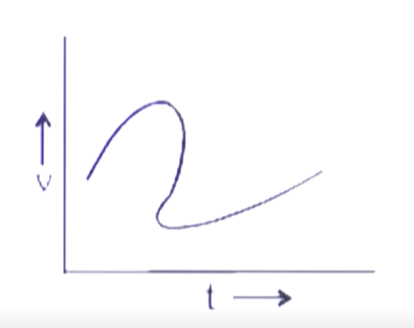
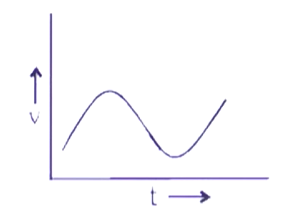
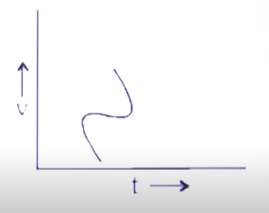
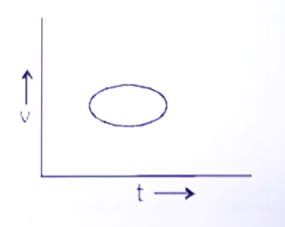
निम्नांकित वेग (v)-समय (t) के बीच कौन सा ग्राफ एक गतिशील वस्तु की वास्तविक स्थिति को प्रदर्शित करता है |
|
Answer»
|
|
| 43. |
A weight Wrests on a rough horizontal plane. If the angle of friction is theta, the least force that can move the body along the plane will be |
|
Answer» `W COS theta` |
|
| 44. |
An electron field of moment p is placed in a uniform electric field E. Then, (i) the torque on the dipole is pxx E (ii) the potential energy of the system is p.E (iii) the resultant force on the dipole is zero. |
|
Answer» (i),(II) and (III) are CORRECT |
|
| 45. |
A storage capacitor on a RAM chip has a capacity 48fF. If the capacitor is charged to a potential of 4.6V, how many excess electrons are on its negative plate? |
|
Answer» Solution :Data supplied, `C=48fF=48 xx 10^(-15)F` `V=4.6V` `e=1.6 xx 10^(-19)C` `q=ne and q=CV ""N=(CV)/e=(48 xx 10^(-15)xx 4.6)/(1.6 xx 10^(-19))=(48 xx 46 xx 10^(4))/(16)` `n=1.38 xx 10^(6)"ELECTRONS"` |
|
| 46. |
The area of moon's image produced by a convex lens is proportional to focal length as : |
|
Answer» `sqrt(f)`  `tan theta = (r )/(f)` where r is radius of IMAGE of moon `therefore r = theta f`. AREA `= pi r^(2) = pi theta^(2) f^(2)` `therefore "area" prop f^(2)` |
|
| 47. |
Calculate the wavelength of the red and violate satellites, closest to the fixed line, in the vibrations specturm of Raman scattering by F_(2) molecule if the incident light wavelength is equal to lambda_(0)= 404.7nm and the natural vibration frequency of the molecule is omega-2.15.10^(14)s^(-1) |
|
Answer» Solution :If `lambda_(R)=` wavelength of the red satellite and `lambda_(V)=` wavelength of the violet satellite and `(2piħc)/(lambda_(R))=(2pi ħc)/(lambda_(0))- ħomega` and `(2pi ħc)/(lambda_(V))=(2pi ħhc)/(lambda_(0))` Substitution gives `lambda_(R)= 424.3nm` `lambda_(V)= 386.8nm` The TWO FORMULAS can be combined to give `lambda=((2pic))/(((2pi c))/(lambda_(0))+-)=((lambda_(0)))/(1+-(lambda_(0)omega)/(2 pic))` |
|
| 48. |
एण्टोनी वॉन ल्येईवेनहॉक किस देश से निवासी थे ? |
|
Answer» स्वीडन के |
|
| 49. |
Calculate the energy of a photon with momentum 3.3 xx 10^(-3) kg m s^(-1), given planks constant to be 6.6 xx 10^(-34) Js. |
|
Answer» `7.3 XX 10^4 J` |
|