

Saved Bookmarks
This section includes 7 InterviewSolutions, each offering curated multiple-choice questions to sharpen your Current Affairs knowledge and support exam preparation. Choose a topic below to get started.
| 1. |
The position vector of a moving particle att sec is given by vecr=3hati+4hat t^(2)hatj-t^(3) hatj, Its displacement during an interval of t = ls to 3 sec is |
|
Answer» `hatj-hatk` |
|
| 2. |
Two long and parallel straight wire A and B carrying currents of 8.0 A and 5.0 A in the same direction are separated by a distance of 4.0 cm. Estimate the force on a 10 cm section of wire A. |
|
Answer» Solution :Here `l_1 = 8.0A, l_2 = 5.0 A and d = 4.0 cm = 4 xx 10^(-2) m` `:.` FORCE on length `l = (10 cm = 0.1 m)` of wire A `F = (mu_0)/(4 PI) cdot (2I_1 I_2)/(d) cdot l = (10^(-7) xx 2 xx 8 xx 5)/(4 xx 10^(-2)) xx 0.1 = 2 xx 10^(-5)N` As TWO wires carry currents in the same direction, the force is attractive force NORMAL to wire A towards the wire B. |
|
| 3. |
An object of length 10cm is placed at right angles to the principal axis of a mirror of radius of curvature 60 cm such that its image is virtual, erect and has a length 6 cm. What kind of mirror is it and also determine the position of the object? |
|
Answer» Solution :Since the image is virtual, erect and of a SMALLER size, the given mirror is ` (##AKS_ELT_AI_PHY_XII_V02_C_C02_SLV_006_S01.png" width="80%"> convex.(concave mirror does not form an image with the said description). Given`R= +60cmf= (R )/( 2) =30cm` Transverse magnification, ` m=(1)/(O)= (6)/(10) =+ (3)/(5 ) ` further`m=-(v)/(U )= 3/5` `thereforev= ( 3u )/(5)` USING`(1)/(v )+ (1 )/(u ) = (1)/(f)""(-5)/(3u ) +(1)/(u )= (1)/(30)` `(-5+3)/( 3u) = (1)/(30)thereforeu=- 20 cm ` Thus the object is at a distance 20 cm (from the pole) in front of the mirror. |
|
| 4. |
Using Eq.(6.2e), find the probability D of a particle of mass m and energy E tunneling through the potential barrier shown in fig. where U(x)=U_(0)(1-x^(2)//l^(2)). |
|
Answer» Solution :The potential is `U(x)=U_(0)(1-(x^(2))/(l^(2)))`. The turning points are `(E )/(U_(0))=1-(x^(2))/(l^(2)) or x=+-lsqrt(1-(E )/(U_(0)))` Then `D~~exp[-(4)/( ħ)int_(0)^(lsqrt(1-(E//U_(0))))sqrt(2M{U_(0))(1-(x^(2))/(l^(2)))-E}}dx]` `=exp=exp[-(4)/(ħ)int_(0)^(lsqrt(1-(E//U_(0))))sqrt(2mU_(0))sqrt(1-(E)/(U_(0))-(x^(2))/(l^(2))dx)` `=exp[-(4L)/(ħ)sqrt(2mV_(0)) int_(0)^(x_(0))sqrt(x_(0)^(2)-x^(2))dx], x_(0)=sqrt(1-E//V_(0))` The intergal is `int_(0)^(x_(0))sqrt(x_(0)^(2)-x^(2))dx=x_(0)^(2)int_(0)^(x//2)COS^(2) thetad theta=(pi)/(4)x_(0)^(2)` Thus `D~~exp[-(pil)/(ħ)sqrt(2mU_(0))(1-(E)/(U_(0)))]` `=exp[-(pil)/(ħ)sqrt((2m)/(U_(0)))(U_(0)-E)]` |
|
| 5. |
What is mathematically the value of impendance in AC circuit ? |
| Answer» SOLUTION :`SQRT Z=R^2 + [OMEGA L-1/ omega C]^2` | |
| 6. |
The half life of Co^58 is 72 days its average life is |
|
Answer» 103.9 DAYS |
|
| 7. |
Two small balls having equal positive charge Q C on each are suspended by two insulating strings of equal length L metre, from a hook fixed to a stand. The whole setup is taken into space where there is no gravity (state of weightlessness). Then the angle theta between the two strings is |
|
Answer» `0^(@)` |
|
| 8. |
An electric field prevailing in a region depends only on x and y coordinates according to an equation vecE = b(xhati + yhatj)/(x^(2) + y^(2))where & is a constant. Flux passing through a sphere of radius r whose centre is on the origin of the coordinate system is………….. |
|
Answer» SOLUTION :As shown in the fig. `hatr`, is the UNIT VECTOR in the direction of `vecr`. `hatr = vecr/r = (XHATI + yhatj + zhatk)/r`………(i) Now, `vecE = b(xhati + yhatj)/(x^(2) + y^(2))` is given: For flux, applying Gauss.s LAW, `vecE.dveca = b(xhati + yhatj)/(x^(2) + y^(2)).((xhati+yhatj +zhatk)da)/r` `=b/r da` `therefore intvecE. dveca = b/r int da = b/r. 4pir^(2) = 4pibr`........(ii) But, `phi = intvecE.dveca``[therefore intda = 4pir^(2)]` `therefore phi = 4pibr` [From eq. (ii)) |
|
| 9. |
The intrinsic semiconductor behaves insulator at : |
|
Answer» `0^(@)C` |
|
| 10. |
Sperm and egg nuclei fuse due to |
|
Answer» Base pairing of their DNA and RNA |
|
| 11. |
If I_(1), I_(2), I_(3) and I_(4) are the respective r.m.s. values of the time varying currents as shown in the four cases I, II, III and IV. Then identify the correct relations. |
|
Answer» `I_(1)=I_(2)=I_(3)=I_(4)` 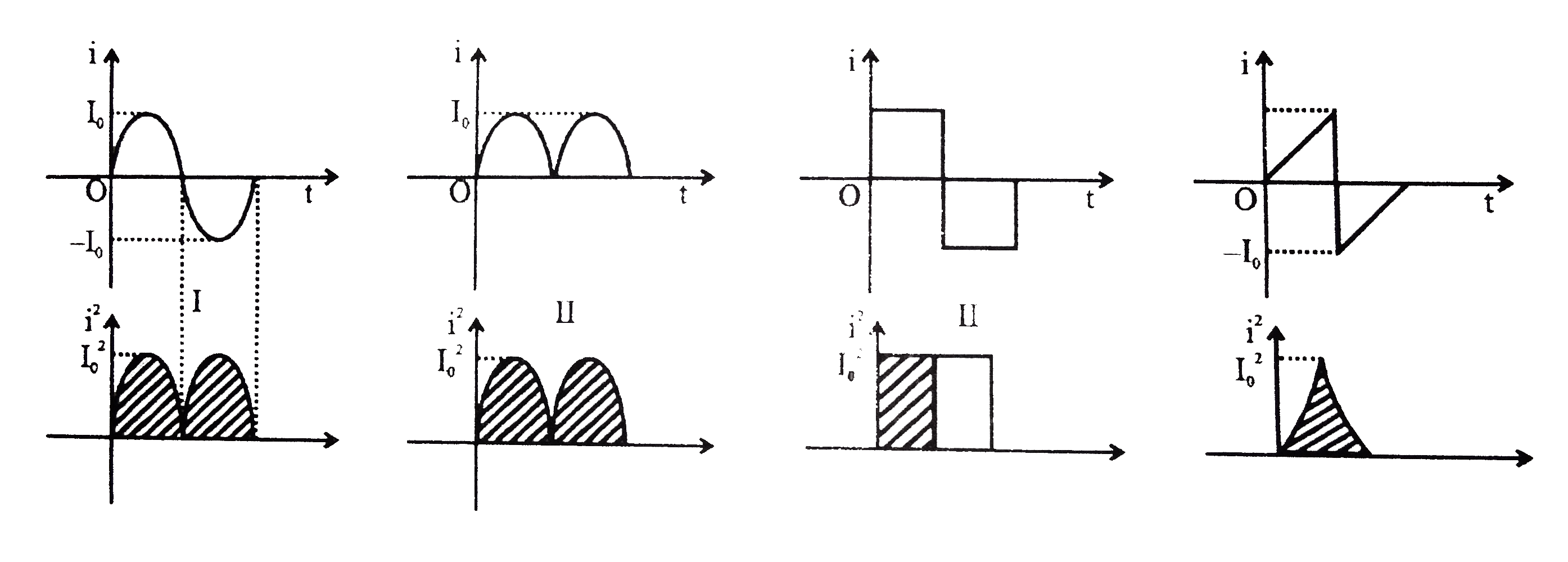 `int I_(2)dt` = area of `I^(2)-t` curve on time axis will be maximum for `III` than for and `I` and `II` and least `IV`. `I_(3) gt I_(1)=I_(2) gt I_(4)` |
|
| 12. |
Twoshort magnets of magnetic moment 2 Am^(2)and 5 Am^(2)are placedalong two lines drawn at right angle to each other on the sheet of paperwhat is the magnetic fieldat thepoint of intersection of their axis |
|
Answer» `2.15 xx10^(-5) T` `B_(1)=(mu_(0))/(4PI)(2M_(1))/(r_(1)^(3))` `therefore` Mangeticfielddue to magnet `=(mu_(0))/(4pi)(2M_(2))/(r_(2)^(2))` `therefore` Netmagneticfield at point p `B=sqrt(B_(1)^(2)+B_(2)^(2))` `=2.15 xx10^(-5) T` |
|
| 13. |
The binding energy per nucleon is largest for |
|
Answer» `O^16` |
|
| 14. |
Draw the circuit diagram to determine unknown resistance using meter bridge. Write the equation used for determining the unknown resistance. |
|
Answer» SOLUTION :Circuit DIAGRAM EQUATION used `S=(100-l)/(l)R`. |
|
| 15. |
State one factor which determines the intensity of light in the photon nature of light. |
| Answer» SOLUTION :Number of photons incident per UNIT AREA per unit time on a surface GOVERNS the intensity of LIGHT there. | |
| 16. |
A ball is dropped vertically from a height h above the ground .It hits the ground and bounces up vertically to a height h/2.Neglecting subsequent motion and air resistance ,its velociry v varies with the height h as |
|
Answer»
|
|
| 17. |
Discuss the experiment determine the wavelenght of different colours using diffraction grating. Determination of wavelenght of diferent colours: |
|
Answer» Solution :When WHITELIGHT is USED, th,e diffraction PATTERN consits of a white cental maximum and on both sides contnuous coloured diffraction patterns are formed. The central maximum is white as all thecolours MEET here constructively with no path diffraction of different orders for all colurs from violet to red. It produces a spectrum the angle at which these colours appear for VARIOUS orders of diffraction, the wavelenght of different colours could be calculated using the formula, `lambda = (sin theta)(Nm)` Here, N is the number of rulings per metre in the grating and m is the order of the diffraction image. |
|
| 18. |
Period of oscillation of mass attached to a spring and performing S.H.M. is T. The spring is now cut into four equal pieces and the same mass attached to one piece. Now the period of its simple harmonic oscillation is : |
|
Answer» 2T `k.=4k`. `:.""T.=2pi sqrt((m)/(k.))=2pi sqrt((m)/(4k))=(T)/(2)`. Correct choice is (B). |
|
| 19. |
State the underlying principle of a potntiometer. |
| Answer» SOLUTION :When a CONSTANT current flows through a wire, the potential difference, between any two POINTS on the wire of UNIFORM CROSS section, is directly proporational to the length of the wire between these points. | |
| 20. |
Assertion: The tyres of aircrafts are slightly conducting Reason:If a conductor is connected to ground, the extra charge induced on conductor neutralised by the ground. |
|
Answer» Both ASSERTION and Reason are TRUE and Reason is the CORRECT explanation of Assertion |
|
| 21. |
What does the poem encourage us to do? |
|
Answer» TAKE ACTIONS to SET our future |
|
| 22. |
The mean free path of conduction electrons in copper is about 4.0xx10^(-8) m. The electric field which can give on the average 2.4 eV energy to conduction electron in copper block is axx10^(7) V m^(-1). What is the integer value of a? |
|
Answer» SOLUTION :Here, mean free PATH, `x=400xx10^(-8)m`. Energy acquired by electron before it collides with a copper ioN/Atom, `W=2.4 eV =2.4xx1.6xx10^(-19)J`. If E is the electric FIELD applied, then force on electron due to electric field, `F=eE`. Workdone by electric field on electron, before it collides with a copper ioN/Atom is W= force xx mean free path`=eEx` |
|
| 23. |
A solid sphere of copper of radius R and hollow sphere of copper of inner radius r and outer radius R are heated to the same temperature and allowed to cool in the same environment. The rate of cooling is |
|
Answer» more for HOLLOW sphere |
|
| 24. |
There is a large circle (not a screen this time) around two coherent sources S-1 and S_2 keptat a distance d = 3.4 lambda. (a) Find total number of maximas on this circle. (b) Four angular positions corresponding to third order maxima on this circle. |
|
Answer» `Deltax= d cos theta` CORRESPONDING to given figure `(Deltax)_min = 0` at `theta = 90^(@)` ` (Deltax)_max = d = 3.4lambda` at `theta =0^(@).` Corresponding to third order MAXIMA, At `P_(1`) ` Deltax = 3lambda ` or ` d cos theta = 3lambda ` or ` 3.4 cos theta = 3lambda` ` :. theta = (cos^-1)(3/3.4)` Four angular positions are as shown in figure. |
|
| 25. |
Electric quantity ...... is equivalent to mechanical quantity, force constant (k) |
|
Answer» charge (Q) |
|
| 26. |
If the speed of a particle moving at a relativistic speed is doubled, its linear momentum will |
|
Answer» Become double |
|
| 27. |
Draw a plot of BE/A versus mass number A for 2 le A le 170. Use this graph to explain the release of energy in the process of nuclear fusion of two light nuclei. OR Using the curve for the binding energy per nucleon as a function of mass number A, state clearly how the release in energy in the processes of nuclear fission and nuclear fusion can be explained. OR Draw a plot of the binding energy per nucleon as a function of mass number for a large number of nuclei, 2 lt A lt 240. How do you explain the constancy of binding energy per nucleon in the range 30 lt A lt 170 using the property that nuclear force is short-ranged ? |
Answer» Solution :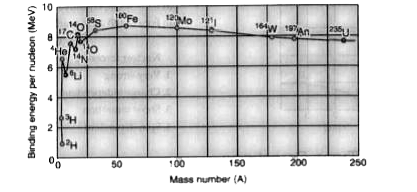 The above curve shows that (i) When a HEAVY nucleus breaks into two MEDIUM sized nuclei (in NUCLEAR fission) the BF/nucleon increases resulting in the release of energy. (ii) When two small nuclei combine to form a relatively bigger nucleus in nuclear fusion BF/nucleon increases, resulting in the release of energy. OR The constancy of the binding energy in the range `30 lt A lt 170` is a consequence of the fact that the nuclear force is short-ranged. If a nucleon can have a maximum of `p` neighbours WITHIN the range of nuclear force, itsbinding energy would be proportional top. If we increase A by adding nucleons they will not change the binding energy of a nucleon inside. Since most of the nucleons in a large nucleus reside inside it and not on the surface, the change in binding energy per nucleon would be small. Hence the binding energy per nucleon is a constant, (saturation property of nuclear forced.) |
|
| 28. |
There are two radio nuclei A and B. A is an alpha emitter and B a beta emitter. Their disintegration constants are in the ratio of 1:2. What should be the ratio of number of atoms of A and B at any time t so that probabilities of getting alpha and beta particles are same at that instant |
| Answer» ANSWER :A | |
| 29. |
An interference is observed due to two coherent sources S_(1) placed at origion and S_(2) placed at (0, 3lambda, 0). Here lambda is the wavelength of the sources. A detector D is moved along the positive x-axis. Find x-coordinates on the x-axis (excluding x= 0 and x= oo) where maximum intensity is observed. |
|
Answer» <P> Solution :At x=0, path difference is `3lambda`. Hence, third order maxima will be obtained. At `x=oo`, path difference is ZERO. Hence, zero order maxima is obtained. In between first and second order maximas will be obtained.First order maxima : `S_(2)P-S_(1)P= lambda` (or) `sqrt(x^(2)+9lambda^(2))-x= lambda` or `sqrt(x^(2)+9lambda^(2))= x+ lambda` SQUARING both sides, we get `x^(2)+9lambda^(2)= x^(2)+lambda^(2)+2x lambda` SOLVING this, we get `x= 4 lambda` Second order maxima : `S_(2)P-S_(1)P= 2 lambda` (or) `sqrt(x^(2)+9lambda^(2))- 2lambda"(or) "sqrt(x^(2)+9lambda^(2))= (x+2lambda)` Squaring both sides, we get `x^(2)+9lambda^(2)= x^(2)+4lambda^(2)+ 4x lambda` Solving, we get `x= (5)/(4)lambda= 1.25 lambda` Hence, the desired x coordinates are, `x= 1.25 lambda" and "x= 4lambda`.  . .
|
|
| 30. |
A potentiometer consisting of a uniform wire of length l and resistance R_(0) is connected to a steady voltage source of V_(0) find the voltage V supplied by it to a fixed load R as the funciton of the distance x of sliding contact from the higher potential end Analyse the case when RgtgtR_(0) |
|
Answer» |
|
| 31. |
A point charge q is a distance r from the centre of an uncharged spherical conducting layer, whose inner and outer radii equal to a and b respectively. The potential at thepoitO ifr lt ais(q)/(4 pi in_0 )times |
|
Answer» `((1)/(R ) -(1)/(a)+(1)/(B))` |
|
| 32. |
A copper disc of radius 1m is rotated about its natural axis with an angular velocity 2 rad /sec in a uniform magnetic field of 5 tesla with its plane perpendicular to the field. Find the emf induced between the centre of the disc and its rim. |
| Answer» Solution :`E =1/2 B OMEGA r^2 , e = 1/2 xx 5 xx2 xx 1 xx 1 = 5` VOLT | |
| 33. |
A bar magnet is pivoted at its centre and placed in such a manner that it can freely rotate in horizontal plane. Time period of oscillation for this magnet in earth's magnetic field is measured at two different places. Time period of oscillation is 3s at a place where angle of dip is 30^@and time period is 4s at a place where angle of dip is 60^@. Let B_1 and B_2are the net magnetic fields due to earth at two places in same order. Then B_1//B_2 |
|
Answer» `(16)/(9 sqrt3)` `COS delta = (B_H)/(B)` ` rArr B= B_H sec delta ` Hence we can write the following for two places on earth. `B_1/B_2 = (B_(H_1) sec delta_1)/(B_(H_2) sec delta_2)` Time period of oscillation of magnet due to horizontal component can be written as follows: ` T = 2pi sqrt((I)/(MB_H) )` `rArr (T_1^2)/(T_2^2) = (B_(H2))/(B_(H1))` `rArr (B_(H1) )/(B_(H2)) = (T_2^2)/(T_1^2)` ` rArr (B_(H1))/(B_(H2)) = ((4)^2)/((3)^2)` ` rArr (B_(H1))/(B_(H2)) = 16/9`.....(ii) Substituting given angles of dip and value from equation (2) in equation (1) we get the following: `B_1/B_2 = 16/9 xx (sec 30^@)/(sec 60^@) ` `B_1/B_2 = 16/9 xx (2)/(sqrt3 xx 2)` `B_1/B_2 = (16)/(9 sqrt3)` 
|
|
| 34. |
Three measurements of the time for 20 oscilla- tions of a pendulum give t_(1) = 39.6 s t_(2) = 39.9s andt_(3) = 39.5 sThe precision in the measurement is |
| Answer» ANSWER :A | |
| 35. |
If a conductor is moving in the north direction and magnetic field is applied. Vertically upward then change in flux is -4xx10^-4Wb within four second. If the resistance of inductor is 5 Ohm. Then magnitude and direction of induced current will be: |
|
Answer» 0.02mA in north |
|
| 36. |
Explain the difference between intrinsic semiconductors and extrinsic semiconductors. |
|
Answer» Solution :Intrinsicsemiconductor. An intrinsic semiconductor is a pure semiconductor . Outer shell of such semiconductors are complete at low temperatures and they behave as insulators. At room temperature, due to thermal agitation, a few electrons are freed CREATING some holes. These holes are filled by electrons from some covalent bonds thereby creating more holes. THUS at room temepratures a pure semiconductors will have a feq electrons and holes which are CALLED intrinsic carriers. It should be noted that these electrons and holes are not current in themselves but they act as the negative and positive carriers of current respectively. As the temperature rises, a large number of electrons cross over the forbidden gap and jump from valence band to conduction band. HENCE conductivity of a semiconductor increases with rise of temperature. Extrinsix semiconductor. A pure semiconductor, at room temperature , has a few electrons and holes and so the conductivity offered by the pure semiconductor cannot be made of any practical use. By adding suitable impurities (pentavalent impurity or trivalent impurity), the conductivity of the semiconductor can be remarkably improved. Such a crystal, in which doping is done, is called extrinsic semiconductor. Just we have pure (intrinsic) n-type and p-type semiconductors, similarly we can obtain p-type (extrinsic) semiconductor or n-type (extrinsic) semiconductor. |
|
| 37. |
The velocities of light in two different media are 2xx10^(8) m/s and 2.5xx10^(8) m/srespectively. The critical angle for these media is |
|
Answer» `SIN^(-1)(1/5)` |
|
| 38. |
Define the terms (i) drift velocity, (ii) relaxation time.A conductor of length L is connected to a d.c. source of emf epsi . If this conductor is replaced by another conductor of same material and same area of cross-section but of length 3L, how will the drift velocity change ? |
|
Answer» Solution : (i) Drift velocity : Drift velocity is the AVERAGE uniform velocity acquired by conduction (free) electrons inside a metal by the application of an electric FIELD which is responsible for current through it. (ii) Relaxation time : Relaxation time is the average time between successive collisions of conduction electrons with heavy fixed ions inside a metal when a current flows through it on applying an electric field. The average is taken over a large number of collisions. The drift velocity of electrons through a current carrying conductor is given by the relation `I =epsi/R =n A e v_d "or" v_d = (epsi)/(RnAe)` where `v_d`is the drift velocity and R the resistance of given conductor. If instead of a conductor of length L we USE another conductor of same material and same area of cross-section but of length 3L, then resistance of new conductor will be R. = 3R (since resistance of a conductor is directly proportional to its length). New drift velocity `v_d = (epsi)/(R. nAe) = (epsi)/((3R) nAe) = (v_d)/(3)` |
|
| 39. |
PureSi at 500 Khas equal number of electron (n_(e))andhole (n_h) concentraionsof1.5 xx 10^(16) m^(-3). Dopingby indium incresesn_(h)" to "4.5 xx 10^(22) m^(-3). The doped semiconductor is of |
|
Answer» n-type with electron concentration ` n_(E)= 5 xx 10^(22) m^(-3)` ` (1.5 xx 10^(16)m^(-3))^(2) = n_(e) xx (4.5 xx10^(22) m^(-3)) ` ` thereforen_(e) = ((1.5 xx 10^(16) m^(-3))^(2))/ (4.5 xx 10^(22) m^(-3)) = 5XX 10^(9) m^(-3)` ` As n_(n) lt ltn_(e)` So semiconductoris p-typeand ` n_(e) = 5 xx 10^(9) m^(-3) ` |
|
| 40. |
The maximum range of projectile fired with some initial velocity is found to be 1000 m, in the absence of wind and air resisstance. The maximum height reached by the projectile is |
|
Answer» 250 m For maximum range, ANGLE of projection ` theta " is"45^(@)` ` R_(max)= (u^(2) sin (2 xx 45^(@))/g = u^(2)/g = 1000m` maximum HEIGHT, ` H = ( u^(2) sin^(2) 45^(@))/( 2 g ) ` `H = 1/2 xx 1000 xx (1/sqrt2)^(2)= 250 m` |
|
| 41. |
A parallel combination of 0.1 M Omega resistor and a 10 muF capacitor is connected across a 1.5V source of negligible resistance. The time required for the capacitor to get charged up to 0.75 V is approximately (in seconds). |
|
Answer» `oo` 0.75 V, the charge on the plates should be as follow. 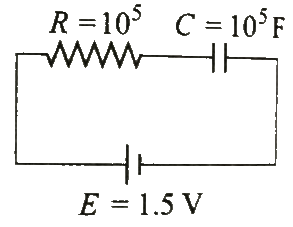 `q=CE[1-e^(-t//RC)]` or `0.75 xx 10^(-5) = 10^(-5) xx 1.5 [1-e^(-t/(10^5 xx 10^(-5)))]` or `1/2 = [1-e^(-t)] or e^(-t) = 1/2` TAKING LOG on both SIDES, we get `-t = -1n2 or t =0.693s`. |
|
| 42. |
Solve a similar problem for three fermions. |
|
Answer» `F_(av)=(2h^(2))/(4mL^(3))+(4h^(2))/(4mL^(3))=(3H^(2))/(2mL^(3))` |
|
| 43. |
Two charges 2mu c and 1 mucare placed at a distance of 10 cm. Where should a third charge be placed between them so that it does not experience any force. |
|
Answer» Solution :`Q_1 = 2mu C = 2 xx 10^(-6) C` `Q_2 = 1 muC = 1 xx 10^(-6)C` `d = 10 cm` Let the third charge Q be placed at a distance of X from `Q_1` then x = ? The resultant FORCE on 3rd charge is zero. `VEC(F_R) = vec(F_1) + vec(F_2) = 0"" vec(F_1) + vec(F_2) = 0` `(Q_1)/(x^2) = (Q_2)/((d - x)^2) implies (2 xx 10^(-6))/(x^2) = (1 xx 10^(-6))/((10 - x)^2)` By square rooting on both sides `(1.414)/x = 1/(10 - x) implies x = 5.9 cm " from " 2 mu C`. (or) Shortcut `x = d/(sqrt((q_2)/(q_1)) +- 1) = 10/(sqrt(2/1 + 1)) = 10/(2.414)` = 4.1 cm from`1 mu C` [+ for like charges, - for unlike charges]. |
|
| 44. |
Charge Q is distributed uniformly over a non conducting sphere of radius R. Find the electric p-0tential at distance r from the centre of the sphere r (r lt R). The electric field at a distance r from the centre of the sphere is given as (1)/(4pi epsilon_(0)). (Q)/(R^(3))hatr . Also find the potential at the centre of the sphere . |
|
Answer» Solution :The ELECTRIC potential on the surface of such a sphere is `V(R) = (1)/(4pi epsilon_(0)).(Q)/(R)` We can use the equation `V(r) : V(R)= : vint_(R)^(r)vecE.dvecr` `:. V(r): (R) =: int_(R)^(r)(1)/(4piepsilon_(0))(Q)/(R^(3))RDR (hatr.hatr)` `( because dvecr = dr vecr)` `=: (Q)/(4pi epsilon_(0)R^(3))int_(R)^(r)rdr` `=: (Q)/(4piepsilon_(0)R^(2))[(r^(2))/(2)]_(R)^(r)` `=: (Q)/(4pi epsilon_(0)R^(3))[(r^(2))/(2) -(R^(2))/(2)]` `:. V(r)=V(R)+(Q)/(4piepsilon_(0)R^(3))[(R^(3))/(2)-(r^(2))/(2)]` `:. V(r)=(1)/(4piepsilon_(0))(Q)/(R)+(Q)/(8piepsilon_(0)R^(3))(R^(2)-r^(2))` `:. V(r) = (1)/(4piepsilon_(0))(Q)/(2R) (2+(1)/(R^(2))(R^(2)-r^(2)))` `=(1)/(4piepsilon_(0))(Q)/(2R) (2+(R^(2))/(R^(2))-(r^(2))/(R^(2)))` `:. V(r) = (1)/(4piepsilon_(0))(Q)/(2R) (3-(r^(2))/(R^(2)))=r lt R` `:. V(r)=(kQ)/(2R)[3-(r^(2))/(R^(2))]` At the centre of sphere r =0 `:. V (0) =(1)/(4pi epsilon_(0)).(3Q)/(2R) = (3kQ)/(2R)` |
|
| 45. |
In L-C-R series circuit at resonance p.d. between two ends of resistor is 100V. R = 1kOmega and C = 2muF, if resonant angular frequency is omega = 200 "rad/s"^(-1), p.d. between two ends of inductor of resonance is ..... |
|
Answer» 250 V `therefore L=1/(omega^2C)` `=1/((200)^2xx2xx10^(-6))` `=100/8`=12.5 H p.d. between two ends of INDUCTOR, `V_L=IX_L = I omegaL` =0.1 X 200 x 12.5 `therefore V_L`= 250 V |
|
| 46. |
A sky wave with a frequency 55 MHz is incident on D-region of the earth.s atmosphere at 45^(@). The angle of refraction is (electron density for D-region is 400 electron/c.c) |
|
Answer» `60^(@)` |
|
| 47. |
A square loop of side 12 cm with its sides parallel to X and velocity of 8 cm s in the positive x-direction in an environment containing a magnetic field in the positive z-direction. The field is neither uniform in space nor constant in time. It has a gradient of 10 T cm along the negative x-direction (that is it increases by 103 T cm- as one moves in the negative x-direction), and it is decreasing in time at the rate of 103 Ts. Determine the direction and magnitude of the induced current in axes is moved with a the loop if its resistance is 4.50 m2. Sol. Given, side of loop a = 12 cm . Area of loop (A) = a = (12) = 144 cm = 144 x 10 m? (. Area of square = (side)) |
|
Answer» Solution :The magnetic field in loop varies with position .x. of loop and also with time SIMULTANEOUSLY. The rate of change of FLUX due to variation of .B. with time is `(d phi)/(dt)=A xx (DB)/(dt)` The rate of change of flux due to variation B with position .x. is `(d phi)/(dt)= A xx (dB)/(dt) -A(dB)/(dx) xx (dx)/(dt)=A(dB)/(dx) vartheta` Since both cause decrease in flux, the two effects will add up `:.` The net emf induced `e=(dphi)/(dt)=A(dB)/(dt)+A(dB)/(dx) xx vartheta=A[(dB)/(dt)+vartheta.(dB)/(dx)]` `=144 xx 10^(-4)[10^(-3)+8 xx 10^(-3)]` `=144 xx 9 xx 10^(-7)=129.6 xx 10^(-6)` V |
|
| 48. |
In the ciruit shown in figure, Initially K_1is closed and K_2is open, let charge on capacitor C_2is Q_2Then K_1was opened while K_2kept closed, let charge on capacitor C_2is Q_2(Take, C=1muF ) Then ratio Q_2/Q_1 is |
|
Answer» `1:1` |
|
| 49. |
Can wegenerateelectrogneticwavesof frequency6.2 xx 10 ^(14)Hzin thevisableregion oflightbyoscillatingcharges ? |
| Answer» Solution : No. We cannot generate ELECTROMAGNETIC WAVES in the VISIBLE region by this method. To generate electromagneticwaves, charge is oscillated at some FREQUENCY which generates an Oscillating electric field which in turns produces oscillating magnetic field. This further produces oscillating electric field and so on. These simultaneous procedures generate electromagnetic wave of the same frequency. THUS to generate electromagnetic waves in visible region, charge will have to be oscillated with the same frequency which is practically not possible. | |


