

Saved Bookmarks
This section includes 7 InterviewSolutions, each offering curated multiple-choice questions to sharpen your Current Affairs knowledge and support exam preparation. Choose a topic below to get started.
| 1. |
An ellipsoidal cavity is carved with in a perfect conductor. A positive charge q is placed at the centre of the cavity. The points A and B are on the cavity surface as shown in the figure then (a) Electric field near A in the cavity = Electric field near B in the cavity (b) Charge density at A= Charge density at B (c ) Potential at A= Potential at B (d) Total electric flux through the surface of the cavity is q//epsi_(0). |
|
Answer» a,B,C,d are correct |
|
| 3. |
The work function of the following metal is given Na = 2.75 eV, K=2.3 eV, Mo= 4.14 eV, Ni =5.15 eV which of these metal will not give a photoelectric emission for radiation of wave length 3300 A^@ from a laser source placed at 1m away from the metal . What happensif the laser is brought nearer and placed 50 cm away. |
|
Answer» Solution :`lambda=3300A^@,E=(hc)/(lambda)=(6.6xx10^(-34)xx3xx10^8)/(3300xx10^(-10)xx1.6xx10^(-19))eV~~3.8eV` WORK function of `M_o &NI gt 3.8` eV hence no PHOTOELECTRON emission from `M_o and Ni`. |
|
| 4. |
The radius of a narrow toroid is 10^(-1)mand has 1000 turns of wire on it .If magnetic induction inside it is 0.05T,then the current flowing through it is : |
|
Answer» 5A |
|
| 5. |
In an A.C. circuit, the current flowing is I = 5 sin (100t-pi//2) ampere and the potential difference is V = 200 sin (100t) volts. The power consumption is equal to |
|
Answer» Solution :CURRENT (I) `= 5 sin (100t-pi//2)` and voltage (V) `= 200 sin(100 t)`. Comparing the given equation, with the standard equation, we find that phase angle between current and voltage is `phi=pi//2 = 90^(@)`. Powe consumption `P=I_(rms)V_(rms)cos phi` `= I_(rms)V_(rms) cos 90^(@)=0` |
|
| 6. |
An equilateral glass prism has a refractive index 1.6 in air. Calculate the angle of minimum deviation of the prism, when kept in a medium of refractive index 4sqrt(2)//5 |
|
Answer» Solution :Here, `angleA = 60^(@), n_("glass") = 1.6` and `n_("MED") = (4sqrt(2))/5` If `D_(m)` be the angle of MINIMUM deviation in given MEDIUM, then `n=(n_("glass"))/(n_("med")) = (sin(A+D_(m))/2)/(sin(A/2)) rArr 1.6/(4sqrt(2)/5) = (sin(60^(@) + D_(m))/2)/(sin(60^(@))/2)` `rArr 30^(@) = D_(m)/2 = 45^(@) rArr D_(m) = 30^(@)` |
|
| 7. |
The photoelectric surface is receiving light of wave length 5000Å at the rate of10^(-7) J/s. The no. of photoelectron received per sec is: |
|
Answer» `2.5xx10^(12)` `=(10^(-7)xx5000xx10^(-10))/(6.6xx10^(-34)xx3xx10^(8))` `=2.5xx10^(11)` |
|
| 8. |
Doctor uses .optical fibre. to observe inner parts of body, which works on ...... principle. |
|
Answer» REFRACTION |
|
| 9. |
Show that a convexmirror always forms a virtual image of diminished size as compared to the object. |
|
Answer» Solution :According to the equation of the SPHERICAL mirror, `(1)/(v)+(1)/(u) = (1)/(f) or, (1)/(v) = (1)/(f) - (1)/(u)` `or, "" v=(uf)/(u-f)` Now for a convex mirror f is considered as positive. Again, as the object is real, u is taken as negative. Following this sigh convention, form equation (1) we get, `v=((-u)xxf)/(-u-f) = (uf)/(u+f)` As v is positive, so for any position of the object in front of a convex mirror, the image will be formed behind the mirror i.e., Again, magnification, `m=(v)/(u)` [considering the magnitude of m only] `=(f)/(u+f)` [from equation (2)] Clearly, `u+fgtf.so, m lt 1` i.e, the image formed by a convex mirror is diminished in size as compared to object. |
|
| 10. |
A thin rectangularmagnet suspeded freeely hasa period of oscilltion equal to T now it is broken into tow equalhalveseach having of original lengthfieldif its period of oscillation is T then(T)/(T)is |
|
Answer» `1/2` `T=2pisqrt(I)/(MVB), I=(m)/(2xx12)=1/8M=M//2` `therefore T./T=1//2` |
|
| 11. |
Four point charges Q , q Q and q are placed at the corners of a square of side 'a' as shown in the Fig. Find the potential energy of this system . |
|
Answer» Solution :The potential energy of the system `U = (1)/(4PI in_(0)) [ (q_(A) q_(B))/(a) + (q_(A) q_(C))/(asqrt2) + (q_(A) q_(D))/(a) + (q_(B) q_(C))/(a) + (q_(B) q_(D))/(a sqrt2) + (q_(C) q_(D))/(a)]` `= (1)/(4 pi in_(0)) [ (qQ)/(2) + (Q^(2))/(a sqrt2) + (qQ)/(a) + (qQ)/(a) + (q^(2))/(asqrt2) + (qQ)/(a)]` `(1)/(4pi in_(0)) [ (4qQ)/(a) + ((Q^(2) + q^(2)))/(a sqrt2)] = (1)/(4 pi in_(0) a) [4 qQ + ((Q^(2) + q^(2)))/(sqrt2)]` |
|
| 12. |
A galvanometer has current sensitivity of 5 divisions/mA and a voltage sensitivity of 2 division/mV. If the instrument has 30 divisions, how will you use it to measure (i) a current of 3 A, and (ii) a voltage of 15V? |
|
Answer» |
|
| 13. |
Potential difference that is applied across a conductor of resistance .R. varies with time .t. according to the equation V(t)=V_(0)e^(-t//z) where z is a constant that has dimonsions of time. Obviously, the applied potential difference decreases exponentially with time. Charge that passes through any fixed observation point within the conductor between t=0 and t=z will be |
|
Answer» `(V_(0))/(R)` |
|
| 14. |
Suppose that the same system of charge is now placed in an external electric field E = A(l/r^(2)), A= 9 xx 10^(5) cm^(-2). What would the electrostatic energy of the configuration be ? |
| Answer» SOLUTION :U = 29.3 J | |
| 15. |
Four point charges Q , q Q and q are placed at the corners of a square of side 'a' as shown in the Fig. Find the resultant electric force on a charge Q |
|
Answer» Solution :Let us calculate electric force on a charge Q situated at the corner A in figure , then `|vecF_(AB)| = (1)/(4 pi in_(0)) (Qq)/(q^(2)) , |vecF_(AC)| = (1)/(4pi in_(0)) * (Q^(2))/(2A^(2)) ` and `|vecF_(AD)| = (1)/(4pi in_(0)) * (Qq)/(a^(2))` Directions of the force are as shown in Fig. 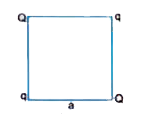 `therefore` Force along BA , `F_(1) = F_(AB) + F_(AC) sin 45^(@)` `= (1)/(4pi in_(0)) (Qq)/(a^(2)) + (1)/(4 pi in_(0)) * (Q^(2))/(2a^(2)) (1)/(sqrt2)` `= (Q)/(4pi in_(0) a^(2)) [ q + (Q)/(2sqrt2)]` and force along `DA, F_(2) = F_(AD) + F_(AC) cos 45^(@)` =` (1)/(4 pi in_(0)) (Qq)/(a^(2)) + (1)/(4pi in_(0)) * (Q^(2))/(2a^(2)) (1)/(sqrt2)` `= (Q)/(4 pi in_(0) a^(2)) [ a + (Q)/(2 sqrt2)]` `therefore` Resultant electric force `F_(A)= sqrt(F_(1)^(2) - F_(2)^(2)) = (Q)/(4 pi in_(0) a^(2)) [ q + (Q)/(2sqrt2)] sqrt2 = (Q)/(8 pi in_(0) a^(2)) [2 sqrt2q + Q]` The resultant force acts along the EXTENDED line CA. 
|
|
| 16. |
frame S' moves relative to frame S with velocity 0.620c hati while a particle moves parallelto the common x and x' axes. An observerattached to frame S' measures the particle's velocity to be 0.47 chati. In terms of c, what is the particle's velocity as measured by an observer attached to frame S according to the (a) relativistic and (b) classsical velocity ransformation? Suppose, instead, that the S'measure of the particle's velocity is -0.47c hati. What velocity does the observer in S now measure according to the (c ) relativistic and (d) classical velocity transformation? |
|
Answer» |
|
| 17. |
The radius of a spherical nucleus as measured by electron scattering is 3.6 fm. What is the mass number of the nucleus most likely to be ? |
|
Answer» 27 where A is the MASS number of a nucleus . GIVEN, R=3.6 fm `therefore` 3.6 fm=(1.2 fm) `(A^(1//3)) "" [because R_0=1.2 fm]` or A=`(3)^3`=27 |
|
| 18. |
The velocity of projection of a body is increased by2%. Other factors remaining unchanged, what will be the percentage change in the maximum height reached |
|
Answer» 0.01 |
|
| 19. |
A particle of mass 'm' executes simple harmonic motion with amplitude 'a' and frequency v. The average kinetic energy during its motion from the position of equilibrium to the end is : |
|
Answer» `2PI^(2)ma^(2)v^(2)` For S.H.M `y=a sin omega COS omegat` `:. K.E.=1/2ma^2omega^2cos^2omegat` Max.`(K.E.)_("average")=1/4(ma^2)(2piv)^2=pi^2ma^2v^2` |
|
| 20. |
In the figure shown, a semi-circular wire loop of radius R is placed in a uniform magnetic field B. The plane of the loop is perpendicular to the magnetic field. Find magnetic force on the loop. |
| Answer» Solution :`BI xx (2R) or F = Bi(PQ)` force will be ALONG X - axis | |
| 21. |
When the upper tip of a magnetic dip needle is loaded with a small mass, the dip is found to drop from 45^@ to 30^@If the total magnetic intensity at the place is 0.42 oersted and the pole strength of the magnetic needle is 200 CGS units, what is the mass attached? |
|
Answer» Solution :As shown in fig., on loading the upper end of the needle for its rotational, equilibrium, `vecrxxvacF+vacMxxvacB=0` `i.e.,MgxxLcos30^(@)=mxx2LxxBsin(45^@-30^@)` i.e.,`M=2mBsin15^(@)/gcos30^(@)` Substituting the current data, `M=2xx200xx0.42xx9.2588/980xx(SQRT(3)//2) = 0.051 g` |
|
| 22. |
What is sky wave propagation ? |
| Answer» Solution :The RADIO waves which are reflected BACK to the earth by ionosphere are knownas SKY wave PROPAGATION. | |
| 23. |
The first & second stage of two stage rocket separately weigh 100 kg and 10 kg and contain 800kg and 90kg fuel respectively. If the exhaust velocity of gases is 2 km/sec then find velocity of rocket (nearly) (log_(10)5=0.6990) (neglect gravity) |
|
Answer» Solution :`V=V_(0) + 2.3 log (m_(0)//m)` Velocity as the FIRST stage is detached `=V_(0)` `V_(0) = 2.3 ulog (m_(0)//m)` `=2.3 xx 2 xx 10^(3) xx log (1000//200)` `=2.3 xx 2 xx 0.699 xx 10^(3) = 3.2 xx 10^(3)` Velocity acquired with SECOND stage =V `V=V_(0) + 2.3 u log (m_(0)//m)` `=3.2 xx 10^(3) + 2.3 xx 2 xx 10^(3) xx log (100//10)` `=3.2 xx 10^(3) + 4.6 xx 10^(3) = 7.8 xx 10^(3) m//s` |
|
| 24. |
Two non-viscous, incompressible and immiscible liquids of densities p and 1.5pare poured into the two limbs of a circular tube of radius R and small cross section kept fixed in a vertical plane as shown in the figure. Each liquid occupies one fourth the circumference of the tube.(i)Find the angle theta that the radius to the interface makes with the vertical in equilibrium position. _________ (ii) If the whole liquid column is given a small displacement from its equilibrium position, show that the resulting oscillations are simple harmonic. Find the time period of these oscillations. ____________ |
|
Answer» (i) The pressure due to liquid on left limb (at bottom) `P_(1)=R(1sintheta)1.5pg`...(i) The pressure due to liquids on right limb `P_(2)=(Rsintheta+Rcostheta)pg+R(1-costheta)1.5pg`...(ii) In EQUILIBRIUM, `P_(1)=P_(2)` Which gives, `tantheta=((1)/(5))impliestheta=tan^(-1)((1)/(5))` (ii) If the liquid is given a small angular displacement `alpha`, the pressure difference, `dP=P_(1)-P_(2)` `dP=[Rsintheta+alpha)+Rcos(theta+alpha)]pg+R[l-cos(theta+alpha)]1.5pg-R[l-sin(theta+alpha)]1.5pg` As `alpha` is small, `sinalpha=alpha`,`cosalpha=1` `dP=Rpg[2.5sintheta+2.5costhetaalpha-0.5costheta+0.5sinthetaalpha]` `tantheta=0.2`,`sintheta=(0.2)/(sqrt(1.04))` and `costheta=(1)/(sqrt(1.04))` `dP=2.55Rpgalpha=2.55pgy`(as `Ra=y`) Restoring force `F=dPx` area =`-2.55pgA` Mass of the liquid in tube `m=(2piR)/(4)Ap+(2pir)/(4)Axx1.5p=1.25piRAp` Hence acceleration `a=(F)/(m)=-(2.55pgyA)/(1.25piRAp)`,`a=-2.04((g)/(piR))y`,`a=-omega^(2)y` Hence, `omega=sqrt(2.04((g)/(piR)))`,TIME period, `T=(2pi)/(omega)=2.5sqrtRsec` 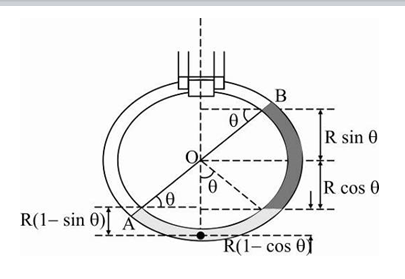 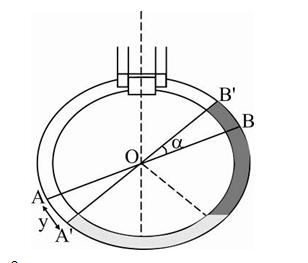
|
|
| 26. |
Mass and lengh of a metal cube are "10 kg "pm" 0.01 kg and 1 m "pm" 0.02 m". Its density with percentage then percentage error is |
|
Answer» `10kg//m^(3)pm7%` |
|
| 27. |
Whena long rod of iron is magnetised by meamns of an electriccurrentit is found to increase in length this is called |
|
Answer» magneto EFFECT |
|
| 28. |
Two persons A and B start from the same location and walked around a square in opposite directions with constant speeds. The square has a side 60 m. Speed of A and B are 4 ms ^(-1) and 2 ms ^(-1) respectively. When will they meet for the first time ? |
|
Answer» 30 s |
|
| 29. |
A particle of 2m is projected at an angle of 45^(@) with horizontal with a velocity of 20sqrt(2)m//s. After 1 sec. explosion takes place and the particle is broken into two equal pieces. As a result of expansion one point comes to rests. The maximum height from the ground attained by the other part is (g=10 m//s^(2)) |
|
Answer» Solution :`u_(x)=20sqrt(2)XX(1)/(sqrt(2))=20 m//s , u_(y)=20sqrt(2)xx(1)/(sqrt(2))=20 m//s` After 1 s `u_(x)=20 m//s` `V_(y)=u_(y)-"gt"=20-10=10 m//s` Due to EXPLOSION one part comes to rest `2cancel(m)(20vec(i)+10vec(j))= cancel(m).0+m vec(V) vec(V)=40vec(i)+20vec(j)` `V_(y)^(1)=20M//s "" therefore H_(2)=(V_(y)^(1)^(2))/(2g)` HEIGHT attained after explosion `=(20xx20)/(2xx10)=20m` But height attained before Explosion `= ut-(1)/(2)"gt"^(2)` `=20xx1-(1)/(2)xx10xx1^(2)=15 m H_("total")=15+20=35m` |
|
| 30. |
The time period of a satellite in a circular orbit of radius R is T. The radius of the orbit in which time period is 8T is: |
|
Answer» 5R `therefore (r_(2))/(r_(1)) = ((T_(2))/(T_(1)))^((2)/(3))=(8)^((2)/(3))=4` `rArr r_(2)=4r_(1)` Hence correct CHOICE is (C ). |
|
| 31. |
Following figure, as shown an an generator connected to a "block box" through a pair fo terminal.The box contains possible R,L,C of their combination, whoe elements and arrangements are not known to us. Measurements outside the box revals that |
|
Answer» There must be a CAPACITOR in the box. |
|
| 32. |
""^(131)I is an isotope of Iodine that beta- decays to an isotope of xenon with a half life of 8 days. A small amount of a serumlabeled with ""^(131)I is injected into the blood of a person. The activity of the amount of ""^(131)I injected was 2.4xx10^(5) Becquerel (Bq).It is known that the injected serum will get distributed uniformly in the blood stream in less than half an hour. After 115 hours, 2.5 ml of blood is drawn from the person's body, and gives an activity of 115 Bq. The total volume of blood in the person'sbody, in liters is approximately (you may use e^(x)~~1=x for |x| lt lt 1 and In 2~~0.7). |
|
Answer» |
|
| 33. |
A cylinder contains an ideal gas at a pressure of two atmospheres, the volume being 5 litres at a temperature of 250 K. The gas is heated at constant volume to a pressure of 4 atmospheres and then at constant pressure to a temperature of 650 K. Calculate the total heat input during these processes. For the gas C_v = 21 J "mole"^(-1) degree^(-1), The gas is then cooled at constant volume to its original pressure and then at constant pressure to its original volume. Find the total heat output during these processes and the total work done by the gas in the whole cyclic process. |
|
Answer» |
|
| 34. |
The pattern which consists of a broad and intense central maximum and number of narrows and fainter maxima called secondary maxima on both sides of central maxima what we call ? |
| Answer» SOLUTION :DIFFRACTION at SINGLE SLIT | |
| 35. |
In a diode valve, the state of saturation can be obtained easily by |
|
Answer» High plate voltage and high filament CURRENT |
|
| 36. |
A vessel is partitioned in two equal halves by a fixed diathermic separator. Two different ideal gases are filled in left (L) and right (R ) halves. The rms speed of the molecules in L part is equal to the mean speed of molecules in the R part. Then the ratio of the mass of a molecule in L part to that of a molecule in R part is |
|
Answer» `sqrt((3)/(2))` `sqrt((3RT)/(M_(1)))=sqrt((8RT)/(piM_(2)))implies(M_(1))/(M_(2))=(3pi)/(8)` |
|
| 37. |
Who all reached the earth? |
|
Answer» SERGEANT Oop |
|
| 38. |
Whom we call semiconductors and why ? |
| Answer» Solution :These are solids whose CONDUCTIVITY LIES between " conductors and insulators.. Ex. GERMANIUM, SILICON etc. | |
| 39. |
A ring of radius R is having charge Q uniformly distributed. A point charge Q_(0) is placed at the centre of the ring. Find tension developed in the ring. If radius of cross - section of the ring is a and Young's modulus of wire is Y, find increase in the radius of ring. |
|
Answer» Solution :To find tension//compression in the ring, find the force on small length of angle ` d theta` and remove `d theta` from the expression (refer to Circular Motion , Example 33 , page 351 Vol. 1). Charge on small length of angle `d theta` `Q' = (Q)/( 2 pi R) DL = (Q)/( 2 pi R) R d theta = (Q d theta)/(2 pi)` Electric force on `Q'` , `F = (1)/(4 pi in_(0)) (Q' Q_(0))/(R^(2)) = (1)/( 4 pi in_(0)) . (Q Q_(0))/(2 pi R^(2)) d theta` Tension in the string `T = (Q Q_(0))/( 8 pi^(2) in_(0) R^(2))` Let increase in the radius of ring is `DELTA R`. Longitudinal strain `in = ( 2pi (R + Delta R) - 2 pi R)/( 2 pi R) = (Delta R)/(R)` Longitudinal stress `sigma = (T)/(A) = (T)/(pi d^(2))` where `a`: radius of cross - section of ring. `Y = (sigma)/(in) = (T//pi a^(2))/(Delta R//R)` `Delta R = (T R)/(pi a^(2) Y) = (Q Q_(0))/(8 pi^(2) in_(0) R^(2)) . (R )/(pi a^(2) Y)` `= (Q Q_(0))/(8 pi^(3) in_(0) R Y a^(2))` 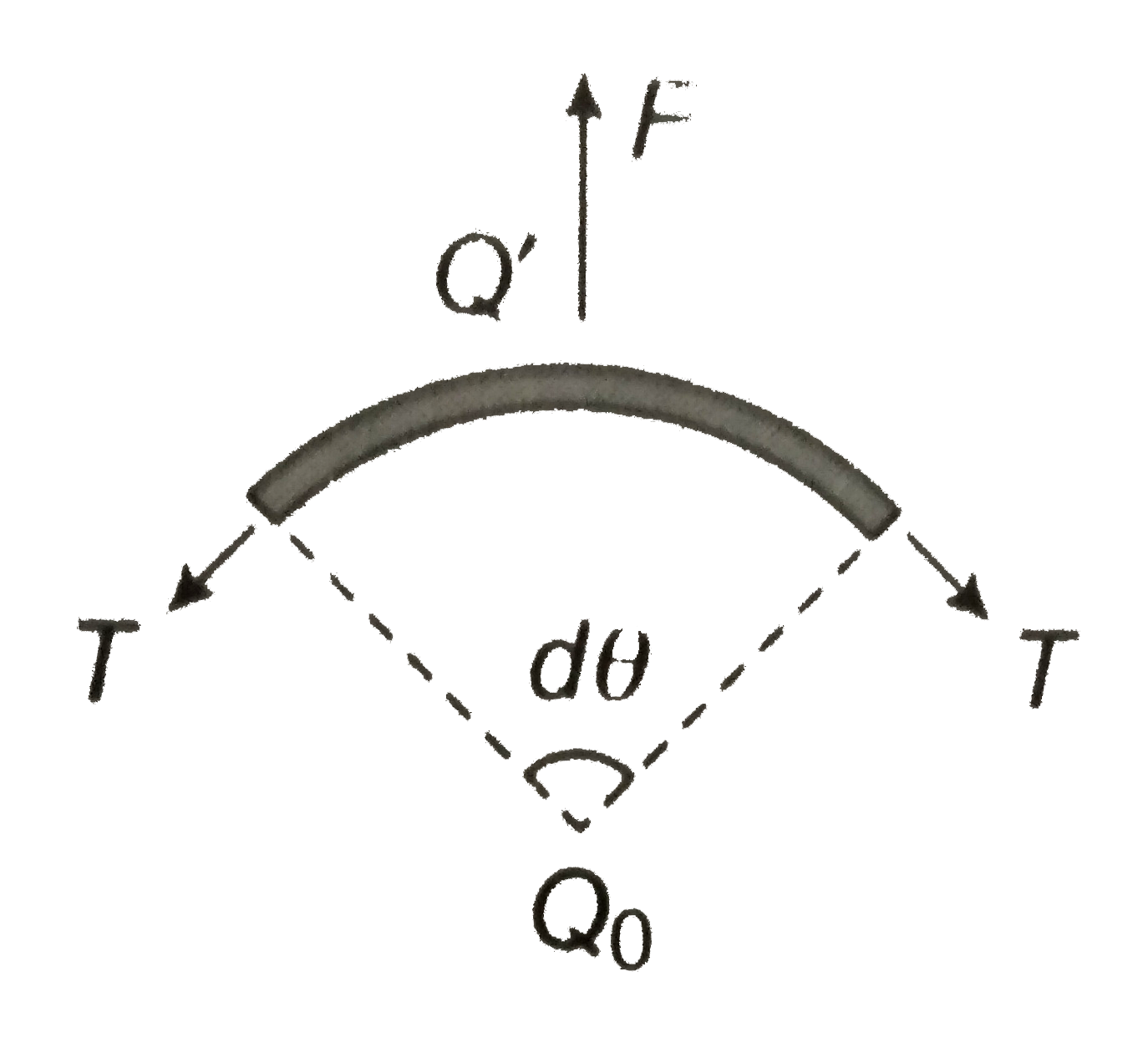 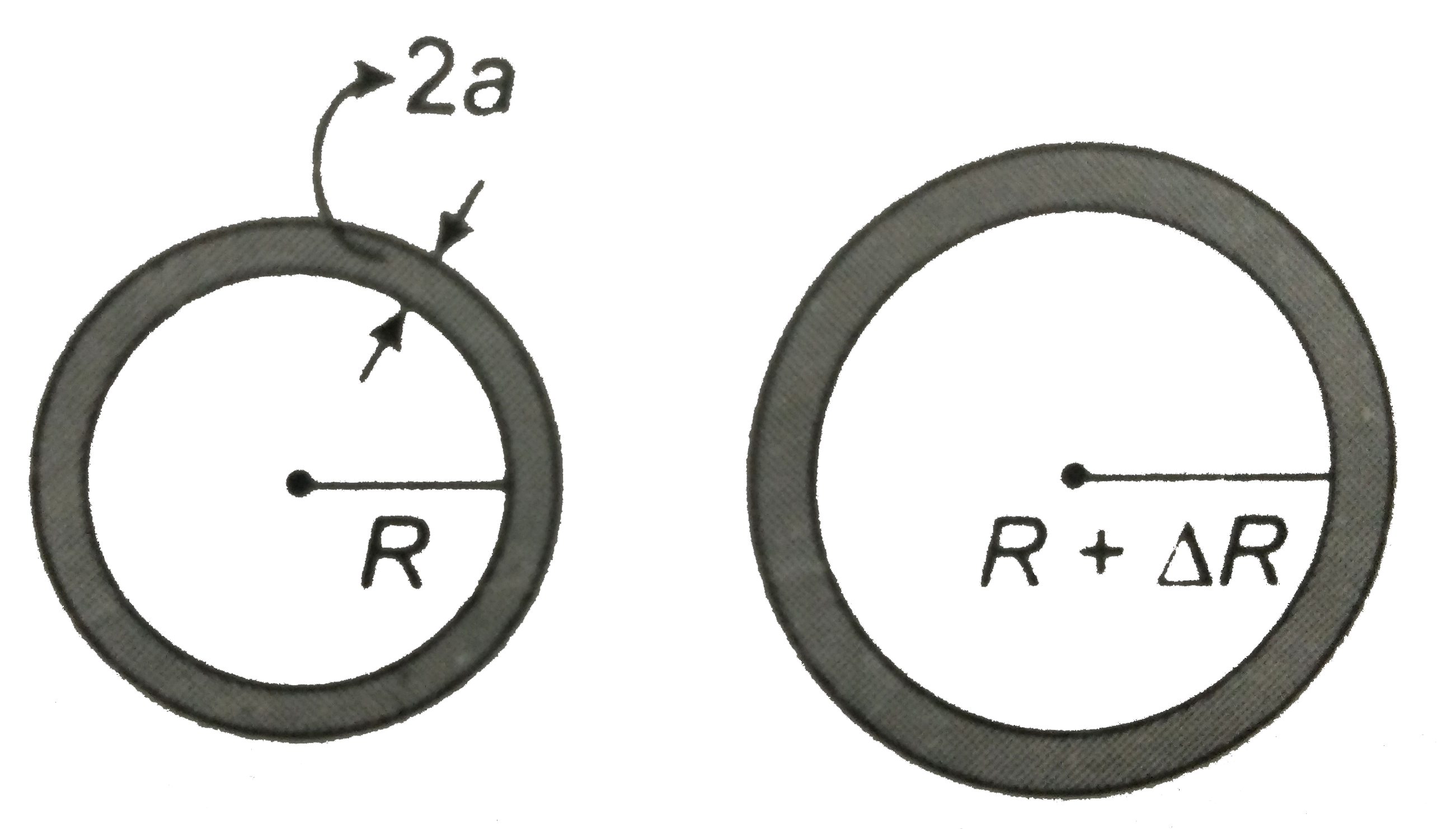
|
|
| 40. |
Steel wire of length 'L' at 40^(@)C is suspended from the ceiling and then a mass 'm' is hung from its free end. The wire is cooled dowa from 40^(@)C" to "30^(@)C to regain its original length 'L'. The coefficient of linear thermal expansiou of the steel is 10^(-5)//^(@)C, Young's modulus of steel is 10^(11)N//m^(2) and radius of the wire is 1 mm. Assume that L gt gt diameter of the wire. Then the value of 'm' in kg is nearly |
|
Answer» 1 CORRECT choice : (c ). |
|
| 41. |
If the current in the inner loop changes according to I = 2t^(2) (Fig .), then find the current in the capacitor as a function of time. |
Answer» Solution :`M = (mu_(0))/(2b) pia^(2)` 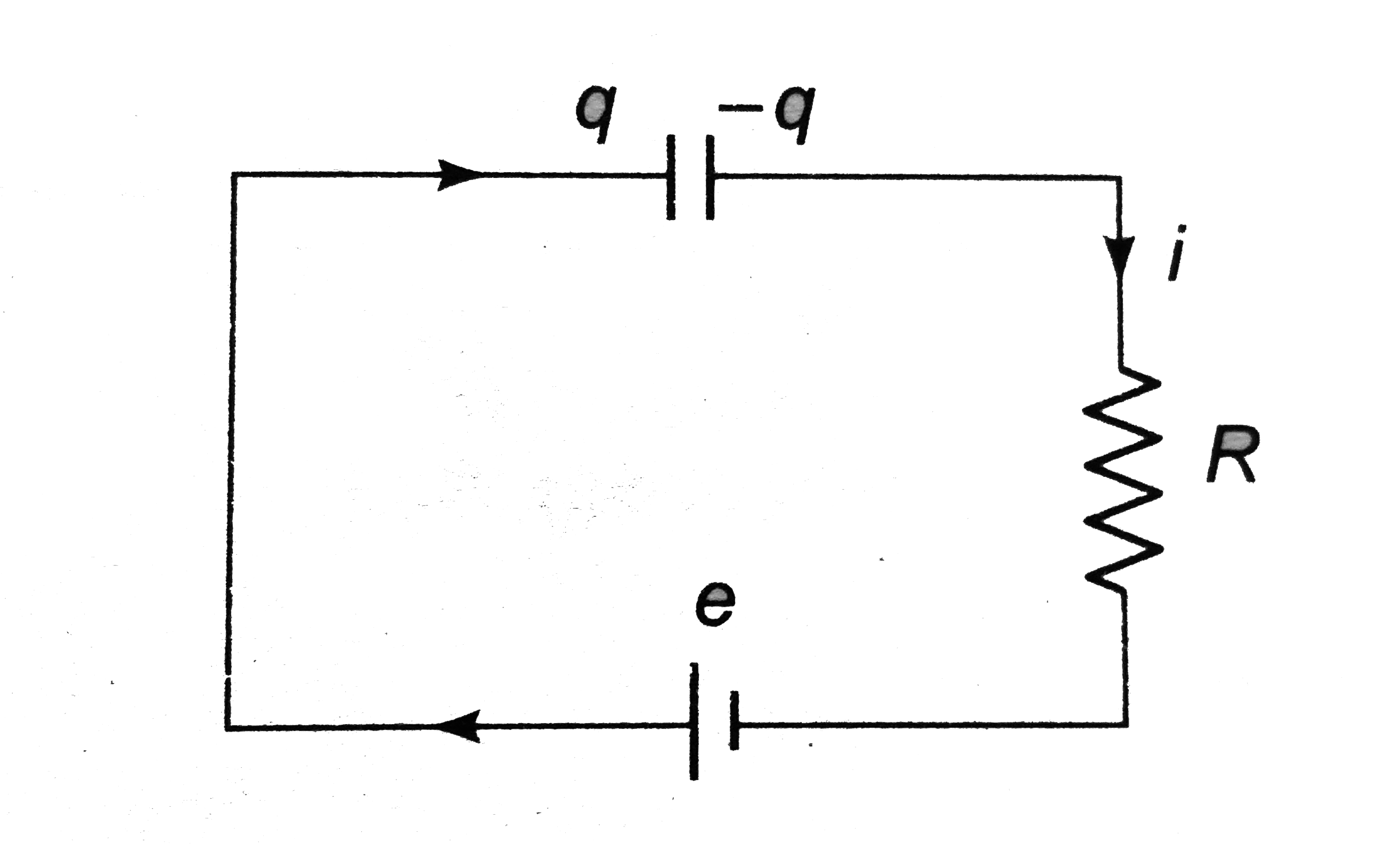 |emf induced in LARGER coil|`= [((DI)/(DT))` in smaller coil] `e = (mu_(0))/(2b) pia^(2) (4t) = (2 mu_(0)pi a^(2)t)/(b)` Applying `KVL`, `+ e - (q)/(C) - iR = 0 rArr (2mu_(0) pia^(2)t)/(b) - (q)/(C) - iR = 0` Differentiating w.r.t. time, we get `(2mu_(0)pia^(2))/(b) - (i)/(C) - (di)/(dt) R = 0 = 0` On SOLVING, `i = (2mu_(0)pia^(2)C)/(b) [1 - e^(-t//RC)]` |
|
| 43. |
What are sky waves? |
| Answer» Solution :When radiowaves from the transmitting antenna PROPAGATE through SKY so as to reach the RECEIVING antenna after reflection in the ionosphere, the WAVE PROPAGATION is called sky wave propagation. | |
| 44. |
(A): The maximum range of coverage by the ground wave propagation is limited up to a few MHz. (R): The attenuation of ground wave increases very rapidly with frequency. |
|
Answer» ASSERTION and REASON are true and reason is the CORRECT EXPLANATION of assertion |
|
| 45. |
A block of ice at temperature -20^@ C is slowly heated and converted to steam at 100^@ C. Which of the following diagram is most appropriate? |
|
Answer»
henceoption(a)is correct . 
|
|
| 46. |
A geostationary satellite is orbiting the earth at a height of 6R above the surface of the earth, where R is the radius of the earth. What is the time period of another satellite orbiting at a height of 2.5 R from the surface of the earth ? |
|
Answer» 6.2 hour `therefore (T_(2))/(T_(1))=((R_(2))/(R_(1)))^(3//2)` where `R_(2)=2.5R+R=3.5R` and `R_(1)=7R` `therefore T_(2)=((3.5R)/(7R))^(3//2)xx T_(2)=((1)/(2))^(3//2)xx 24=8.48` hour |
|
| 47. |
A packet is released from a satellite by simple detaching it from the outer wall of the satellite. What will happen to the packet? |
|
Answer» It will fall on the earth |
|
| 48. |
A block of mass m is at rest under the action of force F against a wall as shown in the figure. Which of the following statements is incorrect? |
|
Answer» f = MG (where f is FRICTIONAL force) |
|
| 49. |
The resistivity of material is expressed in: |
| Answer» Answer :D | |


