Saved Bookmarks
This section includes 7 InterviewSolutions, each offering curated multiple-choice questions to sharpen your Current Affairs knowledge and support exam preparation. Choose a topic below to get started.
| 1. |
A balloon rises with uniform velocity of 10 ms^(-1). When the balloon is at a height of 75 m if a stone is dropped from it the time taken by it to reach the ground is |
| Answer» ANSWER :C | |
| 2. |
Plot a graph showing the variation of undecayed nuclei N versus time t. From the graph, find out how one can determine the half-life and average life of the radioactive nuclei. |
Answer» Solution :A graph showing the variation of undecayed nuclei N versus time FT has been plotted here.  Let at time t=0, the number of nuclei be `N_(0)`. Then time CORRESPONDING to `N = N_(0)/2` will GIVE us the value of half-life period `T_(1/2)` of given radioactive nuclei. Now AVERAGE life of the nuclei `tau=T_(1/2)/0.6931=1.44T_(1/2)` |
|
| 3. |
A vessel of volume V = 6.0 1 contains water together with its saturated vapour under a pressure of 40 atm and at a temperature of 250 ^@ C. The specific volume of the vapour is equal to V'_v = 50 1//kg under these conditions. The total mass of the system water-vapour equals m = 5.0 kg. Find the mass and the volume of the vapour. |
|
Answer» Solution :The specific volume of water (the liquid) will be WRITTEN as `V'_l` since `V'_v GT gt V'_l` most of the weight is due to water. Thus if `m_l` is mass of the liquid and `m_v` that of the VAPOUR then `m = m_l + m_v` `V = m_l V'_l + m_v V'_v` or `V - m V'_l = m_v(V'_v = V'_l)` So `m_v =(V - mV'_l)/(V'_v - V'_1) = 20 gm` in the present case. Its volume is `m_v V'_v = 1.01`. |
|
| 4. |
An electric dipole vec(P) and a point charge q (gt 0) are located at a separation r as shown. Force on the dipole vec((F)) due to the point charge on the qualitatively dinoted as : |
|
Answer»
|
|
| 5. |
Bodies which do not allow the charge to pass through them are called ................ . |
|
Answer» |
|
| 6. |
A coil of N turns and mean area A is rotating with uniform angular velocity omega about an axis ai right angles to a uniform magnetic field B. The induced emfe in the coil will be |
|
Answer» ` N B A SIN omegat` |
|
| 7. |
The correct statement among the following is: |
|
Answer» Ammeter is CONNECTED in series in a circuit because its RESISTANCE is generally high |
|
| 8. |
A 60 muF capacitor is connected to a 110V, 60 Hz ac supply. Determine the rms value of the current in the circuit. |
|
Answer» Solution :`X_(C) = ( 1)/( omega C )` ` = ( 1)/( 2PI f C )` ` = ( 1)/( 2 xx 3.14 xx 60 xx 60 xx 10^(-6))` `= 44.23 Omega` `I_(rms) = ( V_(rms))/( |Z|)` `= (V_(rms))/( X_(C))( :. `Here, `|Z| = X_(C )`) `= (110)/( 44.23)` `= 2.487 A` |
|
| 9. |
Identify correct statement/s from the following: (a) Input transducer converts variations in physical quantiy. (b) The electrical equivalent of the original information is called the baseband signal. (c ) Transducer converts electrical energy into sound energy. (d) Microphone is an example of transducer. |
|
Answer» |
|
| 10. |
A circular arc of wire subtends an angle pi /2 at the centre. If it carries a current i and its radius of curvature is R then the magnetic field at the centre of the arc is |
|
Answer» `(mu_(0)i)/R` |
|
| 11. |
An iron block of sides 50 cm * 8 cm * 15 cm has tobe pushed along the floor. The force required will be minimum when the surface in contact with ground is |
|
Answer» `8 CM xx 15 cm` surface |
|
| 12. |
Questions 57 and 58 are based on following paragraph : Aglass plate 12 xx 10^(-4) mm. Thick is placed in the path of one of the interfering beams in a biprism experiment using wavelength 600 Å 57. The central band shifts a distance equal to width of the band, then refractive index of glass plate is |
|
Answer» `1.5` then `delta = (mu_(g) -1)t.(D)/(d)` Band width =` (LAMBDA.D)/(2d)` `THEREFORE (mu_(g) -1)t.(D)/(d) = (lambdaD)/(d)` `therefore (mu_(g) - 1) = (lambda)/(t) , mu_(g) = (lambda)/(t) + 1 = (lambda + t)/(t)` Then `mu_(g) = 1.5` after calculations. |
|
| 13. |
A unit mass of solid converted to liquid at its melting point. Heat is required for this process is |
|
Answer» SPECIFIC HEAT |
|
| 14. |
A coil has a inductance of 1 henry. If a current changing at the rate of 3A/S. What is the induction? |
| Answer» SOLUTION :`E = L(dI)/DT = 1xx3= 3V` | |
| 15. |
The figure below shows a network of currents is shown here. The current I will be: |
|
Answer» 3A |
|
| 16. |
A positive charge particle of charge q, mass m enters into a uniform magnetic field with velocity v as shown in the figure. There is no magnetic field to the left of PQ.Find distance travelled in the magnetic field |
|
Answer» Solution :The PARTICLE will move in the FIELD as shown. Angle subtended by the arc at the centre = `2theta` DISTANCE travelled by the CHARGE in magnetic field : `=r(2theta)=(MV)/(qB).2theta` 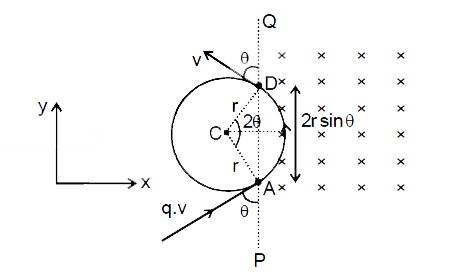
|
|
| 17. |
What is resonant frequency ? |
|
Answer» SOLUTION :The condition is when at PARTICULAR FREQUENCY `f_0`the value of `omega_L` and `1/omega C` are equal. i.e., `omega_0L=1/omega_0C``omega^2_0=1/LC` or, `omega_0=1/sqrt LC` or, `2pif_0=1/sqrtLC` or, `f_0=1/2pi sqrt LC` |
|
| 18. |
A positive charge particle of charge q, mass m enters into a uniform magnetic field with velocity v as shown in the figure. There is no magnetic field to the left of PQ.Find impulse of magnetic force. |
|
Answer» Solution :The particle will MOVE in the field as shown. Angle subtended by the ARC at the centre = `2theta` Impulse = change in momentum of the CHARGE `=(-mvsinthetahati+mvcosthetahatj)` `-(mvsinthetahati+mvcosthetahatj)=-2mvsinthetahati` |
|
| 19. |
The work function of a photoelectric material is 3.3 V. the threshold frequency will be equal to [Given that h=6.6xx10^(-34)Js] |
|
Answer» `8.0xx10^(14)Hz` |
|
| 20. |
Current in the circuit will be : |
|
Answer» `5/40 A` |
|
| 21. |
What is the meaning of disciple? |
|
Answer» A follower |
|
| 22. |
The total force acting on the mass at any time t, for damped oscillator is given as (where symbols have their usual meanings) |
|
Answer» `VECF = -k vecx` |
|
| 23. |
Column-I gives different situtions in which bodes are floating in liquid. Column-II gives correspoding time periods of oscillation. A cube floating in liquid. |
|
Answer» <P>`{:(,P,Q,R,S),((A),3,4,2,1):}` |
|
| 24. |
A cicular disc of radius Ris placed co-axially and horizontally inside an opaque hemi spherical bowl of radius .a. (see figure). The faredge of the disc in just visible when viewed from the edge of the bowl . The bowl is filled with transparent liquid of refractive index mu and the near edge of the disc becomes just visible. How far below the top of the bowl is the disc placed ? |
|
Answer» Solution :CONSIDER situartion before pouring water in an opaque bowl of radius a. Now consider a CIRCULAR disc of radius R and centre C which si placed inside the bowl horizontnally and coaxially with the bowl. Here we have to calculate OC=d . `rArr` Here before filling bowl with water, incident light ray is AMA. . Now when water is paured in the hemispherical bowl completely, the nearer and B of the disc is seen for which inciden ray is `vec (BM)` and refracted ray is `vec(MA)`. Here NN. is perpedicular to water surface, drawn at point M. Hence `anlge (BMN)` = i (angle of incidence) and `angle NMA = alpha` (angle of refraction) `rArr` Now, applying Snell.slaw at point M , `u sin i = (1) sin r` `thereforemu sin i = sin alpha (therefore r = alpha)` `therefore 1/mu = (sin i)/(sin alpha)` ........(1) `[because r = alpha]` Now, from , figure `sin i= (BN.)/(BM)` but `BN.= CN. - CB = OM -CB` and `BM = SQRT(d^2 + (a-R)^2)` `therefore sin i = sqrt(a-R)/(sqrt(d^2 + (a-R)^2))`...... (2) and `sin alpha = cos(90^@ - alpha) = (AN.)/(AM) = (AC + CN.)/(AM)` `thereforesin alpha = (AC +OM)/(AM)` `= (a+R)/(sqrt(d^2(a+R)^2)) ........(3)` `therefore` From equation (1),(2) and (3), `1/mu= (a-R)/(sqrt(d^2 +(a-R)^2)) xx (sqrt(d^2 + (a+R)^2))/(a+R)` `therefore mu(a-R)(sqrt(d^2 + (a+R)^2))=(a+R)(sqrt(d^2+(a-R)^2))` Taking squares on the both sides, `therefore mu^2(a-R)^2 {d^2 + (a+R)^2}=(a+R)^2{d^2 + (a-R)^2}` `therefore {mu^2(a-R)^2d^2} + {mu^2(a-R)^2(a+R)^2} = {d^2(a+R)^2} + {(a+R)^2(a-R)^2}` `therefore(a-R)^2(a+R)^2(mu^2 -1)=d^2{(a+R)^2-mu^2(a-R)^2}` `therefore d^2 = ((mu^2-1){(a-R)(a+R)}^2)/((a+R)^2 - mu^2 (a-R)^2)` `therefore d^2 = ((mu^2-1)(a^2-R^2)^2)/((a+R)^2-mu^2(a-R)^2)` `therefore d=sqrt((mu^2-1)/((a+R)^2-mu^2(a-R)^2))xx (a^2 xxb^2)` `rArr`Above equation gives required result. |
|
| 25. |
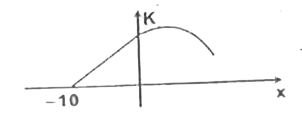
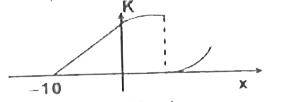
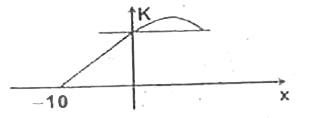
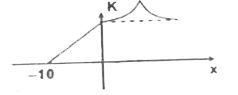
A particle initiallyat rest is displaced from x=-10 m to x=+10m, under a force F as shown in the figure. Now the kinetic energy vs position graph of the particle is |
|
Answer»
|
|
| 26. |
A stone falls down without initial velocity from a height h onto the Earth's surface. The air drag assumed to be negligible, the stone hits the ground with velocity v_0=sqrt(2gh) relative to the Earth. Obtain the same formula in terms of the reference frame "falling" to the Earth with a constant velocity v_0. |
|
Answer» Solution :In a frame moving relative to the EARTH, ONE has to include the kinetic energy of the earth as well as earth's acceleration to be able to apply conservation of energy to the problem. In a reference frame falling to the earth with velocity `v_0`, the stone is INITIALLY going up with velocity `v_0` and so is the earth. The final velocity of the stone is `0=v_0-g t` adn that of the earth is `v_(o)+m/M g t` (M is the mass of earth), from Newton's third law, where t=time of fall. from conservation of energy `1/2mv_0^2+1/2Mv_0^2+mgh=1/2M(v_0+m/Mv_0)^2` Hence `1/2v_0^2(m+m^2/M)=mgh` Neglecting `m/M` in comparison with 1, we get `v_0^2=2gh` or `v_o=sqrt(2gh)` The point is this in earth's rest frame the effect of earth's acceleration is of order `m/M` and can be neglected but in a frame moving with RESPECT to the earth the effect of earth's acceleration MUST be kept because it is of order one(i.e. large).s |
|
| 27. |
(A): At resonance power factor of L-C-R series circuit is unity. (R) : At resonance X_(C) = X_(L) |
|
Answer» Both 'A' and 'R' are TRUE and 'R' is the correct EXPLANATION of 'A'. |
|
| 28. |
A boy sitting on a swing which is moving to an angle of 30^@from the vertical is blowing a whistle which has a frequency of 100 Hz. The whistle is at 2.0 m from the point of support of the swing.A girl stands in front of the swing. The maximum frequency she will hear is nearly 10^x Hz (velocity of sound 330 m/s,g= 9.8 m//s^2). Find x |
|
Answer» |
|
| 29. |
What happens to the intensity of light from a bulb if the distance from the bulb is doubled ? As a laser beam travels across the length of a room, its intensity essentially remains constant. What geometrical characteristic of LASER beam is responsible for the constant intensity which is missing in the case of light from the bulb ? |
|
Answer» Solution :Intensity of waves is inversely proportional to SOURCE of distance from source `(because I prop (1)/(r^(2)))`when distance become double then intensity become `(1^(TH))/(4)` value they do not SPREAD hence here intensity remains same. Following geometric characteristics of LASER beam are responsible for constant intensity, (i) Unidirectional (ii) Monochromatic (III) Coherent light (iv) Highly collimated These characteristics are absent in case of bulb in given case. |
|
| 30. |
The width of the depletion region in. a-p-n junction diode is 400 nm and an intense electric field of 8xx10^5V//m exists in it What is the kinetic energy which a conduction electron must have in order to diffuse from the n region to p region ? |
|
Answer» `0.16eV` |
|
| 31. |
The resistance in the four arms of a Wheatstone network in cyclic order are 5Omega, 2Omega, 6Omega and 15Omega. If a current of 2.8 A enters the junction of 5Omega and 15Omega, then the current through 2Omega resistor is |
|
Answer» 1.5 A  Resistance of the upper arm = `5Omega+2Omega=7Omega` Resistance of the lower arm = `15Omega+6Omega=21Omega` Current through the upper arm `I_(1)=(2.8Axx21Omega)/(7Omega+21Omega)=2.1A` Hence, the current through the `2Omega` resistor is 2.1 A. |
|
| 32. |
The reactance of the coil is 10Omega and its resistance is 10Omega. It is connected to an A.C. source of e.m.f. 220V. The peak value of the current in the circuit is |
| Answer» Answer :C | |
| 33. |
Given the value of Rydberg constant is 10^(7) m^(-1) the wave number of the last line of the Balmer series in hydrogen spectrum will be |
|
Answer» `0.5xx10^(7)m^(-1)` `(1)/(LAMBDA)=R[(1)/(2^(2))-(1)/(OO^(2))]` For final line` n=oo` `(1)/(lambda)=(R)/(4)=(10^(7))/(4)` `:.(1)/(lambda)=0.25xx10^(7)m^(-1)` `:.` Wave number `0.25xx10^(7)m^(-1)` |
|
| 34. |
A ray of light falls on the surface of a spherical glass paper weight making an angle alpha with the normal and is refracted in the medium at an angle B. The angle of deviation of the emergent ray from the direction of the incident ray |
|
Answer» `(ALPHA - BETA)` |
|
| 35. |
In a biprism experiment,fringe width is 0.4 mm when the eypiece is at a distance of 1 mm from theslit. If eyepieceis moved without changing any other arrangment then the change in fringe width is |
|
Answer» `0.1 mm ` THUS, change in FRING width is, `beta_(1)-beta_(2)=0.4-0.3=0.1 mm` |
|
| 36. |
For photoelectronic effect in sodium, the figure shows the plot of cut-off voltage versus frequency of incident radiation. Calculate threshold frequency |
|
Answer» Solution :The threshold FREQUENCY is the frequencyof incident light at which kinetic ENERGY of ejected photoelectron is zero. `:.` From fig. threshold is zero. `v_(0) = 4.5 xx 10^(14) Hz` |
|
| 37. |
The work done in bringing a unit positive charge from infinite distance to a point at distance x from a positive charge Q is W. Then the potential at that point is |
|
Answer» WQ/x |
|
| 38. |
A pendulum clock with a pendulum made of invar (alpha = 0.7 xx 10^(-6) ""^(@) C^(-1)) has period of 0.5 s and is accurate at 25^(@) C .if the clock is used in a country where the temperature average 35^(@) C , what correction is necessary at the end of a month (30 days) to the time given by the clock– |
|
Answer» Solution : In time interval t, the clock will become slow by `Delta t = (1)/(2) alpha t Delta THETA` `= (1)/(2) XX 7 xx 10^(-7) xx 30 xx 86400 xx (35-25)` `= 9.1 s` |
|
| 39. |
For photoelectronic effect in sodium, the figure shows the plot of cut-off voltage versus frequency of incident radiation. Calculate work function for sodium. |
|
Answer» SOLUTION :WORK function, `W = hv_(0)` `= 6.6 xxx 10^(-34) xx 4.5 xx 10^(14) `JOULE `= ( 6.6 xx 10^(-34) xx 4.5 xx 10^(14))/( 1.6 xx 10^(-19)) EV` `= 1.85 eV` |
|
| 40. |
The radionuclide ""^(64)Cuhas a half-life of 12.7 h. If a sample contains 5.50 g of initially pure "^(64)Cu at t = 0, how much of it will decay between t = 14.0 h and t= 16.0 h? |
|
Answer» |
|
| 41. |
What does Lencho do when he recieves the letter signed God? |
|
Answer» He does not GET surprised |
|
| 42. |
Arrange the following networks in increasing order of the number of computers that may be present in the network: Internet, LAN, WAN |
| Answer» SOLUTION :LAN, WAN, INTERNET. | |
| 43. |
An electric field given by vecE = ( yhati + x hatj) N//C. The work done in moving a 1Ccharge from vecr_A= (2 hati+ 2hatj)m to vec(r_B) = ( 4 hati+ hatj )m is: |
| Answer» Answer :D | |
| 44. |
In order to determine the internal resistance of a primary cell by means of potentiometer the emf of the battery connected across the ends of the potentiometer wire should be |
|
Answer» equal to the EMF of the primary cell |
|
| 45. |
An EM wave has amplitude of electric field E_0 and amplitude of magneticfield is B_0. The electric field at some instant become 3/4 E_0. What willbe magnetic field at this instant? (Wave is travelling in vacuum). |
|
Answer» Solution :In vaccum `C=E_0/B_0` If ELECTRIC field BECOME`3/4E_0` , MAGNETIC field will be `3/4B_0` |
|
| 46. |
Two loud speakers are being compared . One is perceived to be 32 times louder than the other. The difference in intensity levels between the two , when measured in decibels is |
|
Answer» 60 |
|
| 47. |
A small source of sound moves on a circle of radius r with constant speed V_s. eta is the actual frequencyof the source.For thepositionsof the source indicated in the figure find the frequency as heard by three observers at the points P,O & Q respectively |
|
Answer» <P> Solution :Here, `eta_1=eta{V/(V-V_s cos theta)}`(a) At P `theta=pi//4 "" therefore eta_0=eta{V/(V-(V_s//sqrt2))}` (B)At O `theta=pi//2 "" therefore eta_0=eta ` (c ) At S `theta=(3pi//4) "" thereforeeta_Q=eta {V/(V+(V_s//sqrt2))}` |
|
| 48. |
A wheel having n conducting concentric spokes is rotating about it geometrical axis with an angular velocity omega, in a uniform magnetic field B perpendicular to its plane prove that the induced emf generated between the rim of the wheel and the center is (omegaBR^2)/2, where R is the radius of the wheel. It is given that the rim of the wheel is conducting. |
|
Answer» Solution :Consider a small element dr on any spoke at a DISTANCE r from the center. Linear velocity of this element `v = romega`, emf induced in a small element dr is, `d epsilon = Bvl` `=B(r omega)dr` Total emf induced along the entire LENGTH of any spoke is , `epsilon =int_0^R B omega r dr` `therefore epsilon = B omega int_0^R r dr` `therefore epsilon =Bomega[r^2/2]_0^R` `therefore epsilon =Bomega [R^2/2-0^2/2]` `therefore epsilon =(BomegaR^2)/2` which is PROVED. Now according to right hand screw rule with equation `vecF = -e(vecv xx vecB)` shows that free electrons in a spoke will experience force towards the center of the wheel therefore, the free electrons accumulate at the center of the wheel leaving the rim positively charged. So it act as BATTERY with emf will be `(BomegaR^2)/2`. Here voltage obtained from all spokes are PARALLEL so the resultant emf will be `(BomegaR^2)/2`. |
|
| 49. |
The temperatures of the source and the sink of a heat engine are 127^@C and 27^@C respectively. An inventor claims its efficiency to be 30% then |
|
Answer» it is impossible |
|
| 50. |
What is the value of inductance L for which the current is maximum in a series LCR circuit with C=10 mu F and omega =1000 s^(-1) ? |
|
Answer» 1 mH `therefore` Resonant FREQUENCY `omega = (1)/(sqrt(LC))` `therefore omega^(2)=(1)/(LC)` or, `L=(1)/(omega^(2)C)` Given `omega = 1000 s^(-1)` and `C=10 MU F` `therefore L=(1)/(1000xx1000xx10xx10^(-6))=0.1 H=100 mH`. |
|