

Saved Bookmarks
This section includes 7 InterviewSolutions, each offering curated multiple-choice questions to sharpen your Current Affairs knowledge and support exam preparation. Choose a topic below to get started.
| 1. |
If an electron in any hydrogen atom jumps from an orbit n_(i)=3 to an orbit with level n_f= 2, the frequency of the emitted radiation is : |
|
Answer» `v=(36c)/(5R)` `c=v lambda, 1/lambda=v/c` `v/c=R (1/n_(i)^(2)-1/n_(f)^(2))` `v=cR (1/2^(2)-1/3^(2))=5/(36)cR` |
|
| 2. |
Carbon, silicon and germanium have four valence electrons each . At room temperature which one of the following statements is most appropriate ? |
|
Answer» The number of free electrons for CONDUCTION is SIGNIFICANT only in Si and GE but SMALL in C. |
|
| 3. |
One requires an energy E_nto remove a nucleon from nucleus and an energy E_cto remove an electron from an atom. then |
| Answer» Answer :C | |
| 4. |
Two infinitely long parallel wires 5 cm apart in air carry currents of 2A and 4A respectively. Find the magnitude of the force on each metre of wire if currents are (i) in the same direction. (ii) in opposite direction. |
|
Answer» Solution :`(i) 3.2 xx 10^(-5)N` ATTRACTIVE (II) `3.2 xx 10^(-5)` N repulsive |
|
| 5. |
Into what number of sublevels are the following terms split in a weak magnetic field: (a).^(3)P_(0),(b) .^(2)F_(5//2),(c ) .^(4)D_(1//2) ? |
|
Answer» Solution :(a) The term `3P_(0)` does not split in weak MAGNETIC firld as it has zero total angular momentum. (b) The term `.^(2)F_(5//2)` will split into `2XX(5)/(2)+1=6` sublevels. The shift in each sublevel is GIVEN by `DeltaE= -g mu_(B)M_(Ƶ)B` where `M_(j)= -J(J-1),....,J` and `g` is the Landi factor `g=1+((5xx7)/(4)+(1xx3)/(4)-3xx4)/(2xx(5xx7)/(4))=1+(38-48)/(70)=(6)/(7)` (c ) In this case for the `.^(4)D_(1//2)` term `g=1+((1xx)/(4)+(3xx5)/(4)-2xx3)/(2xx(1xx3)/(4))=1+(3+15-24)/(6)=1-1=0` Thus the energy difference VANISH and the level does not split. |
|
| 6. |
A stationary sound wave has frequency 165 Hz (speed of sound in air = 330 m/s), then distance between two consecutive nodes is : |
|
Answer» 2 m distance between two consecutive nodes = `(lambda)/(2) ` = 1m THUS correct choice is (C). |
|
| 7. |
Two non-ideal identical batteries are connected in parallel. Consider the following statements (i) The equivalent e.m.f. is smaller than either of the two e.m.f.s (ii) The equivalent internal resistance is smaller than either of the two internal resistances |
|
Answer» Both (i) and (II) are CORRECT |
|
| 8. |
The radius of hydrogen atom, in the ground state is of the order of |
|
Answer» `10^(-18)` cm |
|
| 9. |
A person move 30m north, then 30m east, then 30 sqrt 2 m south west. His displacement from the original position is |
|
Answer» Zero |
|
| 10. |
The dimensional formula of dielectric strength is……. |
|
Answer» `M^1L^1T^2Q^-1` `=N/C` `therefore` DIMENSIONAL formula of dielectric strength `=([M^1L^1T^-2])/([Q^1])=[M^1L^1T^-2Q^-1]` |
|
| 11. |
A dipole consisting of +10 nC and -10 nC separated by a distance of 2cm oscillates in an electric field of strength 60,000 Vm^(-1). The frequency of its oscillation is (M.I. about the axis of oscillations is 3 xx 10^(-10)kg m^(2)) |
|
Answer» 20.2 Hz |
|
| 12. |
The binding energy of a hydrogen molecule is 4.75 eV. Energy required to dissociate 0.05% of hydrogen gas at NTP occupying volume 5.6 litres is : |
|
Answer» 20 J NEARLY |
|
| 13. |
Two mutually perpendicular wire carry charge densities lambda_1 and lambda_2. The electric lines of force makes angle alpha with second wire, then lambda_1//lambda_2 is |
|
Answer» `TAN^(2)alpha` `(E_(1))/(E_(2))=((lambda_(1))/(lambda_(2)))((y)/(x))` `(1)/(tanalpha)=((lambda_(1))/(lambda_(2)))tanalpha` or `(lambda_(1))/(lambda_(2))=cot^(2)alpha` 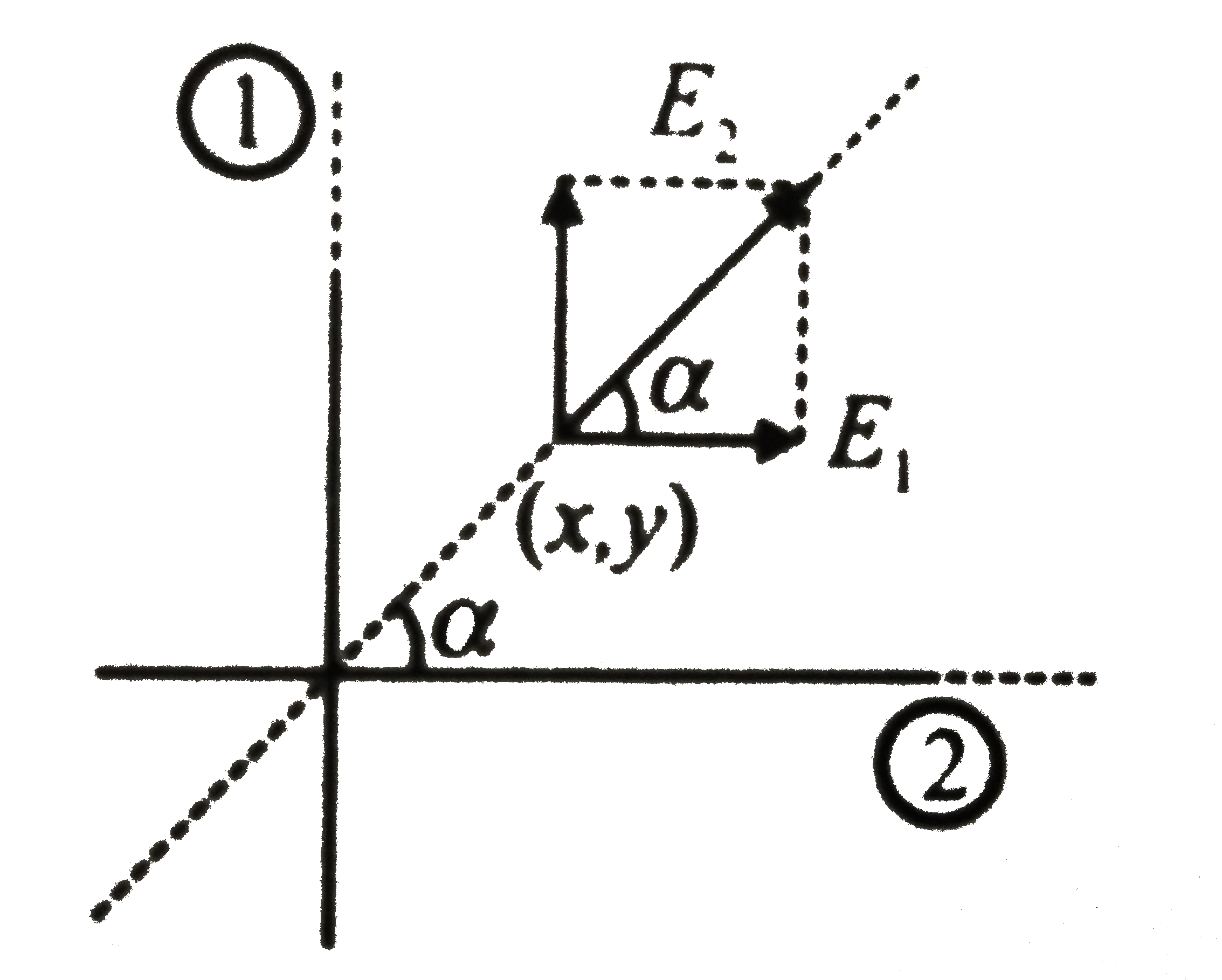
|
|
| 14. |
Two insulated metal spheres of different capacitances charged to different potentials are joined together by a wire so as to share their charges. What happens to the total electrical energy of the system? |
| Answer» Solution :SHARING of CHARGES is always ACCOMPANIED with some LOSS of ELECTRICAL energy. | |
| 15. |
What is the function of soft iron cylinder in a moving coil galvanometer ? |
| Answer» Solution :Since soft iron is good conductor of MAGNETIC flux, most of the magnetic lines of force would tend to pass through it. This INCREASE the STRENGTH of magnetic field in which the COIL rotates. | |
| 16. |
Figure shows initial state of an ideal gas trapped in a container with conducting walls and a piston (mass m) which can move without any friction. The container is placed on point supports and its wall are conducting. Assuming that atmospheric pressure is P_(0) and the mass of the ideal gas is negligible as compared to the mass of the piston and the mass of container. Take the cross section area of piston to be A. The piston is slowly lifted by an external agent and held in its position. Let M be the maximum mass of container so that it may "lift off" while pulling the piston upwards and P_(i) be the pressure of ideal gas in initial state. Pick the correct choice: |
|
Answer» `P_(i)=P_(0)+(MG)/A` `M=(P_(0)A)/G-(PA)/g` `P=(P_(i))/2=(P_(0)+(mg)/A)/2` `impliesM=(P_(0)A)/(2g)-m/2` 
|
|
| 17. |
A body is projected at angle 30^@ to the horizontal with speed 30m/s. What will be the angle the horizontal after 1.5 seconds. |
| Answer» ANSWER :A | |
| 18. |
Assuming the expression for radius of the orbit, derive an expression for total energy of an electron in hydrogen atom. |
|
Answer» Solution :As per Rutherford.s model : `(mv^(2))/(r)=(1)/(4piepsi_(0)).(Ze^(2))/(r^(2))` `impliesmv^(2)=(1)/(4piepsi_(0)).(Ze^(2))/(r)`  TOTAL energy =P.E +K.E. `=-(1)/(4piepsi_(0)).(Ze^(2))/(r)+(1)/(2)mv^(2)=(-1)/(4piepsi_(0)).(Ze^(2))/(r)+(1)/(8piepsi).(Ze^(2))/(r)` `=-(1)/(2).(1)/(4piepsi_(0)).(Ze^(2))/(r)=-(1)/(8piepsi_(0)).(Ze^(2))/(r)` Negative sign implies that ELECTRON - NUCLEUS form a BOUND system. |
|
| 19. |
A ray of light is incident on a glass plate at 60^@. The reflected and refracted rays are found to be mutually perpendicular. The refractive index of the glass is : |
|
Answer» 2.25 |
|
| 20. |
The arms of a deflection magnetometer in thetan Bposittion are placed |
|
Answer» east-west |
|
| 21. |
What is a light emitting diode? Write an advantage of using it over conventional low power lamps. |
| Answer» Solution :Light EMITTING diode : It is a heavily doped P-n junction which under forward BIAS emits spontaneous radiation. (p-n junction diode which emits light when forward) Advantages : (i) Low operational voltage and less power. (ii) Fast action and no warm- up time REQUIRED. (iii) The bandwidth of emitted light is 100 Å to 500 Åor in other WORDS it is nearly (but not exactly) monochromatic. (iv) LONG life and ruggedness. (v) Fast on-off switching capability | |
| 22. |
The acceleration due to gravity is directly proportional to velocity of the planet.Is it true? |
|
Answer» |
|
| 23. |
A circular coil of 5 turns and of 10 cm mean diameter is connected to a voltage source. If the resistance of the coil is 10Omega , the voltage of the source so as to nullify the horizontal component of the earth's magnetic field at 30 A turn m^(-1) at the center of the coil should be |
|
Answer» 6V, plane of the coil NORMAL to MAGNETIC meridian Field at centre, `B=(mu_(0)NI)/(2a) = (mu_(0)N)/(2a) xx V/R` `THEREFORE V= (2aRB)/(mu_(0)N)` `=2 xx (5 xx 10^(-2)) xx 10 xx (30 xx 4pi xx 10^(-7))/((4pi xx 10^(-7)) xx 5)` = 6 volt. To NULLIFY the horizontal component of magnetic field of the earth, plane of the coil should be normal to magnetic meridian. |
|
| 24. |
In an electron microscope, the electrons are accelerated by a voltage of 14 kV. If the voltage is changed to 224 kV, then the de Broglie wavelength associated with the electrons would…………… |
|
Answer» increase by 2 time de-Broglie wavelength of ELECTRON, `LAMBDA = (12.3)/(sqrt(14000)) Å = 0.104 Å` At voltage, V = 224 kV `lambda. = (12.3)/(sqrt(224000))Å = 0.026 Å` `(lambda)/(lambda.) = (0.104)/(0.0260) = 4 rArr lambda = 4 lambda.` `lambda. = (lambda)/(4)` |
|
| 25. |
Who's oceans are black with oil? |
|
Answer» Earth |
|
| 26. |
In an L-R circuit connected to a battery of constant emf E, switch is closed at time t =0. If en denotes the induced emf across the inductor and i the current in the circuit at any time t. Then the graph shows the correct variation of .e. with .i. is |
|
Answer»
|
|
| 27. |
The optical properties of a medium are governed by the relative permitivity (epsi_(r)) and relative permeability (mu_(r)). The refractive index is defined as sqrt(mu_(r)epsi_(r))=n. For ordinary material epsi_(r)gt0 and mu_(r)gt0and the positive sign is taken for the square root. In 1964, a Russian scientist V. Veselago postulated the existence of material with epsi_(r)lt0andmu_(r)lt0. Since then such 'metamaterials' have been produced in the laboratories and their optical properties studied. For such materials n=-sqrt(mu_(r)epsi_(r)). As light enters a medium of such refractive index the phases travel away from the direction of propagation. (i) According to the description above show that if rays of light enter such a medium from air (refractive index = 1) at an angle theta in 2^(nd) quadrant, then the refracted beam is in the 3^(rd) quadrant. (ii) Prove that Snell's law holds for such a medium. |
|
Answer» Solution :(i) Let us first understand about equivalent optical path length of a given transparent medium. According to definition, refractive index of a given denser transparent medium is, `n=(c)/(v)impliesc=nv"".......(1)` If time taken by light ray to travel l distance in above medium is t then, `v=(l)/(t)impliest=(l)/(v)` Now, the distance that can be travelled by light ray in air or in VACUUM in above time is called an equivalent optical path length of a given denser transparent medium. If it is shown by symbol `l_(0)` then since velocity of light ray in air or vacuum is c, we can write, `c=(l_(0))/(t)=(l_(0))/(((l)/(v)))=(vl_(0))/(l)` `:.(c)/(v)=(l_(0))/(l)` `:.(c)/(v)=(l_(0))/(l)` `:.l_(0)=nl""......(2)` Above equation is used in the solution present question.  As shown in figure 1, suppose plane wavefront of light (AB) is made incident on the surface MN at time t = 0.Now if prediction made in the statement is correct then at time t, the refracted wavefront ED will be as shown in figure 1 which indicates that when angle of incidence `theta_(i)` is in second quadrant, angle of REFRACTION `theta_(r)` should be obtained in third quadrant. Here ED is a wavefront. Hence at all the points on it, we should have equal phases of OSCILLATIONS of light vectors. For this to happen, when light rays emanating from A and B reach respectively at points E and D, their optical path lengths must be obtained same. If these lengths are respectively `r_(1)` and `r_(2)` then using equation (2). `r_(1)=r_(2)` `:.` Optical path length equivalent to `vecAE=BC+` optical PATHLENGTH equivalent to `vecCD` `:.n (AE)=BC+n(CD)` `:.-sqrt(in_(r)mu_(r))(AE)=BC-sqrt(in_(r)mu_(r))(CD)` `:.BC=sqrt(in_(r)mu_(r))(CD-AE)""......(3)` Since measure of `vecBC` is positive in the figure from above equation it is proved that `CDgtAE`. But this will happen only when if `theta_(i)` is in second quadrant, `theta_(r)`should be in third quadrant. From this fact, prediction regarding existence of metamaterial is proved to be correct. (Because if here lower medium would have been ordinary denser transparent medium INSTEAD of metameterial then we should obtain `CDltAE` as shown in figure 2 but in the present case of metamaterial, we obtain `CDgtAE`, which indicates that there must be existence of metamaterial with `nlt0`, (ii) Proof of Snell.s law, From equation (3), `BC=-n(CD-FD)` `("":.n=-sqrt(in_(r)mu_(r))andAE=FD)` `:.BC=-n(CF)""......(4)` In right angled `DeltaABC`, `sintheta_(i)=(BC)/(AC)` `:.BC=AC(sintheta_(i))""......(5)` In right angled `DeltaAFC`, `sintheta_(r)=(CF)/(AC)` `:.CF=AC(sintheta_(r))""......(6)` From equations (4), (5), (6), `(AC)(sintheta_(i))=-n(AC)sintheta_(r)` `:.sintheta_(i)=-nsintheta_(r)` `:.n_(1)sintheta_(i)=-n_(2)sintheta_(r)` ( `:.` Here `n_(1)=1andn_(2)=n` ) Above equation indicates generalised form of Snell.s law. |
|
| 28. |
यदि y=t^(4/3) -3t^(-2/3) to dy/dt= |
|
Answer» `(2t^2 +3) /3T^(5/3)` |
|
| 29. |
Chromosomes are made up of |
|
Answer» DNA |
|
| 30. |
What was grandmother's routine in the city? |
|
Answer» She USED to SPIN her wheel |
|
| 31. |
Two balls A & B of mass m_(1) and m_(2) are kept on a horizontal smooth surface. A is given a velocity towards B so that they perform head on collision |
|
Answer» If `m_(1)=m_(2)` and collision is ELASTIC. A stops and `B` moves with the velocity of `A` after collision (a) Elastic collision principle (b) Internal force (c) If `m_(1)GT gt gt m_(2)` Direction of velocity of motion does not change `vecv_(1)(1+e)vecv_(c)=evecv_(1)(vecv_(c)~~vecv_(1))` `vecv_(1)=vecv_(c)` |
|
| 32. |
An atom has a nearly continuous mass distribution in a ....... but has a highly non-uniform mass distribution in .. . (Thomson's model/ Rutherford's model.) |
| Answer» SOLUTION :Thomson.s MODEL, Rutherford.s model | |
| 33. |
Does the apparent depth of a tank of water changes when viewed obliquely. |
| Answer» SOLUTION :YES, if DECREASES | |
| 34. |
Two plates identical in size, one of black and rough surface (B_1) and the other smooth and polished (A_2)are interconnected by a thin horizontal pipe with a mercury pellet at the centre. Two more plates A_1(identical to A_2 ) and B_2(identical to B_1) are heated to the same temperature and placed closed to the plates B_1, and A_2as shown in the diagram. The Mercury pellet |
|
Answer» MOVES to the RIGHT |
|
| 35. |
Two coherent monochromatic light sources are located at two vertices of an equilateral triangle. If the intensity due to each of the source independently is 1 Wm^(-2) at the third vertex. The resultant intensity due to both the source at that point (i.e. at the third vertex) is (in Wm^(2)). |
| Answer» ANSWER :D | |
| 36. |
In a musical scale,the following interval is known as a major tone |
| Answer» Answer :D | |
| 37. |
A spaceship of mass m = 4.50 xx 10^3 kg is in a circular Earth orbit of radiusr = 8.00 xx 10^6m and period T_(0) = 118.6 min=7.119 xx 10^3 s when a thruster is fired in the forward direction to decrease the speed to 96.0% of the original speed.What is the period T of the resulting elliptical orbit ? |
Answer» Solution :(1) An ellipical orbit period is related to the semimajor exis a by Kepler.s THIRD law,written as Eq. 13.36 `(T^2 = 4pi^2r^3//GM)` but withareplacing r.(2) The semima-jor axis is related to the total mechanical energy E of the ship by Eq. 13-44 (E = -GMm/2a), in which Earth.s 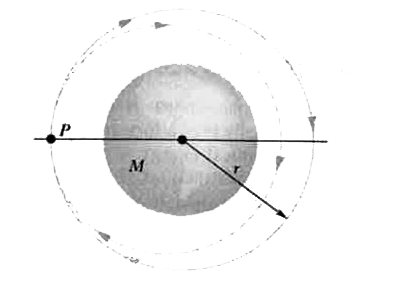 mass is `M = 5.98 xx 10^24 kg`. (3) The potential energy of the ship at radius r from Earth.s center is given by Eq. 13-23 (U = -GMm/r). Calculations : Looking over the Key Ideas, we see that we need to CALCULATED the total energy E to find the semimajor axis a, so that we can then determine the period of the elliptical orbit. Let.s start with the KINETIC energy, calculating it just after the thruster is fired. The speed v just then is 96% of the circumference of the initial circular orbit tot he initial period of the orbit. Thus, just after the thrusteris fired, the kineticenergy is `K = 1/2mv^2 = 1/2 m(0.96v_0)^2 = 1/2 m (0.96)^2 ((2pir)/(T_0))^2` `=1/2 (4.50 xx 10^3 kg) (0.96)^1 ((2pi(8.00xx10^6m))/(7.119xx10^3s))^2` `=1.0338 xx 10^11J`. Just after the thruster is fired,the ship is still at orbital radius r, and thus its gravitational protential energy is `U = -(GMm)/(r)` `=-((6.67xx10^(-11)N.m^2//kg^2)(5.98xx10^24kg)(4.50xx10^3kg))/(8.00xx10^6m)` `=-2.2436 xx 10^11 J`. We can now find the semimojar axis by REARRANGING Eq. 13.44, substituting a for , and then substitutingin our energy results: `a = -(GMm)/(2E) = -(GMm)/(2(K+U))` `=-((6.67xx10^(-11)N.m^2//kg^2)(5.98xx10^24kg)(4.50xx10^3kg))/(2(1.0338xx10^11J-2.2436xx10^11J))` `= 7.418 xx 10^6m`. Now, one more step to go. We substitute a for r in Eq. 13.36 and then solve for the period T,substituting our result for a: `T = ((4pi^2a^3)/(GM))^(1//2)` `=((4pi^2(7.418xx10^6m)^3)/((6.67xx10^(-11)N.m^2//kg^2)(5.98xx10^24kg)))^(1//2)` `=6.356xx10^3 s = 106 min`. This is the period of the elliptical orbit that the ship takes after the thrusteris fired.It is less than the period `T_0` for the circular orbti for two reasons. (1) The orbital path length is now less. (2) The elliptical path takes the ship closer to Earth everywhere except at the POINT of firing. The resulting decrease in gravitational potential energy increases the kinetic energy and thus also the speed of the ship. |
|
| 38. |
A beam of light consisting of two wavelengths, 650 nm and 520 nm, is used to obtain interference fringes in a Young's double-slit experiment. (a) Find the distance of the third bright fringe on the screen from the central maximum for wavelength 650 nm. (b) What is the least distance from the central maximum where the bright fringes due to both the wavelengths coincide?The distance between the two slits is 0.28mm and the screen is at a distance of 1.4m from the slits |
| Answer» SOLUTION :(a) 1.17 NM (B) 1.56 MM | |
| 39. |
The equation of travelling wave is y = 60 cos (1800 t - 6x) , where y is in microns, t in seconds and x in metres. The ratio of maximum particle velocity to velocity of wave propagation is : |
|
Answer» `3.6` COMPARING it with y = r cos `(omega t - kx)` r = `60 xx 10^(-6) m "" omega= 1800 s^(-1) k = 6 m^(-1) ` v = `(omega)/(K) = (1800)/(6)= 300 MS^(-1)`. now maximum particle velocity `V_(max).= r omega` = 60 `xx 10^(-6) xx 1800 = 108 xx 10^(-3)`. Now`(V_(max))/(v) = (108 xx 10^(-3))/(300) = 36 xx 10^(-5) = 3.6 xx 10^(-4)` correct CHOICE is (d). |
|
| 40. |
Eddy current are produced when. |
|
Answer» a metal is KEPT in varying magnetic FIELD |
|
| 41. |
What is the difference of angular momenta of an electron between two consecutive orbits in hydrogen atom? |
|
Answer» `(h)/(pi)` `l_(n+1)=((n+1)h)/(2pi)` Angular momentum in `n^(th)` orbit `I_(n) = (nh)/(2pi)` `:.` DIFFERENCE of angular momenta between two CONSECUTIVE orbits. `=l_(n+1)-l_(n)=(nh)/(2pi)+(h)/(2pi)-(nh)/(2pi)=(h)/(2pi)` |
|
| 42. |
When a current flows through a conductor, its temperature |
|
Answer» may INCREASE or decrease |
|
| 44. |
The moment of inertia of a solid sphere of mass M and radius R, about an axis through its centre, is (2)/(5)MR^(2). The moment of inertia about an axis tangential to the surface of the sphere will be : |
|
Answer» `(4)/(5)MR^(2)` 
|
|
| 45. |
Two wires X, Y have the same resistivity, but their cross-sectional areas are in the ratio 2:3 and lengths in the ratio 1:2. They are first connected in series and then in parallel to a d.c. source. Find out the ratio of the drift speeds of the electrons in the two wires for the two cases. |
|
Answer» SOLUTION :Here, it is given that `rho_X = rho_Y ` but ` (A_X)/(A_Y) = 2/3 ` and `(l_X)/(l_Y) = 1/2` ` THEREFORE (R_X)/(R_Y) = (rho_X)/(rho_Y) xx (l_X)/(l_Y) xx (A_Y)/(A_X) = 1 xx 1/2 xx 3/2 = 3/4` We know that current `I = nAe v_d` or drift speed `v_d = (I)/(nAe)` (i) When wires X and Y are joined in series to a d.c. source, current I flowing through them is same. MOREOVER, for same material free electron DENSITY n is also same. Hence, ` therefore ( (v_d)_X)/((v_d)_Y) = (A_Y)/(A_X) = 3/2` (ii) When wires X and Y are joined in parallel to a d.c. source, voltage across both wires is same.Hence `v_d = (V)/(RnAe) ` `((v_d)_X)/((v_d)_Y) = (R_Y)/(R_X) . (A_Y)/(A_X) = 4/3 xx 3/2 = 2/1` |
|
| 46. |
For a body travelling with uniform acceleration ration ,its final velocity is v=sqrt(180-7x), where x is the distance travelled by the body.Then the acceleration is |
|
Answer» `-8 m//s^(2)` |
|
| 47. |
A uiform ring of mass M and radius R is placed directly above a uniform sphere of mass 8M and same radius R. The centre of the sphere. The gravitational atraction between the sphere and the ring is |
|
Answer» `(8GM^(2))/(R^(2))` |
|
| 48. |
Let(1+X^(2))^(2)(1+X)^(n)=sum_(k=0)^(n+4)a_(k)X^(k).ifa_(1),a_(2),a_(3)are in arithmetic progression then possible value (s) of n is/are : |
|
Answer» 5 |
|
| 49. |
A train moves from rest with acceleration alpha and in time t_(1) covers a distance x. It then decelerates rest at constant retardation beta for distance y in time t_(2). Then |
|
Answer» `(X)/(y) = (BETA)/(alpha)` `alpha=(nu_(0))/(t_(1)),beta=(nu_(0))/(t_(2)):.(beta)/(alpha)=(t_(1))/(t_(2))` Displacement = area under `nu-t` graph `:. X = (1)/(2) t_(1)xxnu_(0)` and `y=(1)/(2)t_(2)xxnu_(0)` Hence `(x)/(y) = (t_(1))/(t_(2))=(beta)/(alpha)` 
|
|
| 50. |
Show that two waves interfere constructively when the path difference them is an integral multiple of wave length. |
|
Answer» Solution :Let , `Y_1=A_1 SIN (omega t- phi_1) and Y_2 =A_2 sin (omega t-phi_2)` when these WAVES interfere, the resultant DISPLACEMENT will be `Y=Y_1+Y_2` i.e. `Y=A_1 sin (omega t-phi_1)+A_2 sin (omega t-phi_2)`. i.e., `Y=A sin (omega t-phi)` where, `A=sqrt(A_1^2+A_2^2+2A_1 A_2 cos (phi_1-phi_2))` and `phi=tan^(-1){(A_1 sin phi_1+A_2 sin phi_2)/(A_ cos phi_1+A_2 cos phi_2)}` For a constructive interference , `A=A_("MAX")`. This implies that `cos (phi_1-phi_2)=+1,` So that `A=A_1+A_2` i.e. `phi_1-phi_2=0,2 pi, 4pi..........2npi` or `(phi_1-phi_2)=2npi` where `n=0,1,2...........` For a constructive interference, PATH difference `delta=nlambda` |
|


