

Saved Bookmarks
This section includes 7 InterviewSolutions, each offering curated multiple-choice questions to sharpen your Current Affairs knowledge and support exam preparation. Choose a topic below to get started.
| 1. |
आर्सेनिक को सिलिकॉन में मिश्रित करने पर किस प्रकार का अर्द्धचालक प्राप्त होता है? |
|
Answer» n-प्रकार |
|
| 2. |
Which of the following pairs of space and time varying E=[hati E_(x) + hatj E_(y)+hatk E_(z)] and B =[hati B_(x) + hatj B_(y)+hatk B_(z)] would generate a plane electromagnetic wave travelling in the z-direction ? |
|
Answer» `E_(X), B_(Z)` |
|
| 3. |
In spite of the validity of ohm's law, it has some limitations.Give one limitation of ohm's law. |
| Answer» SOLUTION :REFER TEXT | |
| 4. |
Name three basic units of any communication system. |
| Answer» SOLUTION :`(i)` Transmitter `(II)` COMMUNICATION channel `(iii)` Receiver. | |
| 6. |
Consider the circuit shown in the figure. (a) Find the current i flowing through the circuit when the key K_(1)is open and K_(2) is closed.(b) Find the net charge on the capacitor when K_(1) is open & K_(2) is.closed and also when K_(1) & K_(2) both are closed. (c) What is the change in the current'i, when K_(1) is closed |
|
Answer» SOLUTION :`approx2.36amp` `4.8muC` `0.34 AMP` |
|
| 8. |
Interference phenomenon appears in ...... |
|
Answer» only TRANSVERSE WAVES |
|
| 9. |
A wire loop is rotated in a magnetic field. The frequency of change of direction of the induced e.m.f is |
|
Answer» Once PER revolution |
|
| 10. |
Consider a sphere of radius R withcharge density distributed as rho (R) = kr for r le R, rho (R) = 0for r gt R. (a) Find the electric field at all points r. (b) suppose the total charge on the sphereis 2e, where e is theelectron charge. Where can twoprotons be embedded such thatthe force on each of them is zero. Assume that the introduction of the proton does not alter the negativecharge distribution. |
Answer» Solution :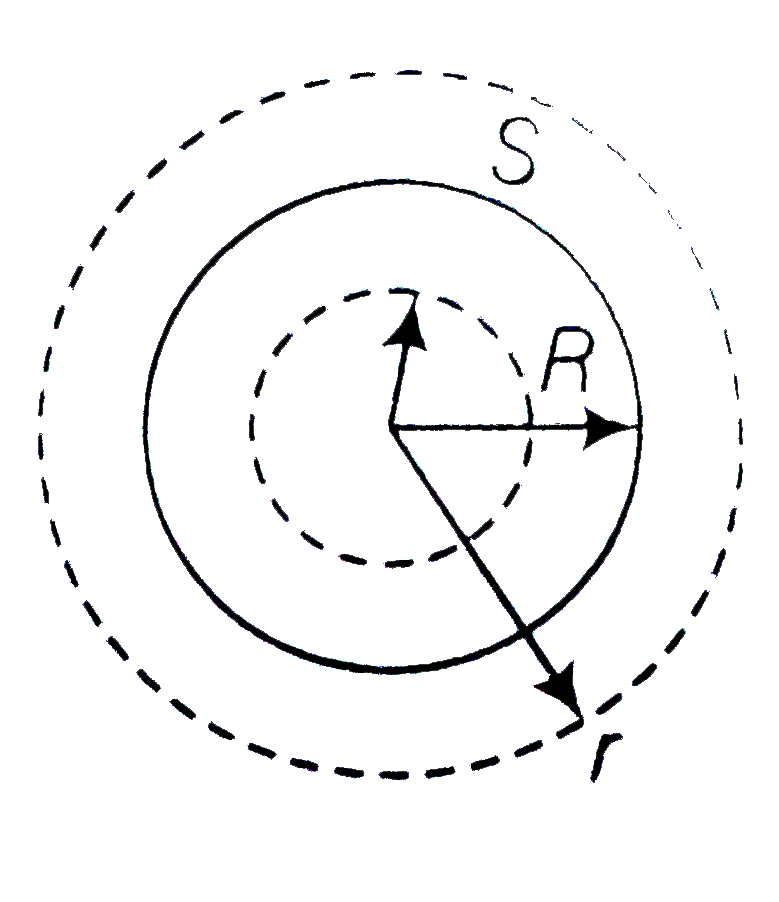 (a) Let us consider a SPHERE S of radius R and two hypothetic sphere of radius `r lt R and r gt R` Now, for point rltR, electric field intenstiy will be given by: `ointE.dS=(1)/(epsi_(0))intrhodV` [For dV, `V=(4)/(3)pir^(3)impliesdV=3xx(4)/(3)pir^(3)dr=4pir^(2)dr`] `impliesointE.dS=(1)/epsi_(0))4piKint_(0)^(r)r^(3)dr`(`becausep(r)=Kr`) `implies(E)4pir^(2)=(4piK)/(epsi_(0))(r^(4))/(4)` `impliesE=(1)/(epsi_(0))Kr^(2)` here, charge density of POSITIVE. So, direction of E is radially outwards. For points `r gtR`, electric field intenstiy will be given by `ointE.dS=(1)/(epsi_(0))intrho.dV` `impliesE(4pir^(2))=(4piK)/(epsi_(0))int_(0)^(R)r^(3)dr=(4piK)/(epsi_(0))(R^(4))/(4)` `impliesE=(K)/(4epsi_(0))(R^(4))/(r^(2))` Charge density is again positive. So, the directio of E is radially OUTWARD. (b). The two protons must be on the opposite sides of the centre along a diameter folloiwng the rule of symmetry. this can be shown by the figure given below. cahrge on the sphere. 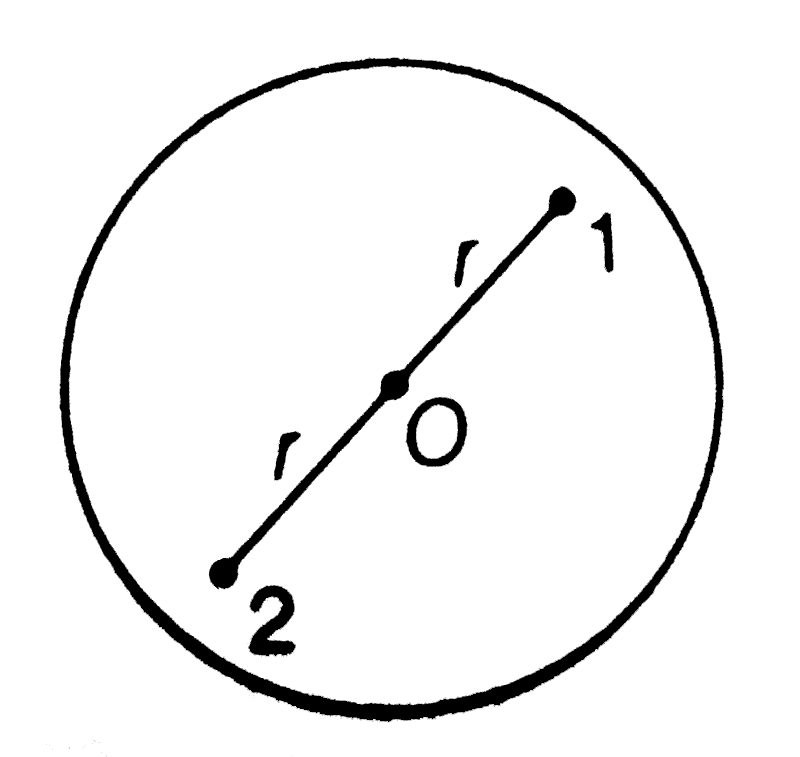 `q=int_(0)^(R)rhodV=int_(0)^(R)(Kr)4pir^(2)dr` `q=4piK(R^(4))/(4)=2e` `thereforeK=(2e)/(piR^(4))` If protons 1 and 2 are embedded at distance r from the centre of the sphere as shown, the attractive FORCE on proton 1 due to charge distribution is `F_(1)=EE=(-eKr^(2))/(4epsi_(0))` Repulsive force on proton 1 due to proton 2 is `F_(2)=(e^(2))/(4piepsi_(0)(2r)^(2))` ltBrgt Net force on proton 1, `F=F_(1)+F_(2)` `=F=(-eKr^(2))/(4epsi_(0))+(e^(2))/(16piepsi_(0)r^(2))` so, `F=[(-er^(2))/(4epsi_(0))(Ze)/(4piR^(4))+(e^(2))/(16piepsi_(0)r^(4))]` Thus, net force on proton 1 will be zero, when `(er^(2)2e)/(4epsi_(0)piR^(4))=(e^(2))/(16piepsi_(0)r)` `impliesr^(4)=(R^(4))/(8)` `impliesr=(R)/((8)^(1//4))` ltBrgt This is the distance of each of the two protons from the centre of the sphere. |
|
| 11. |
A particle of mass 10 kg is driven by a machine that delivers a constant power of 20 watts. If particle starts from rest and moves along a straight line, then force (in Newton) on particle at time t(t>0) is |
|
Answer» `10sqrtt` |
|
| 12. |
यदि A={x : x=3n+1,2len |
|
Answer» 15 |
|
| 13. |
A tuning fork of known frequency 256 Hz makes 5 beats per second with the vibrating string of a piano . The beat frequency decreases to 2 beats/s when the tension in the piano string is slightly increased. The frequency of the piano string before increasing the tension was : |
|
Answer» (256 + 2) Hz `v_(2) = 261` or 251 Hz. when tension in string increases i.e., `V_(2)` increases then beat frequency DECREASES`therefore v_(2)= 251` Hz. So CORRECT choice is (b) . |
|
| 14. |
A bullet weighing 50 gm leaves the gun with a velocity of 30 m/s.If the recoil speed imparted to the gun is 1 m/s , the mass of the gun is |
|
Answer» 15 kg |
|
| 15. |
A wave represented by the equationy=a cos(kx - wt)is superposed with another wave to form a stationary wave such that piont x= 0 is a node. The equaion for the other wave is |
|
Answer» `a sin (kx + OMEGAT)` |
|
| 16. |
Two container A and B are partly filled with water and closed. The volume of A is twice that of B and it contains half the amount of water in B. If both are at same temperature, the water vapour in the container will have pressure in the ratio of |
|
Answer» `1:2` |
|
| 17. |
The equation of motion of a bodyare givensuch thathorizontal displacementx = 3tmeterand vertical displacement , y = 4t- 5t^(2)meter, where "t" is in seconds. Findthe angleof projection, velcoity of projectionandhorizontal range? |
| Answer» SOLUTION :`53^(@),5MS^(-1),2.4m` | |
| 18. |
A particle of mass 2 kg released from point A(2, 0, 0) m as shown in the figure. The rate of change of angular momentum of the particle about the origin at time t = 2 s will be (Origin is taken somewhere above the ground in space at sufficient height and g = -10 hat j m/s^2 ) |
|
Answer» `(+40 hat k)N-m` |
|
| 19. |
A metallic square loop ABCD of size 15 cm and resistance 1.0Omega is moved at a uniform velocity of v m/s in a uniform magnetic field of 2 T, the field lines being normal to the plane of paper. The loop is connected to an electrical network of resistors, each of resistance 2Omega. Calculate the speed of the loop, for which 2 mA current flows in the loop. |
|
Answer» Solution :The network of resistors shown in Fig. 6.48 is equivalent to 3 resistors of `2 + 2 = 4Omega,2Omega and 2 + 2 = 4 omega` respectively joined in parallel. Hence, their combined RESISTANCE `R_(1)` is given by `1/R_(1) = 1/4+1/4+1/2=1/1 impliesR_(1) = 1 Omega` As resistance of loop `R_(2) = 1Omega`, hence total resistance `R = R_(1) + R_(2) = 1 + 1 = 2 Omega`. As length of side AB of loop l = 15 cm = 0.15 m and B = 2 T and direction of motion v is perpendicular to B as WELL as I, hence induced EMF `varepsilon = B l v` and induced current `implies v = (IR)/(Bl) = (2m Axx2Omega)/(2Txx0.15m)=(2 xx10^(-3)xx2)/(2xx0.15)m//sor 0.0133cm s^(-1)`. |
|
| 20. |
In Fig. 29-41 four long straight wires are perpendicular to the page, and their cross sections form a square of edge length a=13.5 cm. Each wire carries 7.50 A, and the currents are out of the page in wires 1,3, and 4 and into the page in wire 2. In unit - vector notation, what is the net magnetic force per meter of wire length on wire 4 ? |
|
Answer» |
|
| 21. |
At an airport, a person is made to walk through the doorway of a metal detector, for security reasons. If she/he is carrying anything made of metal, the metal detector emits a sound. On what principle does this detector work ? |
| Answer» Solution :The METAL detector works on the principle of resonance in ac circuits. When you walk through a metal detector, you are, in fact, walking through a coil of many turns. The coil is connected to a CAPACITOR tuned so that the circuit is in resonance. When you walk through with metal in your pocket, the impedance of the circuit CHANGES – resulting in significant CHANGE in current in the circuit. This change in current is detected and the electronic circuitry causes a SOUND to be emitted as an alarm. | |
| 22. |
A free electron is placed in the path of plane electromagnetic wave. The electron will start moving: |
|
Answer» ALONG the DIRECTION of PROPAGATION of the wave |
|
| 23. |
The true statements regarding refractive index of amterial are : (a) it depends on the natureof the material (B)it increases with temperature (C )it decreases with increase in wavelength (D )it is inversely proportional to velocity of light in the medium |
| Answer» Answer :A | |
| 24. |
In Fig. 29-41 four long straight wires are perpendicular to the page, and their cross sections form a square of edge length a=8.50 cm. Each wire carries 15.0 A, and all the currents are out of the page. In unit - vector notation, what is the net magnetic force per meter of wire length on wire 1 ? |
|
Answer» |
|
| 25. |
A thin convex lens of focal length 5 cm is used as a simple microscope by a person with normal near point. What is the magnifying power of the microscope? |
| Answer» SOLUTION :`m=1+D/f=1+ 25/5=6` | |
| 26. |
de Broglie wavelength lamda associated with neutrons is related with absolute temperature T is : |
|
Answer» `LAMDA PROP T` |
|
| 27. |
The percentage error in measuring resistance with a metre bridge can be minimized by adjusting the balancing point close to |
|
Answer» a. 0 CM |
|
| 28. |
The resultant of the three vectors vec(OA), vec(OB) and vec(OC)shown in figure is |
|
Answer» r Resultant = `r +sqrt(2r) = r (1+sqrt(2))` |
|
| 29. |
The speed of projection of a projectile is increased by 10% without changing the angle of projection. The percentage increase in the range will be ? |
| Answer» Answer :B | |
| 30. |
An aeroplane with wingspan 50 m is flying horizontally with a speed of 360kmh^(-1) over a place where the vertical component of the earth's magnetic field is 2xx10^(-4)Wbm^(-2). The potential difference between the tips of the wings would be : |
|
Answer» 0.1 V |
|
| 31. |
The half-life of radium is about 1600 years. Of 100g of radium existing now, 25g will remain unchanged after |
|
Answer» 2400 years |
|
| 32. |
If Two charges +q and +4p are separated by a distance .d. and a point Q is charge placed on the line joining the above two charges and in between them such that ali charges are in equilibrium. Then the charge Q and it.s position are |
|
Answer» `-(4q)/(9) "at a distance"(d)/(3)"from4q"` |
|
| 33. |
Refractive index of a medium depends |
|
Answer» on the medium only |
|
| 34. |
The smallest and largest units of length are |
|
Answer» MILLIMETER Centimeter |
|
| 35. |
Photoelectric current does not depend on energy of the radiation, but on its intensity . Explain. |
| Answer» Solution :According to Elinstein, a single incident photon can eject only a single electron PROVIDED that if it has sufficient ENERGY. As the INTENSITY of the incident radiation increases, the number of incident photons and HENCE the number of ejected electrons increases. As a result photoelectric current increases. On the other hand above threshold frequency, the energy of hte incident radiation has no EFFECT on the number of photoelectrons ejected. | |
| 36. |
The capacitance of a capacitor is 4muF and its potential is 100 V. The energy released on discharging it fully will be |
|
Answer» 0.02 J `u = 1/2 CV^2 = 1/2 (4 MUF) xx (100 V)^2 = 1/2xx 4 xx 10^(-6) xx 100 xx 100 xx 2 xx 10^(-2) J = 0.02J` |
|
| 37. |
A roller-coaster car enters the circular-loop part of the ride. At the very top of the circle (where the people in the car are upside down), the speed of the car is v and the acceleration points straight down. If the radius of the loop is r and the total mass of the car (plus passenger) is m, find the magnitude of the normal force exerted by the track on the car at this point. |
Answer» Solution :There are TWO forces acting on the car at its HIGHEST point: the normal force exerted by the track and the gravitational force, both of which point DOWNWARD.  The combination of these two forces, `F_(N)+F_(w)`, provides the centripetal force, so `F_(N)+F_(w)=(mv^(2))/(r)IMPLIES F_(N)=(mv^(2))/(r)-F_(w)`. |
|
| 38. |
An object of mass 40 kgand having velocity 4 ms^(-1)collides with another object of mass 60 kg. havingvelocity 2m s^(-1)The lossof kinetic energy when the collision is perfectlyineleastic is |
|
Answer» SOLUTION :Here, ` m_(1) = 40 kg , u_(1) = 4 m s^(-1)` `m_(2) = 60 kg , u_(2) =m s^(-1)` Accordingto law of conservation of linear momentum,we get ` (m_(1) + m_(2))v = m_(1)u_(1) + m_(2)u_(2)` ` v = ( m_(1)u_(1)+m_(1)u_(2))/( m_(1)+m_(2)) = (40 xx 4 + 60 xx 2)/(40 + 60 )= 2.8 m s^(-1) ` Loss in KE = ` 1/2m_(1)u_(1)^(2) + 1/2 m_(2)u_(2)^(2) - 1/2 (m_(1) + m_(2))v^(2)` `1/2 [40 xx 16 + 60 xx 4 - 100 xx 2.8^(2)] = 48 J ` |
|
| 39. |
A glass plate of thickness d and refractiv index n is placed on the path of one of the twi coming out of two slits in Young's experiment The minimum thickness of plate for havin zero intensity of central bright fringe should be ........lambdais the wavelength of light |
|
Answer» `(n-1)(lambda)/(2)` For dark fringe of `m^(th)` number, Path MINIMUM thickness of plate m=1 `:. (n-1)d=(2m-1)(lambda)/(2)` For minimum thickness of plane m=1 `:. (n-1)d=(lambda)/(2)` `:. d=(lambda)/(2(n-1))` |
|
| 40. |
Electric current is sent through a resistance of 20 Omega from a battery of emf 2V and of negligible internal resistance .During measurements of current with the help of an ammeter , 20% error is incurred.What is the resistance of the ammeter? |
|
Answer» |
|
| 41. |
Write SI unit of electric dipole moment. |
|
Answer» <P>`Cm^(-1)` |
|
| 42. |
How does the de-Broglie wavelength of a charged particle changes when the acceleratingpotential increases ? |
| Answer» SOLUTION :The de-Broglie wave length DECREASES when accelerating POTENTIAL INCREASES . i.e., `lambda alpha 1/v`. | |
| 43. |
If a.b.c source of 7V is connected across AB, how much charge is drawn from the source and what is the energy stored in the network ? |
|
Answer» SOLUTION :If the voltage across AB be V = 7 V, then net charge drawn from the voltage source `Q = CV = (6/7 muF) xx (7 V) = 6 muC` and the energy stored in the network `U = 1/2 QV = 1/2 xx(6 muC) xx (7 V) = 21 muJ` |
|
| 44. |
Mathematically, how we represent velocity of electromagnetic waves ? |
| Answer» SOLUTION :1/(sqrtmu_0epsilon_0) | |
| 45. |
In one observation, the column in a mercury barometer (as is shown in Fig. ) has a measured height h of 740.35 mm. The temperature is -5.0^(@) C, at which temperature the density of mercury rho is 1.3608 xx 10^(4) kg//m^(3) . The free-fall acceleration g at the site of the barometer is 9.7828 m/s^(2). What is the atmospheric pressure at thal site in pascals and in torr (which is the common unit for barometer readings)? |
| Answer» SOLUTION :739.21 TORR | |
| 46. |
An important milestone in the evolution of the universe just after the big bang is the Planck time t^(p), the value of which deponds on three fundamental constants-speed c of light in vacuum, gravitational constant G and Planck's constant h. Then, t_(p)prop |
|
Answer» `GHC^(5)` `M^(0)L^(0)T^(1)prop[L^(1)T^(-1)]^(x)[M^(-1)L^(3)T^(-2)]^(y)xx[ML^(2)T^(-1)]^(z)propM^(-y+z)xxL^(x+3y+2z)XXT^(-x-2y-z)` `:.-y+z=0|x+3y+2z=0|` and `-x-2y-z=1` or `{:(y=3),("or"),(z=(1)/(2)):}|{:(x+5y=0),(x=-5y),(x=-(5)/(2)):}|{:(-x-3y=1),(5y-3y=1),(y=(1)/(2)):}` `:.t_(p)alphaG^((1)/(2))h^((1)/(2))c((-5)/(2))=[(Gh)/(c^(5))]^((1)/(2))` Hence `T^(2)=4pi^(2).(L)/(g)` or `g=(4pi^(2)L)/(T^(2))`. |
|
| 47. |
(A) : A charged particle can be accelerated in a cyclotron by the oscillatory electric field. (R) : Energy of charged particle is increased by the electric field applied. |
|
Answer» Both 'A' and 'R' are TRUE and 'R' is the correct EXPLANATION of 'A'. |
|
| 48. |
किसी गतिमान कण के लिए |विस्थापन| का दूरी से अनुपात होता है |
|
Answer» सदैव 1 से कम |
|
| 49. |
Diffractio of light is |
|
Answer» the bending of light at the surface of separation when is travels FROMRARER medium to denser medium |
|
| 50. |
Explain the band theory of solids. |
|
Answer» Solution :In the case of CONDUCTORS, CB and VB overlap with each other. Free ELECTRONS are the charge carriers. There are a number of electrons available to conduct electricity at room temperature. In the the case of insulators, there is a wide gap between CB and VB. Forbidden gap energy is greater than 5 eV. There are no electrons in the CB to conduct electricity. In the case of semiconductors. Forbidden gap energy is LESS than 5 eV. There are EQUAL number of holes and electrons in a pure semiconductor. However these charge are too low so as to conduct electricity at room temperature. 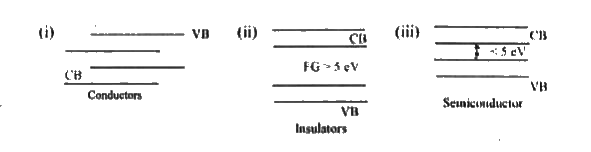
|
|