Saved Bookmarks
This section includes 7 InterviewSolutions, each offering curated multiple-choice questions to sharpen your Current Affairs knowledge and support exam preparation. Choose a topic below to get started.
| 1. |
A thin equiconvex lens madeof glass of refractive index 3//2 and of focal length 0.3m in air is sealed into an opening at one end of a tank filled with water (mu=(3)/(2)). On the opposite side of the lens, a mirror is placed inside the tank on the tank wall perpendicular to the lens axis as shown in Figure. The separation between the lens and mirror is 0.8m.A small objectis placed outside the tank infront of the lens at a distance oa 0.9m from the lens along its axis. Find the position (relative to lens) of the image of the object formed by the system. |
|
Answer» SOLUTION :If R is radius of curvature of each lens surface, then for air on either side of lens, we have `1/(f)=(._amu_(g)-1)((1)/(R_(1))-(1)/(R_(2)))=((3)/(2)-1)((1)/(R)+(1)/(R))` `rArr (1) /(f)=(1)/(R)rArr f=RrArrR=F=0.3m` If `mu_(2)` is refractive index of lens material and `mu_(1),mu_(2)` are refractive indices on either side of the lens, then the formula is `(mu_(3))/(v)-(mu_(1))/(mu)= (mu_(2)-mu_(1))/(R_(1))+(mu_(3)-mu_(2))/(R_(2))` Here `R_(1)=0.3m, R_(2)=-0.3m, mu_(1)=mu_(air)=1` , ` mu_(2)=mu_("glass")=(3)/(2), mu_(3)=mu_("WATER")=(4)/(3), u=-9m, v=?` `:. (4//3)/(v) -(1)/((-0.9))=(((3)/(2)-1))/(0.3)+(((4)/(3)-(3)/(2)))/(-0.3)` or `(4)/(3v)+(1)/(0.9)=(1)/(0.6)+(1)/(1.8)` or `(4)/(3v)=(1)/(0.6)+(1)/(1.8)=(1)/(0.9)=(1)/(0.9)` or `v=(0.9xx4)/(3) =1.2m` That is image`I_(1)` is at a DISTANCE 1.2m from lens L to the right or at a distance `(1.2-0.8)=0.4m`to the right of mirror M. This image `I_(1)` acts as a virtual source for the plane mirror and forms real image `I_(1)` at a distance 0.4m on to the left of mirror and hence at a distance `(0.8-0.4)=0.4m` to the right of convex lens. This image `I_(2)` acts as an object for the lens. Again, the formula if `(mu_(2)^('))/(v^(''))-(mu_(1)^('))/(mu^(''))=(mu_(2)^(')-mu_(1)^('))/(R_(1))+(mu_(3)^(')-mu_(2)^('))/(R_(2))` But now `mu_(1)^(')=mu_("water")=(4)/(3),mu_(3)^(')=mu _("glass")=(3)/(2), mu_(2)^(')=mu_("air")=1` `R_(1)=-0.3m, R_(2)= +0.3m,u^('')=0.4m,v^('')=?` `:. (1)/(v^(''))-(1)/(0.3)=-(1)/(1.8)-(1)/(0.6)` or `(1)/(v^(''))=(1)/(0.3)-(1)/(1.8)-(1)/(0.6)=(1)/(0.9) rArr v^('')= 0.9m` That is image `I_(3)` is FORMED to the right at a distance 0.9m from the lens and is virtual. That is position of final iamge will be 0.9m to the right of lens. 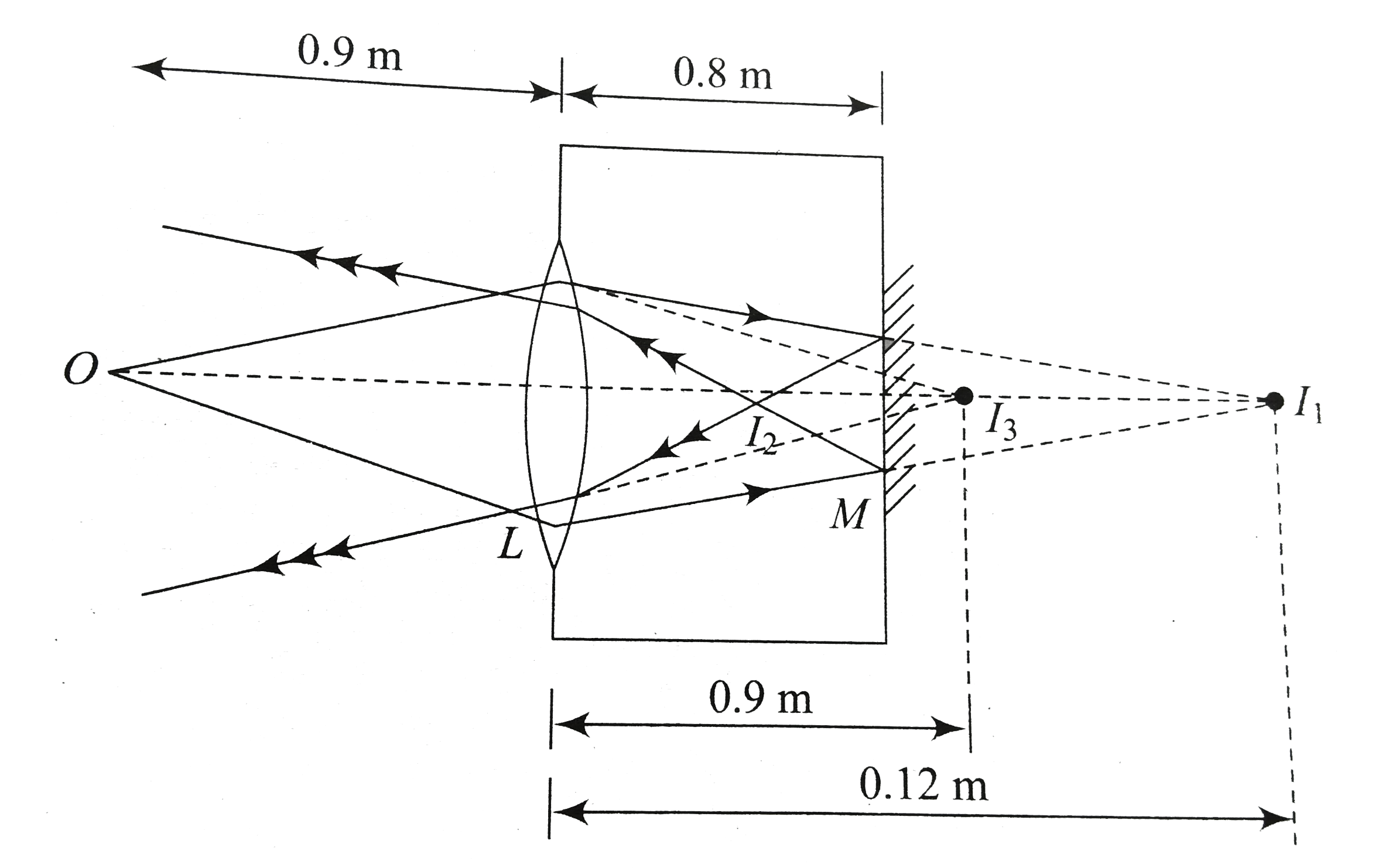
|
|
| 2. |
What is Brewster's angle ? Derive relation between Brewster angle and refractive index of medium which produces Plane Polarised light. |
Answer» Solution :Brewster.s angle (or polarising angle) is the angle of incidence `.i_(p).` at a PLANE surface so that reflected light is completely plane polarised. 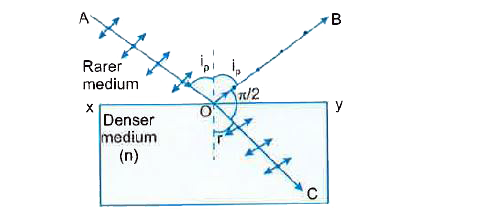 When light is incident at the polarising angle `i_(p)`, the reflected and refracted RAYS make a right angle with each otheri.e., `angle r=angle(90^(@)-i_(p))`. THEREFORE, as per Snell.s law, we have `n=(sini_(p))/(sin r)=(sin i_(p))/(sin (90^(@)-i_(v)))=(sin i_(p))/(cosi_(p))=tani_(p)` |
|
| 3. |
A 500 resistance Galvanometer has 25 divisions on its scale. On sending a current of 4 xx 10^(-4) A in it, the pointer gives a deflection of 1 division. How much resistance should be connected with it so that this galvanometer becomes a. voltmeter of 2.5 volt range? |
|
Answer» `120Omega` |
|
| 4. |
In cartesian coordinate system, the position of a particle is defined by "_____________" coordinates. |
|
Answer» 3 |
|
| 5. |
(A): Every component of a null vector is zero (R) : Origin and terminus of null vector are at the same point. |
|
Answer» Both (A) and (R) are TRUE and (R) is the CORRECT EXPLANATION of (A) |
|
| 7. |
A driver at a depth 12 m inside water (mu = 4//3) see the sky in a cone of semi-vertical angle is |
|
Answer» `sin^(-1)((4)/(3))` |
|
| 8. |
A metallic wire is subjected to a tension of 400 g wt . If its diameter is 0.5 mm , what is the value of stress exerted upon it ? |
|
Answer» a)`2 XX 10^7 N/m^2` |
|
| 9. |
Scientist……..performed experiment related to photo-electric effect. |
|
Answer» Only Hallwach |
|
| 10. |
The coefficient of absorption is the ratio of |
|
Answer» RADIANT ENERGY INCIDENT to the radiatnt energy abosrbed |
|
| 11. |
Find the enrgy of the reaction N^(14)(alpha,p)O^(17) if the kinetic enrgy of the incoming alpha-pariticle is T_(alpha)=40MeV and the proton outgoing at an angle theta=60^(@) to the motion direction of the alpha-particle has a kinetic energy T_(P)= 2.09 MeV. |
|
Answer» Solution :The reaction is `N^(14)(alpha,p)O^(17)` It is given that (in the Lab frmae where `N^(14)` is at rest)`T_(alpha)=4.0MeV` The momentum of incident `alpha` particle is `sqrt(2m_(alpha)T_(alpha))hat(i)=sqrt(2eta_(alpha)m_(0)T_(alpha))hat(i)` The momentum of OUTGOING proton is `sqrt(2m_(p)T_(p)) (COS theta hat(i)+ sin theta hat(j))` `=sqrt(2eta_(p)m_(0))(cos theta hat(i)+sin theta hat(j))` where `eta_(p)=(m_(p))/(m_(0)), eta_(alpha)=(m_(alpha))/(m_(0))` , and `m_(0)` is the mass of `O^(17)`. Teh momentum of `O^(17)` is `(sqrt(2 eta_(alpha)m_(0)T_(alpha))-sqrt(2eta_(p)m_(0)T_(p)cos theta))hat(i)` `-sqrt(2m_(0)eta_(p)T_(p))sin theta hat(j)`  By energy conservation( conservation of enrgy incliding rest mass energy and kinetic energy) `M_(14)c^(2)+M_(alpha)c^(2)+T_(alpha)` `=M_(p)c^(2)+T_(p)+M_(17)c^(2)` `+[(sqrt(eta_(alphaT_(alpha)))-sqrt(eta_(p)T_(p)) cos theta)^(2)+eta_(p)T_(p)sin^(2) theta+eta_(p)T_(p) sin^(2) theta]` Hence by defination of the `Q` of reaction `Q=M_(14)c^(2)+M_(alpha)c^(2)-M_(p)c^(2)-M_(17)c^(2)` `=T_(p)+eta_(alpha)T_(alpha)+eta_(p)T_(p)-2sqrt(eta_(p)eta_(a)T_(alpha)T_(p))xx cos theta-T_(alpha)` `=(1+eta_(p))T_(p)+T_(alpha)(1-eta_(alpha))` `-2sqrt(eta_(p)eta_(alpha)T_(alpha)T_(p))cos theta= -1.19MeV` |
|
| 12. |
Above curle temperature, ferromagnetic substance becomes |
|
Answer» paramagnetic |
|
| 13. |
In Figure (a), two concentric coils, lying in the same plane, carry currents in opposite direction. The current in the larger coil 1 is fixed. Current i_(2) in coil 2 can be varied. Figure (b) gives the net magnetic moment of the two-coil system as a function of i_(2). The vertical axis scale is set by mu_(net),s=2.0xx10^(-5) A.m^(2), and the horizontal axis scale is set by i_(2s)=10.0mA. If the current in coil 2 is then reversed, what is the magnitude of the net magnetic moment of the two-coil system when i_(2)=7.0 mA? |
|
Answer» |
|
| 14. |
U - tube moves with a constant speedparallel to the surface of a stationary liquid. The cross - section area of the lower part of the tube lowered into the liquid, is equal to S_(1) and that of thetop part located over the liquid is S_(2). Friction and formation of waves should be neglect difference in heights at both the openings of the tube. The velocity of the liquid coming out of the top part as seen by an observer on the ground will be |
|
Answer» `V((S_(1))/(S_(2)))` |
|
| 15. |
The resistance of a 10 m long potentiometer wire is 10 Omega. If the current through it is 0.4 A, what are the balancing lenghts when two cells of emfs 1.3 V and 1.1V are connected so as to (i) assist (ii) oppose each other? |
|
Answer» Solution :Data: L=10 m, `r=10 Omega, I=0.4 A, E_(1)=1.3 V, E_(2)=1.1 V` Potential gradient, `k=V/L = (Ir)/L = (0.4 xx 10)/10 xx 0.4 V//m` When the CELLS assist each other, the resultant EMF `=E_(1) + E_(2)`, LET `l_(1)` be the balancing length. `therefore E_(1) + E_(2) = kl_(1)` `therefore l_(1) = (E_(1) + E_(2))/(k) = (1.3 + 1.1)/(0.4) = 2.4/0.4 = 6m` When the cells oppose each other, the resultant emf `=E_(1) -E_(2)`. Let `I_(2)` be the balancing length. `therefore E_(1)-E_(2)=kl_(2)` `therefore I_(2) = (E_(1) +E_(2))/k = (1.3-1.1)/0.4 = 2.4/0.4 = 0.5`m |
|
| 16. |
इनमें से किस प्रकार की भूगर्भीय प्लेटों में गति के कारण भूकंप की क्रिया होती है - |
|
Answer» अभिसारी भूगर्भीय प्लेट |
|
| 17. |
If the directions of electric and magnetic field vectors of a plane electromagnetic wave are along positive y- direction and positive z-direction respectively , then the direction of propagation of the wave is along |
|
Answer» POSITIVE z - direction |
|
| 18. |
A 16cm^(2) coil has 20 turns. Its suspended by a phosphor bronze wire of 10^(-6) Nm per degree as couple per unit twist. When 'i' ampere is passing through it, in a 0.2T field, the wire twisted by 45°. The value of 'i' is? |
| Answer» Answer :A | |
| 19. |
Two charged particles q_1, and q_2 are moving through a uniform magnetic field (B) as shown in figure:What is the shape of path of q_1 and q_2. |
| Answer» SOLUTION :`q_1` charges UNDERGOES helical MOTION and `q_2` MOVES in a circular path. | |
| 21. |
Show that the radiation exerted by an EM wave of intensity I on a surface kept in vacuum is (I)/(c ). |
|
Answer» Solution :Pressure `=("Force")/("Area")=(F)/(A) therefore P=(F)/(A)` Rate of change of momentum is force, `therefore F=(dp)/(dt)` Now `E=mc^(2)` `therefore U=(mc)C "" [because E=U]` `therefore U=Pc "" [because mc = " P momentum"]` By TAKING differentiation both side w.r.t TIME, `(dU)/(dt)=c(dP)/(dt)` `therefore (dU)/(dt)xx(1)/(c )=F "" [because (dP)/(dt)=F]` Now `P=(F)/(A)=(dV)/(dt)xx(1)/(Ac)` `therefore P=(I)/(c )"" [because (dV)/(Adt)=" Intensity I"]` |
|
| 22. |
A uniform rope of mass M length L hangs vertically from the ceiling, with lower end free. A distubance on the rope traelling upwards starting from the lower end has a velocity v. At a point P at distance x from the lower end. |
|
Answer» Tension at point P is mg |
|
| 23. |
For the circuit shown, which of the following statements is true |
|
Answer» `S_(1)` closed, `V_(1) = 15 V, V_(2) = 20 V` |
|
| 24. |
In the situations shown in the figure surfaces are frictionless. Find the maximum extension of the springs if blocks are initially at rest and springs are initially in natural lengths. |
|
Answer» |
|
| 25. |
दूरी के संबंध में कौन सा कथन असत्य है? |
|
Answer» इसका मान ऋणात्मक नहीं हो सकता |
|
| 26. |
When cells are arranged in series |
|
Answer» the current CAPACITY DECREASES |
|
| 27. |
In space a horizontal electric field (E = mg/q) exist as shown in figure and a charged partical of charge .q. and mass m attached at the end of a light l. If mass m is released from the position shown in figure find the angular velocity of the rod when itpases through the bottom most position. |
|
Answer» `sqrt((g)/(L))` |
|
| 28. |
In an intrinsic semiconductor the energy gapE_(g )is1.2 eV. Its hole mobility is much smaller than electron and independent of temperature. What is the ratio between conductivity at 600 K and that at 300 K? Assume that the temperature dependence of intrinsic carrier concentration n_(i)is givenby n_(i) = n_(o) exp (- ( E_(g))/( 2K_(B)T )T) where n_(0) is a constant . |
|
Answer» Solution :Given , INTRINSIC carrier CONCENTRATION `n_(i)=n_(0)e^(-Eg//2k_(B)T)` and Energy gap`E_(g) = 1.2 eV`. `K_(B) = 8.62 xx 10^(-5)eV //K ` For` T=600 k ` `n_(600) =n_(0) e^(-Eg//2k_(B)XX600)` ...(1) For `T=300K` `n_(300) =n_(0) e^(-Eg//2kB xx300)` ...(2) Dividing EQN (1) by Eq(2) we get `(n_(600))/( n_(300))= e^([(E_(g))/(2K.B)((1)/(600) -(1)/( 300))])= e^((E_(g))/(2K.B)((1)/(300)- (1)/(600)))` `= e^((1.2)/( 2 xx8.62 xx10^(-5))((1)/(600)))``( :'e=2.718) =e^(11.6)=(2.718)^(11.6) =1.1 xx 10^(5)` Let the condcutivity are `sigma_(600)` and `SIGMA _(300)` `( :' sigma=enmuc)` `( sigma_(600))/(sigma_(300))= ( n_(600))/( n _(300))=1.1xx 10^(5)` |
|
| 29. |
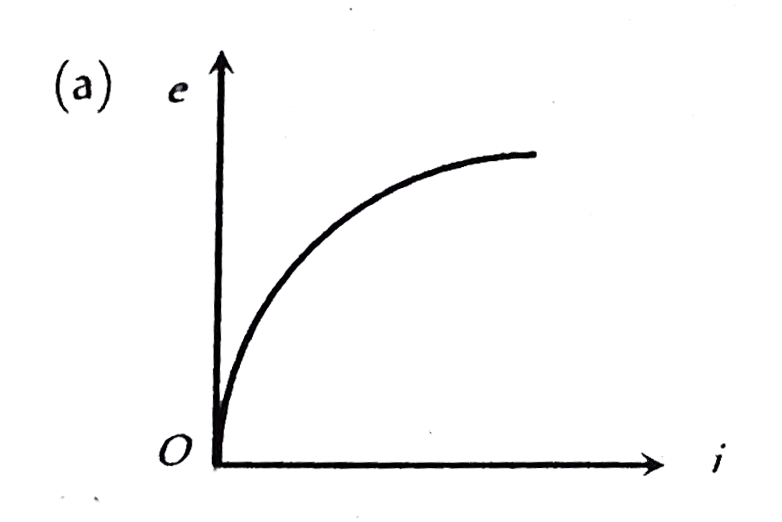
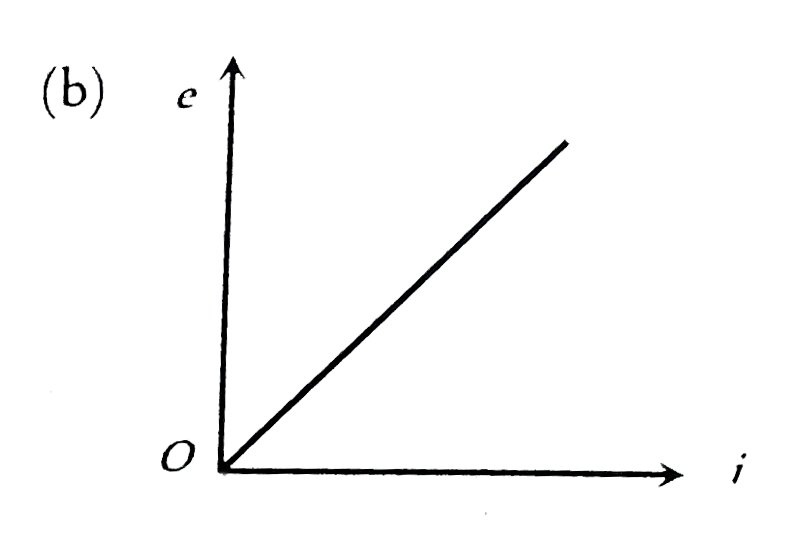
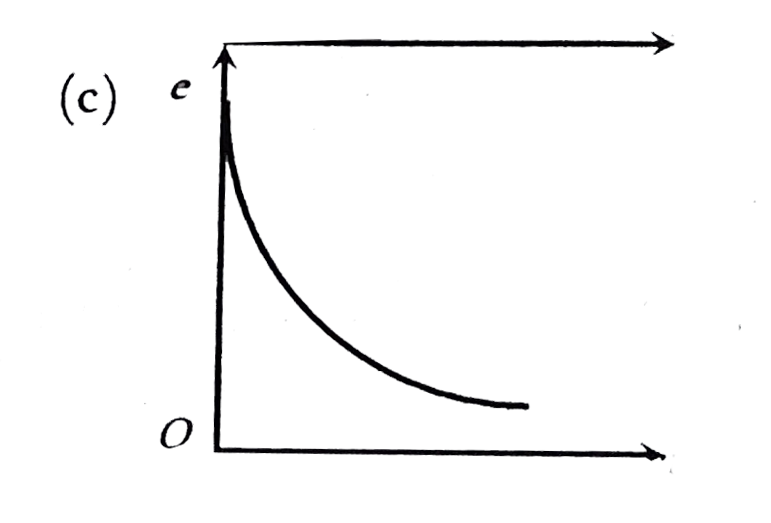
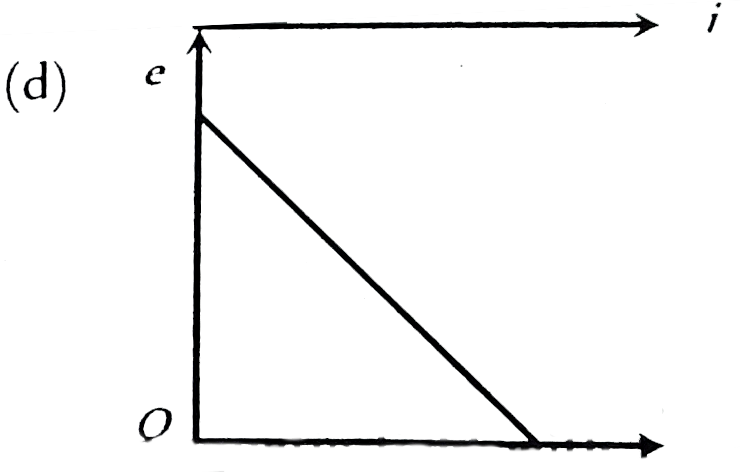
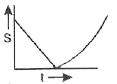
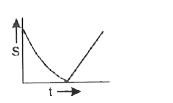
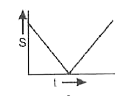
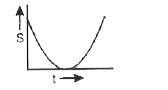
For previous objective, which of the following graphs is correct |
|
Answer»
|
|
| 30. |
If a straight conductor is moved with a uniform velocity at right angle to a uniform magneti field then e.m.f. induced in it is |
|
Answer» `e=-B//v` |
|
| 31. |
(a) In the given'S' is a semiconductor. Would you increase or decrease the value of R to keep the reading of the ammeter A constant when S is heated ? Give reason for your answer. (b) Draw the circuit diagram of a photodiode and explain its working. Draw its 1-V characteristics. |
|
Answer» Solution :(a) When semiconductor S is heated, we shall INCREASE the value of resistance R so as to keep the reading of the ammeter (i.e., the current flowing in the CIRCUIT) constant. On HEATING the TEMPERATURE of semiconductor increases and its resistance decreases. To maintain total resistance of circuit constant we increase R and so ammeter reading may remain UNCHANGED. (b) See Short Answer Question Number 21. 
|
|
| 32. |
Unpolarized light passes through a polarizer and analyser which are at an angle of 45^@with respect to each other. The intensity of polarized light coming from analyser is 5W//m^2. Find the intensity of unpolarized light incident on polarizer. |
| Answer» SOLUTION :`20 w//m^2` | |
| 33. |
A small ideal mirror of mass m = 10 mg is suspended by w weightless theard of length l = 10 cm. Find the angle through which the thread will be deflected when a short laser pulse angles enegry E = 13J is shot in the horizontal direction at right angles to the mirror. Where does the mirror get its kinetic energy? |
|
Answer» Solution :When light falls on a small mirror and is reflected by it, the mirror recoils. The enegry of recoil is obtained from the incident beam photon and the frequency of reflected photons is less than the frequency of the incident photons. This shify of frequency can however be neglected in calculating QUANTITIES related to recoil (to a first approximation.) Thus, the MOMENTUM acquired by the mirror as a result of the laser PULSE is `|oversetrarr(P_(f))-oversetrarr(P_(1))| = (2E)/(c)` Or assuming `oversetrarr(P_(1)) = 0`, we get `|overset rarr(P_(f))| = (2E)/(c)` Hence the kinetic enegry of the mirror is `(p_(f)^(2))/(2m) = (2E^(2))/(mc^(2))` Suppose the mirror is DEFLECTED by an angle `theta`. Then by conservation of energy fi9nal `P.E. = mgl(1-cos theta) =`Initial `K.E. = (2E^(2))/(mc^(2))` or `mgl2 SIN^(2).(theta)/(2) = (2E^(2))/(mc^(2))` or `sin.((theta)/(2)) = ((E)/(mc))(1)/(sqrt(gl))` Using the data. `sin.((theta)/(2)) = (13)/(10^(-5)xx3xx10^(8)sqrt(9.8xx.1)) = 4.377 xx 10^(-3)` This given `theta = 0.502` degreess. |
|
| 34. |
निम्नलिखित मे से कौन सी अपरिमेय संख्या है - |
|
Answer» `SQRT 36/121` |
|
| 35. |
In the circuit in figure emf E_(1) = 14V (internal resistance r_(1) = 1Omega),R_(1) = 6Omega R_(2) = 3.5 Omega, emf E_(2) = 12v (internal resistance r_(2) = 0.5Omega), C_(1) = 4muF and C_(2) = 2muF. The charge on capacitor C_(2) is |
|
Answer» `20muC` |
|
| 36. |
Relative permeability of iron is 5500, then its magnetic susceptibility is ...... |
|
Answer» `55000 xx 10^(7)` `= 5500 -1 = 5499` |
|
| 37. |
A rectangular loop of wire is oriented with the left corner at the origin, one edge along X-axis and the other edge along Y-axis as shown in the figure. A magnetic field is directed into the page and has a magnitude that is given by B = alpha y where alpha is a constant. Find the total magnetic force on the loop if it carries current i. |
| Answer» SOLUTION :`F = ALPHA a^2 i HAT J` | |
| 38. |
How would a blue object appear under sodium lamp light? |
| Answer» Solution :An object LOOKS blue in white light because it absorbs all colours EXCEPT blue. If it is placed in yellow SODIUM light, it will ABSORB yellow light. Hence the object will APPEAR dark. | |
| 39. |
The magnetic field in the cylinderical region shown in figure increases at a constant rate of 10.0mT/s Each side of the square loop abcd and defa has a length of 2.00 cm and resistance of 2.00 Omega. Correctly match the current in the wire 'ad' in four differentsituations as listed in column-I with the values given in column-II |
|
Answer» |
|
| 40. |
Two identically charged spherical objects are suspended from a common point , using two different threads of equal length. Due to repulsion between charges both strings are maintaining a constant angle with the vertical, and both the objects are in equilibrium. Usem as mass , L as length of each thread. The angle made by each thread with the vertical is theta. Calculate the charge on objects. |
Answer» Solution :T is the tension in the strings. Weight , mg, is acting VERTICALLY downwards. Electric force of repulsion between objects is F. DISTANCE between objects can be written as `2L sin theta` . The electric force can be written as : `F=1/(4piepsilon_0)q^2/(2L sin theta)^2` Tension (T) is resolved along horizontal and VERTICAL directions. Objects are in equilibrium along horizontal and vertical directions . So we may write the following equations : `T cos theta =mg`…(i) `T sin theta = 1/(4piepsilon_0)q^2/(2L sin theta)^2` ….(ii) Dividing EQUATION (ii) by (i) , `(sin theta)/(cos theta)=1/(4piepsilon_0)q^2/(mg(2L sin theta)^2)` `rArr q=sqrt((16piepsilon_0mgL^2 sin^3 theta)/(cos theta ))` |
|
| 41. |
The axes of the polarizer and analyser are inclined to each other at 60^@. If the amplitude of polarized light emergent through analyser A. Find the amplitude of unpolarized light incident on polarizer. |
| Answer» SOLUTION :`2sqrt2A` | |
| 42. |
Tritium has a half life of 12.5Y undergoing beta decay. The fraction of a sample of pure tritium will remain undecayed after 25Y |
|
Answer» `1/2` |
|
| 43. |
In a Young's double-slit experiment performed with a source of white light, only black and white fringes are observed. |
| Answer» SOLUTION :False-Central fringe is WHITE and few fringes on EITHER SIDE of it are coloured fringes and then it is UNIFORM illumination. | |
| 44. |
Based on the magnetic property materials are classified into diamagnetic, paramagnetic and ferromagnetic. State the law expalining the variation of magnetic susceptibility with temperature in the case of ferro magnetic material What happens to its magnetic property when the temperature is increased? |
|
Answer» SOLUTION :(i) CURIE law, (ii) When temparature increases, at a particular temparature ferromagnetic BECOMES paramagnetic |
|
| 45. |
Based on the magnetic property materials are classified into diamagnetic, paramagnetic and ferromagnetic. Compare paramagnetic and ferromagnetic ma terials in view of magnetic susceptibility. |
| Answer» Solution :For paramagnetic susceptibility is small and post TIVE but for FERROMAGNETIC its VALUE is POSITIVE and HIGH | |
| 46. |
A voltmeter resistance 500Omega is used to measure the emf of a cell of internal resistance 4Omega. The percentage error in the reading of the voltmeter will be |
|
Answer» Solution :`V=E-ir` `THEREFORE"PERCENTAGE ERROR "=(DeltaE)/(E)xx100=(ir)/(E)xx100` `=((E)/(R+r)r)/(E)xx100=((r)/(R+r))xx100` `=((4)/(500+4))xx100=0.8%` |
|
| 47. |
A coil of wire of certain radius has 600 turns and a self inductance of 108mH. What will be the self inductance of a second similar coil of 500 turns? |
|
Answer» |
|
| 48. |
A ball is thrown vertically upwards. Which of the following plots represents the speed-time graph of the ball during its flight in the air (resistance of air is not ignored)? |
|
Answer»
|
|
| 49. |
Mercury does not wet wood, glass or iron. It indicates that its cohesive force is |
|
Answer» GREATER than its ADHESIVE force |
|