

Saved Bookmarks
This section includes 7 InterviewSolutions, each offering curated multiple-choice questions to sharpen your Current Affairs knowledge and support exam preparation. Choose a topic below to get started.
| 1. |
A circular ring of radius 7cm is supported horizontally from the pan of a balance, so that it comes in contact with the water in a glass vessel. What force will be required to detach it from the surface of water? (Surface tention of water = 0.072N//m.) |
|
Answer» Solution :NEGLECTING the thickness of the ring, the net downward force on the inner and OUTER circumference of the ring due to surface TENSION = `Sxx2pi(R+R)=Sxx4piR`. `S=0.072N//m, R=7cm=7xx10^(-2)m`. The vertical force required to detach it from the water surface is `F=Sxx4piR` `=0.072xx4xx(22)/(7)xx10^(-2)=6.336xx10^(-2)N`. |
|
| 2. |
A solid sphere of uniform density and radius 4 units is located with its centre at the origin of coordinates, O. Two spheres of equal radii of 1 unit, with their centres at A (-2,0,0) and B(2,0,0) respectively, are taken out of the solid sphere, leaving behind spherical cavities as shown in the figure a) The gravitational force due to this object at the origin is zero b) The gravitational force at the point B(2,0,0)is zero c) The gravitational potential is the same at all points of the circle y^(2) + z^(2) = 36 d) The gravitational potential is the same at all points on the circle y^(2) + z^(2) = 4 |
|
Answer» only a & B are TRUE |
|
| 3. |
(A) : A spinning ball in a region of uniform wind motion, will get an uplift (or) downlift. (R ) : Due to spin of the all in a region of uniform wind motion, the difference in velocity of air flow is present between the lower and upper position of ball, leading to varying pressure. |
|
Answer» Both (A) and (R ) are true and (R ) is the CORRECT EXPLANATION of (A) |
|
| 4. |
The frequency of a particle performing SHM is 12 hz,. Its amplitude is 4 cm. Its initial displacement is 2 cm towards positive extreme positon. Its equation for displacement is |
|
Answer» `x=0.04 COS (24pi t +(PI)/6)` |
|
| 5. |
Acceleration of block parallel to plane (if M = 2m, theta = 45, mu = 0.5) |
|
Answer» `(5G)/(9sqrt2)` |
|
| 6. |
(A): The position-time graph of a body moving uniformly is a straight line parallel to position axis. (R): The area under position-time graph in a uniform motion gives the velocity of an object. |
|
Answer» Both (A) and (R) are true and (R) is the correct EXPLANATION of (A) |
|
| 7. |
Given below are densities of some solids and liquids. Give rough estimates of the size of their atoms : [Hint : Assume the atoms to be 'tightly packed' in a solid or liquid phase, and use the known value of Avogadro's number. You should, however, not take the actual numbers you obtain for various atomic sizes too literally. Because of the crudeness of the tight packing approximation, the results only indicate that atomic sizes are in the range of a few Å]. |
| Answer» Solution :CARBON[1.29 Å ], Gold [1.59 Å], LIQUID NITROGEN [1.77 Å ], Lithium [ 1.73 Å ], Liquid FLUORINE[1.88 Å] | |
| 8. |
A wooden cube (density of wood d) of side l floats in a liquid of density rho with its upper and lower surfaces horizontal. If the cube is pushed slightly down and released, and it performs simple harmonic motion of period T, then T is equal |
|
Answer» `2pisqrt((lrho)/((rho-d)G))` |
|
| 9. |
Quartz crystal clocks have an accuracy of 1 sec in every |
|
Answer» `10^(-9)s` |
|
| 10. |
A particle of mass m=1 kg collides with the end with velocity v_(0)=6 ms^(-1) of a spinning rod of mass 2m and length l=1 m at the end of he rod. If the coefficient of restitution of collision e=(2//3),find the a. velocity of the particle b. angular velocity of the rod just after the impact. |
Answer» Solution :If we take rod and particle as system we FIND no EXTERNAL impulse acting on the sytem. Hence, we can use conservation of linear moemntum just before collision just after collision. Let the velocities of particle and rod just after collision is `v_(1)` and `v_(2)` respectively. 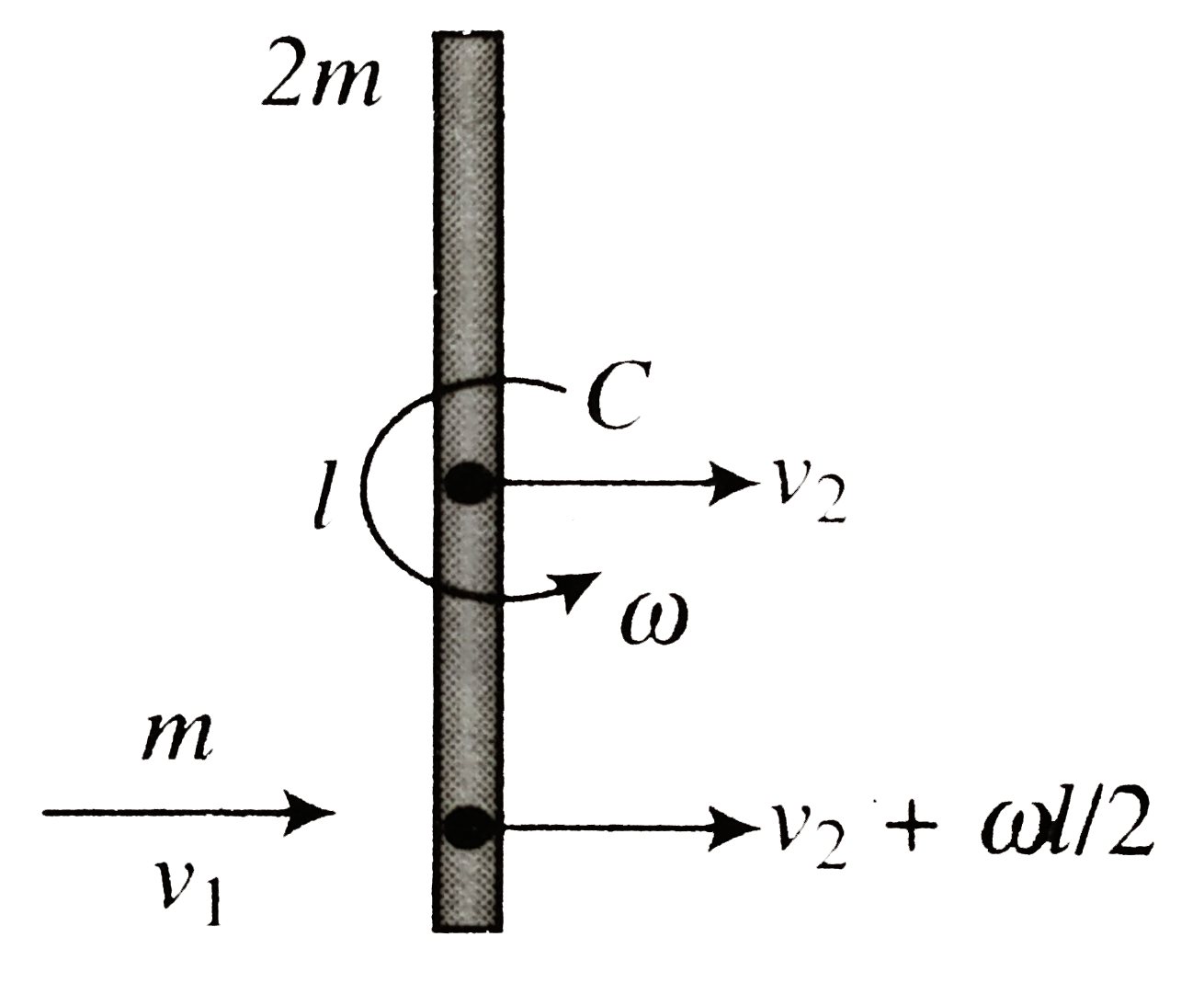 `mv_(1)+2mg_(2)=mv_(0)` `v_(1)+2v_(2)=6`..........i No applying Newton's restitution equation at the point of collision. `e=2/2=((v_(2)+omegal)=v_(1))/(v_(0)-(-omega_(0)l/2))` `2.(6+3)=3v_(2)+(3omega)/2-3v_(1)` `36=6v_(2)3omega-6v_(1)`.........ii Conservation of angular momentum about point of collision `(-2ml^(2))/12 .omega_(0)=(2ml^(2))/12.omega-2mv_(2).l/2` `-omega_(0)l=omegal-6v_(2)impliesomega=6v_(2)-6`..........iii PUT the value of `omega` in ii , `36=6v_(2)+18v_(2)-18-6v_(1)` `v_(1)-4v_(2)=9`.......iv From i and iii `v_(1)=1ms^(-1), v_(2)=2.5ms^(-1)` and `omega=9rads^(-1)` |
|
| 11. |
Deduce Charles's law based on kinetic theory. |
|
Answer» SOLUTION :`PV=2/3U` For a fixed PRESSURE , the volume of the gas is proportional to internal ENERGY of the gas. (or) AVERAGE kinetic energy is DIRECTLY proportional to absolute temperature . It is implied that, `V prop T` (or) `V/T` = Constant |
|
| 12. |
The accuracy in a measurement may depend on several factors like(I) Personal erroes(II) Imperfection in technique/procedure(III) Instrumental errors, Random error(IV) Resolution of measuring instrumentWhich the following is true ? |
|
Answer» Only IV is CORRECT |
|
| 13. |
The displacement time graph of a particle executing SHM is shown in figure. Which of the following statement is/are true? |
|
Answer» The force is zero at `t= (3T)/(4)`  At time `t= (4T)/(4)`, oscillator is at extreme positive point and at that point acceleration is maximum `[a= -omega^(2)|A|]` hence, option B is true. ATTIME `t= (T)/(4)`,oscillator is at mean position and hence its velocity is maximum `[v= -omega sqrt(A^(2)-X^(2))]`, so option C is true. At time `t= (T)/(2)`, oscillator is at extreme negative point and at this point KINETIC energy is zero `[K= (1)/(2) k(A^(2)-x^(2))]` and hence POTENTIAL energy is maximum `[U= (1)/(2)kx^(2)]` so, option D is false. |
|
| 14. |
A 10 kW drilling machine is used to drill a bore in a small aluminium block of mass 8.0 kg. How much is the rise in temperature of the block in 2.5 minutes, assuming 50% of power is used up in heating the machine itself or lost to the Surroundings. Specific heat of aluminium= 0.91 J g^(-1) K^(-1). |
| Answer» SOLUTION :`103 ^(@) C` | |
| 15. |
A uniform rod is suspended horizontally from its mid-point. A piece of metal whose weight is W is suspended at a distance l from the mid-point. Another weight W_(1) is suspended on the other side at a distance l_(1) from the mid-point to bring the rod to a horizonatl postion. When W is completely immersed in water, W_(1) needs to be kept at a distance l_(2) from the mid-point to get the rod into horizontal postion. The specific gravity of the metal piece is |
|
Answer» `W/W_(1)` In equilibrium CONDITION of rod immersed in water, `(W-F_(B))l=W_(1)l_(2)` Where, `F_(B)` = buoyant force on the body of weight `W=W/rho` So, `(W-W/rho)l=W_(1)l_(2)=Wl/l_(1)l_(2)or,1-1/rho=l_(2)/l_(1)` `THEREFORE" "rho=l_(1)/(l_(1)-l_(2))` |
|
| 16. |
125 water droplets, each of radius r, coalesce to form a single drop. The energy released raises the temperature of the drop. If sigmarepresents surface tension,p represents density, S represents specific heat, then the rise in temperature of the drop is - ((eta +7) sigma)/(eta r p S) where etais a dimensionless constant. Find eta . |
|
Answer» |
|
| 17. |
The mercury in a thermometer bulb at 0°C is 200"mm"^3, and the radius of the capillary tube, at thattemperature is 1 xx 10^(-4)m. Assuming uniform expansion of mercury, the spacing between any two consecutive degree will be: |
|
Answer» 0.1 mm |
|
| 18. |
A string is wrapped around a wheel of radius r. The axis of the wheel is horizontal and its M.I. about the axis is I. Weight mg is tied to free end of the string which is released to fall down from rest position. The angular velocity of the wheel afterit has fallen through distance .h. will be |
|
Answer» `((2gh)/(I+mr^(2)))^((1)/(2))` |
|
| 19. |
A rigid body is made of three identical thin rods, each of length 'L' fastended together in the form of the letter 'H'. The body is free to rotate about a horizontal axis that runs along the length of one of the legs of 'H'. The body is allowed to fall from rest from a position in which the plane of 'H' is horizontal. What is the angular speed of the body when the plane of 'H' is vertical ? |
|
Answer» Solution :The MOMENT of inertia of the system about the axis is `I=(4)/(3)ML^(2)`. By conservation of mechanical energy the lose in PE of BODY is equal to the gain in rotational KE. `:.(3)/(2)MGL=(1)/(2)((4)/(3)mL^(2))omega^(2)` on solving `omega=(3)/(2)sqrt((g)/(L))` 
|
|
| 20. |
Why dimensional methods are applicable only up to three quantities? |
| Answer» Solution :Understanding dimensions is of UTMOST IMPORTANCE as it helps us in STUDYING the nature of physical QUANTITIES mathematically. The basic concept of dimensions is that we can add or subtract only those quantities which have same dimensions. Also, two physical quantities are equal if they have same dimensions. these basic ideas help us in deriving the new relation between physical quantities, it is just like UNITS. | |
| 21. |
What do you know about restoring force? |
| Answer» Solution :The INTERMOLECULAR FORCE developed within a body due to RELATIVE molecular displacements is CALLED restoring force. | |
| 22. |
There are atomic (Calcium) clocks capable of measuring time with an accuracy of 1 part in 1011. If two such clocks are operated to precision, then after running for 5000 years, these will record a difference of |
| Answer» ANSWER :B | |
| 23. |
Two cars A and B approach a stationary observer from opposite sides with the speed of 15m/s and 30 m/s respectively.The observer hears nobeats. If the frequency of the horn of the car B is 504 Hz , the frequency of the horn of the car A will be : |
|
Answer» `440.5 HZ` `(V)/(v-v_(s))xxv=(v)/(v-v_(s))xxv` `(v)/(v-15)=(504)/(v-30)` `v=(340-15)/(340-330)xx504` `=529.2 Hz`. |
|
| 24. |
One mole of diatomic ideal gas undergoes a cyclic process ABC as shown in figure. The process BC is adiatomic. The temperature of A, B and C are 400 K, 800 K and 600 K respectively. Choose the correct statement ____ |
|
Answer» The change in internal energy in the process AB is - 350 R. `THEREFORE DeltaU=(1)5/2 R(T_2-T_1)` `=(1)(5/2R)(600-800)` `=-(5R)/2xx200` =-500 R |
|
| 25. |
Show that the projection of uniform circular motion on a diameter is SHM. |
Answer» Solution :considera particle moving along the y circumference of a circle of RADIUS a andcentre O , with uniform speed V, in anticlockwise direction  Let xx' and yy' be the two perpendicular x diameters . Suppose the particle is at p after a TIME t. If `SQUARE` is the angular velocity then the angular displacement `theta` in time t is given by `theta=-square t.` From P draw PN perpendicular to yy'. AS the particles moves from x to y , foot of the perpendicular N moves from 0 to y . As it moves further from y to x', then from x' to y' and back again to x, the point N moves from y to 0 , from 0 to y' and back again to 0 . When the particle CONFERENCE , the point N completes one vibration about the mean position 0 . The motion of the point N along the diameter yy' is simple harmonic. Hence the projection of a uniform circular motion on a diameter of side in simple harmonic motion. |
|
| 26. |
What are transverse waves? Give one exmaple. |
|
Answer» Solution :ln transverse wave motion, the CONSTITUENTS of the medium oscillate or VIBRATE about their mean positions in a direction perpendicular to the direction of PROPAGATION (dil.ection of energy transfer) of WAVES. EXAMPLE : light (electromagnetic waves) |
|
| 27. |
Calculate the solid angle subtended by the periphery of an area of 1 cm^(2) at a point situated symmetrically at a distance of 5 cm from the area. |
|
Answer» SOLUTION :SOLID angle `Omega=("Area")/(("Distane"^(2))` `=(1 cm^(2))/((5 cm)^(2))=(1)/(25)=4xx10^(-2)SR` |
|
| 28. |
A simple pendulum has a time period T_(1) when on the earth.s surface and T_(2) when it taken a height .R. above the earth.s surface, where .R. is the radius of the earth. The value of T_(2)//T_(1) is |
| Answer» ANSWER :D | |
| 30. |
For one closed pipe and one open pipe, frequencies of their first harmonics are same. Find ratio of their lengths. |
|
Answer» `1:2` `F._(a) = (v)/(2L)` `therefore (f _(1))/(f._(1)) = (v)/(4L) xx (2L)/(v) = 1/2` |
|
| 31. |
If the moment of inertia of a body is I and its mass be M the, its radius of gyration would be |
|
Answer» `I/M` |
|
| 32. |
In the following table relation of graph in column-I and shape of graph in column-II is shown match them appropriately. . |
| Answer» SOLUTION :`IMPLIES A-i, B-iii, C-ii` | |
| 33. |
Do waves carry momentum also along with energy ? |
| Answer» Solution :Yes, because of elasticity PROPERTY, INTERATOMIC FORCES TRANSFER momentum to successive particles. | |
| 35. |
Which physical quantityis conserved in elastic as well as inelastic collision ? |
| Answer» SOLUTION :LINEAR momentum is conserved in both TYPE of collision . | |
| 36. |
Can liquid and gaseous substances withstand shearing strain? |
|
Answer» |
|
| 37. |
Angular velocity is obtained by object due to torque. |
|
Answer» |
|
| 38. |
Gases have two principal types of specific heats, but solid and liquids posses onle one. Why? |
| Answer» Solution :Since GASES expand on heating, the CONDITION under which the gas is heated should be taken into consideration. Consequently gases POSSESS two principal SPECIFIC heats, specific heat at constant volume and specific heat at constant pressure. In the case of solids and liquids, expansion is negligble and they have only one specific heat, specific haet at constant volume. | |
| 39. |
To go from town A to town B a plane must fly about 1780 km at an angle of 30^(@) West of North. How far north of A is B ? |
|
Answer» 1542 km |
|
| 40. |
A child of mass m is sitting on a swing suspended by a rope of length L. The swing and the rope have negligible mass and the dimension of child can be neglected. Mother of the child pulls the swing till the rope makes an angle of theta_(0)=1 radian with the vertical. Now the mother pushes the swing alongthe arc of the circle with a forceF=(Mg)/2 andreleases it when the string gets vertical. How high will the swing go?[Take cos(1 radian) ~= 0.5] |
|
Answer» |
|
| 41. |
The time period for U - tube Oscillation is ……….. . |
|
Answer» `T = SQRT((L)/(2G))` |
|
| 42. |
Out of the following functions representing motion of a particle which represents SHM? 1. x=sin^(3)omegat 2. x=1+omegat+omega^(2)t^(2) 3. x=cosomegat+cos3omegat+cos5omegat 4. x=sinomegat+cosomegat |
|
Answer» Only 1 It REPRESENTS a periodic motion with time PERIOD, `T=(2pi)/(OMEGA)` but not SHM. (2). `x=1+omegat+omega^(2)t^(2)` It represents a non-periodic motion. (3) `x=cosomegat+cos3omegat+cos5omegat` It represents a periodic motion with time period `T=(2pi)/(omega)` but not SHM. (4) `x=sinomegat+cosomegat=sqrt(2)[(1)/(sqrt(2))sinomegat+(1)/(sqrt(2))cosomegat]` `=sqrt(2)[sinomegat"cos"(pi)/(4)+"sin"(pi)/(4)cosomegat]` `=sqrt(2)sin(omegat+(pi)/(4))` It represents a SHM with time period `T=(2pi)/(omega)` |
|
| 43. |
Two balls are dropped to the ground from different heights. One ball is dropped 2s after the other, but both strike the ground at the same time 5s after the Ist is dropped. a) What is the difference in the heights from which they were dropped ? b) From what height was the first ball dropped? |
|
Answer» SOLUTION :(a) For the first ball `s=h_(1), u=0, t=5s` `h_(1)=0 XX 5 +1/2 9.8 xx 10^(5)=122.5m` For the second ball `s=h_(2), u=0, t=3s` `h_(2)=1/2 gt^(2)=1/2 xx 9.8 xx 9=4.9 xx 9=44.1m` Difference in HEIGHTS `h=h_(2)-h_(1)=122.5 -44.1=78.4m` (B) The first ball was dropped from a height of `h_(1)=122.5m` |
|
| 44. |
An object is gently placed on a long conveyer belt moving with a speed of 5 ms^(-1) If the coefficient of friction between the object and the belt is 0.5, the block will slide on the belt up to a distance (Take g = 10 m s^(-2)) |
|
Answer» `2.0 m` |
|
| 45. |
(A): Collision between two fundamental particles is elastic (R) : Fundamental particles lose their shape in collision |
|
Answer» Both .A. and .R. are true and .R. is the CORRECT explanation of .A. |
|
| 46. |
If the mass of earth and radius suddenly become 2 times and 1/4 th of the present values the length of the day becomes |
| Answer» ANSWER :D | |
| 47. |
Assume that the a planet radiates heat at a rate proportiona to the fourth power of its surface temperature T and that the planet assumes such a steady temperature that this loss of heat is exactly compensated by the heat gained from the sun. Show that other thing remaining the same, a planet's surface temperature varies inversely as the square root of its distance from the sun. |
|
Answer» |
|
| 48. |
A particle is executing SHM of amplitude A, about the mean position X=0. Which of the following cannot be a possible phase difference between the positions of the particle at X=+ A//2 and X=-A//sqrt(2). |
|
Answer» `75^(@)` |
|
| 49. |
A ring - type flywheel of mass 100 kg and diameter 2m is rotating at the rate of (300//pi) revolutions per minute. Then : |
|
Answer» The MOMENT of INERTIA of the flywheel is `100"kg-m"^(2)` |
|
| 50. |
A space-ship is stationed on Mars. How much energy must be expanded on the spaceship to rocket it out of the solar system ? Mass of the spaceship = 1000 kg, Mass of the sun =2 xx 10^(30) kg. Mass of the Mars = 6.4 xx 10^(23)kg, Radius of Mars = 3395 km. Radius of the orbit of Mars = 2.28 xx 10^(11)m, G = 6.67 xx 10^(-11) Nm^(2) kg^(-2). |
|
Answer» Solution :Let R, be the radius of ORBIT of Mars and R. be the radius of the Mars, M be the mass of the Sun and M. be the mass of Mars. If m is the mass of the space-ship, then Potential energy of space-ship due to gravitational attraction of the sun = -GMM/R Potential energy of space-ship due to gravitational attraction of Mars = -GM.m/R. Since the K.E. of space-ship is ZERO, therefore, total energy of space-ship `= -(GMm)/(R) -(GM.m)/(R.) = -Gm((M)/(R) +(M.)/(R"))` `therefore` Energy required to rocket out the spaceship from the solar system = -(total energy of spaceship) `=-[-Gm((M)/(R)+(M.)/(R.))] = Gm((M)/(R)+(M.)/(R.))` `= 6.67 XX 10^(-11) xx 1000 xx [(2 xx 10^(30))/(2.28 xx 10^(11)) + (6.4 xx 10^(23))/(3395 xx 10^(3))]` `= 6.67 xx 10^(8)[(20)/(2.28) + (6.4)/(33.95)]xx 10^(18) J = 5.98 xx 10^(11)J` |
|