

Saved Bookmarks
This section includes InterviewSolutions, each offering curated multiple-choice questions to sharpen your knowledge and support exam preparation. Choose a topic below to get started.
| 3551. |
Choose any two developments each from Timelines 1 and 2 at the end of the chapter and indicate why these are significant. |
|
Answer» Solution :Development from Timeline-1 1. The evidence of the first Hominids was found about 5.6 mya. The Hominids evolved from HOMINOIDS. They had some common features. Hominids had larger brain than Hominoids. Hominids had an upright posture and bipedal locomotion. There was a marked difference in regard to hand. It helped them in use of tools. 2. Around 2.5 mya, large parts of the earth were covered with snow. There were major changes in the enviroment. Itled to expansion of grassland. Developments from Timeline-2 1. Around 200,00 years ago, the evolution of the voice BOX took place. After the evolution of voice box, now the man was about to speak and express his views. 2. After 27,000 years ago , the earliest evidence of figurines made of fired clay was ALSO found. The invention of sewing machines made the LIFE of people more comfortable. |
|
| 3552. |
Describe the merits and demerits of feudal system. |
|
Answer» Solution :Merits of the feudal SYSTEM: (i) Common people were provided security of life and PROPERTY. (ii) LAW and order was maintained in their territories. Demerits of the feudal system: (i) There were mutual conflicts among feudal LORDS to expand their own states. That is why PEACE and order in the society got disturbed. (ii) The feudal system proved to be an obstacle in the growth of political unity. |
|
| 3553. |
Write about expansion of Mayan civilisation. |
| Answer» Solution :Between 300 and 900 CE, mayan civilisation was at its peak of development. It was STRETCHED in a large part of CENTRAL america. Regions of maxico, gautemala and HONDURAS were included in it. | |
| 3554. |
What was the name of the book composed by Jacob? |
| Answer» SOLUTION :The CIVILISATION of the RENAISSANCE in ITALY. | |
| 3555. |
Between whom the Battle of Camel was fought? |
| Answer» Solution :The Battle of CAMEL was fought in 656 CE, between CALIPHA ALI and Aisha. | |
| 3556. |
How was the economic condition in the early Roman empire? |
| Answer» Solution :The empire had a substantial economic infrastructure of harbours, mines, quarries, brickyards, olive oil factories, ETC. Wheat, wine and olive-oil were traded and consumed in huge QUANTITIES, and they CAME mainly from Spain, the Gallic provinces, North Africa, Egypt and to a lesser extent, Italy where conditions were suitable for these crops. Liquids like wine and olive oil were TRANSPORTED. | |
| 3557. |
Discuss the achievements of the nation-states. |
|
Answer» Solution :The nation-STATES are known for achievements. Some of them were: (i) The rise of nation-states crushed the power of the lords and this made people free from their excesses. (ii) They PAVED way for setting up peace. (iii) They taught the people to give support to their kings. (iv) They infused the spirit of nationalism among the people of different classes. (v) They TOOK remarkable STEPS for the consolidation of the ECONOMY of states. (vi) They contributed a lot in the development of language, literature and architecture. |
|
| 3558. |
How was the institution of Caliphate created? |
| Answer» Solution :Prophet Muhammad attained salvation in 632 CE. After his death, there was no one, who could legitimately claim to be the next Prophet of Islam. No rule was MADE regarding the institution. That.s why after his death ISLAMIC authority was transferred to the Ulema. In this way, the institution of Caliphate was created. | |
| 3559. |
Who established themselves as a political power in South Africa and how? |
| Answer» Solution :The East INDIA Company established themselves as a political power in SOUTH Africa. The company defeated the local leaders and annexed their territories to FIRMLY establish its power. | |
| 3560. |
Who was the President of Chinese Revolutionary League ? |
| Answer» Solution :Dr. SUN Yat-sen was the President of CHINESE Revolutionary LEAGUE. The THREE guiding principles of this league were-nationalism, democracy and SOCIALISM. | |
| 3561. |
What kind of impression do you get about the status of women in business families? |
| Answer» SOLUTION :Women were very SUPPORTIVE. They co-operated their husbands in every bit of business. In families of MERCHANTS and bankers, wives LOOKED after the business when the MALE members were away on work. | |
| 3562. |
Which were the two powerful empires that ruled over most of Europe? |
| Answer» SOLUTION :The TWO POWERFUL EMPIRES that RULED over most of Europe were Rome and Iran. | |
| 3563. |
List the wild animals hunted and consumed as meat by Hadza groups. |
| Answer» Solution :Hadza groups consumed the MEAT of ZEBRA, giraffe, buffalo, shinoceor and waterduck, BABOON, LION, LEOPARD, hare and many more. | |
| 3564. |
Trace the process of evolution of homo habilis's growth. |
| Answer» Solution :The FOSSILS of Homo habilis are dated back to 2.2 mya to 1.8 mya. Their fossils have been FOUND from Omo(ETHIOPIA) and Olduvali Gorge (Tanzania). The size of their brain was bigger and were considered more intelligent than Austalopithecus. They were ABLE to use their hands dexterously. Their MUTUAL understanding during hunting expeditions led to the growth of language. | |
| 3565. |
How many native communities were in Australia in the late 18th century? What was their unique quality? |
| Answer» Solution :There were about 350 to 750 native communities in AUSTRALIA in the LATE 18th century. Each community had its own language. | |
| 3566. |
What were the most favourable conditions for industrialisation? |
|
Answer» Solution :The most favourable conditions for industrialisation were as follows: (i) Natural resources: For the development of any industry, the AVAILABILITY of natural resources is must. It must be in abundance. (ii) Capital: Sufficient capital is also necessary for the development of industries. Without the availability of capital, the development of industries is not possible. (iii) Raw materials: Availability of raw-materials is also needed for the industrialisation. It must be in plenty. The raw materials include cotton, jute, sugarcane, etc. (iv) Sources of energy: There must be sufficient sources of energy like electricity, oil or coal etc. (v) markets: There must be potential markets for the consumers. If there is potential market, more finished GOODS will be consumed. And the economy will grow. (vi) Transportation facilities: There must be efficient transportation facility. Roads, railway lines, SHIPPING facilities etc. play a major role in the development of country. (vii) Cheap labour: For the growth of any industry a number of labourers must be AVAILABLE at resonable price. (viii)Suitable CLIMATE: For the growth of any industry, suitable climate is must. If the climate is not suitable, production will also be affected. Worker.s health will also deteriorate. If their health is ill, there will be shortfall in production. (ix) Govt.s policy: The policy of govt. is also one of the factors in the growth of industry. If the govt is stable, it will have positive results on the industry. The industry will grow at fast pace. |
|
| 3567. |
What do you mean by 'Principate' ? |
| Answer» SOLUTION :The regime established by Augustus, the FIRST Emperor, in 27 BCE was called the ‘PRINCIPATE.. | |
| 3568. |
What were the duties of the serfs? |
|
Answer» Solution :(i) The serfs had to do FORCED labour. (II) The serfs had to SERVE in their lord.s army for 40 DAYS in a YEAR. |
|
| 3569. |
How had Emperor Gallienus ruled? |
| Answer» SOLUTION :The Emperor Gallienus (253-68) consolidated their rise to power by EXCLUDING SENATORS from military command and reorganized the army. | |
| 3570. |
Japan's transformation into a modern society can also be seen in the changes in everyday life. Comment. |
| Answer» Solution :Japan.s transformation into a modern society can also be seen as the changes in everyday LIFE. Patriarchal system was in practice. The patriarchal household system comprised many generations living together under the control of the head of the house. More people became affluent. New ideas of the family spread. The new home (Homu as the Japanese say) was that of the nuclear family, where husband and WIFE lived as breadwinner and homemaker. This new concept of domesticity inturn generater demands for new types of domestic goods, new types of family entertainments, and new forms of housing. In the 1920s, construction companies MADE CHEAP housing available fora down paymentof 200 yen and a mothly installment of 12 yenfor ten years. It wasat that TIME when the salary of a bankemployee (a preson withhighereducation) was 40 yen per month. | |
| 3571. |
Mention a few features of the new constitution of Japan of 1889. |
|
Answer» Solution :A few features of the new constitution of Japan of 1889 are as follows: (a) The emperor occupied an important place in Japan. He was considered to be the REPRESENTATIVE of God. All the MINISTERS were appointed by him and they were accountable to the emperor. (b) The Parliament of Japan was known as Diet. It had limited powers. Military had IMMENSE power. In due course of time, Diet came under the influence of military. (C) Police had enough power. They had the power to control press, to put BAN on publicmeetings and demonstrations. (d) Only 3% people had the right to use their franchise. |
|
| 3572. |
What do you know about early man's tools and weapons made by them? Which techniques were used to make these tools? |
Answer» Solution :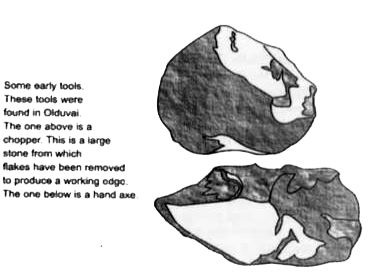 Early man.s tools and weapons were made of stones. Early man used hard stones known as FLINT, along with other types of stones for making tools and weapons. Flint was the STONE that was used for lighting fire. It was also found that these types of stones can be given desired shape. However, the tools early man used were rough and unpolished. We get the earliest evidence for making and use of these stone tools from Ethiopia and Kenya. The Astralopithecus were the first to make use stone tools. The stone tools were made by USING following techniques: (i) Stone on Stone: In this technique, the pbble from which the tool was to be made was held in one hand and the second stone was used to STRIKE off flakes from the first. (ii) Pressure Flaking: In this technique, the core was placed on a firm surface. The hammer stone was used on a place of BONE or stone that was placed on the core to remove flakes that could be shaped into tools. (iii) The Punch Blade Technique: In this technique, the top of a pebble is removed by using hammer stone to produce a flat surface. This flat surface, thus so produced, is called striking platform. This is then struck using a hammer and a punch made of bone. It then leads to the production of blades. It also leads to formation of knives. 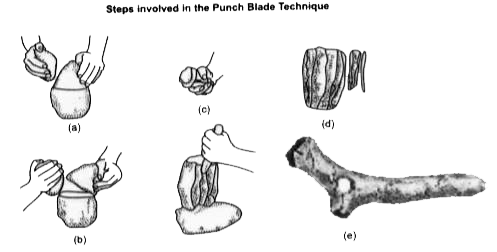
|
|
| 3573. |
Name the two main sects of Muslims. |
|
Answer» Solution :The two main sects of MUSLIMS are : (i) Shias (II) SUNNIS. |
|
| 3574. |
What does the term ‘Republic' refer to in the history of the Roman empire? |
| Answer» Solution :The Republic was the name for a regime in which the power lay with the Senate, a body dominated by a small GROUP of wealthy families who formed the .nobility.. The Republic represented the GOVERNMENT of the nobility, exercised through the body called the Senate. The Republic lasted from 509 BCE to 27 BCE, when it was OVERTHROWN by OCTAVIAN, the adopted son and heir of Julius Caesar. | |
| 3575. |
Write on the following:(i) The Gold Rush (ii) Position of natives in Australia |
|
Answer» Solution :(i) The Gold Rush: It was expected that there was gold in America. Traces of gold were found in the USA, California in the 1840S. It only led to the .Gold Rush.. A lot of European§ went to America in the expectation of making a quick fortune. It also led to the building of railway lines throughout the continent. Thousands of Chinese workers were also RECRUITED. (ii) POSITION of natives in Australia: In the late 18th century, there were about 350-750 native communities. Each community had its own language. Most of the communities resided in the north, i.e. called Torres Strait islanders. Hence, the WORD, .aborigines. is not used to describe them as they migrated from DIFFERENT places and belonged to a different race. |
|
| 3577. |
What was the fiction kept alive about Augustus? |
| Answer» Solution :Augustus was the SOLE RULER and the only REAL source of authority. The fiction was that he was only the .leading CITIZEN. not the absolute ruler. | |
| 3578. |
Which rivers made boundaries of the Roman empire from the north side? |
| Answer» Solution :The BOUNDARIES of the Roman EMPIRE were SURROUNDED by TWO GREAT rivers, the Rhine and the Danube. | |
| 3579. |
Write three points about the life of native peoples of North America. |
|
Answer» Solution :(i) They SPOKE VARIOUS languages. (ii) They believed that time moved in cycles. (III) They could understand the CLIMATES and different landscapes. |
|
| 3580. |
Discuss the social changes that had taken way to the development of monarchy-feudal system. |
|
Answer» Solution :Social CHANGES that had TAKEN way to the development of monarchy-feudal system were: (i) Decreasing rate of ECONOMIC growth had given chance to the MONARCH to consolidate their power. (ii) STRONG infantry equipped with gun and artillery helped the monarch to establish their monarchy. |
|
| 3581. |
How satisfactory is a museum gallery display in explaining the culture of a people?Give examples from your own experience of a museum. |
|
Answer» Solution :A museum gallery displays the culture of a people in the following ways: • In museum, we seek information regarding DIALECTS and languages. • Remains of pots, apparels, ornaments and other things are displayed. • Books, RESEARCH papers, survey reports and works of historians and archaeologists are kept in the gallery of museum. • Icons of the ancient periods, the theology in its basic forms and coins are also found in the museum. In fact, the museum is a storehouse of all the things SYMBOLIZING CULTURES of human beings from prehistoric period to the present. These things DISPLAY cultures of the respective periods. |
|
| 3582. |
"Cortes without any explanation placed the emperor under house arrest and attempted to rule his name." Explain how it happened? |
|
Answer» Solution :(i) Mexico, where he made friends with the Totonacs. It was a group who wanted to secede from Aztecs rule. The aztecs king, montezuma, sent an offical to meet him. He was terrified at the aggressiveness of the spanish, their gunpowder and their horses. montezuma himself was convinced that Cortes was reincarnation of an exiled God who had returned to avenge himself. (ii) The invading Spaniards were dumbstruck at the sight of Tenochtitlan. it was five times larger than Madrid and had about 1 lac inhabitants. it was twice the population of Seville, the largest city of spain. (iii) Cortes was cordially received by Montezuma. the aztecs took the spaniards into the HEART of the city, where the emperor showered them with gifts. his people were apprehensive, having heard of the massacre of the Tlaxcalans. (iv) The fears of the Aztecs proved to be well founded. without any explanation, cortes put the emperor under house arrest and attempted to rule in his name. cortes also installed christian images int he aztec temple. mantezuma suggested a compromise and placed both aztec and christian images in the temple. (v) The high-handedness of the spanish occupation and their incessant demands for gold provoked a general uprising. alvarado ordered a massacre during the aztecs spring festival of Huizilpochtli. when cortes returned on 25 june, 1520, he had on his hands a ful-blown crisis. the spaniards faced acute shortage of food and drinking water. (vi)The Aztecs continued to FIGHT the Spaniards. Around 600 conquistadores and more of their Tlaxcalan allies were killed in what is known as the night of tears cortes was forced to retreat to Tlaxcala to plan his strategy, against the newly elected king, cuatemoc. with just 180 SOLDIERS and 30 horses, cortes moved into they could see OMENS foretelling that their end was near, and because of the emperor chose to give up his life. |
|
| 3583. |
What are the advantages of living in caves? |
|
Answer» Solution :Advantages of living in caves are given below: (i) It HELPED in protecting MEN from severe cold. (ii) It also protected them from the predators. (iii) It also protected them from the danger of WILD animals. |
|
| 3584. |
How did the Europeans justify the displacement of the natives? |
| Answer» Solution :The Europeans justified the displacement of the natives by saying that they (the natives) did know the judicious use of their land. They criticised them by calling them SLUGGISH. They were unaware about their crafts skill to produce goods for the market. Natives were also criticised on the GROUND that they were not interested in learning English and wearing western dress. So they DESERVED to DIE out. Wild bisons were killed on a large scale to clear prairies for FARMLAND. | |
| 3585. |
Write about the importance of Shahnama. |
| Answer» Solution :Shahnama is a great historical POLITICAL work of FIRDAUSI. It is an EPIC of 50,000 couplets and also a masterpiece of Islamic literature. It took nearly 30 years to complete. Ghazni, because the centre of PERSIAN literary LIFE. The rulers of Ghazni also patronised art and learning for enhancing their prestige. Shahnama is a collection of traditions and legends which depicts Iran from creation up until the Arab conquest. According to Ghaznavi tradition, Persian later became the language of administration and culture in India. | |
| 3586. |
Doctor Galen on how Roman Cities Treated the Countryside The famine prevalent for many successive years in many provinces has clearly displayed for men of any understanding the effect of malnutrition in generating illness. The city-dwellers, as it was their custom to collect and store enough grain for the whole of the next year immediately after the harvest, carried off all the wheat, barley, beans and lentils, and left to the peasants various kinds of pulse after taking quite a large proportion of these to the city. After consuming what was left in the course of the winter, the country people had to resort to unhealthy foods in the spring, they ate twigs and shoots of trees and bushes and bulbs and roots of inedible plants.........What did the city dwellers do? |
| Answer» Solution :The city dwellers collected and stored sufficient GRAIN for the whole of the NEXT YEAR. | |
| 3587. |
Doctor Galen on how Roman Cities Treated the Countryside The famine prevalent for many successive years in many provinces has clearly displayed for men of any understanding the effect of malnutrition in generating illness. The city-dwellers, as it was their custom to collect and store enough grain for the whole of the next year immediately after the harvest, carried off all the wheat, barley, beans and lentils, and left to the peasants various kinds of pulse after taking quite a large proportion of these to the city. After consuming what was left in the course of the winter, the country people had to resort to unhealthy foods in the spring, they ate twigs and shoots of trees and bushes and bulbs and roots of inedible plants......... What does the given passage depict ? |
| Answer» Solution :It depicts the ILL EFFECTS of FAMINE which resulted into SHORTAGE of food. | |
| 3588. |
Doctor Galen on how Roman Cities Treated the Countryside The famine prevalent for many successive years in many provinces has clearly displayed for men of any understanding the effect of malnutrition in generating illness. The city-dwellers, as it was their custom to collect and store enough grain for the whole of the next year immediately after the harvest, carried off all the wheat, barley, beans and lentils, and left to the peasants various kinds of pulse after taking quite a large proportion of these to the city. After consuming what was left in the course of the winter, the country people had to resort to unhealthy foods in the spring, they ate twigs and shoots of trees and bushes and bulbs and roots of inedible plants.........How was ancient Roman society divided ? |
|
Answer» Solution :Ancient ROMAN society was divided into three classes. These were: (a) The Patrician (b) The PLEBEIAN (C) The SLAVES |
|
| 3589. |
What was the political system that emerged in nation-states? |
| Answer» Solution : King was the supreme authority. He was considered to be the representative of God on the earth. The king was FREE from the intervention of pope and the feudal lords. The powerful monarchies had strong courts of APPEAL. The courts could challenge and condemn the decisions of the feudal lords. The rich MIDDLE classes financed, SUPPORTED and strengthened the king. | |
| 3590. |
Read the following passages and answer the questions that follow: We also caused to be painted, by the exquisite hands of many masters from different regions, a splendid variety of new windows... Because these windows are very valuable on account of their wonderful execution and the profuse expenditure of painted glass and sapphire glass, we appointed an official master craftsman for their protection, and also a goldsmith-who would receive their allowances, namely, coins from the altar and flour from the common storehouse of the brethren, and who would never neglect their duty to look after these. Windows were precious. How? |
| Answer» Solution :WINDOWS were precious on account of their wonderful execution and the PROFUSE EXPENDITURE of PAINTED glass and sapphire glass. | |
| 3591. |
Read the following passages and answer the questions that follow: We also caused to be painted, by the exquisite hands of many masters from different regions, a splendid variety of new windows... Because these windows are very valuable on account of their wonderful execution and the profuse expenditure of painted glass and sapphire glass, we appointed an official master craftsman for their protection, and also a goldsmith-who would receive their allowances, namely, coins from the altar and flour from the common storehouse of the brethren, and who would never neglect their duty to look after these. Who would receive their allowances, namely coins? |
| Answer» SOLUTION :A GOLDSMITH WOULD RECEIVE their ALLOWANCES. | |
| 3592. |
Read the following passages and answer the questions that follow: We also caused to be painted, by the exquisite hands of many masters from different regions, a splendid variety of new windows... Because these windows are very valuable on account of their wonderful execution and the profuse expenditure of painted glass and sapphire glass, we appointed an official master craftsman for their protection, and also a goldsmith-who would receive their allowances, namely, coins from the altar and flour from the common storehouse of the brethren, and who would never neglect their duty to look after these. Who was appointed for the protection of windows? |
| Answer» SOLUTION :An official MASTER CRAFTSMAN was appointed for the PROTECTION of windows. | |
| 3593. |
What was the status of women in business families? |
| Answer» Solution :In business FAMILIES, the WOMEN USED to co-operate with their HUSBANDS. They looked after the business because their husbands were away from work. | |
| 3594. |
Which factors were responsible for Industrial Revolution in England? Explain. |
|
Answer» Solution :The factors responsible for Industrial Revolution in England were as follows: (i) Natural resources: There was plenty of natural resources like iron and coal in England. These resourcesare ESSENTIAL for the industries. (ii) Capital: The traders of Britain had established good trade relations with numerous countries since a long time. They were quite affluent. So, they were successful in doing any king of business. (iii) Climate: The climate of Britain is humid. Because it is located near the sea. It was also one of the factors of Industrial Revolution. (iv) Control over the colonies: British had established a large number of new colonies from where she could get the cheap new materials and they could also SERVE as markets to sell the finished goods. Now they could sell their products in the colonies. (v) SHIPPING Industry: Shipping industry of England was much developed. Through ships, they could do their business in proper way. They could now transport the things from far away countries and also cell their products in the market. (vi) FOREIGN Trade: The British had established their trade relations with another countries. Through this, they were able to expand their business. Foreign trade was also one of the main factors of Industrial Revolution. (vii) Innovative Ideas: The British had developed innovative ideas. That is why they made new discoveries. It was one of the main causes of the Industrial Revolution. |
|
| 3595. |
What were the causes of Renaissance in Western Europe? |
|
Answer» SOLUTION : Following were the main causes of Renaissance in Western Europe: • The Crusades: Many fanatic lords and barons died during the crusades. Besides this, people came in contact with the developed culture of the Arabs. The new ideas INSPIRED them to think freely. They started learning about the superstitions and narrow mindedness which proved helpful in bringing Renaissance. • SPREAD of Islam : During the period of the Middle Ages, Islam spread rapidly. Constantinople was conquered by Turks in 1493. This RESULTED in the fleeing of most of the Christians from Constantinople w Italy and some other places. They spread among the people the spirit of reasoning and free thinking. All these led to the Renaissance. • Emergence of cities and towns : Growth of free cities took place due to the decline of feudalism. In these cities, trade, commerce and industry grew quite rapidly. The trading class became rich, They did some welfare works also. They set up many schools and colleges. |
|
| 3596. |
Who is Jame Woodburn? |
| Answer» Solution :James Woodburn was a FAMOUS antropologist. He gave a new INSIGHT to Hadza GROUP in 1960. | |
| 3597. |
What do you know about Augustus? Explain. |
|
Answer» Solution :Augustus was the founder of the Roman empire and its first EMPEROR, ruling from 27 BCE until his death in 14 CE. He was born Gaius Octavius into an old and wealthy equestrian branch of the Plebeian Octavii family. In 44 BCE he was adopted posthumously by his maternal great-uncle Gaius Julius Caesar following Caesar.s assassination. TOGETHER with Mark Antony and Marcus Lepidus, he formed the Second Triumvirate to defeat the assassins of Caesar. Following their victory at Phillipi, the Triumvirate divided the Roman Republic among them and ruled as military dictator. Lepidus was kept into exile and stripped of his position and Antony committed suicide following his defeat at the Battle of Actium by Augustus in 31 BC. After the demise of the Second Triumvirate, Augustus restored the outward facade of the free Republic, with governmental power vested in the Roman Senate, the executive magistrates, and the legislative assemblies. In reality, however, he retained his AUTOCRATIC power over the Republic as a military dictator. By law, Augustus held a collection of POWERS granted to him for life by the Senate, including supreme military command, and those of tribune and censor. It took several years for Augustus to develop the framework within which a formally REPUBLICAN state could be led under his rule. He rejected monarchial titles, and instead called himself Princeps Civitatis ("First Citizen"). The resulting constitutional framework became known as the Principate, the first phase of the Roman Empire. |
|
| 3598. |
Describe a few characteristics of feudal system. |
|
Answer» Solution : Characteristics of feudal system: (i) NOBLES were vassals to the kings. (ii) The peasants were vassals to the nobles. (iii) The lord COULD protect the vassal loyal to him. (IV) Vassals would receive a written charter or even a clod of earth as a symbol of the LAND being given to him by his lord. |
|
| 3599. |
What do you mean by Agricultural Revolution in England? |
| Answer» SOLUTION :It was related to the PROMOTION of AGRARIAN economy or countryside DEVELOPMENT. | |
| 3600. |
Who was Judith Wright? |
| Answer» Solution :JUDITH Wright was a FAMOUS AUSTRALIAN writer who FOUGHT for the rights of the Australian ABORIGINES. | |