Saved Bookmarks
This section includes InterviewSolutions, each offering curated multiple-choice questions to sharpen your knowledge and support exam preparation. Choose a topic below to get started.
| 1301. |
When receipts of foreign exchange are more than payments of foreign exchange, BOP is: |
|
Answer» Balanced |
|
| 1302. |
Money supply refers to : |
|
Answer» CURRENCY outside banks and all bank DEPOSITS |
|
| 1304. |
thereis inverse relationshipbetweenMPSandinvestmentmultiplier . |
|
Answer» |
|
| 1305. |
Increase or decrease in gold reserve is an item of BOP on Capital account. |
| Answer» Solution :TRUE because change in gold reserve is an ITEM of BOP on Capital ACCOUNT | |
| 1306. |
The balance of trade shows a deficit of Rs 5,000 crores and the value fo imports are Rs 9,000 crores. What is the value of exports ? |
|
Answer» So, Exports = Balance of trade + Imports = (-) 5,000 + 9,000 = Rs 4,000 CRORES |
|
| 1307. |
When marginal revenu is zero, average revenue will be constant. |
Answer» Solution :False : When marginal revenue is ZERO AVERAGE revenue should be diminishing . It can be EXPLAIN with the HELP of FOLLOWING table : 
|
|
| 1308. |
A consumer consumer only two goods X and Y and is in equilibrium . Show that when the price of good X rises, the consumer buys less of good X. Use utility analysis. |
|
Answer» SOLUTION :As , we know condition for consumer equilibrium is , Necessary Condition Marginal utility of last rupeespend on each commodity is same . Suppose there are two commodities , X and Y respectively. So , for commodity X , the condition is , Marginal Utility of Money = Price of X Or, `{:("Marginal Utility of a Product in Util "[MU_x])/("Marginal Utility of One Rupee "[MU_R])=` Price of X Or `(MU_x)/(P_x) = MU_R ""....(1)` Similarly , for commodity Y, the condition is , `(MU_y)/(P_y)=MU_R ""...(2)` PUTTING equation (2) in (1) , we GET `(MU_x)/(P_x)=(MU_y)/P_y` Putting equation (2) in (1), we get `(MU_x)/P_x =(MU_y)/(P_y)` But as given in the questions that the ratio of marginal utility to price in case of X is LOWER than in case of Y.i.e, `(MU_x)/(P_x) lt (MU_y)/P_y` . It is means, marginal utility from the lest rupee spent on commodity X is less than the marginal utility from the last rupee spent on commodity Y . So, to attain the equilibrium the consumer must decrease the quantity of X which will increase the `MU_x` and increase the quantity of Y , which will decrease the `MU_y` . Decrease in quantity of X and increase in quantity of y continue till `(MU_x)/P_x =(MU_y)/(P_y)` . |
|
| 1309. |
What is the difference between development and non development expenditure ? |
| Answer» Solution :Development expenditure DIRECTLY contributes to development of the ECONOMY WHEREAS non-development expenditure indirectly contributes to the development of the economy. | |
| 1310. |
Explain, in brief , the concept fo ex-ante and ex-post saving and investment. Why are ex-ante saving and ex-ante investment not alwaysequal to each other ? |
| Answer» Solution :Ex ante means planned saving and investment and ex post means actual investment and savingEx ante saving and ex ante investment are not always EQUAL to each other because of the following reasons-1. Saving is DONE by HOUSEHOLDS and investment is done by firms. So, savers and investors are different people with different priorities.2. Saving is made in small amount and investment is made in big amounts.3. Saving is made for meeting FUTURE uncertain events whereas investment is done for PROFIT motive. | |
| 1311. |
Explain non-monetary exchanges as a limitation of using gross domestic product as an index of welfare of a country. |
| Answer» Solution :Gross DOMESTIC product (GDP) is the total value of all the final goods and services produced by an economy WITHIN the domestic territory of a country in a particular year. It is one of the best indicators of the economic performance of a country but not of economic WELFARE or economic development because while calculating GDP, the non-monetary transactions are ignored.Non-monetary exchanges include activities like services of family members provided to each other ETC. For example, service of a housewife while teaching her children or while COOKING food in kitchen. These activities are not included in GDP but they contribute to welfare of the people.Thus, GDP indicates the economic growth but not the economic welfare. | |
| 1312. |
Price elasticity of supply of a good is 1.5. Is the supply elastic or inelastic and why ? |
| Answer» SOLUTION :When PES=1.5 , PES is elastic because PERCENTAGE CHANGE in quantity supplied is more than percentage change in PRICE. | |
| 1314. |
Law of demand happens due to application of law of diminishingmarginal productivity. |
|
Answer» |
|
| 1315. |
Import of Machinery' is recorded in the _______ Account and 'Borrowings from abroad' is recorded in the _____ Account. |
|
Answer» CURRENT, CAPITAL |
|
| 1316. |
What is meant by price rigidity, under oligopoly. |
|
Answer» Solution :(i) PRICE rigidity refers to a situation in which whether there is change in demand and supply the price tends to stay fixed. (ii) If a FIRM tries to REDUCE the price the rivals will also react by reducing their prices. Likewise, if it tries to RAISE the price, other firms will not do so. It will lead to loss of customers for the firm which intended to raise the price. |
|
| 1317. |
Which of the following is astock ? |
|
Answer» Wealth |
|
| 1318. |
How will a fall in price of tea affect the equilibrium price of coffee? Explain the chain of effects. |
|
Answer» Solution :Due to fall in price of tea the demand CURVE for coffee shifts leftward as shown in the given figure. In the given diagram price of coffee is on vertical AXIS and quantity demanded and supplied is on horizontal axis. Initially, the equilibrium price is OP and equilibrium quantity is OQ. But due to fall in price of tea the demand curve of coffee shifts leftward from DD TO `D_(1)D_(1)` With new demand curve `D_(1)D_(1)` there is excess supply at initial price OP because at price OP demand is PB and supply is PA, so, there is excess supply of AB at price OP. Due to this excess supply COMPETITION AMONG the producer will make the price fall. Due to fall in price, there is a downward movement along the demand curve (Expansion in demand) from B to C, and similarly there is a downward movement along the supply curve (Contraction in supply) from A to C. So, finally, the equilibrium price falls from OP to `OP_(1)`, and equilibrium quantity also falls from OQ to `OQ_(1)` . So, due to fall in price of Tea, (i) Equilibrium price of coffee falls from OP to OP,, and (ii) Equilibrium quantity of coffee also falls from OQ to `OQ_(1)` ` (##FM_M_ECO_XII_P1_C12_E02_046_S01.png" width="80%"> |
|
| 1319. |
Natural environment refers to : |
|
Answer» Air |
|
| 1320. |
Comment on the following statement: "Firms should maximize the differencebetween marginal revenue andmarginal cost." |
|
Answer» SOLUTION :The statement is FALSE. Firms should maximize PROFIT which is the difference between total revenue and total cost. At the profit-maximizing level of output, marginal revenue is EQUAL to marginal cost. VALUE: Analytic |
|
| 1321. |
If factor income received from abroad is equal to factor income paid abroad , then which of the following is not a valid statement ? |
|
Answer» National Income = DOMESTIC Income |
|
| 1322. |
Which among the following are capital goods and which are consumer goods and why? (a) A car used as a taxi (b) Refrigerator in a hotel (c) Air-conditioner in a house OR Define intermediate consumption and explain it with an example. How is it different from finel consumption? |
|
Answer» SOLUTION :A car used as a taxi: It Is a capital good because it is used for producing services for generating income. (b) Refrigerator in a hotel: It is a capital good because it is used for providing services over a period of time to the production unit. (C ) Air-conditioner in a house: It is a consumer good because It is used for satisfaction of a want by a household. OR Intermediate Consumption refers to the expenditure incurred by a production unit on purchasing those goods and services from other production units, which are meant for resale or for using up completely during the same year. For Example: MILK purchased by a hotel because It is purchased from another production unit for resale Indirectly. WHEREAS Final Consumption refers to the expenditure on goods and services meant for final consumption and INVESTMENT. |
|
| 1323. |
Give equation of Budget Line. |
|
Answer» <P> Solution :The equation for BUDGET line is as follows.`P_(1)X_(1)+P_(2)X_(2)=M` Where, `P_(1)` represents price of good 1 `X_(1)` QUANTITY of good 1 `P_(2)` represents price of good 2 `X_(2)` Quantity of good 2 M represents income of the consumer |
|
| 1324. |
If MC is more than MR at a particularlevel of output, how will the producer maximize the profits- |
|
Answer» DECREASE Production |
|
| 1325. |
thevalueof APS can never begreaterthan1. |
|
Answer» |
|
| 1326. |
Government has started spending more on providing free services like eduction and health to the poor. Explain the economic value it reflects. |
| Answer» Solution :Spending on free SERVICES to the POOR raises their standard of living and at the same TIME HELPS in reduction in income inequalities. It also helps in raising production potential of the country by raising the efficiency level of the working CLASS among the poor | |
| 1327. |
Differentiate between balance of trade and current account balance. |
| Answer» Solution :BALANCE of Trade is the difference between a country's exports and imports. CURRENT ACCOUNT Deficit is a measurement of a country's trade in which the VALUE of GOODS and services it imports exceeds the value of goods and services it exports. While a favorable balance of trade is known as trade surplus. | |
| 1328. |
GNP exceeds NNP by : |
|
Answer» AMOUNT of TOTAL taxes |
|
| 1329. |
Greater flow of foreign exchange from ROW always reflect higher level of development of domestic economy. |
| Answer» SOLUTION :FALSE because GREATER FLOW of foreign exchange can happen on account of borrowing from ROW. | |
| 1330. |
How are following treated in the estimation of national income ? Wheat grown by a farmer but used entirely for family's consumption. |
| Answer» Solution :YES, it is INCLUDED in the national INCOME because it adds to the CURRENT flow of goods and services. THEREFORE, its imputed value should be included. | |
| 1331. |
Value Added by a firm is equal to : |
|
Answer» Sales |
|
| 1332. |
why shouldpeoplesavecausesa leakagefromcircularflowof incomethereby shrinkingGDP? |
| Answer» Solution :NO diubtsavingaswithdrawal causesa leakagefromcircularflowofincomeAsa resultGDPshrinks atmacrolevel whensavingtakeplaceat a largescale .Butfor anindividualandhousehold, savingis avirtuebecausepeoplehold cashbalancesforunforessioncontingencieslikesickness, ACCIDENTS ,etc. THEREFORE , WHATIS trueat individualmaynot BEAT ECONOMY 'slevel . | |
| 1333. |
What is micro-macro paradox ? Or What is Macroeconomics paradox ? |
|
Answer» SOLUTION :When a particular situation is logical at the MICRO level but BECOMES illogical at the macro-level, it is known as micro-macro paradox (contradiction). For EXAMPLE, Saving is a virtue at the micro level but if all the people in the SOCIETY start saving, it will lead to : 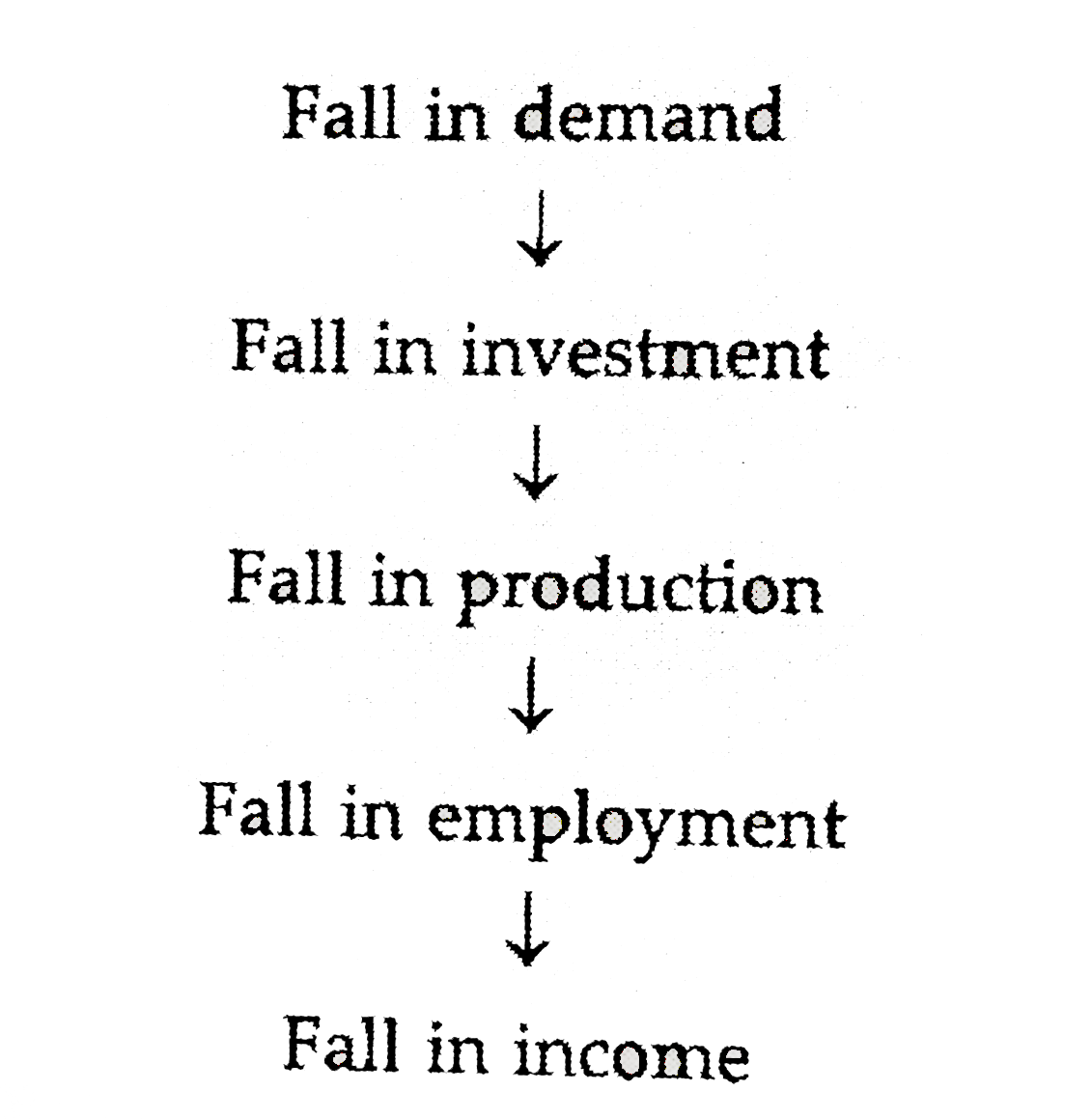 thereby decreasing the growth of the economy. |
|
| 1334. |
Equilibrium price of an essential medicine is too high. Explain what possible steps can be taken to bring down the equilibrium price but only through the market forces. Also explain the series of changes that will occur in the market |
Answer» SOLUTION :If the EQUILIBRIUM price of an essential medicine is too high then the price can be reduced by increasing the supply of the commodity. This can be explained with the help of the following diagram  In the given diagram, we can see that the demand and supply forces intersect each other at point E. This is the initial market equilibriumwith equilibrium price at P and equilibrium quantity at Q. Now let us suppose that there is an INCREASE in the supply of the commodity. This increase will shift the supply curve towards right from SS to `S_(1) S_(1)`. Holding the demand constant, at the initial price OP, we can observe that there will be an excess supply. This excess supply will increase competition among the producers and consequently they WOULD be willing to sell their output at a lower price. The price now, will continue to fall unit it reaches `OP_(1)`, where the new supply curve intersects the initial demand curve. This new equilbrium will be established at `E_(1)` with the new equilibrium price at `OP_(1)`. Thus, we can observe that the equilibrium price has fallen from OP to `OP_(1)`. |
|
| 1335. |
Define circular flow. |
| Answer» Solution :CIRCULAR flow means the flow of MONEY income and the flow of goods and SERVICES AMONG different SECTORS of the economy. | |
| 1336. |
Explain in brief the various components of expenditure method. |
| Answer» Solution :The various COMPONENTS of final expenditure are:1. Private Final Consumption Expenditure (PFCE):It refers to expenditure incurred by households and private non-profit institutions serving households on all types of consumer goods, i.e. durable (except houses), semi-durable, non-durable goods and services.2. Government Final Consumption Expenditure (GFCE):It refers to the expenditure incurred by general government on various administrative services like defense, law and order, education etc. Government produces goods and services with the aim of social welfare without any intention of earning profits.. Gross Domestic Capital Formation (GDCF) or Gross Investment:It refers to the addition to capital stock of the economy. It represents the expenditure incurred on acquiring goods for investment by the production units located within the domestic territory.There are two components of GDCF:(i) Gross Fixed Capital Formation:It refers to the expenditure incurred on purchase of fixed assets.This expenditure is generally divided into three sub-categories:(a) Gross Business Fixed Investment:It includes expenditure on the purchase of new plants, machinery, equipment’s, etc.(b) Gross Residential Construction Investment:It includes expenditure on purchase or construction of new houses by the households.(c) Gross Public Investment:It includes expenditure on construction of flyovers, roads, bridges etc. by the government.(ii) Inventory Investment (Change in Stock):It refers to the physical change in the stock of raw material, semi-finished goods and finished goods lying, with the producers. It is included as an investment item because it represents the goods produced but not used for current consumption. It is calculated as the difference between the closing stock and the opening stock of the YEAR.It means,GDCF = Gross Fixed Capital Formation + Inventory Investment; orGDCF = Gross Business Fixed Investment + Gross Residential Construction Investment + Gross Public Investment + Inventory Investment.It is important to understand that purchase of shares and DEBENTURES, either old or new, is not included in investment. For example, if I have purchased 500 shares of Reliance Industries, it may be an investment from my point of view, but for economy, it is simply a transfer of PURCHASING power and not an investment.4. NET Exports (X – M):It refers to the difference between exports and imports of a country during a period of one year. | |
| 1337. |
When is the demand for a good said to be inelastic ? |
| Answer» SOLUTION :The demand for a good is INELASTIC when the percentagge change in the demand of a PRODUCT is less than the percentagge change in the price of the good. | |
| 1338. |
What is meant by gross domestic capital formation ? State its components . |
| Answer» Solution :Gross domestic CAPITAL formation refers to the addition to capital STOCK of the economy. It represents the expenditureincurred on acquiring GOODS for investment by the production units located within the domestic territory.its components are:1.Gross fixed capital formation:Its refers to the expenditureincurred on purchase of fixedasset.2.Inventory investment ( change in stock ): It refers to the physical change in the stock of raw MATERIAL, semi-FINISHED goods and finished goods lying with the producer | |
| 1339. |
What is meant by mixed income ? |
| Answer» Solution :Mixed income REFERS to the income GENERATED by own account workers (like FERMERS, barber etc.) and unincorporated ENTERPRISES (like retail traders, shopkeepers etc.). | |
| 1340. |
Write down the two essential conditions to become a bank |
|
Answer» Solution :Two essential CONDITIONS to become a BANK are (i) ACCEPTING DEPOSITS (ii) Advancing loans. |
|
| 1341. |
Which of the following is an example of an intermediate goods ? |
|
Answer» Car SOLD by a dealer of SECOND hand cars |
|
| 1342. |
AR is also known as : |
|
Answer» Price |
|
| 1343. |
The function performed by central bank |
|
Answer» CURRENCY AUTHORITY |
|
| 1344. |
Classify the following as real flow or money flow Purchase of cement for construction of a house. |
| Answer» SOLUTION :REAL FLOW | |
| 1345. |
It is observed by the railway minister that the quantity of railway service demanded is decreasing day - by - day. So, price has to be reduced to increase the service demanded. How much price did the railway minister reduce, so that the railway may earn the maximum profit ? Comment on PED. |
| Answer» Solution :The price should be reduced in such a WAY so that percentage change in quantity demanded will be greater than percentage change in price to maximize profit. So, PED will be more than unitary ELASTIC or elastic DEMAND. | |
| 1346. |
The supply of a good refers to |
|
Answer» Actual PRODUCTION of the good. |
|
| 1347. |
Which of the three countrieshas lowest rate of population growth ? |
|
Answer» INDIA |
|
| 1348. |
Calculate (a) National Income, and (b) Net National Disposable Income : {:("","","₹ in crore"),((i),"Compensation of employees",2","000),((ii),"Rent",400),((iii),"Profit",900),((iv),"Dividend",100),((v),"Interest",500),((vi),"Mixed income of self-employed",7","000),((vii),"Net factor income to abroad",50),((viii),"Net exports",60),((ix),"Net indirect taxes",300),((x),"Depreciation",150),((xi),"Net current transfers to abroad",30):} |
|
Answer» Solution :(a) NI = (i) +(ii)+ (iii)+ (V) + (vi)-(vii) = 2,000 +400 + 900+ 500+ 7,000-50 = Rs 10,750 crore. (b) NNDI = NI+ (ix)-(xi) = 10,750 + 300-30 = Rs 11,020 crore |
|
| 1349. |
What is the principal differences between Microeconomics and Macroeconomic ? |
|
Answer» SOLUTION :MICROECONOMICS deals with economic issues at the INDIVIDUAL level, while Macroeconomics does it at the level of economy as a whole. Allocation of resources is the CENTRAL issur in Microeconomics, while fuller utilisation and growth of resources is the central ISSUE in Macroeconomics. There is limited aggregation in Microeconomics as compared to vast aggregation in Macroeconomics. |
|
| 1350. |
In case of single commodity , consumer will be in equilibrium when M.U. = Income. |
| Answer» Solution :FALSE : A consumer is in EQUILIBRIUM when MU = Price. | |