Saved Bookmarks
This section includes 7 InterviewSolutions, each offering curated multiple-choice questions to sharpen your Current Affairs knowledge and support exam preparation. Choose a topic below to get started.
| 1. |
SiO_(4)^(4-) ion has geometry |
|
Answer» TRIANGULAR |
|
| 2. |
SiO_(4)^(4-)"ion" has __________ geometry |
|
Answer» Trinagular |
|
| 3. |
SiO_(2)is ……………….. |
|
Answer» PLASTICIZER |
|
| 5. |
SiO_(2) is a: |
|
Answer» flux |
|
| 6. |
Single electrode potential is |
|
Answer» The potential DEVELOPED at any electrode of a cell at all times. |
|
| 7. |
Since N, N-diethylbenzene sulphonamide does not contain any hydrogen atom attached to N-atom, it is not __________ and hence __________ in alkali. |
|
Answer» |
|
| 8. |
Single bond between sulphure atoms is present in |
|
Answer» `H_2S_2O_7` |
|
| 9. |
Since, Grignard reagents resemble carbanion, so they are strong nucleophile and strong base. Their most useful nucleophilic reaction is addition to carbonyl group. Arrange the following compounds in decreasing order of nucleophilic addition reaction : |
|
Answer» `RgtPgtSgtQ` |
|
| 10. |
Since, Grignard reagents resemble carbanion, so they are strong nucleophile and strong base. Their most useful nucleophilic reaction is addition to carbonyl group. Which of the following compounds will not give acid-base reaction with RMgX? |
| Answer» Solution :N//A | |
| 11. |
Since, lanthanides relased electron from 4f, 5d and 6s orbitals, they show |
|
Answer» fixed oxidation state |
|
| 12. |
Since glucose is converted to fructose by this method, what can you say about the configuration of C_3,C_4 " and "C_5 in the sugars. |
Answer» Solution :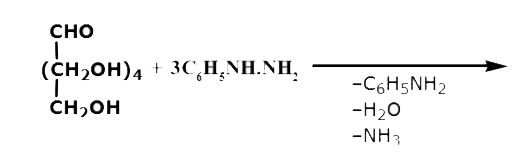 Here aldohexosereacts with one MOLECULE of phenylhdrazine which condenses with the aldehyde group to give phenylhydrazone. When warmed with axcess of phenyl hydrazine, the SECONDARY alcoholic group adjacent to the aldehyde group is oxidised by another molecule of PHENYLHYDRAZINE, to a ketonic group. With this ketonic group, the third molecule of phenylhydrazine condenses to GIVEN osazone. The phenylhydrazinyl group is transferred from osazone to `C_6H_5CHO` giving `C_6H_5CH=N.NHC_6H_5` and a dicarbonyl compound called an osone. The more reactive aldehyde group of the osone is REDUCED, not the less reactive keto group and it give the 2-ketohexose. |
|
| 13. |
Since both aldehydes and ketones possess carbonyl functional group, they undergo similar chemical reactions. (i) Explain the structure of carbonyl group. |
|
Answer» |
|
| 14. |
Since both aldehydes and ketones possess carbonyl functional group, they undergo similar chemical reactions. (ii) Explain Aldol condensation with an example. |
|
Answer» |
|
| 15. |
Since all lanthanides and actinides belong to group IIIB or 3rd group they have common oxidation state of +3 as the most stable state. In addition to +3, they also show +2 and +4 states also. M+2 states they are good reducing agents. Actinides show higher oxidation states of +5, +6 and +7. For them +3 state is not the most stable state especially for the flfst four elements Based upon the information above answer the following questions Lanthanides which show powerful reducing action in +2 state |
|
Answer» La, OD, HO |
|
| 16. |
Since all lanthanides and actinides belong to group IIIB or 3rd group they have common oxidation state of +3 as the most stable state. In addition to +3, they also show +2 and +4 states also. M+2 states they are good reducing agents. Actinides show higher oxidation states of +5, +6 and +7. For them +3 state is not the most stable state especially for the flfst four elements Based upon the information above answer the following questions Actinides which show higher uxidastion state +5, +6 and +7 states and respectively are |
| Answer» Solution :[Pa= +5,U=+6,Np=+7] | |
| 17. |
Since 1891 lighting lamps have been manufactured in the Netherlands. The improvement today in comparison to the first lamp is enormous , especially with the intorduction of the gas discharge lamps. The life- time has increased by orders of magnitude . the colour is also an important aspect. Rare earth metal compunds like CeBr_(3) are now included to reach a colour temperature of 6000K in the lamp the compounds are ionic solids at room temperature , and upon heating they sublime partially to give a vapour of neutral metal halide molecules . To achieve a high vapour pressure, the sublimation enthalpy should be as low as possible. Conclusion in relation to the previous answers. was adding CsBr a good idea ? Mark the correct answer. implies Adding CsBr is counterproductive. implies AddingCsBr has no influence implies Adding CsBr is advantageous implies From these data no clear answer can be given. |
|
Answer» |
|
| 18. |
Since 1891 lighting lamps have been manufactured in the Netherlands. The improvement today in comparisonto the first lamp is enormous , especially with the intorduction of the gas discharge lamps. The life- time has increased by orders of magnitude . the colour is also an important aspect. Rare earth metal compunds like CeBr_(3) are now included to reach a colour temperature of 6000K in the lamp the compounds are ionic solids at room temperature , and upon heating they sublime partially to give a vapour of neutral metal halide molecules . To achieve a high vapour pressure, the sublimation enthalpy should be as low as possible. Calculate the enthalpy of sublimation of CeBr_(3) (in intergers, be aware of signs). Attemps to make a better lamp have been undertaken by adding a stoichiometric amount of CsBr to the CeBr_(3) in the lamp leading at room temperature to solid CsCeBr_(4) lattice has a NaCl structure with Cs as cations and tetrahedral CeBr_(4)^(-) as complex anions. Sublimation of CsCeBr_(4) leads to a vapour of CsBr and CeBr_(3) molecules. |
|
Answer» |
|
| 19. |
Since 1891 lighting lamps have been manufactured in the Netherlands. The improvement today in comparison to the first lamp is enormous , especially with the intorduction of the gas discharge lamps. The life- time has increased by orders of magnitude . the colour is also an important aspect. Rare earth metal compunds like CeBr_(3) are now included to reach a colour temperature of 6000K in the lamp the compounds are ionic solids at room temperature , and upon heating they sublime partially to give a vapour of neutral metal halide molecules . To achieve a high vapour pressure, the sublimation enthalpy should be as low as possible. Calculate the enthalpy of sublimation fo CsCeBr_(4) (in integers) Use the Born-Lande formula for all steps in the process and report the separate energies also (be aware of the signs). The CeBr_(4)^(-) anion is a teteahedron and in which the ratio between the edge and the destance between a corner of the tetrahedron and the centre of gravity (body - radius) amounts to (2sqrt(6))//3 = 1.33 . The Born exponent of the CsBr is 11.The radius of Cs is 0.181 nm. |
|
Answer» |
|
| 20. |
Since 1891 lighting lamps have been manufactured in the Netherlands. The improvement today in comparisonto the first lamp is enormous , especially with the intorduction of the gas discharge lamps. The life- time has increased by orders of magnitude . the colour is also an important aspect. Rare earth metal compunds like CeBr_(3) are now included to reach a colour temperature of 6000K in the lamp the compounds are ionic solids at room temperature , and upon heating they sublime partially to give a vapour of neutral metal halide molecules . To achieve a high vapour pressure, the sublimation enthalpy should be as low as possible. Give a thermochemical cycle (law of Hess) for sublimation of CeBr_(3) , via vapour of mononucler ions (H_(1) =H_("lattice"), H_(e) = H_("electrostatic"), H_(s) =H_("sublimation") , H is not absolute , H means DeltaH) H_(s)=-H_(1) + H_(e) The lattice energy of the solid can be calculatedusing the Baron -Lande formula, H_(1)=d(Z+Z-Ae^(2))/(r_(+) +r_(-))(1-(1)/(n)) The factorFe^(2) (necessary in order to calculate the lattice is 2.985. The Borm exponent n is 11. The charge of the ions Z_(+) and Z_(_) are integer number (Z is negative ). For the calculation of the energy of gaseous CeBr_(3) (when formed from ions) the same Born- Lande formula can be used without A. The structure of CeBr_(3) in the gas phase is planer triangular . The radius of Ce^(3+) is 0.115 nm and of Br is 0.182nm. |
|
Answer» |
|
| 21. |
Since 1891 lighting lamps have been manufactured in the Netherlands. The improvement today in comparison to the first lamp is enormous , especially with the intorduction of the gas discharge lamps. The life- time has increased by orders of magnitude . the colour is also an important aspect. Rare earth metal compunds like CeBr_(3) are now included to reach a colour temperature of 6000K in the lamp the compounds are ionic solids at room temperature , and upon heating they sublime partially to give a vapour of neutral metal halide molecules . To achieve a high vapour pressure, the sublimation enthalpy should be as low as possible. Give the reaction equations of the thermochemical cycle (Law of Hess) for this process in which some steps involve CeBr_(4)^(-) ions monmelecular ions and /or neutral molecules in the phase. Step 1: overset(+H_(1))rarr""+ Step 2 : +""overset(+H_(2)) rarr Step 3 : +""overset(+H_(3))rarr Step 4: +""overset(+H_(4))rarr Total : (CsCeBr_(4))_("lattice") overset(+H_("total"))rarr (CeBr_(3))_("molecules") + (CsBr)_("molecules") |
|
Answer» |
|
| 24. |
Simplest proteins has one peptide linkage. It is |
|
Answer» TRIPEPTIDE |
|
| 25. |
Simple proteins bonded with a non-protein prosthetic group ( acting as cofactor ) are called |
|
Answer» SIMPLE proteins |
|
| 26. |
Simple distillation is used to separate liquids which differ in their boiling point by : |
|
Answer» `5^@C` |
|
| 27. |
Simple aliphatic acids having upto four carbon atoms are ______ in water. |
| Answer» SOLUTION :MISCIBLE | |
| 28. |
Simple and mix ethers can be prepared by which process ? |
|
Answer» WURTZ REACTION |
|
| 29. |
Similarity of fluorine and oxygen may not be attributed to |
|
Answer» their ATOMIC and IONIC radii are closely similar |
|
| 30. |
Silverware turns black after a period of time due to formation of |
|
Answer» nitrate coating on SILVER `2Ag + H_(2)S to Ag_(2)underset("black")(S + ) H_(2)` |
|
| 31. |
Silvering of mirror is done by |
|
Answer» `AgNO_(3)` |
|
| 32. |
Silver with impurity of lead is refined by ......... |
|
Answer» Vapour PHASE refining |
|
| 33. |
Silver sulphide is heated in the presence of air and common salt to convert it to sodium sulphate. This is an example of |
|
Answer» sulpliatising ROASTING |
|
| 34. |
Silver on warming in O_3 the reaction is |
|
Answer» Oxidaition of the METAL |
|
| 35. |
Silver salt method is used todeterminemolecular weight of |
|
Answer» Organic ACIDS `:.` (B), (c ) and (d) are not react. |
|
| 36. |
Silver possesses metallic lusture because: |
|
Answer» It is noble metal |
|
| 37. |
Silver salt of a fatty acid on refluxing with an alkyl halide gives an |
| Answer» Answer :C | |
| 38. |
Silver salt of a diabsic acid contains 71.05 % of Ag. M.Wt of acid is ..... x 10 |
|
Answer» |
|
| 39. |
Silver obtained from argentiferrous lead containing lead impurity is purified by |
|
Answer» Distillation |
|
| 40. |
Silver obtained by argentiferrous lead is purified by: |
|
Answer» DISTILLATION |
|
| 41. |
Silver obtained from argentiferous lead is purified by : |
|
Answer» DISTILLATION |
|
| 42. |
Silver nitrate solution when added to a colorless aqueous solution E forms a white precipitate which dissolves in excess of E. If the white precipitate is heated with water it turns black and the supernatant solution gives a white precipitate with acidified barrum nitrate solution. Therefore, E is : |
|
Answer» `Na_(2)S` |
|
| 43. |
Silver nitrate solution is kept in brown bottles in laboratory because: |
|
Answer» it REACTS with ordinary bottles |
|
| 44. |
Silver nitrate solution gives a red precipitate with : |
|
Answer» SODIUM iodide |
|
| 45. |
Silver nitrate solution is gradually added to an aqueous solution containing 0.01 M each of chloride, bromide and iodide ions. The correct sequence in which the halides will be precipitated is |
|
Answer» `Br^(-) ,CI^(-),I^(-)` |
|
| 46. |
Silver nitrate on heating gives |
|
Answer» `AgO and NO_(2)` |
|
| 47. |
Silver nitrate produces a black stain on skin due to : |
|
Answer» Its corrosive action |
|
| 48. |
Silver nitrate, on heating at molerate temperature gives |
|
Answer» `Ag_(2)O` (a) is not possible because it is unstable. |
|
| 49. |
Silver nitrate is usually kept in coloured bottles because it is: |
|
Answer» oxidised in AIR |
|