

Saved Bookmarks
This section includes 7 InterviewSolutions, each offering curated multiple-choice questions to sharpen your Current Affairs knowledge and support exam preparation. Choose a topic below to get started.
| 1. |
Silver nitrate is prepared by |
|
Answer» The action of only CONC. `HNO_(3)` on silver |
|
| 2. |
Silver Mirror test is given by which one of the following compounds ? |
|
Answer» Acetaldehyde 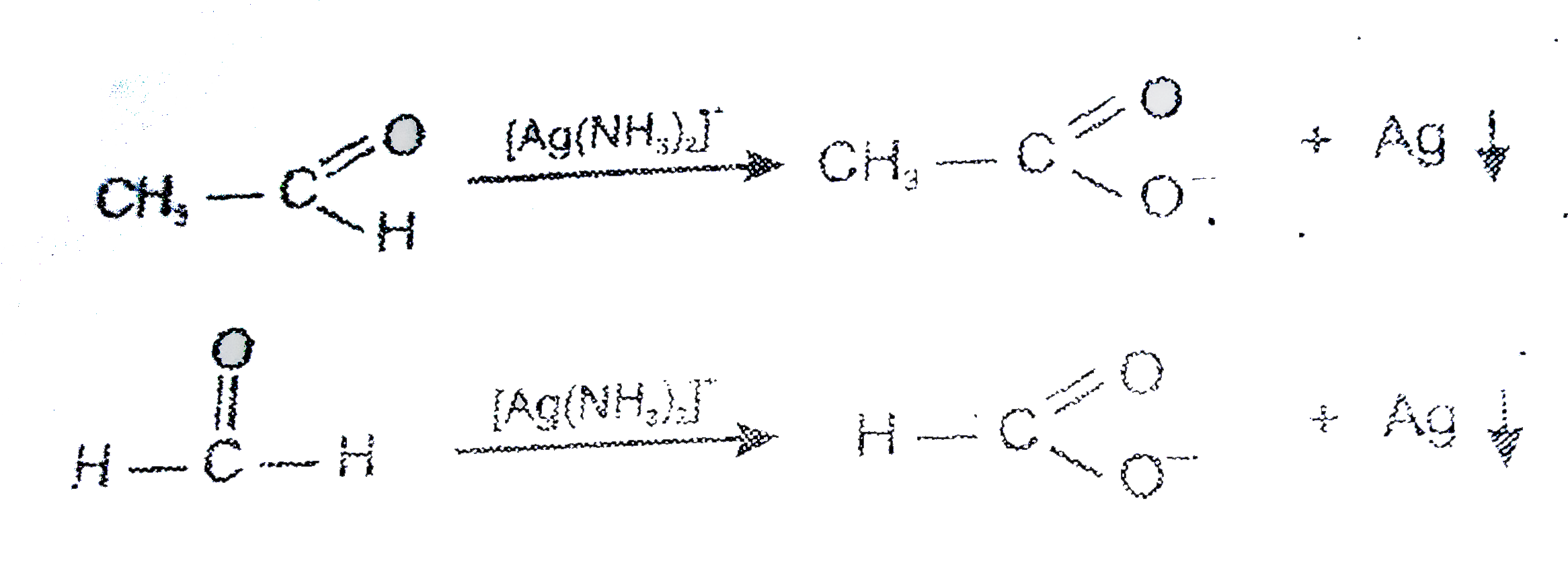
|
|
| 3. |
Silver metal is extracted from Ag_(2) S by cyanide process. The one is concentrated through froth floation process. The concentrated ore is the leached and solution is r ed with reducing agents to get spongy silver which then purified by fusion with an oxidant followed by electrolysis. Which of the following statements about electrolytic refining of silver is not true |
|
Answer» Anode consists of impure silver |
|
| 4. |
Silver nitrate is mainly used |
|
Answer» In photography |
|
| 5. |
Silver metal is extracted from Ag_(2) S by cyanide process. The one is concentrated through froth floation process. The concentrated ore is the leached and solution is r ed with reducing agents to get spongy silver which then purified by fusion with an oxidant followed by electrolysis. Ag is precipitated from an aqueous solution of sodium argentocynide by adding |
|
Answer» Zn dust `UNDERSET("Sodium ARGENTO cyanide")(2Na[Ag(CN)_(2)]+Zn) to underset("Sodium Zincoyanide")(Na_(2)[Zn(CN)_(4)]+2Ag)` |
|
| 6. |
Silver metal is extracted from Ag_(2) S by cyanide process. The one is concentrated through froth floation process. The concentrated ore is the leached and solution is r ed with reducing agents to get spongy silver which then purified by fusion with an oxidant followed by electrolysis. Leaching of Ag_(2)S is carried out by heating it with a dilute solution of |
|
Answer» NACN alone `4g_(4)S+4NaCN hArr 2Na Ag(CN)_(2)+Na_(2)S` `4Na_(2)S+5O_(2)+2H_(2)O to 2Na_(2)SO_(4)+4NaOH+2S` |
|
| 7. |
Silver metal is extracted by cyanide process from silver glance (Ag_(2)S). The ore is concentrated through forth floatation process. The concentrated ore is then leached and solution is treated with reducing agent to get spongy silver which is then purified by fusion with an oxidsing agent followed by electrolysis. |
|
Answer» Silver is precipitated from an aqueous solution of sodium argntocyanide by adding |
|
| 8. |
Silver metal is extracted by cyanide process from silver glance (Ag_(2)S). The ore is concentrated through forth floatation process. The concentrated ore is then leached and solution is treated with reducing agent to get spongy silver which is then purified by fusion with an oxidsing agent followed by electrolysis. Leaching of Ag_(2)S is carried out by heating it with a dilute solution of |
|
Answer» NaCN alone `2Ag_(2)S+8NaCN+O_(2) 2H_(2) O to 4NA[Ag(CN_(2))]+4NaOH+2S` |
|
| 9. |
Silver metal is extracted by cyanide process from silver glance (Ag_(2)S). The ore is concentrated through forth floatation process. The concentrated ore is then leached and solution is treated with reducing agent to get spongy silver which is then purified by fusion with an oxidsing agent followed by electrolysis. Which of the following statement about electrolytic refining of silver is not true |
|
Answer» Anode consists of impure silver |
|
| 10. |
Silver metal crystallizes with a face centred cubic lattice. The length of the unit cell is found to be 4.077 xx 10^(-8) cm. Calculate atomic radius and density of silver. (Atomic mass of Ag = 108 u, N_A = 6.02 xx 10^(23) mol^(-1)) |
|
Answer» Solution :(i) `d = (Z xx M)/(a^3 xx N_A)""...(1)` According to the given DATA: `a =4.077 xx 10^(-8)` cm, Z=4, M = 108 G `mol^(-1)`, `N_A=6.02 xx 10^(23) g mol^(-1)` SUBSTITUTING these values in the EXPRESSION (1), we get `d=(4 xx 108 g mol^(-1))/((4.077 xx 10^(-8) cm)^3 xx 6.022 xx 10^(23) mol^(-1))` = 10.58 g `cm^(-3)` `R=(a)/(2sqrt2)=(4.077 xx 10^(-8) cm)/(2sqrt2) = 1.44 xx 10^(-8) cm` |
|
| 11. |
Silver metal crystallises with a face centred cubic lattice. The length of unit cell is formed to be 4.077 xx 10^(-8) cm. Calculate atomic radius and density of silver. (Atomic mass of Ag = 108 u, N_(A) = 6.023 xx 10^(23) mol^(-1)). |
|
Answer» Solution :GIVEN : `a = 4.077 xx 10^(-8)` cm, Z = 4, M = 108 g `MOL^(-1)` `N_(A) = 6.023 xx 10^(23)` `d = (Z xx M)/(a^(3) xx N_(A))` `= (4 xx 108)/((4.077 xx 10^(-8))^(3) xx 6.023 xx 10^(23))` `= 6.22 g//cm^(3)` For fcc `r = (a)/(2 SQRT(2))` `= (4.077 xx 10^(-8) cm)/(2 sqrt(2))` `= 1.44 xx 10^(-8)` cm |
|
| 12. |
Silver, mercury (ous) and lead are grouped together in the scheme of qualitative analysis because they form |
|
Answer» soluble nitrates |
|
| 13. |
Silver, mercury (ous) and lead are grouped together in a scheme of qualitative analysis because they form |
|
Answer» soluble NITRATES |
|
| 14. |
Silver, mercury and lead have been placed in same group of qualitative analysis, because they form: |
|
Answer» Carbonates SOLUBLE in DILUTE `HNO_3` |
|
| 15. |
Silver may be obtained by __________. |
|
Answer» reduction of `Ag_(2)S` by (Zn+HCl) |
|
| 16. |
Silver is uniformly electro-deposited on a metallic vessel of surface area of 900 cm^2 by passing a current of 0.5 ampere for 2 hours. Calculate the thickness of silver deposited. |
|
Answer» Solution :CALCULATIONS of MASS of Ag deposited: The electrode reaction is `Ag^(+)+e^(-) to Ag` The QUANTITY of ELECTRICITY passed `= Current times time` `=0.5 (amp.) times 2 times 60 times 60 (sec)` =3600 C. From the electrode reaction, it is clear that 96500C of electricity deposit Ag=108g 360 C of electricity will deposit Ag=`108/96500 times 3600` =4.03g Calculation of thickness: Let the thickness of deposited be x cm. Mass= Volume `times` density = Area `times` thickness `times` density (Volume= Area` times` thickness) `4.03g=900(cm^2) times x (cm) times 10.5 (G cm^-3)` `x=4.03/(900 times 10.5)=4.26 times 10^-4 cm` |
|
| 17. |
Silver iodide is used for producing artificial rain because AgI |
|
Answer» is EASY to spary at high altitude |
|
| 18. |
Silver is removed electrically from 200 ml of a 0.1 N solution of AgnO_(3) by a current of 0.1 ampere. How long will it take to remove half of the silver from the solution. |
|
Answer» 16 sec |
|
| 19. |
Silver is removed electrolytically from 200 mL of a 0.1 N solution of AgNO_3by a current of 0.1 ampere. Hoe long will it take to remove half of the silver from the solution: |
|
Answer» 10 sec |
|
| 20. |
Silver is monovalent and has atomic mass of 108. Copper is divalent and has an atomic mass of 63.6. The same electric current is passed for the same length of time through a silver couloment and a copper coulometer. If 27.0 g of silver is deposited, then the corresponding amount of copper deposited is |
|
Answer» 63.60 g |
|
| 21. |
Silver is extracted from argentiferous lead by : |
|
Answer» MOND PROCESS |
|
| 22. |
Silver is extracted by |
|
Answer» CUPELLATION METHOD |
|
| 23. |
Silver is exfracted by: |
|
Answer» CUPELLATION method |
|
| 24. |
Silver is electro-deposited on a metallic vessel of surface area 800 cm^(2) by passing current 0.2 ampere for 3 hours. Calculate the thickness of silver deposited. Given the density of silver as 10.47 g/cc (Atomic mass of Ag=107.92amu) |
|
Answer» Solution :Quantity of electricity passed`=0.2xx3xx60xx60C=2160C` `At^(+)+e^(-)toAg` 96500 C deposit `Ag=107.92g` 2160 C will deposit `Ag=(107.92)/(96500)xx2160g=2.4156g` VOLUME DEPOSITED`=(Mass)/(Density)=(2.4156)/(10.47)c c=0.2307c c` THICKNESS deposited`=("Volume")/("Area")=(0.2307)/(800)=2.88xx10^(-4)cm` |
|
| 25. |
Silver is a soft metal . It is hardened by alloying it with small amount of : |
|
Answer» |
|
| 26. |
Silver iodide is used to produce artificial rain because : |
|
Answer» It is easily prepared |
|
| 27. |
Silver halides are used in photography because they are : |
|
Answer» Photosensitive |
|
| 28. |
Silver forms ccp lattice and X-ray studies of its crystals show that the edge length of its unit cell is 408.6 pm. Calculate the density of silver (Atomic mass = 107.9 u). |
|
Answer» Solution : Since the lattice is ccp, the number of Ag atoms per unit cell (z) = 4 Molar mass of Ag `= 107.9 "g mol"^(-1)` Edge length of (a) = 408.6 PM Volume of cube = `(408.6)^3 xx 10^(-30) "CM"^3` `d = (Z xx M)/(N_A xx a^3)` `therefore d= (4 xx (107.9 "g mol"^(-1)))/((6.022 xx 10^(23) "atomsmol"^(-1)) xx (408.6)^3 xx 10^(-30) "cm"^3)` `therefore d = 10.5 "g cm"^(-3).` |
|
| 29. |
Silver from silver nitrate is deposited by copper, because : |
|
Answer» `E^@(CU^(2+)//Cu) lt E^@(Ag^+//Ag)` |
|
| 30. |
Silver forms ccp lattice and X-ray studies of its crystals show that the edge length of its unit cell is 408.6 pm. Calculate the density of silver (Atomic mass = 107.9u). |
|
Answer» M=107.9 U, For ccp, Z = 4, `d =(ZM)/(N_A a^3)G cm^(-3)=(4 xx 107.9)/(6.023 xx 10^(23) xx (4.086)^3 xx 10^(-24)cm^3)= 10.5 g cm^(-3)` |
|
| 31. |
Silver crystallizes in CCP lattice. The edge length of its unit cell is 408.6 pm. Calculate density of silver (atomic mass of silver is 107.9) |
|
Answer» SOLUTION :here, `Z=4, a=408.6xx10^(-12)m` `:.d=(ZxxM)/(a^3xxN_A)=(4xx108)/((408.6xx10^(-12))^3xx6.023xx10^(23))=10.5g//cm^3` |
|
| 32. |
Silver forms ccp lattice and x-ray studies of its crystals show that the edge length of its unit cell is 408.6 pm. Calculate the density of silver. (Atomic mass of Ag = 107.9 u) |
|
Answer» Solution :Since it is, cop the number of atoms PER UNIT cell, Z = 4 Molar MASS of silver,`M=108 g mol^(-1)` Edge length of the unit cell, `a=408.6` pm. `=408.6xx10^(-10)cm`. DENSITY of the unit cell `d=(ZM)/(N_(A)a^(3))=(4xx108 gmol^(-1))/(6.022xx10^(23)mol^(-1)xx(408.6xx10^(-10)cm)^(3))` `d=10.51 gmol^(-3)`. |
|
| 33. |
Silver dissolves in the solution of an alkali cyanide in the presence of oxygen, forming: |
|
Answer» `[Ag(CN)_2]^-` |
|
| 34. |
Silver dissolves in the solution of an alkali cyanide in the presence of oxygen to form: |
|
Answer» `[AG(CN)_2]^-` |
|
| 35. |
Silver crystallises in an fcc lattice. The edge length of its unit cell is 4.077 xx 10^(-8) cm and its density is 10.5 g cm^(-3). Calculate on this basis the atomic mass of silver. [N_(A)= 6.02 xx 10^(23) mol^(-1)] |
|
Answer» Solution :APPLY the RELATION : `=(dxxa^(3)xxN_(A))/(z)` `"Given :d = 10.5 g cm"^(-3), a=4.077xx10^(-8)cm` In fcc LATTICE, z= 4 Substituting the values in the above equation, we get `M=(10.5xx(4.077)^(3)xx10^(-24)xx6.02xx10^(23))/(4)=107.09` Thus, the ATOMIC mass of silver = 107.09u. |
|
| 36. |
Silver crystallizes in face-centred cubic unit cell. Each side of this unit cell has a length of 400 pm. Calculate the radius of the silver atom. (Assume the atoms touch each other on the diagonal across the face of the unit cell. That is each face atom is touching the four corner atoms). |
|
Answer» For a face-centred cubic unit CELL, radius (r) = `(a)/(2sqrt2)=(400)/(2xx1.41)` pm = 141.8 pm |
|
| 37. |
Silver crystallizes in a face centered cubic structure. If the edge length is 4.077 xx 10^(-8) cm and density is 10.5 g//cm^(3), calculate the atomic mass of silver. |
|
Answer» Solution :`d = (ZM)/(a^(3)N_(A))` `M = (d XX a^(3) xx N_(A))/(Z)` `= (10.5 xx (4.077)^(3) xx 10^(-24) xx 6.022 xx 10^(23))/(4)` `= (428.50)/(4)` The atomic mass of silver (M) = 107.12 u |
|
| 38. |
Silver crystallizes in ſec lattice. If edge length of the cell is 4.077 xx 10^(-8) cm and density is 10.5 g cm^(-3). Calculate the atomic mass of silver. |
|
Answer» Solution :`"Density" rho= (Z xx M)/(a^(3) xx N_(0))` or`M= (rho xx a^(3) xx N_(0))/(Z)` Z= 4(fcc lattice) `rho= 10.5 g cm^(-3), N_(0)= 6.022 xx 10^(23), a= 4.077 xx 10^(-8)` cm `:. M= ((10.5 xx 4.077 xx 10^(-8))^(3) xx 6.022 xx 10^(23))/(4)=107.12 "g MOL"^(-1)` |
|
| 39. |
Silver crystallises with face-centred cubic unit cells. Each side of the unit cell has a length of 409 pm. Calculate the radius of silver atom. (Assume the atoms just touch each other on the diagonal across the face of the unit cell. That is each face atom is touching the four corner atoms.) |
|
Answer» SOLUTION :For fcc UNIT cell `R = (a)/(2 SQRT(2))` Given, a = 400 PM `r = 400//2 sqrt(2)` pm r = 141.4 pm |
|
| 40. |
Silver crystallises in face-centered cubic unit cell. Each side of this unit cell has a length of 400 pm. Calculate the radius of the silver atom. (Assume the atoms just touch each other on the diagonal across the face of the unit cell. That is each face atom is touching the four corner atoms) |
|
Answer» Solution :For fcc unit CELL the relation between EDGE length and RADIUS is GIVEN by `r=(a)/(2SQRT2)` Given a = 400 pm `therefore""r=(400)/(2sqrt2) or r =" 141.4 pm."` |
|
| 41. |
Silver crystallises in fcc lattice. If edge length of the cell is 4.07 xx 10^(-8) cm and density is 10.5 g cm^(-3), calculate the atomic mass of silver. |
|
Answer» Solution :The relation between atomc MASS, density, edge length and z is given by `M=(d xx a^(3)xxN_(A))/(z)` Substituting the VALUES, we get `M=((10.5 g CM^(-3))xx(4.077xx10^(-8)cm)^(3)xx6.022xx10^(23)mol^(-1))/(4)="107.09 g mol"^(-1)`. |
|
| 42. |
Silver crystallises in fcc lattice. If edge length of the cell is 4.07 xx 10^(-8) cm and density is 10.5 "g cm"^(-3), calculate the atomic mass of silver. |
|
Answer» Solution :Edge length `(a) = 4.07 xx 10^(-8)` CM `therefore` Volume of unit CELL `= a^3 = (4.07)^3 xx 10^(-24) "cm"^3` Density `(d) = 10.5 "g cm"^3` Atomic Mass (M) = ? NUMBER of ATOMS PER unit cell (Z) = 4 `therefore M= (d xx N_A xx a^3)/(Z)` `therefore M = (10.5 xx 6.022 xx 10^23 xx (4.07)^3 xx 10(-24))/(4)` `therefore` M= 107.12 g/mol . |
|
| 43. |
silvercrystallises in face- centred cubicstructure . Theedgelength of unitcell isfoundto be408.7pm. Calculatedensityofsilver(Ag= 108 g mol^(-1)) |
| Answer» SOLUTION :Density=10.51 `G CM^(-3)` | |
| 44. |
Silver crystallies in face centred cubic (fcc) unit cell. If the radius of silver atom is 145 pm, what is the length of each side of the unit cell ? |
|
Answer» Solution :For fcc CELL Radius `= (sqrt(3))/(4)a` a = 316.5 pm Radius `= (sqrt(3))/(4) XX 316.5` pm `= (1.732)/(4) xx 316.5` = 334.87 pm |
|
| 45. |
Silver containing lead as impurity is purified by : |
|
Answer» POLING |
|
| 46. |
Silver containing lead as an impurity is removed by |
|
Answer» poling |
|
| 47. |
Silver containing lead as an impurity is not purified by |
|
Answer» Poling |
|
| 48. |
Silver chloride is soluble in methylamine due to the formation of : |
|
Answer» `[AG(CH_(3)NH_(2))_(4)]CL` |
|
| 49. |
Silver chloride is soluble in methylamine due to the formation of: |
|
Answer» `Ag(CH_(3)NH_(2))Cl` |
|
| 50. |
Silver chloride is prepared by (i) dissolving 0.5 g of silver wire in nitric acid and adding excess of hydrochloric acid to silver nitrate formed. The silver chloride precipitated is separated, washed and dried. The weight of silver chloride is 0.66 g. (ii) heating 1 g of silver metal in a current of dry chlorine gas till the metal is completely converted into its chloride. It is found to weight 1.32 g. Illustrate the law of constant composition by the above data. |
|
Answer» SOLUTION :`%" of AG in AgCl in 1st case"=(0.5)/(0.66)xx100=75.76%` `%" of Cl"=24.24%` `%" of Ag in AgCl in 2ND case"=(1)/(1.32)xx100=75.76%` `5" of Cl"=24.24%` |
|