

Saved Bookmarks
This section includes 7 InterviewSolutions, each offering curated multiple-choice questions to sharpen your Current Affairs knowledge and support exam preparation. Choose a topic below to get started.
| 1. |
Read the given passage and answer the questions number 1 to 5 that follow : Bauxite is the principal ore of aluminium. It usually contains SiO_(2), iron oxides and titanium oxide (TiO_2) as impurities. Concentration is carried out by heating the powdered ore with a concentrated solution of NaOH at 473-523 K and 35-36 bar pressure. This process is called digestion. This way, Al_(2)O_(3) is extracted out as sodium aluminate. The impurities, SiO_(2), too dissolves forming sodium silicate. Other impurities are left behind. Al_(2)O_(3)(s)+2NaOH(aq)+3H_(2)O(l) to 2Na[Al(OH)_(4)](aq) The sodium aluminate present in solution is neutralised by passing CO_2 gas and hydrated Al_(2)O_(3) is precipitated. At this stage, small amount of freshly prepared sample of hydrated Al_(2)O_(3) is added to the solution. This is called seeding. It induces the precipitation. 2Na[Al(OH)_(4)](aq)+CO_(2)(g) to Al_(2)O_(3).xH_(2)O(s)+2NaHCO_(3) (aq) Sodium silicate remains in the solution and hydrated alumina is filtered, dried and heated to give back pure Al_(2)O_(3). Al_(2)O_(3).xH_(2)O(s) overset(1470K)(to) Al_(2)O_(3)(s)+xH_(2)O(g). What are the impurities present in bauxite ore? |
| Answer» SOLUTION :SILICA, iron oxide and TITANIUM oxide are the impurities present in bauxite. | |
| 2. |
Read the given passage and answer the questions: Most of the chemical reactions are accelerated by increase in temperature. For example, in decomposition of N_(2)O_(5), the time taken for half of the original amount of material to decompose is 12 min at 50""^(@)C, 5 h at 25 ""^(@)C and 10 days at 0 ""^(@)C. You also know that is a mixture of potassium permaganate and oxalic acid H_(2)C_(4)O_(4), potassium permaganate KMnO_(4) gets decolourised faster at a higher temperature than at a lower temperature. It has been found that for a chemical reactionwith rise in temperature by 10 ""^(@)C, the rate constant is nearly doubled. The temperature dependenceof the rate of a chemical reaction can be accurately explained by Arrhenius equation: k=Ae^(-E_(a)//RT) where A is the frequency factor, E_(a) is the activation energy measured in joules per mole. Q. How will change this equation into natural logaritham form? |
| Answer» SOLUTION :In `K=-(E_(a))/(RT)+`In A | |
| 3. |
Read the given passage and answer the questions: Most of the chemical reactions are accelerated by increase in temperature. For example, in decomposition of N_(2)O_(5), the time taken for half of the original amount of material to decompose is 12 min at 50""^(@)C, 5 h at 25 ""^(@)C and 10 days at 0 ""^(@)C. You also know that is a mixture of potassium permaganate and oxalic acid H_(2)C_(4)O_(4), potassium permaganate KMnO_(4) gets decolourised faster at a higher temperature than at a lower temperature. It has been found that for a chemical reactionwith rise in temperature by 10 ""^(@)C, the rate constant is nearly doubled. The temperature dependenceof the rate of a chemical reaction can be accurately explained by Arrhenius equation: k=Ae^(-E_(a)//RT) where A is the frequency factor, E_(a) is the activation energy measured in joules per mole. Q. Give the Arrhenius equation in the original form. |
| Answer» SOLUTION :`k=Ae^(-E_(a)//RT)` | |
| 4. |
Read the given passage and answer the questions: Most of the chemical reactions are accelerated by increase in temperature. For example, in decomposition of N_(2)O_(5), the time taken for half of the original amount of material to decompose is 12 min at 50""^(@)C, 5 h at 25 ""^(@)C and 10 days at 0 ""^(@)C. You also know that is a mixture of potassium permaganate and oxalic acid H_(2)C_(4)O_(4), potassium permaganate KMnO_(4) gets decolourised faster at a higher temperature than at a lower temperature. It has been found that for a chemical reactionwith rise in temperature by 10 ""^(@)C, the rate constant is nearly doubled. The temperature dependenceof the rate of a chemical reaction can be accurately explained by Arrhenius equation: k=Ae^(-E_(a)//RT) where A is the frequency factor, E_(a) is the activation energy measured in joules per mole. Q. How does the time required for half change vary with the change in time? |
| Answer» Solution :Increase of TEMPERATURE reducesthe time REQUIRED for HALF CHANGE. | |
| 5. |
Read the given passage and answer the questions: Most of the chemical reactions are accelerated by increase in temperature. For example, in decomposition of N_(2)O_(5), the time taken for half of the original amount of material to decompose is 12 min at 50""^(@)C, 5 h at 25 ""^(@)C and 10 days at 0 ""^(@)C. You also know that is a mixture of potassium permaganate and oxalic acid H_(2)C_(4)O_(4), potassium permaganate KMnO_(4) gets decolourised faster at a higher temperature than at a lower temperature. It has been found that for a chemical reactionwith rise in temperature by 10 ""^(@)C, the rate constant is nearly doubled. The temperature dependenceof the rate of a chemical reaction can be accurately explained by Arrhenius equation: k=Ae^(-E_(a)//RT) where A is the frequency factor, E_(a) is the activation energy measured in joules per mole. Q. A reaction was carried out at 20""^(@)C and than at 30""^(@)C. How do you expect the rate constant to change ? |
| Answer» Solution :Rate CONSTANT BECOMES nearly DOUBLED with `10^(@)` RISE in temperature. | |
| 6. |
Read the given passage and answer the questions: Most of the chemical reactions are accelerated by increase in temperature. For example, in decomposition of N_(2)O_(5), the time taken for half of the original amount of material to decompose is 12 min at 50""^(@)C, 5 h at 25 ""^(@)C and 10 days at 0 ""^(@)C. You also know that is a mixture of potassium permaganate and oxalic acid H_(2)C_(4)O_(4), potassium permaganate KMnO_(4) gets decolourised faster at a higher temperature than at a lower temperature. It has been found that for a chemical reactionwith rise in temperature by 10 ""^(@)C, the rate constant is nearly doubled. The temperature dependenceof the rate of a chemical reaction can be accurately explained by Arrhenius equation: k=Ae^(-E_(a)//RT) where A is the frequency factor, E_(a) is the activation energy measured in joules per mole. Q. In the volumetric titration of oxalic acid against potassium permanganate (KMnO_(4)), we heat the oxalic acid solution to about 40 ""^(@)C before performing the titration. Why? |
| Answer» Solution :It takes a much longer TIME to BREAK the bonds in oxalic acid and GIVE the products at room temperature. Hence heated is required to ACCELERATE the reaction. | |
| 7. |
Read the given passage and answer the questions : Molecules of ethanoic acid dimerise in benzene due to hydrogen bonding. This normally happens in solvents of low dielectric constant. In this case, the number of particles is reduced due to dimerisation. The molar mass calculated on the basis of this Delta T_b or Delta T_fwill, therefore, be twice the expected value. Such a molar mass that is either lower or higher than the expected or normal value is called as abnormal molar mass.Why does ethanoic acid dimerise in benzene solution ? |
| Answer» SOLUTION :This is because of HYDROGEN BONDING. | |
| 8. |
Read the given passage and answer the questions : Molecules of ethanoic acid dimerise in benzene due to hydrogen bonding. This normally happens in solvents of low dielectric constant. In this case, the number of particles is reduced due to dimerisation. The molar mass calculated on the basis of this Delta T_b or Delta T_fwill, therefore, be twice the expected value. Such a molar mass that is either lower or higher than the expected or normal value is called as abnormal molar mass.Shall we obtain a abnormal molar mass if we determine the boiling point of glucose solution ? |
| Answer» SOLUTION :YES, ABNORMAL molar mass will be OBTAINED. | |
| 9. |
Read the given passage and answer the questions : Molecules of ethanoic acid dimerise in benzene due to hydrogen bonding. This normally happens in solvents of low dielectric constant. In this case, the number of particles is reduced due to dimerisation. The molar mass calculated on the basis of this Delta T_b or Delta T_fwill, therefore, be twice the expected value. Such a molar mass that is either lower or higher than the expected or normal value is called as abnormal molar mass. Under which conditions do we obtain an abnormal molar mass ? |
| Answer» SOLUTION :If DISSOCIATION or association of the solute takes PLACE in the solvent, we OBTAIN abnormal molar mass. | |
| 10. |
Read the given passage and answer the questions: According to Arrhenius equation, the lower the value of activation energy, faster will be the rate of reaction. A small amount of catalyst can catalysea large amount of reagents. A catalyst does not alter Gibbs energy. DeltaG of a reaction. It catalyses the spontaneous reactions but does not catalyse non-spontaneous reactions. It is also found that a catalyst does not change the equilibrium constant of a reaction rather, it helps in attaining the equilibrium faster, that is, it catalyses the forward as well as the backward reactions to the same extent so that the equilibrium state remains same but it reached earlier. Q. What is the utility of a catalyst? |
| Answer» SOLUTION :The equilibrium state of the REACTION is REACHED FASTER. | |
| 11. |
Read the given passage and answer the questions: According to Arrhenius equation, the lower the value of activation energy, faster will be the rate of reaction. A small amount of catalyst can catalysea large amount of reagents. A catalyst does not alter Gibbs energy. DeltaG of a reaction. It catalyses the spontaneous reactions but does not catalyse non-spontaneous reactions. It is also found that a catalyst does not change the equilibrium constant of a reaction rather, it helps in attaining the equilibrium faster, that is, it catalyses the forward as well as the backward reactions to the same extent so that the equilibrium state remains same but it reached earlier. Q. Out of Gibb's energy and equilibrium constant, which quantity is changed by the catalyst? |
| Answer» SOLUTION :NEITHER QUANTITY is CHANGED by CATALYST. | |
| 12. |
Read the given passage and answer the questions : Molecules of ethanoic acid dimerise in benzene due to hydrogen bonding. This normally happens in solvents of low dielectric constant. In this case, the number of particles is reduced due to dimerisation. The molar mass calculated on the basis of this Delta T_b or Delta T_fwill, therefore, be twice the expected value. Such a molar mass that is either lower or higher than the expected or normal value is called as abnormal molar mass.Write the structure of dimerised ethanoic acid. |
Answer» SOLUTION :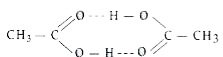
|
|
| 13. |
Read the given passage and answer the questions : Molecules of ethanoic acid dimerise in benzene due to hydrogen bonding. This normally happens in solvents of low dielectric constant. In this case, the number of particles is reduced due to dimerisation. The molar mass calculated on the basis of this Delta T_b or Delta T_fwill, therefore, be twice the expected value. Such a molar mass that is either lower or higher than the expected or normal value is called as abnormal molar mass. What is meant by abnormal molar mass ? |
| Answer» SOLUTION :If the molecular MASS is more or LESS than the NORMAL or expected molar mass, we CALL itabnormal molar mass. | |
| 14. |
Read the given passage and answer the question number 1 to 5 that follows: The halogens have the smallest atomic radii in their respective periods. The atomic radius of fluorine is extremely small. All halogens exhibit-1 oxidation state. They are strong oxidising agents and have maximum negative electron gain enthalpy. Among halogens, and ionisation enthalpy are higher for fluorine than expected whereas bond dissociation enthalpy, m.p and b.p and electron gain enthalpy are quite lower than expected. Halogens react with hydrogen to give hydrogen halides (HX) and combine amongst themselves to form a number of compounds of the type, XX',XX'_3,XX'_5 and XX'_7 called inter-halogens. What are the sizes of X and X' in the interhalogen compounds? |
| Answer» Solution :X is the halogen of LARGER SIZE and X. is the halogen of SMALLER size. | |
| 15. |
Read the given passage and answer the questions: According to Arrhenius equation, the lower the value of activation energy, faster will be the rate of reaction. A small amount of catalyst can catalysea large amount of reagents. A catalyst does not alter Gibbs energy. DeltaG of a reaction. It catalyses the spontaneous reactions but does not catalyse non-spontaneous reactions. It is also found that a catalyst does not change the equilibrium constant of a reaction rather, it helps in attaining the equilibrium faster, that is, it catalyses the forward as well as the backward reactions to the same extent so that the equilibrium state remains same but it reached earlier. Q. Write Arrhenius equation in the mathematical form. |
| Answer» Solution :` "LOG"(k_(2))/(k_(1))=(E_(a))/(2.303R)[(T_(2)-T_(1))/(T_(1)T_(2))]` | |
| 16. |
Read the given passage and answer the questions: According to Arrhenius equation, the lower the value of activation energy, faster will be the rate of reaction. A small amount of catalyst can catalysea large amount of reagents. A catalyst does not alter Gibbs energy. DeltaG of a reaction. It catalyses the spontaneous reactions but does not catalyse non-spontaneous reactions. It is also found that a catalyst does not change the equilibrium constant of a reaction rather, it helps in attaining the equilibrium faster, that is, it catalyses the forward as well as the backward reactions to the same extent so that the equilibrium state remains same but it reached earlier. Q. Can a catalyst bring about a change which is generally not probable? |
| Answer» SOLUTION :No, it is not POSSIBLE. | |
| 17. |
Read the given passage and answer the questions: According to Arrhenius equation, the lower the value of activation energy, faster will be the rate of reaction. A small amount of catalyst can catalysea large amount of reagents. A catalyst does not alter Gibbs energy. DeltaG of a reaction. It catalyses the spontaneous reactions but does not catalyse non-spontaneous reactions. It is also found that a catalyst does not change the equilibrium constant of a reaction rather, it helps in attaining the equilibrium faster, that is, it catalyses the forward as well as the backward reactions to the same extent so that the equilibrium state remains same but it reached earlier. Q. What is conveyed by Arrhenius equation? |
| Answer» SOLUTION :Lower the VALUE of ACTIVATION energy, FASTER will be the RATE of reaction. | |
| 18. |
Read the given passage and answer the question number 1 to 5 that follows: The halogens have the smallest atomic radii in their respective periods. The atomic radius of fluorine is extremely small. All halogens exhibit-1 oxidation state. They are strong oxidising agents and have maximum negative electron gain enthalpy. Among halogens, and ionisation enthalpy are higher for fluorine than expected whereas bond dissociation enthalpy, m.p and b.p and electron gain enthalpy are quite lower than expected. Halogens react with hydrogen to give hydrogen halides (HX) and combine amongst themselves to form a number of compounds of the type, XX',XX'_3,XX'_5 and XX'_7 called inter-halogens. Why fluorine is a stronger oxidising agent than chlorine. |
| Answer» SOLUTION :It has GREATER REDUCTION POTENTIAL than CHLORINE. | |
| 19. |
Read the given passage and answer the question number 1 to 5 that follows: The halogens have the smallest atomic radii in their respective periods. The atomic radius of fluorine is extremely small. All halogens exhibit-1 oxidation state. They are strong oxidising agents and have maximum negative electron gain enthalpy. Among halogens, and ionisation enthalpy are higher for fluorine than expected whereas bond dissociation enthalpy, m.p and b.p and electron gain enthalpy are quite lower than expected. Halogens react with hydrogen to give hydrogen halides (HX) and combine amongst themselves to form a number of compounds of the type, XX',XX'_3,XX'_5 and XX'_7 called inter-halogens. Arrange the hydrogen halides (HF to HI) in the decreasing order of their reducing character. |
| Answer» SOLUTION :`HI gt HBR gt HCL gt HF` | |
| 20. |
Read the given passage and answer the question number 1 to 5 that follows: The halogens have the smallest atomic radii in their respective periods. The atomic radius of fluorine is extremely small. All halogens exhibit-1 oxidation state. They are strong oxidising agents and have maximum negative electron gain enthalpy. Among halogens, and ionisation enthalpy are higher for fluorine than expected whereas bond dissociation enthalpy, m.p and b.p and electron gain enthalpy are quite lower than expected. Halogens react with hydrogen to give hydrogen halides (HX) and combine amongst themselves to form a number of compounds of the type, XX',XX'_3,XX'_5 and XX'_7 called inter-halogens. Why flourine shows anomalous behaviour as compared to other halogens? |
| Answer» SOLUTION :This is due to small ATOMIC RADIUS and HIGH ELECTRON density. | |
| 21. |
Read the given passage and answer the question number 1 to 5 that follows: The halogens have the smallest atomic radii in their respective periods. The atomic radius of fluorine is extremely small. All halogens exhibit-1 oxidation state. They are strong oxidising agents and have maximum negative electron gain enthalpy. Among halogens, and ionisation enthalpy are higher for fluorine than expected whereas bond dissociation enthalpy, m.p and b.p and electron gain enthalpy are quite lower than expected. Halogens react with hydrogen to give hydrogen halides (HX) and combine amongst themselves to form a number of compounds of the type, XX',XX'_3,XX'_5 and XX'_7 called inter-halogens. Why halogens have maximum negative electron gain enthalpy? |
| Answer» SOLUTION :This is because they have only ONE electron LESS than noble GAS configuration. | |
| 22. |
Read the given passage and answer questions number 1 to 5 that follow : The lower aliphatic amines are gases with fishy odour. Primary amines with three or more carbon atoms are liquid and still higher one are solid. Aniline and other arylamines are usuallycolourless but get coloured on storage due to atmospheric oxidation. Lower aliphatic amines are soluble in water because they can form hydrogen bonds with water molecules. However, solubility decreases with increase in molar mass of amines due to increase in size of the hydrophobic alkyl part. Higher amines are essentially insoluble in water. Considering the electronegativity of nitrogen of amine and oxygen of alcohols in water. Out of butan-1-ol and butan-1-amine, which will be more soluble in water and why? Amines are soluble in organic solvents like alcohol, ether and benzene. You may remember that alcohols are more polar than amines and form stronger intermolecular hydrogen bonds than amines. Primary and secondary amines are engaged in intermolecular association due to hydrogen bonding between nitrogen of one and hydrogen of another molecule. This intermolecular association is more in primary amines than in secondary amines as there are two hydrogen atoms available for hydrogen bond formation in it. Tertiary amines do not have intermolecular association due to the absence of hydrogen atom available for hydrogen bond formation. Therefore, the order of boiling points of isomeric amines is as follows : "Primary "gt" Secondary "gt" Tertiary". Arrange the following compounds in increasing order of boiling point : ""CH_(3)-CH_(2)-underset(underset(CH_(3))(|))(CH)-NH_(2), CH_(3)-underset(underset(CH_(3))(|))overset(overset(CH_(3))(|))(C)-NH_(2),CH_(3)CH_(2)CH_(2)CH_(2)NH_(2) |
| Answer» Solution :`CH_(3)-underset(underset(CH_(3))(|))overset(overset(CH_(3))(|))(C)-NH_(2) LT CH_(3)-CH_(2)-underset(underset(CH_(3))(|))(CH)-NH_(2)lt CH_(3)CH_(2)CH_(2)CH_(2)NH_(2)` | |
| 23. |
Read the given passage and answer questions number 1 to 5 that follow : The lower aliphatic amines are gases with fishy odour. Primary amines with three or more carbon atoms are liquid and still higher one are solid. Aniline and other arylamines are usuallycolourless but get coloured on storage due to atmospheric oxidation. Lower aliphatic amines are soluble in water because they can form hydrogen bonds with water molecules. However, solubility decreases with increase in molar mass of amines due to increase in size of the hydrophobic alkyl part. Higher amines are essentially insoluble in water. Considering the electronegativity of nitrogen of amine and oxygen of alcohols in water. Out of butan-1-ol and butan-1-amine, which will be more soluble in water and why? Amines are soluble in organic solvents like alcohol, ether and benzene. You may remember that alcohols are more polar than amines and form stronger intermolecular hydrogen bonds than amines. Primary and secondary amines are engaged in intermolecular association due to hydrogen bonding between nitrogen of one and hydrogen of another molecule. This intermolecular association is more in primary amines than in secondary amines as there are two hydrogen atoms available for hydrogen bond formation in it. Tertiary amines do not have intermolecular association due to the absence of hydrogen atom available for hydrogen bond formation. Therefore, the order of boiling points of isomeric amines is as follows : "Primary "gt" Secondary "gt" Tertiary". Out of benzene and water which will dissolve C_(6)H_(13)NH_(2) more ? |
| Answer» SOLUTION :Benzene will DISSOLVE `C_(6)H_(13)NH_(2)` more. | |
| 24. |
Read the given passage and answer questions number 1 to 5 that follow Rubber is a natural polymer and possesses elastic properties. It is also termed as elastomeric polymer. In elastomeric polymers, the polymer chains are held together by the weak intermolecular forces. These weak binding forces permit the polymer to be stretched. A few 'crosslinks' are introduced in between the chains, which help the polymer to retract to its original position after the force is released. Rubber has a variety of Lises. It is manufactured from rubber latex which is a colloidal dispersion of rubber in water. This latex is obtained from the rubber tree which is found in India, Srilanka, Indonesia, Malaysia and South America, Natural rubber may be considered as a linear polymer of isoprene (2-methyl-1, 3-butadiene) and is also called as cis-1, 4-polyisoprene. The cis.polyisoprene molecule consists of various chains held together by weak van der Waals interactions and has a coiled structure. Thus, it can be stretched like a spring and exhibits elastic properties. Natural rubber becomes soft at high temperature (> 335 K) and brittle at low temperatures (< 283 K) and shows high water absorption capacity. It is soluble in non-polar solvents and is non-resistant to attack by oxidising agents. To improve upon these physical properties, a process of vulcanisation is carried out. Give some properties of natural rubber. |
| Answer» SOLUTION :NATURAL rubber becomes soft at high TEMPERATURE and becomes BRITTLE at low temperature and shows high WATER absorption capacity. | |
| 25. |
Read the given passage and answer questions number 1 to 5 that follow : The lower aliphatic amines are gases with fishy odour. Primary amines with three or more carbon atoms are liquid and still higher one are solid. Aniline and other arylamines are usuallycolourless but get coloured on storage due to atmospheric oxidation. Lower aliphatic amines are soluble in water because they can form hydrogen bonds with water molecules. However, solubility decreases with increase in molar mass of amines due to increase in size of the hydrophobic alkyl part. Higher amines are essentially insoluble in water. Considering the electronegativity of nitrogen of amine and oxygen of alcohols in water. Out of butan-1-ol and butan-1-amine, which will be more soluble in water and why? Amines are soluble in organic solvents like alcohol, ether and benzene. You may remember that alcohols are more polar than amines and form stronger intermolecular hydrogen bonds than amines. Primary and secondary amines are engaged in intermolecular association due to hydrogen bonding between nitrogen of one and hydrogen of another molecule. This intermolecular association is more in primary amines than in secondary amines as there are two hydrogen atoms available for hydrogen bond formation in it. Tertiary amines do not have intermolecular association due to the absence of hydrogen atom available for hydrogen bond formation. Therefore, the order of boiling points of isomeric amines is as follows : "Primary "gt" Secondary "gt" Tertiary". Out of C_(5)H_(11)OH" and "C_(5)H_(11)NH_(2), which is more soluble in water and why ? |
| Answer» SOLUTION :`C_(5)H_(11)OH` is more soluble. | |
| 26. |
Read the given passage and answer questions number 1 to 5 that follow : The lower aliphatic amines are gases with fishy odour. Primary amines with three or more carbon atoms are liquid and still higher one are solid. Aniline and other arylamines are usuallycolourless but get coloured on storage due to atmospheric oxidation. Lower aliphatic amines are soluble in water because they can form hydrogen bonds with water molecules. However, solubility decreases with increase in molar mass of amines due to increase in size of the hydrophobic alkyl part. Higher amines are essentially insoluble in water. Considering the electronegativity of nitrogen of amine and oxygen of alcohols in water. Out of butan-1-ol and butan-1-amine, which will be more soluble in water and why? Amines are soluble in organic solvents like alcohol, ether and benzene. You may remember that alcohols are more polar than amines and form stronger intermolecular hydrogen bonds than amines. Primary and secondary amines are engaged in intermolecular association due to hydrogen bonding between nitrogen of one and hydrogen of another molecule. This intermolecular association is more in primary amines than in secondary amines as there are two hydrogen atoms available for hydrogen bond formation in it. Tertiary amines do not have intermolecular association due to the absence of hydrogen atom available for hydrogen bond formation. Therefore, the order of boiling points of isomeric amines is as follows : "Primary "gt" Secondary "gt" Tertiary". Why does the solubility of amines decrease with the increase of molar mass ? |
| Answer» Solution :This is due to INCREASE in the HYDROPHOBIC alkyl PART. | |
| 27. |
Read the given passage and answer questions number 1 to 5 that follow Rubber is a natural polymer and possesses elastic properties. It is also termed as elastomeric polymer. In elastomeric polymers, the polymer chains are held together by the weak intermolecular forces. These weak binding forces permit the polymer to be stretched. A few 'crosslinks' are introduced in between the chains, which help the polymer to retract to its original position after the force is released. Rubber has a variety of Lises. It is manufactured from rubber latex which is a colloidal dispersion of rubber in water. This latex is obtained from the rubber tree which is found in India, Srilanka, Indonesia, Malaysia and South America, Natural rubber may be considered as a linear polymer of isoprene (2-methyl-1, 3-butadiene) and is also called as cis-1, 4-polyisoprene. The cis.polyisoprene molecule consists of various chains held together by weak van der Waals interactions and has a coiled structure. Thus, it can be stretched like a spring and exhibits elastic properties. Natural rubber becomes soft at high temperature (> 335 K) and brittle at low temperatures (< 283 K) and shows high water absorption capacity. It is soluble in non-polar solvents and is non-resistant to attack by oxidising agents. To improve upon these physical properties, a process of vulcanisation is carried out. What is the cause of elasticity of natural rubber? |
| Answer» Solution : There are WEAK van der WAALS FORCES between the units of ISOPRENE units in natural RUBBER. Natural rubber can stretch on applying force. | |
| 28. |
Read the given passage and answer questions number 1 to 5 that follow Rubber is a natural polymer and possesses elastic properties. It is also termed as elastomeric polymer. In elastomeric polymers, the polymer chains are held together by the weak intermolecular forces. These weak binding forces permit the polymer to be stretched. A few 'crosslinks' are introduced in between the chains, which help the polymer to retract to its original position after the force is released. Rubber has a variety of Lises. It is manufactured from rubber latex which is a colloidal dispersion of rubber in water. This latex is obtained from the rubber tree which is found in India, Srilanka, Indonesia, Malaysia and South America, Natural rubber may be considered as a linear polymer of isoprene (2-methyl-1, 3-butadiene) and is also called as cis-1, 4-polyisoprene. The cis.polyisoprene molecule consists of various chains held together by weak van der Waals interactions and has a coiled structure. Thus, it can be stretched like a spring and exhibits elastic properties. Natural rubber becomes soft at high temperature (> 335 K) and brittle at low temperatures (< 283 K) and shows high water absorption capacity. It is soluble in non-polar solvents and is non-resistant to attack by oxidising agents. To improve upon these physical properties, a process of vulcanisation is carried out. What is the chemical formula of natural rubber? |
| Answer» SOLUTION :Natural rubber is a LINEAR polymer of ISOPRENE (2-methyl-1, 3-butadiene) and is CALLED as cis-1, 4-polyisoprene. | |
| 29. |
Read the given passage and answer questions number 1 to 5 that follow Rubber is a natural polymer and possesses elastic properties. It is also termed as elastomeric polymer. In elastomeric polymers, the polymer chains are held together by the weak intermolecular forces. These weak binding forces permit the polymer to be stretched. A few 'crosslinks' are introduced in between the chains, which help the polymer to retract to its original position after the force is released. Rubber has a variety of Lises. It is manufactured from rubber latex which is a colloidal dispersion of rubber in water. This latex is obtained from the rubber tree which is found in India, Srilanka, Indonesia, Malaysia and South America, Natural rubber may be considered as a linear polymer of isoprene (2-methyl-1, 3-butadiene) and is also called as cis-1, 4-polyisoprene. The cis.polyisoprene molecule consists of various chains held together by weak van der Waals interactions and has a coiled structure. Thus, it can be stretched like a spring and exhibits elastic properties. Natural rubber becomes soft at high temperature (> 335 K) and brittle at low temperatures (< 283 K) and shows high water absorption capacity. It is soluble in non-polar solvents and is non-resistant to attack by oxidising agents. To improve upon these physical properties, a process of vulcanisation is carried out. Name the countries producing rubber tree. |
| Answer» Solution :India, SRILANKA, INDONESIA Malaysia and South AMERICA. | |
| 30. |
Read the given passage and answer questions number 1 to 5 that follow Rubber is a natural polymer and possesses elastic properties. It is also termed as elastomeric polymer. In elastomeric polymers, the polymer chains are held together by the weak intermolecular forces. These weak binding forces permit the polymer to be stretched. A few 'crosslinks' are introduced in between the chains, which help the polymer to retract to its original position after the force is released. Rubber has a variety of Lises. It is manufactured from rubber latex which is a colloidal dispersion of rubber in water. This latex is obtained from the rubber tree which is found in India, Srilanka, Indonesia, Malaysia and South America, Natural rubber may be considered as a linear polymer of isoprene (2-methyl-1, 3-butadiene) and is also called as cis-1, 4-polyisoprene. The cis.polyisoprene molecule consists of various chains held together by weak van der Waals interactions and has a coiled structure. Thus, it can be stretched like a spring and exhibits elastic properties. Natural rubber becomes soft at high temperature (> 335 K) and brittle at low temperatures (< 283 K) and shows high water absorption capacity. It is soluble in non-polar solvents and is non-resistant to attack by oxidising agents. To improve upon these physical properties, a process of vulcanisation is carried out. What is latex ? |
| Answer» Solution : LATEX is a COLLOIDAL DISPERSION of RUBBER in water. | |
| 31. |
Read the given passage and answer questions number 1 to 5 that follow : In common system, an aliphatic amine is named by prefixing alkyl group to amine, i.e., alkylamine as one word (e.g., methylamine). In secondary and tertiary amines, when two or more groupsare the same, the prefix di or tri is appended before the name of alkyl group. In IUPAC system, primary amines are names as alkanamines. The name is derived by replacement of 'e' of alkane by the word amine. For example, CH_(3)NH_(2) is named as alkanamines. The name is derived by replacement of 'e' of alkane by the word amine. For example, CH_(3)NH_(2) is named as methanamine. In case, more than one amino group is present at different positions in the parent chain, their positions are specified by giving numbers to the carbon atoms bearing -NH_(2) groups and suitable prefix such as di, tri, etc., is attached to the amine. The letter 'e' of the suffix of the hydrocarbon part is retained. For example, H_(2)N-CH_(2)-CH_(2)-NH_(2) is named as ethane-1, 2-diamine. To name secondary and tertiary amines, we use locant N to designate substituent attached to a nitrogen atom. For example, CH_(3)NHCH_(2)CH_(3) is named as N-methylethanamine and (CH_(3)CH_(2))_(3)N is named as N, N-diethylethanamine. In arylamines, -NH_(2) group is directly attached to the benzene ring. C_(6)H_(5)NH_(2) is the simplest example of arylamine. In common system, it is known as aniline. It is also an accepted IUPAC name. While naming arylamines according to IUPAC system, suffix 'e' of arene is replaced by 'amine'. Thus in IUPAC system, C_(6)H_(5)-NH_(2) is named as benzenamine. Give the name of the compound : |
| Answer» SOLUTION :N, N-Dimethylbenzenamine. | |
| 32. |
Read the given passage and answer questions number 1 to 5 that follow : In common system, an aliphatic amine is named by prefixing alkyl group to amine, i.e., alkylamine as one word (e.g., methylamine). In secondary and tertiary amines, when two or more groupsare the same, the prefix di or tri is appended before the name of alkyl group. In IUPAC system, primary amines are names as alkanamines. The name is derived by replacement of 'e' of alkane by the word amine. For example, CH_(3)NH_(2) is named as alkanamines. The name is derived by replacement of 'e' of alkane by the word amine. For example, CH_(3)NH_(2) is named as methanamine. In case, more than one amino group is present at different positions in the parent chain, their positions are specified by giving numbers to the carbon atoms bearing -NH_(2) groups and suitable prefix such as di, tri, etc., is attached to the amine. The letter 'e' of the suffix of the hydrocarbon part is retained. For example, H_(2)N-CH_(2)-CH_(2)-NH_(2) is named as ethane-1, 2-diamine. To name secondary and tertiary amines, we use locant N to designate substituent attached to a nitrogen atom. For example, CH_(3)NHCH_(2)CH_(3) is named as N-methylethanamine and (CH_(3)CH_(2))_(3)N is named as N, N-diethylethanamine. In arylamines, -NH_(2) group is directly attached to the benzene ring. C_(6)H_(5)NH_(2) is the simplest example of arylamine. In common system, it is known as aniline. It is also an accepted IUPAC name. While naming arylamines according to IUPAC system, suffix 'e' of arene is replaced by 'amine'. Thus in IUPAC system, C_(6)H_(5)-NH_(2) is named as benzenamine. How do we name secondary and tertiary amines according to IUPAC nomenclature ? |
| Answer» Solution :We use locant N to DESIGNATE SUBSTITUENT attached to nitrogen atom. For EXAMPLE, `CH_(3)NHCH_(2)CH_(3)` is named as N-methylethanamine. | |
| 33. |
Read the given passage and answer questions number 1 to 5 that follow : In common system, an aliphatic amine is named by prefixing alkyl group to amine, i.e., alkylamine as one word (e.g., methylamine). In secondary and tertiary amines, when two or more groupsare the same, the prefix di or tri is appended before the name of alkyl group. In IUPAC system, primary amines are names as alkanamines. The name is derived by replacement of 'e' of alkane by the word amine. For example, CH_(3)NH_(2) is named as alkanamines. The name is derived by replacement of 'e' of alkane by the word amine. For example, CH_(3)NH_(2) is named as methanamine. In case, more than one amino group is present at different positions in the parent chain, their positions are specified by giving numbers to the carbon atoms bearing -NH_(2) groups and suitable prefix such as di, tri, etc., is attached to the amine. The letter 'e' of the suffix of the hydrocarbon part is retained. For example, H_(2)N-CH_(2)-CH_(2)-NH_(2) is named as ethane-1, 2-diamine. To name secondary and tertiary amines, we use locant N to designate substituent attached to a nitrogen atom. For example, CH_(3)NHCH_(2)CH_(3) is named as N-methylethanamine and (CH_(3)CH_(2))_(3)N is named as N, N-diethylethanamine. In arylamines, -NH_(2) group is directly attached to the benzene ring. C_(6)H_(5)NH_(2) is the simplest example of arylamine. In common system, it is known as aniline. It is also an accepted IUPAC name. While naming arylamines according to IUPAC system, suffix 'e' of arene is replaced by 'amine'. Thus in IUPAC system, C_(6)H_(5)-NH_(2) is named as benzenamine. Name the compound according to IUPAC system : ""CH_(3)-underset(underset(NH_(2))(|))(CH)-CH_(2)-CH_(2)-NH_(2) |
| Answer» SOLUTION :Butane-1, 3-diamine. | |
| 34. |
Read the given passage and answer questions number 1 to 5 that follow : In common system, an aliphatic amine is named by prefixing alkyl group to amine, i.e., alkylamine as one word (e.g., methylamine). In secondary and tertiary amines, when two or more groupsare the same, the prefix di or tri is appended before the name of alkyl group. In IUPAC system, primary amines are names as alkanamines. The name is derived by replacement of 'e' of alkane by the word amine. For example, CH_(3)NH_(2) is named as alkanamines. The name is derived by replacement of 'e' of alkane by the word amine. For example, CH_(3)NH_(2) is named as methanamine. In case, more than one amino group is present at different positions in the parent chain, their positions are specified by giving numbers to the carbon atoms bearing -NH_(2) groups and suitable prefix such as di, tri, etc., is attached to the amine. The letter 'e' of the suffix of the hydrocarbon part is retained. For example, H_(2)N-CH_(2)-CH_(2)-NH_(2) is named as ethane-1, 2-diamine. To name secondary and tertiary amines, we use locant N to designate substituent attached to a nitrogen atom. For example, CH_(3)NHCH_(2)CH_(3) is named as N-methylethanamine and (CH_(3)CH_(2))_(3)N is named as N, N-diethylethanamine. In arylamines, -NH_(2) group is directly attached to the benzene ring. C_(6)H_(5)NH_(2) is the simplest example of arylamine. In common system, it is known as aniline. It is also an accepted IUPAC name. While naming arylamines according to IUPAC system, suffix 'e' of arene is replaced by 'amine'. Thus in IUPAC system, C_(6)H_(5)-NH_(2) is named as benzenamine. How do we name primary amines according to IUPAC system ? |
| Answer» SOLUTION :In IUPAC SYSTEM, primary AMINES are named as ALKANAMINES. | |
| 35. |
Read the given passage and answer questions number 1 to 5 that follow : In common system, an aliphatic amine is named by prefixing alkyl group to amine, i.e., alkylamine as one word (e.g., methylamine). In secondary and tertiary amines, when two or more groupsare the same, the prefix di or tri is appended before the name of alkyl group. In IUPAC system, primary amines are names as alkanamines. The name is derived by replacement of 'e' of alkane by the word amine. For example, CH_(3)NH_(2) is named as alkanamines. The name is derived by replacement of 'e' of alkane by the word amine. For example, CH_(3)NH_(2) is named as methanamine. In case, more than one amino group is present at different positions in the parent chain, their positions are specified by giving numbers to the carbon atoms bearing -NH_(2) groups and suitable prefix such as di, tri, etc., is attached to the amine. The letter 'e' of the suffix of the hydrocarbon part is retained. For example, H_(2)N-CH_(2)-CH_(2)-NH_(2) is named as ethane-1, 2-diamine. To name secondary and tertiary amines, we use locant N to designate substituent attached to a nitrogen atom. For example, CH_(3)NHCH_(2)CH_(3) is named as N-methylethanamine and (CH_(3)CH_(2))_(3)N is named as N, N-diethylethanamine. In arylamines, -NH_(2) group is directly attached to the benzene ring. C_(6)H_(5)NH_(2) is the simplest example of arylamine. In common system, it is known as aniline. It is also an accepted IUPAC name. While naming arylamines according to IUPAC system, suffix 'e' of arene is replaced by 'amine'. Thus in IUPAC system, C_(6)H_(5)-NH_(2) is named as benzenamine. How do we name secondary and tertiary amines according to common system? |
| Answer» Solution :The PREFIX di or tri is APPENDED beforethe NAME of the alkyl group followed by the word .AMINE.. | |
| 36. |
Read the given passage and answer questions number 1 to 5 that follow : Do you think that daily life would have been easier and colourful without the discovery and varied applications of polymers? The use of polymers in the manufacture of plastic buckets, cups and saucers, children's toys, packaging bags, synthetic clothing materials, automobile tyres, gears and seals, electrical insulating materials and machine parts has completely revolutionised the daily life as well as the industrial scenario. Indeed, the polymers are the backbone of four major industries viz., plastics, elastomers, fibres and paints and varnishes. The word 'polymer' is coined from two Greek words: poly means many and mer means unit or part. The term polymer is defined as very large molecules having high molecular mass (10 -10'). These are also referred to as macromolecules, which are formed by joining of repeating structural units on a large scale. The repeating structural units are derived from some simple and reactive molecules known as monomers and are linked to each other by covalent bonds. The process of formation of polymers from respective monomers is called polymerisation. Name another term that is used for polymers. |
| Answer» SOLUTION : SYNTHETIC CLOTHING MATERIAL. | |
| 37. |
Read the given passage and answer questions number 1 to 5 that follow : Do you think that daily life would have been easier and colourful without the discovery and varied applications of polymers? The use of polymers in the manufacture of plastic buckets, cups and saucers, children's toys, packaging bags, synthetic clothing materials, automobile tyres, gears and seals, electrical insulating materials and machine parts has completely revolutionised the daily life as well as the industrial scenario. Indeed, the polymers are the backbone of four major industries viz., plastics, elastomers, fibres and paints and varnishes. The word 'polymer' is coined from two Greek words: poly means many and mer means unit or part. The term polymer is defined as very large molecules having high molecular mass (10 -10'). These are also referred to as macromolecules, which are formed by joining of repeating structural units on a large scale. The repeating structural units are derived from some simple and reactive molecules known as monomers and are linked to each other by covalent bonds. The process of formation of polymers from respective monomers is called polymerisation. Name four articles of daily use that are obtained from polymers. |
| Answer» SOLUTION :PLASTIC buckets, CUPS and SAUCERS, children toys and packing bags. | |
| 38. |
Read the given passage and answer questions number 1 to 5 that follow : Do you think that daily life would have been easier and colourful without the discovery and varied applications of polymers? The use of polymers in the manufacture of plastic buckets, cups and saucers, children's toys, packaging bags, synthetic clothing materials, automobile tyres, gears and seals, electrical insulating materials and machine parts has completely revolutionised the daily life as well as the industrial scenario. Indeed, the polymers are the backbone of four major industries viz., plastics, elastomers, fibres and paints and varnishes. The word 'polymer' is coined from two Greek words: poly means many and mer means unit or part. The term polymer is defined as very large molecules having high molecular mass (10 -10'). These are also referred to as macromolecules, which are formed by joining of repeating structural units on a large scale. The repeating structural units are derived from some simple and reactive molecules known as monomers and are linked to each other by covalent bonds. The process of formation of polymers from respective monomers is called polymerisation. What is the range of molecular mass of polymers ? |
| Answer» SOLUTION :`10^(3) - 10^(7) U` | |
| 39. |
Read the given passage and answer questions number 1 to 5 that follow : Do you think that daily life would have been easier and colourful without the discovery and varied applications of polymers? The use of polymers in the manufacture of plastic buckets, cups and saucers, children's toys, packaging bags, synthetic clothing materials, automobile tyres, gears and seals, electrical insulating materials and machine parts has completely revolutionised the daily life as well as the industrial scenario. Indeed, the polymers are the backbone of four major industries viz., plastics, elastomers, fibres and paints and varnishes. The word 'polymer' is coined from two Greek words: poly means many and mer means unit or part. The term polymer is defined as very large molecules having high molecular mass (10 -10'). These are also referred to as macromolecules, which are formed by joining of repeating structural units on a large scale. The repeating structural units are derived from some simple and reactive molecules known as monomers and are linked to each other by covalent bonds. The process of formation of polymers from respective monomers is called polymerisation. How are the polymers formed ? |
| Answer» SOLUTION :POLYMERS are FORMED by JOINING of REPEATING structural units on a large scale. | |
| 40. |
Read the given passage and answer questions number 1 to 5 that follow : Do you think that daily life would have been easier and colourful without the discovery and varied applications of polymers? The use of polymers in the manufacture of plastic buckets, cups and saucers, children's toys, packaging bags, synthetic clothing materials, automobile tyres, gears and seals, electrical insulating materials and machine parts has completely revolutionised the daily life as well as the industrial scenario. Indeed, the polymers are the backbone of four major industries viz., plastics, elastomers, fibres and paints and varnishes. The word 'polymer' is coined from two Greek words: poly means many and mer means unit or part. The term polymer is defined as very large molecules having high molecular mass (10 -10'). These are also referred to as macromolecules, which are formed by joining of repeating structural units on a large scale. The repeating structural units are derived from some simple and reactive molecules known as monomers and are linked to each other by covalent bonds. The process of formation of polymers from respective monomers is called polymerisation. Name the industries that are dependent on polymers. |
| Answer» SOLUTION :PLASTICS, elastomers, FIBRES and PAINTS and vamishes are based on POLYMERS. | |
| 41. |
Read the given passage and answer questions number 1 to 5 that follow : Consider the reaction of an alkanamine and ammonia with a proton to compare their basicity. Due to the electron releasing nature of alkyl group, it (R) pushes electrons towards nitrogen and thus makes the unshared electron pair more available for sharing with the proton of the acid. Moreover, the substituted ammonium ion formed formedfrom the amine gets stabilised due to dispersal of the positive charge by the +I effect of the alkyl group. Hence, alkylamines are stronger bases than ammonia. Thus, the basic nature of aliphatic amines should increase with increase in the number of alkyl groups. This trend is followed in the gaseous phase. The order of basicity of amines in the gaseous phase follows the expected order : tertiary amine >secondary amine > primary amine > NH_(3). Th trend is not regular in the aqueous state as evident by their pK_(b) values. In the aqueous phase, the substituted ammonium cations get stabilised not only by electron releasing effect of the alkyl group (+I) but also by solvation with water molecules. The greater the size of the ion, lesser will be the solvation and the less stabilised is the ion. Why does the sequence of basicity of an amine change when we move from the gaseous phase to the aqueous solution phase ? |
| Answer» SOLUTION :BESIDE the INDUCTIVE effect of the alkyl GROUPS, the solvent effect of the water molecules ALSO plays it part. | |
| 42. |
Read the given passage and answer questions number 1 to 5 that follow : Consider the reaction of an alkanamine and ammonia with a proton to compare their basicity. Due to the electron releasing nature of alkyl group, it (R) pushes electrons towards nitrogen and thus makes the unshared electron pair more available for sharing with the proton of the acid. Moreover, the substituted ammonium ion formed formedfrom the amine gets stabilised due to dispersal of the positive charge by the +I effect of the alkyl group. Hence, alkylamines are stronger bases than ammonia. Thus, the basic nature of aliphatic amines should increase with increase in the number of alkyl groups. This trend is followed in the gaseous phase. The order of basicity of amines in the gaseous phase follows the expected order : tertiary amine >secondary amine > primary amine > NH_(3). Th trend is not regular in the aqueous state as evident by their pK_(b) values. In the aqueous phase, the substituted ammonium cations get stabilised not only by electron releasing effect of the alkyl group (+I) but also by solvation with water molecules. The greater the size of the ion, lesser will be the solvation and the less stabilised is the ion. What is the basicity order of the following compounds in aqueous solution ? ""C_(2)H_(5)NH_(2), (C_(2)H_(5))_(2)NH, (C_(2)H_(5))_(3)N |
| Answer» SOLUTION :`(C_(2)H_(5))_(2)NH gt (C_(2)H_(5))_(3)N gt C_(2)H_(5)NH_(2)` | |
| 43. |
Read the given passage and answer questions number 1 to 5 that follow : Consider the reaction of an alkanamine and ammonia with a proton to compare their basicity. Due to the electron releasing nature of alkyl group, it (R) pushes electrons towards nitrogen and thus makes the unshared electron pair more available for sharing with the proton of the acid. Moreover, the substituted ammonium ion formed formedfrom the amine gets stabilised due to dispersal of the positive charge by the +I effect of the alkyl group. Hence, alkylamines are stronger bases than ammonia. Thus, the basic nature of aliphatic amines should increase with increase in the number of alkyl groups. This trend is followed in the gaseous phase. The order of basicity of amines in the gaseous phase follows the expected order : tertiary amine >secondary amine > primary amine > NH_(3). Th trend is not regular in the aqueous state as evident by their pK_(b) values. In the aqueous phase, the substituted ammonium cations get stabilised not only by electron releasing effect of the alkyl group (+I) but also by solvation with water molecules. The greater the size of the ion, lesser will be the solvation and the less stabilised is the ion. How is the basicity of an amine effected with increase in the number of alkyl groups ? |
| Answer» SOLUTION :Greater the number of ALKYL groups, greater is the BASICITY of the AMINE. | |
| 44. |
Read the given passage and answer questions number 1 to 5 that follow : Consider the reaction of an alkanamine and ammonia with a proton to compare their basicity. Due to the electron releasing nature of alkyl group, it (R) pushes electrons towards nitrogen and thus makes the unshared electron pair more available for sharing with the proton of the acid. Moreover, the substituted ammonium ion formed formedfrom the amine gets stabilised due to dispersal of the positive charge by the +I effect of the alkyl group. Hence, alkylamines are stronger bases than ammonia. Thus, the basic nature of aliphatic amines should increase with increase in the number of alkyl groups. This trend is followed in the gaseous phase. The order of basicity of amines in the gaseous phase follows the expected order : tertiary amine >secondary amine > primary amine > NH_(3). Th trend is not regular in the aqueous state as evident by their pK_(b) values. In the aqueous phase, the substituted ammonium cations get stabilised not only by electron releasing effect of the alkyl group (+I) but also by solvation with water molecules. The greater the size of the ion, lesser will be the solvation and the less stabilised is the ion. Arrange the following compounds in increasing orderbasicity in the gaseous phase : ""(C_(2)H_(5))_(3)N, (C_(2)H_(5))_(2)NH, C_(2)H_(5)NH_(2) |
| Answer» SOLUTION :`C_(2)H_(5)NH_(2) lt (C_(2)H_(5))_(2)NH lt (C_(2)H_(5))_(3)N` | |
| 45. |
Read the given passage and answer questions number 1 to 5 that follow : Consider the reaction of an alkanamine and ammonia with a proton to compare their basicity. Due to the electron releasing nature of alkyl group, it (R) pushes electrons towards nitrogen and thus makes the unshared electron pair more available for sharing with the proton of the acid. Moreover, the substituted ammonium ion formed formedfrom the amine gets stabilised due to dispersal of the positive charge by the +I effect of the alkyl group. Hence, alkylamines are stronger bases than ammonia. Thus, the basic nature of aliphatic amines should increase with increase in the number of alkyl groups. This trend is followed in the gaseous phase. The order of basicity of amines in the gaseous phase follows the expected order : tertiary amine >secondary amine > primary amine > NH_(3). Th trend is not regular in the aqueous state as evident by their pK_(b) values. In the aqueous phase, the substituted ammonium cations get stabilised not only by electron releasing effect of the alkyl group (+I) but also by solvation with water molecules. The greater the size of the ion, lesser will be the solvation and the less stabilised is the ion. What is the role of alkyl group towards the basicity of an amine ? |
| Answer» SOLUTION :It INCREASES the BASICITY of the AMINE. | |
| 46. |
Read the given passage and answer questions number 1 to 5 that follow : Carbohydrates are primarily produced by plants and form a very large group of naturally occurring organic compounds. Some common examples of carbohydrates are cane sugar, glucose, starch, etc. Most of them have a general formula, C_(x)(H_(2)O)_(y) and were considered as hydrates of carbon from where the name carbohydrate was derived. For example, the molecular formula of glucose (C_(6)H_(12)O_(6)) fits into this general formula, C_(6)(H_(2)O)_(2). But all the compounds which fit into this formula may not be classified as carbohydrates. For example, acetic acid (CH_(3)COOH) fits into this general formula, C_(2)(H_(2)O)_(2)but is not a carbohydrate. Similarly, rhamnose, C_(6)H_(12)O_(5)is a carbohydrate but does not fit in this definition. A large number of their reactions have shown that they contain specific functional groups. Chemically, the carbohydrates may be defined as optically active polyhydroxy aldehydes or ketones or the compounds which produce such units on hydrolysis. Some of the carbohydrates, which are sweet in taste, are also called sugars. The most common sugar, used in our homes is named as sucrose whereas the sugar present in milk is known as lactose. Carbohydrates are also called saccharides. Name the carbohydrate present in milk. |
| Answer» SOLUTION :LACTOSE . | |
| 47. |
Read the given passage and answer questions number 1 to 5 that follow : Carbohydrates are primarily produced by plants and form a very large group of naturally occurring organic compounds. Some common examples of carbohydrates are cane sugar, glucose, starch, etc. Most of them have a general formula, C_(x)(H_(2)O)_(y) and were considered as hydrates of carbon from where the name carbohydrate was derived. For example, the molecular formula of glucose (C_(6)H_(12)O_(6)) fits into this general formula, C_(6)(H_(2)O)_(2). But all the compounds which fit into this formula may not be classified as carbohydrates. For example, acetic acid (CH_(3)COOH) fits into this general formula, C_(2)(H_(2)O)_(2)but is not a carbohydrate. Similarly, rhamnose, C_(6)H_(12)O_(5)is a carbohydrate but does not fit in this definition. A large number of their reactions have shown that they contain specific functional groups. Chemically, the carbohydrates may be defined as optically active polyhydroxy aldehydes or ketones or the compounds which produce such units on hydrolysis. Some of the carbohydrates, which are sweet in taste, are also called sugars. The most common sugar, used in our homes is named as sucrose whereas the sugar present in milk is known as lactose. Carbohydrates are also called saccharides. Write the molecular formula for cane sugar. |
| Answer» SOLUTION :`C_(12)H_(22)O_(11)`. | |
| 48. |
Read the given passage and answer questions number 1 to 5 that follow : Carbohydrates are primarily produced by plants and form a very large group of naturally occurring organic compounds. Some common examples of carbohydrates are cane sugar, glucose, starch, etc. Most of them have a general formula, C_(x)(H_(2)O)_(y) and were considered as hydrates of carbon from where the name carbohydrate was derived. For example, the molecular formula of glucose (C_(6)H_(12)O_(6)) fits into this general formula, C_(6)(H_(2)O)_(2). But all the compounds which fit into this formula may not be classified as carbohydrates. For example, acetic acid (CH_(3)COOH) fits into this general formula, C_(2)(H_(2)O)_(2)but is not a carbohydrate. Similarly, rhamnose, C_(6)H_(12)O_(5)is a carbohydrate but does not fit in this definition. A large number of their reactions have shown that they contain specific functional groups. Chemically, the carbohydrates may be defined as optically active polyhydroxy aldehydes or ketones or the compounds which produce such units on hydrolysis. Some of the carbohydrates, which are sweet in taste, are also called sugars. The most common sugar, used in our homes is named as sucrose whereas the sugar present in milk is known as lactose. Carbohydrates are also called saccharides. Most of the carbohydrates fit into a general formula. What is that? |
| Answer» Solution :`C_(x)(H_(2)O)_(y)` where x ANDY are WHOLENUMBER . | |
| 49. |
Read the given passage and answer questions number 1 to 5 that follow : Carbohydrates are primarily produced by plants and form a very large group of naturally occurring organic compounds. Some common examples of carbohydrates are cane sugar, glucose, starch, etc. Most of them have a general formula, C_(x)(H_(2)O)_(y) and were considered as hydrates of carbon from where the name carbohydrate was derived. For example, the molecular formula of glucose (C_(6)H_(12)O_(6)) fits into this general formula, C_(6)(H_(2)O)_(2). But all the compounds which fit into this formula may not be classified as carbohydrates. For example, acetic acid (CH_(3)COOH) fits into this general formula, C_(2)(H_(2)O)_(2)but is not a carbohydrate. Similarly, rhamnose, C_(6)H_(12)O_(5)is a carbohydrate but does not fit in this definition. A large number of their reactions have shown that they contain specific functional groups. Chemically, the carbohydrates may be defined as optically active polyhydroxy aldehydes or ketones or the compounds which produce such units on hydrolysis. Some of the carbohydrates, which are sweet in taste, are also called sugars. The most common sugar, used in our homes is named as sucrose whereas the sugar present in milk is known as lactose. Carbohydrates are also called saccharides. How do you define a carbohydrate chemically ? |
| Answer» Solution :CHEMICALLY, thecarbohydrates MAY be definedas optically activepolyhydroxy ALDEHYDES and ketones or THECOMPOUNDS whichproduced such unitson hydrolysis. | |
| 50. |
Read the given passage and answer questions number 1 to 5 that follow : Carbohydrates are primarily produced by plants and form a very large group of naturally occurring organic compounds. Some common examples of carbohydrates are cane sugar, glucose, starch, etc. Most of them have a general formula, C_(x)(H_(2)O)_(y) and were considered as hydrates of carbon from where the name carbohydrate was derived. For example, the molecular formula of glucose (C_(6)H_(12)O_(6)) fits into this general formula, C_(6)(H_(2)O)_(2). But all the compounds which fit into this formula may not be classified as carbohydrates. For example, acetic acid (CH_(3)COOH) fits into this general formula, C_(2)(H_(2)O)_(2)but is not a carbohydrate. Similarly, rhamnose, C_(6)H_(12)O_(5)is a carbohydrate but does not fit in this definition. A large number of their reactions have shown that they contain specific functional groups. Chemically, the carbohydrates may be defined as optically active polyhydroxy aldehydes or ketones or the compounds which produce such units on hydrolysis. Some of the carbohydrates, which are sweet in taste, are also called sugars. The most common sugar, used in our homes is named as sucrose whereas the sugar present in milk is known as lactose. Carbohydrates are also called saccharides. Give some examples of carbohydrates. |
| Answer» SOLUTION :GLUCOSE, FRUCTOSE, CANE sugar and STARCH. | |