Saved Bookmarks
This section includes 7 InterviewSolutions, each offering curated multiple-choice questions to sharpen your Current Affairs knowledge and support exam preparation. Choose a topic below to get started.
| 1. |
R - X + Mg overset("ether". Delta)(to) overset(delta-)( R) - overset(delta+)(Mg) XGrignand reagent may be prepared from 1^@, 2^@ and3^@halides as well as from Vinyl and Aryl halide, vicinal dihalides are those halides which contain acidic tail do not form Grignand reagent.Which of the following compounds can form Grignand reagent on reaction with mg/ether |
|
Answer»

|
|
| 2. |
R-X+Naloverset("dry")underset("Acetone")toR-1+NaX what is the name of reaction ? |
| Answer» SOLUTION :Finkelstein.s REACTION | |
| 3. |
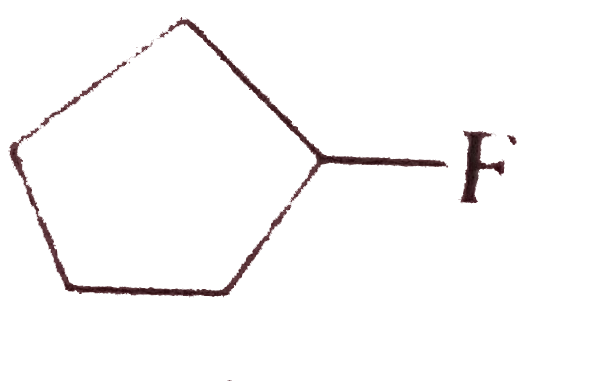
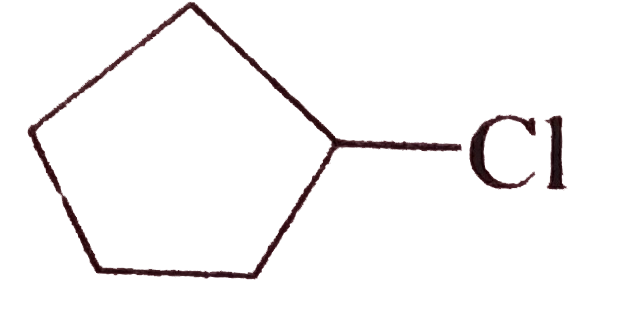
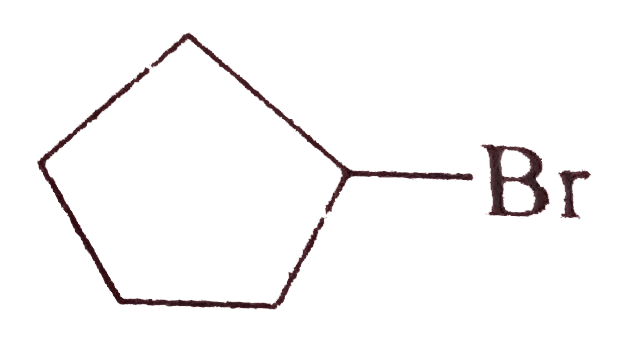
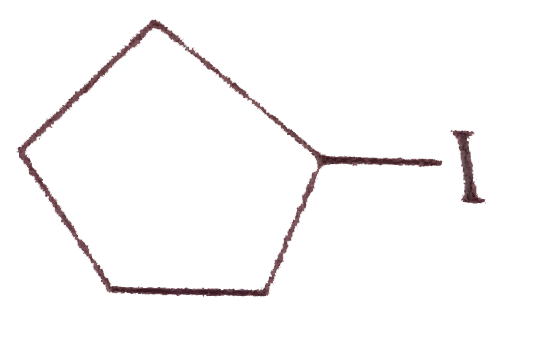
R-X+Mgoverset(Ether,Delta)rarroverset(delta-)R-overset(delta+)Mg-X Grignard reagents may be prepared from 1^(@) , 2^(@)" and "3^(@) halides as well as from vinayl and aryl halide. Vicinal dihalide and those halide which contain acidic tail do not form Grignard reagent. Which of the following halides is most reactive for the preparation of Grignard reagent? |
|
Answer»
|
|
| 4. |
R-X + NaI overset("Dry Acetone")toRI + NaX. This reaction is known as………………… |
| Answer» SOLUTION :FINKELSTEIN REACTION | |
| 5. |
R - X + Mg overset("ether". Delta)(to) overset(delta-)( R) - overset(delta+)(Mg) XGrignand reagent may be prepared from 1^@, 2^@ and3^@halides as well as from Vinyl and Aryl halide, vicinal dihalides are those halides which contain acidic tail do not form Grignand reagent.Which of the following halide is most reactive for preparation of Grignand reagent |
|
Answer»

|
|
| 6. |
R-underset(N-OH)underset("||")C-R'overset(PCl_(5))rarrR'-overset(O)overset("||")C-NH-R Which of the following statements are correct for above reaction ? |
|
Answer» Reaction is intermolecular |
|
| 7. |
R-overset(O)overset(||)C-NH_(2)+xNaOH+Br_(2)rarrR-NH_(2)+2NaBr+Na_(2)CO_(3)+H_(2)O Number of moles of NaOH used in above Hoffmann bromamide reaction is : |
|
Answer» 3 |
|
| 8. |
R - oversetunderset(||)(O)(C ) - Cl + Z to R - oversetunderset(||)(O)(C ) - RThe reagent Z is |
|
Answer» `R_2CuLi` |
|
| 9. |
R - overset(O)overset(||)(C) - OR' underset((ii) HNO_(2))overset((i)NH_(2)NH_(2))rarr A underset((iv) NaOH) overset((iii) C_(2)H_(5)OH) rarr B Identify A and B in the above reaction |
|
Answer» `RCHO, RCOOH, |
|
| 10. |
R-overset(O)overset(||)N to O and R-O-N = O are a pair of |
|
Answer» CHAIN isomers |
|
| 11. |
R-overset(O)overset(||)C-Roverset(?)rarr-R Idenitify the number of reagents that can be used for above conversion. |
|
Answer» |
|
| 12. |
R-overset(O)overset(||)C-H+ NH_3 + HCN to A overset(H_3 O^(+))to Brespectively A and B can be |
|
Answer»
|
|
| 13. |
R-overset(O)overset(||)(C)-Cl overset(NH_(3))toNH_(4)Cl+(X) overset(P_(4)O_(10))underset(Delta)to(Y) overset((i) DIBAL -H)underset((ii)H_(2)O)to(Z) The compound (Z) is |
|
Answer» R-COOH |
|
| 14. |
R-overset+overset(NH_3)overset|CH-COO^(-) overset(pH=12)to R-oversetoverset(NH_2)|CH-COO^(-) overset(H^+) to Zcompound Z is |
|
Answer» `R-oversetoverset(NH_2)|CH-COO^-` |
|
| 15. |
R-OH + HX to R-X + H_(2)O. In this reaction, the reactivity of alcohols is |
|
Answer» TERTIARY GT SECONDARY gt PRIMARY |
|
| 16. |
R-OH +SOCl_2 overset("Pyridine") to R-Cl+SO_2+HCl Pyridine in the above reaction - |
|
Answer» CATALYSES the reaction |
|
| 17. |
R-OH + HX rarr R - X + H_(2)O In the above reaction, the reactivity of different alcohols is |
|
Answer» TERTIARY `GT` SECONDARY `gt` PRIMARY |
|
| 18. |
R-OH chrial central and is optically active. It is subjected to following reaction : I ROH overset(PCl_(5)) tooverset(Alc. KOH) to II ROHoverset(PCl_(5)) tooverset(Ag_(2)O""//H_(2)O) to Configruation about chiral centre is retainedin |
| Answer» Answer :B | |
| 19. |
R- OH+ HCl underset(Delta)overset("Anhy." ZnCl_(2))to X+ H_2O What is X? |
|
Answer» R- Cl |
|
| 20. |
R-O-R' + HI overset"cold"to ROH+R'+I If R contains three carbon atoms then how many carbon atoms are in R' ? |
|
Answer» 2 |
|
| 21. |
R - NO_(2) overset(Sn + conc.Hcl)to X.Inthisreaction Xis |
| Answer» Answer :B | |
| 22. |
R-NH_(2)+xKOH+CHCl_(3) to R-N-=CH where x is moles of KOH consumed, and is equal to |
|
Answer» 1 |
|
| 23. |
R-NH_2 + underset"(excess)"(CH_3COCl)to A The product (A) will be- |
|
Answer» `RNHCOCH_3` 
|
|
| 24. |
R-NH-COHunderset("pyridine")overset(POCl_(3))rarr product |
|
Answer» `R-N=C=O` |
|
| 25. |
R-N equiv C+HgO rarr A+Hg_2O, What is A: |
|
Answer» `RNH_2` |
|
| 27. |
R-COOH to R-CH_(2)-OH. Name the reagent used in this conversion. |
| Answer» SOLUTION :`LiAlH_(4)` is PRESENCE of THF. | |
| 28. |
R-COOH+(CF_(3)CO)_(2)OrarrX overset(R'-OH)rarrY+Z: |
|
Answer» `Y " is "R'-underset(O)underset("||")C-O-R` |
|
| 30. |
R_1 - COCl+R_2 C d -> CdCl+X The organic compound 'X' is |
|
Answer» a KETONE |
|
| 31. |
R- COCl is converted into aldehyde by using |
|
Answer» `PD . BaSO_(4)+` quinoline |
|
| 32. |
R-CN" and "R-overset(overset(O)(||))(C)-NH_(2) both can be reduced to R-CH_(2)-NH_(2) by using suitable reducing agents. |
|
Answer» |
|
| 33. |
R -COCH_3 overset( X_2//OH^(-))to CHX_3 +"Carboxylate ion"overset( H^+)to Carboxylic acid . In the above sequence, the carboxylic acid obtained is |
|
Answer» ` CH_3 COOH` |
|
| 34. |
R-Cl is hydrolysed to R-OH slowly but the reaction is rapid in presence of KI as catalyst. Explain. |
|
Answer» SOLUTION :KI supplies `L^(-)` ion which is strong nucleophile and hence reacts RAPIDLY with R-Cl to form `R-I. I^(-)` is also a better leaving GROUP than `Cl^(-)` . Hence R-I is HYDROLYSED rapidly to form R-OH and `I^(-).. I^(-)`ion is again used in converting R-Cl to R-I. `R-Cl + H_2O overset("slow)(rarr)R-OH+Cl^(-)` `R-Cl + I^(-) underset(-Cl^(-))overset("fast")(rarr) R - I underset("fast")overset(+H_2O)(rarr)R-OH` |
|
| 35. |
R - CO - R'overset(HCN) to A overset(B) to R - underset(CH_(2)-NH_(2)) underset(|) overset(OH) overset(|) (C) - R A and B are |
|
Answer» `A = R - underset(CN) underset(|) overset(OH) overset(|) (C) - R'""B = NA + C_(2) H_(5)OH` |
|
| 36. |
R-CO-NH_2 overset(Br_2//KOH)to RNH_2 which of the following are formed as species/compounds in the above conversion. |
|
Answer» `RCONHBr` 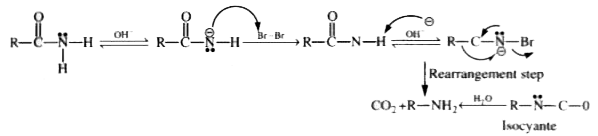
|
|
| 37. |
R-CH=CH-CHO+NH_(2)-overset(O)overset("||")C-NHNH_(2)overset(H^(+))to X (X) in the above reaction is |
|
Answer» `R-CH=CH-overset(OH)overset(|)(CH)-NH_(2)CONHNH_(2)` |
|
| 38. |
R-CH=CH_2underset( C_2H_5OH)overset(Na//NH_3(l))rarrRCH_2CH_3 |
|
Answer» CLEMMENSEN reduction |
|
| 39. |
R - CH = CH_(2) + CO + H_(2) overset(High Temp) underset (High Pressure) to RCH_(2) CH_(2) CHO. |
|
Answer» Mendius REACTION |
|
| 40. |
R- CH_(2)OH underset([O]CH_(2)Cl_(2))overset("PCC")to X What is X ? |
|
Answer» R-COOH |
|
| 41. |
R-CH_(2)-overset(O)overset("||")C-OH overset(P//Cl_(2))underset(H_(2)O)rarrR-overset(Cl)overset(|)CH-overset(O)overset("||")C-OH Which of the following are intermediate species reponsible for product ? |
|
Answer» `R-CH_(2)-overset(O)overset("||")C-CL` |
|
| 42. |
R- CH_(2)OH underset(Na_2Cr_2O_7//H_2SO_4-H_(2)O)overset([O])to X ,What is X? |
|
Answer» R-COOH |
|
| 43. |
R - CH_(2)_CH_(2) OH can be converted into RCH_(2)COOH. The reaction is |
|
Answer» reduction `RCH_(2) CH_(2) OH overset("Oxidation ") to RCH_(2)COOH`. |
|
| 44. |
R - CH_(2) - NO_(2) overset(Dil.H_(2) SO_(4)) to A+ B A, B arerespectively |
|
Answer» R-COONH, `NH_(2) OH` |
|
| 45. |
R-CH_(2)-CH_(2)OH can be converted into RCH_(2)CH_(2)COOH. The correct sequence of reagents is |
|
Answer» `PB r_(3),KCN,H^(+)`<BR>`PBr_(3),KCN,H_(2)` |
|
| 46. |
R-CH_2-CH_2OH can be converted into RCH_2CH_2COOH. The correct sequence of reagent is |
|
Answer» `PBr_3 , KCN , H^+` |
|
| 47. |
R-CH_2-C Cl_2-Roverset"Reagent"to R-C-=C-R The reagent is |
|
Answer» Na This REACTION is an EXAMPLE of dehydrohalogenation . Hence, alcoholicKOH is USED as a REAGENT |
|
| 48. |
R - CH_(2) - CH_(2) - OH can be convertedinto R - CH_(2) - CH_(2) - COOH. Thecorrectsequenceof regentsis . |
|
Answer» `PBr_(3) ,KCN, H^(+)` 
|
|
| 49. |
R-CH_2 -CH_2 OH can be converted into RCH_2 CH_2 COOH. The correct sequence of reagents is : |
|
Answer» `PBr_3 , KCN , H_3O^(+) ` |
|
| 50. |
R - CH = CH_(2) + CO + H_(2) underset("High pressure" ) overset("High temp")(rarr) RCH_(2) CH_(2)CHO. the above reaction is |
|
Answer» Mendius reaction |
|