

Saved Bookmarks
This section includes 7 InterviewSolutions, each offering curated multiple-choice questions to sharpen your Current Affairs knowledge and support exam preparation. Choose a topic below to get started.
| 2. |
Name three types of RNA molecules which perform different functions. |
| Answer» SOLUTION :`MRNA , RRNA , rRNA` | |
| 3. |
Name three oxoacids of nitrogen. Write the disproportionation reaction of that oxoacid of nitrogen in which nitrogen is in (+3) oxidation state. |
|
Answer» Solution :Three OXOACIDS of nitrogen are : (i) NITROUS acid - `HNO_(2)` (ii) Nitric acid -`HNO_(3)` (iii) Hyponitrous acid - `H_(2)N_(2)O_(2)` `underset(+3)(3HNO_(2)) overset("disproportionation")to underset(+5)(HNO_(3)) + H_(2)O + underset(+2)(2NO)` |
|
| 4. |
Name three oxacids of nitrogen. Write the disproportionation reaction of that oxacid of nitrogen in which nitrogen is in +3 oxidation state. |
|
Answer» Solution :Three oxoacids of nitrogen are : (i) `HNO_(2)`, NITROUS acid (ii) `HNO_(3)`, nitric acid and `H_(2)N_(2)O_(2)`, hyponitrous acid. O.S. of N in `HNO_(2) = (+1) + x + 2 (-2) = 0 or x = +3` `OVERSET(+3)(3HNO_(2))overset("Disproportionation")(rarr) overset(+5)(HNO)_(3)+overset(+2)(2NO) + H_(2)O` |
|
| 6. |
Name three metals which are rendered passive to conc. HNO_3. |
| Answer» SOLUTION :Al, CR and NI are passive to conc. `HNO_3` (due to formation of a LAYER of oxide on the surface of metal, which prevents further REACTION). | |
| 7. |
Name the elementthat are included in the nitrogen family. |
| Answer» SOLUTION :PHOSPHORUS, ARSENIC and animony | |
| 8. |
Name three allotropes of phosphorus. Which out of these is most reactive? |
| Answer» Solution :(i) WHITE or YELLOW phosphorus (ii) Red phosphorus (iii) BLACK phosphorus. Out of these three FORMS, yellow or white phosphorus is most REACTIVE. | |
| 10. |
Name the vitamins whose deficiency is responsible for. (i) night blindness (ii) poor coagulation of blood. |
|
Answer» Solution :(i) Vitamin A DEFICIENCY is responsible for night BLINDNESS. (ii) Vitamin K deficiency is responsible for POOR coagulation of BLOOD. |
|
| 11. |
Name the Vitamins whose deficiency cause. i) rickets ii) scurvy |
Answer» SOLUTION :
|
|
| 12. |
Name the vitamins deficiency of which causes (i) rickets (ii) night blindness. (iii) Seurvy. |
|
Answer» SOLUTION :(i) VITAMIN D, (II) Vitamin A, (III) Vitamin C. |
|
| 13. |
Name the Vitamins whosedeficiencycause (i) rickets (ii) scurvy . |
|
Answer» SOLUTION :(i) VITAMIN - Ddeficiency causericketsdisease . (II) Vitamin - Cdeficiencycausescurvy DISEASE. |
|
| 14. |
Name the vitamins whose deficiency cause (i) rickets (ii) night blindness, (iii) scurvy. |
| Answer» SOLUTION :(i) VITAMIN D (II) Vitamin A (III) Vitamin C | |
| 17. |
Name the various hydrides of group 16 elements. Arrange these hydrides in their decreasing order of (i) Volatility (ii) Bond angle (iii) Acidic characterH_2Sis less acidic thanH_2Te1, why (iv) Thermal stability and (v) Reducing character. |
|
Answer» Solution :HYDRIDES of group 16 ELEMENTS. All the elements of group 16 form hydrides such as `H_2O, H_2S, H_2 Se, H_2 Te ` and `H_2 Po` . Water is a colourless, odourless liquid while hydrides of the other elements of this group are colourless, bad smelling, poisonous gases. TRENDS in characteristics : (i) Volatility. All the hydrides are volatile. The volatility increases from H20 to H S and then decreases. This is clear from their boiling points as given ahead : `H_2O "" H_2S "" H_2Te ""H_2Se` `373K ""213K ""232K ""269K` Thus, the TREND of volatility is `H_2O lt H_2S gt H_2Te gt H_2Se` The high boiling point and, therefore, low volatility of water is due to the association of `H_2O`molecules through hydrogen bonding. (ii) Bond angle. The bond angles H-X-H in the hydrides `H_2O, H_2S, H_2Se `and `H_2 Te`decrease as we move from `H_2O` to `H_2Te`as shown below: Hydride`H_2O "" H_2S "" H_2Se "" H_2Te` Bond angle`104.5^@ "" 92.1^@ "" 91^@ "" 90^@` thus `H_2O gt H_2S gt H_2Se gt H_2Te` (iii) Acidic character. The hydrides of this group are weakly acidic in character. The acidic character increases from `H_2O` to `H_2Te`as : `MH_2Te gt H_2Se gt H_2S gt H_2O` The increase of acidic character from `H_2O`to `H_2Te`can be explained on the basis of size of the central atom. As the size of the central atom increases in the order O < S < Se < Te, the distance between the central atom and hydrogen also increases. As a result of increase in bond length, the bond dissociation energy decreases and bond cleavage gets more and more easy. Therefore, the acidic strength of the hydride increases down the group. (iv) Thermal stability. The thermal stability of the hydrides decreases from `H_2O` to `H_2Te`as : `H_2O gt H_2S gt H_2Se gt H_2Te` (v) Reducing character. All the hydrides except water are reducing agents. The reducing power of these hydrides increases from `H_2O` to `H_2Te` . This is due to the decrease in thermal stability of the hydrides. `H_2Te gt H_2Se gt H_2S gt H_2O` |
|
| 18. |
Name the various refining process. |
| Answer» SOLUTION :Distillation, liquation, electrolytic refining, zone refining, VAPOUR PHASE METHOD, van-Arkel method. | |
| 20. |
Name the unit formed by the attachment of a base to 1' Position of sugar in a nucleoside . |
|
Answer» |
|
| 21. |
Name the types of interhalogen compounds ? Give examples. |
|
Answer» Solution :Interhalogen compounds are of four types. (i) XY TYPE : Example : `CLF, BrF, IF, BrCl, IC l`. (ii) `XY_(3)` type : Example : `ClF_(3), BrF_(3), IF_(3), IC l_(3).` (III) `XY_(5)` type : Example : `IF_(5), BrF_(5), ClF_(5)` (iv) `XY_(7)` type : Example : `IF_(7)` |
|
| 22. |
Name the types of solutions . |
| Answer» SOLUTION :SOLID solution, LIQUID solution and GASEOUS solution . | |
| 24. |
Name the type of potential difference produced between the fixed charged layer and diffused layer having opposite charges around the colloidal particle. |
| Answer» SOLUTION : It is CALLED electrokinetic POTENTIAL or ZETA potential. | |
| 25. |
Name the type of potential difference produced between the fixed charge layer and diffused layer having opposite charges around the colloidal particle. |
| Answer» SOLUTION :ZETA POTENTIAL. | |
| 26. |
Name the type of isomerism when ambidentate ligands are attached to control metal ion. Give two examples of ambidentate ligands. |
|
Answer» Solution :The type of isomerism when AMBIDENTATE LIGANDS are attached to CENTRAL METAL ion is called LINKAGE isomerism. Examples : 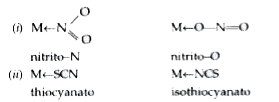
|
|
| 27. |
Name the type of isomerism when ambidentate ligands are attached to central metal ion. Give two examples of ambidentate ligands. |
Answer» SOLUTION :LINKAGE ISOMERISM. 
|
|
| 28. |
Name the type of isomerism that occurs in complex in which both cation and anion are complex ions. |
| Answer» SOLUTION :COORDINATION ISOMERISM | |
| 29. |
Name the type of isomerism exhibited by the following isomers : [Pt(NH_(3))_(4)][PtCl_(6)] and [Pt(NH_(3))_(4)Cl_(2)][PtCl_(4)] |
| Answer» SOLUTION :COORDINATION ISOMERISM. | |
| 30. |
Name the type of hybridisation in nitrogen orbitals in amines. |
|
Answer» |
|
| 31. |
Name the type of drugs having following structural formula : |
Answer» SOLUTION :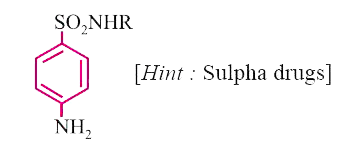
|
|
| 32. |
Name the type of colloid obtained when (i) a liquid is dispersed in a solid (ii) a liquid is dispersed in a liquid. |
| Answer» SOLUTION :(i) GEL (II) EMULSION. | |
| 33. |
Name the type of colloid obtained when. (i) A liquid is dispersed in a solid (ii) A liquid is dispersed in a liquid. |
| Answer» SOLUTION :(i) GEL. (II) EMULSION | |
| 34. |
Name the type of cell which was used in Apollo space programme for providing electrical power. |
| Answer» Solution :Bacause in the OVERALL REACTION, the CONCENTRATION of NONE of the species involved in the reaction changes. | |
| 35. |
Name the type of carbonyl compound which on oxidation gives a carboxylic acid with lesser number of carbon atoms. |
| Answer» Solution :Ketone is the type of CARBONYL compound which on oxidation GIVES a carboxylic acid with LESSER NUMBER of carbon atoms. | |
| 36. |
Name the two types of nucleic acids. |
| Answer» Solution :Two TYPES of NUCLEIC acids are deoxyribonucleic acid (DNA) and RIBONUCLEIC acid (RNA). | |
| 37. |
Namethe typeof bondingwhichstabilies alpha - helixstructurein proteins. |
| Answer» SOLUTION :IntramolecularH - bondingstabilises `ALPHA` - helixstructure in PROTEINS. | |
| 39. |
Name the two types of adsorption phenomenon. |
|
Answer» Solution :(i) PHYSICAL adsorption or PHYSISORPTION. (ii) CHEMICAL adsorption or CHEMISORPTION |
|
| 40. |
Name the two groups into which polymers are classified on the basis of magnitude of intermolecular forces. |
|
Answer» Solution : (i) ELASTOMERS (II) Fibres (iii) Thermoplastic polymers (IV) THERMOSETTING polymers |
|
| 41. |
Name the two groups into which the phenomenon of catalysis can be divided. Give an example of each group with the chemical equation involved. |
|
Answer» SOLUTION :CATALYSIS is of two types : (i) Homogeneous catalysis : A CATALYTIC reaction in which the reacting SUBSTANCE and the catalyst are in the same phase is called homogeneous catalysis. For example: `CH_3COOH_3(l) + H_2O (l) overset(HCl)to CH_3COOH (l) + CH_3OH(l)` (ii) Heterogeneous catalysis: A catalytic reaction in which the reacting substance and the catalyst are in different phases is called heterogeneous catalysis. These catalysts are usually SOLIDS. This type of catalysis is also called surface catalysis. For example: `2SO_2 (g) + O_2(g) overset(V_2O_5)to 2SO_3(g)` |
|
| 42. |
Name the two groups into which phenomenon of catalysis can be divided. Given an example of each group with the chemical equation involved. |
| Answer» | |
| 43. |
Name the two groups into which phenomenon of catalysis can be divided. Give an example of each groups with the chemical equation involved. |
|
Answer» Solution :CATALYSIS can be DIVIDED into : (a) Homogeneous catalysis (b) HETEROGENEOUS catalysis In homogeneous catalysis the catalysis exist in the same PHASE as the reacting SUBSTANCES . `2SO_2(g) + O_(2)(g) overset(NO_((g)))(rarr)2SO_3(g)` Heterogeneous catalysis involves the catalysis in different phase than that of the reactants. `2HI(g) overset("Gold"(s))(rarr)H_2(g) + I_2(g)`. |
|
| 44. |
Name the two constituent of starch. |
|
Answer» Solution :Starch CONSISTS of TWO fraction (i) AMYLASE and (II) amylopectin |
|
| 45. |
Namethe twocomponents of strach. Howdo they differfrom each otherstructurally? |
|
Answer» Solution :AMYLOSE andamylopectin. Amylosein linearpolymerof `alpha` -GLUCOSE whereas AMYLOPECTIN is branched CHAIN polymer of `alpha` - glucose. |
|
| 46. |
Name the two components starch is made up of. How do they differ from each other. |
Answer» Solution :STARCH consist of TWO components AMYLOSE and AMYLOPECTIN. 
|
|
| 47. |
Name the two components of starch. How do they differ from each other structurally ? |
|
Answer» Solution :Starch consists of TWO components (i) amylose and (ii) amylopection. Although , both these components are made of `alpha` - D-glucose units yet they differ in the manner in which the different `alpha`-D-glucose units are linked to one another. Amylose is a linear condersation polymer of `alpha`-D-glucose in which `C_1` of one glucose unit attached to `C_4` of the other through `alpha`-GLYCOSIDIC linkage as shown in FIG. (ii) Amylopectin , on the other hand is a highly branched polymer. It consists of a large number (several HUNDREDS ) of short chains each CONTAINING `20-25` glucose units which are joined together through `alpha` -glycosidic linkages involving `C_2` of one glucose unit with `C_4` of the other. The `C_1` of terminal glucose unit in each chain is further linked to `C_6` of some other glucose unit in the next chain through `C_1-C_6 alpha` -glycosidic linkage.This gives amylopectin a highly branched structure as shown in fig. |
|
| 48. |
Name the two broad categories of organometallic compounds ? |
| Answer» Solution :(i) `sigma`-bond(ii) `sigma`-bonded ORGANOMETALLIC COMPOUND. | |