

Saved Bookmarks
This section includes 7 InterviewSolutions, each offering curated multiple-choice questions to sharpen your Current Affairs knowledge and support exam preparation. Choose a topic below to get started.
| 2. |
Name the synthetic material for preparing Nylon-66. |
| Answer» SOLUTION :HEXAMETHYLENE DIAMINE and ADIPIC ACID. | |
| 3. |
Name the sweetening agent used in the preparation of sweets for a diabetic patient. |
| Answer» SOLUTION :Sucrolose is an APPROPRIATE sweetening agent because it is stable at COOKING TEMPERATURE. | |
| 4. |
Name the sweetening agent used in the preparation of sweet for a diabetic patient . |
| Answer» Solution :Any artificial SWEETENING AGENT such as ASPARTAME MAY be added. | |
| 5. |
Name the sweetening agent used in the cooking of sweets for a diabetic patient. |
| Answer» SOLUTION :SUCRALOSE | |
| 6. |
Name the sugar present in RNA |
|
Answer» D-ribose |
|
| 7. |
Name the sugar present in milk. How many monosaccharide units are present in it ? |
| Answer» Solution :Sugar present in MILK (i.e., milk sugar ) is CALLED lactose . Two monosaccharide UNITS (i.e., GLUCOSE and galactose) are present in it . Such oligosaccharides are called disaccharides. | |
| 8. |
Name the sugar present in milk. How many monosaccharide units are present in it? What are such oligosaccharides called ? |
| Answer» SOLUTION :Lactose. Two monosaccharide UNITS are PRESENT. Such oligosaccharides are CALLED disaccharides. | |
| 9. |
Name the sugar present in milk. How many monosaccharide units are present in it ? What are such oligosaccharides called ? |
| Answer» Solution :The SUGAR present in the milk is LACTOSE. Lactose is a disaccharide in which D-Galactose and D- Glucose units are linked by C1-O-C4 glycosidic LINKAGE. So, on hydrolysis it will give one UNIT of D-Galactose and one MOLECULE of D-Glucose. | |
| 10. |
Name the sugar moiety present in DNA. |
| Answer» SOLUTION :DEOXYRIBOSE | |
| 12. |
Name the substance which on heating with water at 533-543 K gives nylon 6. |
| Answer» SOLUTION :CAPROLACTUM | |
| 13. |
Name the substance which can act as both (i) Analgesic and antipyretic , (ii)Antiseptic and disinfectant. |
| Answer» SOLUTION :(i) ASPIRIN. (ii) 0.2% solution of PHENOL acts as an antiseptic whereas 1% solution acts as a disinfectant | |
| 14. |
Name the substance which are good shape-selective catalysts because of their honey-comb structure. |
| Answer» SOLUTION :ZEOLITES | |
| 15. |
Name the substance used as depressant in the sepressant in the saparation of two sulphide ores in Froth floatation method . |
|
Answer» |
|
| 16. |
Name the sub-groups into which polymers are classified on the basis of magnitude of intermolecular forces. |
|
Answer» Solution :The polymers are classified into the following four sub groups on the basis of magnitude of intermolecular forces present in them. 1. Elastomers : These are rubber-like solid with elastic properties. In these elastomeric polymers, the polymer chain are held together by weakest intermolecular forces. 2. Fibres : These are the thread FORMING solids which possess high tensile strength and high modulus. These characteristics can be attributed to the STRONG intermolecular forces like hydrogen bonding. 3. Thermoplastic polymers : These are linear or SLIGHTLY branched long chain molecules capable of repeatedly softening on-heating and hardening on cooling. Ex-Polyethene. 4. Thermosetting polymers : These polymers are linked or heavily branched molecules, which on heating undergo extensive cross LINKING in moulds and again become infusible. These cannot be reused. Some common examples are bakelite, urea-formaldehyde resins,. etc. |
|
| 17. |
Name the state of hybridisation of orbitals in XeF_2 molecule. |
| Answer» SOLUTION :`SP^(3)d` HYBRIDISATION. | |
| 21. |
Name the species formed when an aqueous solution of amino acid is dissolved in water . |
|
Answer» |
|
| 22. |
Name the slag formed in the extraction of iron/copper. |
|
Answer» SOLUTION :EXTRACTION of iron : Calcium silicate `(CaSiO_(3))` Extraction of COPPER : Ferrous silicate `(FeSiO_(3))` |
|
| 23. |
Name the site other than the active site to which the drugs bind to the enzymes. |
| Answer» SOLUTION :ALLOSTERIC | |
| 24. |
Name the series of salts that are formed by orthophosphoric acid with sodium hydroxide. |
|
Answer» SOLUTION :(i) Sodium dihydrogen PHOSPHATE `(NaH_2PO_4)` (ii) Disodium hydrogen phosphate `(Na_2HPO_4)` (III) Sodium phosphate `(Na_3PO_4)`. |
|
| 25. |
Name the scientist who gave the relationbetween rate of a chemical reaction and temperature. |
| Answer» SOLUTION :ARRHENIUS | |
| 26. |
Name the rifining process where a low melting metal can be made to flow on a sloping surface. |
| Answer» SOLUTION :LIQUATION. | |
| 27. |
NamethereducingagenttoobtainironfromFe_2 O _ 3athigh temperature. |
|
Answer» Solution :Cokereduces ` Fe_2O _3` toFemetalathightemperature. `FE _2 O _3 (s)+3C (s) overset ("HIGH temperature") to2Fe(s//l) +3CO(G)` |
|
| 30. |
Name the reducing agent used in the extraction of zinc from zinc oxide. Write the chemical equation for this reaction. |
|
Answer» SOLUTION :Reducing AGENT - COKE `ZnO + C RARR Zn + CO`. |
|
| 31. |
Name the reagents which are used in the following conversions : (i) A primary alcohol to an aldehyde. (ii) Butan-2-one to butan-2-ol. (iii) Phenol to 2, 4, 6 - tribromophenol. |
|
Answer» SOLUTION :(i) Reagent is pyridinium chlorochromate (PCC), a COMPLEX of chromium trioxide with PYRIDINE and HCl. `underset("PRIMARY alcohol")(R-CH_(2)OH) overset(PCC) rarr underset("Aldehyde")(R-CHO)` (ii) Reagent is `NaBH_(4)`, SODIUM borohydride. `underset("Butan-2-one")(CH_(3)CH_(2)-overset(O)overset(||)C-CH_(3))overset(NaBH_(4))rarr underset("Butan-2-ol")(CH_(3)CH_(2)overset(OH)overset("|")"CH"CH_(3))` (iii) Reagent is bromine water. 
|
|
| 32. |
Name the reagents whch are used in the following conversions : (i) A primary alcohol to an aldehyde(ii) Butan-2-one to butan-2-ol (iii) Phenol to 2, 4, 6-tribromophenol |
|
Answer» Solution :(i) Pyridinium chlorochromate (PC C) a complex of CHROMIUM trioxide with pyridine and HCl `CH_(3)-CH=CH-CH_(2)OH overset("PCC")rarrCH_(3)-CH=CH-CHO` (ii)`Ni//H_(2) " Or "LiAl H_(4) " Or " NaBH_(4)` (iii) AQUEOUS bromine or bromine water 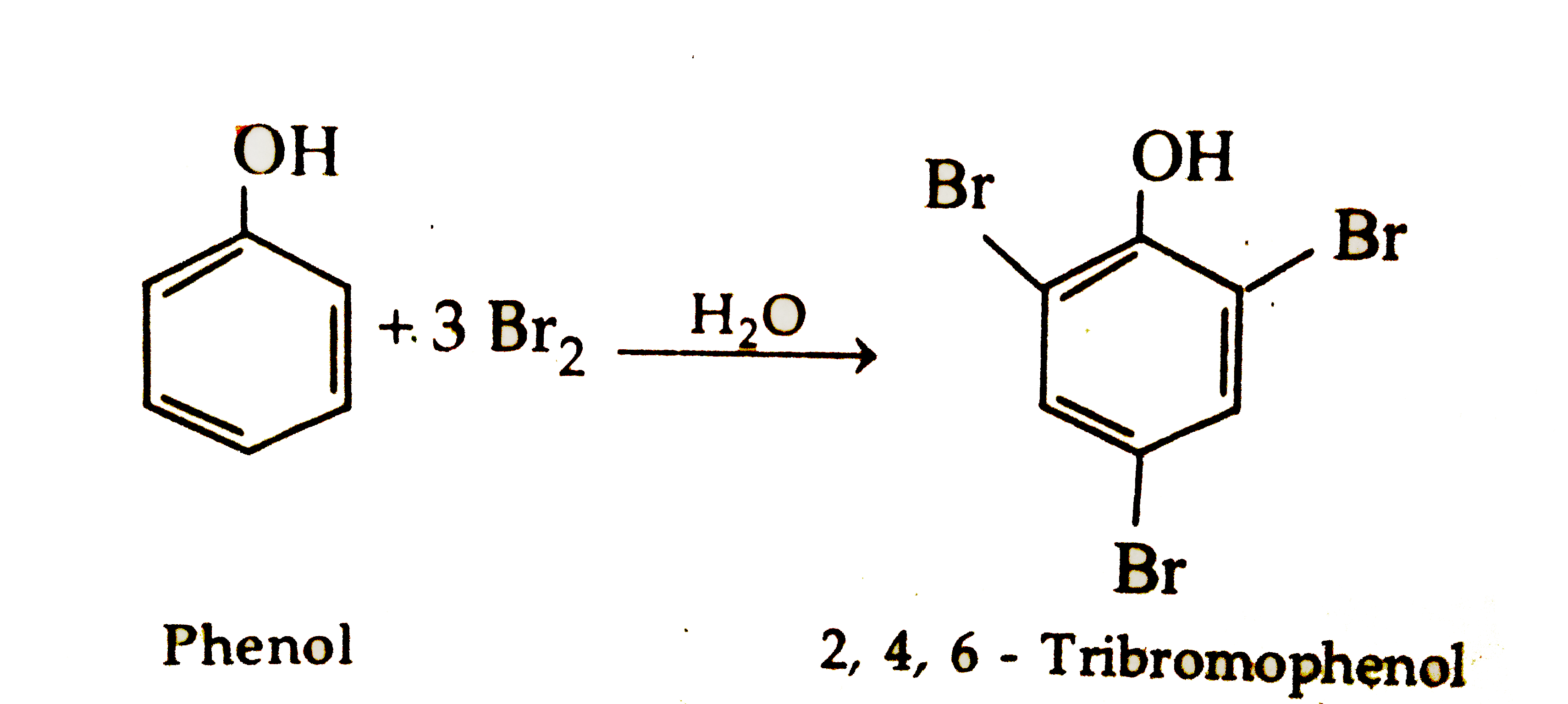
|
|
| 33. |
Name the reagents used to convert phenol into(1) picric acid (2) 2,4,6-tribromophenol (3) Benzene (4) o-phenol sulphonic acid. |
|
Answer» SOLUTION :(1) The reagent used to convert phenol into PICRIC ACID is concentrated NITRIC acid. (2) The reagent used to convert phenol into 2, 4, 6-tribromophenol is bromine water. (3) The reagent used to convert phenol into benzene is zinc dust. (4) The reagent used to convert phenol into o-phenol sulphonic acid is dilute sulphuric acid. |
|
| 34. |
Name the reagents used in the following reactions : (i) Oxidation of a primary alcohol to carboxylic acid, (ii) Oxidation of a primary alcohol to aldehyde. (iii) Bromination of phenol to 2, 4, 6 - tribromophenol. (iv) Benzyl alcohol to benzoic acid. (v) Dehydration of propan -2- ol to propene. (vi) Butan -2- one to butan -2- ol. |
|
Answer» Solution :(i) Acidified postassium dichromate or, neutral, acidic or alkaline postassium permanganate. (II) Pyridinium chlorochromate `("PCC"), C_(5)H_(5)overset(+)NHClCrO_(3)^(-)" in "CH_(2)Cl_(2)` or Pyridinium dichromate `("PDC"),(C_(5)H_(5)NH)_(2)Cr_(2)O_(7)^(2-)" in "CH_(2)Cl_(2)` (III) Aqueous bromine, i.e., `Br_(2)//H_(2)O`. (IV) Acidified or alkaline potassium permanganate. (v) Conc. `H_(2)SO_(4)` at 433 - 443 K or `85%` phosphoric acid at 443 K. (vi) `Ni//H_(2) or NaBH_(4) or LiAlH_(4)`. |
|
| 35. |
Name the reagents used in the following reactions : (i) Oxidation of a primary alcohol to carboxylic acid. (ii) Oxidation of a primary alcohol to aldehyde. of phenol (iii) Bromination tribromophenol. to 2,4,6 (iv) Benzyl alcohol to benzoic acid. (v) Dehydration of propan-2-ol to propene. (vi) Butan-2-one to butan-2-ol. |
|
Answer» Solution :(i) Alkaline` KMnO_(4)` (II) Pyridinium CHLOROCHROMATE in `CH_(2)Cl_(2)` (iii) `Br_(2)//H_(2)O` (iv) CONC. `H_(2)SO_(4)` (V) `LiAlH_(4)//H_(2)O` or `NaBH_(4)//H_(2)O` or `H_(2)//Pd` |
|
| 36. |
Name the reagents used in the following reactions: (i) CH_(3)-CHOoverset(?)(to)CH_(3)-underset(OH)underset(|)(CH)-CH_(3) (ii) CH_(3)-COOHoverset(?)(to)CH_(3)-COCl |
|
Answer» SOLUTION :(i) `CH_(3)-CHOoverset(CH_(3)MgBr)(to)CH_(3)-UNDERSET(OH)underset(|)(CH)-CH_(3)` (ii) `CH_(3)-COOHoverset(PCl_(5))(to)CH_(3)-COCl` |
|
| 37. |
Name the reagent that can be used to convert (i) A primary alcohol to an aldehyde (ii) Butan-2-one to butan -2-ol. |
| Answer» SOLUTION :(i) Pyridine chlorochromate (PCC) (ii) `LiAlH_(4)`. | |
| 38. |
Name the reagents used in the following reactions ? |
| Answer» SOLUTION :`CH_(3)MgBr//H_(3)O^(+)` , (II) `PCl_(5)or PCl_(5) or SOCl_(2).` | |
| 39. |
Name the reagents I the following reactions: (i) Oxidation of a primary alcohol to a carboxylic acid (ii) Oxidation of a primary alcohol to an aldehyde. (iii) Bromination of phenol to 2,4,6-tribromophenol. (iv) Benzyl alcohol to benzoic acid (v) Dehydration of propan-2-ol to propene (vi) Butan-2-one to butan-2-ol. |
|
Answer» <P> Solution :(i) Acidified potassium DICHROMATE or, neutral, acidic or alkaline potassium PERMANGANATE (followed by hydrolysis with dil. `H_(2)SO_(4)`)(ii) Pyridinium chlorochromate `(P C C),C_(5)H_(5)NH^(+)CrO_(3)Cl^(-)` in `CH_(2)Cl_(2)`. or Pyridinium dichromate `(PDC)," "(C_(5)H_(5)overset(+)(NH))_(2)Cr_(2)O_(7)^(2-)` in `CH_(2)Cl_(2)`. (iii) Aqueous bromine, i.e., `Br_(2)//H_(2)O`. (iv) Acidified or alkaline potassium permanganate (followed by hydrolysis with dil. `H_(2)SO_(4)`) (v) 85% `H_(2)SO_(4)` at 440K. (vi) `Ni//H_(2)` or `NaBH_(4)` or `LiAlH_(4)`. |
|
| 40. |
Name the reagents used for the following conversions : i) Hexanol - 1 to hexanal ii) ethanenitrile to ethanal (ii) ethanenitrile to ethanal iii) Butene - 2to ethanal . |
|
Answer» Solution :i) Pyridiniumchlorochromate (PCC) II) Di ISOBUTYL aluminium hydride (DIBAL - H) iii) ozone / `H_2O` - zn dust (Reductive ozonolysis) |
|
| 41. |
Name the reagent which is used in the conversion of -COCl group into -CHO group. |
| Answer» Solution :`H_(2)` GAS is used in the conversion of `-COCL` groupusing a CATALYST PALLADIUM on barium sulphate. | |
| 42. |
Name the reagent used in the following reactions: C_(6)H_(6)-CH_(2)-CH_(3) overset(?)to C_(6)H_(5)-COO^(-)K^(+) |
|
Answer» Solution :When an alkylbenzene is heated with `KMnO_(4)-KOH`, the entire side CHAIN is oxidised to `COO^(-)K^(+)` irrespective of the length of alkyl side chain. `UNDERSET("Ethyl BENZENE")(C_(6)H_(5)-CH_(2)-CH_(3)) underset(Delta)OVERSET(KMnO_(4)-KOH)to underset("Pot. benzoate")(C_(6)H_(5)-COO^(-)K^(+))` |
|
| 43. |
Name the reagent used to convert carboxylic acids directly to the corresponding alcohols. |
| Answer» Solution :`LiAlH_(4)//`ether or `B_(2)H_(6)//`ether, i.e., `C_(6)H_(5) COOH overset("LiAlH_(4)" or "B_(2)H_(6)//"ether")toC_(6)H_(5)CH_(2)OH` | |
| 44. |
Name the reagent used in the conversion of ketone to hydrocarbon. Name the reaction. |
| Answer» SOLUTION :Zinc-Amalgam and CONC. Hydrochloric acid. The NAME of the reaction is Clemmensen REDUCTION. | |
| 45. |
Name the reagent used in reaction given below. underset("Sodium acetate")(CH_(3)-overset(O)overset(||)(C)-ONa)+overset(?)tounderset("Methane")(CH_(4)+Na_(2)CO_(3)) |
| Answer» Solution :The REAGENT USED is NaOH + CaO (sodalime). The REACTION is a DECARBOXYLATION reaction. | |
| 46. |
Name the reagent used in the conversion of benzene diazonium halide to aryl halide. |
| Answer» SOLUTION :`Cu_(2)X_(2)` | |
| 47. |
Name the reagent to distinguish between 2-pentanone and 3-pentanone |
| Answer» SOLUTION :SODIUM HYPOIODITE | |
| 48. |
Name the reagent that is used in leaching of gold |
|
Answer» CARBON |
|
| 49. |
Name the reagent that is used in leaching of gold. |
|
Answer» Carbon `4Au(s)+8CN+O_2(G)+2H_2O rarr4[Au(CN)_2]^-+4OH^-` |
|
| 50. |
Name the reageants used in the following reactions: (i) CH_(3)-CO-CH_(3)overset(?)(to)CH_(3)-underset(OH)underset(|)(CH)-CH_(3) (ii) C_(6)H_(5)-CH_(2)-CH_(3)overset(?)(to)C_(6)H_(5)CO^(-)K^(+) |
|
Answer» Solution :(i) `CH_(3)-CO-CH_(3)overset(LiAlH_(4))(to)CH_(3)-UNDERSET(OH)underset(|)(CH)-CH_(3)` (ii) `C_(6)H_(5)-CH_(2)-CH_(3)underset(KOH,"Heat")overset(KMnO_(4))(to)C_(6)H_(5)COO^(-)K^(+)` |
|