

Saved Bookmarks
This section includes 7 InterviewSolutions, each offering curated multiple-choice questions to sharpen your Current Affairs knowledge and support exam preparation. Choose a topic below to get started.
| 1. |
N_(2) + 3H_(2) to 2NH_(3) molecular weight and equivalent weight of NH_(3) and N_(2) are 17.03 g,14 g and Y_(1),Y_(2)respectively. Find the value of (Y_(1)-Y_(2)). |
|
Answer» `THEREFORE E_(N_(2)) = 14/6 =Y_(2)` `therefore E_(NH_(3)) = (17.03)/3 = Y_(1)` `therefore Y_(1)-Y_(2) = (17.03)/3- X_(2)/6= 5.67 - 2.33 = 3.34` |
|
| 2. |
N_(2)+3H_(2)hArr2NH_(3)+ heat . What is the effect of the increase of temperature on theequilibrium of the reaction ? |
|
Answer» equilibrium is unaltered |
|
| 3. |
N_(2) + 3H_(2) hArr 2NH_(3)""K=4xx 10^(6)"at"298 ""K=41 "at" 400 k Which statements is correct? |
|
Answer» If `N_(2)` is added at equlibrium condition, the equilibrium will shift to the FORWARD direction because according to `II^(nd)` law of thermodynamics the entropy must increases in the direction of spontaneous reaction . |
|
| 4. |
n_(1)Cr_(2)O_(7)^(-2) + n_(2)FeC_(2)O_(4) underset("Medium")overset("Acidic")rarr n_(3)Cr^(+3) + n_(4)Fe^(+3) + n_(5)CO_(2) + n_(6)H_(2)O here n_(1), n_(2), n_(3), n_(4), n_(5) and n_(6) are simplest non fractional coefficients of the balanced redox reaction. Then value of [n_(1) + n_(2) + n_(3) + n_(4) + n_(5) + n_(6)] is : |
|
Answer» `therefore n_(1)= 1, n_(2)=2, n_(3)= 2, n_(4)= 2, n_(5)= 4, n_(6)= 7` And `(n_(1) + n_(2) + n_(3) + n_(4) + n_(5) + n_(6))= 18` |
|
| 5. |
n-valeric acid is functional isomer of |
|
Answer» METHYL propionate |
|
| 6. |
n the completecombustionof c_(n) H_(2n+2), thenumberof oxygenmolesrequiredis : |
|
Answer» `(N) /(2O_(2))` |
|
| 7. |
n-Propylmagnesium bromide on treatment with carbon dioxide and further hydrolysis gives |
|
Answer» ACETIC acid |
|
| 8. |
n-propylbromide on treatment with ethanolic potassium hydroxide produced |
|
Answer» Propane |
|
| 9. |
n-Propylamine yields a volatile compound X on warning with alc alkali and chloroform X has an offensive odour. The structure of X is |
|
Answer» `CH_(3)CH_(2)CH_(2)CN` |
|
| 10. |
n-propyle bromide on treatment with ethanolic potassium hybroxide produces : |
|
Answer» Propane |
|
| 11. |
n-Propyl chloride reacts with sodium metal in dry ether to give |
|
Answer» `CH_(3)-CH_(2)-CH_(2)-CH_(2)-CH_(2)-CH_(3)` |
|
| 12. |
n-Propyl chloride and benzene react in the presence of anhydrous AlCl_(3) to form : |
|
Answer» ETHYL BENZENE 
|
|
| 13. |
n-Propyl bromide on treatment with ethanolic potassium hydroxide produces : |
|
Answer» Propane |
|
| 14. |
n-propyl bromide on treatment with alcoholic KOH produces |
|
Answer» PROPANE |
|
| 15. |
n-propyl bromide reacts with ethanolic KOH to |
|
Answer» propane |
|
| 16. |
n-propyl bromide on treatment with ethanolic potassium hydroxide produces |
|
Answer» Propane |
|
| 17. |
n-propyl bromide on treating with alcoholic KOH produces |
|
Answer» PROPYNE This reaction REMOVES a molecule of HX and therefore, the reaction is called dehydrohalogenation. The hydrogen atom is ELIMINATED from `beta`-carbon atom (carbon atom next to the carbon to which halogen is ATTACHED). Therefore the reaction is ALSO called `beta`-elimination reaction |
|
| 18. |
n-propyl amine reactswith HNO_(2)gives |
|
Answer» ISO - propylalcohol |
|
| 19. |
n- propyl bromide on treating with alcoholic KOH produces |
|
Answer» propyne This reaction REMOVES a molecule of HX and therefor, the reaction is called dehydrohalogenation.The hydrogen atom is eliminated from `beta` CARBON atom (carbon atom NEXT to the carbon to which HALOGEN is attached). Therefore the reaction is also called `beta` - ELIMINATION reaction. |
|
| 20. |
n-Propyl alcohol and isopropyl alcohol can be chemically 5· distinguished by which reagent? |
|
Answer» `PCl_(5)` `underset("n-Propylalcohal")(CH_(3)CH_(2)CH_(2)OH)overset([O])(to) CH_(3)CH_(2)CHO overset([O])(to)CH_(3)CH_(2)COOH` 
|
|
| 21. |
n-Propyl alcohol and iso-propyl alcohol can be distinguished by |
|
Answer» using PCI On oxidation secondary alcohol gives KETONE. Iso-propyl alcohol will give a +ve IODOFORM test whereas n-propylalcohol will not. |
|
| 22. |
n-propyl alcohol and isopropyl alcohol are: |
|
Answer» POSITION isomers |
|
| 23. |
n- Prophylbenzene can be obtained in quantitative yield by (i)treating benzene with n-propyl chloride in presence of AICI_(3) (ii)treating excess of benzene with n - prophyl chloride in presence of AICI_(3) (iii) treating benzene with allyl chloride in presence of AICI_(3) followed by reduction (iv)treating benzene with propionyl chloride in presence of AICI_(3) followed by Clemmensen reduction |
|
Answer» by (II), (III) and (IV) |
|
| 24. |
N-phenyl hydroxylamine is obtained when nitro benzene is reacted with |
|
Answer» `Sn//HCl` |
|
| 25. |
n-prepyl alcohol and isopropyl alcohol can be chemically distinguished by which reagent |
|
Answer» `PCl_5` |
|
| 26. |
N-phenyl ethanmideis obtainedform CH_(3)COCOl and what |
|
Answer»

|
|
| 27. |
n-pentane and neopentane are: |
|
Answer» FUNCTIONAL isomers |
|
| 28. |
n-pentane and 2-methylbutane are a pair of |
|
Answer» Enantiomers The type of consitutional isomerism that exists between n-pentane and 2-methyl BUTANE is chain isomerism. |
|
| 30. |
n-pentane and iospentane can be distinguished by |
|
Answer» `Br_2` `underset"n-pentane"(CH_3CH_2CH_2CH_2CH_3)underset([O])OVERSET(KMnO_4)to underset(1^@"alcohol")(CH_3CH_2CH_2CH_2CH_2OH)` `CH_3CH_2-underset(CH_3)underset(|)CH-CH_3underset"[O]"overset(KMnO_4)to underset(3^@"alcohol")(CH_3CH_2-undersetunderset(CH_3)(|)oversetoverset(OH)(|)C-CH_3)` |
|
| 31. |
N, P, As, Sb and Bi are in group 15, So, Bi in its external most shell contains: |
|
Answer» THREE electrons |
|
| 32. |
'n' number of alkenes yield 2,2,3,4,4-pentamethyl-pentane on catalytic hydrogenation and 'm' number of monochloro structural isomers are possible for this compound. Report your answer as (n+m). |
|
Answer» `H_(3)C-underset(CH_(3))underset(|)overset(CH_(3))overset(|)(C )-underset(CH_(2))underset(||)(C )-underset(CH_(3))underset(|)overset(CH_(3))overset(|)(C )-CH_(3) overset(H_(2)//"catalyst") rarr`H_(3)C-underset(CH_(3))underset(|)overset(CH_(3))overset(|)(C )-underset(CH_(3))underset(|)(CH)-underset(CH_(3))underset(|)overset(CH_(3))overset(|)(C )-CH_(3)` THREE monochloro isomers are possilbe as it has three different TYPES of `'H'` atoms. |
|
| 33. |
N-N- dimethyl phenylaminereact withnitrous acids gives |
|
Answer»

|
|
| 34. |
N, N-dimethyl butanamine -2 is the functional isomer of |
|
Answer» N-butanamine -2 |
|
| 37. |
N, N - dimethyl benzamide cannot be prepared by |
|
Answer» `C_(6)H_(5)COO C_(2)H_(5)+(CH_(3))_(2)NH to` |
|
| 38. |
N-methylaniline reacts with nitrous acid to form____while N,N-dimethylaniline gives_____ |
| Answer» SOLUTION :N-nitroso-N-methylaniline, p-nitroso-N , N-dimethylaniline | |
| 39. |
N-Methyl aniline into N-Methyl benzanilide ? |
Answer» SOLUTION :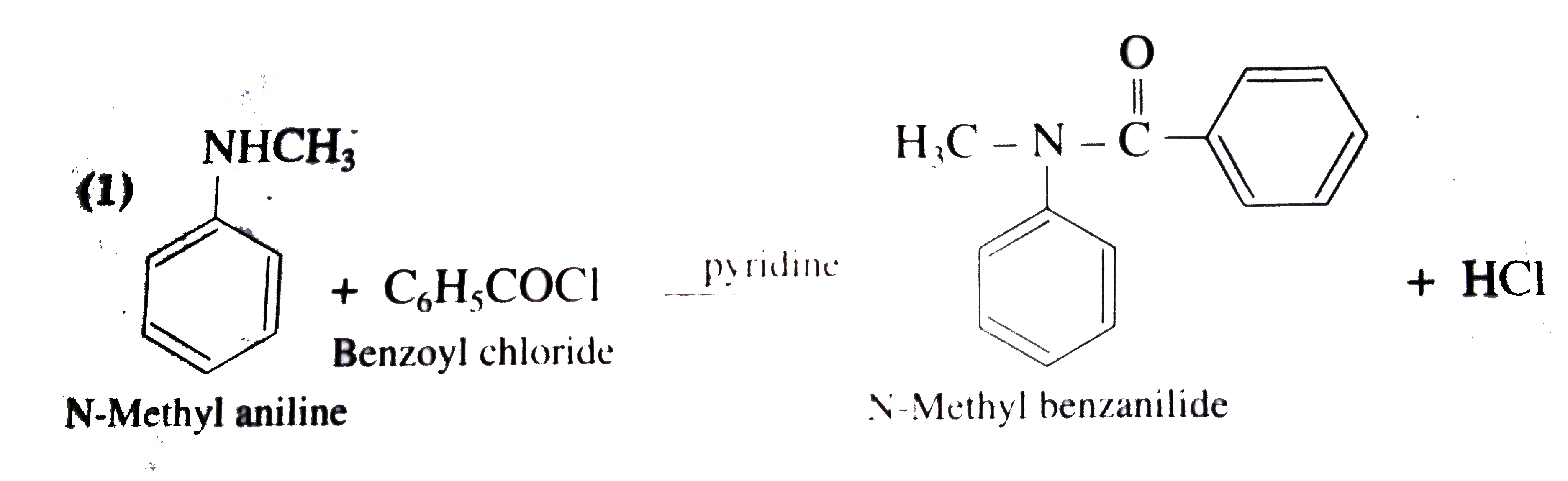
|
|
| 40. |
(N is number of isomeric products) underset("distillation")overset("Fractional")to (M is the number of isomeric products). N and M are respectively. |
|
Answer» 6,6 
|
|
| 41. |
N-isopropyl hydroxyl amineis obtained by reductionof |
|
Answer» `CH_(3)-overset(NO_(2))overset(|)(CH)-CH_(3) andZn+ NH_(4)Cl` |
|
| 42. |
N kg^(-1)is the unit of: |
|
Answer» Momentum These are the UNITS of acceleration |
|
| 43. |
N- Hexane can beconverertedto benzene by thetreatmentwith : |
|
Answer» ALK.`KMnO_(4)` |
|
| 44. |
n-hexadecane (or cetane) has cetane number: |
|
Answer» 100 |
|
| 45. |
n-Heptane passed over chromium trioxide supported over alumina at 873 K finally gives |
|
Answer» Toluene |
|
| 46. |
N- Heptaneon heatingto 773K at10-20atmpresurein thepresenceof V_(2)O_( 5) a |
|
Answer» BENZENE |
|
| 47. |
N- ethyl N- methylpropan -1- amineis _____ amine |
|
Answer» PRIMARY amine |
|
| 48. |
N-ethyl formamide on treatment with POCI_(3) in pyridine gives |
|
Answer» Ethyl isocyanate |
|
| 49. |
N- ethyl benzene sulphonyl amide is strongly acidic and soluble in alkali due to presence of |
|
Answer» STRONG ELECTRON donating sulphonyl group |
|


