

Saved Bookmarks
This section includes 7 InterviewSolutions, each offering curated multiple-choice questions to sharpen your Current Affairs knowledge and support exam preparation. Choose a topic below to get started.
| 1. |
Moderator is a material which is used to slow down the neutrons produced during nuclear fission. The neutrons from the source are of high speed and energy. Heavy water or graphite moderators slow down the speed of the neutrons. The energy of fast moving neutrons decreases from 2MeV to 0.02535 eV, it corresponds to the velocity of 220 m "sec"^(-1). At this velocity, the neutrons are in thermal equilibrium with the moderator. such neutrons are called thermal neutrons. Thermal neutrons cause further fission reaction. The essential characterstices of moderators are: (i) Its molar mass must be low, (ii) It should not absorb neutrons. (iii) It should undergo elastic collisions with neutrons. Moderator in the reactor yields: |
|
Answer» FAST MOVING neutrons |
|
| 2. |
Moderator is a material which is used to slow down the neutrons produced during nuclear fission. The neutrons from the source are of high speed and energy. Heavy water or graphite moderators slow down the speed of the neutrons. The energy of fast moving neutrons decreases from 2MeV to 0.02535 eV, it corresponds to the velocity of 220 m "sec"^(-1). At this velocity, the neutrons are in thermal equilibrium with the moderator. such neutrons are called thermal neutrons. Thermal neutrons cause further fission reaction. The essential characterstices of moderators are: (i) Its molar mass must be low, (ii) It should not absorb neutrons. (iii) It should undergo elastic collisions with neutrons. Which of the following is not used as a moderator? |
|
Answer» HEAVY water |
|
| 3. |
Moderator is a material which is used to slow down the neutrons produced during nuclear fission. The neutrons from the source are of high speed and energy. Heavy water or graphite moderators slow down the speed of the neutrons. The energy of fast moving neutrons decreases from 2MeV to 0.02535 eV, it corresponds to the velocity of 220 m "sec"^(-1). At this velocity, the neutrons are in thermal equilibrium with the moderator. such neutrons are called thermal neutrons. Thermal neutrons cause further fission reaction. The essential characterstices of moderators are: (i) Its molar mass must be low, (ii) It should not absorb neutrons. (iii) It should undergo elastic collisions with neutrons. The moderator in a reactor: |
|
Answer» ABSORBS neutrons |
|
| 4. |
Moderator is a material which is used to slow down the neutrons produced during nuclear fission. The neutrons from the source are of high speed and energy. Heavy water or graphite moderators slow down the speed of the neutrons. The energy of fast moving neutrons decreases from 2MeV to 0.02535 eV, it corresponds to the velocity of 220 m "sec"^(-1). At this velocity, the neutrons are in thermal equilibrium with the moderator. such neutrons are called thermal neutrons. Thermal neutrons cause further fission reaction. The essential characterstices of moderators are: (i) Its molar mass must be low, (ii) It should not absorb neutrons. (iii) It should undergo elastic collisions with neutrons. A good moderator should: |
|
Answer» not be a GAS only |
|
| 5. |
Moderate acts as a bleaching agent only in presence of |
|
Answer» Silica |
|
| 6. |
Mobility of H^+(in aq medium) is high because: |
|
Answer» Of the SMALL size of `H^+` |
|
| 7. |
Mn^(x+) has a magnetic moment of 4.9 BM. Calculate the value of x in the given ion. |
|
Answer» |
|
| 8. |
MnSO_(4)+Sr(NO_(3))_(2) to SrSO_(4) darr |
|
Answer» For COLOURED ppt./Black ppt |
|
| 9. |
MnO_(4)^(2-) in acidic solution undergoes disportionation to give "…....................." and "…...................". |
|
Answer» |
|
| 10. |
MnO_(4)^(2-) can be coverted to MnO_(4)^(-) 1) by oxidation of Cl_(2) 2) by oxidation of CO_(2) 3) by oxidation of H_(2)SO_(4) 4) by oxidations of O_(3) 5) by electrochemical oxidation at anode |
|
Answer» `1,2,3` |
|
| 11. |
MnO_(4)^(2-) is |
|
Answer» Diamagnetic |
|
| 12. |
MnO_(4)^(-) reacts with Br^(-) in alkaline pH to give |
|
Answer» `BrO_(3)^(-), MnO_(2)`<BR>`Br_(2),MnO_(4)^(2-)` |
|
| 13. |
MnO_(4)^(-) react with Br in alkaline pH to give |
|
Answer» `BrO_(3)^(-), MnO_(2)` |
|
| 14. |
MnO_(4)^(-) is off intense pink colour, though Mn is in (+7) oxidation state, it is due to: |
|
Answer» oxygen gives colour to it |
|
| 15. |
MnO_(4)^(-) is of intense pink colour, though Mn is in (7+) oxidation state, it is due to : |
|
Answer» OXYGEN gives colour to it |
|
| 16. |
MnO_(4)^(-) react with Br^(-) in alkaline P^(H) to give |
|
Answer» `BrO_(3)^(-)MnO_(2)`<BR>`Br_(2) MnO_(4)^(2-)` |
|
| 17. |
MnO_(4)^(-) react with Br in alkaline pH to give ……………….. |
|
Answer» `BrO_(3)^(-), MnO_(2)`<BR>`Br_(2), MnO_(4)^(2-)` |
|
| 18. |
MnO_4 ions are reduced in acidic condition to Mn^(2+)ions whereas they are reduced in neutral condition to MnO_2. The oxidation of 25 mL of a solution X containing Fe^(2+) ions required in acidic condition 20 mL of a solution Y containing MnO_4 ions. What volume of solution Y would be required to oxidise 25 mL of solution X containing Fe^(2+) ions in neutral condition? |
|
Answer» 11.4 mL 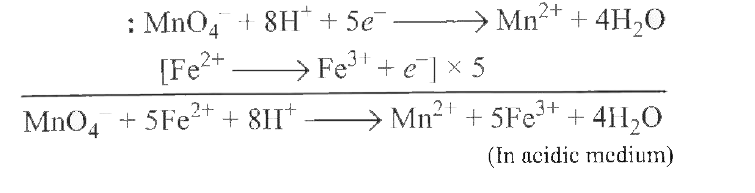 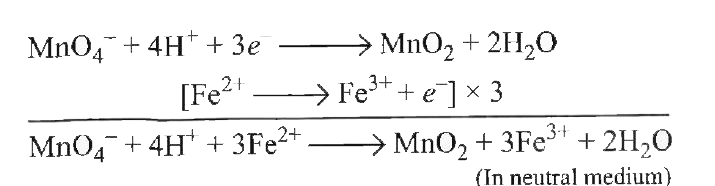 INACIDICMEDIUM 5 volof `Fe^(2+)` requires1 volof `MnO_(4)^(-)` inacidicmedium ` therefore25Vol` of ` Fe^(2+)` requires` 1/5xx 25vol ` of` MnO_4^(- ) `in acidicmedium `1/5xx 25vol` of `MnO_4 ^(- )~=20volor20 mL` In neutralmedium 3 molof ` Fe^(2+)` requires1volof `MnO_(4)^(-)`in neutralmediumthen25volof ` Fe^(2+)` requires`1/3xx 25vol` of ` MnO_4`inneutralmedium `1/5 XX 25vol` of `MnO_(4)^(- )~=20vol` `therefore1/3x 25vol` of ` MnO_4^(-)=(20) /(5) xx(25)/( 3 )vol`of `MnO_(4)^(-)` `= 33.3volor mL` |
|
| 19. |
MnO_(4)^(-) ions can be reduced in strong alkaline medium to give : |
| Answer» Answer :C | |
| 20. |
MnO_(4)^(-) ions are reduced in acidic condition to Mn^(2+) ions whereas they are reduced in neutral condition to MnO_(2). The oxidataion of 25 mL of a solution X containing Fe^(2+) ions required in acidic medium 20 mL of a solutionY containing MnO_(4)^(-) ions. What volume of solution Y would be required to oxidise 25 mL of solution Y containing Fe^(2+) ions in neutral condition ? |
|
Answer» Solution :In acidic medium, `overset(+7)MnO_(4)^(-) to overset(+2)Mn^(2+)` Change in oxidation number = 5 `underset(Fe^(2+))underbrace(N_(1)V_(1))= underset(MnO_(4)^(-))underbrace(N_(2)V_(2))` `N xx 25 = 5 M xx 20 "" …(i)` 25 N = 100 M IN neutral medium, `overset(+7)MnO_(4)^(-) to overset(+4)MnO_(2)` Change in oxidation number = 3 `underset(Fe^(2+))underbrace(N_(1)V_(1))= underset(MnO_(4)^(-))underbrace(N_(2)V_(2))` `25 xxN = 3 M xx V` 25N = 3MV Equating (i) and (ii) 100 M = 3 MV or `V = (100)/(3) = 33.3` mL |
|
| 21. |
MnO_(4)^(-) + 8H^(+) + 5e to Mn^(2+) + 4H_(2)O Fe^(3+) + e to Fe^(2+) , E^(@) = +1.51 V Cl_(2) + 2e to 2Cl^(-), E^(@) = +0.77 V Cl_(2) + 2e to 2Cl^(-), E^(@) =+1.36 V Ce^(4+) + e to Ce^(3+), E^(@) = 1.76 Choose the incorrect statement among the following: |
|
Answer» `MnO_(4)^(-)` is a sufficiently strong oxidant in acidic solution (pH=0) to oxidise `FE^(2+)` ion. |
|
| 22. |
MnO_(4)^(-)+8H^(+)+5e to Mn^(2+)+4H_(2)O""E^(0)=+1.51V Fe^(3+)+e to Fe^(2+)""E^(0)=+0.77V Cl_(2)+2e to 2Cl^(-) ""E^(0)=+1.36V Ce^(4+)+e to Ce^(3+) ""E^(0)=1.76 Choose the incorrect statement among the following: |
|
Answer» `MnO_(4)^(+)` is a sufficlently strong oxidant In acidic solution (pH =0) to oxidize `FE^(2+)` ion. |
|
| 23. |
MnO_(4)^(-) +8H^++5e^-to Mn^(2+) +4H_2 O ,E^@ = 1.51 V MnO_(4)^(-) +4H^++2e^-to Mn^(2+) +2H_2 O ,E^@ = 1.23 VE_(MnO_(4)^(-) "|" MnO_(2))is |
|
Answer» `1.70 v` ` DeltaG_(1)^(@)=- 5 ( 1.51 )F=- 7.55F ` `MnO_2+4H^( +) +2e^(-) toMn^(2+) +2 H_2 O ,E^@= 1.23V ` `DeltaG_(2)^(@)=- 2(1.23 )F= - 2.46F ` onsubtracting `MnO_(4)^@=- 5 ( 1.51) F = - 7.55F ` `E_("MnO_(4)^(-) |MnO_2 ) ^@ = (DeltaG_(3) ^(@) )/(-nF) =(-5.09 F)/(-3F) = 1.70V ` |
|
| 24. |
MnO_(3) in an acidic medium dissociates into |
|
Answer» `MnO_(2) and MnO_(4)^(-)` |
|
| 25. |
MnO_2 liberates oxygen from a solution of H_2O_2 (the action being catalytic) only if the solution is: |
|
Answer» Basic |
|
| 26. |
MnO_2is the most important oxide of manganese. MnO_2 occurs naturally as the black coloured mineral pyrolusite. It is an oxidising agent, and decomposes to Mn_3O_4 on heating to 530^(0) C. It is used in the preparation of potassium permanaga-nate and in the production of Cl_2 gas. Over half a million tonnes per year of MnO_2 is used in dry batteriesWhen MnO_2 is fused with KOH in the presence of air, the product formed is : |
|
Answer» purple COLOUR `KMnO_4` |
|
| 27. |
MnO_2is the most important oxide of manganese. MnO_2 occurs naturally as the black coloured mineral pyrolusite. It is an oxidising agent, and decomposes to Mn_3O_4 on heating to 530^(0) C. It is used in the preparation of potassium permanaga-nate and in the production of Cl_2 gas. Over half a million tonnes per year of MnO_2 is used in dry batteriesMnO_2 dissolve in concentrated HCl to form : |
|
Answer» `Mn^(4+)` ion and `Cl_2` |
|
| 28. |
MnO_(2) is the most important oxide of manganese , MnO_(2) occurs natually as the black coloured mineral pyrolusite. It is an oxidising agent, and decomposes to Mn_(3)O_(4) on heating to 530^(@)C. It is used in the preparation of potassium permanaganate and in the productioon of Cl_(2) gas. Over half million tonnes per year of MnO_(2) is used in dry batteries. Q.In the laboratory, MnO_(2) is made by: |
|
Answer» heating MN in `O_(2)` |
|
| 29. |
MnO_(2) is the most important oxide of manganese , MnO_(2) occurs natually as the black coloured mineral pyrolusite. It is an oxidising agent, and decomposes to Mn_(3)O_(4) on heating to 530^(@)C. It is used in the preparation of potassium permanaganate and in the productioon of Cl_(2) gas. Over half million tonnes per year of MnO_(2) is used in dry batteries. Q.MnO_(2) dissolves in concentrated HCl to form: |
|
Answer» `Mn^(4+)` ion and `Cl_(2)` |
|
| 30. |
MnO_(2) is the most important oxide of manganese , MnO_(2) occurs natually as the black coloured mineral pyrolusite. It is an oxidising agent, and decomposes to Mn_(3)O_(4) on heating to 530^(@)C. It is used in the preparation of potassium permanaganate and in the productioon of Cl_(2) gas. Over half million tonnes per year of MnO_(2) is used in dry batteries. Q.When MnO_(2) is fused with KOH in the presence of air, the product formed is: |
|
Answer» PURPLE colour `KMnO_(4)` |
|
| 31. |
MnO_2is the most important oxide of manganese. MnO_2 occurs naturally as the black coloured mineral pyrolusite. It is an oxidising agent, and decomposes to Mn_3O_4 on heating to 530^(0) C. It is used in the preparation of potassium permanaga-nate and in the production of Cl_2 gas. Over half a million tonnes per year of MnO_2 is used in dry batteries In the laboratory, MnO_2 is made by : |
|
Answer» heating Mn in `O_2` |
|
| 32. |
MnO_(2) is the most important oxide of manganese , MnO_(2) occurs natually as the black coloured mineral pyrolusite. It is an oxidising agent, and decomposes to Mn_(3)O_(4) on heating to 530^(@)C. It is used in the preparation of potassium permanaganate and in the productioon of Cl_(2) gas. Over half million tonnes per year of MnO_(2) is used in dry batteries. Q. In which of the following species, the colour is due to charge transfer? (I)[Mn(OH)_(4)]^(2-)(II)MnO_(4)^(2-)(III)MnO_(4)(IV)KMnO_(4) |
|
Answer» I, II, III |
|
| 33. |
MnO_(2) is fused with an alkali. We obtain a green mass which on acidic hydrolysis produces a solution which has the colour |
|
Answer» DARK PURPLE. |
|
| 34. |
MnO_2 is antiferromagnetic/ferromagnetic substance. |
| Answer» SOLUTION :ANTIFERROMAGNETIC | |
| 35. |
MnO_(2) + HCl overset(Delta)to A_((g)) A_((g)) + F_(2("excess")) overset(573K)to B_((g)) B_((l)) + U_((s)) to C_((g))+ D_((g))The gases A,B, C and D are respectively ________. |
|
Answer» `Cl_(2), CLF, UF_(6), ClF_(3)` |
|
| 36. |
{:(MnO_(2) + HCl overset(Delta)rarr A(g)),(A(g) + F_(2)(excess)overset(573 K)rarr B(g)),(B(l) + U(s) rarr C(g) + D(g)):} The gases A, B, C and D are respectively |
|
Answer» `Cl_(2), ClF, UF_(6), ClF_(3)` The gases (A), (B), (C) and (D) are `Cl_(2), ClF_(3), UF_(6) and ClF` respectively, i.e., option (b) is correct. |
|
| 37. |
MnO_2 + HCl overset(Delta)to A_((s)) A_((g)) + F_(2"(excess)") overset(573K)to B_((s)) B_((l)) + U_((s)) to C_((g)) + D_((g)) The gases A,B,C and D are respectively |
|
Answer» `Cl_(2), ClF, UF_(6), ClF_(3)` `underset((A))(Cl_(2(g)))+3F_(2("excess")) overset(573K)rarr underset((B))(2ClF_(3(g))` `underset((B)"")(3ClF_(3(l))+U_((s))) overset(Delta)rarr underset((C)"")(UF_(6(g)))+underset((D)"")(3ClF_(3(g))` |
|
| 38. |
MnO_(2) + HCl overset(Delta) to A_((g)) + MnCl_(2) + 2H_(2)O A_((g)) + F_(2) ("excess") overset (573 K) to B_((g)) B_((g)) + U((s)) to C_((g)) + D_((g)) The gases A, B, C and D are respectively |
|
Answer» `Cl_(2), ClF, UF_(6),ClF_(3)` 
|
|
| 39. |
MnO_(2) and Ca_(3)(PO_(4))_(2) present in iron ore get reduced to Mn and P in the zone of- |
|
Answer» combustion |
|
| 40. |
MnO_(2) and Ca_(3)(PO_(4))_(2) present in iron are get reduced to Mn and P in the zone of : |
|
Answer» COMBUSTION ` |
|
| 41. |
MnO_(2) and H_(2)SO_(4) added to NaCl, the greenish yellow gas liberated is |
|
Answer» `Cl_(2)` `NaCl+H_(2)SO_(4)toNaHSO_(4)+HCl` `MnO_(2)+4HCL toMnCl_(2)+2H_(2)O+Cl_(2)` |
|
| 42. |
[Mn(CO)_(4)NO] is diamagnetic because: |
|
Answer» Mn metal is diamagnetiic in free state `[overset(-1)(Mn)(CO)_(4)(NO^(+))]:`No unpaired `e^(-)` EITHER on LIGANDS or on `overset(-1)(Mn)` hence it is diamagnetic. |
|
| 44. |
An atom has its K and L shells completely filled and five electrons in M shell. Find out the total number of p electrons in the atom ? |
|
Answer» 3D, 4s |
|
| 45. |
Mn_(3)O_(4) is a mixed oxide of : |
|
Answer» `MnO, Mn_(2)O_(3)` |
|
| 46. |
Mn_(2)O_(7) is |
|
Answer» ACIDIC oxide |
|
| 48. |
Mn_2O_7, CrO_3, V_2O_5 are____oxides |
|
Answer» Basic |
|
| 49. |
Mn^(2+), Fe^(3+)have high magnetic moment. Prove it. |
|
Answer» Solution :(i) `Mn^(2+), Fe^(3+)` configuration is `d^(5)` (ii) `MU= sqrt(5(5+2))= sqrt(35)= 5.916 mu_(B)` AMONG 3d series, `Mn^(2+), Fe^(3+)` have HIGH magnetic moment as 5.916 Hg. |
|
| 50. |
Mn^(2+) is more stable than Mn^(4+). Why? |
|
Answer» SOLUTION :(i) The relative STABILITY of different oxidation states of 3d metals is correlated with the extra stability of half-filled and FULLY filled ELECTRONIC configurations. (ii) Example: `Mn^(2+)(3d^(5))` is more stable than `Mn^(4+)(3d)` |
|