

Saved Bookmarks
This section includes 7 InterviewSolutions, each offering curated multiple-choice questions to sharpen your Current Affairs knowledge and support exam preparation. Choose a topic below to get started.
| 1. |
Match the ore (Column I) with the metal (Column II) |
|
Answer» (i)-`("C")` , (ii)-(A), (iii)-(B), (IV)-(E) |
|
| 2. |
Match the observations of Column-I with inferences in Column-II |
|
Answer» |
|
| 3. |
Match the nature of aqueous solutions of the substances listed in Column I with the character listed in Column II. {:(,"Column I",,"Column II"),((A),KCN_((aq)),(p),"Strongly basic"),((B),TiOH_((aq)),(q),"Neutral"),((C),BeCl_(2(aq)),(r),"Weakly basic"),((D),NaNO_(3(aq)),(s),"Weakly acidic"):} |
|
Answer» (Anionic HYDROLYSIS), `pHgt7`), weakly basic `(B) TiOH"(STRONG base)"rarrTi^(+)+OH^(-)(pHgtgt7),` strongly basic `(C)Be^(2+)+2H_(2)OrarrBe(OH)_(2)+2H^(+)("cationic hydrolysis "pHgt7 ), "weakly ACIDIC"` `(D)NaNO_(3)" "("SALT of strong base NaOH and strong acid "HNO_(3))` `rarr` No hydrolysis of the cation or the anion, pH=7 , neutral |
|
| 4. |
Match the name of the processes given in column-I with type of metallurgical methods given in column-II. {:("Column-I","Column-II"),((a)"Hall-Heroult process",(p)"Molten" Al_2O_3+Na_3AIF_6 "electrolysis"),((b)"Dow's sea water process",(q)"Molten" MgCl_2+CaCl_2+NaCl "electrolysis"),((c)"Hoop's process",(r)"Molten impure aluminium + fluorides of" Na^+, Ba^(2+) and Al^(3+)"electrolysis"),((d)"Mac-Arthur Forrest process",(s)"Complex formation and displacement method"):} |
|
Answer» (b)Dow's sea water process involves the isolation of Mg from sea water as `MgCl_2` and then electrolytic reduction of molten `MgCl_2` dissolved in `CaCl_2` and NaCl. (c)HOOP's process is the electrolytic PURIFICATION of impure aluminium.The cell has three liquid layers middle one contains fluorides of `Na^(+),Ba^(2+), and Al^(3+)`, lower most layer has impure Al. (d)Mac-Arthur forest cyanide process is the process used for the EXTRACTION of gold and silver.Extraction of gold and silver involves LEACHING the metal with `CN^(-)` .the metal is later recovered by displacement method. |
|
| 5. |
Matchthe name reaction( column I)with thereagent( columnII)used . |
| Answer» Answer :A | |
| 6. |
Match the observations of Column-I with inferences in Column-II |
|
Answer» |
|
| 7. |
Match the molecules/species listed in column I with characteristic listed in column II. {:("Column-I","Column-II"),((A)Cl F_5","BrF_4^(+)IF_6^(-),(p)"All molecules/ions are polar in nature"),((B)Cl F_3","BrF_2^(+)IC I_4^(-),(q)"All molecules/ions have same number of lone pair(s) and identical shape"),((C )Xe F_2","IC I_2^(-)I_3^(-),(r)"All molecules/ions have same oxidationstate of central atoms"),((D )CIOF_3","CIF_4^(+)","IO_2F_2^(-),(s)"All molecules/ions have same hybridisation of central atoms"),(,(t)"All molecules/ions are isoelectrnic species"):} |
Answer» 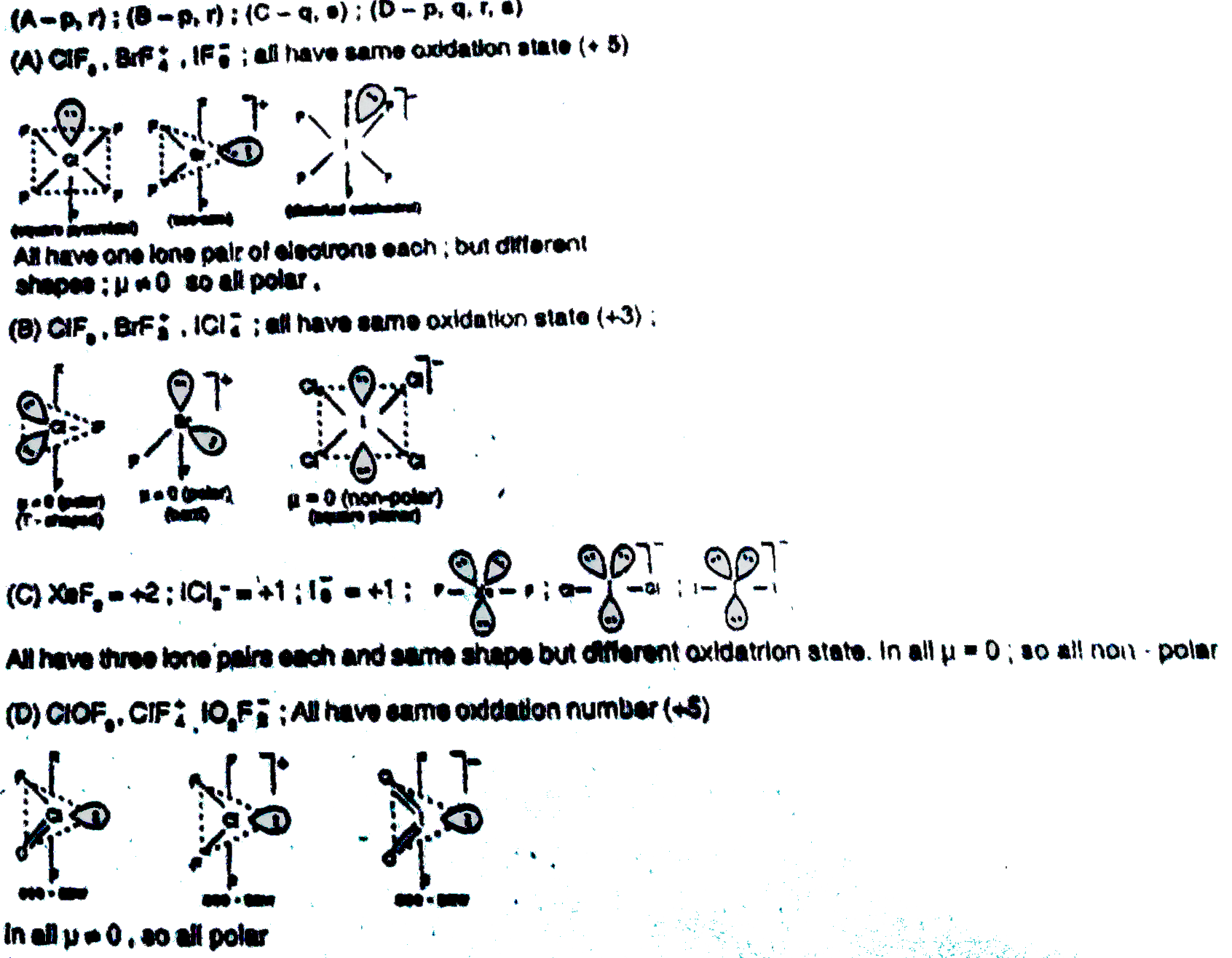
|
|
| 8. |
Match the methods of concentration of ore given in column-I with the different ores given in column-II and select the correct option. column-I (I) magnetic separation (II) froth flotation (III) hydraulic washingcolumn-II (a) Cu_2S (b) Fe_3O_4 (c) Al_2(SiO_3) |
|
Answer» I(a), II(B), III(C) |
|
| 9. |
Match the method of concentration of the ore in column I with the ore in column II and select the correct alternate. {:(""I,""II),("(X) Magnetic separation",(A) Ag_(2)S),("(Y) Froth floatation","(B)" FeCr_(2)O_(4)),("Z Gravity separation","(C)"Al_(2)(SiO_(3))_(3)):} |
|
Answer» `{:(X,Y,Z),(A,B,C):}` |
|
| 10. |
Match the method used (Column I) with the metal for which it is used (Column II) |
|
Answer» (i)-`("C")` , (ii)-(A), (III)-(D), (IV)-(B) |
|
| 11. |
Match the method (column I) with its example (column II) |
|
Answer» (i)-`("C")` , (II)-(A) |
|
| 12. |
Match the metal ions given in Column I with the spin magnetic moments of the ions given in Column II and asign the correct code: |
|
Answer» `{:(A,B,C,D),(iv,v,ii,i):}` A.`Co^(3+),[Ar]3d^(6)(n=4),mu=sqrt(4(4+2))=sqrt(24)BM` B. `Cr^(3+),[Ar]3d^(3)(n=3),mu=sqrt(3(3+2))=sqrt(15)BM` C. `Fe^(3+),[Ar]3d^(5)(n=5),mu=sqrt(5(5+2))=sqrt(35)BM` D. `Ni^(2+),[Ar]3d^(8)(n=2),mu=sqrt(2(2+2))=sqrt(8)BM` Thus, A-iv,B-v,C-ii,D-I THEREFORE, a is the correct match. |
|
| 13. |
Match the metal ions given in Column I with the spin magnetic moments of the ions given in Column H and assign the correct code |
|
Answer» |
|
| 14. |
Match the List with List II and select the correct answer from the codes given below the lists : List I (Reaction) (A) CH_(3)CH=CHCHOrarrCH_(3)CH=CHCOOH (B) CH_(3)CH=CHCHOrarrCH_(3)CH=CHCH_(2)OH (C) R-COOHrarrR-CH_(2)OH (D) CH_(3)CH_(2)COHlrarrCH_(3)CH_(2)CHO List II (Reagent) (1). LiAlH_(4) 2. NaBH_(4),LiAlH_(4) 3. Ammoniacal AgNO_(3) |
|
Answer» `{:(A,B,C,D),(4,3,2,1):}` |
|
| 15. |
Match the medicine given in Column I with theiruses given inColumn |
|
Answer» |
|
| 16. |
Match the maximum number of CH_(3)MgX consumed, per molecule given in Column -II, when the substrates given in Column -I reacts with it. |
|
Answer» |
|
| 17. |
Match the maximum number of CH_(3)MgX consumed, per mole, given in Column -II, when the substrates given in Column -I reacts with it. |
|
Answer» |
|
| 18. |
Match the lists I and II and pick the correct matching from the codes given below |
|
Answer» a-2, b-4, c-5, d-1, e-3 |
|
| 19. |
Match the List with List II and choose the correct option from the codes given below: |
|
Answer» <P>`{:(,P,Q,R,S),((A),3,4,1,2):}` |
|
| 20. |
Match the List I with List II and select the correct answer using the codes given below the lists: {:("List - I ","List - II "),("A) Teflon ","i) Ozone layer depletion "),("B) Pyrene ","ii) Non-biodegradable insecticide "),("C) DDT ","iii) Non-stick cookwares and insulator "),("D) Freon ","iv) Fire extinguisher"):} |
|
Answer» `{:(A,B,C,D),(i,ii,iii,IV):}` |
|
| 21. |
Match the list-I with list-II and select the correct answer from the given codes: . |
|
Answer» I-C,II-B,III-D,IV-A |
|
| 22. |
Match the List I with List II and choose the correct option from the codes given below |
|
Answer» <P>`{:(P,Q,R,S),(3,4,1,2):}` |
|
| 24. |
Match the List -I (containing anions ) with List -II (containing reagent used in testing ) using the codes as given below in the column. {:("List"-I,,"List"-II),(("anions"),,("reagents")),((a)S^(2-),,(p)"Barium chloride solution in presence of HCl"),((b)NO_(3)^(-),,(q)"Sodium nitroprusside"),((c)I^(-),,(r)"chlorine water and chloroform"),((d)SO_(4)^(2-),,(s)"iron"(II)"sulphate solution and conc."H_(2)SOS_(4)):} Code : |
|
Answer» `{:(,"(a)","(B)","(c)","(d)"),(,"(q)","(s)","(r)","(p)"):}` `S^(2+)+BaCl_(2)rarr"No precipitate".` `(b)""2NO_(3)^(-)+4H_(2)SO_(4)+6Fe^(2+)rarr6Fe^(3+)+2NOuarr+4SO_(4)^(2-)+4H_(2)O` `[Fe(H_(2)O)_(6)]^(2+)+NOrarrunderset(("Brown complex"))([Fe(H_(2)O)_(5)NO]^(2+)+H_(2)O)` `(c )""2I^(-)+CL_(2)+I_(2)+2Cl^(-)` `""I_(2)+C CI_(4)rarrI_(2)` dissolves forming a violet solution. `(d)""Ba^(2+)+SO_(4)^(2-)rarrBaSO_(4)darr("white")` `HCl`REMOVES the impurities of `S^(2-),I^(-)` and `NO_(3)^(-)` and white precipitate of `BaSO_(4)` is THUS obtained. |
|
| 25. |
Match the List I (Colloidal dispersion) withList-II (Nature of dispersion) and select answer in terms of code given below. |
|
Answer» A-4, B-2, C-1, D-5 |
|
| 26. |
Match the List-I and List-II correctly using the code given below. |
|
Answer» `{:("A,B,C,D"),("1,2,3.4"):}` |
|
| 27. |
Match the list-I and list-II and select the correct answer from the codes given below the lists: |
|
Answer» |
|
| 28. |
Match the list I and II using the code given below the list . {:(,"List -I",,"List - II"),(A.,t_(1//2)" of first order reaction",1.,k=2.303/tlog.[((A_0))/((A))]),(B.,t_(1//2)"of "n^(th)"order",2.,f=e^(-(E_a)/(RT))),(C.,"Fractionof effective collision",3.,(0.6932)/k),(D.,"Rate constant of first order reaciton",4.,(2^(n-1)-1)/((n-1)k(A_0)^(n-1))):} code |
|
Answer» `{:(A,B,C,D),(3,4,1,2):}` |
|
| 29. |
Match the list I and II using the code given below the list {:("List - I","List - II"),("A. "NaCl,"1. Molecular crystal"),("B. "SiO_(2),"2. Metallic crystal"),("C. "C_(6)H_(12)O_(6),"3. Ionic crystal"),("D. Copper","4. Covalent crystal"):} |
|
Answer» `{:(A,B,C,D),(3,4,1,2):}` |
|
| 30. |
Match the list I and II using the code given below the list . {:(,"List -I",,"List - II"),(A.,2NO+O_2rarr2NO_2,1.,"First order reaction"),(B.,CH_3COOCH_3+H_2Ooverset(H^+)rarrCH_3COOH+CH_3OH,2.,"Zero order reaction"),(C.,""_(92)Uoverset(..)uoverset(..)uoverset(..)urarr_90Th+_2He,3.,"Pseudo first order reaction"),(D.,CH_3COCH_3+I_2rarrICH_2COCH_3+HI,4.,"Third order reaction"):} code |
|
Answer» `{:(A,B,C,D),(3,2,4,1):}` |
|
| 31. |
Match the list I and II using the code given below the list . {:(,"List -I",,"List - II"),(A., N_2O(g)hArrN_2(g)+1//2O_2(g),1.,Order =1 ),(B. ,SO_2Cl(g)rarrSO_2(g)+cl_2(g),2.,Order = 4),(C.,CH_3CHO(g)rarrCH_4(g)+CO(g),3.,Order = 0),(D.,5Br_((aq))^(-)+BrO_(3(aq))^(-)+6H^(+)rarr3Br_(2(l))+3H_2O(l),4.,Order =3//2):} code |
|
Answer» `{:(A,B,C,D),(3,1,4,2):}` |
|
| 32. |
Match the List -I and II and select the correct answer {:(,"List-I",,"List -II"),(1.,"Cannizzaro's reaction",(A),SnCl_(2)+HCl),(2.,"Srephen's reaction",(B),50% NaOH),(3.,"Clemmenson reduction ",(C),Pd - BaSO_(4)+ "quinoline"),(4.,"Rosenmud's reduction",(D),Zn.Hg+Conc.HCl):} |
|
Answer» `1 - B, 2 - D, 3 - A, 4-C` |
|
| 33. |
Match the list I and II using the code given below the list . {:("List -I","List - II"),("A. Acid hydrolysis of an ester","1. Fractional order reaction"),("B. Decomposition of "H_2O_2,"2. Second order reaction"),("C. Decomposition of "CH_3CHO,"3. Pseudo first order reaction"),("D. Substitution of methyl bromide with aqueous KOH","4. First order reaction"):} Code |
|
Answer» `{:(A,B,C,D),(3,4,1,2):}` |
|
| 34. |
Match the list I and II using the code given below the list. {:("List - I","List - II"),("A. Acid hydrolysis of an ester","1. Fractional order reaction"),("B. Decomposition of "H_(2)O_(2),"2. Second order reaction"),("C. Decomposition of "CH_(3)CHO,"3. Pseudo first order reaction"),("D. Substituion of methyl bromide with aqueous KOH.","4. First order reaction"):} |
|
Answer» `{:(A,B,C,D),(3,4,1,2):}` |
|
| 35. |
Match the list I and II using the code given below that list : {:("List - I","List - II"),("A. NaCl","1. Molecular crystal"),("B. "SiO_(2),"2. Metallic crystal"),("C. "C_(6)H_(12)O_(6),"3. Ionic crystal"),("D. Dopper","4. Covalent crystal"):} |
|
Answer» `{:(A,B,C,D),(3,4,1,2):}` |
|
| 36. |
Match the List given below: |
|
Answer» <P>`{:(P,Q,R,S),(1,2,4,3):}` |
|
| 37. |
Match the List given below: |
|
Answer» `{:(,P,Q,R,S),((A),1,2,4,3):}` |
|
| 38. |
Match the laws given in Column I with expressions given in Column II. {:("Column I","Column II"),("(i) Raoult's law","(a) "DeltaT_(f)=K_(f)m),("(ii) Henry'law","(b) "pi=CRT),("(iii) Elevation of boiling point","(c) "p=x_(1)p_(1)^(@)+x_(2)p_(2)^(@)),("(iv) Depression is freezing point","(d) "DeltaT_(b)=K_(b)m),("(v) Osmotic pressure","(e) "p=K_(H)x):} |
|
Answer» |
|
| 39. |
Match the list -1 with list -II and select the correct answers usingthe code given below the list. (##SUR_CHE_XII_V01_C05_E09_009_Q01.png" width="80%"> |
|
Answer» `{:(1,2,3,4 ),(B,C,d,a):}` |
|
| 40. |
Match the list-1 with list -II and select the correct answers using the code given below the list: (##SUR_CHE_XII_V01_C05_E09_008_Q01.png" width="80%"> |
|
Answer» `{:(1,2,3,4 ),(d,a,B,C):}` |
|
| 41. |
Match the laws given in Column - I with express ions given in Column - II{:(,"Column - I",,"Column - II"),((A),"Raoult's law",(1),Delta T_(f)=K_(f).m),((B),"Henry's law",(2),pi=CRT),((C ),"Elevation of boiling point",(3),p=p_(1)^(0)x_(1)+p_(2)^(0)x_(2)),((D),"Depression in freezing point",(4),Delta T_(b)=K_(b).m),((E ),"Osmotic pressure",(5),p=K_(H).x):} |
| Answer» SOLUTION :(A - 3), (B - 5), (C - 4), (D - 1), (E - 2) | |
| 42. |
Match the laws given in Column (I) with expressions given in Column (II) |
|
Answer» |
|
| 43. |
Match the items of Columns I and II and mark the correct option. {:("Column I","Column II"),((A)"Its partial hydrolysis does not change oxidation state of central atom",(1)He),((B)"It is used in modern diving apparatus",(2)XeF_(6)),((C)"It is used to provide inert atmosphere for filling electrical bulbs",(3)XeF_(4)),((D)"Its central atom is in"sp^(3)d^(2)"hybridisation",(4)Ar):} |
|
Answer» `{:(A(1),B(4),C(2),D(3)):}` |
|
| 44. |
Match the items of Columns I and II and mark the correct option. {:("Column I","Column II"),((A) H_(2)SO_(4),(1)"Highest electron gain enthalpy"),((B)"CCl"_(3)NO_(2),(2)"Chalcogen"),((C)Cl_(2),(3)"Tear gas"),((D)"Sulphur",(4)"Storage batteries"):} |
|
Answer» `{:(A(4),B(3),C(1),D(2)):}` |
|
| 45. |
Matchtheitemsof ColumnIwiththeitemsofColumnIIandassignthecorrectcode: {:(,"Column I",,, "Column II"),((A), "Blistered Cu",,(1), "Aluminium"),((B), "Blastfurnace",,(2),2Cu_2O+Cu_2S to6 Cu +SO_2),((C),"Reverberatoryfurnace",,(3),"Iron"),((D),"Hall - Heroultprocess",,(4), FeO+SiO_2 to FeSiO _ 3), (,,,(5), 2Cu_2S +3O_2 to2Cu_2 O+2SO_ 2 ):} |
|
Answer» A(5) `"" `B(4) `""`C(3)`""`D(2) |
|
| 46. |
Match the items of Columns-I and II and mark the correct option. |
|
Answer» A-(1), B-(4), C-(2), D-(3) |
|
| 47. |
Match the items of Columns-I and II and mark the correct option. |
|
Answer» A-(4), B-(3), C-(1), D-(2) |
|
| 48. |
Matchtheitems ofColumn Iwiththeitems of Column IIandassignthecorrect code:{:(,"Column I",,, "Column II"),((A), "Sapphire",,(1), Al _ 2O _3),((B), "Sphalerite",,(2),NaCN),((C),"Depressant",,(3),Co),((D),"Corundum",,(4), ZnS), (,,,(5), Fe_2O_3):} |
|
Answer» A(3) `"" `B(4) `""`C(2)`""`D(1) |
|
| 49. |
Matchthe itemsofColumnIwiththeitemsofColumn IIandassignthecorrectcode : {:(, "Column I",,,"Column II"),((A), "Coloured bands",,(1),"Zone refining"), ((B),"Impure metal to volatile complex",,(2), "Fractionaldistillation"), ((C ), "Purification of Ge and Si",,(3), "Mond Process"), ((D), "Purification",,(4), "Chromatography"), (,,,(5), "Liquation"):} |
|
Answer» A(1) `"" `B(2) `""`C(4)`""`D(5) |
|
| 50. |
Match the items of column I with items of column II. {:("Column I","Column II"),((a)"Antifreeze used in car engine",(I)"Neutral ferric chloride"),((b)"Solvent used in perfumes",(II)"Glycerol"),((c)"Starting meterial for picric acid",(III) "Methanol"),((d)"Wood sprit",(IV)"Phenol"),((e)"Reagent used for detection of phenolic group",(V) "Ethylene glycol"),((f)"By product of soap industry used in cosmetics",(VI)"Ethanol"):} |
|
Answer» |
|