

Saved Bookmarks
This section includes 7 InterviewSolutions, each offering curated multiple-choice questions to sharpen your Current Affairs knowledge and support exam preparation. Choose a topic below to get started.
| 1. |
MatchtheitemsofColumnIwithitems ofColumn IIandassignthecorrect code:{:(, "Column I",,,"Column II"),((A), "Pendulum",,(1),"Chromesteel"), ((B),"Malachite",,(2), "Nickelsteel"), ((C ), "Calamine",,(3), Na _3 AlF_ 6 ), ((D), "Cryolite",,(4), CuCO _3. Cu(OH)_2), (,,,(5), Zn CO_ 3):} |
|
Answer» A(1) `"" `B(2) `""`C(3)`""`D(4) |
|
| 2. |
Match the items of Column I with items of Column II and assign the correct |
|
Answer» `{:(,A,B,C,D),(,3,4,2,1):}` |
|
| 3. |
Match the items of Column I with items of Column II and assign the correct |
|
Answer» `{:(,A,B,C,D),(,4,2,3,1):}` |
|
| 4. |
Match the items of Column I with items of Column II and assign the correct |
|
Answer» `{:(,A,B,C,D),(,1,2,4,5):}` |
|
| 5. |
Match the items of Column I with items of Column II and assign the correct |
|
Answer» `{:(,A,B,C,D),(,1,2,3,4):}` |
|
| 6. |
Match the items of Column I with items of Column II |
|
Answer» |
|
| 7. |
Match the items of Column I with items of Column II |
|
Answer» |
|
| 9. |
Match the items of column I with items of column II. |
| Answer» SOLUTION :(a) (IV), (b) (i), (C) (vi), (d) (v),(e) (iii) , (f) (ii) | |
| 13. |
Match the items of Column I with items of Column II. |
|
Answer» B. Ethanol is a good solvent for fatty and waxy substances. Fats and waxes privide ODOUR to the perfumes. Apart from being a good solvent, it is less irritating to the skin. So, it is used in perfumes. C. Phenol is converted into picric acid (2, 4, 6-trinitro-phenol) by the reaction of phenol with conc. `HNO_(3)` 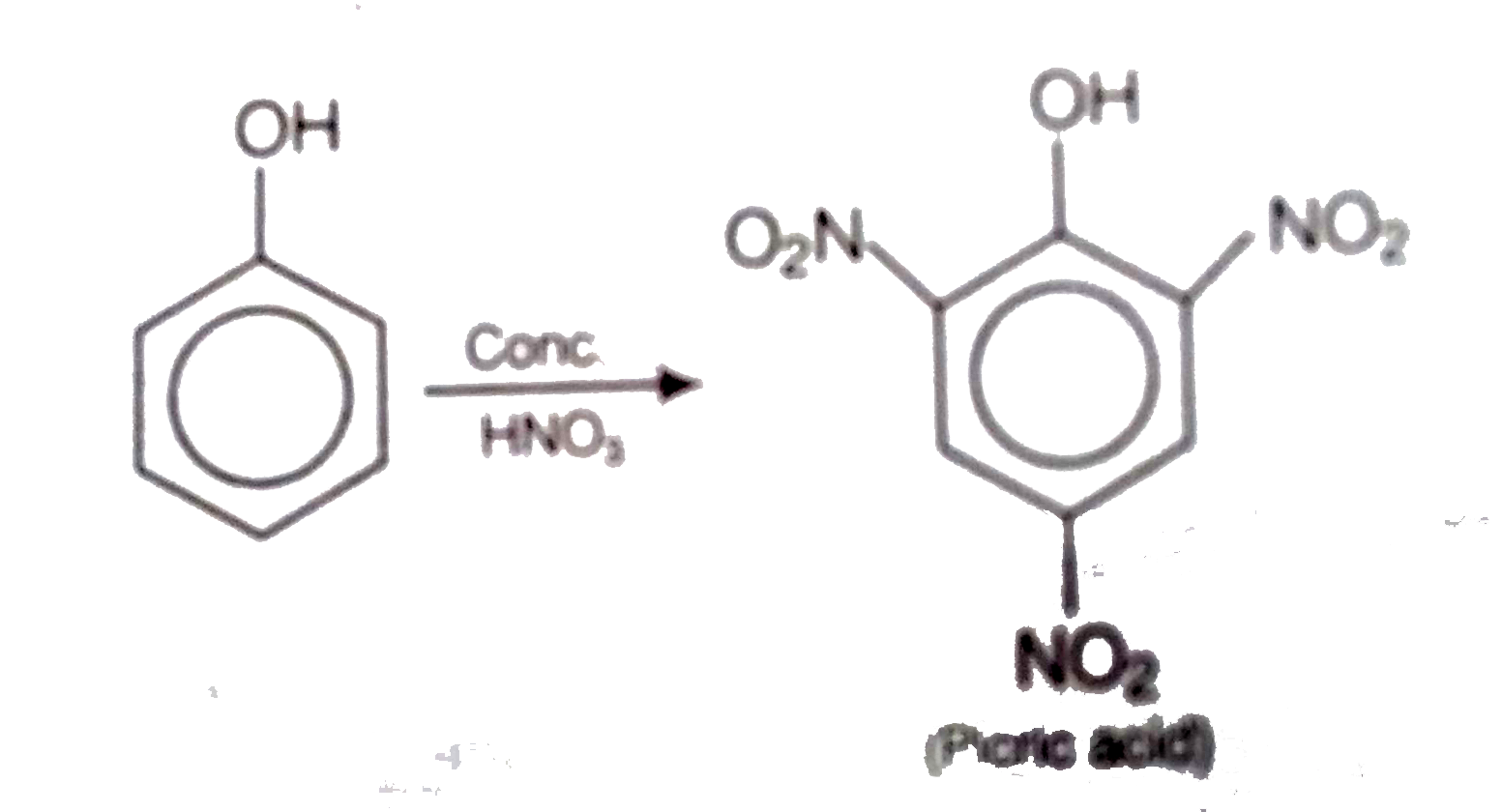 D. Methanol, `CH_(3)OH` is also known as 'wood spirit' as it was produced by the destructive distillation of wood. E. Neutral ferric chloride give purple/red colour when treated with phenols. It is the reagent used for detection of phenolic group. F. Soaps are prepared by the REACTIONS of fatty acid with `NaOH`. `{:(CH_(2)-O-OVERSET(O)overset("||")(C)-OC_(17)H_(35)),("|"overset(O)("||")),(CH-O-C-OC_(17)H_(35)+3NaOH to ),("|"),(CH_(2)-O-underset(O)underset("||")(C)-OC_(17)H_(35)):} underset("(Soap)")underset("Sodium steatate")(3C_(17)H_(35)CO ONa)+{:(CH_(2)OH),("|"),(CHOH),("|"),(underset("Glycerol")(CH_(2)OH)):}` This glycerol (propan-1,2,3-triol) is the by product of soap industry and used in cosmetics. |
|
| 14. |
Match the items of Column-I and Column-II on the basis of data given below: E_(F_(2)|F^(-))^(Theta)=2.87V,E_(Li^(+)|Li)^(Theta)=-3.5V, E_(Au^(3+)|Cu)^(Theta)=1.4V,E_(Br_(2)|Br^(-))^(Theta)=1.09V |
|
Answer» SOLUTION :`(Ato3),(Bto1),(Cto7),(Dto5),(Eto4),(Fto2),(Gto6)` * The following emf SERIES is obtained by following `E^(@)` value  * Any half cell reaction : A+`e^(-)toB` experiencing reduction`to`PRODUCT of reduction. oxidizing agent`to`reducing agent. (A) `F_(2)` : is non-metal and `E^(@)` is maximum. So `F_(2)` is REDUCED easily and is strongest oxidizing agent. (B) Li : is metal, apart from this Au is another metal. Between these two metals Li has high `E^(@)` value so Li is strongest oxidizng agent. (C) `Au^(3+)` is metal ion. it has high reduction potential and so `Au^(3+)` is oxidizing agent. (D) `Br^(-)` is negative ion. Oxidation half reaction: `Br^(-) to (1)/(2)Br` So, oxidation of `Br^(-)` is occur. `3Br^(-) to (3)/(2)Br_(2)+3e^(-)` (Oxidation) `E^(THETA)=1.09V` `Au^(3+)+3e^(-) to Au` (Reduction) `E^(Theta)=1.4V` (E) Au is inert metal because all metals have high `E^(@)` value. (F) `Li^(+)` is metal ions and standard reduction potential is `E^(@)` is low -3.5 V and so it is weak oxidizing agent. (G) `F^(-)` is negative ion and its oxidation `F^(-) to F_(2)` and so `F^(-)` is reducing agent and `E^(@)` is maximum so it is weak reducing agent. |
|
| 18. |
Match the items of Column - I and Column - II.{:(,"Column - I",,"Column - II"),((i),S_(N)"1 reaction",(a),"vic-dibromides"),((ii),"Chemicals is fire extinguisher",(b),"gem-dihalides"),((iii),"Bromination of alkenes",(c ),"Racemisation"),((iv),"Alkylidene halides",(d),"Saytzeff rule"),((v),"Elimination of HX from alkylhalide",(e ),"Chlorobromocarbons"):} |
| Answer» SOLUTION :(i - C), (ii - e), (iii - a), (IV - B), (v - d) | |
| 19. |
Match the items of Column I and Column II on the basis of data given below : E_(F_(2)//F^(-))^(Ï´)=2.87" V ",E_(Li^(+)//Li)^(Ï´)=3.5" V ",E_(Au^(3+)//Au)^(Ï´)=1.4" V ",E_(Br_(2)//Br^(-))^(Ï´)=1.09" V " |
|
Answer» |
|
| 20. |
Match the items of column I and column II {:("Column I","Column II"),(A. CH_(2)CI_(2), P. "Antiseptic"),(B.C CI_(4), Q. "Insecticide"),(C. (p-CI C_(6)H_(4))CHC CI_(3), R. "Pyrene"),(D. CHI_(3), S. "Refrigerend"):} |
|
Answer» A-R, B-Q, C-S, D-p |
|
| 21. |
Match the items of Column I and Column II. {:(,,"Column I",,,,,,"Column II"),((i),,"Mathematical expression for rate of reaction",,,,(a),,"rate constant"),((ii),,"Rate of reaction for zero order reaction is equal to",,,,(b),,"rate law"),((iii),,"Units of rate constant for zero order reaction is same",,,,(c),,"order of slowest step"),(,,"as that of",,,,,,),((iv),,"Order of a complex reaction is determined by",,,,(d),,"rate of a reaction"):} |
|
Answer» |
|
| 22. |
Match the items of Column I and Column II. {:(,,"Column I",,,,,,"Column II"),((i),,"Diamond",,,,(a),,"short interval of time"),((ii),,"Instantaneous rate",,,,(b),,"ordinarily rate of conversion is"),(,,,,,,,,"imperceptible"),((iii),,"Average rate",,,,(c),,"long duration of time"):} |
|
Answer» |
|
| 23. |
Match the items of Column I and Column II {:(A.CH_(3) - underset(x)underset(|)(CH) - CH_(3), P. "Anyl halide"),(B.CH_(3) = CH- CH_(2) - X, Q. "Alkyl halide"),(C. (##DBT_SM_CHE_XII_U_09_E01_024_Q01##),R. "Vinyl halide"),(D. CH_(2) = CH - X, S. "Allyl halide"):} |
|
Answer» A-P, B-Q, C-S, D-P |
|
| 24. |
Match the items of Column I and Column II. |
|
Answer» Solution :`(Ato4),(Bto3),(Cto1,5),(Dto2)` (A) Leclanche cell: It is ALSO known as ddry cell. In which CYLINDER of Zn is used, which is ANODE and on anode has oxidation reactiong according to option number 4, which is as follows: `Zn_((S)) to Zn^(2+)+2e^(-)` (B) Ni-Cd cell : it is a secondary cell. Which can be recharge. (C) Fuel cell : In this cell, combustible ENERGY (Chemical energy) of fuels like hydrogen, methane, methanol etc. is directly converted into the electrical energy. * In Hydrogen fuel cell, in concentrated aqueous solution of NaOH, when hydrogen and oxygen gas is passed, then the following redox reaction is as follows: `2H_(2(g))+O_(2(g))to2H_(2)O_((L))` |
|
| 25. |
Match the items of Column-I and Column-II. |
|
Answer» Solution :`(Ato4),(Bto3),(Cto1),(Dto2)`. (A) Lead storage cell : OXIDATION REACTION of Ph occur on Anode. `Pb_((S))+SO_(4(aq))^(2-) to PbSO_(4(S))+2e^(-)` Reduction reaction of `PbO_(2)` occur on CATHODE. `PbO_(2(S))+SO_(4(aq))^(2-)+4H_((aq))^(+)+2e^(-) to PbSO_(4(S))+2H_(2)O_((l))` (B) Mercury cell does not possess any ions so it have constant potential. (C) Fuel cell possess high combustible capacity, in which lose of energy is minimum and rest has more combustible energy. (D) To stop corrosion of metals, the thin layer of metal is PLATED over the metal, means electroplating is carried out. for example, active Zn metal layer is plated in galvanized metal plate of iron. |
|
| 26. |
Match the items of Column I and Column II. |
|
Answer» Solution :`(Ato4),(Bto3),(Cto2),(Dto1)` (A) `kappa=`Conductivity=`(G^(**))/(R)=("Special conductivity")/("RESISTANCE")` (B) `Lamda_(m)`=Molar conductivity`=(kappa)/(C)=("Special conductivity")/(CONCENTRATION")` (C) `alpha`=Dissociation CONSTANT=`Lamda_(m)//Lamda_(m)^(0)` `=("Molar conductivity")/("Standard molar conductivity")` (D) Quantity of electricity Q coulomb `=ixxt=("Electric CURRENT Ampere")xx("TIME in second")` |
|
| 27. |
Match the items of Column I and Column II. |
| Answer» Solution :(a)-(IV),(B) - (iii), (c) - (i), (d) — (II) | |
| 29. |
Match the items of Column I and Column II |
|
Answer» |
|
| 32. |
Match the items of Column I and Column II. |
|
Answer» |
|
| 34. |
Match the items of column 1 and column 2 and mark the correct option. {:(,"Column 1",,"Column 2"),((A),"Its partial hydrolysis does not change oxidation state of central atom",(1),He),((B),"It is used in modern diving apparatus",(2),XeF_(6)),((C),"It is used to provide inert atmosphere for filling electrical bulbs",(3),XeF_(4)),((D),"Its central atom is in "sp^(3)d^(2)" hybridisation",(4),Ar):} |
|
Answer» A–1, B–4, C–2, D–3 |
|
| 35. |
Match the items of colum I with items of column II. {:("Columnm I","Column II"),((a)"Metanol",(I) "Conversion of phenol to o-hydroxybezoic acid"),((b)"Kolbe's reactions",(II)"Ethyl alcohol"),((c)"Williamso's synthesis",(III)"Conversion of phenol to salicyladehyde"),((d)"Conversion of" 2^(@)"alcohol to ketone",(IV)"Wood spirit"),((e)"Reimer-Tiemann reaction",(V)"Heated copper at"573),((f)"Fermentation",(VI)"Reaction of alkyl halide with sodium alkoxide"):} |
|
Answer» |
|
| 37. |
Match the items in column I with items in column II and assign the correct code |
|
Answer» |
|
| 38. |
Match the items given in Column I with the type of solutions given in Column II. {:("Column I","Column II"),("(i) Soda water","(a) A solution of gas in solid"),("(ii) Sugar solution","(b) A solution of gas in gas"),("(iii) German silver","(c) A solution of solid in liquid"),("(iv) Air","(d) A solution of solid in solid"),("(v) Hydrogen gas in palladium","(e) A solution of gas in liquid"),(,"(f) solution of liquid in solid"):} |
|
Answer» (III) German silver = an alloy of Cu, Zn and Ni (solid in solid) (iv) Air = a MIXTURE of gases (gas in gas) (v) Hydrogen gas in palladium = (gas in solid) |
|
| 39. |
Match the items given in Column - I with the type of solutions given in Column - II.{:(,"Column - I",,"Column - II"),((A),"Soda water",(1),"A solution of gas in solid."),((B),"Sugar solution",(2),"A solution of gas in gas."),((C ),"German silver",(3),"A solution of solid in liquid."),((D),"Air",(4),"A solution of solid in solid."),((E ),"Hydrogen gas in palladium",(5),"A solution of gas in liquid"),(,,(6),"A solution of liquid in solid."):} |
| Answer» SOLUTION :(A - 5), (B - 3), (C - 4), (D - 2), (E - 1) | |
| 40. |
Match the items given in Column (I) with the type of solution give in Coluymn(II) |
|
Answer» |
|
| 41. |
Match the items given in Column I and Column II. {:("Column I","Column II"),("(i) Saturated solution","(a) Solution having same osmotic pressure at a given temperature as that of given solution."),("(ii) Binary solution","(b) A solution whose osmotic pressure is less than that of another."),("(iii) Isotonic solution","(c) Solution with two components."),("(iv) Hypotonic solution","(d) A solution which contains maximum amount of solute that can be dissolved in a given amount of solvent at a given temperature."),("(v) Solid solution","(e) A solution whose osmotic pressure is more than that of another."),("(vi) Hypertonic solution","(f) A solution is solid phase."):} |
|
Answer» |
|
| 42. |
Match the items given in column-I with that in column-II column-I (I) Fool's gold (II) Corundum (III) Diaspore (IV) Calaminecolumn-II (a)Al_2O_3 (b) Sulphide ore (c)ZnCO_3 (d)Al_2O_3H_2O (e) Sulphide of zinc |
|
Answer» I(C), II(d), III(a), IV(e) |
|
| 43. |
Match the items given in Column - I and Column - II.{:(,"Column - I",,"Column - II"),((A),"Saturated solution",(1),"Solution having same osmotic pressure at a given temperature as that of given solution."),((B),"Binarysolution",(2),"A solution whose osmotic pressure is less than that of another."),((C ),"Isotonic solution",(3),"Solution with two components."),((D),"Hypotonic solution",(4),"A solution which contains maximum amount of solute that can be dissolved in a given amount of solvent at a given temperature."),((E ),"Solid solution",(5),"A solution whose osmotic pressure is more than that of an other."),((F),"Hypertonic solution",(6),"A solution in solid phase."):} |
| Answer» Solution :(A - 4), (B - 3), (C - 1), (D - 2), (E - 6), (F - 5) | |
| 44. |
Match the items given in Column I and Column II. |
| Answer» SOLUTION :(a) - (II), (B) - (III), (c)-(IV), (d)-(i) | |
| 45. |
Match the items given in Column I and Column II. |
|
Answer» |
|
| 46. |
Match the items give in Column I and Column II. |
|
Answer» |
|
| 47. |
Match the item under List I with the compounds/elements from the List II. Select the correct answer from the sets (a), (b), (c) and (d) {:("List I","List II"),("(i)Explosive","(A)"NaN_(3)),("(ii)Artificial gem","(B)"Fe_(3)O_(4)),("(iii)Self reduction","(C)"Sn),("(iv)Magnetic material","(D)"Al_(2)O_(3)),(,"(E)"Pb(N_(3))_(2)),(,"(F)"Fe_(2)O_(3)),(,"(G)"Cu),(,"(H)"SiC):} |
|
Answer» (i) A, (II) D, (iii) G, (iv) B |
|
| 48. |
Match the ions of Column-I with the properties of Column-II Column-IColumn-II (A) Mn^(2+)(p) Diamagnetic ( B) V^(3+)( q )Paramagnetic ( C )Zn^(2+)( r ) Coloured compounds ( D ) Ti^(4+)( s ) Magnetic moment = 2.82 BM |
|
Answer» <P> |
|
| 49. |
Match the interhalogen compounds of column-I with the geometry in column-II and assign the correct code. {:(,"Column I",,"Column II"),((A),XX',(i),"T-shape"),((B),XX'_(3),(ii),"Pentagonal bipyramidal"),((C),XX'_(5),(iii),"Linear"),((D),XX'_(7),(iv),"Square pyramidal"),(,,(v),"Tetrahedral"):} |
|
Answer» `{:(,A,B,C,D),((a),(iii),(i),(IV),"(II)"):}` |
|
| 50. |
Match the interhalogen compounds of column I with the geometry in column II and assign the correct{:("Column I","Column II "),(XX',"T-shap"),(XX_(3)',"Pentagonal bipyramidal"),(XX_(5),"Linear"),(XX_(7),"Square -pyramidal"),(,"Tetrahedral"):} |
|
Answer» `{:(a,B,C,d),(iv,iii,ii,i):}` |
|