

Saved Bookmarks
This section includes 7 InterviewSolutions, each offering curated multiple-choice questions to sharpen your Current Affairs knowledge and support exam preparation. Choose a topic below to get started.
| 1. |
Match the imperfections in solids mentioned in column I with the characteristic features mentioned in column II . |
|
Answer» <P> |
|
| 2. |
Match the increasing orders given in column I with the property given in column II {:("Column-I","Column-II"),((A)Na^+ ltF^(-) ltO^(2-)ltN^(3-),(p)"Electronegativity"),((B)Li^(+)ltNa^(+)ltK^(+)ltRb^(+)ltCs^(+),(q)"Nuclear charge"),((C )"OltSltFltCl",(r)"Size"),((D)Cl^(-)ltK^(+)ltCa^(2+)ltSc^(2+),(s)"Electron affinity"),(,(t)"Ionisation energy"):} |
|
Answer» (B)Number of atomic shells increases, ionic size increases. (C )Correct order,as Cl has less inter electronic repulsions than F due to bigger size of 3p-subshell (D)Oxidation STATE increases, the electronegativity increases.For isoelectronic species IONISATION energy and electron affinity increases with increasing nuclear charge. |
|
| 3. |
Match the half-life in Column-I with the order in Column-II : Column-I( Half- life)Column-II ( order) ( A ) t_(1//2)=constant( p ) First order ( B) t_(1//2) prop a( q ) Pseudo first order ( C ) t_(1//2) prop ( 1)/( a)(r) Second order ( D ) t_(1//2) prop p^(-1)(s) Zero order where a = Initial concentration of the reactant p = Initial pressure of the reactant |
|
Answer» |
|
| 4. |
Match the graphs given in column-I to the parameters and conditions. {Given: ROR represents rate of reaction, [R] represents concentration of reactant, t_(1//2) represents half life, [R]_(0) represents initial concentration of reactant.} All other units have their usual meaning. Assume reactions to involve only one reactant unless otherwise stated. |
|
Answer» |
|
| 5. |
Match the graph given in Column I with the order of reaction given in Column II. More than one item in column I may link to the same item of Column II. |
|
Answer» |
|
| 6. |
Match the geometry (given in columnA) with the complexes (given in column B) in |
|
Answer» Q,`[Ni(CO)_4]`: TETRAHEDRAL ,III `R,[Fe(CN)_6]^(4-)`: OCTAHEDRAL ,I |
|
| 7. |
Match the given compounds in Column-I with their appropriate descriptions given in Column II. |
|
Answer» (B) 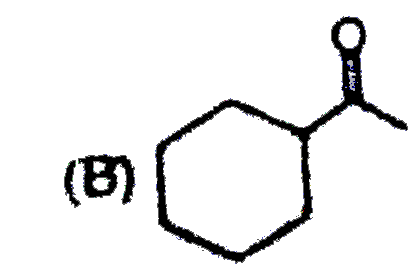 is ketone. It will not give bicarbonate test (test for acids), Lucas test (test of alcohols) and Tollen's test (test for aldehydes ) but it will give 2,4 DNP test. is ketone. It will not give bicarbonate test (test for acids), Lucas test (test of alcohols) and Tollen's test (test for aldehydes ) but it will give 2,4 DNP test. (C )Picric acid gives bicarbonate test but it will not give test of other functional groups . (D)ozonolysis product is 3 moles of CHO-CHO being aldehyde it will give Tollen's test and 2,4 DNP test but not other test. |
|
| 8. |
Match the gases under specified conditions listed in Column I with their properties /laws in Column II |
|
Answer» |
|
| 9. |
Match the four starting materials (P,Q,R,S) given in List-I with the correspoinding reaction schemes (I, II, III, IV) provided in List - II and select the correct answer using the code given below the lists |
|
Answer» `{:(A,Q,R,S),(1,4,2,3):}` 
|
|
| 10. |
Match the four material (P, Q, R, S) given in List -I with the corresponding reaction schemes (I, II, III, IV) provided in List-II and select the correct answer using the code given below the lists. |
|
Answer» <P>`{:(P,Q,R,S),(1,4,2,3):}` |
|
| 11. |
Match the formulas of oxides given in Column I with the type of oxide given in Column II and mark the correct option. {:("Column I","Column II"),((A) Pb_(3)O_(4),(1)"Neutral oxide"),((B)N_(2)O,(2)"Acidic oxide"),((C)Mn_(2)O_(7),(3)"Basic oxide"),((D)Bi_(2)O_(3),(4)"Mixed oxide"):} |
|
Answer» `{:(A(1),B(2),C(3),D(4)):}` |
|
| 12. |
Match the formulas of oxides given in Column I with the type of oxides given in Column II and mark the correct option. |
|
Answer» |
|
| 13. |
Match the formulas of oxides given in Column-I with the type of oxide given in Column-II and mark the correct option. |
|
Answer» A-(1), B-(2), C-(3), D-(4) |
|
| 14. |
Match the foolwing columns : |
|
Answer» |
|
| 15. |
Match the folowing columns : |
|
Answer» |
|
| 16. |
Match the folowing columns : |
|
Answer» |
|
| 17. |
Match the folowing columns : |
|
Answer» |
|
| 18. |
Match the followings . {:(,"List - I" ,, ,"List- II") , (,(A) "Potential of",, (I), 0.76 V), (, "Hydrogen electrode at pH = 10 " ,, (II) , 0.0592 V), (, (B) Cu^(2+)|Cu ,, (III) , -0.592 V), (, (C) Zn|Zn^(2+) ,, (IV) , 0.337 V), (, (D) (2.303RT)/(F) ,, (V) , -.76V):} The correct is - |
|
Answer» `{:( A, B , C , D) , (V , I , IV , II):}` = `-0.0592 XX log 10^(10) = -0.0592 xx 10 = -0.592 V ` (B) `CU^(2+) | Cu , E_("Red")^(@) = +0.337 V` (C) `Zn^(2+) | Zn = E_(Red)^(@) = -0.76 V` (D) `(2.303 RT)/(F) = 0.0592 V ` |
|
| 19. |
Match the folowing |
|
Answer» `A-4, B-2, C-3, D-5` |
|
| 20. |
Match the following X, Y,Z(C_5H_(12)O)are isomeric alcohols on oxidation ‘X’ gives a given, Y gives acid and Z is not oxidised X gives positive I_2//OH^(Theta) test. The activity order with HBr is Z gt X gt Y. |
|
Answer» |
|
| 22. |
Match the following with their appropriate method of preparation |
|
Answer» `1^(@)` aliphatic amine can be SYNTHESIZED by Gabriel method and by reduction of amide with LAH `1^(@)` aromatic amine containing EWG at o- and p-positions can be synthesized by Gabriel method. `1^(@)` aliphatic amine can be synthesized by Gabriel method and by Hoffmann bromamide reaction of butanamide 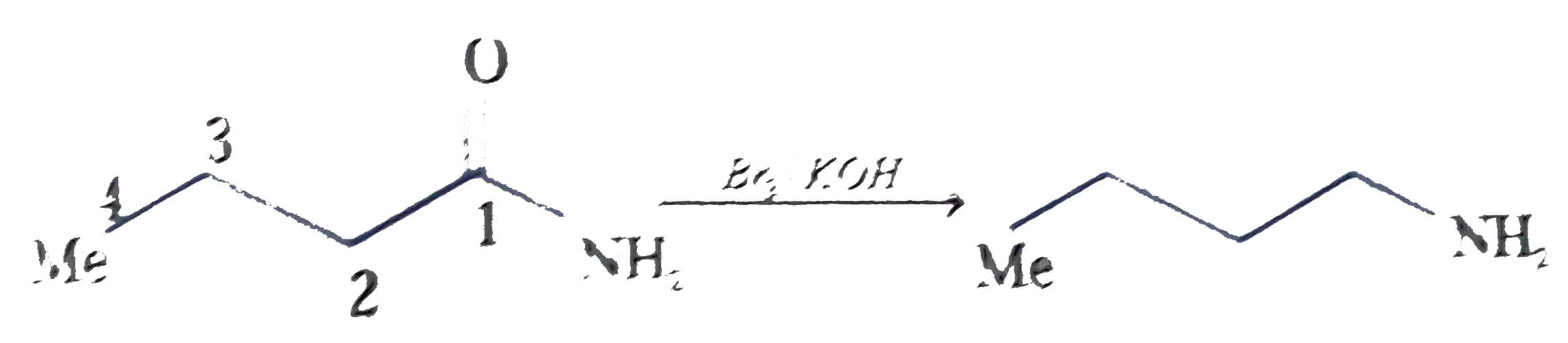
|
|
| 27. |
Match the following two Column - I and Column - II :{:(,"Column - I",,"Column - II"),((U),"Raoult's law for volatile solute and volatile solvent",(i),P_(A)=p_(A)^(0).X_(A)),((V),"Raoult's law for gaseous solute and liquid solvent",(ii),P_(A)p_(A)^(0)+(p_(B)^(0)+p_(A)^(0))X_(B)),((W),"Raoult's law for non - volatile solute and volatile solvent",(iii),(p_(1)^(0)-p_(1))/(p_(1)^(0))=(n_(2))/(n_(1)+n_(2))):} |
|
Answer» `U to (III), V to (i), W to (II)` |
|
| 28. |
Match the following : The correct answer is |
|
Answer» A - V, B - I, C - II, D - III `II rarr A, V rarr B, III rarr C, I rarr D`. Their explanations are as follows : `(D) rarr I` In an isothermal reversible EXPANSION `DELTA T = 0` `Delta U = C_(V) , Delta T = 0` `(A) rarr II` If wall is adiabatic then `q = 0` From first law of thermodynamics `Delta U = q + W` `:. Delta U = W_("adiabatic")` `(C ) rarr III` For thermally conducting walls `Delta U = -q` `(B) rarr V` For close system `q != 0, w != 0` and `W = -ve` From first law of thermodynamics `Delta U = q - W` |
|
| 29. |
Match the following structures of protein in column I with their characteristic features in column II |
Answer» SOLUTION :
|
|
| 30. |
Match the following sets of compounds and Cl-O Bond lengths. {:("COLUMN-I","COLUMN-II"),("A) HClO(Cl-O bond length)","p)" 1.64A^(@)),("B)" HClO_(2)"(Cl-O bond length)","q)" 1.70 A^(@)),("C)" HClO_(3) "(Cl-O bond length)","r)" 1.45 A^(@) ),("D)" HClO_(4) "(Cl-O bond length)","s) " 1.50 A^(@) ):} |
|
Answer» `HClO gt HClO_(2) gt HClO_(3) gt HClO_(4)` |
|
| 31. |
Match the following {:(,"Set-I",,"Set-II"),((A),"Most electronegativity",(1),At),((B),"Most electronaffinity",(2),F_(2)),((C),"Liquid Halogens",(3),Cl_(2)),((D),"Radioactivity Halogens",(4),Br_(2)):} Correct the matching is |
|
Answer» `{:(,A,B,C,D),((1),3,4,1,2):}` |
|
| 32. |
Match the following set related to compounds and Number of lone pairs at central atom {:("COLUMN-I","COLUMN-II"),("A) HClO","p)"0),("B)" HClO_(2),"q)" 1),("C)" HClO_(3),"r)" 2),("D)" HClO_(4),"s)" 3):} |
|
Answer» |
|
| 33. |
Match the following {:("SET - I","SET - II"),("A) "Mn_(2)O_(7),"1) Covalent green oil"),("B) "CrO_(3),"2) Basic"),("C) "V_(2)O_(5),"3) amphoteric"),("D) "CrO,"4) anhydride of cromic acid"),(,"5) acidic"):} |
|
Answer» `{:(A,B,C,D),(1,4,3,2):}` |
|
| 34. |
Match the following set-I with appropriate one from the set-2 Reaction |
|
Answer» `(1-E_1), (2-SN^2), (3-SN^1), (4-E_2) ` |
|
| 35. |
Match the following {:(Set A,, Set B ), ("acetanilde " ,, "acidic ") ,("benzonitrile ",, " basic "),("trimethyl amine ",,"neutral "),("phenol",,-) :} |
|
Answer» `{:(1,2,3,4),(C,C,B,A):}` |
|
| 36. |
Match the following : {:("Reaction (Homogeneous gaseous phase)","Degree of dissociation in terms of equilibrium constant"),((A)A(g)+B(g)hArr2C(g),(p)(sqrtk)//(1+sqrtk)),((B)2A(g)hArr+B(g)+C(g),(q)(sqrtk)//(2+sqrtk)),((C )A(g)+B(g)hArrC(g)+D(g),(r)2k//(1+2k)),((D)AB(g)hArrA/2(g)+B/2(g),(s)(2sqrtk)/(1+2sqrtk)),(,(t)k):} |
|
Answer» |
|
| 37. |
Match the following questions {:("COLUMN - I ","COLUMN - II "),("A) Gold sol ","p) Bredig's Arc method "),("B) Purification of Colloidal solution ","q) - ve charged "),("C) "As_2 S_3 "sol","r) Ultra centrifugation "),("D) Zeta potential ","s) Electro kinetic potential "),(,"t) Double decomposition reaction"):} |
|
Answer» Purification of colloidal solution - ultra CENTRIFUGATION `As_2 S_3`sol -ve charged & Double decomposition Zeta POTENTIAL - Electrokinetic potential |
|
| 38. |
Match the following question Column -I""Column -II (A) XeO_(3), XeF_(2), ClF_(3), PCl_(5)( p ) All are sp^(3) d except one ( B CH_(4) , XeO_(3) , ClO_(4)^(-) , ICl_(2)^(+)(q) All are sp^(3) except one ( C )BF_(4)^(-) , SO_(4)^(2-) , CO_(3)^(-) , POCl_(3)( r )All are sp^(3) ( D ) SO_(2) , SnCl_(2) ,SO_(3)^(-) , SO_(2) Cl_(2) sp^(2) and sp^(3) hybridisation ( t) All are sp^(2) except one |
|
Answer» <P> |
|
| 39. |
Matchthe followingquestion Column I with Column II |
| Answer» SOLUTION :`((A to Q,s)(B-p,s) (c-r,s) (D-t)` | |
| 40. |
Match the following quesitons ColumnI with Column II Column -IColumn -II (A)[H^(+)]in an aqueous solution of NH_(4)Cn( p ) ( k_(a_(1)), k_(a_(2)) ) ^((1)/(2)) ( B ) [H^(+)] in an aqueous solution of NaHCO_(3)(q) ((k_(w)k_(a))/( k_(b)))^((1)/(2)) (C ) [H^(+)]in an aqueous solution of NH_(4)HCO_(3)( s) Does not depend on salt concentration in aqueous solution (D) [CO_(3)^(2-) ] in 0.01 M H_(2)CO_(3)( t) k_(a_(2)) |
|
Answer» |
|
| 41. |
Match the following prefixes with their multiples : {:(,"Prefixes","Multiplies"),((i),"micro",10^(6)),((ii),"micro",10^(9)),((iii),"deca",10^(-6)),((iv),"mega",10^(-15)),((v),"femto",10):} |
| Answer» Solution :`"MICRO "=10^(-6),"DECA = 10,mega"=10^(6)," giga"=10^(9)," femto"=10^(-15)`. | |
| 42. |
Match the following physical quantities with units {:(,"Physical quantity",,"Unit"),((i),"Molarity",(a),"g mL"^(-1)),((ii),"Mole fraction",(b),"mol"),((iii),"Mole",(c),"Pascal"),((iv),"Molality",(d),"Unitless"),((v),"Pressure",(e),"mol L"^(-1)),((vi),"Luminous intensity",(f),"Candela"),((vii),"Density",(g),"mol kg"^(-1)),((viii),"Mass",(h),"kg"):} |
|
Answer» `"Mole fraction = unitless. Hence (ii)-(d)"` `"Mole = mol. Hence, (iii)-(b)"` `"Molality = mol kg"^(-1)." Hence, (iv)-(g)"` `"Pressure = PASCAL. Hence, (v)-(c)"` `"Luminous intensity = Candela. Hence, (VI)-(f)"` `"Density = g mL"^(-1).` Hence, (VII)-(a) `"Mass = kg. Hence, (viii)-(h)"` |
|
| 43. |
Match the followingmixtures with the respective solution used for this separation : {:(,"Column -I",,"Column -II"),((A),H_(2)S,(p),"Decolourises acidified solution of "KMnO_(4)),((B),SO_(2),(q),"Can undergo disproportionation reaction "),((C),HNO_(3),(r),"Can act as reducing agent"),((D),HNO_(2),(s),"V-shaped"),(,,(t),"Acidic nature"):} |
|
Answer» |
|
| 44. |
Match the following : (More than one option in column-II may match with single option in column I |
|
Answer» a CARBOXYLIC functional group gives positive test with `NaHCO_3` a carbonyl group yellow PPT. with 2,4-DNP an ALCOHOL gives positive test with Lucas Reagent. |
|
| 45. |
Match the following Match the compounds given in Column I with respect ot the sequences in which there are found in Column II |
|
Answer» |
|
| 47. |
Match the following : {:("","List-I","List_II",""),((P),"Formation of ammonia by haber's process",(1),"increase in temperature"),((Q),"Formation of" SO_3 "in contact process for manufacture of " H_2SO_4,(2),"Decreasein temperature"),((R ),"Formation of NO in Birk-land Eyde process for manufacture of "HNO_3,(3),"Decrease in pressure"),((S),"Formation of" NO_2(g) "by following reaction" NO(g)+O_3hArr NO_2(g)+O_2(g)+200KJ,(4),"increase in pressure"):} |
|
Answer» <P>`{:(P,Q,R,S),(1.4,2.2,4.1,3):}` |
|
| 48. |
{:(ul("List - I")" (polymer)",ul("List - II")" (Stucture)"),("1) Urea formaldehyde resin","a) "(-NH-(CH_(2))_(5)-CO-)_(n)),("2) Neoprene","b) "(-NH-(CH_(2))_(6)-NH-)_(n)),("3) PVC","c) "(-CH_(2)-underset(Cl)underset(|)C=CH-CH_(2)-)_(n)),("4) Nylon - 5","d) "(-CH-underset(Cl)underset(|)CH-)_(n)),(,"e) "(-NH-CO-NH-CH_(2)-)_(n)):} |
|
Answer» ` {:(1,2,3,4),(E,d,C,B):}` |
|
| 49. |
Match the following : {:(,"LIST -I",,"LIST -II"),((P),K_(4)[Fe(CN)_(6)] to Fe^(3+) + CO_(2)+NO_(3)^(-),(1),61),((Q),FeS_(2) to Fe^(3+) +SO_(2),(2),11),((R),Br_(2)+2NaOH to NaOBr+NaBr+H_(2)O,(3),28),((S),As_(2)S_(3) to As^(+5)+SO_(4)^(2-),(4),5//3):} |
|
Answer» <P>`{:(P,Q,R,S),(1,2,4,3):}` |
|
| 50. |
Match the following {:(,"List - I",,"List - II"),((P),"Simple cubic and face - centred cubic",(1),"Have these cell parameters a = b = c and " alpha = beta = gamma),((Q),"Cubic and rhombohedral",(2),"Are two crystal systems"),((R ),"Cubic and tetragonal",(3),"Have only two crystallography angles of " 90^(@)),((S),"Hexagonal and monoclinic",(4),"Belong to same crystal system"):} |
|
Answer» P-1,3, Q-1,2, R-2,4, S-1,3 |
|