

Saved Bookmarks
This section includes 7 InterviewSolutions, each offering curated multiple-choice questions to sharpen your Current Affairs knowledge and support exam preparation. Choose a topic below to get started.
| 1. |
Match the column : |
|
Answer» |
|
| 3. |
Match the column:- |
|
Answer» A–s, B–q, C–p, D–r |
|
| 4. |
Match the colume (I) and column (II) {:(,"Column (I)",,"Column (II)",),(,"compound (Monocyckuc)",,"Number of " pi -"electrons",),((a),C_(4)H_(4)^(-2),(p),2pie,),((b),C_(4)H_(4)^(+2),(q),6pie,),((c),C_(9)H_(9)^(+1),(r),8pie,),((d),C_(9)H_(9)^(-1),(s),10 pie,):} |
Answer» 
|
|
| 5. |
Match the colour of precipitate listed in column-Iwith the reagent(s) listed in column II. {:(Column-I,Column-II),((A)Bi^(3+)"gives black precipitate with",(p)"Saturated solution of" H_2S "in water"),((B)Cu^(2+)"gives black precipitate with",(q)"Potassium thiocyanate soluion"),((C )Zn^(2+)"gives white precipitate with",(r)"Potassium iodide solution"),((D)Ag^+"gives white precipitate with",(s)"Potassium ferrocyanide solution"),(,(t)"Potassium chloride"):} |
|
Answer» `Bi^(3+)to3I^(-)toBiI_3darr` (black) (B)`CU^(2+)+H_2StoCuSdarr(black)+2H^(+)` `Cu^(2+)+2SCN^(-)toCu(SCN)_2darr`(black) which one standing slowly changes to white `2Cu(SCN)_2to2Cu(SCN)DARR(white)+(SCN)_2` `Cu_2I_2` is white precipitate and `Cu_2[Fe(CN)_6]` brown precipitate (C )`Zn^(2+)+H_2StoZnSdarr(white)+2H^+` `2K^(+)+2Fe(CN)_6]^(4-)+3Zn^(2+)toK_2Zn_3[Fe(CN)_6]_2darr`(white) `ZnI_2to`soluble (D)`4Ag^(+)+[Fe(CN)_6]^(4-)toAg_4[Fe(CN)_6]darr`(white) `Ag^(+)+SCN^(-)toAgSCNdarr`(white) `Ag_2Sdarr` black , `AgIdarr` yellow |
|
| 6. |
Match the coloum I with column II. |
|
Answer» `{:(Column-I(reaction),Column-II("Mechanism")),((##ALN_CHM_C08_E01_046_O01##),(p)S_(N)1):}` |
|
| 7. |
Match the chemical substances in column I with type of polymers/type of bonds in column II. |
|
Answer» <P> |
|
| 8. |
Match the characteristics mentioned in Column II with the process in Column I. {:(,"Column I",,"Column II"),((A),LiF_((s))+AquararrLiF_((aq)),(p),"Exothermic"),((B),KF_((s))+AquararrKF_((aq)),(q),"Endothermic"),((C),O_((g))+e^(-)rarrO_((g))^(-),(r),"Positive affinity"),((D),O_((g))^(-)+e^(-)rarrO_((g))^(2-),(s),"Negative affinity"):} |
|
Answer» Hence, exothermic dissolution. `(B) DeltaH_("lattice")(KF)gtDeltaH_("hydration")(KF),` Hence, endothermic dissolution. `(C) O_((g))+E^(-)rarrO_((g))^(-),DeltaHlt0" (Exothermic)",` `(D) O_((g))^(-)+e^(-)rarrO_((g))^(2-), DELTAHGT0" (endothermic)", Hence negative affinity. |
|
| 9. |
Match the chemical conversions in List -I with the appropriate reagents in List-II and select the correct answer using the code given below and lists. |
|
Answer» |
|
| 10. |
Match the chemical conversions in Column I with the appropriate reagents in Column II and select the correct answer using the code given below the lists. |
|
Answer» P = 2, Q = 3, R = 1, S = 4 `(##SKM_COMP_CHM_V02_XII_C12_1_E01_254_A01##)` |
|
| 11. |
Match the catalysts to the correct processes : {:("Catalyst","Process"),((A)TiCl_(3),"(i) Wacker process"),((B)PdCl_(2),"(ii) Ziegler - Natta"),(,"polymerization"),((C)CuCl_(2),"(iii) Contact process"),((D)V_(2)O_(5),"(iv) Deacon's process"):} |
|
Answer» `PbCl_(2):"WACKER PROCESS"` `CuCl_(2):" Deacon.s process"` `V_(2)O_(5):"CONTACT process"` |
|
| 12. |
Match the catalysts to the correct processes : |
|
Answer» A - (II), B - (III), C - (iv), D-(i) |
|
| 13. |
Match the catalysts given in Column I with the processes given in Column II. {:(,"Column I ( Catalyst)",,"Column II (Process)"),((i) ,"Ni in the presence of hydrogen ",(a),"Ziegler Natta catalyst"),((ii) , Cu_(2)Cl_(2),(b),"Contact process"),((iii) , V_(2)O_(5),(c ) ,"Vegetableoil to ghee"),((iv),"Finely divided iron",(d) ,"Sandmeyer reaction"),((v),TiCl_(4)+Al(CH_(3))_(3),(f),"Decomposition of "KCIO_(3)):} |
|
Answer» |
|
| 14. |
Match the catalyst given in Column I with the processes given in Column II. |
|
Answer» |
|
| 16. |
Match the Atomic number in Column-I with the blcktype of element in Column - II(##FIITJEE_CHE_MB_04_C03_E05_001_Q01.png" width="80%"> |
|
Answer» |
|
| 17. |
Match the anionic species given in Column I that are present in the ore (s) given in Column II {:(,"Column I",,"Column II"),((A),"Carbonate",(p),"Sideritc"),((B),"Sulphide",(q),"Malachite"),((C),"Hydroxide",(r),"Bauxite"),((D),"Oxide",(s),"Calamine"),(,,(t),"Argentite"):} |
|
Answer» (q) Malachite -` CuCO_(3).Cu(OH)_(2)` (r) Bauxite `AlO_(X)(OH)_(3-2x)` (s) Calamine - `ZnCO_(3)` (t)Argentite - `Ag_(2)S` |
|
| 18. |
Match structures given in list I with names given in list II and then select the correct answer from the codes given below the list |
|
Answer» |
|
| 19. |
Match parameters involved in column I with those in column II. {:("Column-I",,"Column-II"),("(A)Moles of any one element in 244 gm of Salicaldehyde",,"(P)4"),("(B)Ratio of density of ozone gas to that of methane at same temperature & pressure",,"(Q)6"),("(C)gm-atoms or gm-molecules in 22.4 litres of " N_(2) " gas at 273 K & 3 atm pressure",,"(R)12"),("(D) gm-ion of anion or total moles of all the ions in 342 gm of aluminium sulphate",,"(S)5"),(,,"(T)3"):} |
|
Answer» `C_(7)H_(^)O_(2) to 122 gm` / mole `n_(C_(7)H_(6)O_(2))=244/122=2` `n_(O)=2xx2=4` `n_(H)=6xx2=12` (B) `d_(O_(3))/(d_(CH_(3)))=((PMO_(3))/(RT))/((PM_(CH_(4))/(RT))=48/16=3` `(C) n=(PV)/(RT)=(3xx22.4)/(0.0021xx273) = 3` mole `n_(N_(2))=3` `n_(N)=6` (D) `Al_(2) (SO)_(3) to 342/342 =1 ` mole `n_(SO_(4)^(2)) =3` `n_("Total")=5` |
|
| 20. |
Match of the following The correct match is |
|
Answer» `{:(a,B,C),(2,1,3):}` |
|
| 21. |
Match of the following |
|
Answer» `{:(A,B,C,D),(4,3,2,1):}` |
|
| 22. |
Match of the Column I with column II and mark the appropriate choice. |
|
Answer» `A to II, B to iii, C to iv D to i` |
|
| 23. |
Match list-l with list-ll and select the correct answer using the codes give below the lists: List-l (A) CH_(2)=CH–CHOoverset(NaBH_(4))(rarr) (B) C_(6)H_(5)CHO+Ph–NH_(2) overset(H^(oplus))(rarr) (C)C_(6)H_(5)COCH_(3)+CH_(3)–CH_(2)–NH_(2) overset(H^(oplus))(rarr) (D) RCHO+2RCH_(2)OH overset(H^(oplus))(rarr) List-ll (P) Acetal (Q) Schiff’s base (R) Unsaturated alcohol (S) Enamine |
|
Answer» <P> |
|
| 24. |
Match Matrix {:("Column I","Column II"),((A)Zn|Zn^(2+)( C)||Zn^(2+)(2C)|Zn,(p)"Spontaneous cell reaction"),((B)H_2(P)|HCl(1N)||H_2SO_4(1N)|H_2(P),(q)"Working cell representation"),(( C)Cu|Cu^(2+)(0.01 M)||Ag^(+)(0.1M)|Ag,(r)"Concentration of cation in cathodic compartment increases upto equilibrium"),((D)Ag|AgCl|(KCl, 0.1 M)||Ag^(+)(0.01 M)|Ag,(s)"Concentration cell"),(,(t)"Concentration of"Cl^(-)"in anodic compartment decreases"):} |
|
Answer» Spontaneous, cell works, conc cell `E_("cell")=-0.0591 "log"1/0.5 =- 0.0591` NON spontaneous cell will not work conc cell `E_("cell")=-0.0591/2"log"0.01/0.1^2-0.74+0.8=0.06` Spontaneous cell works `E_("cell")=-0.0591/1"log"(Cl^-)/(K_(sp))-0.0591/1"log"1/([Ag^+])` `=0.0591/2"log"(0.1xx0.1)/(K_(sp(AGCL))=+ve` Spontaneous cell works conc cell For anode `Ag(s)+Cl^(-)(AQ)toAgCl(s)+e^-` |
|
| 28. |
Match List - I with List - II {:(,"List - I",,"List - II"),((P),"Zinc blende structure",(1),"oxide ions in hcp and 2/3rd of octahedral voids occupied by the trivalent cation."),((Q),"Anti-fluorite structure",(2),"anion in FCC arrangement and alternate tetrahedral voids occupied by bivalent cation."),((R ),"Corundum structure",(3),"Oxide ions in face centres of cubic, bivalent cations in corners and one tetravalent cation ions."),((S),"Pervoskie structure",(4),"Anions in FCC and cations in all tetrahedral voids"):} |
|
Answer» P-1, Q-2, R-4, S-3 |
|
| 29. |
Match List-II with List-II and select the correct answer using the codes given below: |
|
Answer» (i)-C,(II)-A,(III)-D,(IV)-B 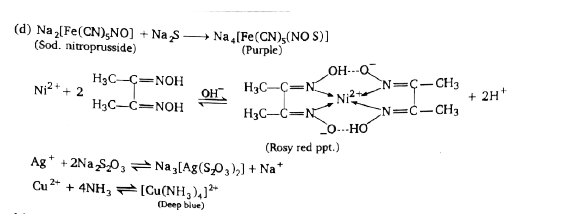
|
|
| 30. |
Match list I with list II and slect the correct anser using the codes below the lists. {:("List I", "List II"),("Reactants", "Products"),((i)CH_(3)CH_(2)CH_(2)CH_(2)Br+KOH_((alc)),(1)"cis 2-butane"),((ii)CH_(3)CH_(2)CHBrCH_(3)KOH_((alc)),(2)"trans 2-butane"),((iii) (CH_(3))_(3)CBr+KOH_((alc)),(3) 1-"butane"),(,(4) 2-"methyl 1- propan"):} |
|
Answer» `{:(""(i),(ii),(iii)),(2,1,3):}` |
|
| 31. |
Match list I with list II for the composition of substance and select the correct answer using the code given below |
|
Answer» `{:("(a)","(B)","(c)","(d)"),("(III)","(IV)","(i)","(ii)"):}` |
|
| 32. |
Match list I with list -II and select the correct options given below: {:("list-I","list-II"),((P)"Haber's process for"NH_(3),(1)C),((Q)"Ostwald's process for"HNO_(3),(2)Al),(®"Alumino-themite process",(3)Pt-gauze),((S)"Serpeck's process",(4)"Finely divided Fe with Mo"):} |
|
Answer» p-4,q-3,r-2,s-1 |
|
| 33. |
Match List I with List II and select the correct options given below : List -IList -II ( P ) 10 ml 0.1 M NaOH aq.Solution is added to 10 0.1 M HCl aqueous solution( 1) Salt of weak acid and strong base (Q) 10 ml, 0.1 M NaOH aq. solution is added to 10 ml 0.1 M CH_(3) COOH aq. solution( 2) Salt of weak base and strong acid ( R )10 ml 0.1 M HCl aq. solution is added to 10 ml 0.1 M NH_(3) aq.solution( 3) pH of the solution will be 7 ( s) 10 ml, 0.2 M HCl aq. solution to 10ml, 0.1 M KOH aq. solution( 4) pH of the solution will be 1.33 Codes : |
|
Answer» <P>`{:(P,Q,R,S),(3,1,2,4):}` |
|
| 34. |
Match List I with List II and selected the correct answer using the codes given below the lists: {:("List I",, "List-II"),((I) "Iodoform" ,, (A) "Anaesthetic"),((II) "Methyl salicylate ",, (B) "Antiseptic"),((III)" Diethyl ether" ,, (C) "Insecticide"),((IV)" Hexachlorocylohexane ",, (D) " Detergent "),(,, (E) "Pain balm"):} |
|
Answer» `I - B, II-E ,III -C ,I-D` |
|
| 35. |
Match List I with List II and select the correct answer using the codes gives below the lists : {:("""List - I","""List - II"),("A. van Arkel method","1. Manufacture of caustic soda"),("B. Solvay process","2. Purification of titanium"),("C. Cupellation","3. Manufacture of" Na_(2)CO_(3)),("D. Poling","4. Purification of copper"),(,"5. Refining of silver"):} |
|
Answer» `{:(A,B,C,D),(2,1,3,4):}` |
|
| 36. |
Match List I with List II and select the correct answer using the codes given below the lists |
|
Answer» 1-(C), II(a), III-d), IV-(b) |
|
| 37. |
Match list I with list II and select the correct answer using the codes given below the lists : {:("""List"I,"""List"II),("A. Cyandide process","I. Ultrapure Ge"),("B. Floatation process",II."Pincoil"),("C. Electrolytic reduction",III."Extraction of Al"),("D.Zone refining",IV."Extraction of Au"):} |
|
Answer» A-III, B-I, C-IV, D-II |
|
| 38. |
Match list -I with list -II and select the correct answer using the codes given below: {:("List-I","List-II"),((P)"Haber process",(1)Na_(2)CO_(3)),((Q)"Birkeyland -Eyde process",(2)NH_(3)),((R )"Solvay's process",(3) HNO_(3)):} |
|
Answer» P-2,Q-3,R-1 |
|
| 39. |
Match list -I with List -II and select the correct answer using the codes given below. {:("List-I","list-II"),((P)"liq Na metal",(1)"Breathing appartus submarine"),((Q)"pot. Sterate",(2)"Explosive"),((R )KNO_(3),(3)"Coolant in nuclear reaction"):} |
|
Answer» P-3,Q-4,R-1,S-2 |
|
| 40. |
Match list-I with list-II and select the correct answer using the codes given below : List-IList -II aCH_(3)COONa1. Strong electrolyte with pH gt 7 b. NH_(4)Cl2. Strong electrolyte with the pH lt 7 c. Bi_(2)S_(3)3.Weak electrolyte with K_(sp) = S^(2) d. CdS4. Weak electrolyte with K_(sp) = 108 S^(5) Codes |
|
Answer» `{:(a,B,C,d),(2,3,1,4):}` |
|
| 41. |
Match List-I with List-II and select the correct answer using the codes given below |
|
Answer» |
|
| 42. |
Match List-I with List-II and select the correct answer using the codes given below |
|
Answer» |
|
| 43. |
Match List-I with List-II and select the correct answer using the codes given below |
|
Answer» |
|
| 44. |
Match List I with List II and select the correct answer using the code given below the lists : {:("List"-I("Reaction"),,"List"-II("Proces")),(a.NH_(4)Br+AgNO_(3)rarrAgBr+NH_(4)NO_(3),,p."Preparation of sensitive film" ),(b.C_(6)H_(4)(OH)_(2)+2AgBrrarr 2Ag+C_(6)H_(4)O_(2)+2HBr,,q."Developing of the film"),(c. 2Na_(2)S_(2)O_(3)+AgBrrarrNa_(3)[Ag(S_(2)O_(3))_(2)]+2NaBr,,r."Fixing of he film"),(d.AuCl_(3)+3Ag rarr3AgCl+Au,,s."Toning process"):} Code: |
|
Answer» `{:(,a,b,C,d),(,p,q,r,s):} ` |
|
| 45. |
match List-I with list-II and select the correct answer using the codes given below: |
|
Answer» I-B,II-A,III-C,IV-D,V-E 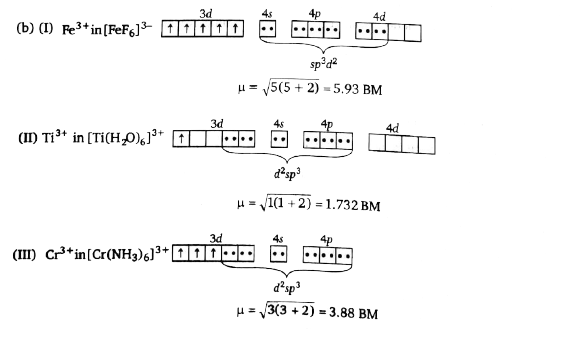 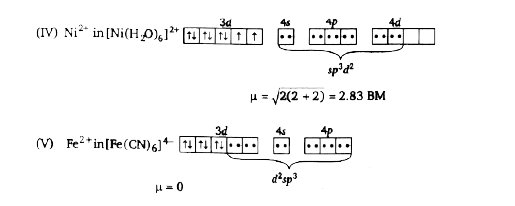
|
|
| 46. |
Match list-I with list -IIand select the correct answer using the codes given below: |
|
Answer» P-3,Q-1,R-4,S-2 |
|
| 47. |
Match List I with List II and select the correct answer using the code given below the lists : {:("List-I","List-II"),((A)"For ionic solid"r_+/r_(-)=0.51,(p)"Anion-anion contact present, cation lies in octahedral void"),((B)"For ionic solid"r_+/r_(-)=0.414,(q)"Anion-anion contact missing, cation lies in tetrahedral void"),((C )"For ionic solid"r_+/r_(-)=0.4,(r)"Anion-anion contact missing, cation lies in cubical void"),((D)"For ionic solid"r_+/r_(-)=0.9,(s)"Anion-anion contact missing, cation lies in octahedral void"):} |
|
Answer» `0.414 le r_+/r_- lt 0.732` Cation is in octahedral VOIDS |
|
| 48. |
Match list I with List II and select the correct answer using the codegiven below the lists : {:("List I , List II"),("A sodium hydroxide , 1 strong acid"),(B "calcium oxide2. Alkali"),(C "Acetic acid, 3. Weak acid"),(D "Hydrochloric acid, 4. Base"):} |
| Answer» Solution :sodium hydroxide is an alkali hydroxie CALCIUM oxide is a baswe ACETIC acid is a weak acid and hydrochloirce acid is a strong acid | |
| 49. |
Match list-I with List II and select the correct answer using the code given below the lists : |
|
Answer» |
|
| 50. |
Match List I with List II and select the correct answer using the code given below the lists : |
|
Answer» (B)  Stereo centres=2 , Total stereoisomers =`2^(2)`= (All optically active) (C )  Stereo centres = 2 , Total stereoisomers =`2^(2-1)+2^(2//2+1)=3` (D)`CH_3-CH(Cl)-CH=CH-CH(Cl)-CH_3` Stereo centre=3, Total stereoisomers =`2^(3-1)+2^(3-1//2)=6` |
|