Saved Bookmarks
This section includes 7 InterviewSolutions, each offering curated multiple-choice questions to sharpen your Current Affairs knowledge and support exam preparation. Choose a topic below to get started.
| 1. |
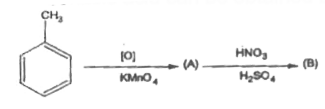
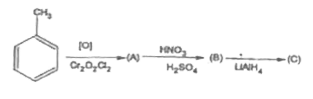
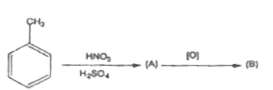
m-nitro benzoic acid can be obtained by |
|
Answer»
|
|
| 2. |
M = molarity of the solutionm = molality of the solutiond = density of the solution(in g. ml^(-1))M^(-1)=gram molecular weight of solute Which of the following relations is correct |
|
Answer» `m=(M)/(1000d-MM^(1))` |
|
| 3. |
m-Methoxybenzoic acid is a________acid than p-methoxybenzoic acid due to____of the OCH_(3) group at m-position. |
| Answer» SOLUTION :STRONGER,-I-effect. | |
| 4. |
M-L bonds in carbonyl compounds posses |
|
Answer» only `SIGMA` CHARACTER |
|
| 5. |
M' is the molecular weight of KMnO_(4). The equivalent weight of KMnO_(4) when it reacts acoording to the equation 2KMnO_(4)+3H_(2)SO_(4)+5H_(2)C_(2)O_(4)rarrK_(2)SO_(4)+2MnSO_(4)+8H_(2)O+10CO_(2) |
|
Answer» `M//2` |
|
| 6. |
M is molecular weight of KMnO_(4). The equivalent weight of KMnO_(4) when it is converted into K_(2)MnO_(4) is |
|
Answer» Molecular weight /10 Change in 0.5 per atom `=7-6=1` `:.` Equivalent weight of `KMnO_(4)` `=("Molecular weight of "KMnO_(4))/("Change of 0.5 per atom")=M/1=M` |
|
| 7. |
M g of a substance when vaporised occupy a volume of 5.6 litre at NTP. The molecular mass of the substance will be |
|
Answer» M |
|
| 8. |
m-Dihydroxybenzene is called as |
|
Answer» Resorcinol |
|
| 9. |
m-Chlorobenzaldehyde on reaction with conc. KOH at room temperature gives: |
|
Answer» POTASSIUM m- chlorobenzoate andm-hydroxybenzaldehyde |
|
| 10. |
m-Chlorobenzaldehyde on reaction with conc. KOH at room temperature gives |
|
Answer» POTASSIUM m-chlorobenzoate and m-hydroxybenzaldehyde 
|
|
| 11. |
m-chlorobenzaldehyde on reaction with conc. KOH at room temperature gives : |
|
Answer» POTASSIUM m-chlorobenzoate and m-hydroxybenzaldehydes |
|
| 12. |
m-Bromoaniline can be prepared by |
|
Answer» `C_(6)H_(6) underset(H_(2)SO_(4))OVERSET(HNO_(3))to underset(2.NAOH,H_(2)O)overset(Sn-HCl)to underset(H_(2)O)overset(Br_(2))to` |
|
| 13. |
m-Bromoaniline can be prepared by :- |
|
Answer» `C_(6)H_(6) underset(H_(2)SO_(4)) overset(HNO_(3))to underset(2." "NaOH,H_(2)O)overset(1." "Sn-HCL)to underset(H_(2)O)overset(Br_(2))to` 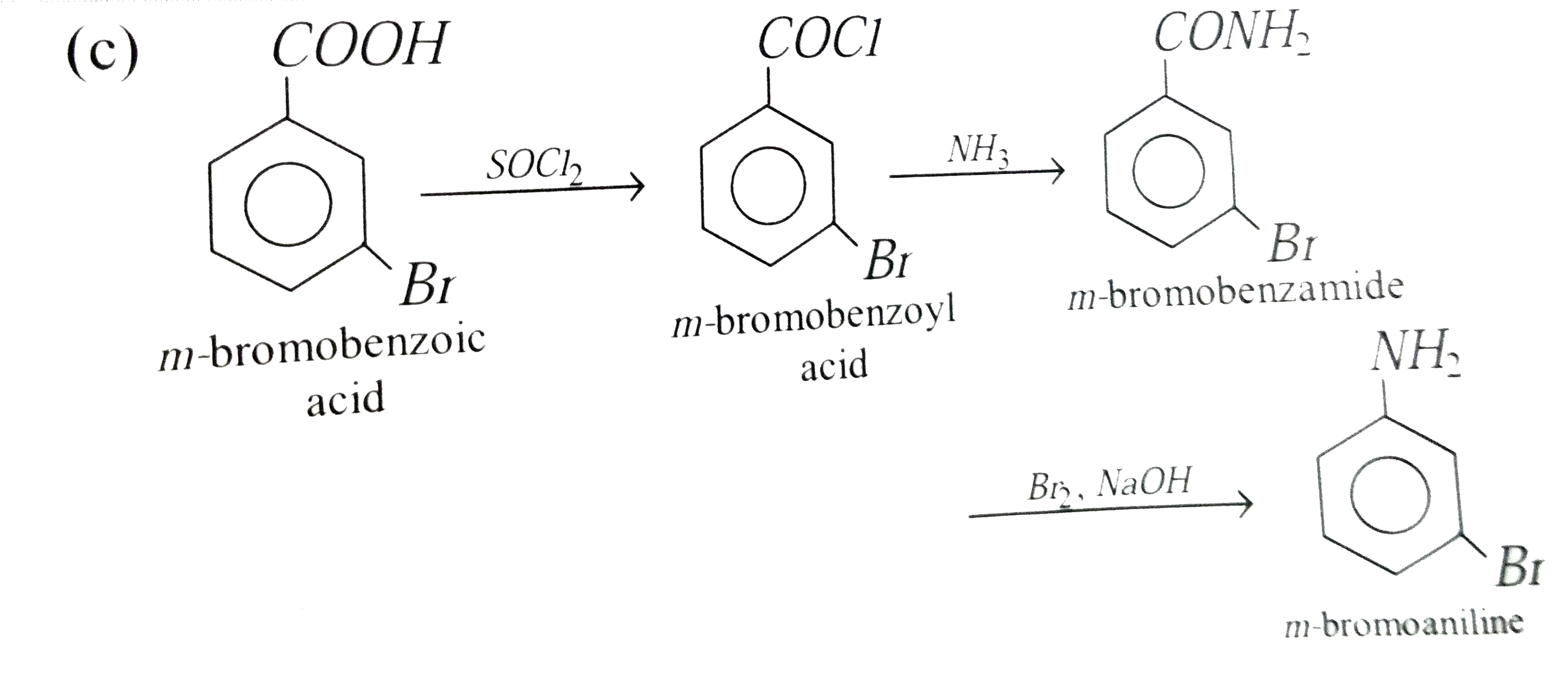
|
|
| 14. |
m-Bromo benzamide reacts with Br_(2) and KOH to give : |
|
Answer» m - Bromoaniline |
|
| 15. |
Lysol is solution of cresol in |
| Answer» Solution :Soaphy water. | |
| 16. |
Lysine has 2 amino groups so it will have three PK_a VIZ-pk_(a_1)=2.2, pk_(a_2)=8.5 and pk_(a_3)=10.5 : overset((1))H_2overset(+)NCH_2CH_2CH_2overset(+(2))overset(NH_3)overset(|)CHCO_2overset((3))H (A) at pH=4 the hydrogen atom (H^(+)) is lost form- (B)At pH=9.5 the hydrogen atom (H^(+)) is lost from- (C ) At pH=13 the hydrogen atom (H^(+)) is lost form- |
|
Answer» Solution :`{:(A,B,C),(3,2,1):}` At LOWER PH VALUES `H^+` is lost from more ACIDIC site. |
|
| 17. |
Lysine is least soluble in water in the p H range |
|
Answer» 3 to 4 |
|
| 18. |
Lysine is least soluble in the pH range |
| Answer» Solution :AMINO acids are least SOLUBLE at isoelectric point i.e. PH 5.5 (5 to 6) at which positive and negative charges on zwitter ion are equal. | |
| 19. |
Lysine, H_(2)N-(CH_2)_(4)-underset(NH_2)underset(|)(CH)-COOH is ........... |
|
Answer» `alpha`-amino acid |
|
| 20. |
Lysine H_(2)N-(CH_(2))_(4)-underset(NH_(2))underset("|")"CH"-COOH is ………. |
|
Answer» `ALPHA`-amino ACID Lysine is basic amino acid |
|
| 21. |
Lysine at pH =3.5 exists as …………………… |
|
Answer»
|
|
| 22. |
Lyophobic sol can be protected |
|
Answer» by addition of oppositely CHARGED SOL |
|
| 23. |
Lyophobic sol can be protecteda)by addition of oppositely charged solb) by addition of an electrolytec) by addition of lyophilic sol.d)by boiling: |
|
Answer» by ADDITION of oppositely CHARGED SOL |
|
| 24. |
Lyophilic sols are more stable than lyophobic sols because |
|
Answer» The colloidal PARTICLES have positive CHARGE |
|
| 25. |
Lyophilic sols are more stable than lyophobic sols because : |
|
Answer» the COLLOIDAL particles have POSITIVE charge |
|
| 26. |
Lyophilic sols are more stable than lyophobic sols because: |
|
Answer» the colloidal particles have POSITIVE charge |
|
| 27. |
Lyophilic sols are called reversible colloids. Explain |
| Answer» Solution :Lyophilic sols are generally known as reversible colloids. In fact, if the dispersed phase is removed completely the colloidal solution can be formed again by mixing the dispersed phase (residue) left in a fresh SAMPLE of DISPERSION MEDIUM. for example, if a colloidal sol of starch in WATER is dried completely, it can be reformed by mixing the residue with fresh water. | |
| 28. |
Lyophilic sols are also called reversible colloids because |
|
Answer» they can be reformed by mixing residue (dispersed phase) in DISPERSION medium even after drying |
|
| 29. |
Lyophillic colloids are more stable than lyophobic colloids. Explain. |
| Answer» | |
| 30. |
Lyophilic sols are: |
|
Answer» Irreversible sols |
|
| 31. |
Lyophilic colloids are stable due to |
|
Answer» small SIZE of the particles |
|
| 32. |
Lunar caustic is chemically: |
|
Answer» SILVER chloride |
|
| 33. |
T/F Luminal and seconal are tranquilizers |
|
Answer» |
|
| 34. |
Lucas test is usedto make distinction between1^(@) 2^(@)"and"3^(@)alcohols ROH+underset("conc.")(Hcl)overset("Anhydrous"ZnCl_(2))rarrunderset("White turbidity")(RCIdownarrow)+H_(2)O This shows that : |
|
Answer» ROH behaves as a base |
|
| 35. |
Luminal, a barbiturate drug is used as a /an |
|
Answer» ANTIHISTAMINE |
|
| 36. |
Lucas test is used to make distinguation between 1^(@), 2^(@) and 3^(@) alcohols. ROH+underset("conc.")(HCl)overset("anydrous ZnCl"_(2))rarr underset("whiteturvidity")(RCl darr)+H_(2)O This shown that - |
|
Answer» ROH behaves as a base GREATER the value of `pK_(a)` (alcohol), greater REACTIVITY with conc. HCl and thus sooner the formation of white TURBIDITY. -HCl is proton donor (ACID)  R-OH act as base, greater the pKa value of `R-OH` greater will basic nature, greater will tendency to donate lone pair a to take `H^(o+)`. |
|
| 37. |
Lucas test is used to make distinction between 1^(@), 2^(@) and 3^(@) alcohols. This do not show that |
|
Answer» ROH behaves as a base |
|
| 38. |
Lucas test is used to distingush between 1^@, 2^@ and 3^@ alcohols. This shows that |
|
Answer» R-OH BEHAVES as base |
|
| 39. |
Lucas test is used for the determination of |
|
Answer» alcohols `R-OH+HCl overset("anhy." ZnCl_(2))to R-Cl+H_(2)O` |
|
| 40. |
Lucas test is used to distinguish between |
|
Answer» `1^(@)` , `2^(@)` and `3^(@)` ALCOHOLS |
|
| 41. |
Lucas test is used for distinguishing primary, secondary and tertiary alchols as: ROH+"Conc."HCloverset(ZnCl_(2))rarrRCl(white turbidity)+H_(2)O The correct statement regarding the above test is/are |
|
Answer» ROH behaves as a base |
|
| 42. |
Lucas test is used for the determination of : |
|
Answer» Alcohols |
|
| 44. |
Lucas test is used for |
|
Answer» Alcohols |
|
| 46. |
Lucas test is associated with |
|
Answer» Phenol Lucas REAGENT i.e. conc. HCl and anhyd `ZnCl_(2)` is ADDED to alcohols and the appearance of turbidity due to formation of alkyl chloride HELPS in the distinction of alcohols. If turbidity APPEARS immediately, alcohol is TERTIARY. If turbidity appears in 5 mins, alcohol is secondary. If solution remains clear, i.e. no turbidity, alcohol is primary. |
|
| 47. |
Lucas reagent produces cloudiness immediately with : |
|
Answer» n-butanol |
|
| 48. |
Lucas reagent is used to distinguish among primary, secondary and tertiary |
|
Answer» ALKYL halides |
|