

Saved Bookmarks
This section includes 7 InterviewSolutions, each offering curated multiple-choice questions to sharpen your Current Affairs knowledge and support exam preparation. Choose a topic below to get started.
| 1. |
Lanthanides are able to show oxidation states |
|
Answer» only `+3` |
|
| 2. |
Lanthanides are |
|
Answer» 14 elements in the `7^(th)` PERIOD filling 4f orbitals |
|
| 3. |
Lanthanides and actinides are also called as |
|
Answer» SHORT periods |
|
| 4. |
Lanthanide for which +2 and +3 oxidation states are common is |
|
Answer» La |
|
| 6. |
Lanthanide contraction occurs because (1) f-orbital are incompletely filled (2) f-orbital electrons are easily lost (3) f-orbital do not come out on the surface of atom and are buried inside (4) f-orbital electron are poor sheilders of nuclear charge |
|
Answer» SOLUTION :Key: 4 The size of lanthanides are smaller than expected. This is associated with the filling up of 4f orbitals which MUST be filled before the 5d orbitals. The electrons in f-orbitals are not EFFECTIVE in screening other electrons from the nuclear charge. |
|
| 7. |
Lanthanide contraction is related to |
|
Answer» VALENCE electron |
|
| 8. |
Lanthanide contraction is observed in |
|
Answer» Gd |
|
| 9. |
Lanthanide contraction is due to increase in |
|
Answer» shielding of 4f electrons |
|
| 10. |
Lanthanide contraction is due to ___ |
|
Answer» IMPERFECT SHIELDING an outer electrons by 4f electrons from the NUCLEAR charge. |
|
| 11. |
Lanthanide contraction due to |
|
Answer» POOR SHIELDING of 5F ORBITALS |
|
| 12. |
Langmuir adsorption isotherm is deduced using at assumption |
|
Answer» The adsorbed molecules interact with each other |
|
| 13. |
Lantanide series arises due to |
|
Answer» stability of 6s-orbitals |
|
| 14. |
Lamitic acid is |
|
Answer» `C_(16)H_(31)COOH` |
|
| 15. |
lamda^(oo) of NH_4OH at infinite dilution is ______Scm^2 eq^(-1) given lamda^(oo)of OH^(-) = 174 , lamda^(oo) of OH^(-) = 174 , lamda^(oo) of Cl = 66 and lamda^(oo) of NH_4Cl = 130 Scm^2eq^(-1) |
|
Answer» 140 |
|
| 16. |
Lamda_(m(NH_(4)OH))^(@) is equal to_____ |
|
Answer» `Lamda_(m(NH_(4)OH))^(@)+Lamda_(m(NH_(4)Cl))^(@)-Lamda_((HCl))^(@)` * According to KOHLRAUSCH LAW, limiting molar conductivity of electrolyte is the summation of positive and negative IONS, which are two individual ions PRESENT in the solution. |
|
| 17. |
Lamda_(m)^(@)(H_(2)O) is equal to ______ |
|
Answer» `Lamda_(m(HCL))^(@)+Lamda_(m(NaOH))^(@)-Lamda_(m(NaCl))^(@)` `Lamda_(m(H_(2)O))^(@)=lamda_(m(H^(+)))^(@)+lamda_(m(OH^(-)))^(@)` The value of `lamda_(m(H^(+)))^(@)` is OBTAINED from the `Lamda_(m(HCl))^(@)` and value of `lamda_(m(OH^(-)))^(@)` is obtained from the `Lamda_(m(NaOH))^(@)` but by doing so `lamda_(m(Na^(+)))^(@)` and `lamda_(m(Cl^(-)))^(@)` are added. So to eliminate them `Lamda_(m(NaCl))^(@)` should be subtracted. |
|
| 18. |
lamda_(ClCH_(2)COONa)=224ohm^(-1)cm^(2)gmeq^(-1) lamda_(NaCl)=38.2ohm^(-1)cm^(2)gmeq^(-1) lamda_(HCl)=203ohm^(-1)cm^(2)gmeq^(-1) What is the value of lamda_(ClCH_(2)COOH) |
|
Answer» 288.5 `OHM^(-1)cm^(2)gmeq^(-1)` `lamda_(ClCH_(3)COONa)+lamda_(HCL)=lamda_(CiCH_(2)COOH)+lamda_(NaCl)` ltBrgt `224+203=lamda_(ClCH_(2)COOH)+38.2` `lamda_(ClCH_(3)COOH)=427-38.2=388.8ohm^(-1)cm^(2)gmeq^(-1)`. |
|
| 19. |
Lambda_(m(NH_(4)OH)^(@) is equal to - |
|
Answer» `Lambda_(m(NH_(4)OH))^(@)+Lambda_(m(NH_(4)CL))^(@)-Lambda_(HCl)^(@)` |
|
| 20. |
lamda_m^0for NaCl,HCL and NaAc are 126.4,425.9and91.0Scm^2mol^(-1)respectively. Calculate^^_m^0for Hac. |
|
Answer» SOLUTION :`^^_m^0(HA_C)=lamda_m^0(NAAC)+lamda_m^0(HCL)-lamda_m^0(NACL)` `=91+425.9-126.4=390.5Scm^2mol^(-1)` |
|
| 21. |
Lambda_(m)^@ values of the weak electrolytes can be determined using .................... . |
| Answer» SOLUTION :Kohlraush.s LAW | |
| 22. |
Lambda_(m)^(@) values of KCl and KNO_(3) is 149.86 and "154.96 ohm"^(-1)."cm"^(-1)."mol"^(-1). If lambda_(m)^(@)(Cl^(-))? ="71.44 ohm"^(-1)."cm"^(2)."mol"^(-1), calculate lambda_(m)^(@)(NO_(3)^(-)). |
| Answer» SOLUTION :`"76.54 OHM"^(-1)"CM"^(-1)"MOL"^(-1)` | |
| 23. |
lambda_m^(@)(AgNO_3), lambda_m^(@)(HCl) and lambda_m^(@)(HNO_3) are a,b and c S cm^(2) mol^(-1) respectively . If the conductivity of a saturated solution is Z S cm^(-1) . Then the solubility of AgCl is |
|
Answer» `(a+B+c)/(1000 MZ)` ` S = M = (K xx 1000)/(^^_M) , S = [(Z xx 10^(3))/((a + b -c))]` |
|
| 24. |
lambda_(m)^(@) for NaCl, HCl and CH_(3)COONa are 126.4,425.9 and "91.0 S cm"^(2)//"mol" respectively. Calculate lambda_(m)^(@)" for "CH_(3)COOH. |
| Answer» SOLUTION :`lambda_(m_(CH_(3)COOH))^(@)=lambda_(CH_(3)COONA)^(@)+lambda_(HCl)^(@)-lambda_(NaCl)^(@)=91+425.4-126.4=390.5scm^(3)//mol` | |
| 25. |
lambda_(CICH_(2)COONa)=224ohm^(-1)cm^(2) gm eq^(-1) lambda_(NaCl)=38.2 ohm^(-1)cm^(2) gm eq^(-1) lambda_(HCl)=203 ohm^(-1)cm^(2)gm eq^(-1), what is the value of lambda_(CICH_(2)COOH)? |
|
Answer» `288.5ohm^(-1)cm^(2)gm eq^(-1)` `=(224+203-38.2)ohm^(-1)cm^(2)(g eq^(-1))` =`388.8ohm^(-1)cm^(2)(g eq^(-1))` |
|
| 27. |
lambda_(HCN) is 0.1M solution is20S m^(2) " mol"^(-1) lambda_(HCN)^(@)is 200S m^(2) "mol"^(-1) . The P^(H) of 0.1M HCN solution is ____________ |
|
Answer» |
|
| 28. |
Lambda_(ClCH_(2)COONa)^(@)=224 Ohm^(-1)cm^(2)g meq^(-1), Lambda_(NaCl)^(@)=38.2Ohm^(-1)cm^(2)gm eq^(-1), Lambda_( HCl)^(@)=203Ohm^(-1)cm^(2)gm eq^(-1). What is the value of L_(ClCH_(2)COOH)^(@) ? |
|
Answer» `288.5 Ohm^(-1)CM^(2)gm EQ^(-1)` |
|
| 29. |
Lambda_(c) of acetic acid at 25^(@)C is 16.3 ohm^(-1)cm^(2)eq^(-1).The ionic conductances of H^(+) andCH_(3)COO^(-) are 349.83and 40.89 ohm^(-1).What is prop ofCH_(3)COOH ? |
|
Answer» |
|
| 30. |
Lake Cayuga has a volume of water estimated to be 8.2 xx 10^(12) litres. A power station not so far above Cayuga's waters produces electricity at the rate of 1.5 xx 10^(6) coulombs per second at an appropriate voltage. How long would it take to electrolyse the kale ? |
|
Answer» |
|
| 31. |
Lake of oxygen at high altitude produces : |
|
Answer» Bends |
|
| 32. |
Lake Cayuga has a volume of water estimated to be 8.2 xx 10^(12)" Litre." A power station not so far above. Cayuga's water produces electricity at a rate of 1.5 xx 10^(6) Coulomb per second at an appropriate voltage. How long would it take to electrolyse the lake? |
|
Answer» `1.86 X 10^(6)" YEARS"` |
|
| 33. |
Laevorotatory substance or l-Isomer. |
| Answer» Solution :An optically ACTIVE substance (or isomer) which ROTATES the PLANE of a plane polarized light to the left hand SIDE (LHS) is called laevorotatory substance (or isomer) and denoted by l or `(-)` SIGN. | |
| 34. |
Lactose on hydrolysis produces |
|
Answer» `BETA`-D-glucose and `beta`-D-galactose |
|
| 35. |
Lactose on hydrolysis yields : |
|
Answer» Two GLUCOSEMOLECULES |
|
| 36. |
Lactose on hydrolysis gives |
|
Answer» TWO MOLECULES of GLUCOSE |
|
| 38. |
Lactose has ………………….. |
|
Answer» only `ALPHA`-D-Glucose |
|
| 39. |
Lactose can be names as |
|
Answer» `BETA`-D-glucopyanosyl `beta`-D-galactospyranose |
|
| 40. |
Lactoseact as reducingsugar. Justifythisstatement . |
|
Answer» SOLUTION :(i)Lactose is a disaccharideand containsone galactoseunitand oneglucos unit . (ii)In lactose ,the `beta` - DGALACTOSE`beta - D`glucoseare linked `beta - 1, 4-` glycosidic bond. (iii) Thealdehydecarbonis notinvolvedin theglycosidic bondhenceit retainsitsreducingpropertyand is calleda reducingsugar . |
|
| 41. |
Lactic acid shows |
|
Answer» metamerism |
|
| 42. |
Lactic acid show which type of isomerism |
|
Answer» Geometrical ISOMERISM 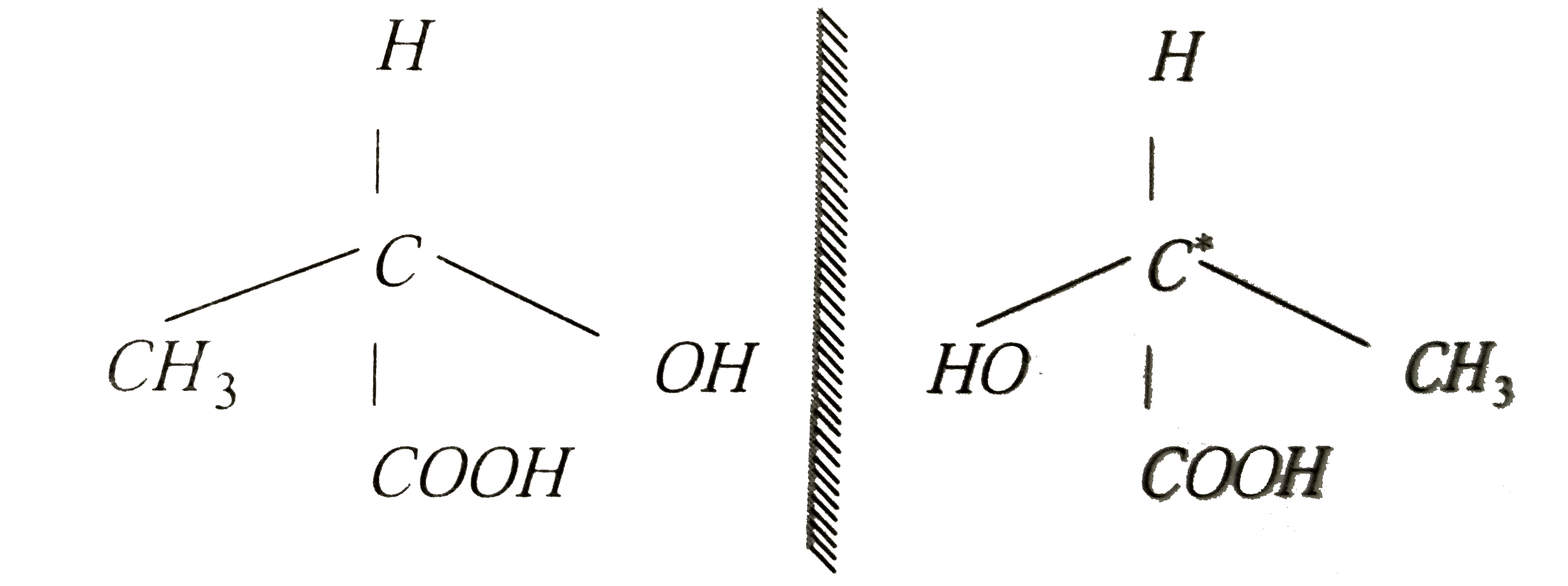
|
|
| 43. |
Lactic acid on oxidation with Fenton.s reagent gives main product: |
|
Answer» `CH_3COOH` |
|
| 44. |
Lactic acid on oxidation by alkaline potassium permanganate gives |
|
Answer» Tartaric acid |
|
| 45. |
Lactic acid on oxidation with Fenton's reagent gives: |
|
Answer» a.`CH_(3)COCOOH (Pyruvic ACID)` |
|
| 46. |
Lactic acid molecule has |
|
Answer» One CHIRAL CARBON atom 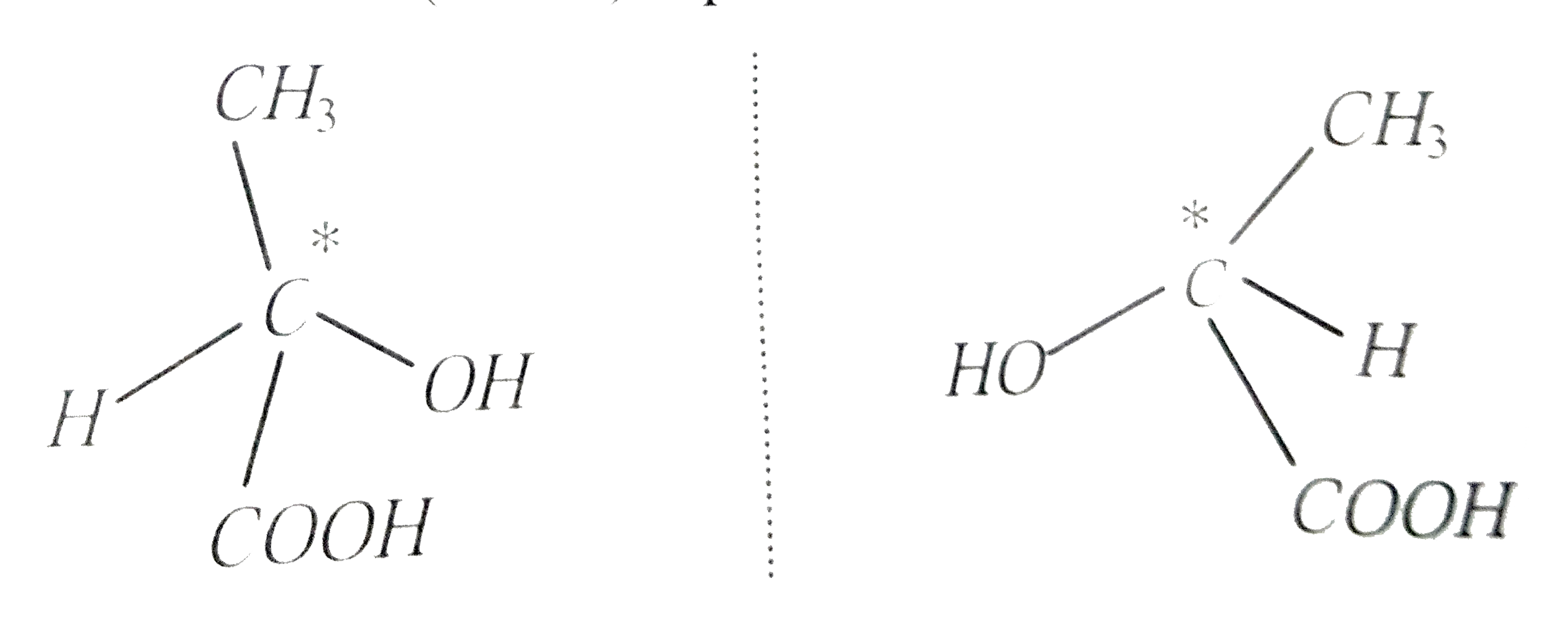
|
|
| 47. |
Lactic acid is a classical example of ___________. |
|
Answer» POSITION ISOMERISM |
|
| 48. |
Lactic acid in which a methyl group, a hydroxyl group, a carboxylic acid group and a hydrogen atom are attached to a central carbon atom, show optical isomerism due to the molecular geometry at the |
|
Answer» Central CARBON atom |
|
| 49. |
Lactic acid CH_3-oversetoverset(OH)(|)C-CH-oversetoverset(O)(||)C-OH can be prepared by acid hydrolysis of reaction product of |
|
Answer» ETHANAL with HCN/KCN mixture |
|
| 50. |
Lactic acid and glycolic acid are the monomers used for preparation of polymer |
|
Answer» NYLON -2-nylon -6 |
|