Saved Bookmarks
This section includes 7 InterviewSolutions, each offering curated multiple-choice questions to sharpen your Current Affairs knowledge and support exam preparation. Choose a topic below to get started.
| 1. |
In the reaction involving C-OH bond, in alcohols the order of reactivity is : |
|
Answer» `1^@ GT 2^@ gt 3^@` |
|
| 2. |
In the reaction I_(2)+2S_(2)O_(3)^(2-)to2I^(-)+S_(4)O_(6)^(2-), the equivalent weight of iodine will be equal to |
|
Answer» MOLECULAR weight `therefore`EQ. wt. `=(1)/(2)XX`molecular wt. |
|
| 3. |
In the reaction I_(2)+I^(-) rarr I_(3)^(-), the Lewis base is |
| Answer» Solution :It donates their `e^(-)` pair. | |
| 4. |
In the reaction, HNO_3 + P_4O_10 to 4HPO_3+X,the product X is |
|
Answer» `N_2O_5` NITROGEN PENTOXIDE can be FORMED by heating `P_4O_10` with CONC. Nitric ACID . |
|
| 5. |
In the reaction HNO_(3)+P_(4)O_(10) to 4HPO_(3)+x , the product x is |
| Answer» Solution :We know that, `4HNO_(3) +P_(4)O_(10) to 4HPO_(3) +2N_(2)O_(5)` the product is dinitrogen pentaoxide `(N_(2)O_(5))` | |
| 6. |
In the reaction HCOOH overset(H_2 SO_4) to CO + H_2 O, H_2 SO_4 acts as |
|
Answer» Dehydrating agent `HCOOH overset(H_(2)SO_(4))to CO +H_(2)O` |
|
| 7. |
In the reaction HgCl_2 + 2KI rarr M + 2KCl, M is : |
|
Answer» `HgI_2` |
|
| 8. |
In the reaction +Hclrarr the major product formed is |
|
Answer»
|
|
| 9. |
In the reaction :HCN+H_(2)O hArr H_(3)O^(+)+CN^(-)the conjugate acid - base pair is |
|
Answer» 1. `HCN, H_(3)O^(+)` |
|
| 10. |
In the reaction HCl + H_(2)O hArr H_(3)O^(+) + Cl^(-) |
|
Answer» `H_(2)O` is the CONJUGATE base of HCl acid |
|
| 11. |
In the reaction : HC -= CH overset(NaNH_(2))rarr X overset(CH_(3)I)rarr Y underset(HgSO_(4))overset(H_(2)O, H_(2)SO_(4))rarr Z, Z is : |
|
Answer» `CH_(3)CHO` |
|
| 12. |
In the reaction HAsO_(2)+Sn^(2+) rarr As+Sn^(4+)+H_(2)O oxidising agent is |
|
Answer» `Sn^(2+)` `OVERSET(+3)(HAsO_(2))+overset(+2)(Sn) rarr overset(0)(As)+overset(+4)(Sn)+H_(2)O` Hence, here `HAsO_(2)` is acting as oxidizing agent. |
|
| 13. |
In the reaction H_(3)C-overset(Br)overset(|)CH-CH_(2)-Brunderset((ii)C_(2)H_(5)Br)overset((i)"X mole "NaNH_(2))toCH_(2)-C-=C-C_(2)H_(5) The value of [X] is: |
|
Answer» ONE |
|
| 14. |
In the reaction: H_(2)S hArr 2H^(+) + S^(-), when NH_(4)OH is added, then |
|
Answer» `S^(--)` is precipitate `NH_(4)OH hArr NH_(4)^(+) + OH^(-)` `H_(2)S hArr 2H^(+) + S^(2-)` `OH^(-) + H^(+) hArr H_(2)O`. So that `S^(2-)` is increased. |
|
| 15. |
In the reaction H_(2)S+O_(3) to ………. the products are: |
|
Answer» `H_(2)O` |
|
| 16. |
In the reaction H_2S + O_3 rarr…….the products are: |
|
Answer» `H_2O, S, O_2` |
|
| 17. |
In the reaction H_(2)O + HCl rarr H_(3)O^(+) + Cl^(-), the species that acts as Bronsted base is |
|
Answer» `H_(2)O` |
|
| 18. |
In the reaction H_(2(g))+3H_(2)hArr2NH_(3(g)), the value of the equlibrium constatn depends on |
|
Answer» VOLUME of the REACTION vessel |
|
| 19. |
In the reaction, H_2O_2 +Na_2CO_3 rarrNa_2O_2 +CO_2 +H_2O,the substance undergoing oxidation is : |
|
Answer» `H_2O_2` |
|
| 20. |
In the reaction : H_2O + Br_2 toHOBr + HBr, Br_2 gets ............ |
|
Answer» Only reduced<BR>Only oxidized |
|
| 21. |
In the reaction, H_(2)+I_(2)hArr 2.Hl. In a 2 litre flasek 0.4 moles of HI each H_(2) and I_(2) are taken. At equlibrium 0.5 moles of HI are formed. What will be the value of equilibrium constant, k_(c) |
|
Answer» `20.2` `K_(C)=([H]^(2))/([H_(2)][I_(2)])=([(0.5)/(2)]^(2))/([(0.15)/(2)][(0.15)/(2)])=(0.5xx0.5)/(0.15xx0.15)=11.11` |
|
| 22. |
In the reaction H-C=C-H overset(NaNH_(2))to A overset(CH_(3)l)to B overset(Hg^(2+))underset(H_(3)O^(+))to C the final product 'C' is : |
|
Answer» `CH_(3)CHO` |
|
| 23. |
In the reaction: H_(2)+Cl_(2)rarr2HCl, DeltaHCl, DeltaH=194 kJ.Heat of formation of HCl is |
|
Answer» `+ 97` KJ |
|
| 24. |
In the reaction H-C-=CH underset((2)CH_3CH_2Br)overset((1)NaNH_2//liq.NH_3)toXunderset((2)CH_3CH_2Br)overset((1)NaNH_2//liq.NH_3)toY X and Y are |
|
Answer» X=1-Butyne : Y=3-Hexyne 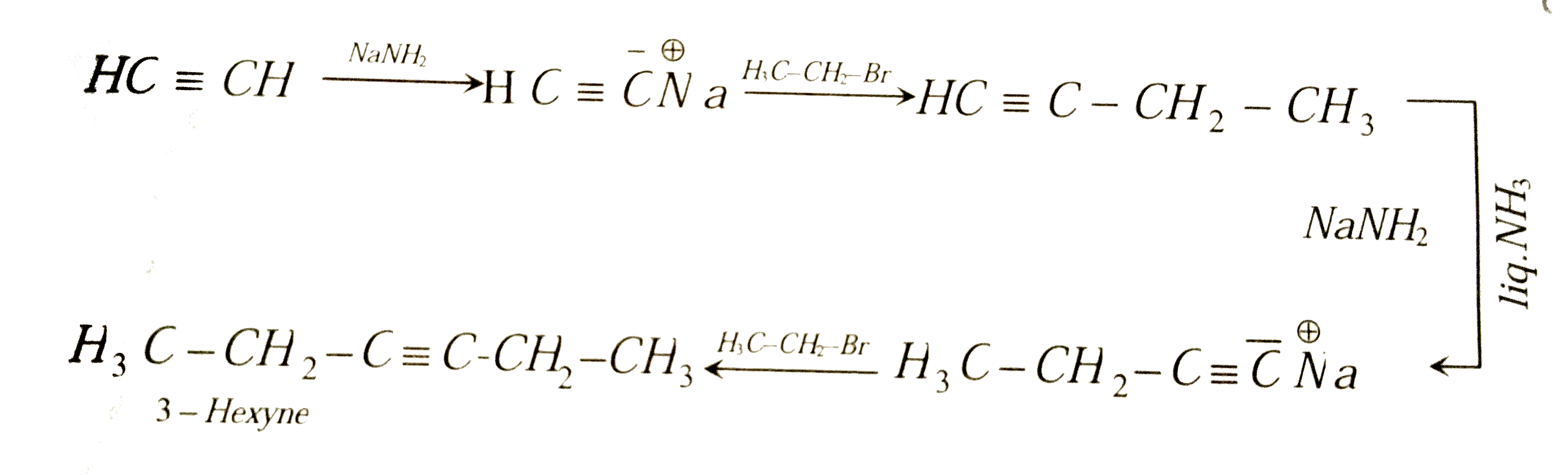
|
|
| 25. |
In the reaction, H-C-=C-overset(NaNH_(2))rarrAoverset(CH_(3)l)rarrBoverset(Hg^(2+))underset(H_(3)O^(+))rarrCn the final product 'C' is : |
|
Answer» `CH_(3)CHO` |
|
| 26. |
In the reaction given below, X is Neo-pentyl alcohol overset(H_(2)SO_(4))to X |
|
Answer» 2-methypentane |
|
| 27. |
In the reaction given below : Which of the following statements is/are incorrect ? |
|
Answer» The reaction proceeds via `S_(N)2` mechanism hence INVERSION of configuration takes place. |
|
| 28. |
In the reaction given below, X is C_(6)H_(5)MgBr+CH_(3)OHrarrX |
|
Answer» `C_(6)H_(6)` 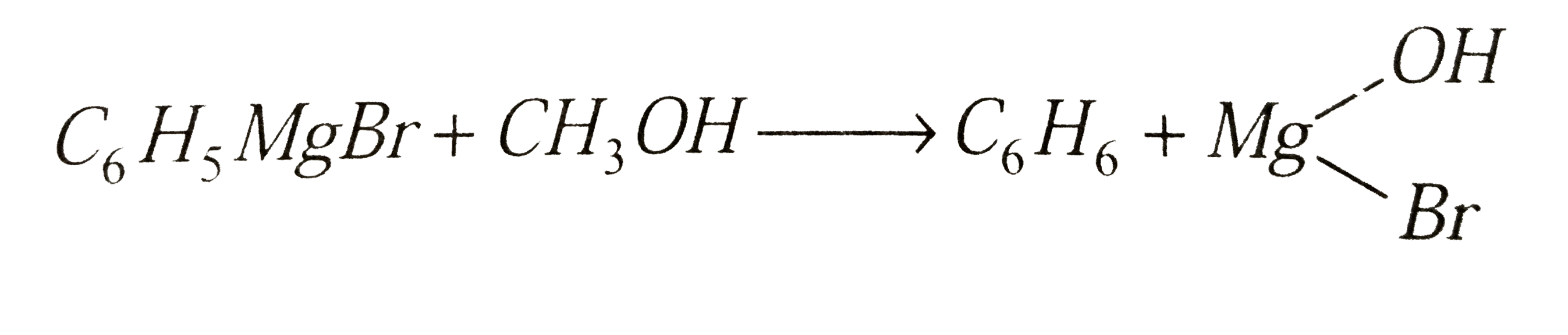
|
|
| 29. |
In the reaction given below, how many different oximes would be fomred? CH_(3)CH=CH-overset(O)overset(||)C-CH=CHCH_(3)+H_(2)NOHrarr"Oximes" |
|
Answer» |
|
| 30. |
In the reaction for the transition of carbon in the diamond form to carbon in the graphite form, DeltaH is -453.5 cal. This points out that |
|
Answer» Graphite is CHEMICALLY different from diamond i.e. ENERGY of `C_(G)` is less and thus more stable. |
|
| 31. |
In the reaction, Fe(OH)_(3)hArrFe_(aq)^(3+)+3OH_(aq)^(-) if the concentration of OH^(-) ions is decreased by (1)/(4) times , then the equilibrium concentration of Fe^(3+) will increases by |
|
Answer» 8 TIMES When concentration of `OH^(-)` oins is decreased by `(1)/(4)` times , `K_(C)=[x.][(3x)/(4)]^(3)`….(II) equating eq (i) and (ii) `xxx(3x)^(3)=x.((3x))/(4)^(3)` 64x=x. |
|
| 32. |
In the reaction Fe_(2)O_(3)+3Cto2Fe+3CO, oxidation number of C |
|
Answer» increases by 3 per atom |
|
| 33. |
In the reaction "Ethyl bromide"overset(KCN)rarr Xoverset(H_(2)//Ni)underset(or LiAlH_(4))rarr Y, Y is : |
|
Answer» n - PROPYLAMINE |
|
| 34. |
In the reaction , Etheroverset(" hot " HI)to A+B + H_2 O , If A and Bare same , the ether __________ |
|
Answer» is SIMPLE |
|
| 35. |
In the reaction :Ethnol overset(PCl_5)to X overset("alc KOH")to Y underset("H_2 O_2 Delta)overset(H_2 SO_4. "Room temp.")to Z, the product Y is, |
|
Answer» `C_(2)H_(4)`  `CH_(3)CH_(2)OHoverset(H_(2)SO_(4)"ROOM temp")underset(H_(2)O,Delta)toCH_(2)=CH_(2)` |
|
| 36. |
In the reaction Ethanol overset(PCl_5)to X overset(alc. KOH)to Y overset(H_2SO_4//H_2O)underset(298K) to Z. The 'Z' is ………………….. . |
|
Answer» ETHANE |
|
| 37. |
in the reaction, DeltaH and DeltaS both are more than zero then in which of the following cases the reaction would be spontaneous |
|
Answer» `DeltaHgtTDeltaS` |
|
| 38. |
In the reaction (##DBT_SM_CHE_XII_U_12_E01_015_Q01##) The structure of product A is: |
|
Answer»
|
|
| 39. |
In the reaction , Cu(s)+2Ag^(+)(aq)rarrCu^(2+)(aq)+2Ag(s), the reduction half cell reaction is |
|
Answer» `Cu+2e^(-)rarrCu^(2+)` |
|
| 40. |
In the reaction Cu_((s))+2Ag_((aq))^(+)toCu_((aq))^(2+)+2Ag_((s)) the reduction half-cell reaction is:- |
|
Answer» `Cu+2e^(-)TOCU^(2-)` |
|
| 41. |
In the reaction C(s) +CO(g) hArr 2CO(g) the equilibrium pressure is 12 atm. If 50% of CO_2 reacts, calculated K_p. |
|
Answer» |
|
| 42. |
In the reaction C(s) + CO_2(g) hArr 2CO(g) the equilibrium pressure is 12 atm. If 50% OF CO_2 reacts. Calculate the K_P for the change: |
|
Answer» 12 atm |
|
| 43. |
In the reaction , Cr_2O_7^(2-) + 14H^+ +6I → 2Cr^(3+) + 7H_2 O +3I_(2 which element is reduced ? |
|
Answer» I |
|
| 44. |
In the reaction : CrO_(4)^(2-) + X to Cr_(2)O_(7)^(2-) X is |
|
Answer» `OH^(-)` |
|
| 45. |
In the reaction Cr_2O_3+ 2Al to Al_2O_3 + 2Cr, DeltaG^@ = - 421 kJ is thermodynamically feasible. This is apparent from Gibbs energy value. Why does it not take place at room temperature ? |
| Answer» Solution :The reaction is thermodynamically FAVOURABLE. As we know, even thermodynamicallyfavourable reactions require some activation ENERGY to PROCEED, therefore, this reaction does not occur at ROOM temperature. Heating is REQUIRED for this reaction to start. | |
| 46. |
In the reaction COCl_2(g)hArr CO(g)+Cl_2(g) at 550^@C, when the initial pressure of CO & Cl_2 are 250 and 280 mm of Hg respectively. The equilibrium pressure is found to be 380 mm of Hg.Calculate the degree of dissociation of COCl_2 at 1 atm.What will be the extent of dissociation, when N_2 at a pressure of 0.4 atm is present and the total pressure is 1 atm. |
|
Answer» 0.32 and no change x+250-x+280-x=380 x=150 `K_P=0.114` `K_P=(P_(CO).P_(Cl_2))/(P_(COCl_2))implies K_P=(alpha^2 . P)/(1-alpha^2) implies 0.114 =(alpha^2 . 1)/(1-alpha^2)` hence `alpha=0.32 " " alpha=0.32` In presence of `N_2` (CONSTANT pressure process) `K_P=(alpha^2xx0.6)/(1-alpha^2)implies alpha=sqrt(0.114/0.714)implies alpha=0.4` `alpha` increases from 0.32 to 0.4 |
|
| 47. |
In the reaction CO_(2)(g)+H_(2)(g)rarrCO(g)+H_(2)O(g),DeltaH=80 kJDeltaHis known as |
|
Answer» HEAT of formation |
|
| 48. |
In the reaction : CO_(2)(g) + H_(2)(g) hArr CO(g) + H_(2)O(g), Delta H = 2.8 kJ.Delta H represents |
|
Answer» HEAT of reaction |
|
| 49. |
In the reaction Cl_(2) + CH_(4) overset(hv)(to) CH_(3) Cl + HCl , presence of a small amount of oxygen |
|
Answer» Increases the rate of REACTION for a brief PERIOD of time |
|
| 50. |
In the reaction :Cl_(2)+2OH^(-)toOCl^(-)+Cl^(-)+H_(2)O |
|
Answer» `OH^(-)`is OXIDISING and `CL^(-)` is REDUCING agent O.N . Of Cl changes from 0 to +1 (in `Ocl^(-))and-1 "in" (Cl^(-))`. |
|
_S01_380_O01.png)
_S01_380_O02.png)
_S01_380_O03.png)
_S01_380_O04.png)