

Saved Bookmarks
This section includes 7 InterviewSolutions, each offering curated multiple-choice questions to sharpen your Current Affairs knowledge and support exam preparation. Choose a topic below to get started.
| 1. |
In the reaction : C_(3)H - underset(CH_(3))underset(|)(CH)-CH_(2) - O - CH_(2)- CH_(3) + CI overset("heat")(to) |
|
Answer» `CH_(3) - OVERSET(CH_(3))overset(|)(CH) - CH_(2) - OH + CH_(3)- CH_(3)` |
|
| 2. |
In the reaction C_(3)H_(7)CONH_(2)overset(P_(2)O_(5))rarr Xoverset(Pt.H_(2))rarrY. Y is : |
|
Answer» <P>`C_(3)H_(7)CN` |
|
| 3. |
In the reaction C_2H_5OH+HX overset(Zncl_2) (rarr) C_2H_5X+H_2O. The order of reactivity of HX is |
|
Answer» HL GT HBR gt HCl |
|
| 4. |
In the reaction, C_(2)H_(5)OC_(2)H_(5)+COoverset(BF_(3))underset(150^(@)C,"500atm pressure")to X What is X? |
|
Answer» ETHYL propionate |
|
| 5. |
In the reaction C_(2)H_(5)CH=CH_(2)+HX toproduct. Wha is the product ? |
|
Answer» `C_(2)H_(5)CH_(3)` `CH_(2)CH_(2)+HBr to c_(2) H_(5)Br+H_(2)O` THUS, ehtyl bromide `(C_(2)H_(5)Br)` is obtained by the action of hydrogen bromide (HBr) on ethanene. |
|
| 6. |
In the reaction C_2H_5CH=CH_2+H-X to Product. What is the product |
|
Answer» `C_2H_5-CH_3` |
|
| 7. |
In the reaction C_(2)H_(5)-X+KCN overset (alc) to A overset(dil. HCl) to B The product B is |
|
Answer» `C__(2)H_(5)-CH_(2)NH_(2)` |
|
| 8. |
In the reaction C_(2) H_(5) NH_(2) overset( HCl + NaNO_(2)) to Aoverset( HCl) to Boverset( KCN ) toCThefinalproduct C is |
|
Answer» PROPANE nitrile |
|
| 9. |
In the reaction C+2SrarrCS_(2)+DeltaH, DeltaH is the |
|
Answer» HEAT of combustion |
|
| 10. |
In the reaction, "BrO"_(3)^(-)(aq)+5"Br"^(-)(aq)+6" H"^(+)to3" Br"_(2)(l)+3" H"_(2)O(l), the rate of appearance of bromine ("Br"_(2)) is related to the rate of disappearance of bromide ions as follows : |
|
Answer» `(d[Br_(2)])/(DT)=-(5)/(3)(d[BR^(-)])/(dt)` |
|
| 11. |
In the reaction BrO_(3).^(-)(aq)+5Br^(-)(aq)+6H^(+) to 3Br_(2)(l)+3H_(2)O(l) The rate of appearance of bromine (Br_(2)) is related to rate of disappearance of bromide ions as following |
|
Answer» `(d(Br_(2)))/(dt)=(3)/(5)(d(Br^(-)))/(dt)` |
|
| 12. |
In the reaction BrO_(3)^(-)(aq)+ 5Br^(-)+6H^(+) rarr 3Br_(2)+3H_(2)O the rate of appearance of bromine is related to the rate of disappearance of bromide ions as : |
|
Answer» `(d[Br_(2)])/(dt)=-(5)/(3)(d[BR^(-)])/(dt)` ` (d[Br_(2)])/(dt) =-(3)/(5) (d[Br^(-)]]/(dt)` |
|
| 13. |
In the reaction BrO^(-3)(aq) + 5Br^(-) (aq) + 6H^(+) rarr 3Br_(2)(1) + 3H_(2)O(1) The rate of appearance of bromine (Br_(2)) is related to rate of disapperance of bromide ions as folllwoing : |
|
Answer» `(d Br_(2))/(DT) = - (3)/(5) (d (BR^(-)))/(dt)` |
|
| 14. |
In the reaction , BrCH_(2)CH_(2)CH_(2)Brunderset(2.H_(3)O^(+))overset(1.alc . KCN)toXthe product X is : |
|
Answer» Glutaric acid |
|
| 15. |
In the reaction, B(OH)_(3) + 2H_(2)O to [B(OH)_(4)]^(-) + H_(3)O^(+) ,B(OH)_(3) functions as |
|
Answer» PROTONIC acid |
|
| 16. |
In the reaction between sodium and chlorine to form NaCl which of the following is reduced: |
| Answer» ANSWER :C | |
| 17. |
In the reaction between acidifiedK_2Cr_2O_7 and iron (II) ions shown by the equation : Cr_2O_7^(2-)(aq)+6Fe^(2+)(aq) + 14H^+(aq) rarr2Cr^(3+)(aq)+7H_2O(l)+6Fe^(3+)(aq) |
|
Answer» The COLOUR of the solution changes from green to yellow |
|
| 18. |
In the reaction between acidified K_(2)Cr_(2)O_(7) and Iron (II) ions shown by the equation Cr_(2)O_(7)^(2-)(aq.)+6Fe^(2+)(aq.)+14H^(+)(aq.) rarr 2Cr^(3+)(aq.)+7H_(2)(l)+6Fe^(3+)(aq.) |
|
Answer» The DICHROMATE IONS are reduced |
|
| 19. |
In the reaction AtoB, the value of the rate constant was found to be 1.0xx10^(-2)mol^(-1)"L "s^(-1). What is the order of the reaction ? How will the catalyst affect the value of the rate constant ? |
|
Answer» |
|
| 20. |
In the reaction BCl_(3) + PH_(3) rarr Cl_(3)B rarr PH_(3), Lewis base is |
|
Answer» `BCl_(3)` |
|
| 21. |
In the reaction B (OH)_(2).2H_(2)Oto[B(OH)_(2)]^(-)+2H_(2)O^(+).[B(OH)_(2)]^(-)is |
|
Answer» LEWIS base |
|
| 22. |
In the reaction, As_(2)S_(5)+xHNO_(3)rarr5H_(2)SO_(4)+yNO_(2)+2H_(3)AsO_(4)+12H_(2)O the values of x and y are: |
|
Answer» 40,40 |
|
| 23. |
In the reaction , As_2S_3+HNO_3➡ H_3AsO_4 +H_2SO_4 +NO,the element oxidised is/are: |
|
Answer» As only |
|
| 24. |
In the reaction Ar-OH+RX overset("alkali")to A, A is |
|
Answer» An aldehyde 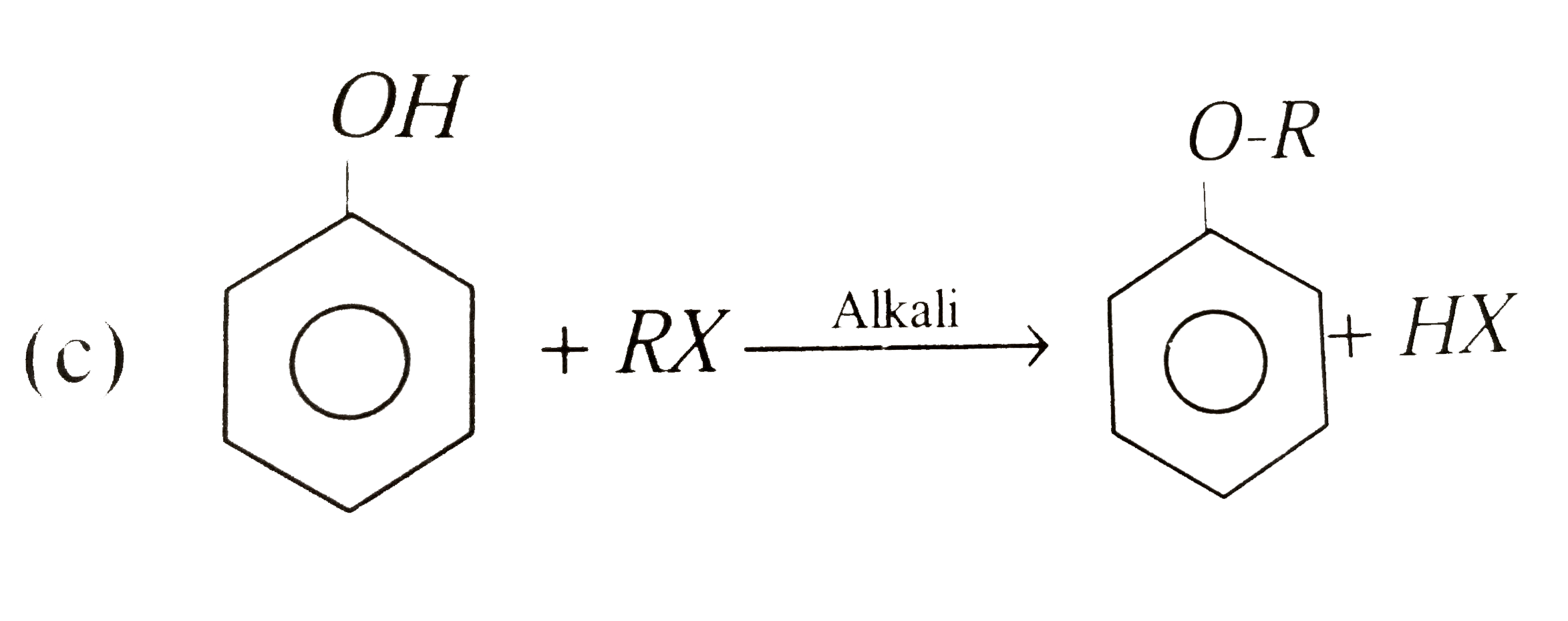
|
|
| 25. |
In the reaction , AlCl_(3) + Cl^(-) = AlCl_(4)^(-) , AlCl_(3) can be classified as |
| Answer» Answer :A | |
| 26. |
In the reaction Alcl_3 + Cl rarr [Alcl_4]^- , AlCl_3 acts as : |
|
Answer» Salt |
|
| 27. |
In the reaction, AgCl + KI hArrKCI + Aglwhen KI is added, the equilibrium is shifted towards right giving more Agl precipitate, because |
|
Answer» both AgCl and AgI are sparingly soluble `AgCl +KIhArrKCI+Agl` |
|
| 28. |
In the reaction A_((g))+2B_((g))hArrC_((g))+QkJ, greater product will be obtained or the forward reaction is foroured by |
|
Answer» At high TEMPERATURE and high PRESSURE |
|
| 29. |
In the reaction AB_((g))hArrA_((g))+B_((g))at 30^(@)C, K_(p) for the dissociation equlibrium is 2.56xx10^(-2) atm. If the total pressure at equlibrium is I atm, then the precentage dissociation of AB |
|
Answer» `87%` APPLYING law of mass ACTION `K_(p)=(alpha^(2)P)/(a-alpha^(2))` `(alpha^(2))/(1-alpha)=2.56xx10^(-2)""[therefore(1-alpha)=1]` `impliesalpha^(2)=2.56xx10^(-2)` `impliesalpha=sqrt(2.56xx10^(-2))impliesalpha=0.16` `%` age dissociation `=16%` |
|
| 30. |
In the reaction, A_(2(g))+4B_(2(g))hArr2AB_(4(g)) DeltaHlt0 the formation of AB_(4) is will be favoured at |
|
Answer» LOW temperature, HIGH pressure |
|
| 31. |
In the reaction, "Acetamide" overset(P_2O_5) to X overset(4H) to Ythe end product is : |
|
Answer» Methylamine |
|
| 32. |
In the reaction A_2(g) +4B_2(g) hArr 2AB_3(g) , DeltaH lt 0 .The decomposition of AB_4 (g) will be favoured at |
|
Answer» LOW TEMPERATURE and HIGH pressure |
|
| 33. |
In the reaction Ato2B the concentration of a falls from 1.0M to 0.98 2M in one minute what is the rate of in moles "litre"^(-1)"sec^(-1) |
|
Answer» `1.8xx10^(-3)` |
|
| 34. |
In the reaction : A overset(HBr)rarr B underset("alcohol")overset(KOH)rarr C underset(Zn, H_(2)O)overset(O_(3))rarr HCHO + CH_(3) CHO the compound A is : |
|
Answer» Ethylene |
|
| 35. |
In the reaction, A+BhArr2C. at equilibrium, the concenration of A and B is 0.20 molI^(-1) each and that of c was found to be 0.6molI^(-1). tTe equiibrium constant of the reaction is |
|
Answer» Solution :`A+Boverset(K_(2))hArr2C` `K_(C)=([C]^(2))/([A][B])=([0.6]^(2))/([0.2][0.2])=9` |
|
| 36. |
In the reaction, A+B_(2) rarr AB_(2), identify the limiting reagent, if any, in the following mixtures {:("(i) 300 atoms of A"+"200 molecules of B","(ii) 2 mole A"+"3 mol B"),("(iii) 100 atoms of A"+"100 molecules of B","(iv) 5 mol A"+"2.5 mol B"):} |
|
Answer» Solution :(i) According to the given reaction, 1 atom of Areacts with 1 molecule of B. `therefore` 200 molecules of B will react with 200 atoms of A and 100 atoms of A will be left unreacted. Hence, B is the limiting REAGENT while A is the excess reagent. (II) According to the given reaction, 1 mole of A react with 1 mole of B `therefore` 2 MOLES of A will react with 2 moles of B. Hence, A is the limiting REACTANT. (iii) No limiting reagent. (iv) 2.5 moles of B will react with 2.5 moles of A. Hence, B is the limiting reagent. (iv) 2.5 moles of A will react with 2.5 moles of A. Hence, B is the limiting reagent. (v) 2.5 moles of A will react with 2.5 moles of B. Hence, A is the limiting reagent. |
|
| 37. |
In the elementary reactionA + Bto AB, if theconcentrationA andB isdoubled, the rateof reactionwill |
|
Answer» Bedoubled |
|
| 38. |
In the reaction, A+B hArr 2C, at equilibrium, the concentration of A and B is 0.20 mol litre^-1 each and that of C was found to be 0.60 mol litre^-1. The equilibrium constant of the reaction ? |
|
Answer» 9 |
|
| 39. |
In the reaction A+3BrArr2C, initially 10 mole each ofA and B were taken . If equilibrium pressure is 8 atm andalpha " of "A=20%then K_(p) will be:- |
| Answer» Answer :2 | |
| 40. |
In the reaction a+3B rarr 2C, the rate of formation of C is |
|
Answer» the same as RATE of CONSUMPTION of A |
|
| 41. |
In the reaction, A+ 2B rarr 3C+D which of the following expression does not describe changes in the. concentration of various species as a function of. time: |
|
Answer» `(d[C])/DT=(-3d[A])/dt` |
|
| 42. |
In the reaction A+2B hArr 2C, if 2 moles of A, 3.0 moles of B and 2.0 moles of C are placed in a 2.0 I flask and the equilibrium ocncentration of C is 0.5 mole /I. The equlibrium constant (K_(c)) for the reaction is |
|
Answer» `0.073` `{:("Initial conc.",2,3,2),("at eqm.",2.5,4,1),("MOLAR",(2.5)/(2)=1.25,(4)/(2)=2,(1)/(2)=0.5):}` `K=([0.5]^(2))/([1.25]xx[2]^(2))=0.05` |
|
| 43. |
The missing nucleide in the nuclear reaction : ""_(93)^(239)Npto.......+_(-1)^(0)e is |
|
Answer» Bi |
|
| 44. |
In the reaction : ""_(93)^(239)Npto""_(94)^(239)Pu+? The missing particle is : |
|
Answer» neutron |
|
| 45. |
In the reaction : ""_(84)^(215)Poto""_(82)^(211)Pb+""_(2)^(4)He If Pb belongs to group 14, Po belongs to group |
|
Answer» 15 |
|
| 46. |
In the reaction, 4NH_(3)(3(g)) + 5O_(2)(g) to 4NO_(g) + 6H_(2)O_(l) when 1 mol of ammonia and 1 mol of O_(2)are made to react to completion then |
|
Answer» 1.0 mol of `H_(2)O` will be produced `underset(4 mol)(0.8 mol)(4 NH_(3(G)) + underset(1 mol)underset(5 mol)(5O_(2(g))) to underset(0.8 mol)(4 mol)(4NO_(g)) + underset(1.2 mol)(6 mol)(6H_(2)O_(l))` In this reaction, 1 MOLE of `O_(2)` and 0.8 mole of `NH_(3)` are consumed thereby indicating complete consumption of `O_(2)`. |
|
| 47. |
In the reaction, 4NH_(3)(g)+5O_(2)(g)rarr4NO(g)+6H_(2)O(l), when 1 mole of ammonia and 1 mole of O_(2) are made to react to completion |
|
Answer» 1.0 mole of `H_(2)O` is produced |
|
| 48. |
In the reaction 4NaCl+MnO_(2)+4H_(2)SO_(4)toMnCl_(2)+4NaHSO_(4)+2H_(2)O+'X'Then the correct statement regarding 'X' are I) It is a greenish yellow coloured gas . II) It can also be prepared by Deacons process III) It can be liquefied into greenish yellow liquid which boils at 239K |
|
Answer» Only I & III |
|
| 49. |
In thereaction, 4P + 3KOH + 3H_2O rarr3KH_2PO_2+PH_3 |
|
Answer» <P>P is oxidised only |
|
| 50. |
In the reaction 4Fe+3O_(2)rarr4Fe^(3+)+6O^(2-) Which of the following statements is incorrect? |
|
Answer» ACETIC acid |
|