Saved Bookmarks
This section includes 7 InterviewSolutions, each offering curated multiple-choice questions to sharpen your Current Affairs knowledge and support exam preparation. Choose a topic below to get started.
| 1. |
In the metallurgy of aluminium |
|
Answer» `Al^(3+)` is oxidised to Al (s)` |
|
| 2. |
In the manufacturing of sulphuric acid write the equation with condition for oxidation of SO_2 to SO_3 |
| Answer» Solution :`2SO_2 + O_2 overset(V_2O_5) to 2SO_3 , DeltaH = - 196. 6 KJ " mol"^(-1)` | |
| 3. |
In the mesophyll cells of leaves the chloroplast get aligned parallel to the wall when- |
|
Answer» `CO_(2)` CONCENTRATION is high |
|
| 5. |
In the manufacturing of sulphuric acid write the formation of Oleum from SO_3. |
| Answer» SOLUTION :`SO_3+ H_2SO_4 to H_2S_2O_7` | |
| 6. |
In the manufacturing of metallic sodium by fused salt electrolysis method (Down's process), small amount of CaCl_(2) that added is known as auxillary electrolyte and is used to |
|
Answer» IMPROVE the ELECTRICAL conductance |
|
| 7. |
In the manufacture of sulphuric acid write : (i) The equation with condition for oxidation of SO_(2) to SO_(3). (ii) Formation of Oleum from SO_(3). |
|
Answer» Solution :(i) `2SO_(2)(G) + O_(2) rarr 2SO_(3)` Any one conditions : Temperature = 270 K or Pressure = 2bars or Catalyst `= V_(2)O_(5)` (ii) `SO_(3) + H_(2)SO_(4) rarr H_(2)S_(2)O_(7)` (Oleum) (i) In manufacturing of `H_(2)SO_(4)`, equation with condition for oxidation of `SO_(2)` to `SO_(3)` are as follows : Equations : `2SO_(2) + O_(2) overset("catalyst")hArr 2SO_(3)`. Condition : (a) Oxidation is ALWAYS done by passing warm `SO_(2)` bearing gas, through a catalyst like , V, K, NA, Cs, `SIiO_(2)` etc. Now a days `V_(2)O_(5)` (Vanadium penta oxide) is perfered, as it is cheaper and not poisoned by impurities. (b) Low temperature (about 720 K). (c ) Excess of air. (d) High pressure (about 2 atm). (ii) Formation of Oleum from `SO_(3)` : `SO_(3) + H_(2)SO_(4) rarr underset("(Oleum)")(H_(2)S_(2)O_(7))` `SO_(3)` cannot absorbed in water because it produces dense fog, while `H_(2)SO_(4)` absorbs `SO_(3)` to GIVE oleum. |
|
| 8. |
In the manufacture of sodium hydroxide, by product obtained is: |
|
Answer» `O_2` |
|
| 9. |
In the manufacture of Teflon, the monomer used is .............. |
| Answer» SOLUTION :TETRA fluoroethylene | |
| 10. |
In the manufacture of sulphuric acid (H_2SO_4), the final product obtained is oleum.Write chemical equation for the conversion of oleum to sulphuric acid. |
| Answer» SOLUTION :`H_2S_2O_7+H_2O` to `2H_2SO_4` | |
| 11. |
In the manufacture of sulphuric acid (H_(2)SO_(4)) the final product obtained is oleum. (i) What is oleum ? (ii) Write chemical equation for the conversion of oleum to sulphuric acid. |
|
Answer» Solution :`H_(2)S_(2)O_(7)` is CALLED oleum. To convert oleum into sulphuric acid, a calculated AMOUNT of water is added. `UNDERSET("Oleum")(H_(2)S_(2)O_(7)) + H_(2)O rarr underset("Sulphuric acid")(2H_(2)SO_(4))` |
|
| 12. |
In the manufacture of sulphuric acid (H_2SO_4), the final product obtained is oleum. What is oleum? |
| Answer» SOLUTION :`H_2S_2O_7` | |
| 13. |
In the manufacture of sulphuric acid by the contact process, sulphur trioxide is not directly dissolved in water. Why? |
| Answer» Solution :`SO_(3)` reacts with water to FORM `H_(2)SO_(4)`, which is not EASILY condensed. It escapes in the atmosphere. It is, therefore, absorbed in conc. `H_(2)SO_(4)` to from oleum which MAY be DILUTED to form `H_(2)SO_(4)` | |
| 14. |
In the manufacture of sulphuric acid by contact process, Tyndall box is used to |
|
Answer» filter DUST particles |
|
| 15. |
In the the manufacture of sulphuric acid by the Contact process ,give the equations for the conversionof sulphur trioxide to sulphuric acid . |
| Answer» SOLUTION :Impurities POISON the CATALYST and decrease its EFFICIENCY. | |
| 16. |
In the manufacture of sulfuric acid by the contact process, why great care is taken to purify the mixture of air and sulfur dioxide, especially to free it from arsenic impurities? |
| Answer» SOLUTION :Impurities poison the CATALYST and DECREASE its EFFICIENCY. | |
| 17. |
In the manufacture of safety matched, we use: |
|
Answer» RED PHOSPHORUS |
|
| 18. |
In the manufactureof phenol from isopropyl benzene , the important by-product obtained is _________ |
|
Answer» toluene |
|
| 19. |
In the manufacture of NH_(3) by Haber's process, the condition which would give maximum yield is N_(2)+3H_(2)hArr2NH_(3)+Q kcal |
|
Answer» High temperatue, high PRESSURE and HIG CONCENTRATIONS of the rectants |
|
| 20. |
In the manufacture of nitric acid by Ostwald's process, Write a) the catalyst for the oxidation of ammonia by atmospheric oxygen. |
| Answer» SOLUTION :Pt/Rh GAUGE | |
| 21. |
In the manufacture of nitric acid by Ostwald's process, write the dehydrating agent used to convert 68% by mass of HNO_(3) to 98%. |
| Answer» SOLUTION :`"CONC. "H_(2)SO_(4)` | |
| 22. |
In the manufacture of nitric acid by Ostwald's process, Write the chemical equation for the dissolution of NO_(2) in water. |
| Answer» Solution :`3NO_(2)+H_(2)Orarr HNO_(3)+NO` | |
| 23. |
In the manufacture of iron from hacmatite, the limestone acts as |
|
Answer» A REDUCING AGENT |
|
| 24. |
In the manufacture of iron from haematite, limestone is added to act as : |
|
Answer» Flux |
|
| 25. |
In the manufacture of iron from haematite, the limestone acts as |
|
Answer» A REDUCING AGENT |
|
| 26. |
In the manufactureof H_(2)SO_(4) the nitratedacid from the Gay-Lussac'stower chemically. |
|
Answer» `NO_(2).H_(2)SO_(4)` |
|
| 27. |
In the manufacture of iron from an iron oxide ore , limestone is added because it acts as : |
|
Answer» An OXIDISING agent |
|
| 28. |
In the manufacture of hydrogen from water gas (CO + H_2), which of the following is correct statement? |
|
Answer» CO is oxidized to `CO_(2)` with steam in the PRESENCE of a catalyst FOLLOWED by absorption of `CO_(2)` in ALKALI. |
|
| 29. |
In the manufacture of H_2SO_4 the nitrated acid forms the Gay-Lussac.s tower is chemically" |
|
Answer» `H_2SO_4. NO_2` |
|
| 30. |
In the manufacture of bromine from sea water the mother liquor containing bromides is treated with |
|
Answer» `CO_2` |
|
| 31. |
In the manufacture of glass, addition of MnO_2 gives: |
|
Answer» YELLOW colour |
|
| 32. |
In the manufacture of chlorine by electrolysis of brine - |
|
Answer» `Cl^(-)` ion is oxidised to yeild `Cl_(2)` GAS |
|
| 33. |
In the manufacture of ammonia by Haber's process, N_(2(g))+3H_(2)hArr2NH_(3(g))+92.3kJ, which of the following conditions is unfavourable |
|
Answer» Increasing the TEMPERATURE |
|
| 34. |
In the manufacture of ammonia by Haber's process, N_(2(g))+3H_(2)leftrightarrow 2NH_(3(g))+92.3 kJ, which of the following conditions is unfavourable |
|
Answer» increasing the temperature As the reaction is EXOTHERMIC, so increase the temperature is unfavourable condition |
|
| 35. |
In the manufacture of ammonia by Haber's process: i) Mention the optimum temperature and optimum pressure employed. ii) What is the role played by potassium oxide (K_(2)O)? |
|
Answer» Solution :On large scale ammonia is manufactured by Habers process according to the equation. `N_(2)(g)+3H_(2)(g)hArr 2NH_(3)(g), Delta_(f)H=-46kj mol` According to the lechatelier.s principle i) High pressure would favour the formation of ammonia the pressure used is 200 atm or 20 Mpa ii) Low temperature FAVOURS the formation of ammonia because formation of ammonia is exothermic reaction. The optimum temperature used in Haber.s process is 700k. III) Iron oxide is used as catalyst to attain equilibrium quickly. iv) `K_(2)O and Al_(2)O_(3)` are used as catalytic promoter to increase the activity of catalyst. Note:- Earlier Iron was used as catalyst with molybdenum as promoter. i) Optimum temperature is `= 700k or 427^(@) c` Optimum pressure is `= 200 XX 10^(5)" pa or 200 atm"` ii) potassium oxide increase the rate of attainment of equilibrium/promoter/increase the activity of the catalyst. |
|
| 36. |
In the manufactore of ammonia by Haber's process, write the flow chart and chemical equations with optimum conditions. |
Answer» Solution :PRINCIPLE : Ammonia is manufacture by laber.s process by the DIRECT combination of nitrogen and HYDROGEN `N_2 + 3H_2 hArr NH_3 `  Process : Compression: A mixture of PURE acid of nitrogen and hydrogen in the ratio 1:3 by compressed to 200 atmosphere pressure . Process : Compression: A mixture of PURE acid of nitrogen and hydrogen in the ratio 1:3 by compressed to 200 atmosphere pressure . Conversion : The conmpressed gases are passed through a converter. The converter contains finely divided catalyst (Fe) and little of molybdenum (Mo)promoter. is electrically heated to 773 K `(500^(@)C)` to START reaction. Nitrogen combines with hydrogen to form ammonia . `N_2 + 3H_2 underset(Fe + Mo)overset(773K)hArr 2NH_4 , DeltaH =-ve` This reaction being exothermic, the heat evolved maintains the required temperature and further heating is not required . About 15-20% of the mixture is converted to ammonia . |
|
| 37. |
In the main group elements (i) as we proceed down the same group in the periodic table and (ii) as we proceed from left to right in the same period, the atomic radius |
|
Answer» (i) Increase continuously, (ii) DECREASES continuously |
|
| 38. |
In the Ma-Al cell, the number of electrons involved in the cell reaction are : |
|
Answer» Solution :`Mg(s)OVERSET((aq))rarr Mg^(2+)(aq)+2E^(-)+2e^(-)]xx3` `AL^(3+)(aq)+3E^(-) to Al(s)]xx2` |
|
| 39. |
In the low spin [Fe(H_(2)O)_(6)]^(2+) complex, the number of unpaired electrons are : |
|
Answer» 2 |
|
| 40. |
In the Lucas test, terbidity is not shown by |
| Answer» Answer :A | |
| 41. |
In the long form of the periodic table, the transition metals are placed in |
|
Answer» <P>s-BLOCK |
|
| 42. |
In the Lindemann theory of unimolecular reaction, it is shown heat the apparent rate constant for such a reaction is k_("app")=(k_(1)C)/(1+alphaC) where C is the concentration of the reactant k_(1) and alpha are constants. Calculate the value of C for which k_("app") has 90^(@) of its limited value at C tending to infinitely large value, given alpha=9 xx 10^(5). |
|
Answer» `10^(-6)` mole/litre |
|
| 43. |
In the Lindemann theory of unimolecular reactions, it is shown that the apparent rate constant for such a reaction is k_("app") =(k_(1)C)/(1+ alpha C) where C is the concentration of the reactant k_(1) and alpha are constants. Calculate the value of C for which k_("app") has 90% of its limiting value at C tending to infinitely large values, given alpha= 9 xx 10^(5). |
|
Answer» `10^(-6)` mole/litre |
|
| 44. |
In the lime kilns, the reaction : CaCO_(3)(s)hArr CaO(s)+CO_(2)(g)goes to completion because : |
|
Answer» of high temerature |
|
| 45. |
In the lime kiln of Solvay process, lime stone is burnt to get carbon dioxide. Lime stone is : |
| Answer» Answer :B | |
| 46. |
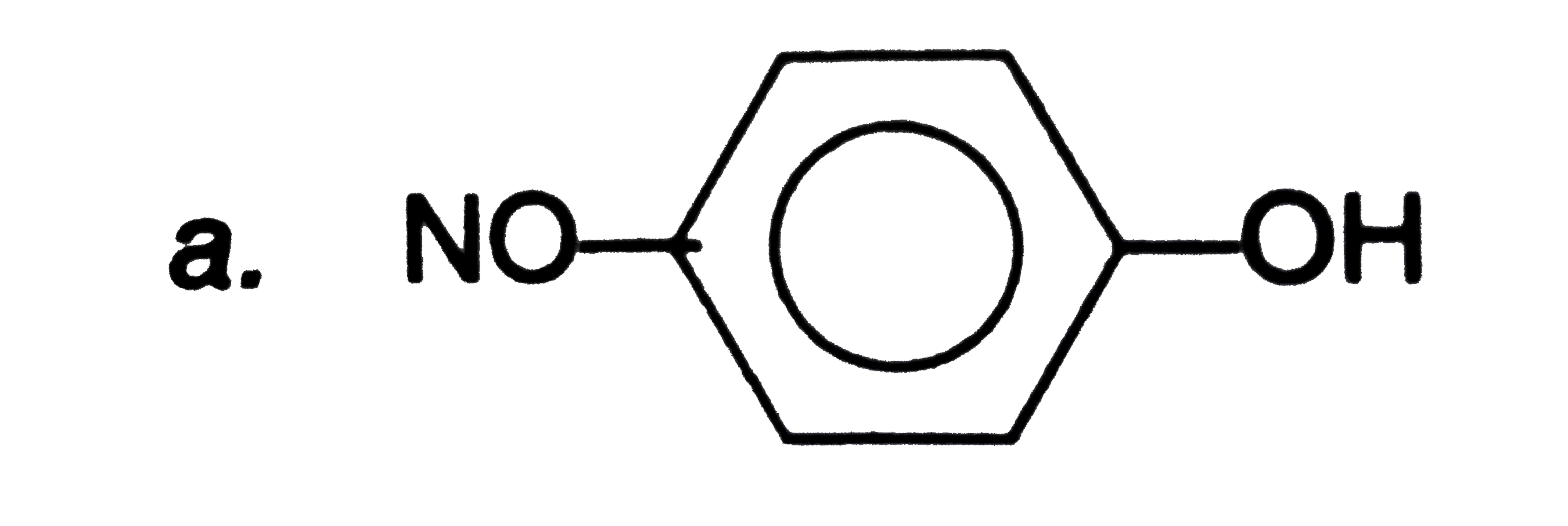
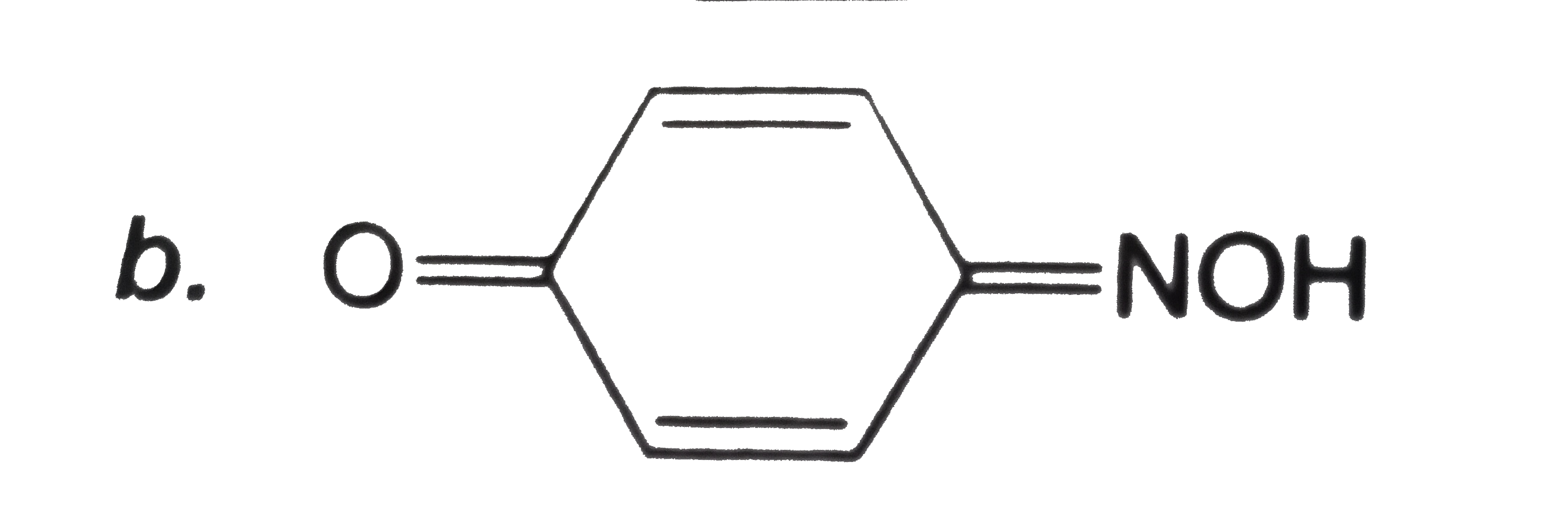
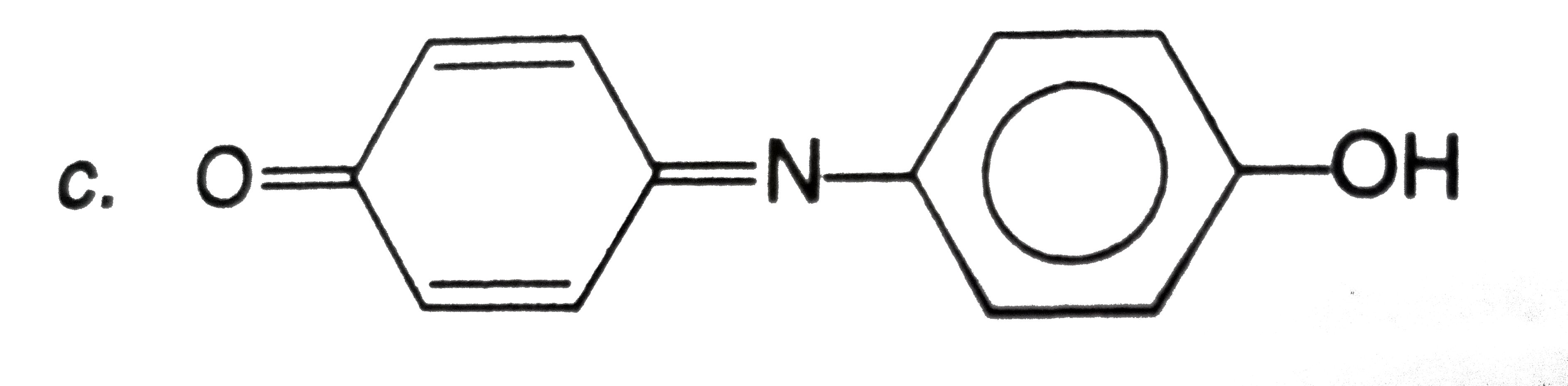
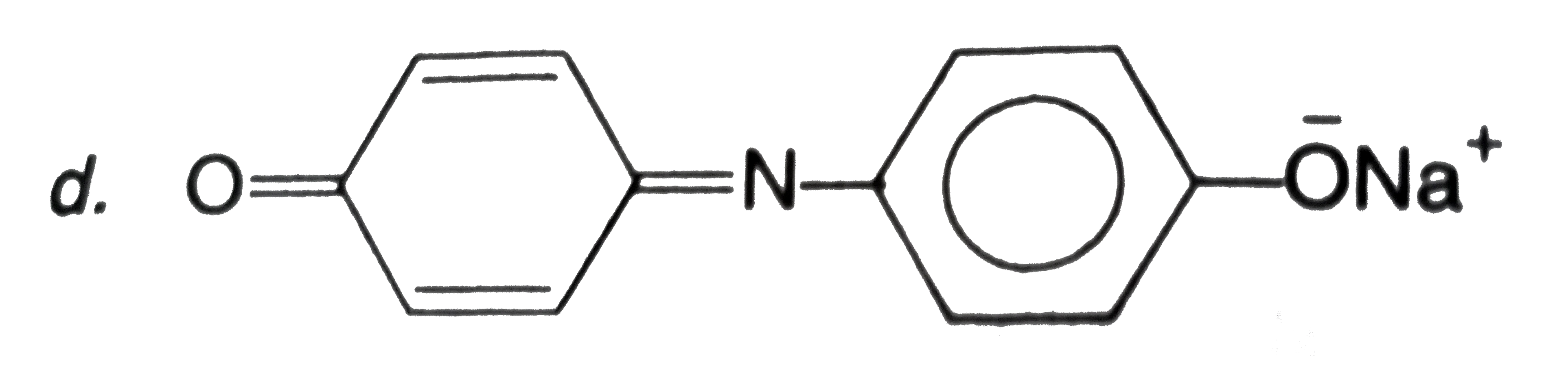
In the Liebermann's test for phenols, the blue or green colour produced is due to the formaton of |
|
Answer»
`"Phenol in conc. "H_(2)SO_(4) overset(NaNO_(2))underset("excess of water")rarr "RED colour" overset(NAOH)underset("(Excess)")rarr "Blue colour"` The blue colour is obtained due to the formation of 
|
|
| 47. |
In the Liebermann's nitroso reaction, sequential changes in the colour of phenol occurs as |
|
Answer» BROWN or RED `to` GREEN `to` red `to`DEEP BLUE |
|
| 48. |
In the lead storage battery during discharging |
|
Answer» `pH` of the ELECTROYTE increases |
|
| 49. |
In the lead-acid battery during charging, the cathode reaction is |
|
Answer» FORMATION of `PbO_(2)` At cathode: `PbSO_(4)(s)+2e^(-)toPb(s)+SO_(4)^(2-)(aq)` At anode: `PbSO_(4)(s)+2H_(2)OtoPbO_(2)(s)+SO_(4)^(2-)(aq)+4H^(+)(aq)+2e^(-)` Thus, `Pb^(2+)` ions of `PbSO_(4)` are REDUCED to Pb on the cathode while `PbSO_(4)` is oxidized to `PbO_(2)` at anode. (Remember: Anode is the electrode on which oxidation takes place, i.e., loss of electrons and cathode is the electrode on which reduction takes place i.e., gain of electrons further, the electrode which ACTS as anode during discharge acts as cathode durig CHARGING and vice-versa. |
|
| 50. |
Inthe leachingofAg_2Swith NaCN,a stream of airisalsopassed.It isbecause |
|
Answer» the REACTIONBETWEEN` Ag_2 S andNaCN ` isreversible |
|