Saved Bookmarks
This section includes 7 InterviewSolutions, each offering curated multiple-choice questions to sharpen your Current Affairs knowledge and support exam preparation. Choose a topic below to get started.
| 1. |
In the extraction of silver from argentite ore the ore is treated witlh dilute solution of NaCN in water in the presence of Y, whereby the following reaction takes place Ag_(2)X + 4NaCN +2Y rarr 2Na [ Ag(CN)_2] + Na_2XO_4 X and Y in this reaction are represented by |
|
Answer» Cl and S X is S and Y is `O_(2)` |
|
| 2. |
In the givenr reaction: [A] and [B] respectively be: |
|
Answer»
|
|
| 3. |
In the given statements the number of statements are incorrect Statement-1 : Hydrated Cu(II) salts are blue and anhydrated salts Cu(II) salts are colourless. Statement-2 : HgCl_(2) A white sublimable substance that in solution forms a white precipitate with NH_(3) Statement-3: Separation of Cu^(+2) and Zn^(+2) ions is not possible by using NaOH. Statement-4 : Pb^(+2), Ag^(+) cations can be separated by using an NH_(3) solution. |
|
Answer» Statement-I : Hydrated Cu(II) SALTS are blue and anhydrated salts Cu(II) salts are colourless. Statement-2 : `HgCl_(2)` A white sublimable substance that in solution forms a white precipitate with `NH_(3)` Statement-3 : Separation of `Cu^(+2)` and `Zn^(+2)` ions is not possible by using NAOH. Statement-4 : `PB^(+2), Ag^(+)` cations can be separated by using an `NH_(3)` solution. |
|
| 4. |
In the given transformation the reactant (A) is |
|
Answer» 2,2-dichloropropane 
|
|
| 5. |
In the extraction of silver from argentite are the one is treated with dilute solution of NaCN in water in the presence of Y, whereby the following reaction takes place. Ag_(2)X+4NaCN+2Y to 2Na[Ag(CN)_(2)]+Na_(2)XO_(4)X and Y in this reaction are repesented by |
|
Answer» CL and S |
|
| 6. |
In the extraction of silver by Mac-arther cyanide process, a small of KNO_(3) is also added as a flux. The function of KNO_(3) is: |
|
Answer» to oxidise Ag in the native form to `Ag^(+)` |
|
| 7. |
In the given structure of a compound, the correct various bond moments direction involving atoms are shown as |
|
Answer» Br = N = `CH_(2) = SiH_(2) = CH_(2) = O = CH_(3)` |
|
| 8. |
In the given statements the number of statements are correct Statement-1 : Ammonia solution can be separate a mixture of AgCl and AgI. Statement-2 : ZnS, NiS, MnS sulphides are insoluble in dil.HCI Statement-3 : Hg_(2)Cl_(2) leaves black residue on addition of NH_(3) Statement-4 : AI^(3+), Mg^(+2) cations can be separated by adding NH_(4)Cl and NH_(4)OH to the mixture. Statement-5 : A white precipitate is obtained when H_(2)S is passed through a solution of ZnSO_(4) |
|
Answer» Statement-1 : Ammonia solution can be separate a mixture of AgCl and AgI. Statement-2 : ZnS, NiS, MNS sulphides are insoluble in dil.HCI Statement-3 : `Hg_(2)CI_(2)` leaves black residue on ADDITION of `NH_(3)`. Statement-4 : `Al^(+3), Mg^(+2)` cations can be separated by adding `NH_(4)Cl` and `NH_(4)OH` to the mixture. Statement-5 : A white precipitate is obtained when `H_(2)S` is passed through a solution of `ZnSO_(4)` |
|
| 9. |
In the extraction of magnesium from magnesium chloride, sodium chloride helps |
|
Answer» lower the conductivity of `MgCl_(2)` |
|
| 10. |
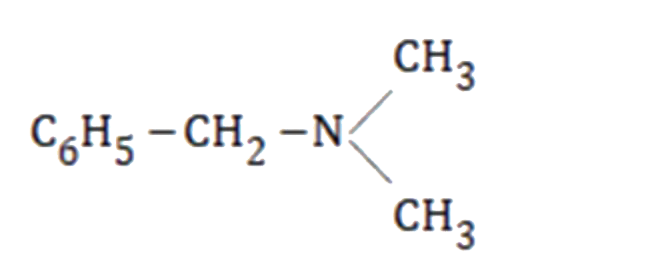
In the given set of reactions, " 2 bromopropane"overset(Alc.AgCN)(to) 'X' overset(LiAlH_4)(to) 'Y'. Identify the product Y and give its IUPAC name. |
Answer» SOLUTION :
|
|
| 11. |
In the extraction of lead from its ore galena, an important element recovered is: |
|
Answer» Au |
|
| 12. |
In the extraction of lead from its or galena am inportant element recovered is |
|
Answer» Au |
|
| 13. |
In the given set of reactions: 2-Bromopropaneunderset("heat")overset("alc. AgCN")to X overset(LiAlH_(4))toY The IUPAC name of the product Y is |
|
Answer» N-isopropylmethanamine 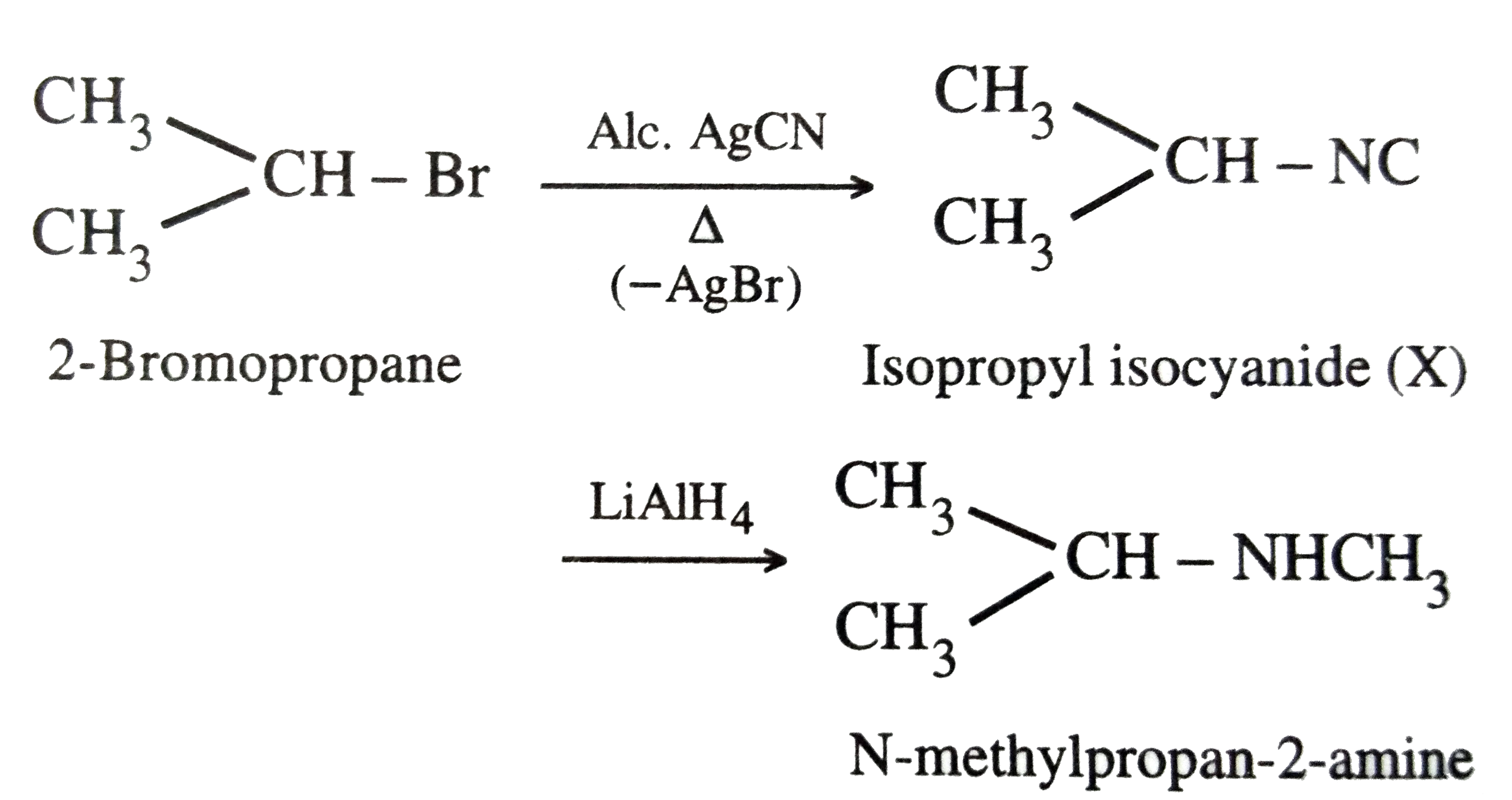
|
|
| 14. |
In the given set of reactions : 2-Bromopropane underset("alc./heat")overset(AgCN)rarrXoverset(LiAlH_(4))rarrY the IUPAC name of product 'Y' is |
|
Answer» Butan-2-amine |
|
| 15. |
In the extraction of iron, the slag produced is : |
|
Answer» `CO` |
|
| 16. |
In the given sequence of first order reaction, A overset(k_(1))to B overset(k_(2))to overset(k_(3))toD What is the ratio of numbers of atoms of A to the number of atoms of B after long time interval starting with pure A, where k_(1) where K_(1) k_(1)=(In2)/(20xx60),k_(2)=(In2)/(30)? |
| Answer» ANSWER :D | |
| 18. |
In the extraction of iron, the slag produced is |
|
Answer» CO |
|
| 19. |
In the given reaction,The main product will be: underset(H_(2)O //H^(oplus))overset(CH_(3)MgBr//Cu_(2)I_(2))(rarr)(Y) |
|
Answer»

|
|
| 20. |
In the extraction of iron ……..is removed as slag. |
| Answer» SOLUTION :CALCIUM SILICATE`(CaSiO_(3))` | |
| 21. |
In the extraction of iron in the blast furnace, the reducing agent for the ore is |
|
Answer» CARBON monoxide |
|
| 23. |
In the extraction of iron from hematite, select the incorrect statement |
|
Answer» MIDDLE zone of BLAST furnace is the reduction zone |
|
| 24. |
In the extractionof gold,alluivalsandisconectratedbywhichmethod |
|
Answer» Gavityseparation |
|
| 25. |
In the extraction of iron in the blast furnace, phosphorous separates as |
|
Answer» SLAG, `Ca_3(PO_4)_2` |
|
| 26. |
In the extraction of copper……….is removed as slag |
| Answer» SOLUTION :FERROUS SILICATE `(FeSiO_(3))` | |
| 27. |
In the extraction of copper, the reaction which takes place in Bessemer converter is : |
|
Answer» `2Cu_2O + CUS to 6Cu + SO_2 uparrow` |
|
| 28. |
In the given reactions : Glucose +3C_6H_5NHNH_2 overset(H^(o+)//Delta) Osazone + A+B (A) and (B) are : |
|
Answer» `C_6H_5NH_2 and NH_3` |
|
| 29. |
In the extraction of copper when molten copper is cooled slowly, blister copper is obtained due to evolution of the following gas |
|
Answer» WATER vapour |
|
| 30. |
In the extraction of copper we use : |
| Answer» Answer :A | |
| 31. |
In the given reaction 'X' will be |
|
Answer» `C_6H_5-CH_2OH` |
|
| 32. |
In the extraction of copper, metal is formed in the Bessemer converter due to which of the following reaction? |
|
Answer» `Cu_2S + 2Cu_2O RARR 6Cu + SO_2` |
|
| 33. |
In the given reaction [X] will be |
|
Answer» Zn/HCl |
|
| 34. |
In the extraction of copper from sulphide ore the metal is formed by reduction of Cu_2O with |
|
Answer» `FeS` `Cu_2O+ FeS to FEO + Cu_2S` `FeO + SiO_2 to underset(("slag"))(FeSiO_3)` `2Cu_2S + 3O_2 to 2Cu_2O + 2SO_2` `2Cu_2O + Cu_2S underset("reduction")overset("auto")(RARR)6Cu + SO_2` |
|
| 35. |
In the given reaction: [X] will be: |
|
Answer»

|
|
| 36. |
In the extraction of copper , the metal formed in the Bessemer's converter is due to the reaction : |
|
Answer» |
|
| 37. |
In the extraction of copper from its sulphide ore, the metal is formed by the reduction of CuO with.... |
|
Answer» `FeS` `Cu_2O + 1/2 Cu_2S to 3Cu + 1/2 SO_2` |
|
| 38. |
In the given reaction : [X] will be |
|
Answer»

|
|
| 39. |
In the given reaction: [X] will be |
|
Answer»

|
|
| 40. |
In the extraction of copper from its sulphide ore, the metal is formed by the reduction of Cu_(2)O with |
|
Answer» FeS `2Cu_(2)O+Cu_(2)S to 6Cu+SO_(2)` |
|
| 41. |
In the given reaction: [X] will be |
|
Answer» `HOOC-CH_(2)-CH_(2)-OVERSET(OH)overset(|)(CH)-CH_(3)` 
|
|
| 42. |
In the given reaction :'X' will be : |
| Answer» Solution :H2/Ni/D reduce - CHO and multiple bond. | |
| 43. |
In the extraction of copper from its sulphide ore, the metal is formed by reduction of Cu^(2)O with |
|
Answer» FeS |
|
| 45. |
Intheextractionof copperfrom itssulphideore,themetalis formedbythereduction ofCu _2 Owith |
|
Answer» ` FES ` |
|
| 46. |
In the given reaction underset(573-673K)overset(Zn+Cr_(2)O_(3))(to) Product |
| Answer» ANSWER :A | |
| 47. |
In the extraction of copper from its sulphide ore, the metal is finally obtained by the reduction of cuprous oxide with : |
|
Answer» CARBON monoxide |
|
| 48. |
In the given reaction, U_92^235overset(-alpha)to (A) overset(-beta)to(B) overset(-beta)to © isotope are : |
|
Answer» A and C |
|
| 49. |
In the extraction of copper from its sulphide ore, the metal finally obtained by the reduction of cuprous oxide with |
|
Answer» IRON (II) sulphide |
|
| 50. |
In the given reaction the products is : CH_(3)-CH_(2)-underset(O)underset(||)(C)-OCH_(3)+CH_(3)-underset(O)underset(||)(C)-OCH_(3) overset((1)CH_(3)O^(Theta)Na^(+))underset((2)CH_(3)OH)to oversert(H_(2)O)underset(Delta)to product |
|
Answer» `CH_(3)-CH_(2)-UNDERSET(O)underset(||)(C)-CH_2-underset(O)underset(||)(C)-OCH_(3)` 
|
|