Saved Bookmarks
This section includes 7 InterviewSolutions, each offering curated multiple-choice questions to sharpen your Current Affairs knowledge and support exam preparation. Choose a topic below to get started.
| 1. |
In order to prepare a 1^(@) amine from an alkyl halide with simultaneous addition of one CH_(2) group in the carbon chain, the reagent used as source of nitrogen is ___________. |
|
Answer» Sodium amide, `NaNH_(2)` |
|
| 2. |
In order to prepare a 1_(@) amine from an alkyl halide with simultaneous addition of one CH_(2) group in the carbon chain, the reagent used as source of nitrogen is: |
|
Answer» Sodium AMIDE, `NaNH_(2)` `RX overset(KCN)underset(-KX) rarr RCNoverset(Na. C_(2)H_(5)OH)rarr underset(1^(@)-" Amine")` |
|
| 3. |
In order to prepare 1 litre normal solution of KMnO_(4), how many grams of KMnO_(4) are required if the solution is to be used in acid medium for oxidation? |
|
Answer» 158g |
|
| 4. |
In order to prepare 1^(@) amine from an alkyl halide with simultaneous addition of one CH_(2) group in the carbon chain, the reagent used as source of nitrogen is |
|
Answer» Sodium amide, `NaNH_(2)` `R-Xunderset(-KX)overset(KCN)to R-CN overset(Na//C_(2)H_(5)OH)to R-CH_(2)NH_(2)` |
|
| 5. |
In order to perdict variation of Gibbs free energy with progress of reaction at constant temperature and 1 bar pressure, it is important to know realtive stability of the components involved in chemical reaction at standard useful work then the change in Gibbs free energy should be calculated In the thermite reaction used obtaining energy, aluminium oxide. From the given data identify the option 9s) which is (are) correct. [Given : DeltaH_(f)^(@)Al-(2)O_(3)=-390kj//mol, DeltaH_(f)^(@)Fe_(2)O_(3)=-176kj//mol, Density of aluminimum = 2/7 gm/ml, Density of Fe_(2)O_(3)=3.2gm//ml |
|
Answer» Maximum calorific value of the fuel can be 1000 J/gm |
|
| 6. |
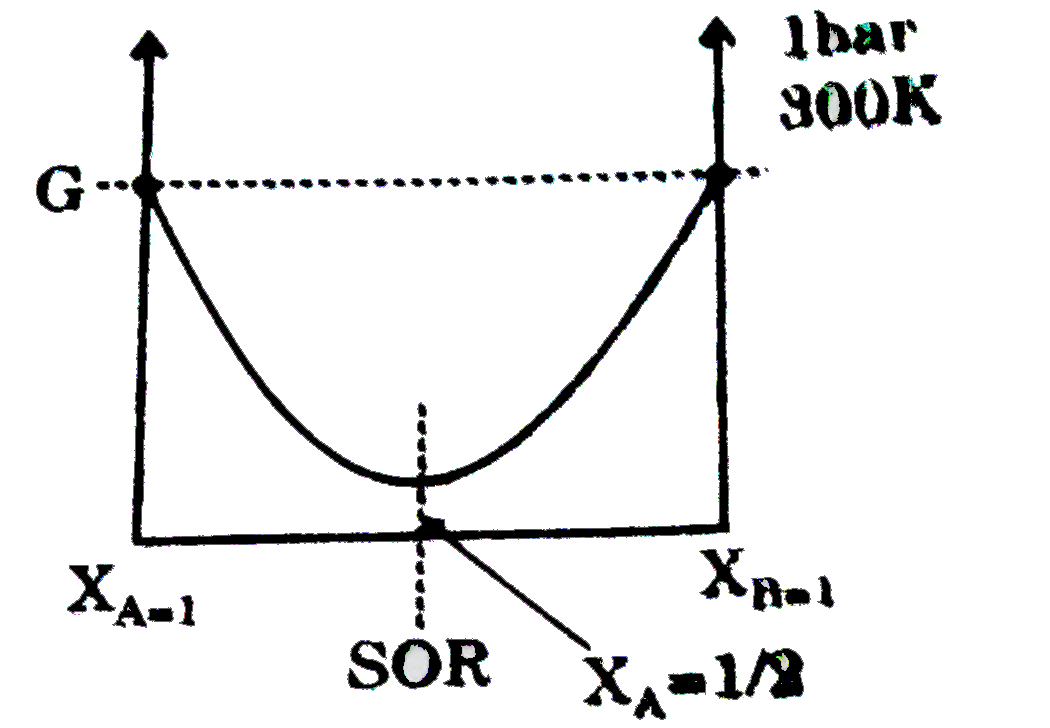
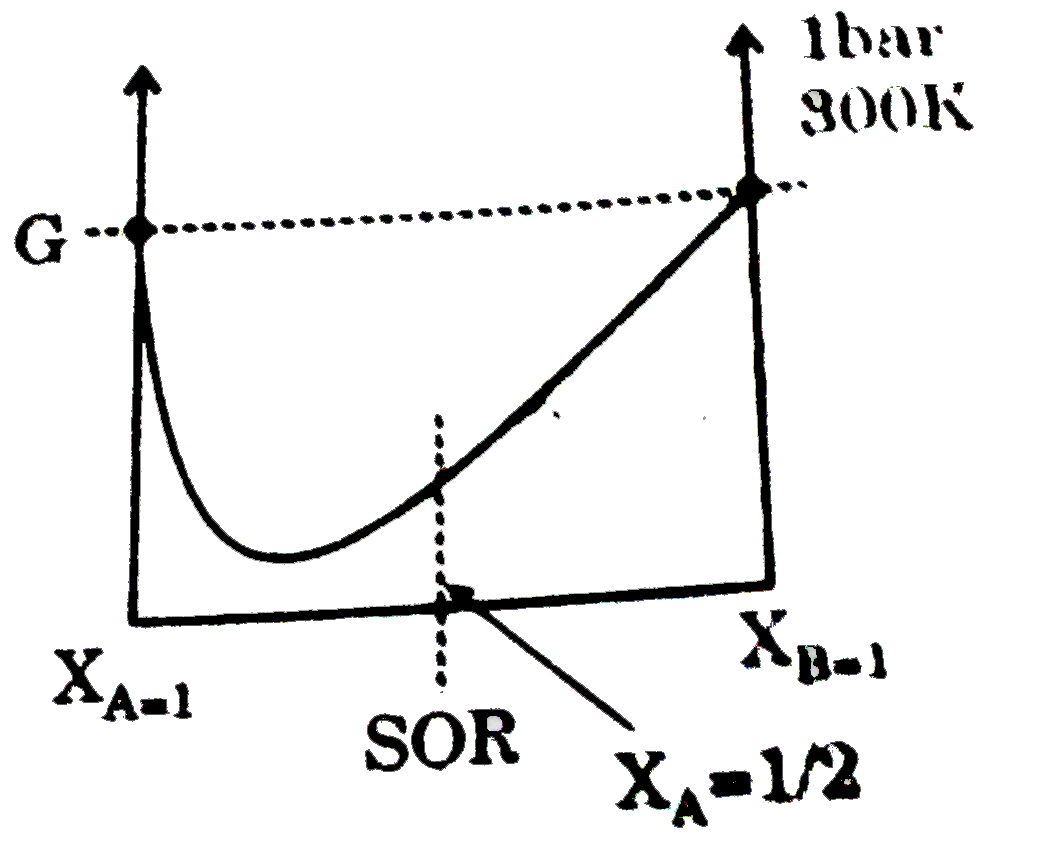
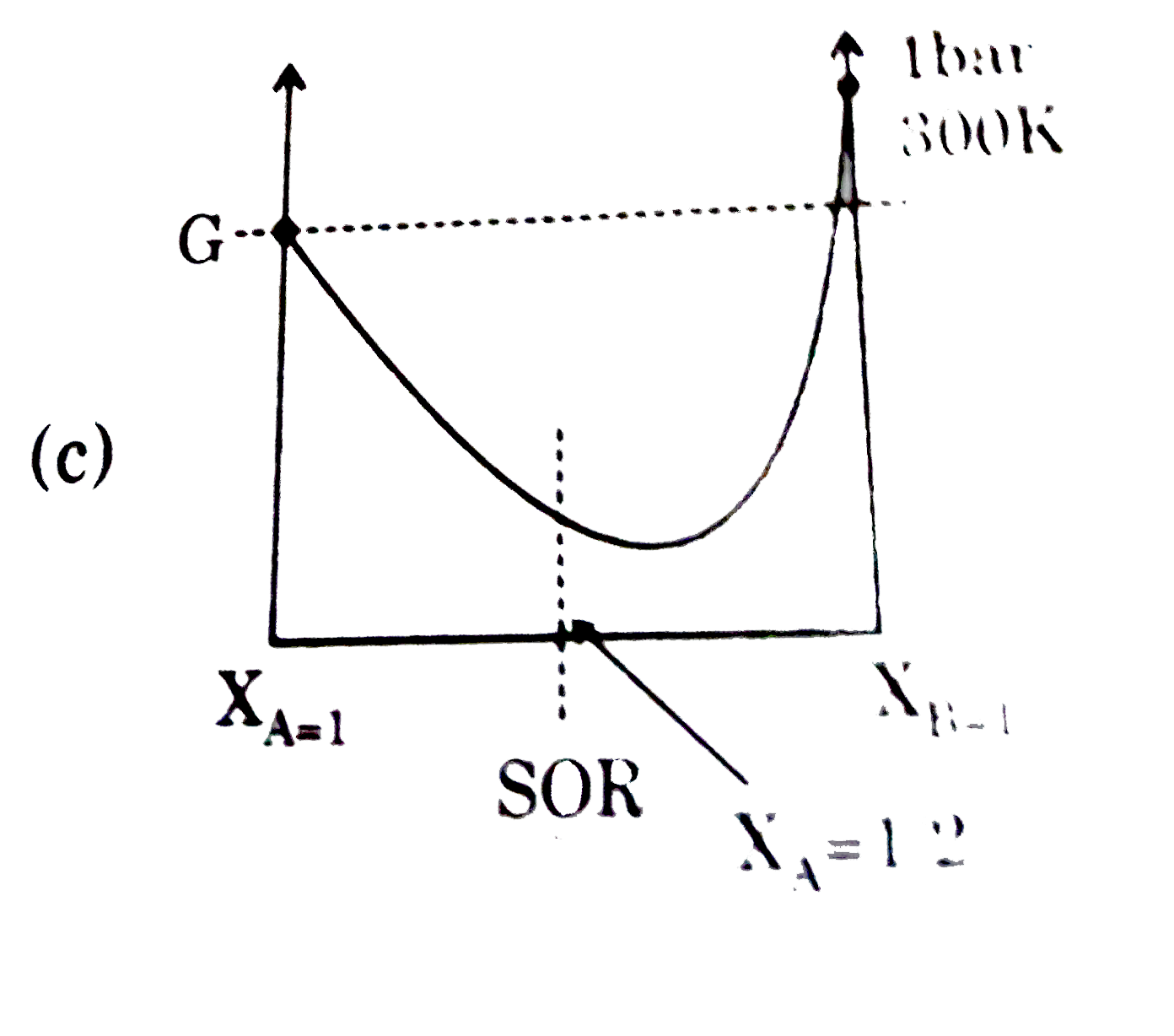
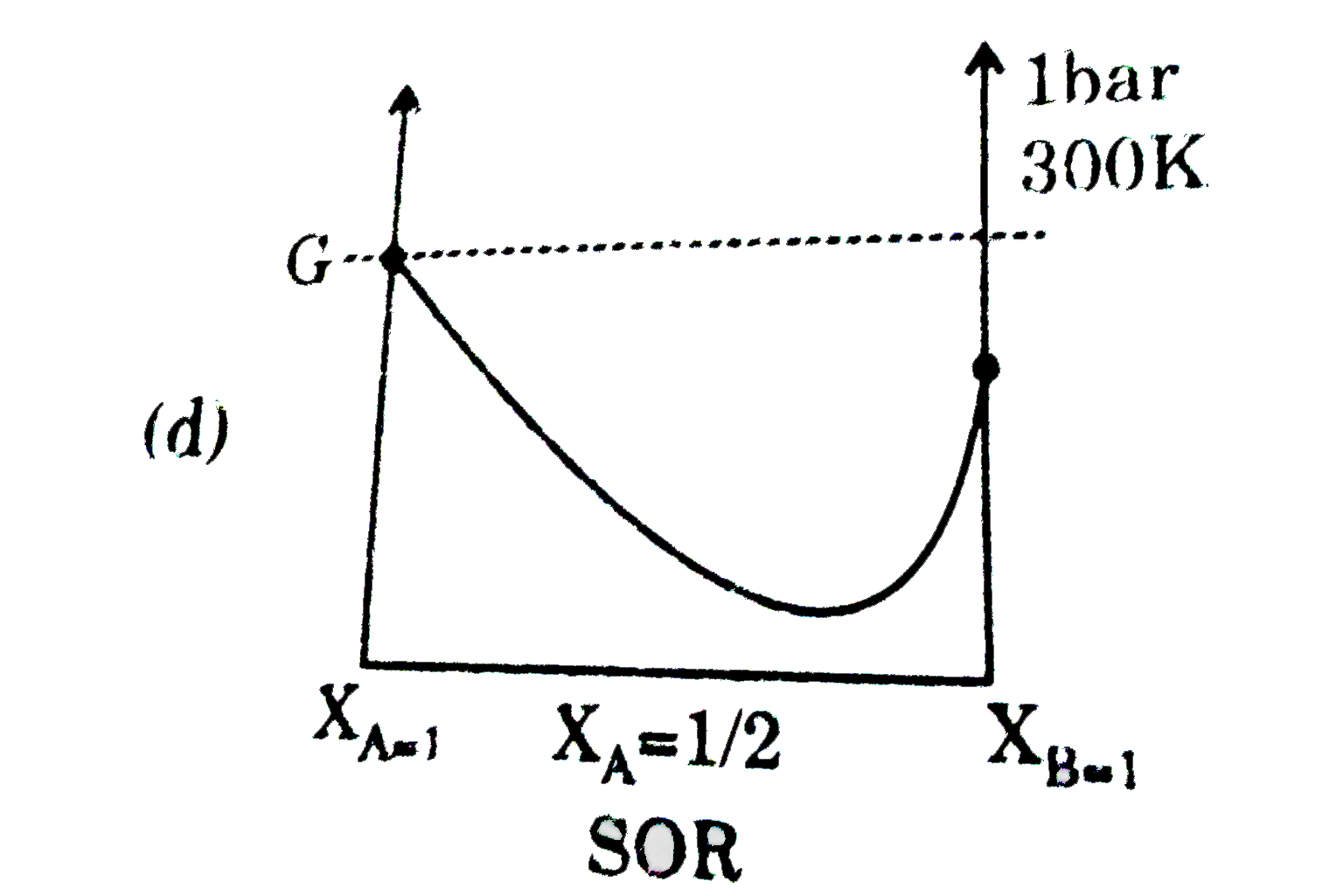
In order to perdict variation of Gibbs free energy with progress of reaction at constant temperature and 1 bar pressure, it is important to know realtive stability of the components involved in chemical reaction at standard useful work then the change in Gibbs free energy should be calculated Which of the following options correctly represects the graph between Gibbs freeenergy (G0 and state of reaction (SOR) at 1 bar and 300 K for the reaction But -1 ene (A) hArr but -2 ene (B) |
|
Answer»
|
|
| 7. |
In order to maintain soil fertility , it is necessary to add containing nitrogen , phosphorous and potassium in the form of manures. Manures are two type they are a) Natural and b) Artificial , Artifical manures are chemical compounds obtained by artificial mean containing N,P or K. These chemical compounds are generally called fertilizers. The chemical substance which are added to the soil as to make up the deficiency of essential elements are called fertilizers. Every chemical compounds of N,P , & K can be used as fertilizer and it must have chracteristic properties. Fertilizers are classified according to the element (N,P or K) which they are supplied tothe soild. Super phosphate of lime is obtained by treating |
|
Answer» CALCIUM phosphate with HCl `underset("phosphate")underset("Calcium")(Ca_(3)(PO_4)_2)+2H_2SO_4+4H_(2) rarr underset("super phosphate of lime")(Ca(H_2PO_4)_(2)+2CaSO_(4).2H_(2)O` |
|
| 8. |
In order to maintain soil fertility , it is necessary to add containing nitrogen , phosphorous and potassium in the form of manures. Manures are two type they are a) Natural and b) Artificial , Artifical manures are chemical compounds obtained by artificial mean containing N,P or K. These chemical compounds are generally called fertilizers. The chemical substance which are added to the soil as to make up the deficiency of essential elements are called fertilizers. Every chemical compounds of N,P , & K can be used as fertilizer and it must have chracteristic properties. Fertilizers are classified according to the element (N,P or K) which they are supplied tothe soild. A compound of N,H,C and 'O' which is used as a fertilizer |
| Answer» SOLUTION :Urea : `H_2N-OVERSET(O)overset(||)C-NH_2` | |
| 9. |
In order to maintain soil fertility , it is necessary to add containing nitrogen , phosphorous and potassium in the form of manures. Manures are two type they are a) Natural and b) Artificial , Artifical manures are chemical compounds obtained by artificial mean containing N,P or K. These chemical compounds are generally called fertilizers. The chemical substance which are added to the soil as to make up the deficiency of essential elements are called fertilizers. Every chemical compounds of N,P , & K can be used as fertilizer and it must have chracteristic properties. Fertilizers are classified according to the element (N,P or K) which they are supplied tothe soild. complete manure is that which supplies |
|
Answer» <P>S,K and N |
|
| 10. |
In order to maintain constant temperature of a system involving an ideal gas, heat has to be removed. Thenwhat is true? |
|
Answer» The gas is being compressed |
|
| 11. |
In order to liberate 4 N electrons how many gram of Mg has to react : |
| Answer» Answer :D | |
| 12. |
In order to increase the volume of a gas by 10%, the pressure of the gas should be: |
|
Answer» decreased by 10% or `p_(1) V_(1) = p_(2) V_(2)` If `V_(2) = V_(1) + ( V_(1) xx 10)/( 100) = 1.1 V_(1)` `p_(2) = ( p_(1)V_(1))/( V_(2)) = ( p _(1) xx V_(1))/( 1.1V_(1)) = 0.9 p_(1) ` % DECREASE in PRESSURE `= ( ( p_(1) - 0.9 p_(1))/( p_(1)))xx 100 = 10%` |
|
| 13. |
In order to get maximum calorific output, a burner should have an optimumfuel-to-oxygen ratio which corresponds to 3 times as much oxygen as is required theoretically for complete combustion of the fuel. A burner which has been adjusted for methane as fuel (with x litre/hour of CH_4 and 6x litre/hour of O_2 ) is to be readjusted for butane, C_4H_10 . In order to get the same calorific output, what should be the rate of supply of butane and oxygen? Assume that losses due to incomplete combustion, etc., are the same for both fuels, and that the gases behave ideally. Heat of combustion: |
|
Answer» Solution :VOL. of `C_4H_10` required per `H = (804)/(2878) L` Vol. of `O_2` required per h`((804x)/(2878)) XX 13/2 xx 3L` `C_4H_10 = 0.28 x L// h` `O_2 = 5.48x L//h` |
|
| 14. |
in order to get ethanthiol from C_2H_5Br the reagent used is : |
|
Answer» `NA_2S` |
|
| 15. |
In order to find the strength of a sample of sulphuric acid, 10 g were dilluted with water and a piece of marble weighing 7 g placed in it. When all action had ceased, the marble was removed, washed, dried and was found to weight 2.2g. What was the percentage strength of sulphuric acid ? |
|
Answer» Solution :Mass of marble taken = 7.0 G. Mass of marble left unsed = 2.2 g `therefore` Mass of marble reacted = 7.0-2.2 =4.8 g. The chemical EQUATION involved in the above problem is `underset(=100 g)underset(40+12+16xx3)(CaCO_(3))+underset(=98 g)underset(2+32+4xx16)(H_(2)SO_(4))rarr CaSO_(4)+H_(2)O+CO_(2)` Step 1. To calculate the mass of pure `H_(2)SO_(4)` required to react with 4.8 g of marble. 100 g of marble react with `H_(2)SO_(4)=98 g` `therefore` 4.8 g of marble will react with `H_(2)SO_(4)=(98)/(100)xx4.8g = 4.704 g`. Step 2. To calculate the strength of sulpuric acid. 10 g of dil. `H_(2)SO_(4)` contain pure `H_(2)SO_(4)=4.704 g`. `therefore` 100 g of dil. `H_(2)SO_(4)` will contain pure `H_(2)SO_(4)=(4.704)/(10)xx100g=47.04 g` Thus, the percentage stremgth of sulphuric acid = 47.04% . |
|
| 16. |
In orderto distinguish between C_(2)H_(5) - NH_(2)and C_(6)H_(5)- NH_(2) , which of the followingreagentis useful |
|
Answer» Hinsberg's reagent `C_(6)H_(5) - NH_(2) + HNO_(2) + HCl overset("Cold")to C_(6)H_(5)-N_(2)^(+)Cl^(-) + 2H_(2)O` |
|
| 17. |
In order to determine order/rate constant of any gaseous reaction pressure data at constant volume and temperature can be analysed. For a gaseous reaction occurring in a rigid vessel at 300 K following data was observed. 2A(g) rarr 3B(g) +2C(g) {:(,"Time (min)",,"10 min",,"30 min",,infty time),(,"Pressure increase (mm of Hg)",,"30 mm",,52.5 min,,"60 min"):} What will be average life of molecules of 'A'? |
|
Answer» `10 min` |
|
| 18. |
In order to determine order/rate constant of any gaseous reaction pressure data at constant volume and temperature can be analysed. For a gaseous reaction occurring in a rigid vessel at 300 K following data was observed. 2A(g) rarr 3B(g) +2C(g) {:(,"Time (min)",,"10 min",,"30 min",,infty time),(,"Pressure increase (mm of Hg)",,"30 mm",,52.5 min,,"60 min"):} What will be the total increase in pressure 20 min after the reaction? |
| Answer» Answer :A | |
| 19. |
In order to determine the volume of blood in an animal, a 1.0mL sample of solution of 10^(3) dpm of ._(1)^(3)H is injected into the animal blood stream. After sufficient time for circulatory equilibrium to be established, 2mL of blood is found to have activity to 10 dpm. The volume of blood in animal is : |
| Answer» Answer :A | |
| 20. |
In order to determine the volume of blood in an animal without killingit, a 1.00 ml sample of an aqueous solution containing tritium is injected into the animal blood stream. The sample injected has an activity of 1.8 xx 10^(6) cps ( counts per second ) . After sufficient time for the sample to becompletely mixed with the animal blood due to normal blood circulation, 2.00ml of blood as withdrawn from animal and the activity of the blood sample withdrawn is found to be 1.2 xx 10^(4) cps. Calculate the volume of the animal blood. |
|
Answer» 300ml |
|
| 21. |
In order to demonastrate the dehydrating action of H_2SO_4 it is poured on: |
|
Answer» `NaHCO_3` SOLUTION |
|
| 22. |
In order to decompose 9g water 142.5 kJ heat is required. Hence the enthalpy of formation of water is |
|
Answer» `-285kJ` `2H_(2)O rarr 2H_(2) + O_(2)` `Delta H_(f) = 2 XX H_((O_(2)))^(0) -2 xx H_((H_(2)O))^(0)` `=0 + 0-2 xx 142.5 = -285kJ` `Delta H_(f)` for 1 MOLE of `H_(2)O = -142.5kJ` |
|
| 23. |
In order to decompose 9 g water 142.5 kJ heat is required.Hencethe enthalpy of formation of water is |
|
Answer» `-142.5 kJ` we KNOW `H_(2)O=2+16=18` THEREFORE heat required for decomposition of 18gm water `=(18)/(9)xx142.5=285 KJ` |
|
| 24. |
In order to convert R-X to R-R prime, which reaction is most suitable? |
|
Answer» Corey Honse reaction `R-X +R_(2) CU LI overset("Dry ether")toR-R'+R'Cu+LiX` |
|
| 25. |
In order to analyse variation of rate constant with temperature Arrhenius equation is used the two parameters involved pre-exponential factor and activation energy are assumed to be constant in the theory while in reality they may vary with temperature It is further observed that Arrhenius factor is proportional to sqrt(T) and hence the equation can be restated as: k=A sqrt(T)e^(-Ea//RT) (where A' is temperature independent). However, for most of the analysis its variation is neglected Also, if activation energy is temperature dependent then Arrhenius equation does not hold true and the following equation should be used (d l n k)/(dT)=(E_(a))/(RT^(2)) where symbols have usual meaning. Assuming Arrhenius factor to be constant and activation energy to be dependent on temperature and varying as (0.02 T^(2)) cal (if T is in Kelvin scale) then calculate by what factor will rate constant increase if temperature is increased from 200 K to 400 K? |
| Answer» Answer :A | |
| 26. |
In order to concentrate galena (which contains ZnS as impurity) by froth floatation process, sodium cyanide is used as department. NaCN dissolves ZnS due to formation of water soluble complex (A). Find wxyz, Where w=corrdination number of central metal ion in complex ion of (A) x=number of unpaired electrons in (A) y=total number of possible linkage isomers of (A) including (A) z=maximum number of atoms in a single plane in the complex ion of (A). |
|
Answer» |
|
| 27. |
In order to analyse variation of rate constant with temperature Arrhenius equation is used the two parameters involved pre-exponential factor and activation energy are assumed to be constant in the theory while in reality they may vary with temperature It is further observed that Arrhenius factor is proportional to sqrt(T) and hence the equation can be restated as: k=A sqrt(T)e^(-Ea//RT) (where A' is temperature independent). However, for most of the analysis its variation is neglected Also, if activation energy is temperature dependent then Arrhenius equation does not hold true and the following equation should be used (d l n k)/(dT)=(E_(a))/(RT^(2)) where symbols have usual meaning. For a reaction where activation energy is 800 cal, by what factor will rate constant increase if Arrhenius factor is assumed to be temperature dependent and temperature is changed from 200 K to 400 K? |
|
Answer» `E^(+1)` TIMES |
|
| 28. |
In order the react, the colliding molecules must process a minimum energy called.......... |
| Answer» SOLUTION :ACTIVATION ENERGY | |
| 29. |
Inorderot getpropanegas , which of thefollowingshouldbesubjectedto sodalime decarboxylation? |
|
Answer» SODIUM FORMATE |
|
| 30. |
In order complete the reaction 1-Pentyneundersetato4-Octyneoversetbtocis-4-Octene, a and b will be (1){:(a,b,),(NaNH_2,CH_3CH_2Br,:H_2,"(one mole )Pd or Ni"):} (2){:(a,b,),(NaNH_2,CH_3CH_2CH_2Br,:H_2,"(two mole )Pd or Ni"):} (3){:(a,b,),(NaNH_2,CH_3CH_2CH_2Br,:H_2,"(one mole )Pd or Ni"):} (4){:(a,b,,),(NaNH_2,CH_3CH_2CH_2Br,:BH_3,H_2O_2,OH^(-)):} |
|
Answer» 1 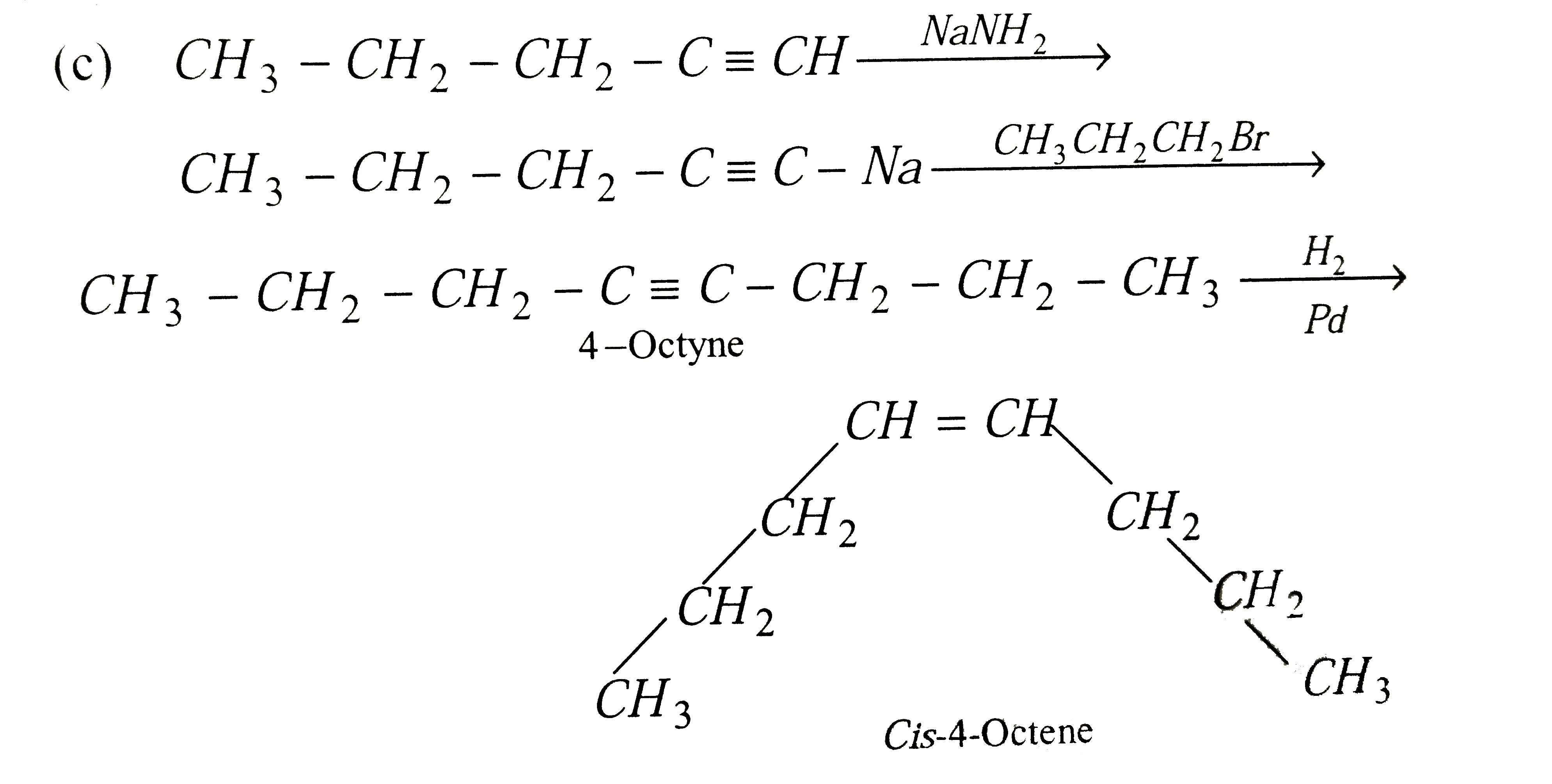
|
|
| 31. |
In order to make alcohol undrinkable pyridine and methanol are added to it. The resulting alcohol is called: |
|
Answer» Power alcohol |
|
| 32. |
In one step ethyne can be obtained from |
|
Answer» ethanol |
|
| 33. |
In one of the experiment performed by two students ''Abraham'' and ''Fienkelstein'' for measurement of optical activity of a substance. Result given by ''Abraham'' was. It is d-form with +30^(@) rotation and by ''Fienkelstein'', it was : It is l-form with -150^(@) rotation. One of them can be correct only as solution can either be d form or, l-form. Which of the following is correct measure to come out of this dispute? |
|
Answer» Result with acute angle is correct. |
|
| 34. |
In one of neutron induced fission of ._(92)U^(235),. _(38)Sr^(90) & ._(54)Xe^(143) were produced. Calculate energy released per neutron produced if masses of ._(92)U^(235), ._(38)Sr^(90), ._(54)Xe^(143) & neutron are 234.83,89.98, 142.71 & 1.02 respectively. [Take 1 amu = 930 MeV] Express your answer in the form X xx 10^(4) eV and fill the value of X in OMR sheet. |
|
Answer» |
|
| 35. |
In one litre of 3M solution of NaOH, H_(2)SO_(4) is added until 27.4 Kcal energy us released. Then 2 moles of CH_(3)COOH is added to the resulting solution and the final volume becomes 2 litre. If x moles of AgCN can be dissolved in the final solution, what is x xx 10^(4)? H^(+)+OH^(-)rarrH_(2)O ""DeltaH=-13.7Kcal//mol K_(sp)AgCN=10^(-12)K_(a)(CH_(3)COOH)=10^(-5) K_(a)(HCN)=10^(-9) |
|
Answer» `AgCNhArr Aunderset(s)(G^(+))+Cunderset(s)(N)^(-)` `CN^(-)+UNDERSET(10^(-5))H^(+)rarrHunderset(s)CN` `(S^(2))/(10^(-5)xx10^(-12))=10^(9)` `s=10^(-4)m/L` |
|
| 36. |
In one mole of ethanol (C_2H_5OH) completely burns to carbon dioxide and water the weight of carbon dioxide formed is about : |
|
Answer» 22g |
|
| 37. |
The ester , ethyl acetate is formed by the reaction of ethanol and acetic acid and the equilibrium is represented as : CH_(3) COOH(l) +C_(2)H_(5)OH(l)hArr CH_(3)COOC_(2)H_(5)(l) +H_(2)O(l) (i) Write the concentration ratio (concentration quotient) Q for this reaction. Note that water is not in excess and is not a solvent in this reaction. (ii) At 293 K, if one starts with 1.000 mol of acetic acid 0.180 mol of ethanol, there is 0.171 mol of ethyl acetate in the final equilibriummixture . Calculate the equilibrium constant. (iii)Starting with 0.50 mol of ethanol and 1.000 mol of acetic acid and maintaining it at 293 K, 0.214 mol of ethyl acetate is found after some time. Has equilibrium been reached? |
|
Answer» `K_c=3.92` |
|
| 38. |
If W is the amount of work done by the system and q is the amount of heat supplied to the system, identify the type of the system |
|
Answer» ISOLATED system |
|
| 39. |
In one experiment , a proton having kinetic energy of 1 eV is accelerated through a potential difference of 3 V. In another experiment, an alpha-particle having initial kinetic energy 20 eV is retarded by a potential difference of 2 V. Calculate the ratio of de-Broglie wavelengths of proton and alpha - particle. |
|
Answer» |
|
| 40. |
In…………………. of the form [MA_(2)B_(2)]^(n+-), cis-trans isomerism exists. |
|
Answer» |
|
| 41. |
In OF _(2) molecule, the total number of bond pairs and lone pairs of electrons present respectively are |
|
Answer» 2, 6 |
|
| 42. |
In of the following case does the reaction go farthest to completion ? |
|
Answer» `K = 10_2` |
|
| 43. |
In octahedral complexes having co-ordination number 6, the degeneracy of the d-orbitals of central atom is removed due to ligand electron metal electron repulsions. In the octahedral complex three orbitals have lower energy, t_(2g) set and two orbitals have higher energy, eg set. This phenomenon is formed as crystal field splitting and the energy seperation is denoted by Delta_(0). Thus the energy of the two eg orbitals will increase by (3//5)Delta_(0) and that of the three t_(2g) will decrease by (2//5)Delta_(0). The erystal field splitling, Delta_(0) depends upon the field produced by the ligand and charge on the metal ion. Some ligands are able to produce strong field and in these cases, the splitting will be large whereas other produce weak fields and consequently result in small splitting of d-orbitals. Predict the order of Delta_(0) for the following compound i) [Fe(H_(2)O)_(6)]^(+2) ii) [Fe(CN)2(H_(2)O)_(4)iii) [Fe(CN)_(4)(H_(2)O)_(2)]^(2-) |
|
Answer» `Delta_(0)(i)ltDelta_(0)(ii)ltDelta_(0)(iii)` |
|
| 44. |
In octahedral complexes having co-ordination number 6, the degeneracy of the d-orbitals of central atom is removed due to ligand electron metal electron repulsions. In the octahedral complex three orbitals have lower energy, t_(2g) set and two orbitals have higher energy, eg set. This phenomenon is formed as crystal field splitting and the energy seperation is denoted by Delta_(0). Thus the energy of the two eg orbitals will increase by (3//5)Delta_(0) and that of the three t_(2g) will decrease by (2//5)Delta_(0). The erystal field splitling, Delta_(0) depends upon the field produced by the ligand and charge on the metal ion. Some ligands are able to produce strong field and in these cases, the splitting will be large whereas other produce weak fields and consequently result in small splitting of d-orbitals. In an octahedral crystal field, t_(2g) orbitals are |
|
Answer» raised in energy by `0.4Delta_(0)` |
|
| 45. |
In octahedral complex Ma_(2)b_(2)cd, total number of steroisomers is |
|
Answer» (ab)(ab)(cd) (AC)(bb)(AD) (aa)(bc)(bd) (ac)(ab)(bd) OP. active (ad)(ab)(bc) op. active |
|
| 46. |
In O_2 (O-O) the number of electrons which are paired is |
|
Answer» 14 |
|
| 47. |
In O_(2) and H_(2)O_(2) the O-O bond lengths are 1.21 and 1.48Å respectively. In ozone, the average O-O bond length is |
|
Answer» 1.28 Å  HENCE it is 1.28Å. |
|
| 48. |
In O_(2) and H_(2)O_(2) the O - O bond lenghts are 1.21 and 1.48 Å . Respectively. In ozone, the average O - O bond length is |
|
Answer» `128 Å`  Hence , it is `1.28 Å` . |
|
| 49. |
In nucleosides, math N-atom of pyrimidine base is joined to n" C-atom of ribose sugar moiety. Here m and n are respectively |
|
Answer» `1,1` |
|