

Saved Bookmarks
This section includes 7 InterviewSolutions, each offering curated multiple-choice questions to sharpen your Current Affairs knowledge and support exam preparation. Choose a topic below to get started.
| 1. |
In permanganate titrations, potassium pemanganats is used an an oxidizing agent in acidic medium. The medium is maintained acidic by the use of dilute sulphuric acid. Potassium permanganate acts as self indicator . The potential equation, when potassium permanganate acts as an oxidizing agent is 2KMnO_(4) + 3H_(2)SO_(4) to K_(2)SO_(4) + 2MnSO_(4) + 3H_(2)O + 5[O] or MnO_(4)^(-) + 8H^(+) + 5e^(-) to Mn^(2+) + 4H_(2)O Before the end point, the solution remains colourless but after teh equivalence point only one extra drop of KMnO_(4) solution imparts pink colour , i.e. appearance of pink colour indicates end point. These titrations are used for estimation of ferrous salts, oxalic acid, oxalates, hydrogen peroxide, As_(2)O_(3) etc. Mass of KHC_(2)O_(4) (potassium acid oxalate ) required to reduce 100 ml of 0.02 KMnO_(4) in acidic medium (MnO_(4)^(-)" changes to " Mn^(2+)) is x gm and to neutralize 100 ml of 0.05M Ca(OH)_(2) is y gm ,then |
|
Answer» `X = y` |
|
| 2. |
In permanganate titrations, potassium pemanganats is used an an oxidizing agent in acidic medium. The medium is maintained acidic by the use of dilute sulphuric acid. Potassium permanganate acts as self indicator . The potential equation, when potassium permanganate acts as an oxidizing agent is 2KMnO_(4) + 3H_(2)SO_(4) to K_(2)SO_(4) + 2MnSO_(4) + 3H_(2)O + 5[O] or MnO_(4)^(-) + 8H^(+) + 5e^(-) to Mn^(2+) + 4H_(2)O Before the end point, the solution remains colourless but after teh equivalence point only one extra drop of KMnO_(4) solution imparts pink colour , i.e. appearance of pink colour indicates end point. These titrations are used for estimation of ferrous salts, oxalic acid, oxalates, hydrogen peroxide, As_(2)O_(3) etc. For decolourization of 1 mol of KMnO_(4) , the number of moles of H_(2)O_(2) required is |
|
Answer» `1/2` |
|
| 3. |
In permanganate titrations, potassium pemanganats is used an an oxidizing agent in acidic medium. The medium is maintained acidic by the use of dilute sulphuric acid. Potassium permanganate acts as self indicator . The potential equation, when potassium permanganate acts as an oxidizing agent is 2KMnO_(4) + 3H_(2)SO_(4) to K_(2)SO_(4) + 2MnSO_(4) + 3H_(2)O + 5[O] or MnO_(4)^(-) + 8H^(+) + 5e^(-) to Mn^(2+) + 4H_(2)O Before the end point, the solution remains colourless but after teh equivalence point only one extra drop of KMnO_(4) solution imparts pink colour , i.e. appearance of pink colour indicates end point. These titrations are used for estimation of ferrous salts, oxalic acid, oxalates, hydrogen peroxide, As_(2)O_(3) etc. In order to prepare one litre of normal solution of KMnO_(4), how many grams of KMnO_(4) is required if solution is to be used in acid medium for oxidation ? |
|
Answer» `158` GM |
|
| 4. |
In permanganate ion, all the bonds formed between Mn and oxygen are covalent. Give reasons. |
| Answer» Solution :Oxidation number of Mn in `MnO_4` IONS is +7. To form `Mn^(7+)`ions, SEVEN electrons are to be removed. However, ENERGETICALLY this is not feasible. HENCE, it forms COVALENT bonds by sharing of electrons. | |
| 5. |
In permanganate ion, all the bonds between Mn and O are covalent. Give reasons. |
| Answer» Solution :Oxidation state of Mn in `MnO_(4)^(-)` is +7. It is energetically not possible to lose SEVEN electrons to give ionic SPECIES. It FORMS bonds by sharing of electrons. HENCE covalent bonds are formed. | |
| 6. |
In PCl_(5), phosphorus is in sp^(3)d hybridised state but all its five bonds are not equivalent. Justify your answer with reason. |
| Answer» Solution :`PCl_(5)` has trigonal bipyramid geometry. It has three equatorial and two axial bonds. Since each axial P-Cl bond is repelled by three bond pairs and each equatorial P-Ci bond is repelled by only two bond pairs, therefore, axial bonds are longer (240 PM) than equatorial bonds (202 pm) than equatorial bonds (202 pm). Thus, all the five P-Cl bonds in `PCl_(5)` are NT equivalent. | |
| 7. |
In PCl_5, phosphorus is in sffid hybridised state but all its five bonds are not equivalent. Justify your answer with reason. |
Answer» SOLUTION : In `PCl_5`, the three equatorial P-Cl bonds are EQUIVALENT present at 120°. The remaining TWO P - CI bonds are axial which has GREATER bond lengththan equatorialbonds. 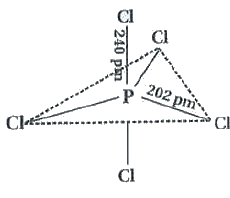
|
|
| 8. |
In passing the electricity through the acidulated H_(2)O , 5.6 dm^(3) of O_(2) liberated at anode . The volume of H_(2) liberated at cathode will be |
|
Answer» `5.6 DM^(3)` |
|
| 9. |
In PCl_5 molecule, P is : |
|
Answer» `sp^3`-hybridised |
|
| 10. |
In para (iv), if NaOH is replaced by an NH_(3) solution, what will the solution D contain? |
|
Answer» `[ZN(NH_(3))_(4)]^(2+)` |
|
| 11. |
In paper chromatography : |
|
Answer» both PHASES are liquids |
|
| 12. |
In P_4O_6 the number of oxygen atoms bonded to each P atom is: |
|
Answer» 1.5 |
|
| 13. |
In P_4O_6 and P_40_10, the numbers of oxygen atoms bonded to each phosphorus atoms are respectively |
Answer» 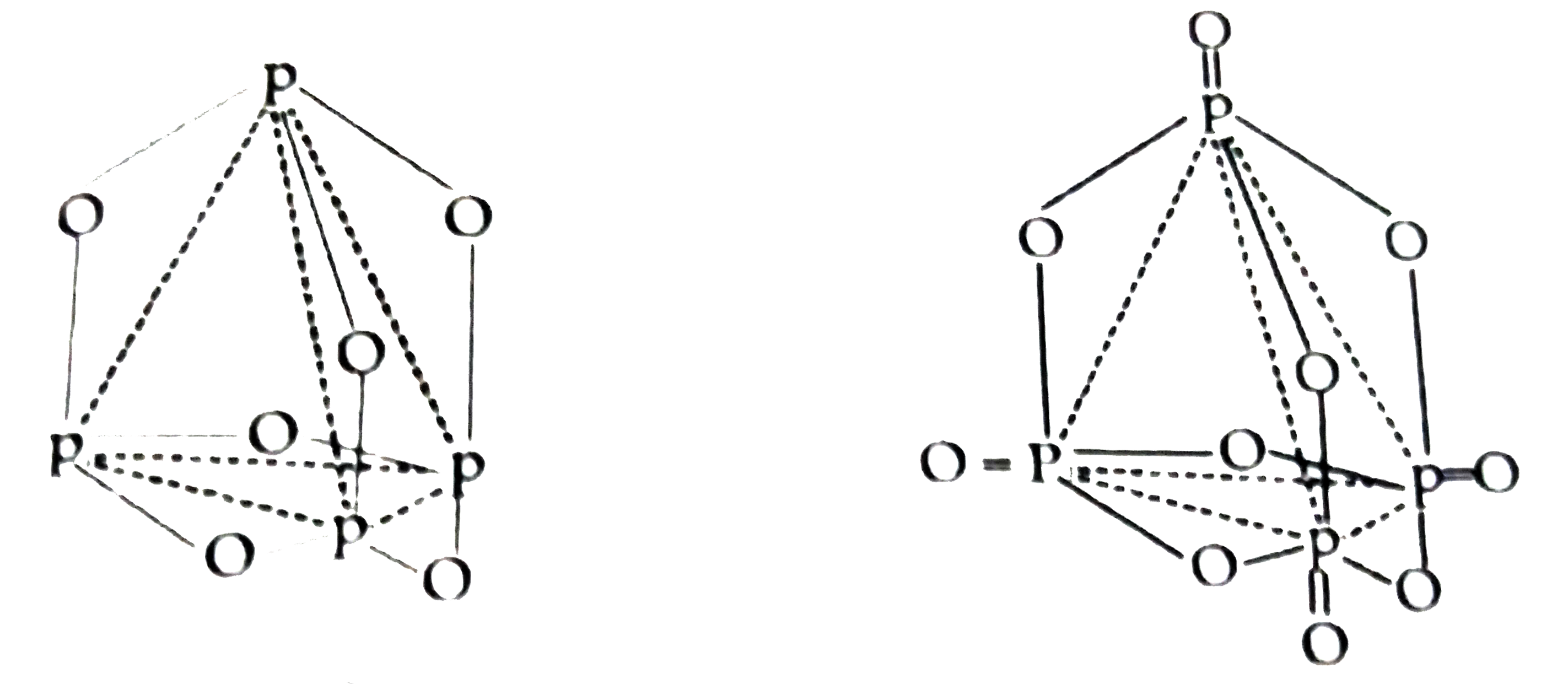 In `P_4O_6` each PHOSPHORUS is linked to THREE oxygen atoms, whereas in `P_4O_10,` each phosphorus atoms. |
|
| 14. |
In P_(4)O_(10) each P atom is linked with ...... O atom |
|
Answer» 2 |
|
| 15. |
In P_4 (tetrahedral) |
|
Answer» Each P is joined to four P  Each P - SI Tetrahedral and `Sp^3` - Hybridised - each P - is Joined to three P Each P - SI Tetrahedral and `Sp^3` - Hybridised - each P - is Joined to three P
|
|
| 16. |
In P versus V graph, the gorizontal line is found in which _______ exists. |
|
Answer» Gas 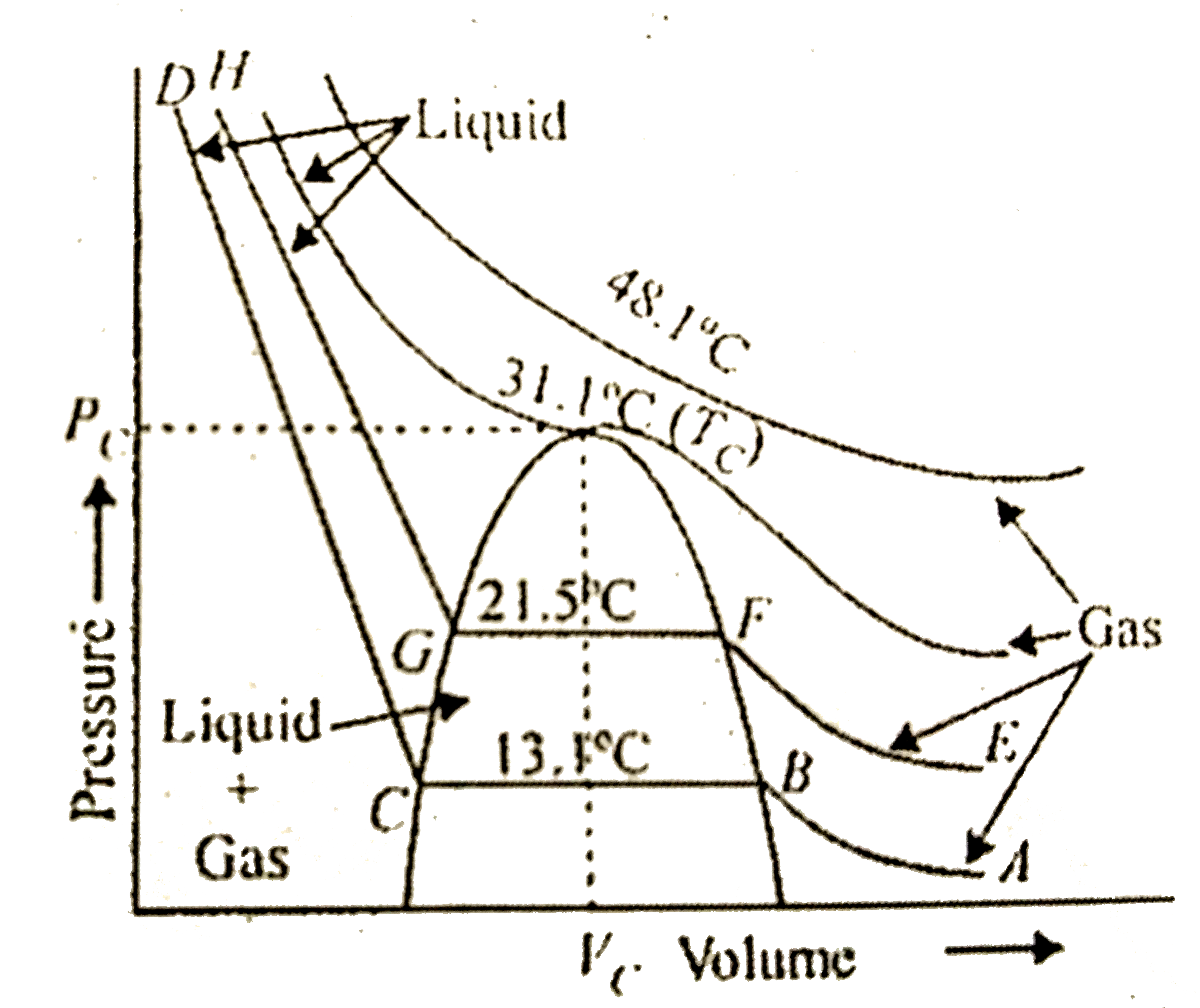 From the graph, at point A, `CO_(2)` exists as a gas, As pressure is INCREASED, the volume of the gas decreases along the CURVE AB. At B liquefaction of the gas starts. Hence, volume decreases rapidly along BC because liquid has much LESS volume than the gas. At point C, liquefaction is complete. Amount of gas decreased = Amount of liquid formed or increased. Because along horizontal line, gas converts into liquid. |
|
| 17. |
In oxidation 1 Hydrogen is displaed form a substance 2 an electropostive element is added to or proportion of electropositive element increases in a substance Select the corrcect answer using the code given below |
|
Answer» 1 and 3 |
|
| 18. |
In oxidisin roasting of Zn, S porducts are |
|
Answer» `ZNO + SO_2` |
|
| 19. |
In Ostwald's process, nitric oxide is prepared by the oxidation of |
| Answer» Answer :1 | |
| 20. |
In Ostwald's dynamic method, the loss in weight in solventbulb is directly proportional to : |
|
Answer» <P>P |
|
| 21. |
In osmosis, there is a net flow of …………..from…………….to………… . |
| Answer» SOLUTION :SOLVENT, solvent, solution | |
| 22. |
In osmosis |
|
Answer» solvent MOLECULES PASS from high concentration of solute to low concentration |
|
| 23. |
In orthorhombic, the values of a,b and c are respectively 4.2 Å and 8.3Å. Giventhe molecular of thesolute of 155 g"mol"^(-1)and density is 3.3 g /cc the number of formula units per unit cell is |
|
Answer» 2 `=(4.2xx8.6xx8.3xx10^(-24)xx6.023xx10^(23)xx3.3)/155=3.84~~4` |
|
| 24. |
In organic reactions, metallic lithium in liquid ammonia behaves as |
|
Answer» oxidising agent |
|
| 25. |
In organic reaction, metallic lithium in liquid ammonia behaves as |
|
Answer» Oxidising agent |
|
| 26. |
In organic layer test, CS_(2) or C CI_(4) is added to Lassaigne's extract and then Cl_(2) water or KMnO_(4) is added. This test is used to distinguish between |
|
Answer» `BR^(-)` and `I^(-)` `2Br^(-)+Cl_(2) to underset("orange")(Br_(2))+2Cl^(-)` `2I^(-)+Cl_(2) to underset("(violet)")(I_(2))+2Cl^(-)` `16H^(o+)+2MnO_(4)^(-)+10Br^(-) to 5Br_(2)+2Mn^(2+)+8H_(2)O` `16H^(o+)+2MnO_(4)^(-)+10I^(-) to 5I_(2)+2Mn^(2+)+8H_(2)O` Here `Cl_(2)` (or) `KMnO_(4)` works as oxidizing AGENT |
|
| 27. |
In organic compounds, nitrogen is tested in Lassaigne's test as |
|
Answer» `NaNH_(2)` |
|
| 28. |
In organic compounds , halogens are estimated by |
|
Answer» Liebig METHOD |
|
| 29. |
In organic compound phosphorus is estimated as : |
|
Answer» MAGNESIUM PYROPHOSPHATE `Mg_2P_2O_7` |
|
| 30. |
Which of the following elements forms oxide easily in air? |
|
Answer» N |
|
| 31. |
In organic compound, phosphorus is estimated as : |
|
Answer» `Mg(NH_(4))PO_(4)` |
|
| 32. |
In order to wash clothes with water containing dissolved calcium hydrogen carbonate.which cleaning agent will you prefer and why : soaps or synthetic detergents ? Give one advantage of soaps over synthetic detergents . |
Answer» Solution :WATER containing calcium HYDROGEN carbonate is hard water. Detergents are preferred over SOAPS for cleaning clothes in hard water because calcium salts of detergents are soluble in water while calcium salts of soaps are INSOLUBLE . As a result, lot of soap is WASTED. 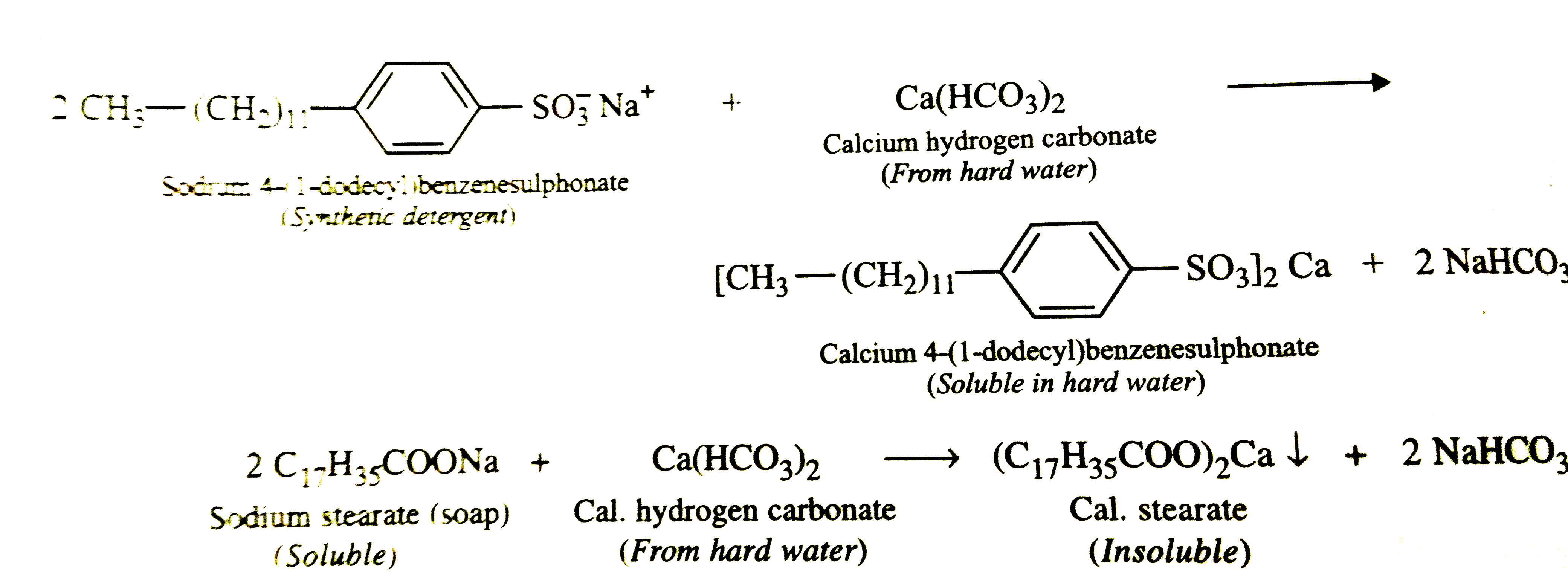
|
|
| 33. |
In organic chemistry the element which is estimated by difference : |
|
Answer» N |
|
| 34. |
In ordinary Cl_2 gas Cl^35 and Cl^37 are in the ratio: |
|
Answer» 1:3 |
|
| 35. |
In order to wash clothes with water containing dissolved calcium hydrogencarbonate, which cleaning agent would you prefer and why: soaps or synthetic detergents ? Give one advantage of soaps over synthetic detergents. |
|
Answer» Solution :Synthetic detergent will be preferred because soaps will FORM scum with WATER containing calcium hydrogencarbonate (hard water). Soaps are BIODEGRADABLE and do not cause water pollution. Detergent MAY not degrade and cause ENVIRONMENTAL problem. |
|
| 36. |
In order to wash clothes with water containing dissolved calcium hydrogen carbonate, which cleaning agent will you prefer and why : soaps or synthetic detergents ? |
| Answer» SOLUTION :Disadvantage of using detergents. SOAPS are biodegradable while detergents having branched HYDROCARBON chains are not biodegradable and hence cause WATER POLLUTION in rivers and other waterways. | |
| 37. |
In order to wash clothes which cleaning agent what will you prefer and why: soap or synthetic detergents? Give one advantage of soaps and synthetic detergents each. |
| Answer» SOLUTION : Soaps have straight hydrocarbon CHAINS and are easily degraded by bacteria PRESENT in the sewage water and hence, do not CAUSE water pollution. Most of the DETERGENTS are non-biodegradable and hence cause water pollution of rivers and waterways. So, one will prefer soap. | |
| 38. |
In order to separate oxygen from one mole of H_(2)O the required quantity of coulomb would be:- |
| Answer» Answer :A | |
| 39. |
In order to synthesise acetophenone from acetyl chloride, we can use : |
|
Answer» WURTZ REACTION |
|
| 40. |
In order to refine "copper" it is melted in a furnace and it is stirred with green logs of wood. The purpose is :- |
|
Answer» to expel the dissolved gases in blister copper |
|
| 41. |
In order to refine blister copper , it melts in a furnance and is stirred with green logs of wood . The purpose is |
|
Answer» to expel the dissoved gases in blister copper `3Cu_(2)O+ underset("From green logs of wood")(CH_(4)) to 6Cu+2H_(2)O+CO` |
|
| 42. |
In order to refine blister copper it is melted in a furnance and is strirred with gree longs of woman the purpose is |
|
Answer» To expel the dissolved gases in the blister |
|
| 43. |
In order to refine blister copper it is melted in a furnace and is stirred with green logs of wood. The purpose is |
|
Answer» to increase the carbon content of copper. |
|
| 44. |
In order to refine "blister copper' it is melted in a furnace and is stirred with green logs of wood. The purpose is _______ |
|
Answer» to EXPEL the dissolved gases in blister copper |
|
| 45. |
In order to prevent the hot metal flament from getting burnt, when the electric current is switched on, the bulb is filled with: |
|
Answer» `CH_4` |
|
| 46. |
In order to refine blister copper it is melted in a furnace and is stirred with green logs of wood. The purpose is: |
|
Answer» To EXPEL the dissolved gases in blister copper |
|
| 47. |
In order to prepare one litre normal solution of KMnO_(4), how many gm of KMnO_(4) are required, if the solution is to be used in acid medium for oxidation |
|
Answer» 158 gm |
|
| 48. |
In order to prepare benzonitrile from C_6H_5N_2CI, the reagent required is |
|
Answer» KCN in presence of ZINC powder |
|
| 49. |
In order to prepare a primary amine from an alkyl halide with simultaneous addition of one CH_2 group in the carbon chain, the reagent used as source of nitrogen is |
|
Answer» Sodium amide (`NaNH_2`) ` R - X underset(-KX ) OVERSET("KCN" )toR -CNoverset(Na//C_2 H_5OH) to R -CH_2 NH_2` |
|
| 50. |
In order to prepare a 1^(@) amine from an alkyl halide with simultaneous addition of one CH_(2)group in the carbon chain, the reagent used as source of nitrogen is….. |
|
Answer» Sodium AMIDE (`NaNH_2`) ` R - X underset(-KX ) overset("KCN" )TOR -CNoverset(Na//C_2 H_5OH) to R -CH_2 NH_2` |
|