

Saved Bookmarks
This section includes 7 InterviewSolutions, each offering curated multiple-choice questions to sharpen your Current Affairs knowledge and support exam preparation. Choose a topic below to get started.
| 1. |
In laboratory, benzene diazonium chloride is not isolated in the crystalline solid state because in solid state it |
|
Answer» EXPLODES |
|
| 2. |
In lab various tests were carried out by student. Following observations made by him is /are correct : |
|
Answer» When ethanol was treated with `I_(2)//NaOH` YELLOW colour appeared. |
|
| 3. |
In lab H_(2)O_(2) solution is |
|
Answer» COLD `H_(2)SO_(4)+BaO_(2)` |
|
| 4. |
In L-Phenyl alanine the amino group lies at |
|
Answer» right SIDE to chiral CENTRE |
|
| 5. |
In kroll and ICI process in the production of titanium, the inert gas used is: |
|
Answer» Ne |
|
| 6. |
In Kolbe's reaction, instead of phenol, the phenoxide is treated with the carbon dioxide. Why ? |
| Answer» Solution :`to` The phenoxide is more reactive than phenol because of greater ability of -O- to donate electron to the benzene RING and THUS the BONDING of `CO_(2)` (weak nucleophile) easier. | |
| 7. |
In Kolbe's reaction, instead of phenol, phenoxide ion is treated with carbon dioxide. Why? |
| Answer» SOLUTION :Due to GREATER ability of `-O^(-)` ion (than OH group) to donate electrons to the BENZENE RING, phenoxide ion is more reactive than phenol towards electrophilic aromatic substitution reactions. In other words, phenoxide ion being a strong nucleophile reacts easily with the weak electrophile carbon dioxide to BRING about the electrophilic substitution reaction. | |
| 8. |
In Koble.s reaction, instead of phenol, phenoxide ion is treated with carbon dioxide. Why? |
| Answer» SOLUTION :Phenoxide ion is more reactive than phenol TOWARDS electrophilic substitution. The negative CHARGE on oxygen is transferred to benzene through resonance. The helps in the attachment of `CO_(2)` which is a weak electrophilie to the benzene ring FINALLY giving salicylic acid. | |
| 9. |
In KMnO_4 titrations the indicator used is |
|
Answer» phenolphthalein |
|
| 10. |
In known interhalogen compounds maximum number of halogen atoms are |
|
Answer» 6 |
|
| 12. |
In KMnO_(4) the crystallographic parameters are |
|
Answer» `alpha=BETA=gammane90^(@)` |
|
| 14. |
In KMnO_(4) molecule the oxidation states of the elements potasiun (K) managenese (Mn) and oxygen (O) are repectively |
|
Answer» Eelctrolytic cell |
|
| 15. |
In Kjeldahl's method,CuSO_(4) acts as |
|
Answer» Oxidising AGENT |
|
| 16. |
In Kjeldahl's method of estimation of nitrogen,K_2SO_4 acts as: |
|
Answer» OXIDISING agent |
|
| 17. |
In kjeldahl's method of estimation of nitrogen, copper sulphate acts as : |
|
Answer» OXIDISING agent |
|
| 18. |
In Kjeldahl's method nitrogen present is quantitatively converted to : |
|
Answer» `NO_2` |
|
| 19. |
In Kjeldahl's method, nitrogen present is estimated as : |
| Answer» Solution :`NH_(3)` | |
| 20. |
In kjeldahl's method ,nitrogen present is estimated as : |
|
Answer» `N_2` |
|
| 21. |
In kjeldahl's method ,nitrogen present in estimated as : |
|
Answer» `N_(2)` |
|
| 22. |
In Kjeldahl's method during digestion, the nitrogen of the organic compound is converted into |
|
Answer» `NH_(4)Cl` (a) , (c ) and (d) are not possible. |
|
| 23. |
In Kjeldahl's method, ammonia from 5g of food neutralizes 30 cm^(3) of 0.1 N acid. The percentage of nitrogen in the food is |
|
Answer» `0.84` `= (1.4 xx 0.1 xx 30)/(5) = 0.84 %` |
|
| 24. |
In Kjeldahl's method, ammonia from 5g of food neutralizes 30cm^(3) of 0.1N acid. The percentage of nitrogen in the food is |
|
Answer» `0.84` `=(1.4xx0.1xx30)/(5)=0.84%` |
|
| 25. |
In Kjeldahl's method 0.12 g of organic substance liberated ammonia. It is absorbed in 40ml of 0.05N acid. Which is neutralised by 27.5 ml of 0.05 N base. Calculate the percentage of nitrogen in the given compound. |
|
Answer» `(NV)_(NH_(3))=2-1.375=0.625(meq NH_(3))` `N%=(1.4(NV))/(W_("ORG"))=(1.4 xx 0.625)/(0.12)=7.3` |
|
| 26. |
In Khcldahl's methofd for the estimation of N_(2), potassium suphate and copper sulphate are used. On the basis of their functions which of the following statement(s) is /are correct? (i). Potassium sulphate raises theb.pt. and ensures complete reaction(ii). Copper sulphate act as Catalyst (iii). Potassium sulphate acts as catalyst and copper sulphate raises the b.pt. |
|
Answer» Only (iii) is CORRECT |
|
| 27. |
In Kipp's apparatus, H_2S is prepared continuously |
|
Answer» by `FeS + HCL` |
|
| 28. |
In keto-enol tautomerism of dicarbonyl compounds, the enol form is preferred in contrast to the keto-form, this is due to |
|
Answer» presence of carbonyl group on each side of ` - CH_(2)` group 
|
|
| 29. |
In K_(2)Cr_(2)O_(7), every Cr is linked to |
|
Answer» TWO O-atoms 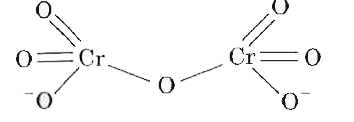
|
|
| 30. |
In IV th groupthe ppt of Mn(OH)_(2) in excessof NaOH , turns brownor bluein airdue to the formation of |
|
Answer» `MnO_(2).xH_(2)O` |
|
| 31. |
In IUPAC system aldehydes are called |
|
Answer» alkanes |
|
| 32. |
In its reaction with silver nitrate acetylene shows |
|
Answer» OXIDISING property |
|
| 33. |
In its reaction with silver-nitrate ,acetylene shows: |
|
Answer» OXIDISING property |
|
| 34. |
In its 0.2 M solution, acid ionies to an extent of 60%. Its hydrogen ion concentration is |
|
Answer» 0.6 M |
|
| 35. |
In isotonic solutions …………………. . |
|
Answer» SOLUTE and SOLVENT both are same |
|
| 36. |
In isotonc solutions |
|
Answer» SOLUTE and SOLVENT both are same. |
|
| 37. |
In isotonic solutions ………… |
|
Answer» Solute and solvent both are same. |
|
| 38. |
Inisomericaminecorrectorderhas lowestB. P |
|
Answer» `1gt 2^(@) GT 3^(@)` `1^(@)`amines= - `NH_(2)`group= 2 activeH - atoms. `2^(@)`amines= ` gt`NHgroup =1 acitveH -atoms. `3^(@)`amines  N group= 0 activeH -atoms. N group= 0 activeH -atoms. HenceB.Porderis `1^(@) gt2^(@)gt3^(@)` |
|
| 39. |
In isothermalideal gas compression : |
|
Answer» `W "is +ve"` |
|
| 40. |
In isothermal expansion of a gas: |
|
Answer» the KINETIC energy of GAS MOLECULES REMAINS same |
|
| 41. |
In isomeric alcohols correct order of boiling point is, |
|
Answer» `2^@` gt`3^@`gt`1^@` |
|
| 42. |
In isoelectronic species, which of the following is correct : |
|
Answer» ZEFF `prop`(+) CHARGE |
|
| 43. |
In iodometric titrations, an oxidizing agent such as KNnO_(4), K_(2)Cr_(2)O_(7),CuSO_(4),H_(2)O_(2) is allowed to react in neutral medium or in acidic medium with excess of potassium iodide to liberate free iodine Kl+ oxidizonagent to l_(2) Free iodine is titrated against stanard reducing agent usually with sodium thiosulphate i.e., K_(2)Cr_(2)O_(7)+6Kl+7H_(2)SO_(4)toCr_(2)(SO_(4))_(3)+4K_(2)SO_(4)+7H_(2)O+l_(2) 2CuSO_(4)+4Kl to Cu_(2)l_(2)+2K_(2)SO_(4)+l_(2) l_(2)+Na_(2)S_(2)O_(3)to 2Nal+Na_(2)S_(4)O_(6) In iodometric titrations, starch solution is used as an indicator. Starch solution gives blue or violet colour with free iodine. At the end point, blue or violet colour disappear when iodine is completely changed to iodide. What volume of 0.40M Na_(2)S_(2)O_(3) would be required to reach with l_(2) liberated by adding 0.04 mole of Kl to 50 mL to 0.20 M CuSO_(4) solution? |
|
Answer» `12.5mL` `0.4xx10^(3)xx1 50xx0.21` `=40 =10` ( limiting REAGENT) `:.` meq.of hypo `=10-Mxx X xxV_(mL)` `=0.4xx2xxv_(mL)=12.5mL` |
|
| 44. |
In ionic crystals______ions adopt ccp or hcp arrangement, while_____ions occupy interstitial sites |
| Answer» SOLUTION :LARGER (ANIONS), SMALLER (CATIONS) | |
| 45. |
In iodometric titration which indicator is used to detect end point of titration reaction? |
|
Answer» Diphenylamine |
|
| 46. |
In interhalogen compounds of the type AB_5 and AB_7 B is invaribly fluorine. Why? |
| Answer» SOLUTION :Being the strongest oxidising agent, fluorine can FORM compounds in +5 and +7 oxidation state. MOREOVER, being the smallest, it can easily fit around A without causing much steric hindrance. | |
| 47. |
In Iodination for preparation of iodomethane compound used is |
| Answer» Answer :3 | |
| 48. |
In insulin molecule there are two chains 'A' and 'B', 'A' contain 'X' - amino acids and 'B' contain 'Y' amino acids. The value of X and Y are |
|
Answer» 21,31 |
|
| 49. |
In industry phenol is prepared from 1. Raschig's method 2. Dow's method 3. Oxidation of cumene 4. Oxidation of hexane |
| Answer» Answer :D | |