

Saved Bookmarks
This section includes 7 InterviewSolutions, each offering curated multiple-choice questions to sharpen your Current Affairs knowledge and support exam preparation. Choose a topic below to get started.
| 1. |
In industry SO_2, is prepared from |
|
Answer» `Na_(2)SO_(3)` |
|
| 2. |
In India thorium deposits are found mainly in the forms of: |
|
Answer» Liqnite |
|
| 3. |
In india steel plants are not located at : |
|
Answer» Jamshedpur |
|
| 4. |
In India. Ethyl alcohol is mainly manufactured by |
|
Answer» DESTRUCTIVE distillation of WOOD |
|
| 5. |
In india iron is obtained from the ore : |
|
Answer» Cassiterite |
|
| 6. |
In india at the occasion of marriages, the fire works used give green flame. Which one of the following radicals may be present |
|
Answer» Na |
|
| 7. |
In India at the occasion of marriages, the fire works are used, which of the following gives green flame? |
|
Answer» BA |
|
| 8. |
In impurestate , phosphineis not combustibledue tothe presence of- |
|
Answer» <P>`P_(2)H_(4)` |
|
| 9. |
In IIIA group , Tl (thallium ) shows +1 oxidation state while other members show +3 oxidationstate. Why |
|
Answer» Presence of lone pair of electron in TL |
|
| 11. |
In III group precipitation NH_(4)CI is added before adding NH_(4)OH due to |
|
Answer» decrease conc. of `OH^(-)` |
|
| 12. |
In ICl_(3) hybridisation of I sp^(x)d^(y)& LP on I is Z then x+y+z |
|
Answer» 5 NO. of lone pairs `=2 :. z = 2 :. x + y + z = 3+1+2 = 6` |
|
| 13. |
In IF_(6)^(-) and TeF_(5)^(-), sum of axial d-orbitals which are used in hybridisation in both species. |
|
Answer» |
|
| 14. |
In [ICl_(2)]^(-) ion, the lone, pairs present in iodine atom are separated at an angle of |
|
Answer» `90^(@)` |
|
| 15. |
In I Cl_(4)^("ϴ"), shape is square planar. The number of bond pair – lone pair repulsion at90^(@) are:- |
|
Answer» 6 |
|
| 16. |
In hypothetical reversible reaction underset((1M))(A)underset(t_(1//2)=2"min")overset(t_(1//2)=6.93"min")(hArr)underset((0.4M))(B) Forward reaction =1st order Backward reaction =0 order What is the rate of disappearance of A at the given moment? |
|
Answer» `r=(-d[A])/(DT)=[(0.1)xx(1)^(1)-(0.1)(0.4)^(@)],r=(0.1-0.1)=0impliesr=0` |
|
| 17. |
In hypobromite reaction of amide, carbonyl carbon atom is lost as : |
|
Answer» CO |
|
| 18. |
In hydrolysis of a salt of weak acid and strong base, the hydrolysis constant (K_a) is equal to |
|
Answer» `K_w/K_b` |
|
| 19. |
In hyper conjugation, the atom involved is: |
|
Answer» `BETA`-H ATOM |
|
| 20. |
In hydrometallurgy of copper, iron scrap is used instead of zinc scrap because ________. |
|
Answer» COST of zinc scrap is comparatively higher than the IRON scrap |
|
| 21. |
In hydrogen fule cell _____________ |
|
Answer» `H_2 and O_2` are consumed in 1:8 mass RATIO |
|
| 22. |
In hydrogen atom, energy of first excited state is -3.4 eV. Then find out the K.E. of the electron in the same orbit of hydrogen atom. |
|
Answer» -1.51eV |
|
| 23. |
In hydrogen atom, energy of first excited state is-3.4eV. TheK.E. of the same orbit of H-atom is |
|
Answer» `+3.4eV` |
|
| 24. |
In hydroboration oxidation of alkene , the initial attack is |
|
Answer» boron |
|
| 25. |
In hydrides of group16 elements, the order of thermal stability of hydrides is ________. |
|
Answer» `H_(2)O GT H_(2)S gt H_(2)Se gt H_(2)Te` |
|
| 26. |
In hydration of alkene first step is |
|
Answer» NUCLEOPHILIC attack of water on CARBOCATION |
|
| 27. |
In human beings and animals, the oils and fats are hydrolysed by the enzyme: |
|
Answer» Diastase |
|
| 28. |
Oils and fats are : |
|
Answer» Diastase |
|
| 29. |
In human body enzymes hydrolyse protein into: |
|
Answer» A KETOGENIC AIDS like `CH_3COCOOH` |
|
| 30. |
In how many ways among the following given, a nuicleus with high n/p ratio is expected to decay alpha-decay,beta-decay, positron decay,K-electron capture. |
|
Answer» `""_(0)n""^(1)to""_(1)H""^(1)+""_(-1)E""^(0)` |
|
| 31. |
In how many reactions CO_(2) gas is released out after reaction with NaHCO_(3) (1) CH_(3)-underset(O)underset(||)overset(O)overset(||)(S)-O-H+NaHCO_(3) rarr (2) CH_(3)-underset(O)underset(||)(C)-O-H+NaHCO_(3) rarr CH_(3)-CH_(2)-OH+NaHCO_(3) rarr (5) CH_(3)-C-=C-H+NaHCO_(3) rarr |
|
Answer» (2) `CH_(3)-underset(O)underset(||)(C )-O-H+NaHCO_(3) rarrCH_(3)-underset(O)underset(||)(C)-overset(Θ)(O)-overset(o+)(Na)+H_(2)O+CO_(2)uarr` 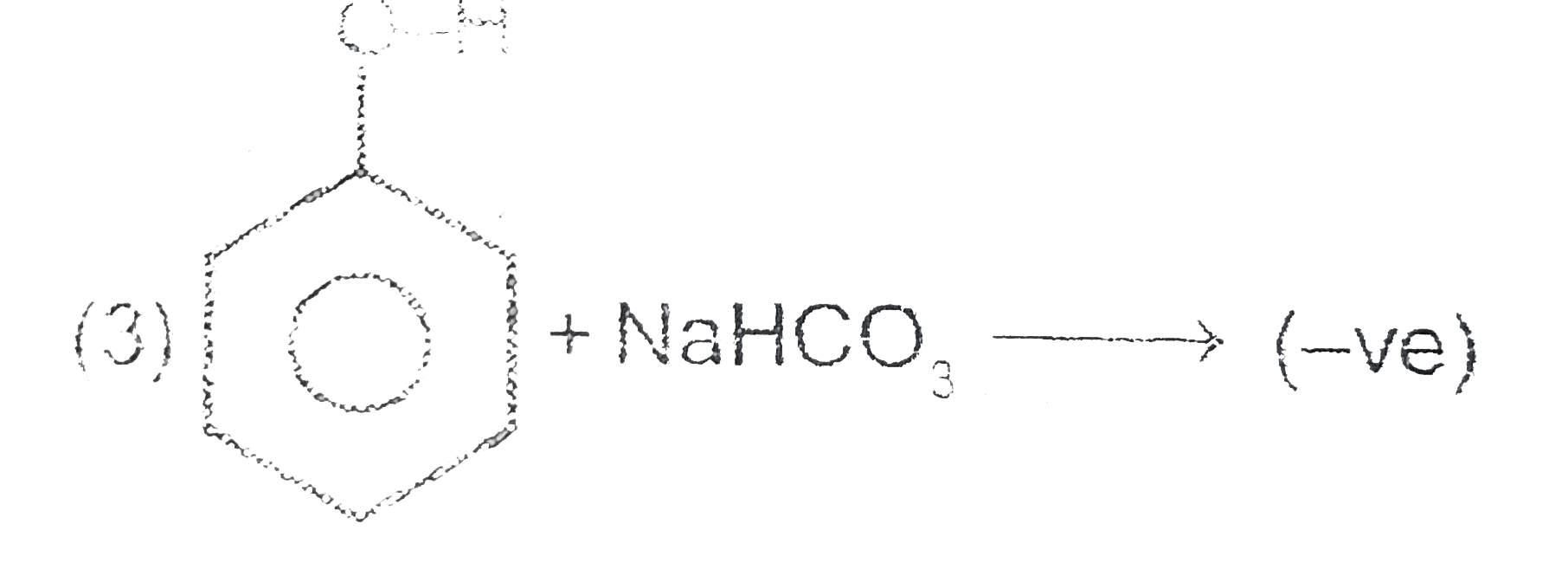 , , (4) `CH_(3)-CH_(2)-OH+NaHCO_(3) rarr (-ve)` (5) `CH_(3)-C-=C-H+NaHCO_(3) rarr (-ve)` |
|
| 32. |
In how many way among the following , a nucleus with high n/p ratio is expected to decay alpha- decay , beta- decay , positron decay , electron capture . |
|
Answer» |
|
| 33. |
In how many total number of compound central atom 'X' has only 3 xoidation state : Hypophosphorous acid, Isohypophospheric acid, Dithionous acid, Phosphorous acid. Sodium trimeta borate, Chlorous acid, Nitrous acid. |
|
Answer» |
|
| 35. |
In how many of the following, the second element has a higher density than the first one? (1) Ag,Au , (2) Hf, Zr , (3) Zn, Hg (4) Na, Cu , (5) Ca,Co , (6) Ta, Nb |
|
Answer» |
|
| 36. |
In how many of the followingreactions, one of the products is obtained as a yellowprecipitate ? {:(Ba^(2+)+CrO_(4)^(2-),rarr,"Product"),(Hg^(2+)+Co^(2+)+SCN^(Θ),rarr,"Product"),(NH_(4)^(o+)+[PtCl_(6)]^(2-),rarr,"Product"),(Ag^(o+)+CrO_(4)^(2-),rarr,"Product"),(NH_(4)^(o+)+[Co(NO_(2))_(6)]^(3-),rarr,"Product"):} |
|
Answer» ii. `Hg^(2+) + Cu^(2+)+4SCN^(THETA) rarr underset("deep blue pptcobalt tetetrucystals mecotue"(II))(Co(Hg(SCN)_(4)])` III. `NH_(6)^(oplus) + [PbCI_(6)]^(2+) rarr underset(yellow ppt)(NH_(4)[Pt^(v)CI_(6)])` |
|
| 37. |
In how many of the followingreactions, one of the products is obtained is a black precipitate ? i.Bi(OH)_(3)darr+[Sn(OH)_(4)]^(2-)._((aq))rarr Products ii.Bi^(3+) ._((aq)) + I^(Θ) ._((aq)) (not in excess) rarr Producets iii. Ag^(o+) ._((aq)) + H_(2)S_((g)) overset(H^(o+)) toProducets iv.[BiI_(4)]^(Θ)._((aq)) + H_(2)O_((I)) overset("Dilution") toProducts |
Answer» 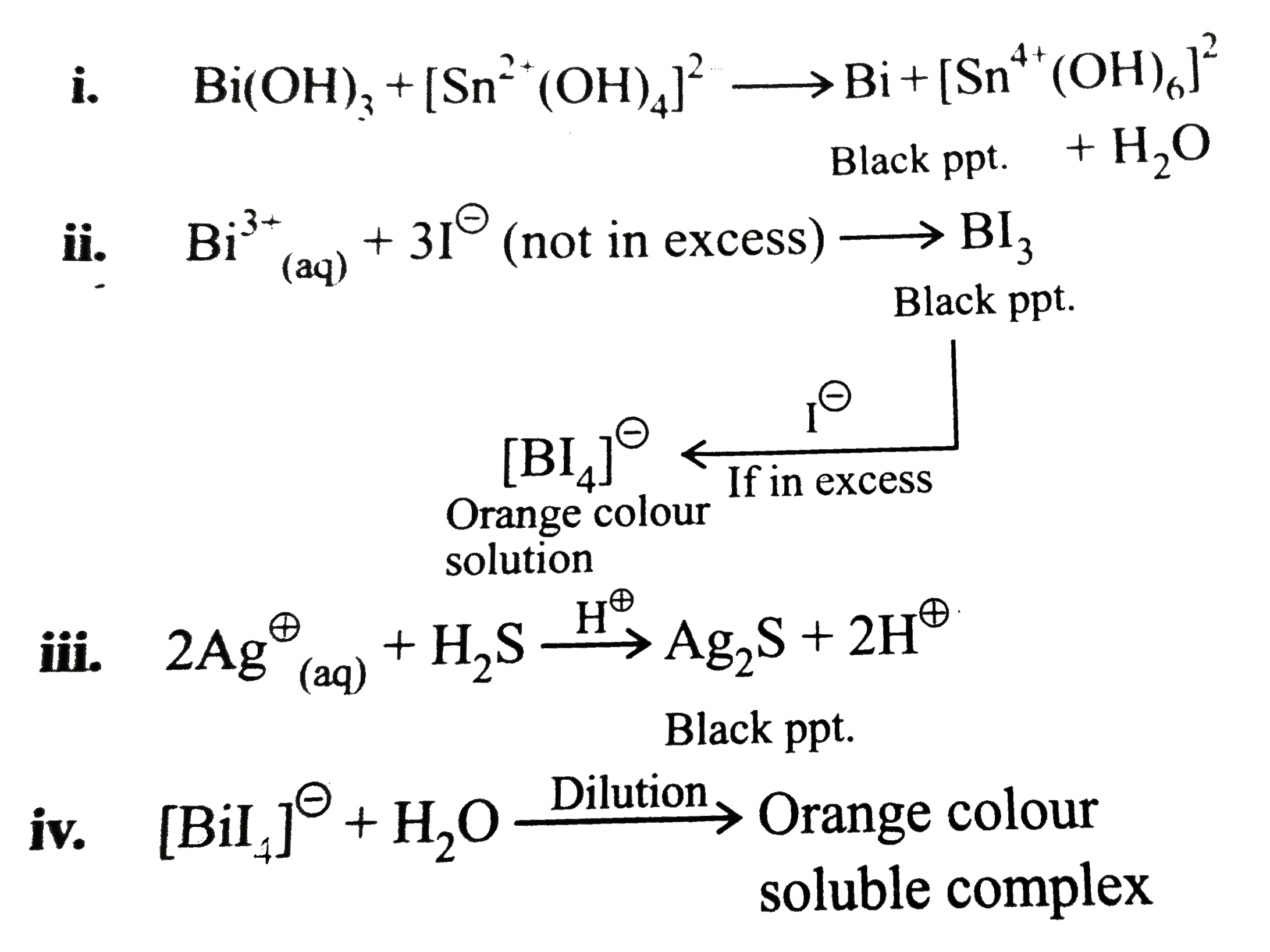
|
|
| 38. |
In how many of the following reactions one of the products is obtained as a black precipitate ? (i)Bi(OH)_3 darr +[Sn(OH)_4]^(2-)(aq)toProducts (ii)Bi^(3+)(aq)+I^(-)(aq)("not in excess")toProducts (iii)Bi^(3+)(aq)+H_2S(g)overset(H^+)toProducts (iv)[Bil_4]^(-)(aq)+H_2O(l)overset("dilution")toProducts (v)Bi^(3+)(aq)+C_9H_7ON(5%)+H^(+)(aq)+I^(-)(6M)to Products (vi)Bi^(3+)(aq)+C_6H_3(OH)_3(10%)toProducts (vii)BiO. OH darr + H_2O_2(aq)to Products |
|
Answer» (ii)`Bi^(3+)(aq)+3I^(-)(aq)("not in excess")to Bil_3`(black) (iii)`2Bi^(3+)(aq)+3H_2S(g)overset(H^+)toBi_2S_3darr`(black)+`6H^(+)` (iv)`[Bil_4]^(-)(aq)+H_2O(l)overset("dilution")toBil_3darr`(black)+`I^(-)` (V)`Bi^(3+)(aq)+C_9H_7ON(5%)+H^(+)(aq)+4l^(-)(6M)toC_9H_7ON.HBil_4darr("red")` (vi)`Bi^(3+)(aq)+C_6H_3(OH)_3(10%)toBi(C_6H_3O_3)darr("YELLOW")+3H^(+)` (vii)`BiO. OHdarr+H_2O_2(aq)toBiO_3^(-)("yellowish-brown")+H^(+)+H_2O` |
|
| 39. |
For which of the following reactions, DeltaH is equal to DeltaU ? |
|
Answer» ` N_2(G) +3H_2(g) to 2NH_3(g) ` |
|
| 40. |
In how many of the following compounds of sulphur, there is S-S bond (only single bond not double bond between two sulphur atoms.) H_2S_2O_4, H_2S_2O_3, H_2S_2O_5, H_2S_2O_6, H_2S_2O_7, H_2S_2O_8, S_2Cl_2, "cyclic"(SO_3)_3. |
Answer» 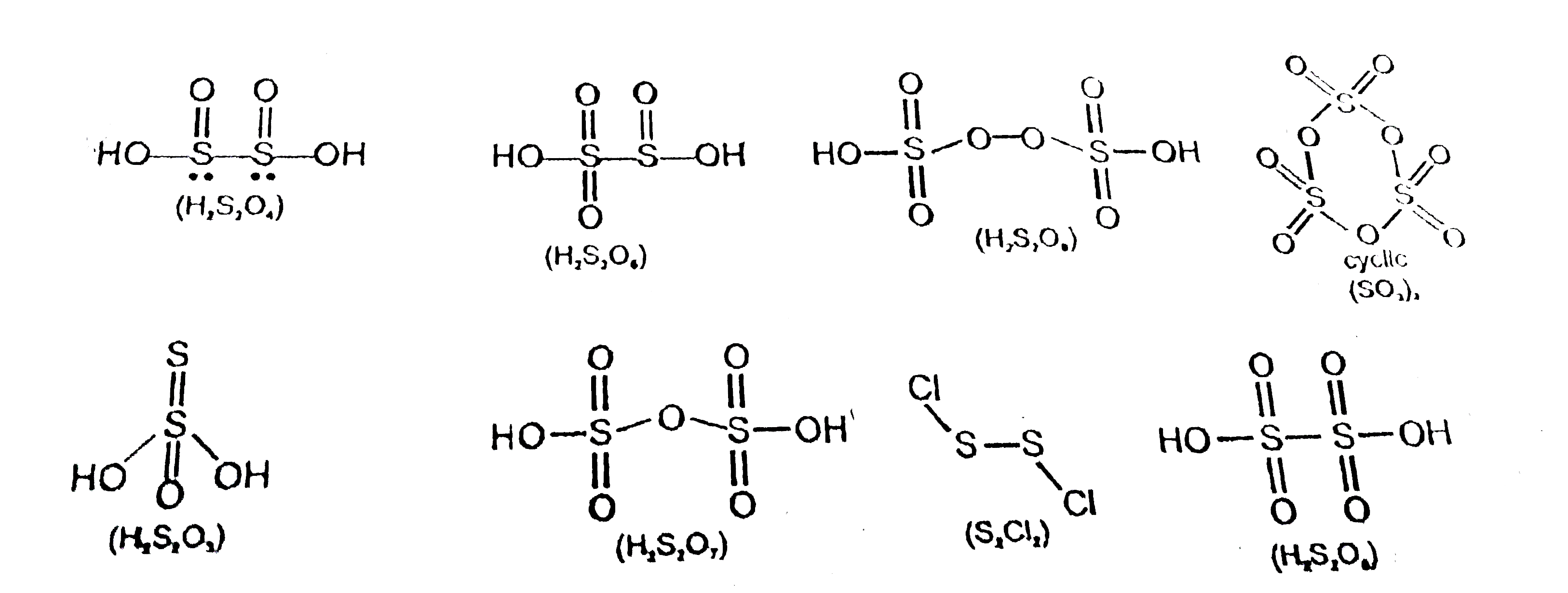
|
|
| 41. |
In how many of the following compounds 'd' orbital (which contains no nodal plane) is used in hybridisation of central atom/ion ? Fe(CO)_(5),""MnO_(4)^(-),""Co(C_(2)O_(4))_(3)^(-3), NiCl_(2)(PPh_(3))_(2),""PtCl_(4)^(2-),""Ni(CN)_(4)^(-2), Ni(CN)_(4)^(-4) |
|
Answer» |
|
| 42. |
In how many of the following compound of sulphur, there is S-S bond (only single bond not double bond between two sulphur atoms). H_2S_2O_4, H_2S_2O_3, H_2S_2O_5, H_2S_2O_6, H_2S_2O_7, H_2S_2O_8, S_2Cl_2, "cyclic"(SO_3)_3 |
Answer» 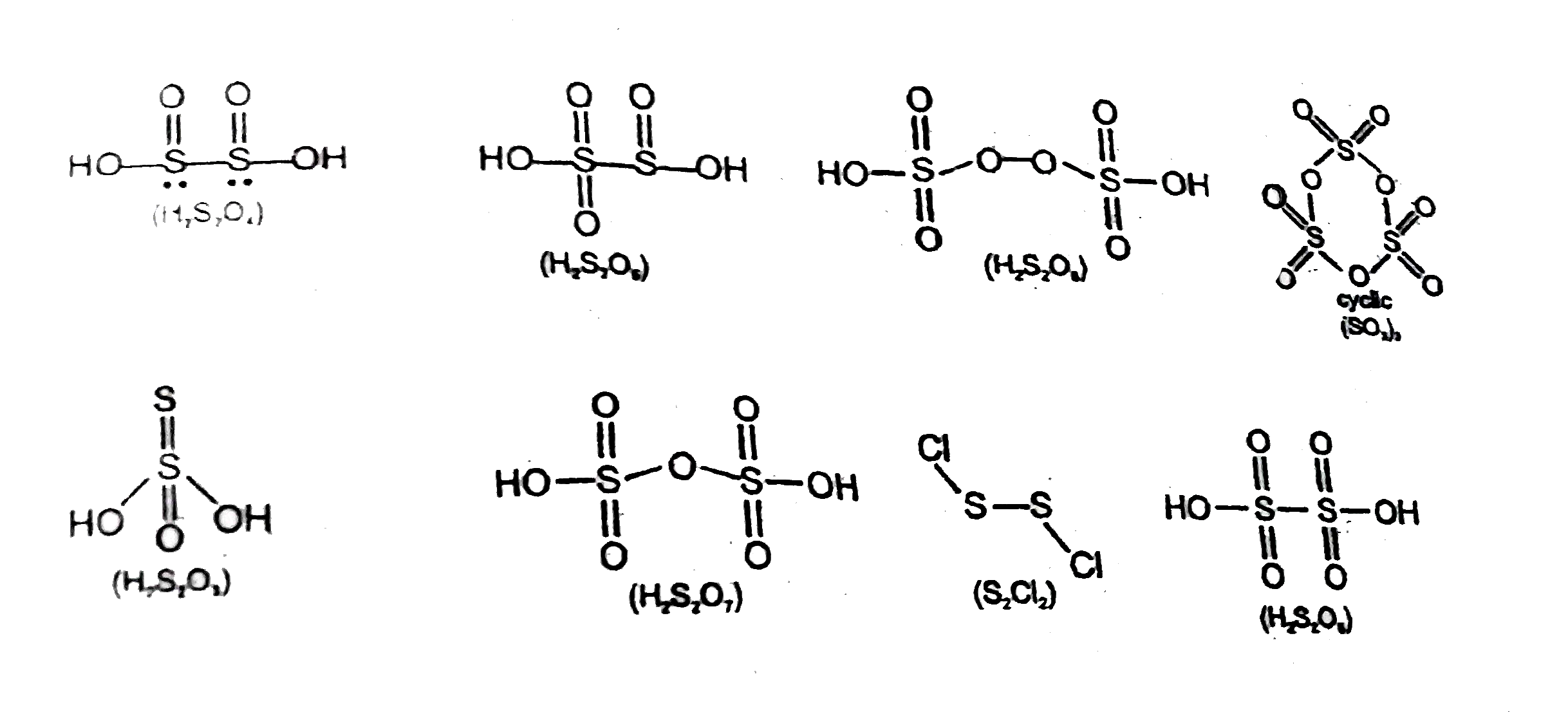
|
|
| 43. |
In how many of the following compound secondary suffix name is used as carboxylic acid ? |
|
Answer» |
|
| 44. |
In how many of the following complex ions, the central metal ions use (n-1)d, ns and np orbitals for hybridisation ? [Mn(CN)_6]^(4-), [Ni(NH_3)_6]^(3-), [Co( o x)_3]^(3-), [Cu(NO_2)_6]^(4-), [AgF_4]^(-), [Ni(CN)_4]^(2-), [PdCl_4]^(2-), [PdCl_4]^(2-), [Pd(CN)_4]^(2-),[Co(SCN)_4]^(2-) |
|
Answer» `[Ni(NH_3)_6]^(2+)-3d^(8),SP^(3)d^2,+2` oxidation state `[CO(o x)_3]^(3-)-3d^(6),d^2sp^(3),+3` oxidation state `[Cu(NO_2)_6]^(4-)-3d^(9),sp^(3)d^2,+2` oxidation state `[AgF_4]^(-)-4d^(8),dsp^(2),+3` oxidation state `[Ni(CN)_4]^(2-)-3d^(8),dsp^(2),+2` oxidation state `[PbCl_4]^(2-)-4d^(8),dsp^(2-),+2` oxidation state `[Pb(CN)_4]^(2-)-4d^(8),dsp^(2-),+2` oxidation state `[Co(SCN)_4]^(2-)-3d^(7),sp^(3-),+2` oxidation state |
|
| 45. |
In how many litres of water, 10 g of CH_3COOHshould be dissolved to give [H] = 10^(-3)? K_a(CH_3COOH) = 1.8 xx 10^(-5)? |
| Answer» SOLUTION :3.0 LITRES | |
| 46. |
In how many compounds delocatisation of electrons is possible ? |
|
Answer» |
|
| 47. |
In how many following species , the central atoms have two lone pairs of electrons ? {:(XeF_4,XeF_5^-,F_2SeO_2),(XeF_3^(+),XeOF_4,CIOF_3),(ICl_4^(-), SCl_2, OSF_4):} |
Answer» 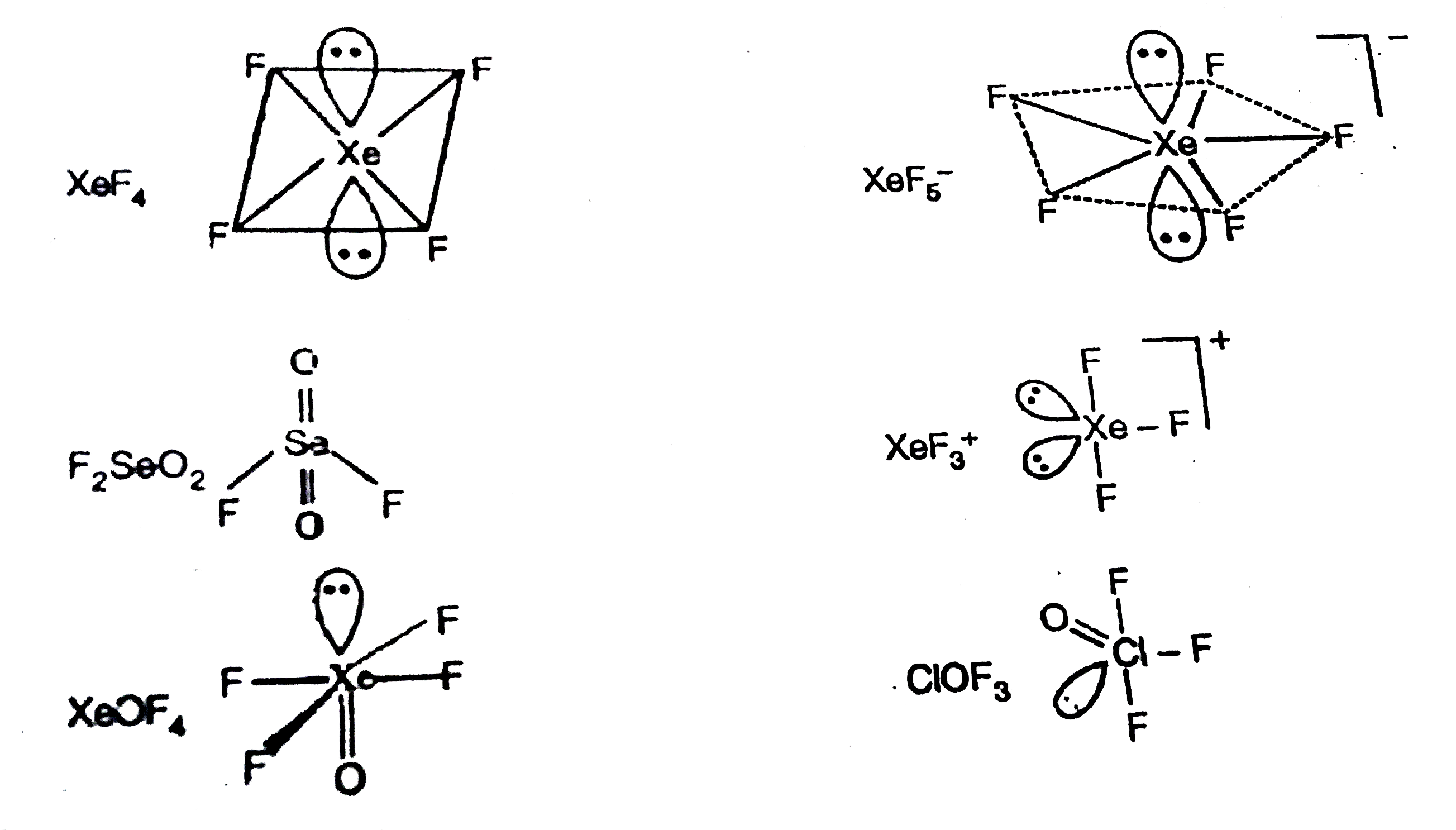 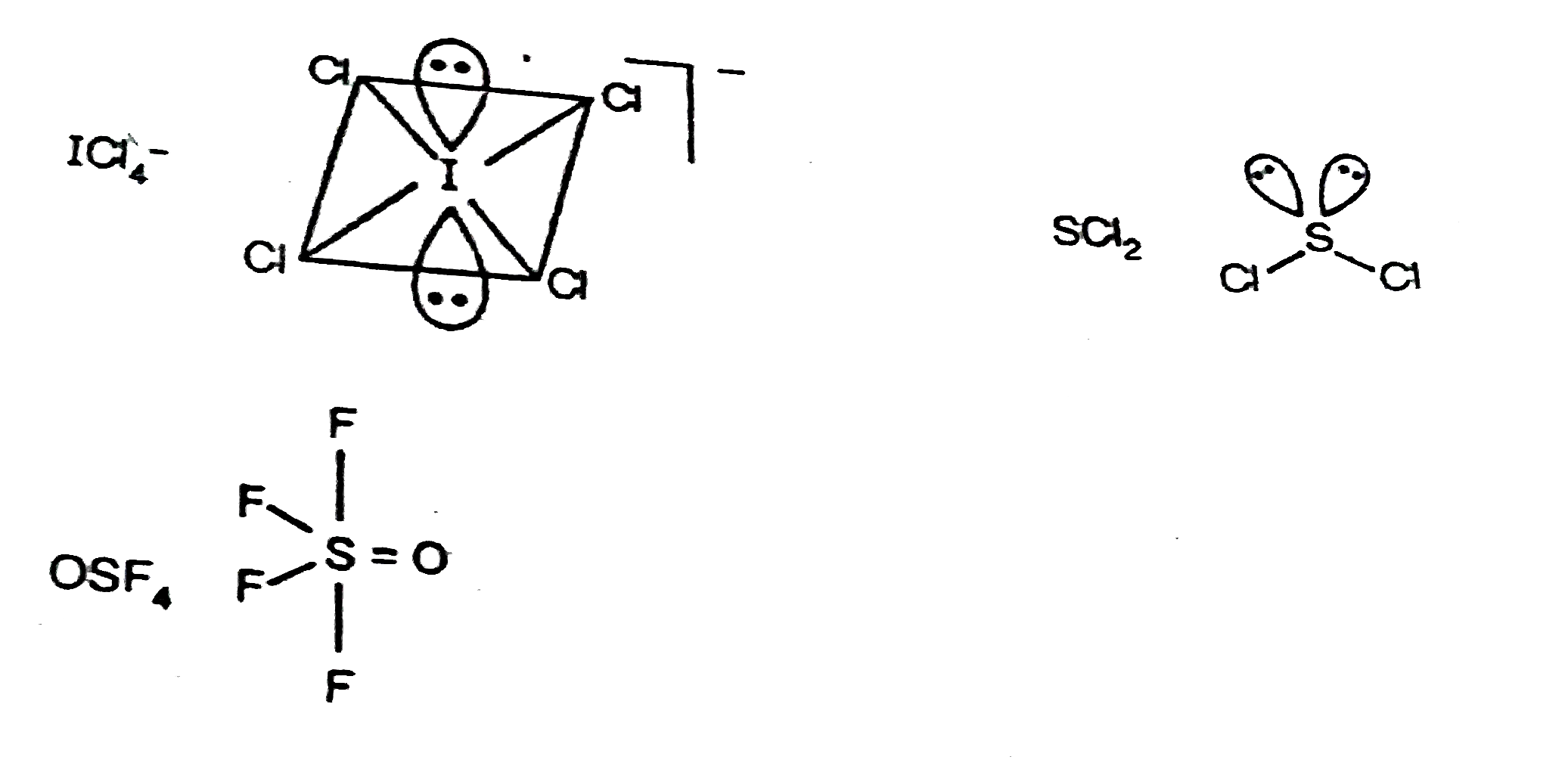
|
|
| 48. |
In hot water Bleaching powder does not given |
|
Answer» `CA^(2+)` ions |
|
| 49. |
In homogeneous catalytic reactions, the rate of reaction: |
|
Answer» DEPENDS UPON the concentration of CATALYST |
|