Saved Bookmarks
This section includes 7 InterviewSolutions, each offering curated multiple-choice questions to sharpen your Current Affairs knowledge and support exam preparation. Choose a topic below to get started.
| 1. |
In an experiment,4 g of M_(2)O_(x) oxide was reduced to 2.8 g of the metal. If the atomic mass of the metal is 56gmol^(-1), the number of O atoms oxide is |
|
Answer» 1 i.e. `(2xx56+16x)g M_(2)O_(x)" gives M"=2xx56g` `= 112g` `therefore 4g M_(2)O_(3)" will GIVE"=(112)/(112+16x)xx6g` `therefore""(112xx4)/(112+16x)=28` i.e., `448=2.87(112+16x)` or `112+16x=160"or"x=3.` |
|
| 2. |
In an ________external source of voltage is used to bring above a chemical change. |
| Answer» SOLUTION :electrolytical CELL | |
| 3. |
In an experiment to measure the charge on an electron, the following values ofcharge were found on oil droplets: -1.6 xx 10^(-15), -2.4 xx 10^(-19),-4.0 xx 10^(-19)(in coulomb). What values of electronic charge would be indicated by these results? |
|
Answer» Solution :FIND the largest common factor. `-0.8 XX 10^(-19)C ` |
|
| 4. |
In an experiment, the following four gases were produced. 11.2L of which two gases at STP will weigh 14g? |
|
Answer» |
|
| 5. |
In an experiment of 0.04F was passed through 400 ml of 1 M solution of NaCl. What would be the pH of the solution after the electrolysis? |
|
Answer» 8 400 ml of 1 M NaCl solution contains NaCl `=(1)/(1000)xx100mol=0.4mol` As `Na^(+)+e^(-)toNa overset(H_(2)O)toNaOH+(1)/(2)H_(2)` 1 F produces 1 MOL of NaOH `therefore0.04F` produces NaOH=0.04 mol Thus, 400 ml of the solution now contain 0.04 mol of NaOH `therefore`Molar concentration of NaOH SOL. `=(0.04)/(400)xx1000=0.1M` `[OH^(-)]=0.1M[H^(+)]=10^(-13)MthereforepH=13` |
|
| 6. |
In an experiment during the analysis of a carbon compound , 145 I of H_(2) was collected at 760 mm Hg pressure and 27^(@)C temperature. The mass of H_(2) is nearly |
|
Answer» 10g |
|
| 7. |
In an experiment addition of 10ml of 0.05 M BaCl_2 to 20ml of As_2S_3 sol causes coagulation in 1 hr. If the coagulation value of Ba^(+2) ion is x^2 then x = ___? |
|
Answer» `20 rarr 5 xx 10^(-4) , 1000 to ?` `0.025 " mole"` = 25 milimole = `X^2 , x = 5` |
|
| 8. |
In an experiment addition of 4.0 mL of 0.005 M BaCl_(2) to 16.0 mL of arsenius sulphide sol just causes complete coagulation in 2 hrs. The flocculating value of the effertive ion is |
|
Answer» `CI^(-)` 1.0 Flocculating value = minimum millimoles of the effective ion PER litre of sol `= (4 xx 0.005)/((4+16)xx 10^(-3))` |
|
| 9. |
In an experiment, addition of 4.0 mL of 0.0005 MBaCI_(2)to 16.0 mL of arseniussol justcauses complete coagulationin 2hrs. The flocculatingvalueof the effective ion is |
|
Answer» `CI^(-), 1.0` Flocculating value = minimum millimolesof the effectiveion perlitre of sol `= (4 xx 0.005)/( (4+16) xx 10^(-3)) = 1.0` |
|
| 10. |
In an experiment, 500ml of 0.5M hydrated oxalic acid is shaken with 5g of activated charocal and filtered. The conc. of filtrate is 0.4 M. If the extent of adsorption (x/m) is 1.26 xx 10^(-x) then x = __? |
|
Answer» adsorbed `31.5 = 25.2 5 GR to 6.3 1 to ? 1.26`. |
|
| 11. |
In an experiment, 2.4 g of iron oxide on reduction with hydrogen yield 1.68 g of iron. In another experiment. 2.9 g of iron oxide give 2.03 g of iron on reduction with hydrogen show that the above data illustrate the law of constant proportions. |
|
Answer» Solution :In the first experiment The mass of IRON OXIDE =2.4g The mass of iron after reduction =1.68g The mass of oxygen =Mass of iron oxide-Mass of iron `=(2.4-1.68)=0.72g` RATIO of oxygen and iron `=0.72:1.68=1:2.33` In the second experiment The mass of iron oxide =2.9g The mass of iron after reduction =2.03 g The mass of oxygen `=(2.9-2.03)=0.87g` Ratio of oxygen and iron =`0.87:2.03=1:2.33` Thus, the DATA illustrate the law of constant proportions, as in both the experiments the ratio of oxygen and iron is the same. |
|
| 12. |
In an experiment, 35 mL of a gas was collected at 23^@ C and 720 mm pressure. Find its volume at NTP. |
|
Answer» |
|
| 13. |
In an experiment, 2.4 g of iron oxide on iron. In another experiment, 2.9 g of iron oxide gave 2.09 g of iron on reduction. Which law is ilustrated from the above data? |
|
Answer» LAW of CONSTANT proportions |
|
| 14. |
Inan experiment , 1804 gof mannitolweredissolvedin 100 g of water . The vapour pressureof waterwaslowered by 0.309 mm Hgfrom 17.535 mm Hg. Calculate the molarmass ofmannitol . |
|
Answer» Mass of a solvent(water) `=W_(1) =100g` Vapourpressureof a solvent (water) `=P_(o)=17.535 mm HG` Lowering ofvapourpressure `=Delta P= 0.309 g mm Hg` Molarmass ofof `H_(2) O = M_(1) =18 g mol^(-1)` Molarmass ofsolute (mannitol) = ? `(P_(o)-P)/(P_(o)) = (W_(2) XX M_(1))/(W_(1) xx M_(2))` `:' P_(o)- P= DeltaP` `(DeltaP)/(P_(o)) = (W_(2) xx M_(1))/(W_(2) xx M_(2))` `:. M_(2) = (P_(o))/(DeltaP) xx (W_(2) xx M_(1))/(W_(1))` `= (17. 535 xx 18.04 xx 18)/(0.309 xx 100)` `= 184 . 3 g "mol"^(-1)` |
|
| 15. |
In an experiment, 10 litre of air at 1 atmospheric pressure and 27^(@) Cwerepassed through an alkaline Kl Solution : At the end , the iodine entrapped in a solution reacted with 1.5 ml of 0.01 NNa_(2)S_(2)O_(3) Solution: Calculate the %volume of O_(3) in the sample . |
|
Answer» |
|
| 16. |
In an experiment , 1.0g CaCO_(3) on heating evolved 224 mL of CO_(2) at NTP. What mass of CaO (calcium oxide) is formed? |
|
Answer» |
|
| 17. |
In an experiment, 0.04 F was passed through 400 mL of a 1M solution of NaCl. What would be the pH of the solution after the electrolysis ? |
|
Answer» 8 NUMBER of equivalents of NaOH formed = 0.04 NORMALITY, `N = (0.04 XX 1000)/(400) = 0.1` `[HO^(-)] = 0.1 M` `pOH = "" :. pH = 13` |
|
| 18. |
In an exothermic reaction, high yield of the product is obtained at |
|
Answer» High TEMPERATURE |
|
| 19. |
In an exothermic reaction ( H_(r) = enthalpy of reactants and H_(p) = enthalpy of products ) |
|
Answer» <P>`H_(r) LT H_(p)` |
|
| 20. |
In an exothermic reaction DeltaH is |
|
Answer» POSITIVE |
|
| 21. |
In an estimation of sulphur by Carius method, 0.160g of the substance gave 0.466g of barium sulphate. The percentage of sulphur in the compound is[At mass of Ba=137, S=32, O=16] : |
|
Answer» `25.0%` `233g` of `BaSO_(4)` CONTAIN SULPHUR `=32G` `0.466g` of `BaSO_(4)` contain sulphur `=(32)/(233)xx0.466=0.064` `%` Sulphur `=(0.064)/(0.160)xx100=40%` |
|
| 22. |
In an equilibrium reaction for which DeltaG=0, the equlibrium constant K = |
|
Answer» Solution :`If DeltaG^(@)=0` `logK_(p)=0""(becauselog1=0)` `K_(p)=1.` |
|
| 23. |
In an equilibrium reaction if DeltaG^o = 0 the equilibrium constant, K should be equal to: |
|
Answer» ZERO |
|
| 24. |
In an endothermic reaction, the value of DeltaH is |
|
Answer» zero So,`DeltaH=E_(P)-E_(R)=+ve` |
|
| 25. |
In an electrolytic cell , one litre of a 1 M aqueous solution of MnO_(4)^(-) is reduced at the cathode . The quantity of electricity required so that the final solution of 0.1 MnO_(4)^(2-) will be |
| Answer» SOLUTION :It is a fact | |
| 26. |
In an electrolytic cell the anode and cathode are respectively represented as : |
|
Answer» POSITIVE ELECTRODE , NEGATIVE electrode |
|
| 27. |
In an electrolytic cell of Ag|AgNO_3|AgNO_3|Ag,when current is passed the concetration of AgNO_3 |
|
Answer» Increases |
|
| 28. |
In an electrolysis process, 10 electrons could deposit x kg of a univalent metal M. The atomic weight of M is (N is Avogadro constant.) |
| Answer» Answer :C | |
| 29. |
In an electrolytic cell current flows : |
|
Answer» From CATHODE to ANODE in OUTER circuit |
|
| 30. |
In an electrolysis experiment, current was passed for 5 hour through two cells connected in series. The first cell contains a solution of gold and second contains CuSO_(4) solutions. 9.85 g of gold was deposited in the first cell. If the oxidation number of gold is +3, find the amount of Cu deposited on the cathode of the second cell. Aso calculate the magnitude of the current in ampere. (If = 96500 coulomb) (Au = 197, Zn = 65.4) |
| Answer» SOLUTION :4.765 G, 0.8037 AMP | |
| 31. |
In an electrolchemical cell |
|
Answer» POTENTIAL ENERGY changes into KINETIC energy |
|
| 32. |
In an electrode reaction , no electrode potential is developed when |
|
Answer» solution pressure is LESS than osmotic pressure |
|
| 33. |
In an electrochemical process, a salt bridge is used |
|
Answer» to MAINTAIN electroneutrally is each solution |
|
| 34. |
In an electrochemical cell, the wrong statement is |
|
Answer» electrons MOVE from cathode to anode. |
|
| 35. |
In an electrochemical cell, if E is the e.m.f. of the cell involving n mole of electrons, then Delta G^(@) is : |
|
Answer» `Delta G^(THETA) = nFE^(theta)` |
|
| 36. |
In an electrochemical cell ,the electrons flow: |
|
Answer» From CATHODE to ANODE |
|
| 37. |
In an electrical field , the particles of a colloidal system move towardscathode . The coagulation of the same sol is studied using K_2SO_4 (i) , Na_3PO_4 (ii) , K_4[Fe(CN)_6] (iii) and NaCl (iv) . Their coagulation power should be ............... |
|
Answer» `II GT I gt IV gt III` |
|
| 38. |
In an electrical field, the particles of a colloidal system move towards cathode. The coagulation of the same sol is studied using K_2SO_4 (i), Na_3 PO_4 (ii), K_4[Fe(CN)_6] (iii) and NaCl (iv) Their coagulating power should be |
|
Answer» II GT I gt IV gt III |
|
| 39. |
In an attempt to prepare ferric hydroxide sol by adding small amount of ferric chloride to water, one person got a precipitate of ferric hydroxide. How can you help him to convert Fe(OH)_3 precipitate to Fe(OH)_3 sol? |
|
Answer» |
|
| 40. |
in an atomic orbital the sign of lobes indicate the |
|
Answer» SIGN of PROBABILITY distribution |
|
| 41. |
In an atom,the signs of lobes indicate the |
|
Answer» SIGN of charges |
|
| 42. |
In an atom the total number of electrons having quantum number n=4, |m_(e )|=1 and m_(s)= - (1)/(2) is…. |
|
Answer» |
|
| 43. |
In an atom, the maximum number of electron having quantum number n-3,-1lem_(l)le1 and m_(s)=+(1)/(2) |
Answer» SOLUTION :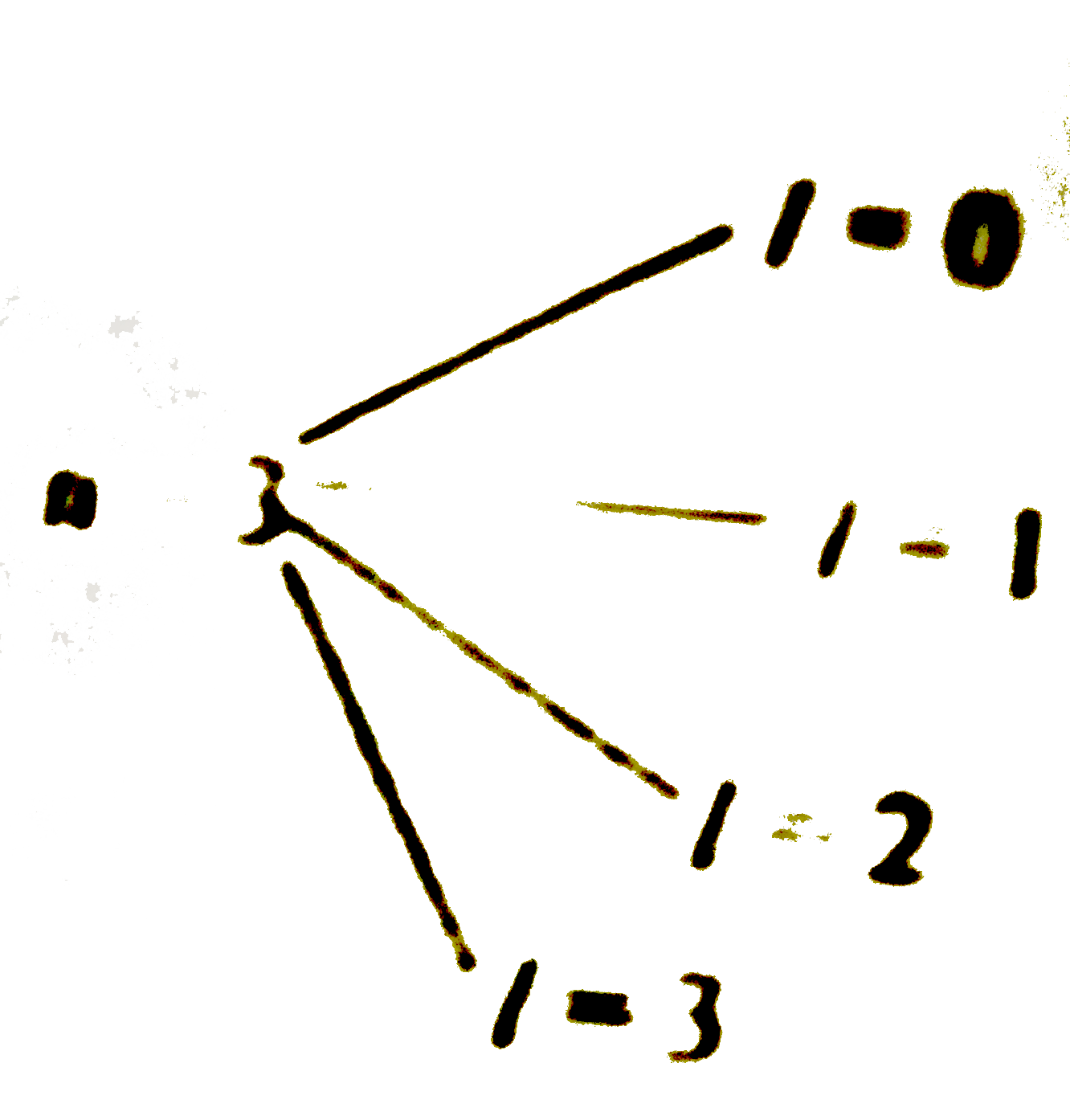 TOTAL orbitals =1+3+3+=6+1=7 Total electron with `m_(s)=+(1)/(2)=6+1=7` |
|
| 44. |
In an atom no two electrons can have the same value for all the quantum numbers. This was proposed by: |
|
Answer» Hund |
|
| 45. |
In an atom, an electron is moving with a speed of 6200 m/s which the position of an electron can be locates is (h=6.6xx10^(-34)kgm^(2)s^(-1), mass of electron e_(m)=9.1xx10^(-31)kg) |
|
Answer» `1.52xx10^(-4)m` `Delta X xx mDeltav=h/(4pi)` `Deltax=h/(4pi mDeltav)=(6.6xx10^(-34))/(4xx3.14xx9.1xx10^(-31)xx6.03)` `=1.92xx10^(-3)m` |
|
| 46. |
In an atom, an electron is moving with a speed of 600 m/s with an accuracy of 0.005%. Certainty with which the position of the electron can be located is, (h=6.6xx10^(-34)kgm^(2)s^(-1),m_(e)=9.1xx10^(-31)kg) |
|
Answer» `1.52xx10^(-4)m` |
|
| 47. |
In an arrangement of type ABABA .... identical atoms of first layer ( A ) and third layer ( A ) are joined by a line passing through their centers . Identify the correct statement . |
|
Answer» No void is found on the line |
|
| 48. |
In an aromatic ring, a functional group with lone pair of electron exerts +M effect, some fnuctional groups like, -NO,-NC-CH=CH_(2) etc., can function both as electron donating (+M) or electron withdrawing (-M) groups. More extended conjugation provide more stabilization. The most stable carbocation is : |
|
Answer»
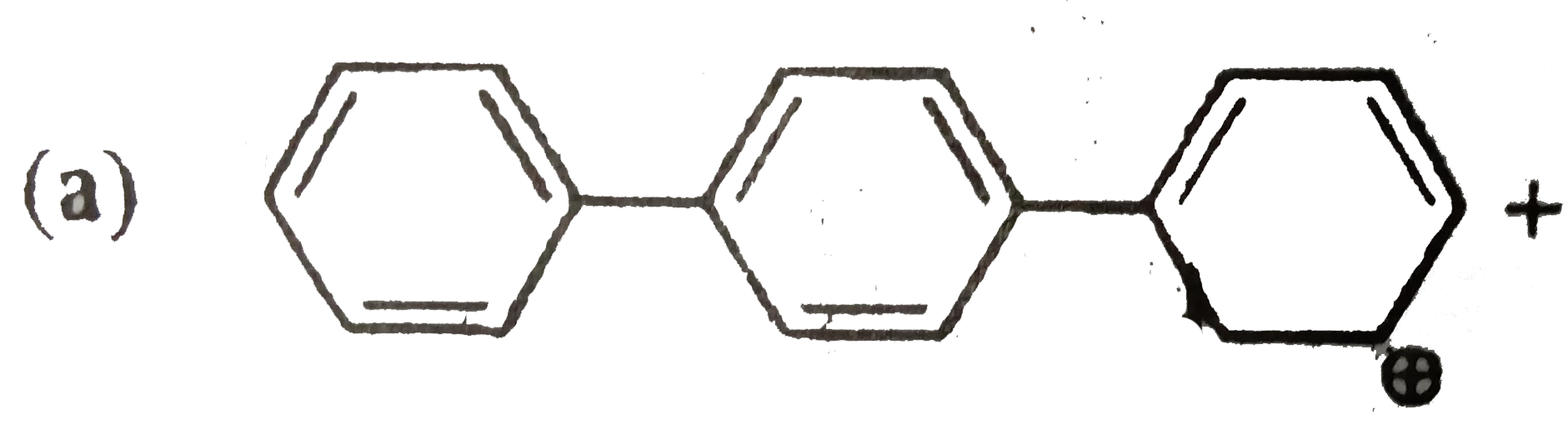 +IVE CHARGE is delocalised in all RINGS. +IVE CHARGE is delocalised in all RINGS.
|
|
| 49. |
In the Arrhenius equation, k = A exp^(-Ea//RT), A may be termed as the rate constant at…………. . |
| Answer» SOLUTION :INFINITE TEMP. | |
| 50. |
In an aqueous solution of volume 500ml when the reaction given below2Ag^(+)+ 2Ag^(+)+Cu hati Cu^(2) +2AgCu^(2+)+2Ag reached at equilibrium the [Cu^(2+] was xM.When 500 ml of wateris further added, at the equilibrium the [Cu^(2+)] will be |
|
Answer» `x` |
|