

Saved Bookmarks
This section includes 7 InterviewSolutions, each offering curated multiple-choice questions to sharpen your Current Affairs knowledge and support exam preparation. Choose a topic below to get started.
| 1. |
In an aquose solution of D-Glucose the percentage of alpha and beta anomers at equilibrium condition are respectively |
|
Answer» 80 and 20 |
|
| 2. |
In an aqueous solution the ionisation constants for carbonic acid are K_(1)=4.2xx10^(-7)andK_(2) =4.8xx10^(-11). Select the correct statement for a saturated 0.034 M solution of the carbonic acid. |
|
Answer» The concentration of `CO_(3)^(2-)` is 0.034 M |
|
| 3. |
In an aqueous solution of urea, mole fraction of urea is 0.4. Then w/w% of urea is: |
|
Answer» 0.155 0.4 MOLES of urea +0.6 moles of `H_(2)O` `%(w//w)=(0.4xx60)/((0.4xx60)+(0.6xx18))=(24)/(24+10.8)XX100` `=(24)/(34.8)xx100=69%` |
|
| 4. |
In an aqueous solution, hydrogen (H_(2)) will not reduce: |
|
Answer» `Fe^(3+)` |
|
| 5. |
In an aqueous solution, how does specific conductivity of electrolytes change with addition of water? |
| Answer» Solution : SPECIFIC conductivity decreases because the number of IONS PER unit VOLUME decreases. | |
| 6. |
In an aqueous solution containing Cu^(2+), Ag^(+), Sn^(2+) and Hg_(2)^(2+) ions, the concentration of each ion is 1 (M). Electrolysis of the solution is carried out in presence of inert electrodes. Given: E_(Hg_(2)^(2+)|Hg)^(@)=+0.79V and E_(Sn^(2+)|Sn)^(@)=-0.14V. If the voltage applied on the electrodes is gradually increased, then the metal that will deposit first and that at the end of the process at the cathode, respectively, are - |
|
Answer» SN, Ag |
|
| 7. |
In an aqueous solution how does specific conductivity of electrolytes change with addition of water? |
| Answer» SOLUTION :Conductivity decreases because NUMBER of IONS per unit VOLUME decreases. | |
| 8. |
In an aqueous solution, how does specific conductivity of electrolytes change with addition of water ? |
|
Answer» Solution :* SPECIFIC CONDUCTIVITY of solution decreases with DILUTION of solution. * On addition of water to the electrolytic solution, i.e., on dilution the interionic distance between ions get increases. So, number of ions in specific volume of solution get decreases. and hence, specific conductivity get decreases on dilution. |
|
| 9. |
In an aqueous of volume500 ml when the reaction, 2Ag^(+) + Cu rarr Cu^(2+) + 2Ag, reaches equilibrium, the concentration of Cu^(2+) ions is x molar: To this solution 500ml of water is added. At the new equilibrium the concentration of Cu^(2+) ions would be |
|
Answer» 2X molar |
|
| 10. |
In an analytical determination of aresenic , a solution containing aresenious acid, (H_(3)AsO_(3)). KI and a small amount of starch is electrolysed. The electrolysis produes free I_(2) from I^(-) ion and the I_(2) immediately oxidises the arsenious acid to hydrogen arsenate ion, (HAsO_(4)^(2-)). I_(2(aq.))+H_(3)AsO_(3(aq.))+H_(2)O_((l))rarr2I_((aq.))^(-)+HAsO_(4(aq.))^(2-)+4H_((aq.))^(+) When the oxidation of arsenic is complete, the free iodine combines with thestarch to give a deep blue colour.If during a particular run, it takes 65.3 s for a current of 10.5 mA to give an end point (indicated by the blue colour), how many grams of arsenic and H_(3)AsO_(3) are present in the solution? ("At. wt. of "As = 75) |
|
Answer» `H_(3)AsO_(3) = 5.0 xx 10^(-4)g ;` |
|
| 11. |
In an antiflourite structure, cations occupy |
|
Answer» OCTAHEDRAL VOIDS |
|
| 12. |
In an answer paper a student wrote as "carborundum crystals are very soft." What is your opinion? |
| Answer» SOLUTION :CARBORUNDUM CRYSTALS are very HARD. | |
| 13. |
In an answer paper a student wrote as "carborundum crystals are very soft." Do you agree with this? |
|
Answer» |
|
| 14. |
In an answer paper a student wrote as "carborundum crystals are very soft." In which crystal type carborundum is included? |
| Answer» SOLUTION :Covaient CRYSTAL. | |
| 15. |
In an amino acid, the carboxyl group ionises at pK_(a_1)=2.34 and ammonium ion at pK_(a_2)=9.60 . The isoelectric point of the amino acid is at pH |
|
Answer» 5.97 |
|
| 16. |
In an amino - acid , the carboxyl group ionises at pKa_(1) = 2.34 and the ammonium ion at pKa_(2) = 9.60 . The isoelectric point of the amino acid is at pH ……………….. |
|
Answer» 5.97 |
|
| 17. |
In an adsorption expetiment, a graph between log (x/m) varuse log P was found to be linear with a slope of 45^(@). The intercept on the log (x/m) axis was found to be 0.3010. Calculate the amount of the gas adsorbed per gram of charcoal under a pressure of 0.5 atmosphere. |
|
Answer» Solution :According to Freundlich equation, `x/m =k P^(1//) or log ""(x)/(m)=log k+1/n log P` `THEREFORE` Plot of `x/m` varsus log P is linear with SLOPE `=1/n` and INTERCEPT `=log k.` Thus, `1/n = TNA theta = TAN 45^(@)=1 or n=1` `log k =0.3010 or k= "Antilig" 0.3010=2` At `P =0.5 atm, x/m =k P^(1//n)=2xx(0.5)^(1)=1.0` |
|
| 18. |
In an adsorption experiment a graph between log x/m vs. log p is found to be linear with a slope of 45^(@). The intercept on the log x/m axis was found to be 0.3010. What is x/m If presure is 0.6 bar (tan 45^(@) = 1) |
|
Answer» 0.6 |
|
| 19. |
In an alkalinemedium acetaldehyde undergoes : |
|
Answer» Benzoin condensation |
|
| 20. |
In an adsorption experiment, a graph of log(x/m) versus log P was found to be linear with a slope of 45°, and the the intercept of of 0.3010. The amount of gas adsorbed per gram charcoal under a pressure of 0.8 bar is |
|
Answer» 1.2 |
|
| 21. |
In an Adsorption experiment a graph between log x/m versus log P was found to be linear with a slope of 45^(@) the intercept of the log x/m was found to be 0.3010. Calculate the amount of gas adsorbed per gram of charcoal under a pressure of 0.6 bar. |
| Answer» SOLUTION :`1.2` | |
| 22. |
In an adsorption experiment a graph between log x/m vs. log p is found to be linear with a slope of 45^@ . The intercept on the log x/m axis was found to be 0.3010. What is x/m if pressure is 0.6 bar |
|
Answer» 0.6 |
|
| 23. |
In an adiabatic process: |
|
Answer» The system EXCHANGES HEAT with surrounding |
|
| 24. |
In an adiabatic expansion of an ideal gas. |
|
Answer» `DELTA T = 0` |
|
| 25. |
In an acidic medium ………………….. behaves as the strongest base (nitrobenzen. Aniline, phenol), |
|
Answer» |
|
| 26. |
In an acidified solution of K_2Cr_2O_7, H_2O_2 is added. Then |
|
Answer» solution TURNS green due to formation of `Cr_2O_3` |
|
| 27. |
In Amylpectin the linkage absent is |
|
Answer» `C_1 & C_4` |
|
| 28. |
In amylopectin glycosidic long chain and branching occurs in between |
|
Answer» C-1 of ONE `ALPHA`-D-glucopyranos`to`C-4 of ANOTHER `alpha`-D-GLUCOPYRANOSE and BRANCHING at C-1 of one glucopyranose C-6 of another glucopyranose |
|
| 29. |
In amylopectin glycosidic branching present in between |
|
Answer» 1-4 `ALPHA`-D-glucopyranose |
|
| 30. |
In amixure of NaOH and NaCl 50% sodium is present. Calculate mass % of NaOH in the solution. |
|
Answer» `95.2%` `n_(NAOH)=a, n_(NaCl)=b` 40a+58.5b=100 . . . .(i) `axx23+bxx23=50gm` `a+b=(50)/(23)` . . . .(ii) `40a+40b=(50xx40)/(23)` 40a+58.5b=100 `18.5b=100-(200)/(23)` `b=(100-86.9)/(18.5)=0.7`. `a=(50)/(23)-0.7=2.17-0.7` In 100 gm mixture `rArr W_(NaOH)=58.8rArr58.8%` APPROX. |
|
| 31. |
In aluminothermic process aluminium acts as : |
|
Answer» OXIDISING AGENT |
|
| 32. |
In aluminium extraction by the Baeyer's process, alumina is extracted from bauxite by sodium hydroxide at high temperatures and pressures. Al_(2)O_(3(s))+2OH_((aq))^(-) to 2AlO_(2(aq))^(-)+H_(2)O_(l) Solid impurities such as Fe_(2)O_(3) and SiO_(2) are removed and then Al(OH)_(4)^(-) is reprecipitated. In the industrial world |
|
Answer» carbon dioxide is ADDED to precipitate the alumina |
|
| 33. |
In aluminothermic process, Al is used as.... |
|
Answer» reducing AGENT |
|
| 34. |
In alumino-thermy, aluminium is heated with : |
|
Answer» CALCIUM oxide |
|
| 35. |
In aluminium oxide, the oxide ions are arranged in hexagonal close packed (hcp) arrangement and the aluminium occupy 2//3 of octahedral voids. What is the formula of oxide ? |
|
Answer» Number of OXYGEN (O) atoms = 1 It is GIVEN that `2//3` of the octahedral sites are OCCUPIED by aluminium ions. Hence, for each oxide ion, there will be `2//3` aluminium ions. so, number of AL atoms = `2//3` Hence, the formula of the oxide = `Al_(2//3) O_1` or `Al_2O_3` |
|
| 36. |
In Alum: K_(2)SO_(4), Al_(2)(SO_(4))_(3). 24 H_(2)O Which metal can replace Al |
|
Answer» Cr |
|
| 37. |
In aluminates, the coordination number of Al is |
|
Answer» `O_(2)` |
|
| 38. |
In aluminates coordination number of Al is : |
|
Answer» 4 |
|
| 39. |
In alpha-helix structure of protein, each turn has nearly ………………….. number of amino acids. |
|
Answer» 3.6 |
|
| 40. |
In alpha- helix structure intramolecular hydrogen bonding takes place between |
|
Answer» NH- group of one UNIT and gtCO group of ANOTHER DIFFERENT unit |
|
| 41. |
In almost all Indian metropolitan cities like Delhi, the major atmospheric pollutants is/are |
|
Answer» SUSPENDED PARTICULATE MATTER (SPM) |
|
| 42. |
Inalpha -helix , structure, polypepetide chains are folded in a |
|
Answer» RIGHT HAND SIDE |
|
| 43. |
In allylic alcohol - OH group is attached to |
|
Answer» SP - hybridised CARBON ATOM |
|
| 44. |
In all expected compounds each central atom only uses its s and p-orbitals in hybridization. The relationship between bond angle 'theta' and decimal fraction of s and p character present in the equivalent orbitals is given by : costheta=(S)/(S-1)=(P-1)/(P), S=decimal fraction of s-character in the equivalent hybrid orbitaland P=decimal fraction of p-character in the equivalent hybrid orbital. . Q.The incorrect statement is : |
|
Answer» The ratio in % p-character to % s-character is less than four, for the bond pair of CENTRAL atom of compound S |
|
| 45. |
In all green leaves and vegetables which of the following vitamin is avialable ? |
|
Answer» VITAMIN A |
|
| 46. |
In all expected compounds each central atom only uses its s and p-orbitals in hybridization. The relationship between bond angle 'theta' and decimal fraction of s and p character present in the equivalent orbitals is given by : costheta=(S)/(S-1)=(P-1)/(P), S=decimal fraction of s-character in the equivalent hybrid orbitaland P=decimal fraction of p-character in the equivalent hybrid orbital. . Q. If the value n is 2 for compound T, then number of lone pair present at central atom of compound T will be : |
Answer» SOLUTION :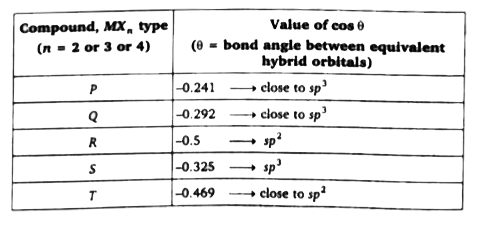
|
|
| 47. |
In all expected compounds each central atom only uses its s and p-orbitals in hybridization. The relationship between bond angle 'theta' and decimal fraction of s and p character present in the equivalent orbitals is given by : costheta=(S)/(S-1)=(P-1)/(P), S=decimal fraction of s-character in the equivalent hybrid orbitaland P=decimal fraction of p-character in the equivalent hybrid orbital. . Q. The correct order of % p-character in bond pairs of central atoms in the following compounds is : |
|
Answer» `PgtTgtSgtQgtR` |
|
| 48. |
In alkyl nitrites the oxygen of -O-N=O group is linked with carbon. An alkyl nitrite is : |
|
Answer» An ester |
|
| 49. |
In alkyl cyanide alkyl group attached with |
|
Answer» C of CN GROUP |
|
| 50. |
In alkanline medium ClO_(2) oxidises H_(2)O_(2) to O_(2) and itself gets reduced to Cl^(-). How many moles of H_(2)O_(2) are oxidised by 1 mol of ClO_(2)? |
|
Answer» `1.0` THUS, ONE mole of `ClO_(2)` oxidises 5/2 or 2.5 moles of `H_(2)O_(2)` |
|