

Saved Bookmarks
This section includes 7 InterviewSolutions, each offering curated multiple-choice questions to sharpen your Current Affairs knowledge and support exam preparation. Choose a topic below to get started.
| 1. |
In a reversible reaction, the catalyst |
|
Answer» increases the activation energy of the backward REACTION forward and backward reaction. |
|
| 2. |
In a reversible reaction if there is no change in total number of molecules , the reaction will be favoured by |
|
Answer» HIGH PRESSURE |
|
| 3. |
In a reversible reaction a catalyst will affect |
|
Answer» the RATE of forward reaction and REVERSE reaction |
|
| 4. |
In a reversible reaction, a catalyst : |
|
Answer» INCREASES the rate of the forward REACTION only |
|
| 5. |
In a reversible process, DeltaS_(sys)+DeltaS_("surr") is |
|
Answer» `gt0` `DeltaS_("TOTAL")=DeltaS_("SYS")+DeltaS_("surroundings")=0` |
|
| 6. |
In a reversible chemical reaction having two reactants in equilibrium, if the concentrations of reactants are doubled, then the equilibrium constant will : |
|
Answer» also be doubled |
|
| 7. |
In a reversible isothermal process the change in internal energy is: |
|
Answer» Zero |
|
| 8. |
In a reversible adiabatic change Delta Sis |
|
Answer» equal to `NR LN V_2//V_1` |
|
| 9. |
In a reversible chemical reaction at equilibrium, if the concentration of any one of the reactants is doubled, then the equilibrium constant will |
|
Answer» also be DOUBLED |
|
| 10. |
In a relation, catalyst changes……….. |
|
Answer» PHYSICALLY |
|
| 11. |
In a redox reaction Na_(2)S_(2)O_(3) changes to Na_(2)S_(4)O_(6) what is the equivalent weight of Na_(2)S_(2)O_(3)? |
|
Answer» same as its molecularweight 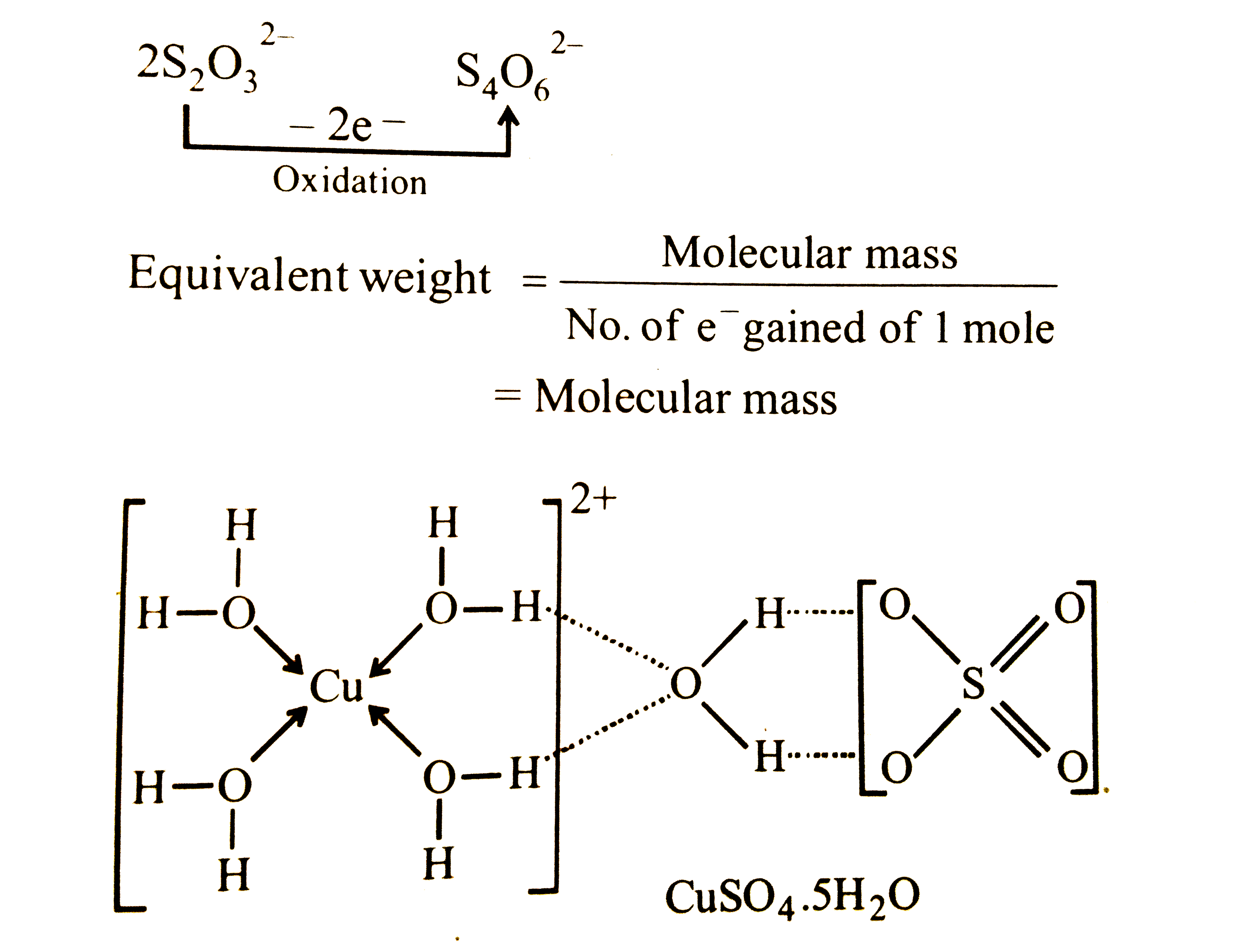
|
|
| 12. |
In a redox reaction, how many moles of electrons are accepted by 1 mol of MnO_(4)^(-) in acidic medium ? |
|
Answer» 3 |
|
| 13. |
In a reaction,the concentration of reactant is increased two times and three times then the increase in rate of reaction were four times and nine times respectively,order of reaction is |
|
Answer» ZERO |
|
| 14. |
In a reaction vessel, the reactants have attained a potential energy of 80K. cal/mole and unable to give even traces of products. The threshold energy of the reaction may be |
|
Answer» 60K.cal |
|
| 15. |
In a reaction to B, the rate of reaction increases two times on increasing the concentration of the reactant four times, then order of reaction is |
|
Answer» 0 |
|
| 16. |
In a reaction vessel, 0.184 g of NaOH is required to be added for completing the reaction. How many millilitres of 0.150 M NaOH solution should be added for this requirement? |
|
Answer» i.e., For 6 g in 0.150 M M NaOH solution, VOLUME of solution `-=" 1000 mL"` `therefore"For 0.184 g in 0.150 M NaOH solution, volume "-=(1000)/(6)xx0.184=30.7mL` |
|
| 17. |
In a reaction, triangleH and triangleS both are more than zero. In which of the following cases, the reaction would not be spontaneous: |
|
Answer» `triangleHgtTtriangleS` |
|
| 18. |
In a reaction the threshold energy is equal to |
|
Answer» AVERAGE ENERGY of the reactants |
|
| 19. |
In a reaction , the time required to complete half of the reaction was found to increase 16 times when the initial concentration of the reactant was reduced to 1//4^(th). What is the order of the reaction ? |
|
Answer» Solution :`3` `(t_(2))/(t_(1))=((a_(1))/(a_(2)))^(n-1)` `implies16=((1)/((1)/(4)))^(n-1)` `n=3` THIRD order REACTION. |
|
| 20. |
In a reaction, threshold energy is equal to |
|
Answer» activation energy |
|
| 21. |
In a reaction the rate of reaction is proporational to its active mass, this statement is known as |
|
Answer» Law of mass action |
|
| 22. |
In a reaction, the rate expression is Rate =k[A][B]^(2//3), the order of reaction is |
|
Answer» 1 Order of reaction `= 1+2/3=5/3` |
|
| 23. |
In a reaction, the threshold energy is equal to: . |
|
Answer» ACTIVATION ENERGY + NORMAL energy of reactants |
|
| 24. |
In a reaction, the rate expression is, rate = k[A][B]^(2//3)[C]^0,the order of reaction is: |
|
Answer» 1 |
|
| 25. |
In a reaction the initial concentration of the reactants increase four fold and the rate becomes eight times its initial value . The order of the reaction is |
|
Answer» `2.0` Or r = `KC^(n) ""… (i)` `8R = K(4C)^(n) "" … (ii)` Dividing EQ. (ii) by (i) , we GET `2^(3) = 2^(2N)` or 2 n =3 n = 1.5. |
|
| 26. |
In a reaction the following equation holds good as per chemical kinetics is viewed. logk=4-4000/(2.303RT). The frequency factor is 10^(x). What is x. |
|
Answer» |
|
| 27. |
In a reaction, the concentration of reactant is increased two times and three times than the increases in rate of reaction were four times and nine times respectively, order of reaction is |
|
Answer» ZERO ` R = k (A)^(2) , R' = k (3A)^(2) , (R')/(R) = 9`. |
|
| 28. |
In a reaction, RCHO is reduced to RCHO_(3) using amalgamated zinc and concentrated HCl and warming the solution. The reaction is known as |
|
Answer» Meerwein-Ponndorf VERLEY formate |
|
| 29. |
In a reaction of the typeA(s) + 2B(g) iff C(g) + D(g)the equilibrium concentrations of A, B, C and D are 1, 2, 5 and 6 mol/litre respectively. Argon is then introduced at equilibrium at constant volume. Calculate the concentrations of A, B, C and D at the new equilibrium position. |
| Answer» SOLUTION :Eqb. concs, do not CHANGE | |
| 30. |
In a reaction K_(2)MnO_(4) is converted into KMnO_(4)The change in the oxidation number of Mn is : |
|
Answer» zero Changes in OXIDATION number= +1 |
|
| 31. |
In a reaction N_(2)+3H_(2)to2NH_(3), the rate of appearance of ammonia is 2.5xx10^(-4)" M sec"^(-1) the rate of disappearance of N_(2) will be |
|
Answer» `7.5XX10^(-4)` |
|
| 32. |
In a reaction if the concentration of reactant A is tripled,the rate of reaction becomes twenty seven times.What is the order of the reaction? |
|
Answer» Solution :Reaction ORDER=3 For any reaction `RtoP` and order =n so rate `r_(1)k[R]^(n)` If the concentration becomes 3 times i.e. 3R then rate ,`r_(2)k[]3R^(n)` So ,`(r_(2))/(r_(1))=(k[3R]^(n))/(k[R]^(n))=(27)/(1)` `THEREFORE (""^(27)r_(1))/(r_(1))=27` `therefore 27=3^(n)` `therefore 3=3^(n)` So, n=3 |
|
| 33. |
In a reaction, if the concentration of reactant A is tripled, the rate of reaction becomes twenty seven times. What is the order of the reaction ? |
| Answer» Solution :`r_(1)=k[A]^(ALPHA)=ka^(alpha),r_(2)=k(3" a")^(alpha),(r_(2))/(r_(1))=3^(alpha)=27("GIVEN")=3^(3):.alpha=3.` | |
| 34. |
In a reaction, if Delta Ult 0, then heat __________ . |
|
Answer» CHANGE is zero |
|
| 35. |
In a reaction, if half of the double bond is broken and two new bonds are formed, this is a case of |
|
Answer» Elimination HALF of the DOUBLE bond is broken. Its MEANS `PI` bond is broken while sigma bond is retained also two new C-Br bonds are formed |
|
| 36. |
In a reaction if half of the double bond is broken and two new bonds are formed, this is a case of: |
|
Answer» Elimination |
|
| 37. |
In a reaction , DeltaH and DeltaS both are more than zeron. In which of the following cases would the reaction be spontaneous ? |
|
Answer» `DeltaHgtTDeltaS` |
|
| 38. |
In a reaction, Cu_2 S is oxidized by reacting with oxygen to given Cu^(2+) and SO_2. If the equivalents of O_2 used were x, the equivalent of Cu^(2+) and SO_2. Produced w.r.t. Cu_2 S would be: |
|
Answer» X and x |
|
| 39. |
In a reaction CH_2=CH_2underset"acid"overset"Hypochlorous"to MoversetRto underset(CH_2-OH)overset(CH_2-OH)| Where M=molecule, R=reagent , M and R are |
|
Answer» `CH_3CH_2Cl` and NAOH 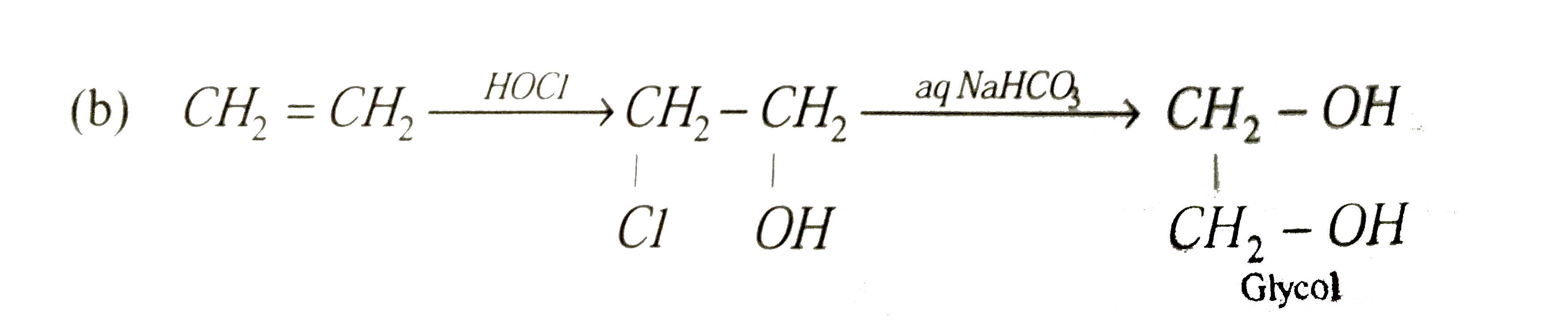
|
|
| 40. |
In a reaction CH_(2)=CH_(2) underset("acid")overset("Hypochlorous")to M overset(R )to underset(CH_(2)-OH)overset(CH_(2)-OH)| Where M =molecule, R=reagent, M and R are |
|
Answer» `CH_(3)CH_(2)Cl and NaOH` 
|
|
| 41. |
In a reaction, catalyst changes ___________. |
|
Answer» physically |
|
| 42. |
In a reaction, catalyst changes .......... |
|
Answer» Physically |
|
| 43. |
In a reaction between A and B, the initial rate of reaction was measured for different intial concentrations of A and B as given below : {:(A//"mol L"^(1),,,0.20,,,0.20,,,0.40),(B//"mol L"^(-1),,,0.30,,,0.10,,,0.05),(r_(0)//"mol L"^(-1)s^(-1),,,5.07xx10^(-5),,,5.07xx10^(-5),,,7.16xx10^(-5)):} Whatis the order of reaction with respect to Aand B ? |
|
Answer» SOLUTION :`r_(0)=[A]^(alpha)[B]^(beta)` `(r_(0))_(1)=5.07xx10^(-5)=(0.20)^(alpha)(0.30)^(beta)""...(i)` `(r_(0))_(2)=5.07xx10^(-5)=(0.20)^(alpha)(0.10)^(beta)""...(ii)` `(r_(0))_(3)=7.16xx10^(-5)=(0.40)^(alpha)(0.05)^(beta)""...(iii)` `((r_(0))_(1))/((r_(0))_(2))=1=((0.30)/(0.10))^(beta)=(3)^(beta):.beta=0` `((r_(0))_(3))/((r_(0))_(2))=(7.16)/(5.07)=((0.40)/(0.20))^(alpha)((0.05)/(0.10))^(beta)" or "1.412=2^(alpha)((1)/(2))^(beta)=2^(alpha)( :.beta=0)` `log1.412=alphalog2"or"alpha=0.1523//0.3010=0.5.` `("or directly "1.412=sqrt(2)=2^(1//2):.2^(alpha)=2^(1//2)" or "alpha=1//2)` THUS, order w.r.t. A = 0.5, orderw.r.t. B = 0 |
|
| 44. |
In a reaction between zinc and iodine in which zinc iodide is formed, which is oxidized ? |
|
Answer» ZINC ions |
|
| 45. |
In a reaction between A and B, the initial rate of reaction was measured for different initial concentration of A and B as given ahead: what is the order of reaction with respect to A and B? |
|
Answer» Solution :The rate law equation may be expressed as: Rate = `k[A]^(p)[B]^(q)` Comparing experiments 1 and 2. `("Rate")_(1) = k[0.2]^(p)[0.3]^(q)= 5.07 XX 10^(-5)`..........(i) `("Rate")_(2) = k[0.2]^(p)[0.1]^(q) = 5.07 xx 10^(-5)`...........(ii) Dividing EQN. (i) by eqn. (ii), `(Rate)_(1)/(Rate)_(2) = (k[0.2]^(p)[0.3]^(q))/(k[0.2]^(p)[0.1]^(q)=(5.07 xx 10^(-5))/(5.07 xx 10^(-5)` `[3]^(q) = [1]^(0)` or q=0 By comparing experiments 2 and 3. `("Rate")_(2)= k[0.2]^(p)[0.1]^(q) = 5.07 xx 10^(-5)`...........(i) `("Rate")_(3) = k[0.4]^(P)[0.05]^(q)= 7.56 xx 10^(-5)`..............(iv) Dividing eqn. (iv) by eqn. (iii), `("Rate")_(3)/("Rate")_(2) = (k[0.4]^(p)[0.05]^(q))/(k[0.2]^(p)[0.1]^(q))= (7.56 xx 10^(-5))/(5.07 xx 10^(-5))` `[2]^(p) = [1.49]=[2]^(3//2)` or p `=3//2` Order with RESPECT to A = `3//2` Order with respect to B = 0 |
|
| 46. |
In a reaction, between A and B, the initial rate of reaction (r_(0)) was measured for different initial concentrations of A and B as given below : What is the order of reaction with respect to A and B ? |
|
Answer» SOLUTION :`r_(0)= k[A]^(ALPHA)[B]^(beta)` `(r_(0))_(1)=k XX 5.07 xx 10^(-5)=(0.20)^(alpha) (0.30)^(beta) ""…(i)` `(r_(0))_(2)= k xx 5.07 xx 10^(-5)= (0.20)^(alpha) (0.10)^(beta)"" …(ii)` `(r_(0))_(3)=k xx 1.43xx10^(-4)=(0.40)^(alpha) (0.05)^(beta) ""...(iii)` Dividing (i) by (ii) `(r_(0))_(1)//(r_(0))_(2)=1=(0.30//0.10)^(beta)=(3)^(beta)` `therefore beta=0` Dividing (iii) by (ii) `(r_(0))_(3)//(r_(0))_(2)=(7.16)/(5.07)=(0.40//0.20)^(alpha) (0.05//0.10)^(beta)` or `1.412=2^(alpha)((1)/(2))^(beta)=2^(alpha) ""[because beta=0]` or `LOG 1.412=alpha log 2` or `alpha=0.1523//0.3010=0.5` Thus, ORDER w.r.t. A = 0.5, order w.r.t. B = 0. |
|
| 47. |
In a reaction at equillibrium X mole of the reactant A decompose to give 1 mole each ofC and D. if the fraction of A decomposed at equillibrium is independent of initial concentration of A then what will be the value pf X ? |
|
Answer» 1 |
|
| 48. |
In a reaction at equilibrium x mole of the reactants A decompose to give 1 mole each of C and D. it has been found that the fraction of A decomposed at equilibrium is independent of initial concentration of A. find the value of x. |
|
Answer» |
|
| 49. |
In a reaction A toproducts, when start is made from 8.0times10^(-2)M of A, half-life is found to be 120minute. For the initial concentration 4.0times10^(-2)M, the half-life of the reaction becomes 240 minutes. The order of the reaction is : |
|
Answer» zero |
|
| 50. |
In a reaction AtoB when the concentration of reaction is made 8 times, the rate got doubled. The order of reaction is |
| Answer» ANSWER :A | |