

Saved Bookmarks
This section includes 7 InterviewSolutions, each offering curated multiple-choice questions to sharpen your Current Affairs knowledge and support exam preparation. Choose a topic below to get started.
| 1. |
In a hypothetical solid C atoms are found to form cubical close packed lattice, A atoms occupy all tetrahedral voids while B atoms occupy all octahedral voids. A and B atoms are of appropriate size, so that there is no distortion in ccp lattice of C atoms. Now if a plane as shown in the following figure is cut, then the cross section of this plane will look like |
|
Answer»
a) not possible, four ATOM marleed b) Not possible, atoms .A. in T.V are not SHOWN in figure. c) Possible since atoms .A. in T.V are not touching each other d) not possible since atoms .A. in T.V are toucing each other |
|
| 2. |
In a hypothetical reaction X to Y, the activation energy for the forward backward reactions are 15 and 9 kJ mol^(-1) respectively. The potential energy of X is 10 kJ mol^(-1). Which of the following statement is/are correct? (i) The threshold energy of the reaction is 25 kJ mol^(-1) (ii) The potential energy of Y is 16 kJ mol^(-1) (iii) Heat of reaction is 6 kJ mol^(-1) The reaction is endothermic. |
|
Answer» Only (i) 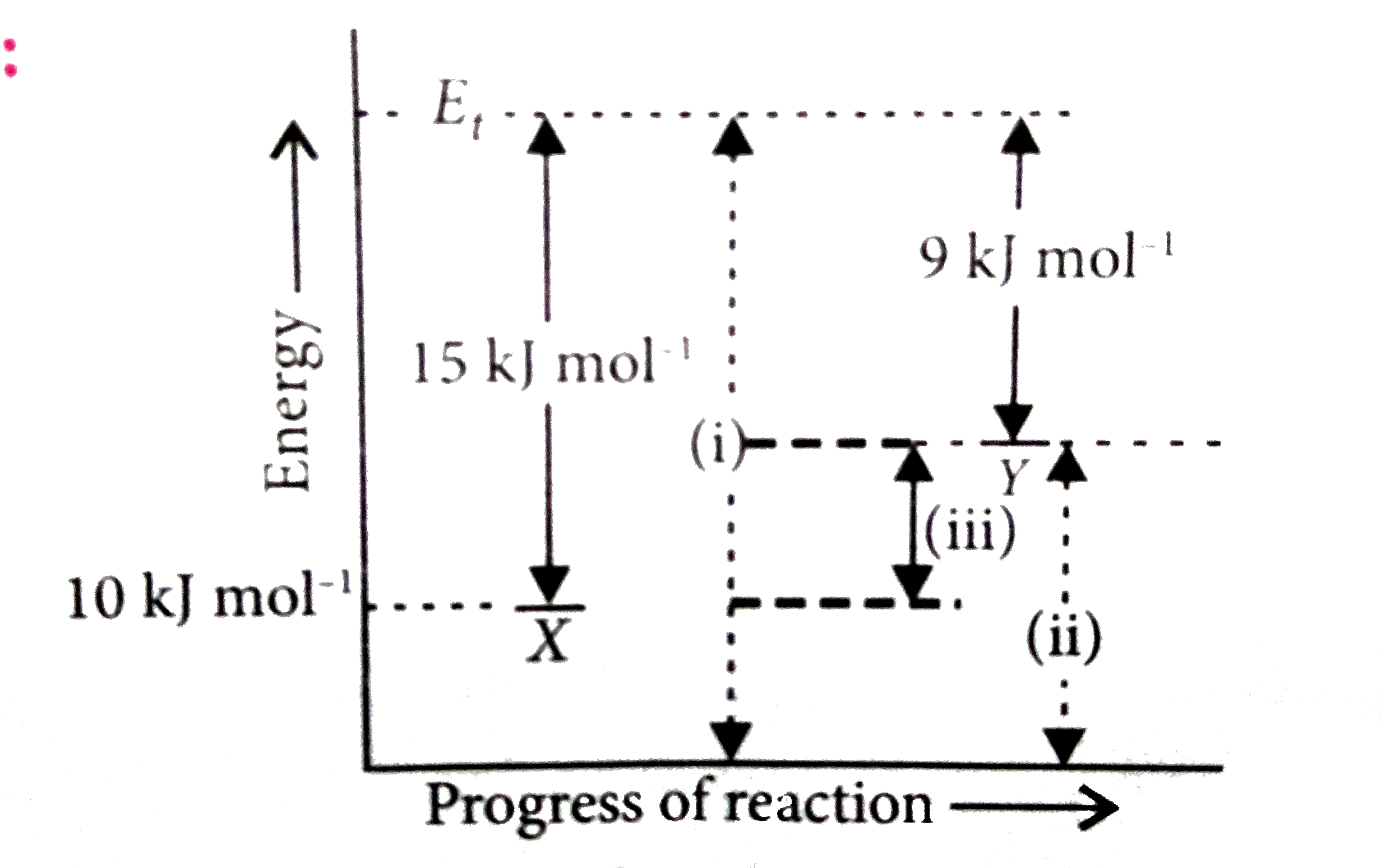
|
|
| 3. |
In a hypothetical reaction X to Y, the activation energy for the forward and the backward reaction are 15 and 9" kJ mol"^(-1) respectively. The potential energy of X is 10" kJ mol"^(-1). Then |
|
Answer» Threshold energy of the reaction is 25 kJ 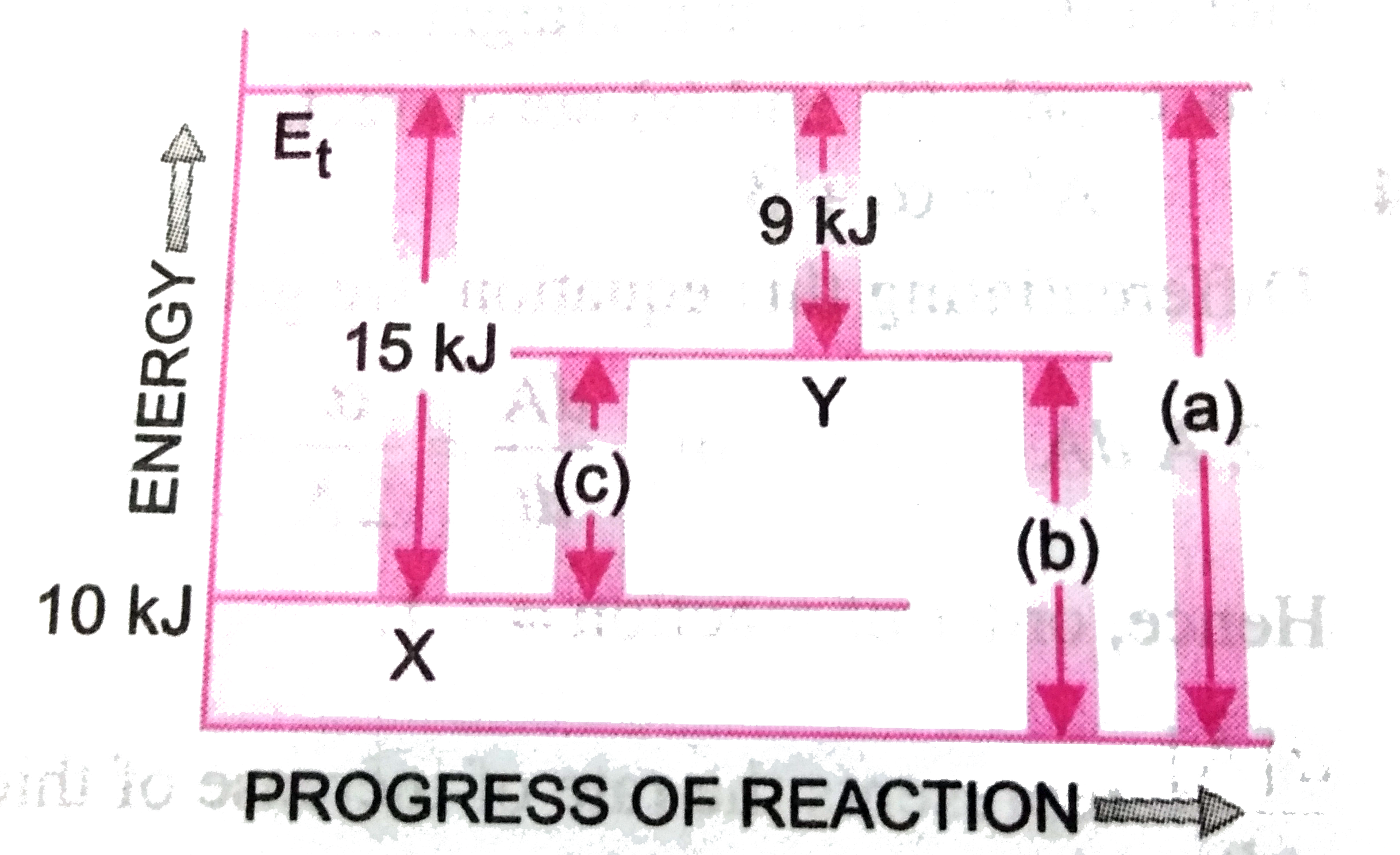
|
|
| 4. |
In a hypothetical reaction A(aq)hArr2B(aq)+C(aq) (1^(st) order decomposition) A(aq)hArr2B(aq)+C(aq) (1^(st) order decomposition) 'A' is optically active (dextro-rototory) while 'B' and 'C' are optically inactive but 'B' takes part in a titration reaction (fast reaction) with H_2O_2.Hence the progress of reaction can be monitored by measuring rotation of plane of polarised light or by measuring volume of H_2O_2 consumed in titration. In an experiment, the optical rotation was found to be theta=30^@C at t=20 min. and theta=15^(@) at t=50min from start of the reaction.If the progress would have been monitored by titration method, volume of H_2O_2 consumed at t=30 min.(from start) is 30 ml then volume of H_2O_2 consumed at t=90 min, will be: |
|
Answer» 60 ml While CONCENTRATION of A at t`=50 "min" prop 15^@` So concentration has decreased to half of its value in 30 min, so `t_(1//2)`, is according to 50% production of B. At t=90 min, production of B =87.5% (Three half lives) So volume CONSUMED `=(30 ml)+(30/2ml)+(30/4)ml=52.5 ml` |
|
| 5. |
In a hypothetical reaction A to B the activation energies for the forward and backward reactions are 15 and 9kJ//mol respectively. The potential energy of A is 10kJ//mol, then |
|
Answer» the THRESHOLD energy of the reaction is `25kJ//mol` 
|
|
| 6. |
In a hypothetical molecule of PCl BrF_(3), choose the incorrect statement : |
|
Answer» `(P-F)_("axial bond length")GT(P-Br)_("equatorial bond length")gt(P-Cl)_("equatorial bond length")gt(P-F)_("equatorial bond length")`  `(P-Br)_(B.L.)gt(P-Cl)_(B.L.)gt(P-F_("axial")_(B.L.)gt(P-F_("equatorial"))_(B.L)` |
|
| 7. |
In a hydrogen - oxygen fuel cell, combustion of hydrogen occurs to |
|
Answer» generate heat |
|
| 8. |
In a hydrogen-oxygen fuel cell, combustion of hydrogen occurs to |
|
Answer» Produce high purity water `2H_(2(g))+4OH_((aq))^(-)to4H_(2)O_((l))+4e^(-)` `underline(O_(2(g))+2H_(2)O_((l))+4e^(-)to4OH_((aq))^(-)"")` Overall reaction=`2H_(2(g))+O_(2(g))to2H_(2)O_((l))` the NET reaction is the same as burning (COMBUSTION) of hydrogen to form water. |
|
| 9. |
In a hydrogenoxygenfuel cellcombustion of hydrogen occurs to |
|
Answer» generate HEAT |
|
| 10. |
In a hydrogen like specieselectrons is in 2^(nd)excited statethe binding energy of the fourth state of this species is 13.6 eV then |
|
Answer» A 25 eV PHOTON can set free the electron from the secondexcited stateof thissample |
|
| 11. |
In a hydrogen atom if the energy of an electron in the ground state is 13.6eV then that in the second excited state is: |
|
Answer» -1.51 eV |
|
| 12. |
In a homogeneous reaction ArarrB +C+D , the initial pressure was P_0 and after time t is was P. Expression of rate constant in terms of P_0 , P and t will be |
|
Answer» `K=((2.303)/t)LOG ((2P_0)/(3P_0-P))`  `a PROP P_0` `(a+2x) PROPP` `a/(a+2x)=P_0/P` `(a-x)=a-((P-P_0_a)/P_0)` `(a-x)=a{(3P_0-P)/(2P_0)}` `k=((2.303)/t) log (a/(a{(3P_0-P)/(2P_0)}))` `k=((2.303)/t)log((2P_0)/(3P_0-P))` |
|
| 13. |
In a homogeneous reaction A rarr B + C + D, the initial pressure was P_(0) and after time t it was P. Expression for rate constant in terms of P_(0), P and t will be ……………………… |
|
Answer» `K = ((2.303)/(t))LOG((2P_(0))/(3P_(0)-P))` `a prop P_(0)` `(a + 2x) prop P` `(a)/((a + 2x)) = (P_(0))/(P)` `x = ((P-P_(0))a)/(P_(0))` `(a-x) = a - (((P-P_(0))a)/(P_(0)))` `(a-x) = a {(3P_(0) - P)/(2P_(0))}` `k = ((2.303)/(t))log ((a)/(a-x))` `k = ((2.303)/(t)) log ((a)/(a{(3p_(0) - P)/(2P_(0))}))` `k = ((2.303)/(t)) log ((2P_(0))/(3P_(0) - P))` |
|
| 14. |
In a homogeneous reaction A rarr B + C + D, the initial pressure was P_(0) and after time t it was P. expression for rate constant in terms of P_(0), P and t will be |
|
Answer» `K=((2.303)/(t))log((2P_(0))/(3P_(0)-P))` |
|
| 15. |
In a hexagonal closest packing in two layers one above the other, the coordination number of each sphere will be |
|
Answer» 4 |
|
| 16. |
In a hexagonal closest packing in two layers one abovethe other, the coordiantion number of each sphere will be |
|
Answer» 4 |
|
| 17. |
In a H-like sample, electrons make transition from 4^(th) excited state upto 2^(nd) state. Then , |
|
Answer» `10` different spectral lines are observed `rArr Deltan=3` HENCE MAXIMUM number of spectral line observed `=(3(3+1))/(2)=6`. 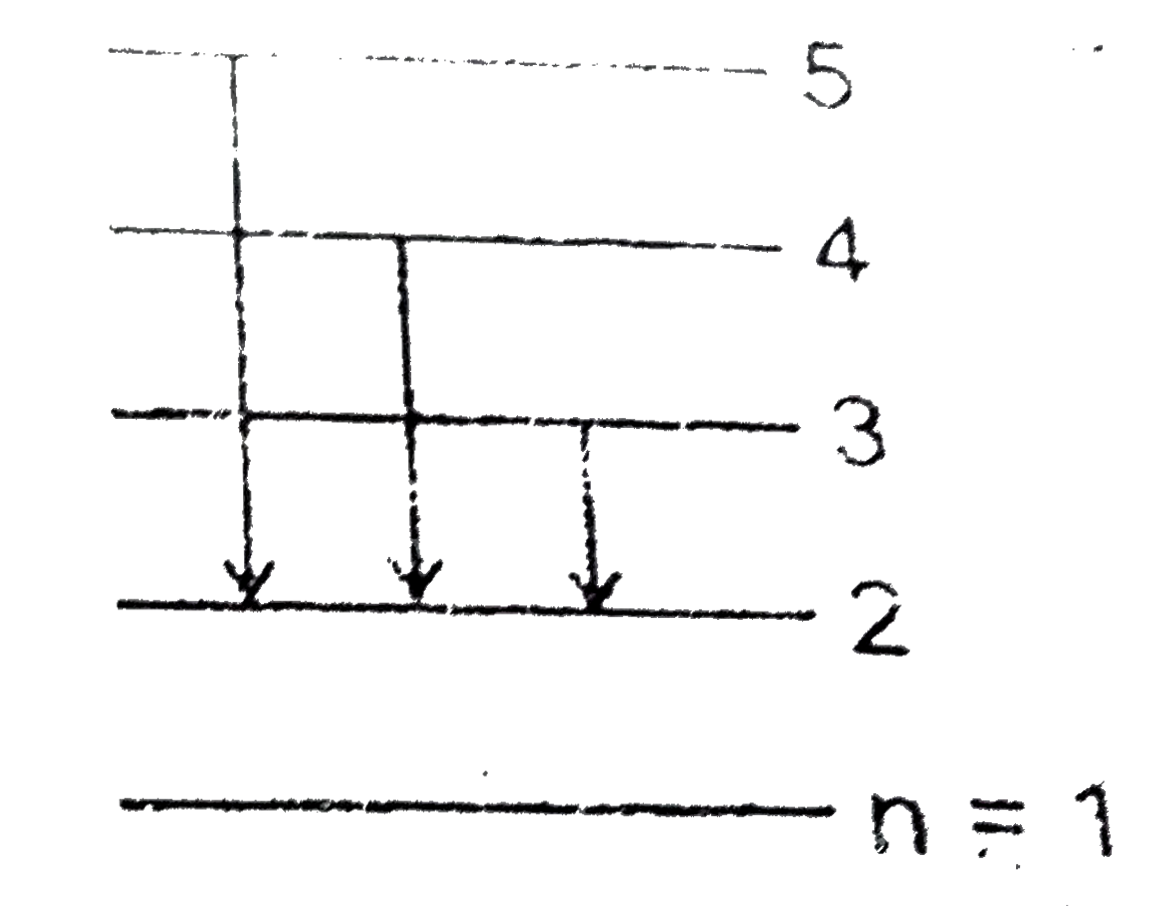 (C) number of lines belonging to the Balmer series `=3(5 rarr2, 4rarr2, 3 rarr 2)` as shown in figure. Number of lines belonging to Paschen series `=2(5 rarr 3, 4 rarr 3)`. |
|
| 18. |
In a hcp arrangement, each atom at the corner contributes to the unit cell equal to |
|
Answer» `1//2` |
|
| 19. |
In a group of the periodic table, the elements possess: |
|
Answer» same NUMBER of ELECTRONS |
|
| 20. |
In a gravimetric determination of phosphorus, 0.248g an organic compound was strongly heated in a Carius tube with concentrated nitric acid. Phosphoric acid so produced was precipitated as MgNH_(4)PO_(4) which on ignition yielded 0.444g of Mg_(2)P_(2)O_(7). Find the percentage of phosphorus in the compound. (Mg= 24, P= 31, O= 16) |
|
Answer» Solution :MOLES of P in `Mg_(2)P_(2)O_(7)=2 xx` moles of `Mg_(2)P_(2)O_(7)` `=2 xx (0.444)/(222)= 0.004g` Weight of `P= 0.004 xx 31g` = 0.124g percentage of `P= (0.124)/(0.248)xx 100= 50%` |
|
| 21. |
In a group of isomeric alkyl halides the order of boiling point is : |
|
Answer» <P>`P LT S lt T` |
|
| 22. |
In a gravimetric determination of P, an aqueous solution of dihydrogen phosphate ion H_(2) PO_(4)^(-)is treated with a mixture of ammonium and magnesium ions to precipitate magnesiumammonium phosphate, Mg(NH_(4))PO_(4). 6H_(2)O . This is heated and decomposed to magnesium pyrophosphate, Mg_(2)P_(2)O_(7), which is weighed. A solution of H_(2) PO_(4)^(-) yielded 1.54 g of Mg_(2) P_(2) O_(7) . What weight of NaH_(2) PO_(4) was present originally ? (Na = 23 , h = 1, P = 31, O = 16, Mg = 24 ) |
|
Answer» Solution :`Na H_(2) PO_(4) + MG^(2+) + NH_(4)^(+) to Mg (NH_(4)) PO_(4). 6H_(2) O overset("heated") to Mg_(2) P_(2) O_(7)` Since P atomsareconserved,applyingPOAC forPatoms, moles of P in`NaH_(2) PO_(4) = ` moles of P in `Mg_(2) P_(2) O_(7)` `1 xx` molesof `NaH_(2) PO_(4) = 2 xx` moles of `Mg_(2) P_(2) O_(7)` (`:.` 1 moles of `NaH_(2) PO_(4)` contains 1 moleof P and 1 mole of `Mg_(2) P_(2) O_(7)`contains 2 molesof P) `(wt .of Na H_(2) PO_(4))/( mol . wt. of Na H_(2) PO_(4)) = 2 xx (wt. ofnMg_(2) P_(2) O_(7))/( mol . wt . of Mg_(2) P_(2) O_(7))` `(wt . of Na H_(2) PO_(4))/( 120 ) = xx (1.054)/( 222)` Wt. of`NaH_(2) PO_(4) = 1.14` [NOTE : in Ex . 5 and Ex. 6 the studentsshouldnote that if in anyreaction, a particular ATOM is conserved, theprincipleof atom conservation(POAC) with RESPECT to thatatomcan be appliedregardlessof thenumberof stepsof the k reactionand theirsequence .] |
|
| 23. |
In a gravimetric determination of phosphorus, 0.248 g of an organic compound was strongly heated in a Carius tube with concentrated HNO_(3). Phosphoric acid so produced was precipitated as MgNH_(4)PO_(4) which on ignition yielded 0.444 g of Mg_(2)P_(2)O_(7). The percentage of phosphorus in the compound is |
|
Answer» 2.5 |
|
| 24. |
In a gravimetric determination of phosphorus 0.24 gr of an organic compound was strongly heated in carius tube with conc nitric acid. Phosphoric acid so produced was precipitated as MgNH_(4)PO_(4) which on ignition yielded 0.444 gr of Mg_(2)P_(2)O_(7) the percentage of phosphorus in the compound is ........... x 10 [Mg = 24, P = 31, O = 16] |
|
Answer» |
|
| 25. |
In a gravimetric determination of P, an aqueous solution of dihydrogen phosphate ion H_(2)PO_(4)^(-) is treated with a mixture of Ammonium and magnesium ions to precipitate magnesium ammonium phosphate [Mg(NH_(4))PO_(4).6H_(2)O].This is heated and decomposed to magnesium pyrophosphate (Mg_(2)P_(2)O_(7)). Which is weighed. A solution of H_(2)PO_(4)^(-) yielded 1.85 g of Mg_(2)P_(2)O_(7). What weight (grams) of NaH_(2)PO_(4) was present originally. |
|
Answer» `2 xx 120 G""222 g` 222 of `Mg_(2)P_(2)O_(7)` OBTAINED from 240 grams of `NaH_(2)PO_(4)` 1.85g obtained from how MANY grams = `(1.85 xx 240)/(222)=2` |
|
| 26. |
In a given shell, the screening effect of various orbitals is in the order : |
|
Answer» <P>`s gt p gt d gt f ` |
|
| 27. |
In a given sample of bleaching power the percentage of available chlorine is 49 the volume of chlorine obtained if 10g of the sample is treated with HCl at NTP is |
|
Answer» 1.5 litre |
|
| 28. |
In a given period, the alkali metals have: |
|
Answer» smallest atomic size |
|
| 29. |
In a gaseous reaction of the type aA+ b B to c C + dD, (i)In a gaseous reaction of the type (ii) a mole of A combines with b moles of B to give C and D (iii) (axxM_(A)) g of a combines with (b xxM_(B)) g of B to give C and D (iv) a molecules of A combines with b molecules of B to give C and D |
|
Answer» i, II, iv |
|
| 30. |
In a gaseous reaction of the type, , a A + b B to c C + d D,whichstatement is wrong ? |
|
Answer» a liters of A combine with B litres of BTO give C and D |
|
| 31. |
In a gaseous reaction A to B + C ,the pressure of A falls from 0.2 atm to 0.15 atm in one hour. Calculate the rate constant if it is a first-order reaction. What will be the pressure of A after 1.5 hours? |
| Answer» SOLUTION :0.2878, 0.13 ATM | |
| 32. |
In a gaseous phase reaction A_(2)(g)toB(t)+1(1//2)C(g), the increase in pressure from 100 mm to 120 mm is noticed in 5 minute.The rate of disappearance of A_(2) in mm "min"^(-1) is |
|
Answer» `100""0""2` `(100-x)""x""x/2` `60""40""20` `implies100-x+x+x/2=120,r_(A_(2))=(d(P_(A_(2))))/(DT)=(100-60)/5=40/5=8` |
|
| 33. |
In a gaseous reaction 2P + QrarrProducts : Rate =k [P]^(2) [Q] The volume of the reaction vessel is suddenly reduced to half of its initial volume . The rate of eaction as compared to original rate becomes : |
|
Answer» `(1)/(4)` TIMES |
|
| 34. |
In a gaseous phase reaction: A_2(g)toB(g)+(1//2)C(g),), the increases in pressurefrom 100 mm to 120 mm is noticed in 5 minute. The total of disappearance of A_2 mm min^-1is : is: |
|
Answer» 4 |
|
| 35. |
In a galvanic cell,t he salt bridge |
|
Answer» Does not participiate chemically in the CELL reation It oes not participiate in the chemical reaction. However, it is not necesary for occurrence of cell reaction, as we know that designs like lead accumulator, there was no salt bridge, but still reaction TAKES place. |
|
| 36. |
In a galvenic cell the direction of current is: |
|
Answer» anode to cathode |
|
| 37. |
In a galvanic cell, which one of the following statements is not correct? |
|
Answer» Anode is NEGATIVELY charged |
|
| 38. |
In a galvanic cell , which of the following statements is correct ? |
|
Answer» 1. ANODE is NEGATIVELY charged |
|
| 39. |
Ina galvanic cell, which is wrong : |
|
Answer» Anodehas NEGATIVE polarity |
|
| 40. |
In a galvanic cell, the half-cell having more standard potential serves as ____terminal and that having less standard potential serves as ____terminal. |
|
Answer» |
|
| 41. |
In a galvanic cell the following reaction takes place at 298^(@)K Cr_(2)O_(7)^(2-)+14H^(+)+6Fe^(2+)to2Cr^(3+)+6Fe^(3+)+7H_(2)O given that :E^(o)(Cr_(2)O_(7)^(2-),H^(+),Cr^(3+)//Pt)=1.33V E^(o)(Fe^(3+),Fe^(2+)//Pt)=0.77V. The standard e.m.f. of the cell is |
|
Answer» (1.33+0.77)V |
|
| 42. |
In a galvanic cell, the salt bridge |
|
Answer» does not participate chemically in the cell reaction |
|
| 43. |
In a galvanic cell, the following reaction: Zn(s)+2Ag^(2+)(aq)toZn^(2+)(aq)+2Ag(s),E_(cell)^(@)=1.50V (a) Is the direction of flow of electrons from zinc to silver or silver to zinc? (b) How will the concentration of Zn^(2+) ions and Ag^(+) ions be affected when the cell functions? |
| Answer» Solution :(a) Zn LOSES electrons while `Ag^(+)` ions in `Ag//Ag^(+)` electrons gais electrons. Hence, FLOW of electrons is from Z to Ag. ltBrgt (bgt Zn changes into `Zn^(2+)` ions. Hence, CONCENTRATION of `Zn^(2+)` ions increases. `Ag^(+)` ions change into Ag. Hence, concentration of `Ag^(+)` ions keeps on decreasing. | |
| 44. |
In a galvanic cell, the following cell reaction occurs : Zn (s) + 2Ag^(+ )(aq) toZn^(2+) (aq) + 2Ag (s) E_("cell") = + 1.56 V (a) Is the direction of flow of electrons from zinc to silver or silver to zinc ? (b) How will concentration of Zn^(2+) ions and Ag^(+ )ions be affected when the cell functions ? |
|
Answer» Solution : (a) Flow of electrons will take place from zinc to SILVER. (b) The REACTION takes place as under: `Zn + 2Ag^(+) to Zn^(2+)+ 2Ag` THEREFORE concentration of `Zn^(2+)`ions will increase and that of `Ag^(+)` ions will decrease |
|
| 45. |
In agalvanic cell the eletrons flow from |
|
Answer» anode to CATHODE through the solution |
|
| 46. |
In a galvanic cell, the electrons flow from ……………… . |
|
Answer» ANODE to cathode through the SOLUTION |
|
| 47. |
In a galvanic cell, the electrons flow from |
|
Answer» anode to cathode through the SOLUTION |
|
| 48. |
In a galvanic cell, the electrons flow from …………… |
|
Answer» ANODE to CATHODE through the solution |
|
| 49. |
In a galvanic cell, the electrode which acts as anode is a_______ pole. |
| Answer» SOLUTION :NEGATIVE | |


