Saved Bookmarks
This section includes 7 InterviewSolutions, each offering curated multiple-choice questions to sharpen your Current Affairs knowledge and support exam preparation. Choose a topic below to get started.
| 1. |
If we take 44g of CO_(2) and 14g of N_(2) what will be mole fraction of CO_(2) in the mixture |
|
Answer» `1//5` |
|
| 2. |
If period number and grou number of any representative element(s) are same then which of the following statement is incorrect regarding such type element(s) in their ground state? (period number and group number are according to modern form of periodic table) |
|
Answer» The possible value of principan quantum NUMBER is 2 |
|
| 3. |
If we replace all the fuoride and water ligands from [CoF_(3)(H_(2)O)_(3)] by oxalate ligand without changing the oxidation state and co-ordination number of central metal atom or ion, then, predict which of the following value increases in the newly formed complex. (a) Delta_(0) (b) Number of t_(2g) electrons (c ) Number of e_(g) electrons (d) Number of stereo isomers (e ) Number of geometrical isomers, (f) EAN value |
|
Answer» |
|
| 4. |
If pH in the cathode compartment of the galvanic cell Zn|Zn^(2+)||H^(+)|H_(2)["g, P (1 atm)"] Pt is increased, then - |
|
Answer» EQUILIBRIUM of the CELL REACTION will SHIFT towards left |
|
| 5. |
If pentane is used as fuel cell then it's Gibb's free energy change is expressed is …... (E^@ = 1.23V) |
|
Answer» `DELTAG^@=-32F(1.23)` |
|
| 6. |
If we plot a graph between log K and (1)/(T) by Arrhenius equation , the slope is |
|
Answer» `-(E_(a))/(R)` |
|
| 7. |
If PD vs P (where P si pressure in atm and D is density in gm/lit). Is plotted for H_(2) ideal gas at a particular temperature. If [(d(PD))/(dP)]_(P = 8.21 "atm") = 10, then the temperature will be |
|
Answer» 40 K `D = (PM)/(RT)` `PD = (P^(2)M)/(RT)` `(d (PD))/(DP) = (2PM)/(RT) = 10` `(2 XX 8.21 xx 2)/(R xx T) = 10` `T = (4 xx 8.21)/(0.0821 xx 10) = 40 K` |
|
| 8. |
If we mix a pentavalent impurity in a crystal lattice of germanium, what type of semiconductor formation will occur? |
|
Answer» p-type |
|
| 9. |
If PCl_5is heated to 250^@Cand allowed to reach equilibrium, 50% of PCl_5isdissociated. Calculate how many moles of Cl_2must be mixed with one mole of PCl_5to reduce the dissociation to 40%, volume remaining constant. |
| Answer» SOLUTION :0.35 MOLE | |
| 10. |
If we mix 50 ml 0.2 M FeCl_(3) and50 ml 0.4 M NaOH, then what mass of Fe(OH)_(3) (in gm) will precipitale. |
|
Answer» `0.356 gm` `n_(Fe (OH)_(3))` FORMED `= (20)/(3) xx 10^(-3)` mole Mass of `Fe(OH)_(3) = (20)/(3) xx 107 xx 10^(-3)` `= 0.713 gm` |
|
| 11. |
If we know the equilibrium constant for a particular reaction, we can calculate the concentrations in the equilibrium mixture from the initial ocncentrations. Commonly only the initial concentration of reactants are given. In a study of equilibrium 2SO_(2)(g) + O_(2)(g)hArr2SO_(3)(g) Starting with 2 mole SO_(2) and 1.5 mole O_(2) in 5 litre flask. Equilibrium mixture required 0.4 mole KMnO_(4) in acidic medium. Hence K_(c) is : |
|
Answer» 0.2 |
|
| 12. |
If we know the equilibrium constant for a particular reaction, we can calculate the concentrations in the equilibrium mixture from the initial ocncentrations. Commonly only the initial concentration of reactants are given. In above prolem, what is K_(p) at the temperature of the experiment. |
|
Answer» 1 |
|
| 13. |
If we know the equilibrium constant for a particular reaction, we can calculate the concentrations in the equilibrium mixture from the initial ocncentrations. Commonly only the initial concentration of reactants are given. In a study of equilibrium H_(2)g+I_(2)(g)hArr2HI(g) 1 mole of H_(2) and 3 mole of I_(2) gave rise at equilibrium to x mol of HI. Addition of a further 2 mol of H_(2) gave an additional x mol of HI. What is x ? |
|
Answer» 0.5 |
|
| 14. |
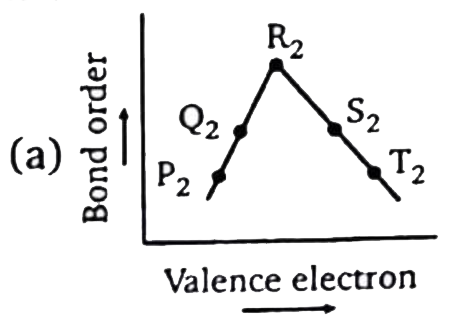
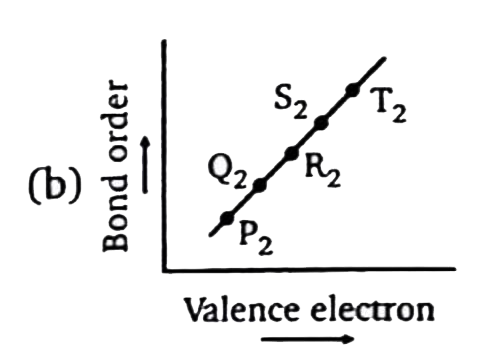
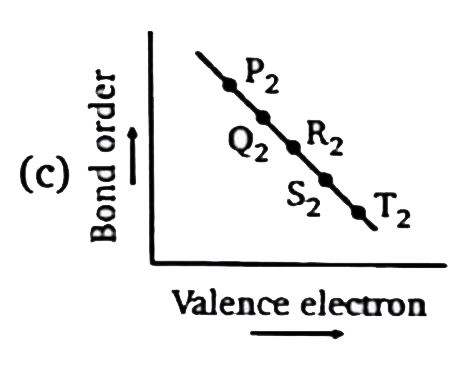
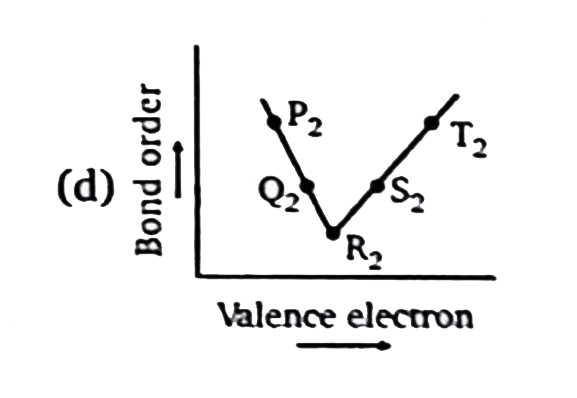
If P to T are second period p-block elements then which of the following graph show corrrect relation between valence electrons in P_(2) to T_(2) |
|
Answer»
|
|
| 15. |
If we consider that (1)/(6), in place of (1)/(12), mass of carbon atoms is taken to be relative atomic mass unit, the mass of one mole of a substance will |
|
Answer» INCREASE two fold |
|
| 16. |
If we consider that 1//6, in place of 1//12, mass of carbon atom is taken to be the relative atomic mass unit, the mass of one mole of a substance will. |
|
Answer» DECREASE twice |
|
| 17. |
If P_0 and P_delta are the vapour pressure of solvent and solution respectively and N_1 and N_2 are the mole of solute and solvent then: |
|
Answer» <P>`P_s = P _On_1` |
|
| 18. |
If we consider that 1/6 in place of 1/12, mass ofcarbon atom is taken to be the relative atomic mass unit, the mass of one mole of a substance will |
|
Answer» decrease twice |
|
| 19. |
If P, Q, R and S are elements of 3rd period of p-block in modern periodic table, among these one element is metal and rest are non-metals and their order of electronegativity is given as: P lt Q lt R lt S Q. Chloride compound of which element is hypovalent? |
|
Answer» S |
|
| 20. |
Ifwater pollution continues at its present rate, if will eventually |
|
Answer» Stop WATER cycle |
|
| 21. |
If P, Q, R and S are elements of 3rd period of p-block in modern periodic table, among these one element is metal and rest are non-metals and their order of electronegativity is given as: P lt Q lt R lt S Which element is expected to form amphoteric oxide? |
|
Answer» `P` `Al_(2)O_(3)`. |
|
| 22. |
If water contains dissolved calcium hydrogencarbonate, out of soaps and synthetic detergents, which one will you use for cleaning clothes ? |
|
Answer» Solution :Water containing calcium hydrogen CARBONATE is hard water. Calcium ions react with soap to form calcium salts of soap which are insoluble. They form a gummy mass and stick to the clothes. This difficulty does not arise when we use detergents because calcium salts of detergents are soluble in water. `underset("Soluble in water")underset("SODIUM STEARATE (soap)")(2C_(17)H_(35)COONa)+ Ca(HCO_(3))_(2) RARR underset("(insoluble)")underset("Calcium stearate")((C_(17)H_(35)COO)_(2)Ca)+2NaHCO_(3)` 
|
|
| 23. |
If P, Q, R and S are elements of 3rd period of p-block in modern periodic table, among these one element is metal and rest are non-metals and their order of electronegativity is given as: P lt Q lt R lt S Q. |
|
Answer» |
|
| 24. |
If water contains dissolved calcium hydrogencarbonate, which out of soap and detergent, will you prefer to use ? Why ? |
| Answer» Solution : We will use detergent because it will not form insoluble PRECIPITATE with `Ca^(2+)`. | |
| 25. |
If p is the momentum of the fastest electron ejected from a metal surface after the irradiation of light having wavelengthlamda,thenfor1.5pmomentumofthe photoelectron, the wavelength of the light should be( 4 ) /(a) lamda. What is numerical value of a ? (Assume kinetic energy of ejected photoelectron to be very high in comparison to work function): |
|
Answer» <P> SOLUTION : ` E= W +KE _(max ) ``( hc ) /(lamda )= W +(P ^ 2 ) /( 2m ) ` `( W TO0 ) ` `(lamda_ 2 ) /( lamda _ 1 )=( P_ 1^ 2 ) /(P _2 ^ 2 ) ` `(lamda_2 ) / (lamda _ 1 )=( P ^ 2 ) /( (1.5 P ) ^ 2) ` ` (lamda_ 2) /(lamda_ 1 )=( 4 ) /(9) ` |
|
| 26. |
If water is boiled for sometime it becomes free from: |
|
Answer» PERMANENT HARDNESS |
|
| 27. |
If p^(@) and p_(s) are the vapour pressures of the solvent and its solution respectively and N_(1) and N_(2) are the mole fractions of the solvent and solute respectively, then |
|
Answer» <P>`P_(S)=p^(@)N_(2)` |
|
| 28. |
If water contains dissolved calcium hydrogencarbonate, out of soaps and synthetic detergents which one will you use for cleaning clothes ? |
| Answer» SOLUTION :We will use synthetic detergents because if WATER contains dissolved CALCIUM hydrogencarbonate then that water is HARD water and synthetic detergents can be used with hard water but SOAP can not be used with hard water. | |
| 29. |
If water contains dissolved calcium hydrogen carbonate (or Ca^(2+) ions), out of soaps and synthetic detergents , which one will you use for cleaning clothes ? |
Answer» Solution :WATER CONTAINING calcium hydrogen carbonate is hard water. DETERGENTS are preferred over soaps for cleaning clothes in hard water because calcium salts of detergents are soluble in water while calcium salts of soaps are insoluble . As a result, lot of soap is wasted. 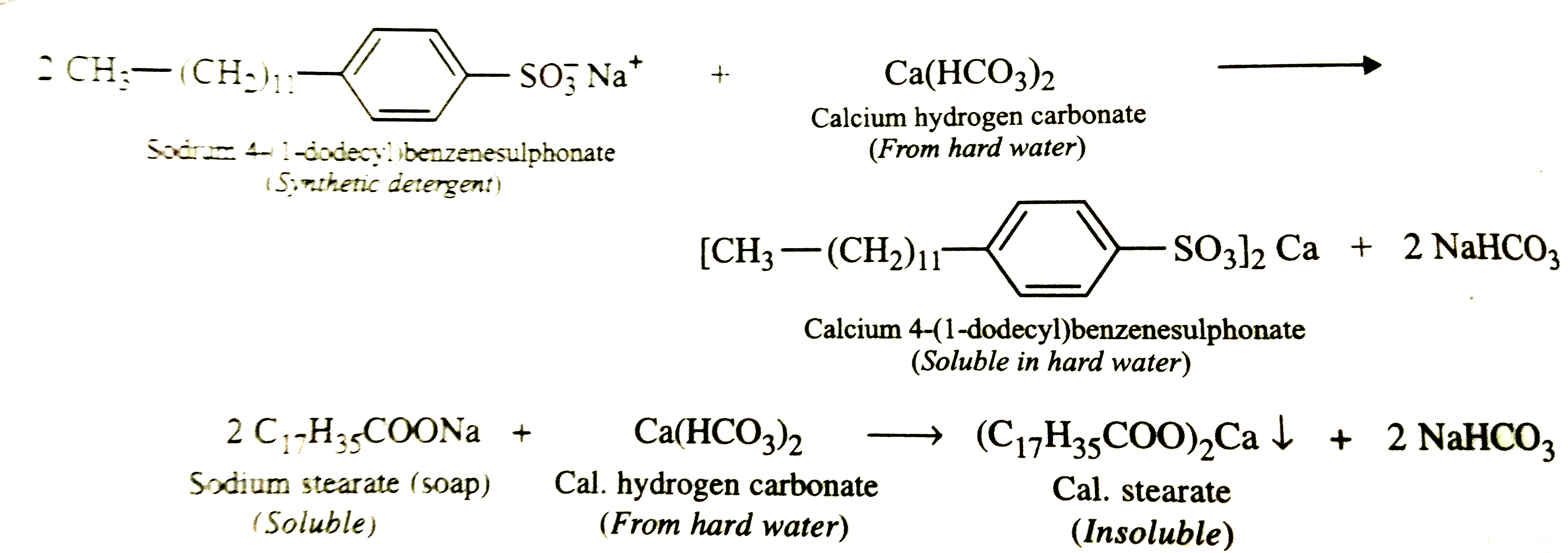
|
|
| 30. |
If water contains dissolved calcium bicarbonate, out of soaps and synthetic detergents which one will you use for cleaning clothes ? |
| Answer» Solution :Calcium BICARBONATE makes water hard. Soap will give precipitate with this hard water and therefore, cannot be used for cleaning CLOTHES. On the other hand, a synthetic detergent does not give precipitate in hard water because its calcium SALT is also SOUBLE in water. Therefore, synthetic detergent can be used for cleaning clothes in hard water. | |
| 31. |
If oxygen is attached to a secondary carbon, the compound is known as : |
|
Answer» ALDEHYDE |
|
| 32. |
If W is the amoung of work done by the system and q is the amount of heat supplied to the system, identify the type of the system. |
|
Answer» isolated system |
|
| 33. |
If osmotic pressure of a solution at 27^(@)C is 0.82 bar, what will be molarity of solution ? |
|
Answer» 0.33 M |
|
| 34. |
If values of Lambda_(0) of NH_(4)Cl , NaOH and NaCl are 130 , 127 and 109 Omega^(-1) cm^(2) eq^(-1) respectively . The Lambda_(NH_(4)OH)^(@) inOmega^(-1) cm^(2) eq^(-1) is |
|
Answer» 456 `= 130 + 217 - 109` `= +238 Omega cm^(2) eq^(-1)` |
|
| 35. |
If osmotic pressure of an aqueous solution of sucrose having concentration of 34.2 gm/litre at 17^(@)C is 2.38 atmosphere, then ……….. gm / mL glucose is isotonic with solution. |
|
Answer» `34.2` So concentration 18.0 gm / liter GLUCOSE is 0.1 M. |
|
| 36. |
If orange turbidity appears ondilutionwith H_(2)O of the solutionin dil HCl , it isdue to (a) ___and (b) _____ ion is assumed confirmed. |
|
Answer» |
|
| 37. |
If van't Hoff factor is less than unity, this shows that the solute undergoes ……………..in the solution. |
| Answer» SOLUTION :ASSOCIATION | |
| 38. |
if value of spin quantum number(s)=-1//2,0,+1//2 then calculate number of groups in the new form of periodic table if all other rules of electronic configurations are remain same. |
|
Answer» |
|
| 39. |
If orange-red colour is absorbed from white light, the observed colour is |
|
Answer» yellow |
|
| 40. |
If V_(1) mL of a gas at 37^(@)C and 1.2 atm pressure contains N_(1) molecules and V_(2) ml of the gas contains N_(2) molecules at the same temperature and pressure, then : |
|
Answer» `( V_(1)) /( V_(2)) = ( N_(2))/( N_(2))` |
|
| 41. |
If order of reaction ,A+Boverset(hv)rarrABis zero .If means that : |
|
Answer» RATE of reaction is independent of temperature |
|
| 42. |
The u_(rms) of a gas at 300K is 3R^(1//2) The molar mass of the gas in kg mo1^(-1) is . |
|
Answer» 0.02 kg/mol |
|
| 43. |
If O.P. of 1M of the following in water can be measured, which one will show the maximum O.P. ? |
|
Answer» `AgNO_(3)` |
|
| 44. |
If orange -red colour is absorbed from white light, the observed colour is : |
|
Answer» Yellow |
|
| 45. |
If one third HI decomposes at a particular temperature: K_c for 2HI hArr H_2+ I_2 is : |
|
Answer» 1/16 |
|
| 46. |
If one strand of the DNA has the sequence 'ATGCTTGX, then the sequence of complementary strand would be |
|
Answer» TACGAACT |
|
| 47. |
If one strandof the DNAhas thesequence' ATGCTTGA' ,thenthe sequence of complementarystrand would be ………… . |
|
Answer» Fat |
|
| 48. |
If one strand of DNA has the sequence ATGCTTGA, the sequence in the complimentary strand would be |
|
Answer» TACGAACT `{:(A:T:G:C:T:T :G :A, I) ,(T:A:C:G:A:A:C:T ,II) :}` |
|
| 49. |
If one of the strands of DNA has the following sequence of bases in the 5'-3' direction : 5'-G-A-A-T-A-C-C-G-G-T-A-3' (i) What is the sequence of bases in the complementary strand ? (ii) Which base is closest to the 5'-end in the complementary strand ? |
|
Answer» SOLUTION :According to base -PAIRING principle. G faces, C,T faces A and VICE -versa in the complimentary strand of DNA. Thus , the sequence of bases in the complementary strandis : `3'-C-T-T-A-T-G-G-C-C-A-T-5'`. (ii) Since the complimentary strands run in the OPPOSITE direction , THEREFORE , the closest base to the 5'-end is T. |
|
| 50. |
If one of the strands of DNA has the following sequence of bases running in the 5'-3' direction : 5'-G-G-A-C-A-A-T-C-T-G-C-3' (i) What is the sequence of bases in the complementary strand? (ii) Which base is closest to the 5'-end in the complementary strand. |
|
Answer» Solution :(i) SEQUENCE of bases in COMPLEMENTARY STRAND : `3.-C-C-T-G-T-T-A-G-A-C-G-5.` (ii) Guanine |
|